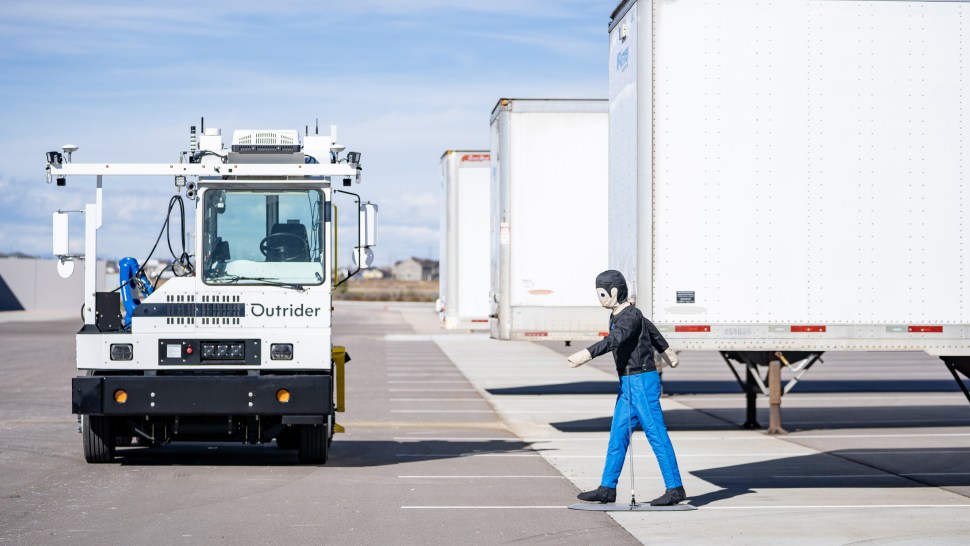
The autonomous yard truck turf war in the trailer yard is heating up with Outrider recently announcing it has developed the industry’s first safety system designed specifically for driverless movement in mixed traffic trailer yards.
Outrider is a technology developer of autonomous yard operations for logistics hubs. The company’s proprietary functional safety approach recently received validation from TÜV SÜD, a globally recognized independent testing and certification organization, determining it aligns with its AV Conformity Framework requirements.
“Outrider pioneered the yard automation space with the goal of making autonomous yard operations inherently safer than present-day operations, and we have prioritized the safety system from day one,” said Andrew Smith, founder and CEO of Outrider. “It is not hard to create a driverless demonstration. It is a major technical undertaking to design an 80,000-pound robot that operates among over-the-road trucks, delivery trucks and warehouse personnel.”
Smith spoke with FreightWaves about the milestone, noting that the company has been operating with both human drivers and safety observers for several years. According to Smith, the company has completed hundreds of thousands of fully autonomous trailer moves within its customers’ fleets.
The TÜV SÜD validation was the next big step as the company is going through the final steps of its validation process. “Having our safety process approved by TÜV SÜD means that we can go through the final steps of validation according to this defined process, so that Outrider and our customers feel comfortable starting to scale these driverless systems throughout their standard operating environments,” Smith told FreightWaves.
The Outrider System that drives these autonomous terminal tractors uses advanced artificial intelligence to handle complex logistics yard movements with precision and predictability. Recognizing that even sophisticated AI systems can experience unexpected failures, the company built a comprehensive safety system with 14 distinct safety mechanisms addressing over 200,000 yard-specific hazards.
The safety system includes redundant hazard detection, fail-safe hardware redundancies and real-time health monitoring capabilities that can detect environmental anomalies, override unsafe behaviors and stop vehicles when necessary. Unlike teleoperated solutions, these autonomous vehicles operate independently alongside manual drivers, over-the-road trucks and pedestrians in distribution facilities.
Another notable difference between terminal and yard operations is that fleet electrification has become more established, with EV terminal tractors being in use among large OEMs since the mid-2010s.
All Outrider systems operate on electric truck platforms, which offer enhanced safety, stability and lower total cost of ownership compared to diesel alternatives. The systems feature automated charging during off-peak distribution cycles, reducing operational downtime.
“At the current electric vehicle costs, for medium to high utilization applications, the EVs are meeting, exceeding or showing lower total cost of ownership than diesel trucks, mainly based on maintenance issues and fuel cost,” Smith added.
Another added benefit of an electric autonomous yard tractor is that these two technologies are complementary.
Smith told FreightWaves, “It is the safer, more stable power platform for autonomy. It allows for automated charging and easy off-peak charging of the system. So we have perfect knowledge of the yard operations and we just take low periods in the distribution cycle to charge them. And then also from a maintenance standpoint, rather than having to do fueling, changing oil, and emissions treatment changes, etc. These systems are working day in and day out at the customer yards.”
To make money, Outrider offers its technology as a subscription service, including the autonomy stack, cloud-based management software, automated trailer inventory tracking and 24/7 support.
Once deployed, Smith notes that these fully driverless terminal tractors will be managing distribution center yards alongside human drivers and workers. “They will work alongside the over-the-road trucks coming in and out. They will work alongside the occasional pedestrians that need to be there driving delivery vehicles or doing repairs in the yard,” said Smith.
Outrider notes that initial deployment of the latest-generation driverless yard trucks will begin with select enterprise customers in the second half of 2025. While capacity remains constrained for 2025, the company is currently accepting orders for deployments in 2026 and 2027.
Brokerage Compliance Symposium
The day before F3. Every compliance issue you face - fraud exposure, carrier liability, FMCSA rules, cargo theft, insurance gaps - navigated by attorneys and operators defining best practices in a changing industry.
F3 Awards Dinner
The night before F3. FreightTech100 companies honored. FreightTech 25 and Shipper of Choice winners revealed live. Cocktail reception into dinner and live music - 300 industry leaders in one purpose-built room.
F3: Future of Freight Festival
Industry-defining keynotes, rapid-fire technology demos, and industry leaders networking in experiences across Chattanooga - plus the inaugural F3 Awards Dinner featuring the FreightTech and Shipper of Choice reveals.
The day before F3. Every compliance issue you face - fraud exposure, carrier liability, FMCSA rules, cargo theft, insurance gaps - navigated by attorneys and operators defining best practices in a changing industry.
The Signal at Chattanooga Choo Choo • Chattanooga, TN Register NowThe night before F3. FreightTech100 companies honored. FreightTech 25 and Shipper of Choice winners revealed live. Cocktail reception into dinner and live music - 300 industry leaders in one purpose-built room.
The Signal at Chattanooga Choo Choo • Chattanooga, TN Register NowIndustry-defining keynotes, rapid-fire technology demos, and industry leaders networking in experiences across Chattanooga - plus the inaugural F3 Awards Dinner featuring the FreightTech and Shipper of Choice reveals.
The Signal at Chattanooga Choo Choo • Chattanooga, TN Register Now