Shell, FAW test immersion-cooled batteries to improve truck performance

Shell and FAW Trucks have developed and tested a battery pack that uses an immersion-cooling system to better manage battery heat, improve vehicle performance and durability, Shell announced.

The battery pack uses an electrically insulating fluid that surrounds the battery cells, allowing heat to be transferred away from the cells more effectively during operation. Managing battery temperature is particularly important for commercial vehicles, which can place significant demands on their batteries during acceleration, heavy loads and charging.

By keeping the cells at more consistent temperatures, the companies said the technology can improve the truck’s energy efficiency and performance while potentially extending battery life.

Shell and FAW Trucks developed the system as part of their ongoing work regarding hybrid and electrified commercial vehicle technology. Both companies are continuing to validate the battery pack for potential use in future FAW hybrid trucks.

“As commercial vehicles continue to evolve, so do the technologies needed to support them. By working closely with original equipment manufacturers (OEMs) like FAW TRUCKS, we’re developing advanced fluid solutions designed to support evolving vehicle technologies, including electrification powertrains and thermal management systems,” Cara Tredget, vice president of Mobility & Lubricants Technology at Shell, said. “The Shell Starship Hybrid vehicle demonstrates what’s possible when collaboration and innovation come together.”

What the tests showed

Initial vehicle validation showed potential improvements in several areas, including an up to 98% increase in maximum gradability, a 0.8% improvement in vehicle-level energy efficiency and a potential battery life improvement of up to 32%, according to Shell. The results came from testing the battery pack under specific vehicle conditions, including sustained high-power charging and discharging.

The battery pack also underwent industry-standard testing and vehicle evaluations, with the results verified by the China Automotive Technology and Research Center, according to Shell. The company also said the reported data is based on joint testing conducted by Shell and FAW Trucks under specific test conditions, and final performance data will be released after the validation process is completed.

How immersion cooling works

Immersion cooling is designed to remove heat from battery cells by surrounding them with an electrically insulating fluid. Instead of transferring heat through a separate cooling plate or system, the fluid comes into direct contact with the cells, allowing heat to move away from a larger portion of the battery. This can help keep temperatures more consistent across the battery pack, which is important as batteries generate more heat during high-power charging and discharging.

Shell’s system uses this approach on the Starship 3.0 Hybrid. Shell said conventional battery cooling systems primarily cool the battery from the bottom, while its immersion fluid surrounds the cells and is designed to improve heat transfer and maintain more consistent temperatures across the pack.

From concept to commercial use

For commercial trucks, better thermal management could help manufacturers increase power output and charging capabilities without sacrificing battery durability. But the Shell and FAW testing has so far been conducted on a concept vehicle under specific test conditions, rather than across a production fleet.

The battery pack has not been announced as a production system. Shell and FAW Trucks said it is being evaluated for potential use in future FAW hybrid commercial vehicles, while Shell plans to continue developing immersion-cooling fluids for broader commercial vehicle applications.

The technology is part of the Shell Starship program, a technology demonstration platform focused on improving commercial vehicle efficiency and reducing emissions. The Starship 3.0 Hybrid was developed by Shell and FAW Trucks as a platform for testing technologies including hybrid powertrains and battery thermal management under commercial vehicle operating conditions.

FAW Trucks is a majority-owned subsidiary of China FAW Group and is headquartered in Changchun, China. Shell brings its work in lubricants and thermal-management fluids to the partnership, while FAW contributes commercial vehicle engineering and development expertise.

The companies will showcase the latest validation progress and the Shell Starship Hybrid equipped with the immersion-cooled battery pack at the FAW Trucks booth during IAA Transportation 2026 in Hannover, Germany, beginning Sept. 14.

For now, the technology remains in the validation stage. Whether the performance seen in the Starship concept truck can translate into a battery system suitable for production hybrid commercial vehicles remains to be determined.

Why this matters

Battery thermal management is becoming increasingly important as commercial vehicle manufacturers look to improve power, charging capability and battery life. Immersion cooling could give truck manufacturers another way to manage the heat generated by batteries under demanding operating conditions.
Spartan Logistics expands warehouse footprint through acquisition

closed doors at a warehouse

Third-party logistics provider Spartan Logistics announced it has acquired Allen Logistics. The deal adds 100,000 square feet of space to Spartan’s asset-based network of over 20 dry storage and food-grade warehouses.

Financial terms of the transaction were not provided.

Spartan Logistics’ latest acquisition in Whitehouse, Ohio, gives it seven locations in the Northwest Ohio market and 11 total in the state. The warehousing and transportation provider’s footprint now includes 4.5 million square feet of space across nine states in the Midwest and the South. It has a large presence at South Carolina ports in Charleston and Savannah.

“Toledo has been a key market for Spartan for many years, and this acquisition represents another investment in our future here,” said Spartan Logistics CEO Steve Harmon.

The Columbus, Ohio-based company operates a fleet of approximately 50 tractors, providing local shuttle and regional freight transportation services, including just-in-time delivery. It offers cross-docking, fulfillment and warehouse management services. It also has a real estate construction and brokerage services arm.

“We’re excited about the opportunity to welcome a strong group of employees and customers to Spartan and build on the relationships and operations that have already been established,” Harmon said.

Why it matters? Spartan Logistics’ acquisition of Allen Logistics expands its network and strengthens its regional service density across 11 Ohio locations. Additionally, the integration of warehousing with its truck fleet enhances the company’s ability to provide streamlined freight transportation, delivery and fulfillment services.

More FreightWaves articles by Todd Maiden:

CooperVision contact lens shipment stranded on disabled Amazon cargo jet

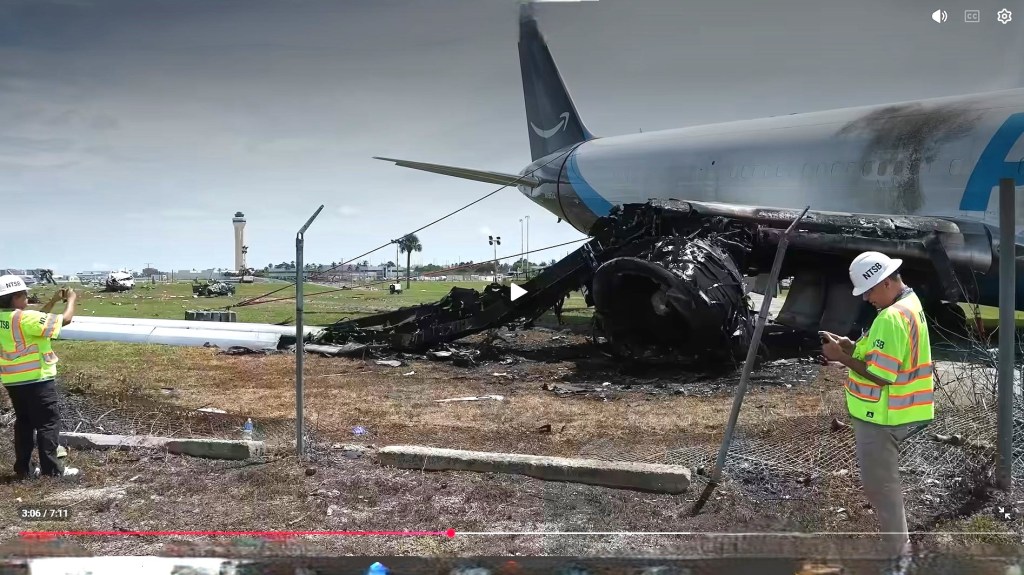
NTSB investigators wearing yellow hard hats and vests walk around the damaged Amazon Prime Air jet that overran the runway in Miami.

Contact lens maker CooperVision has a large shipment stranded onboard the Amazon freighter aircraft that ran off the runway on Sunday at Miami International Airport and now rests tilted, and partially damaged in a grassy field as authorities continue to investigate the cause of the accident.

It is unclear if any of the product is damaged or if it can be salvaged.

During a media briefing Tuesday evening, National Transportation Safety Board Chairwoman Jennifer Homandy said Flight 7598, a Boeing 767-300 passenger-to-freighter conversion aircraft operated by 21 Air in support of Amazon’s logistics network, was carrying more than 32,000 pounds of contact lenses and that the eye-care products were the primary cargo onboard.

CooperVision acknowledged in a statement to FreightWaves that it was the Amazon (NASDAQ: AMZN) customer involved in the accident, which left five people dead and several others injured after the plane struck two vehicles.

“Our thoughts are with everyone affected by the incident involving a flight at Miami International Airport. Among the aircraft’s cargo were contact lenses manufactured at CooperVision’s Juana Diaz facility in Puerto Rico. The company contracted with an independent third-party logistics provider that transports freight out of Puerto Rico on behalf of multiple organizations. CooperVision will support the National Transportation Safety Board and other relevant authorities as needed,” the company said.

CooperVision is a  division of San Ramon, California-based CooperCompanies (NASDAQ: COO).

The circumstances suggest that the flight primarily served Amazon Air Cargo, a two-year-old logistics unit that sells excess capacity on Amazon cargo jets to third-party shippers. Amazon Air was launched a decade ago to expedite package delivery for Amazon Prime members who ordered goods online, and now counts more than 100 aircraft in its fleet and more than 65 destinations in its air network.

Amazon Air Cargo is part of a broader company shift to commercialize a range of supply chain services developed to support internal inventory distribution and sales. After building a large, interconnected air network Amazon made capacity available to all shippers, regardless of whether they were sellers on Amazon’s marketplace and used Amazon’s fulfillment service. 

An analysis of data from FlightRadar24, which tracks commercial aircraft movements, shows that 21 Air continues to operate on behalf of Amazon and DHL Express as questions increase about 21 Air’s safety culture. Information extracted by the NTSB from the flight data and cockpit voice recorder shows Flight 7598 approached the airport too fast and that the pilots had trouble slowing the plane, overshot the runway’s touchdown zone, then had trouble getting all three landing gear on the runway, didn’t engage speed brakes or thrust reversers to slow the plane and hit the throttle in a a late attempt to take off before exiting the runway. The pilot received his type certification for the Boeing 767-300 cargo jet in May.

Since Sunday’s accident, 21 has operated seven Boeing 767-300s, primarily shuttling between Amazon’s superhub at Cincinnati-Northern Kentucky International Airport and Miami, and also connecting those airports with San Juan, Puerto Rico; Quito, Ecuador; Bogota, Colombia and Lakeland, Florida, among other destinations.

Why It Matters: When shipments get delayed or lost they can disrupt supply chain operations. In CooperVision’s case, the affected shipment involves a very small amount of the company’s overall inventory and is not expected to impact operations or customer supply.

Meanwhile, the widow of one of five aircraft cleaning workers killed when their van was struck by the Amazon jet on Sunday is suing Amazon, Amazon Air Cargo, related companies, lessors and the pilots,  alleging pilot mistakes, safety failures and problems with the aircraft itself, according to a wrongful death complaint filed in Miami-Dade County Wednesday.

Yaraisi Santiso Morejon brought the lawsuit on behalf of her husband, Yoel Rodriguez Naranjo, who was 53. Two coworkers in the van remain hospitalized in critical condition. 

The lawsuit alleges Amazon Air Flight 7598 was traveling significantly faster than normal as it approached Runway 30 and that its pilots failed to abandon the landing despite a tailwind and an unstable approach. 

The lawsuit alleges Amazon exercised substantial control over 21 Air’s flying for its cargo network, including flight schedules, aircraft use, cargo procedures and safety requirements.

Amazon should be held responsible for allegedly failing to adequately select, monitor and oversee the carrier.

The complaint also cites previous safety complaints it says were raised by former 21 Air employees involving maintenance, training, supervision and flight operations.

It argues Amazon knew, or should have known, about reported safety deficiencies before the crash.

Click here for more FreightWaves/American Shipper stories by Eric Kulisch.

Write to Eric Kulisch at ekulisch@freightwaves.com.

‘Utter devastation’ from Amazon cargo jet crash, NTSB chief says

2 Miami runways still closed after deadly Amazon cargo jet accident

21 Air eyes larger Boeing 777 cargo jets to access long-haul market

Canada’s Cargojet plays role in CEO exit at Amazon partner 21 Air

Uber Freight warns tight capacity could fuel Q4 freight rate surge 

The U.S. freight market is entering the fourth quarter with truck capacity struggling to recover, truckload rates sharply above year-ago levels and shippers facing the possibility of another surge in spot prices if demand accelerates, according to Uber Freight.

Uber Freight released its Q3 Market Update & Outlook Report on Thursday, saying truckload conditions have begun to stabilize after two quarters of rate inflation, but capacity constraints continue to ripple through less-than-truckload, intermodal and cross-border transportation.

The report identifies three major forces shaping the market heading into the fourth quarter: constrained trucking capacity, volatile diesel prices and rapidly changing U.S. trade policy.

“Transportation decisions carry more weight than ever before. Conditions can change quickly, and the cost of reacting too late is often higher than expected,” Uber Freight CEO Rebecca Tinucci said in the report.

Uber Freight said shippers that continue sourcing transportation capacity week to week are particularly vulnerable if freight demand suddenly accelerates during the fourth-quarter peak.

September and October provide a relatively stable window for most markets to repair routing guides and secure capacity ahead of peak season, according to the report. 

Truckload and Mexico were rated as having “high” exposure heading into late October, while intermodal and Canada were rated at medium severity.

Truckload rates remain sharply above 2025

National average dry van contract linehaul rates reached $2.39 per mile in July, an 18% increase from July 2025, according to data cited by Uber Freight. The 13-cent increase from June was the largest June-to-July gain on record.

Dry van spot linehaul averaged $2.39 per mile in July, 47% higher year over year.

Spot pricing has subsequently eased as the seasonal July peak faded. Van spot linehaul averaged $2.21 per mile during the week of Aug. 26, but remained 35.6% above the same period last year and 23.8% above the nine-year seasonal average.

Carriers are also seeking double-digit contract increases this year and next, according to Uber Freight.

The company’s primary tender acceptance rate improved from 76% in July to 78% in August as repriced routing guides began to hold and spot conditions softened. That remains substantially below the 90% to 94% range seen during the previous three years.

Uber Freight said capacity is not rebuilding as quickly as typically expected during a tightening freight cycle. The report estimates more than 48,000 noncompliant drivers have exited the industry over the past year, while Class 8 truck backlogs represent roughly nine months of production.

As of Sept. 10, the SONAR Outbound Tender Rejection Index for the U.S. (STRI.USA) was at 13.45%, much higher than the same period in the previous three years.

Tender rejection rates held at 13.45% on Sept. 10, with the Labor Day spike larger than any of the prior three years: 2025 (yellow), 2024 (green), and 2023 (pink), according to the SONAR Outbound Tender Rejection Index (STRI.USA). To learn more about FreightWaves SONAR, click here.  

Mexico capacity remains tight despite easing at Laredo

Cross-border transportation remains one of the more constrained portions of the freight market.

Uber Freight said about 20,000 Mexican truck drivers lost U.S. visas between April 2025 and April 2026, while the number of active Mexican-domiciled southern border carriers was 6.3% lower in late June compared with late December.

Capacity around Laredo has eased from extremely tight second-quarter conditions but remains significantly tighter than a year ago.

The Laredo dry van load-to-truck ratio stood between 8.0 and 8.5 in mid-August, down from roughly 10-to-1 during the second quarter but still 61.9% higher year over year.

Mexico-to-U.S. long-haul spot rates remained 8% to 15% above mid-February levels, with increases of as much as 30% on critical corridors. Produce exports through Laredo increased 8% year over year during the second quarter, according to the report.

Uber Freight said those constraints are prompting more companies to rethink how they move freight across the border.

Shippers that previously depended on direct-trailer capacity using B-1 drivers are increasingly incorporating transloading into their networks in Laredo — and are beginning to explore the strategy in El Paso.

“Transloading is moving from workaround to network design,” the report said.

Uber Freight cited one major beverage manufacturer that had relied solely on direct B-1 capacity but began missing delivery appointments in Nuevo Laredo. The company rerouted critical freight through a Laredo cross-dock and is now developing a hybrid network combining transloading for time-sensitive shipments with direct B-1 transportation for more flexible freight.

Diesel adds another layer of pressure

Fuel costs could further complicate freight pricing heading into bid season.

The national average diesel price reached $5.652 per gallon during the week of Aug. 24, the highest level of 2026 and 52.4% above the same week last year. Diesel had fallen as low as $4.58 per gallon in early July before rebounding.

Uber Freight warned that smaller truckload carriers operating on thin margins could park equipment rather than haul freight at a loss if fuel volatility persists.

At the same time, shippers face an increasingly complicated trade environment following changes to U.S. tariff policy and the shift of the United States-Mexico-Canada Agreement into annual reviews.

The combination leaves transportation networks with little margin for another unexpected disruption.

Uber Freight recommends that shippers use the relatively stable September-October period to secure baseline capacity, repair underperforming routing guides and establish backup carriers before the traditional late-October freight peak.

Why it matters: The prolonged freight downturn appears to be giving way to a more carrier-favorable pricing environment across multiple transportation modes.

DEA seizes over 2,000 pounds of meth in cabbage freight shipment in South Texas

UPDATE 9/12/26: DEA confirmed late Friday that agents seized the methamphetamine from a commercial tractor-trailer hauling cabbage. The agency also provided new details about the ongoing investigation.

Federal agents seized more than 2,000 pounds of methamphetamine hidden inside a cabbage shipment in South Texas. DEA confirmed the drugs were concealed in a commercial tractor-trailer carrying the produce. The McAllen office seized the load Tuesday during an ongoing Homeland Security Task Force investigation. No arrests have been made.

Investigation brings multiple agencies together

The seizure involved several federal and state law enforcement agencies. Homeland Security Task Force investigators worked together on the case. Participating agencies included HSI, FBI, CBP, U.S. Border Patrol and Texas DPS. DEA called the discovery a “major seizure” while announcing the operation.

DEA provided FreightWaves with additional information about the seizure late Friday. The San Antonio Division oversees the agency’s McAllen District Office. Officials confirmed the investigation remains ongoing. Authorities have made no arrests.

DEA’s San Antonio Division frequently encounters methamphetamine hidden in produce shipments, according to Jonathan C. Pullen. He serves as associate chief of operations for DEA’s Southcentral Region. Pullen identified lettuce and blueberries as other produce used to conceal the drug. He described the practice as part of traffickers’ efforts to move methamphetamine into the United States.

Details about the tractor-trailer remain unknown

DEA has not identified the carrier, driver, origin or destination of the cabbage shipment. No border crossing or port of entry appeared in the agency’s response. Officials have not explained how investigators discovered the concealed drugs.

Why it matters

Traffickers continue using legitimate commercial freight to conceal massive quantities of narcotics. DEA says its San Antonio Division frequently encounters methamphetamine hidden in produce shipments.

Click here for more articles on cargo theft and freight fraud by Phil Brink.

Cartel logistics boss gets nearly 19 years for moving cocaine and cash through trucking network – FreightWaves

FMCSA suspends USDOT deactivations for missed biennial updates during MOTUS rollout – FreightWaves

Police find $3.8M in cocaine in Indiana truck’s sleeper after ‘mystery’ Memphis pickup – FreightWaves

Descartes reports another record-breaking quarter

an ocean container being loaded on a sleeper cab at a port

Descartes Systems Group again reported record quarterly results as it continues to see “good demand” amid a global trade landscape that remains in flux.

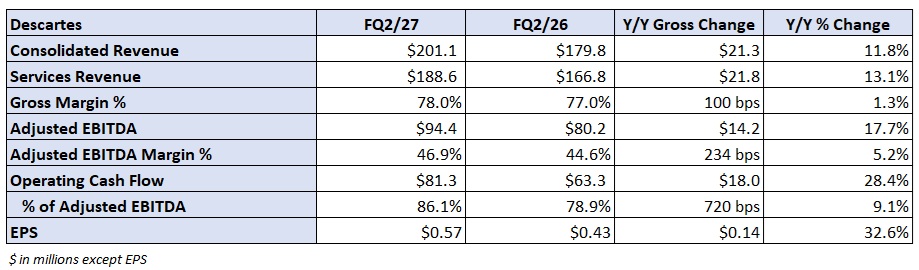
Descartes (NASDAQ: DSGX) reported consolidated revenue of $201 million for its fiscal quarter ended July 31, a 12% year-over-year increase and 1% ahead of the consensus estimate. Services revenue was up 13% y/y to $189 million (organic growth in services revenue was approximately 9%, excluding foreign exchange fluctuations).

Earnings per share of 57 cents for the quarter came in 14 cents higher y/y and a penny ahead of Seeking Alpha’s unadjusted EPS estimate.

Descartes reported adjusted EBITDA of $94.4 million in the period, which was 18% higher y/y. It recorded an adjusted EBITDA margin of 46.9%, which was up 230 basis points y/y.

“Today’s supply chains and logistics operations need to be agile in the face of an increasingly dynamic global trade environment,” said CEO Ed Ryan. “Having a broad scope of solutions on our Global Logistics Network is imperative to help isolate our customers from complexity, bringing together the data and domain expertise required to efficiently manage the lifecycle of shipments.”

Table: Descartes’ key performance indicators

The company generated $81 million in cash flow from operations in the period, a 28% y/y increase.

It ended the quarter with $401 million in cash, up $24 million from the prior quarter. It has no debt and an untapped $350 million line of credit. It has used approximately $220 million in cash to fund two acquisitions since the quarter closed.

Descartes acquired Extensiv, a warehouse management and fulfillment tech provider, for $120 million last week. It acquired Tai, a TMS provider to freight brokers, for $100 million at the end of August.

Descartes implemented a share repurchase plan at the end of 2025 to buy back up to 10% of its public float (8.6 million shares). It repurchased 651,800 shares for $45.1 million in the first half of its current fiscal year.

It will continue to use cash to fund future acquisitions. Management said on a Thursday evening call that it would take on leverage, up to 3 times annual EBITDA, to accomplish a larger deal.

Shares of DSGX were up 1.7% in after-hours trading on Thursday.

Why it matters? Descartes’ strong financial performance and strategic acquisitions of transportation tech providers highlight the industry’s shift toward unified, agile logistics ecosystems. Its expanded network capabilities help supply chain professionals navigate ongoing global trade complexity and operational volatility.

More FreightWaves articles by Todd Maiden:

El Niño Winter Forecast: Freight Risks Fleets Can’t Ignore

El Niño winter forecast for freight: warmer doesn’t mean safer for fleets. DTN’s Ben Hershey breaks down what carriers should actually watch this winter: major snow events still possible, wetter western mountain routes, and why AI-driven crash risk forecasting is becoming an operational tool instead of just another weather map. If you move freight, this is the planning window that matters. #FreightWeather #ElNino #TruckingSafety

The strongest El Niño pattern in years is underway, and fleets hauling freight across western mountain passes and the central U.S. should prepare for a wetter, more volatile winter season, according to DTN product manager of transportation and logistics Ben Hershey. DTN has also just launched WeatherHub, a weather intelligence platform that puts hyperlocal road-condition data and a patent-pending crash risk index directly in the hands of dispatchers and fleet operators.

The El Niño signal points to a warmer-than-average winter across much of the central United States, but Hershey cautioned against complacency. Significant snow events can still hit the northern, central, and southern plains, and below-freezing temperatures will still reach much of the South for at least short periods. The more acute risk for carriers is out west, where a substantially wetter winter could hammer mountain corridors — including high-volume passes in the Sierra Nevada and Rockies — with repeated waves of heavy precipitation.

“We’re looking at a potential of a much wetter winter season, which could challenge those operators trying to travel those mountain passes,” Hershey said. “It is going to put a challenge for those operators that have to travel up and over those mountain ranges moving freight from the western part of the United States into the central and eastern parts.”

“We are trying to apply it to their operations — giving them a potential risk of a crash in that situation heightens their attention to the weather conditions,” Hershey said, describing the crash risk index logic.

The crash risk index, which DTN has filed as a patent-pending solution, fuses historical crash records — including precise location, time, and concurrent weather conditions — with real-time traffic data and forecasted weather to generate a forward-looking crash probability along a given route. The tool produces hyperlocal forecasts down to a couple of miles in resolution and looks out to a 72-hour window, a range Hershey said was calibrated specifically to how fleet operators actually make route-planning decisions. Weather data from DTN extends several days further, but the 72-hour horizon covers the detailed operational window carriers told the company they rely on most.

AI is central to making the system practical. Hershey noted that processing the same combination of weather and traffic data would have taken hours to run a decade ago, making it nearly useless for real-time decisions. “Now we’re able to do this in minutes,” he said, adding that DTN continues to layer AI tools on top of its core traditional meteorological models rather than replacing proven science with AI alone.

WeatherHub, launched within the last few months, lets users scroll through road-network conditions hour by hour — including air temperature, road-surface temperature, and road conditions — across the U.S. Dispatchers can enter an origin and destination and see projected conditions along that specific route timed to when their driver is expected to be there, along with alternate routing options. For carriers and third-party logistics providers that prefer not to add another standalone application, DTN also offers the crash risk index and full weather dataset via API for integration into existing platforms. Hershey pointed to tangible financial stakes beyond safety: fleets with documented weather data can use it to contest late-delivery penalties from shippers, a meaningful lever given ongoing economic and fuel-cost pressures across the industry.

  • DTN’s patent-pending crash risk index blends historical crash records, traffic, and weather forecasts to project route hazards up to 72 hours out at hyperlocal resolution of a few miles.
  • El Niño points to a warmer central U.S. winter on average, but carriers face a potentially much wetter season across western mountain corridors, threatening key freight passes.
  • DTN’s newly launched WeatherHub platform delivers hour-by-hour road-condition data and route-specific forecasts, with full API access for integration into third-party logistics systems.

This Summary is generated thanks to a transcription of the interview, for the full interview please enjoy the video above.

Tender Rejections at 13.5%: Tight Market or Fade?

Tender rejections are still sitting around 13.5% — and that’s the key signal for where the truckload market goes next. In this SONAR update, we break down whether post-Labor Day freight is fading or holding, what tender volumes are saying about demand, and why rising diesel still matters. Also in this update: spot rates, import volumes, inventory risk and what the next few days could mean for carriers, brokers and shippers heading into Q4.

The Outbound Tender Rejection Index held at 13.45% as of Sept. 10, remaining significantly above the same period in prior years and signaling a still-tight truckload market even as rates pull back from a Labor Day-driven surge, according to Zach Strickland’s Thursday Sonar market update.

Strickland noted that the Labor Day bump in rejection rates was more pronounced than in any of the previous three years — a detail that carriers and brokers should weigh carefully. The central question now is whether rejections continue falling at a steep pace or stabilize near current levels, which will set the tone for the next month of freight activity.

“It’s still going to be tight, I think, for the rest of the year. That’s not in question. It’s just the rate of change that I think we’re really interested in at this point,” said Strickland.

On the demand side, the Sonar Tender Volume Index — a seven-day moving average of all accepted and rejected tenders — has been softer since mid-July, a trend Strickland attributed partly to modal conversion as shippers shifted long-haul moves to intermodal and rail, with East Coast rail increasingly absorbing that volume. A component of economic softness may also be a factor, though current trough levels still sit above the comparable period last year.

Lean inventory levels add urgency to the demand outlook heading into Q4. Strickland warned that tight inventories entering a period of uncertain holiday demand could force carriers into expedited trucking moves, particularly as intermodal becomes less fungible with trucking later in the year. “This is a huge risk for this index as we move into the 4th quarter,” he said, pointing to the sharp post-Labor Day spike in tender volumes as a sign that shipper urgency has returned.

Spot rates continue to face upward fuel pressure, with the national van rate on the NTI sitting at $3.43 — a figure that includes fuel surcharges. Retail diesel prices are approaching $6 per gallon, a level Strickland flagged as a direct and immediate cost for shippers: fuel surcharge bills are expected to rise again this week and next. The Reefer Tender Index showed continued pressure, while the Flatbed Tender Index was flatlining — consistent with Q4 seasonality that traditionally softens flatbed demand.

Import volumes tracked by the IOTI remain elevated relative to both earlier this year and historical norms for this time of year, supporting the view that inventory levels across the supply chain are still lean. Dry van spot rate maps showed significant geographic dispersion, with many lanes still running in negative territory — a sign, Strickland said, that capacity has not yet fully returned to the market following the holiday period, though he expects that to change in the coming weeks.

  • Tender rejection rates held at 13.45% on Sept. 10, with the Labor Day spike larger than any of the prior three years.
  • Diesel approaching $6 per gallon is pushing fuel surcharges higher for shippers this week and next, with van spot rates at $3.43 on the NTI including fuel.
  • Lean inventories heading into Q4 could force expedited trucking moves as intermodal becomes less substitutable later in the year.

This Summary is generated thanks to a transcription of the interview, for the full interview please enjoy the video above.

Margin Collapse: 9.7 to 0.6 in One Quarter

Margin collapse hit fulfillment operators fast: cushions fell from 9.7 points to 0.6 in one quarter. This breakdown digs into the live network data behind rising parcel costs, slower GMV growth and what it means before peak season. Eric Lemus of Deposco explains why shipping costs are rising faster than revenue, how order growth is diverging from dollar growth, and why lean inventory could backfire in Q4. If you run parcel, fulfillment or e-commerce ops, this is the number to watch. #ParcelShipping #Fulfillment #SupplyChainData

Operator margin cushions nearly vanished in the second quarter, shrinking from 9.7 percentage points in April to just 0.6 points by the end of June, according to Commerce Signal, a new quarterly report from supply chain software firm DePASCO built on live fulfillment transaction data. The collapse was driven primarily by accelerating parcel shipping costs outpacing gross merchandise value growth — and peak season surcharges have yet to hit.

Eric Lemus, Vice President of Strategy and Analytics at Deposco, said the divergence between GMV growth and order volume growth tells the core story. GMV growth decelerated from 15.4% to 13.4% during the quarter, while order volume growth nearly doubled, climbing from roughly 4% to 8.8%. “Demand is slowing in dollars, but not necessarily in units,” Lemus said. “Consumers are still buying, but operators are moving more units through their platform or through their networks without seeing the reciprocal revenue growth as they anticipated.”

Parcel shipping costs rose approximately 13% year over year by the end of Q2, more than three times the pace of broader consumer inflation. Lemus identified carrier mix, dimensional weights, and contracted rates as the primary internal drivers pushing costs higher within individual operator networks, on top of structural factors like energy costs. Deposco’s forward forecast calls for parcel inflation to remain elevated at a minimum of 12% year over year through Q4 — before peak season surcharges are applied.

“There’s been reports, and what we’re seeing is surcharges are likely to range anywhere from 6+% on average. So if you compound that with a pretty heightened environment of year-over-year inflation with parcels, this Q4 peak season will certainly show some pressure on the margins due to that carrier spend,” Lemus said.

Inventory levels add another layer of risk heading into peak. Days on hand closed Q2 at 89.3 — the leanest level in several months — and brands and third-party logistics providers ended the quarter just 3.3 days apart in inventory coverage, an unusually narrow gap. Lemus noted that inventory has begun ticking up since July, but said the pickup may be arriving too late to fully buffer peak season demand. Operators running in the leanest inventory quartile face the most acute exposure to stockouts and unfulfilled orders.

Deposco’s Commerce Signal report is drawn from more than $80 billion in fulfilled GMV across over 4,000 brands and operators, and hundreds of millions of orders per year on its warehouse and order management platform. Lemus, a former Wall Street analyst, said the real-time transactional foundation distinguishes it from survey-based or forecast-reliant reports, which he argued carry inherent bias and lag. The Q2 report’s four forward calls — continued parcel inflation, sustained GMV growth, lean inventory levels, and low days-on-hand turns — have largely played out as projected, with parcel inflation the one area that moderated slightly before an expected re-acceleration in Q4.

For operators looking to protect margins before peak, Lemus pointed to carrier diversification as the highest-impact lever available. “If you’re able to generate a more diversified carrier strategy, what we’ve seen and what we believe to continue throughout the peak season, you’ll likely reduce your parcel spend by 21%,” he said. He also cautioned operators against anchoring forecasts to last year’s peak season data, given the significant volatility in parcel costs this year, and urged SKU-level inventory analysis to identify replenishment gaps before demand accelerates.

  • Operator margin cushions collapsed from 9.7 percentage points to 0.6 in Q2 as parcel costs rose ~13% year over year while GMV growth slowed from 15.4% to 13.4%.
  • Deposco forecasts parcel inflation will remain at least 12% year over year through Q4, with peak season surcharges expected to average 6% or more on top of that baseline.
  • Operators using diversified carrier strategies reduced parcel spend by 21%, according to DePASCO’s live transaction data across 4,000-plus brands and 3PLs.

This Summary is generated thanks to a transcription of the interview, for the full interview please enjoy the video above.

3PL victory: TQL tossed as defendant in Colorado liability trial

While a dire view of what might happen to brokerages in a post-Montgomery world ripping through the logistics industry, one of the biggest 3PLs just won a victory in Colorado that relieved it of potential liability.

Total Quality Logistics (TQL) had its request to be dismissed from a case in a Colorado federal court granted on Tuesday by Judge Nina Wang. 

The facts of the case filed by Deann Miller are that her husband, Scott Miller, was driving on U.S. 285 in the Centennial State in June 2024 when steel beams fell off a truck and on to the pickup truck Miller was driving, killing him.

Judge Wang said it was “unclear” who Ignacio Cruz-Mendoza was driving for when the metal on his truck fell off his vehicle, but that he “may have been delivering the cargo on behalf of Monique Trucking.”

Lots of defendants

Deann Miller sued pretty much everybody in the supply chain. The original complaint from March 2025 only had the driver and Monique as defendants. But an amended complaint brought in TQL, Intsel Steel West LLC (which was the customer that was supposed to receive the shipment), and Triple-S Steel Holdings, which also was a customer for the steel. It also brought in a company called Searing Industries, which actually delivered the steel on to the truck involved in the fatal crash. 

Judge Wang granted the request of TQL, Intsel and Triple-S Steel to have them tossed out as defendants. However, the dismissals were without prejudice, so the plaintiff can refile with a different legal approach.

Not surprisingly, when the lawsuit was first filed, TQL in its response cited the Federal Aviation Administration Authorization Act (F4A) as shielding it from charges of liability or negligence. F4A held that states could not take action that might impact a “price, route or service.” TQL also argued that the so-called “safety exception” that did open the door to lawsuits against, for example, a carrier involved in a crash, could not be extended to a broker. 

That defense ended with the Supreme Court unanimous decision in the case of Montgomery vs. Caribe Transport II. The judge’s decision in a footnote acknowledges that TQL withdrew the F4A defense after Montgomery.

Judge is not ambigous

The judge’s separate rulings for TQL and (jointly) Triple-S and Intsel left little doubt where she stood on the issue, at times calling the plaintiffs’ arguments “vague” and having “not adequately alleged facts” supporting her claims.

Judge Wang said Miller “clearly averred that the negligence, carelessness and/or recklessness of defendants, as being vicariously liable for the actions of (Cruz-Mendoza, the driver of the truck carrying the steel), consisted of various actions or omissions.”

But TQL argued that there was no legal basis to “establish…that TQL employed Mr. Cruz-Mendoza or that (they) otherwise had a principal-agent relationship.”

The plaintiff was seeking to establish vicarious liability that could be applied to TQL in her arguments. But having tossed out that argument against the steel customers, Judge Wang dismissed it against TQL as well.

Miller also alleged a negligent hiring claim against TQL. But Judge Wang said the plaintiff “does not allege any facts suggesting that TQL hired Mr. Cruz-Mendoza as an employee or independent contractor or had any sort of principal-agent relationship with Monique Trucking, instead relying exclusively on broad references to ‘defendants’ generally.”

Charges of a joint venture or joint enterprise among the defendants also were thrown out for TQL, Intsel and Triple-S, all without prejudice.

C.H. Robinson speaks again

The issue of broker liability post-Montgomery, along with the prospect of brokers facing nuclear verdicts without the possibility of F4A protection, came up twice this past week for C.H. Robinson (NASDAQ: CHRW) at investor conferences.

An email sent to TQL had not been responded to by publication time.

Transcripts of the remarks at those conferences–one at Citi and the other at Jefferies & Co.–reveal a consistent message: insurance costs are not a major budget item at C.H. Robinson, and even with the Lipe vs. Lupus Superior nuclear verdict in which C.H. Robinson on the surface faces a charge of  hundreds of millions of dollars, such cases are an “anomaly,” according to CFO Damon Lee at the Jefferies conference.

“We certainly don’t believe the earnings trajectory that we’ve been on, the outperformance that we’ve been on in any way is going to be derailed by insurance,” Lee said.

But he added “we believe the average small and medium-sized broker is going to have a very difficult time surviving in the post Montgomery, post Lipe world.”

More articles by John Kingston

Comments close on EPA’s DEF rule; which way will it go?

2 key trucking groups in filing raise alarm on Penske decision fallout

TQL case on broker transparency heads to oral arguments