




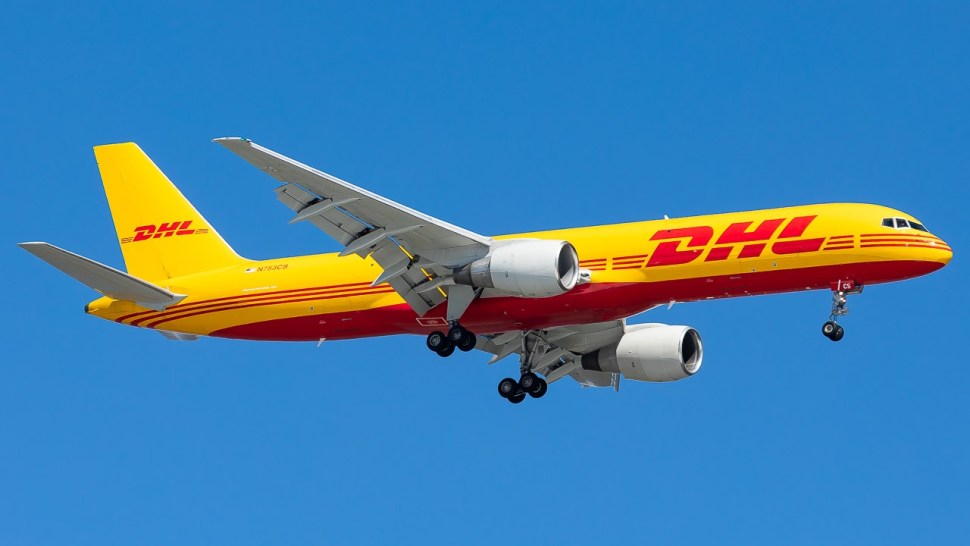
21 Air, a small mid-size cargo airline that provides dedicated transport for DHL Express and Amazon, is preparing to step up a level in aircraft size to the Boeing 777 in search of more lucrative international business under the guidance of a new interim CEO, said owner Jim Crane, the billionaire founder and chairman of Crane Worldwide Logistics, in an exclusive interview. At the same time, Canadian investor Cargojet is exiting its position in the company.
Crane told FreightWaves that he has installed Keith Winters, a confidant and former CEO of Houston-based Crane Worldwide Logistics whose ties to Crane go back more than 25 years as an executive at Crane-led Eagle Global Logistics, to run 21 Air on a temporary basis. Winters succeeds Tim Strauss, 70, who was ready to retire after his two-year contract expired in February.
Strauss left on good terms and was extended through June on a consulting basis, said Crane in a phone interview. An information vacuum about the leadership transition led some industry sources with company connections to suspect that Cargojet had pushed for a new CEO given its 25% ownership stake and history of having a representative at 21 Air’s Miami operations center.
“I own the controlling interest. I’ve got all the buttons. I don’t do deals where I don’t have control,” Crane insisted, rejecting the notion that anyone, let alone a foreign air carrier, would pull the strings at one of his companies. “We haven’t done anything to suggest Cargojet is running the airline whatsoever.”
Crane, who also owns the Houston Astros baseball team, made his fortune in logistics. His net worth is $2.5 billion, according to Forbes. He founded Eagle Global Logistics in the mid-1980s before selling it to a private equity firm in 2007. Eagle was eventually acquired by Ceva Logistics. With proceeds from the sale, Crane formed an investment management company, Crane Capital Group, and in 2008 he formed Crane Worldwide Logistics.
U.S. ownership rules for airlines require the president and two-thirds of the board be U.S. citizens and that no more than 25% of the voting shares may be held by non-U.S. citizens. The airline also must be under the actual control of American citizens. Crane noted that Cargojet’s 2021 investment in 21 Air was agreed to by U.S. regulators.
But Cargojet is selling its stake in 21 Air because it doesn’t want its pilot union to exploit the relationship in negotiations over a new labor contract, said Crane. Cargojet pilots, for example, could seek benefits enjoyed by U.S.-based 21 Air pilots. The existing labor agreement expires in June. The Air Line Pilots Association, which represents 21 Air and Cargojet pilots, urged the U.S. Department of Transportation in 2021 to prevent Cargojet from loaning aircraft to 21 Air to operate on its behalf. Cargojet operates at least two aircraft on an interchange basis with 21 Air. The company maintains it simply dry leases the cargo jets to 21 Air.
ALPA has long argued that the arrangement is a way for Cargojet to bypass restrictions on foreign carriers operating domestic routes in the United States.
21 Air is legally owned by Avia Acquisitions LLC, which is owned by a joint venture between Crane and Cargojet called Avia Investments LLC. Crane previously served as chairman of the board at publicly traded Cargojet before acquiring 21 Air in 2021.
He denied that Cargojet has any managers seconded to 21 Air, saying that he hired former Cargojet executive Luis Fernando Alvarado after buying the airline. Fernando Alvarado was promoted in February to chief operating officer.
“I’ll call Ajay (Virmani, Cargojet’s founder and chairman), it might be weekly, it might be more than that, might be less than that and ask how did you do this? Why would you do this?,” Crane said. “He’s run that airline for quite some time. I’ve been out of the airline business for a while, but I know how it works, and I know the intricacies of it. And it’s not for the faint of heart.”
Crane said the FAA has approved his purchase of Cargojet’s stake and that the transaction is expected to be finalized soon. Going forward, 21 Air and Cargojet will cooperate on a transactional basis, as needed. Cargojet will be paid to provide consulting services and simulator training for pilots, while aircraft trades will be done as traditional arrangements between leasing companies and airlines, the owner explained.
Winters, who has more than 35 years of logistics experience in various senior positions, resigned three years ago from Crane Worldwide Logistics for health reasons. He is now tasked with building out the executive team at 21 Air. He will stay there until the new leadership is in place “and set up to facilitate an accelerated growth plan,” Crane told FreightWaves.
Expansion mode
When Crane bought 21 Air it had four or five freighter aircraft. The airline currently operates 16 planes in its fleet, including seven Boeing 767-300 converted freighters that shuttle e-commerce packages in Amazon’s domestic air network, according to aviation databases. Strauss is credited with bringing Amazon (NASDAQ: AMZN) on board as a customer in late 2024. Amazon controls the aircraft and supplies them to 21 Air to operate on its behalf. Four 767-300s, two 767-200s and three 757-200s, recently added, round out the fleet. Those aircraft fly for DHL, Cargojet and other customers. 21 Air is expected to soon receive three additional 757 large narrowbody aircraft. Of the six freighters, five are supplied by DHL and one by Cargojet.
21 Air sees an opportunity to move up to large freighters and fly international routes because express delivery companies find cargo airlines owned by private equity groups difficult to work with, while his companies can make decisions quickly because they don’t require layers of management, said Crane.
Air Transport Services Group, which has two airlines that operate for Amazon and DHL Express, was taken private last year by Stonepeak. Atlas Air, another large U.S. cargo airline that partners with DHL Express and also supplies on-demand airlift to FedEx and UPS, was acquired by a private equity consortium led by Apollo Global Management in 2023.
Large customers “are more comfortable with our structure, in my opinion. I got a small team. You make two phone calls, and you’re done,” Crane said. “That’s why we’ve been so successful in our other businesses. I can move faster than everybody. Once you switch out leadership, oftentimes it affects the service. I think that’s been the biggest thing that they’ve seen.”
The 777s could also be used to provide charter service for Crane Worldwide customers, many of whom are looking for an air cargo option, he added.
21 Air intends to get certified for the new aircraft within a year, ideally by the end of 2026. Airlines must go through an extensive process that can last several months before the FAA will approve the addition of a new aircraft type onto an airline’s certificate for commercial operations. Onboarding a new aircraft type requires the operator to update manuals, training programs and maintenance procedures, submit a formal application, undergo aircraft conformity inspections, conduct proving flights and ensure safety management systems comply with regulations. Then, the airline needs to hire and train pilots to fly the new aircraft.
Crane said 21 Air could obtain 777s from various sources. DHL, which has reservations with Mammoth Freighters to convert nine 777-200 passenger jets to a cargo configuration, might choose to sublease some of those aircraft to 21 Air. The company could also rent used production freighters or converted 777s from a lessor, he added.
“The revenue base on those 777s is probably triple that of the planes we’re running. And they’re flying long routes, so you get a lot of billable hours,” the CWW founder said.
Click here for more FreightWaves/American Shipper stories by Eric Kulisch.
Write to Eric Kulisch at ekulisch@freightwaves.com.
RELATED STORIES:
Canada’s Cargojet plays role in CEO exit at Amazon partner 21 Air
New UPS revenue helps Cargojet overcome loss of China e-commerce volume
Brokerage Compliance Symposium
The day before F3. Every compliance issue you face - fraud exposure, carrier liability, FMCSA rules, cargo theft, insurance gaps - navigated by attorneys and operators defining best practices in a changing industry.
F3 Awards Dinner
The night before F3. FreightTech100 companies honored. FreightTech 25 and Shipper of Choice winners revealed live. Cocktail reception into dinner and live music - 300 industry leaders in one purpose-built room.
F3: Future of Freight Festival
Industry-defining keynotes, rapid-fire technology demos, and industry leaders networking in experiences across Chattanooga - plus the inaugural F3 Awards Dinner featuring the FreightTech and Shipper of Choice reveals.
The day before F3. Every compliance issue you face - fraud exposure, carrier liability, FMCSA rules, cargo theft, insurance gaps - navigated by attorneys and operators defining best practices in a changing industry.
The Signal at Chattanooga Choo Choo • Chattanooga, TN Register NowThe night before F3. FreightTech100 companies honored. FreightTech 25 and Shipper of Choice winners revealed live. Cocktail reception into dinner and live music - 300 industry leaders in one purpose-built room.
The Signal at Chattanooga Choo Choo • Chattanooga, TN Register NowIndustry-defining keynotes, rapid-fire technology demos, and industry leaders networking in experiences across Chattanooga - plus the inaugural F3 Awards Dinner featuring the FreightTech and Shipper of Choice reveals.
The Signal at Chattanooga Choo Choo • Chattanooga, TN Register Now