White Paper: Identifying Current Gaps in Parcel Shipping: Packing and Packaging Optimization
In recent years, the logistics industry has poured unprecedented amounts of time, effort, and money into revolutionizing and optimizing the way goods move through the supply chain. This has changed the way companies approach everything from shipment tracking to RFPs.
One area that has garnered much less attention — shipment packing efficiency. Despite this, proper cartonization is a crucial piece of a thriving supply chain, especially as e-commerce continues to grow.
FreightWaves teamed up with Paccurate and Cubiscan to survey shippers about their packing and cartonization processes.
Insights include:
Old school techniques as a crutch
Today’s inefficiencies
The intersection of rates and cartonization
Cost savings with modern solutions
Download the complimentary report today to access the full insights.
Diesel, crude give up most of their gains since attack on Israel
Broader oil markets have given up most of the increase in prices that came out of the Hamas invasion of Israel Oct. 7, and the benchmark retail diesel price has renewed its slide to a level last seen before renewed hostilities began.
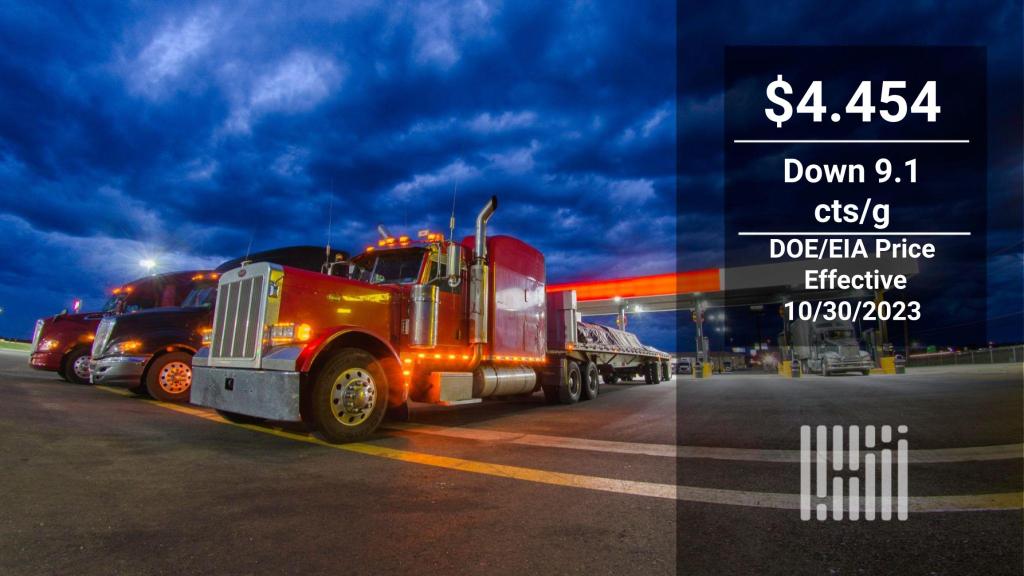
The Department of Energy/Energy Information Administration average retail weekly diesel price fell 9.1 cents a gallon Monday to $4.454. On Oct. 10, right after Hamas’ incursion into Israel but too soon for it to have affected retail diesel prices, the DOE/EIA price came in at $4.498 a gallon. After several weeks of tensions and now the Israeli counterinvasion into Gaza, the price used for most fuel surcharges is actually 4.4 cents a gallon less than where it was before Hamas attacked.
The DOE/EIA price never did have the type of surge seen in the futures market, because that sharp increase proved to be short-lived and retail numbers at the pump operate on a lag. But the Hamas-driven upward move is now mostly over in broader petroleum futures markets.
On Oct. 6, the last day before the Hamas invasion, world crude benchmark Brent settled at $84.58 a barrel on the CME commodity exchange. Its peak settlement after that was $92.38 a barrel on Oct. 19. But its settlement Monday was $87.45, with just a few dollars of “war premium” left in the price.
A similar trend has been witnessed in the price of ultra low sulfur diesel on CME. It settled at $2.9008 a gallon Oct. 6 and peaked at $3.2117 on Oct. 13. Its Monday settlement of $2.9663 a gallon is only 0.0003 cents less than where it settled on the first trading day after Hamas invaded Israel.
Driving the downward trend, according to analysts, is that for all the fears of a broader Mideast war that could take out oil production, shipping capabilities or both, none of those fears have been realized.
To the contrary, Iran reported earlier this week that its production had reached 3.4 million barrels a day. In April, according to S&P Global Commodity Insights, its output was just over 2.6 million barrels a day. That added output of 800,000 barrels a day is coming even as the OPEC+ group and Saudi Arabia on top of that continue to stick to their output cuts implemented in May (for OPEC+) and June (for Saudi Arabia’s additional 1 million-barrel-a-day cut). Add to that higher increases out of places like Brazil, Guyana and the U.S. — where production is up roughly 1 million barrels a day since April — and the fears of $100-a-barrel Brent crude so prevalent in the spring have largely faded.
That isn’t to say all worries about the spread of war in the Middle East have dissipated. The headline number that came out of the World Bank report released Monday was that a large-scale conflict in the Middle East could spike oil prices to more than $150 a barrel, assuming a baseline price of $90.
However, the more sober parts of the report said that a “small oil supply disruption” scenario arising from any sort of armed conflict in the Middle East could tack on 3% to 13% more than the $90 baseline.
Sierra Club still sees rail as ‘a climate solution’
More than 15 years after it was first produced, the Sierra Club has revised its statement on how to promote clean transportation within the rail space.
For the grassroots environmental organization, 2023 marked an opportune moment to revise the statement, which looks at how passenger and freight railroads can reduce and minimize their greenhouse gas emissions. The Infrastructure Investment and Jobs Act (IIJA), which President Joe Biden signed into law in November 2021, encourages the U.S. Department of Transportation and other related agencies such as the Federal Railroad Administration (FRA) to pursue ways to encourage states and local communities to adopt transportation options that address climate change or emissions reductions.
Following passage of the IIJA, FRA developed an initiative in April 2022 spurring the industry to address climate change and achieve net-zero greenhouse gas emissions by 2050. The agency also appointed staff to address issues related to climate change and resiliency.
“Given this historic investment and given the stark reality that we are seeing the effects of climate change, we felt that it would be appropriate to update the statement and really use it as a resource, [particularly for those] who are interested in getting involved in advocacy,” Katherine García, director of the Sierra Club’s Clean Transportation for All campaign, told FreightWaves.
García’s role is to ensure that everyone in the U.S. has access to clean mobility. That includes access not only to zero-emitting cars, trucks and buses but also encouraging communities to promote walking or biking.
“And really, the point of the statement is to say that rail is a climate solution, and we want to make sure that it’s well invested and that the investments really benefit communities across the country,” García continued.
According to García, the Sierra Club first published its rail transportation statement in 2007. The organization revised its statement and released it in August.
To revise the rail statement, García relied on volunteers who she said are “very passionate” about rail, as well as local and state chapters that might be active in rail initiatives, such as those in California.
According to a summary of the statement, Sierra Club recommends the following actions for freight rail: Call for all levels of government to take an intermodal approach to transportation policies as a means to ensure safe, energy-efficient and cost-effective freight movements; urge U.S. officials to adopt European-style open access rail policies; and call upon DOT and FRA to develop a comprehensive training program for railroad personnel.
Sierra Club also supports efforts by the California Air Resources Board (CARB) to pass regulation calling for zero-emission locomotives over the next two decades. The regulation — which is facing some legal pushback from the freight rail industry in part because of the aggressive timeline prescribed in the new rule — calls for switch, industrial and passenger locomotives built in 2030 or after to operate in zero-emissions configurations, while locomotives built in 2035 for freight linehaul operations will need to comply with zero-emissions configurations. CARB defines zero-emission configurations as a zero-emission locomotive or a zero-emission-capable locomotive.
“The standard is long overdue and we’re seeing it as a blueprint for other states,” García said.
While the rail industry has looked at deploying more battery-electric locomotives and hydrogen-powered locomotives as ways to reduce locomotive emissions, García and the rail statement say the ultimate goal should be electrification of the freight rail system in the U.S. Fuels like biodiesel serve as a bridge fuel, García said, and so rather than supporting bridge fuels, regulatory focus should be on electrification.
“Unlike aviation, which will be very difficult to move away from petroleum fuels, rail can convert to electricity generated from clean sources in the grid like hydroelectric, wind, solar, and geothermal. Electric trains can use regenerative braking, and directly feed power to the motors,” the rail statement said. “It is also far easier and more energy efficient to electrify trains than trucks, particularly for long-haul trucks which would have to stop to charge every couple hundred miles on long-distance trips.”
Garcia said the Sierra Club supports the use of green hydrogen from renewable sources, because even though it is more expensive, it does rely upon dirty sources to produce hydrogen.
“What we’re really calling out is that the majority of trains run on diesel, [which] causes a significant burden on communities that are around rail yards, and so we really want to make sure that we’re putting policies in place that will reduce those emissions around the rail yards,” she said.
Ultimately, Sierra Club sees its revised statement as something environmental advocates can use to rally around when pursuing local, state and federal initiatives.
“The Sierra Club has been working in coalition with environmental justice partners to … [promote] a shift from trucks to rail. We want to reduce traffic congestion on the highways and reduce diesel emissions” from the movement of goods, García said.
The statement’s summary said: “All levels of government need to recognize the importance of robust rail transportation for both passenger and freight. In the near term, cities, counties, states and tribes can leverage grant opportunities such as those offered by the Infrastructure Investment and Jobs Act. Because most federal grant opportunities require matching funds, it is important for these levels of government to have well-developed project plans that are ready for construction when funding becomes available.”
Air Canada reaffirms cargo commitment after 777 freighter cancellation
Air Canada remains committed to growing its startup freighter division despite canceling an order with Boeing last month for two 777 freighters, said CEO Michael Rousseau on Monday.
Air Canada (TO: AC) reported a 24% drop in third-quarter cargo revenue compared to the same period last year, to $155.5 million (CA$215 million), due to lower yields caused by weak market conditions. The air cargo industry writ large is coping with an 18-month contraction from pandemic peaks, exacerbated by excess capacity from the rapid reintroduction of international passenger flights. Cargo revenue of $491.7 million was 30% lower for the nine months through September.
“We haven’t changed our strategy. We are still committed and excited about growing the freighter business, and we’ve always run and will continue to run a very strong belly business,” Rousseau said on the earnings call with analysts. “We did cancel two 777 freighters because it was a little bit too early for us to take those into our network, but we are looking to expand our 767 freighter business and build that business over time.”
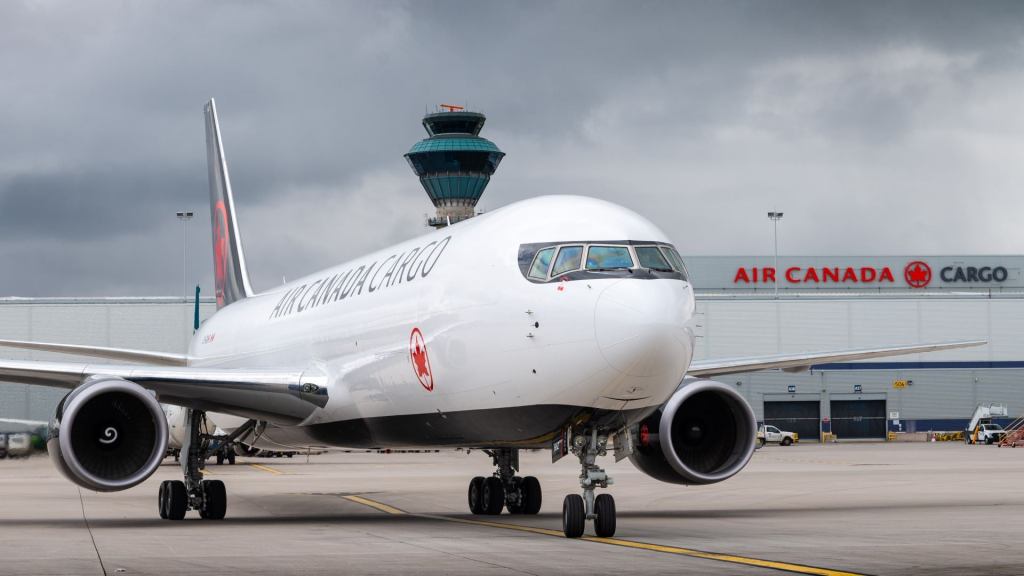
Air Canada Cargo currently operates six Boeing 767-300 converted cargo aircraft. It is scheduled to receive one more freighter by the end of the year and two more next year. The planes are former passenger jets retired from Air Canada’s fleet that are being retrofitted by aftermarket aerospace firms for carrying large containers in the main cabin area.
“The market has been soft. We believe we’ve hit the bottom and we’re starting to see some early signs of strengthening demand and yield, and we’ll take full advantage of that with both our bellies and our freighters. Again, the freighters play an important role in providing cargo for our bellies, and so that’s a synergy that we have within our system that adds value,” Rousseau explained.
He noted that the 18 Dreamliners that were reserved have room for two more pallet positions than the 787-9s the airline currently operates, which will enable more cargo shipments per flight.
Adding extra cargo capacity on passenger aircraft will be more profitable than potentially flying two 777 freighters, said Rousseau.
Last year, Air Canada had cargo sales of $935 million after a record $1.2 billion in 2021.
All-cargo pivot
Air Canada executives decided in late 2020 to establish a dedicated freighter operation. The surge in cargo business during the pandemic along with growing shipper concerns about passenger reliability and the rise of e-commerce convinced them there was an opportunity to grow and diversify revenue even after cargo demand cooled.
Air Canada was one of the first airlines at the start of the COVID crisis to quickly repurpose idle passenger aircraft for dedicated cargo service, including seven large aircraft that had seats temporarily removed to make room for light shipments.
Freighters allow the airline to provide more consistent capacity and cargo-focused routes than is possible by simply relying on the passenger network, where routes and frequencies fluctuate by season and often don’t include industrial destinations with large cargo activity.
Air Canada performed better in cargo during the third quarter than most rivals that have released financial results so far. American, Delta, United, IAG Cargo (parent of British Airways) and Air France-KLM Group all suffered revenue declines of 30% to 36%.
Air Canada said increased freighter operations to Central and South America and to Europe partially offset the year-over-year decline in cargo business.
The freighter division’s network in recent months has expanded to San Jose, Costa Rica; Punta Cana, Dominican Republic; Basel, Switzerland; and Liege, Belgium.
North American destinations include Dallas, Atlanta, Miami, Mexico City and Guadalajara, Mexico. Air Canada Cargo flies to Quito, Ecuador; Lima, Peru; and Bogota, Colombia in Latin America. In Europe, the network covers Frankfurt and Cologne, Germany; Barcelona, Spain; and Istanbul.
Air Canada last year expanded its cold storage facility in Toronto and a warehouse at Frankfurt airport. It also is in the midst of a huge remodel of its London Heathrow cargo terminal. An expansion of the terminal in Vancouver, British Columbia, was done with 777 freighters in mind.
Air Canada recently extended passenger service for the full year on several European routes that were previously summer seasonal operations, giving shippers more opportunity to move freight on a consistent basis. Key routes that will remain available to customers throughout the winter include Montreal to Rome, Toronto to Copenhagen, Denmark, and Toronto to Madrid, Air Canada Cargo announced. In addition to the new year-round routes, Air Canada Cargo will benefit from increased frequencies on routes out of either Toronto or Montreal to Barcelona; Casablanca, Morocco; Paris; Lisbon, Portugal; Athens; Rome; and Edinburgh, Scotland.
Air Canada Cargo in September operated its first on-demand horse flights for the annual Spruce Meadows “Masters” in Calgary. Boeing 767 freighters safely transported 48 prized show jumpers, companion dogs and show equipment to and from Toronto Pearson International Airport. The airline relaunched equine service late last year, after a long hiatus.
Overall, Air Canada enjoyed a $1.25 billion profit versus a half-billion-dollar loss in the year-ago period as travel demand continued to spike. Passenger revenues jumped 22%. The airline saw costs increase 5% on 10% more capacity and inflation.
Air Canada is currently in negotiations with its pilots’ union and a new deal is likely to pressure future earnings.
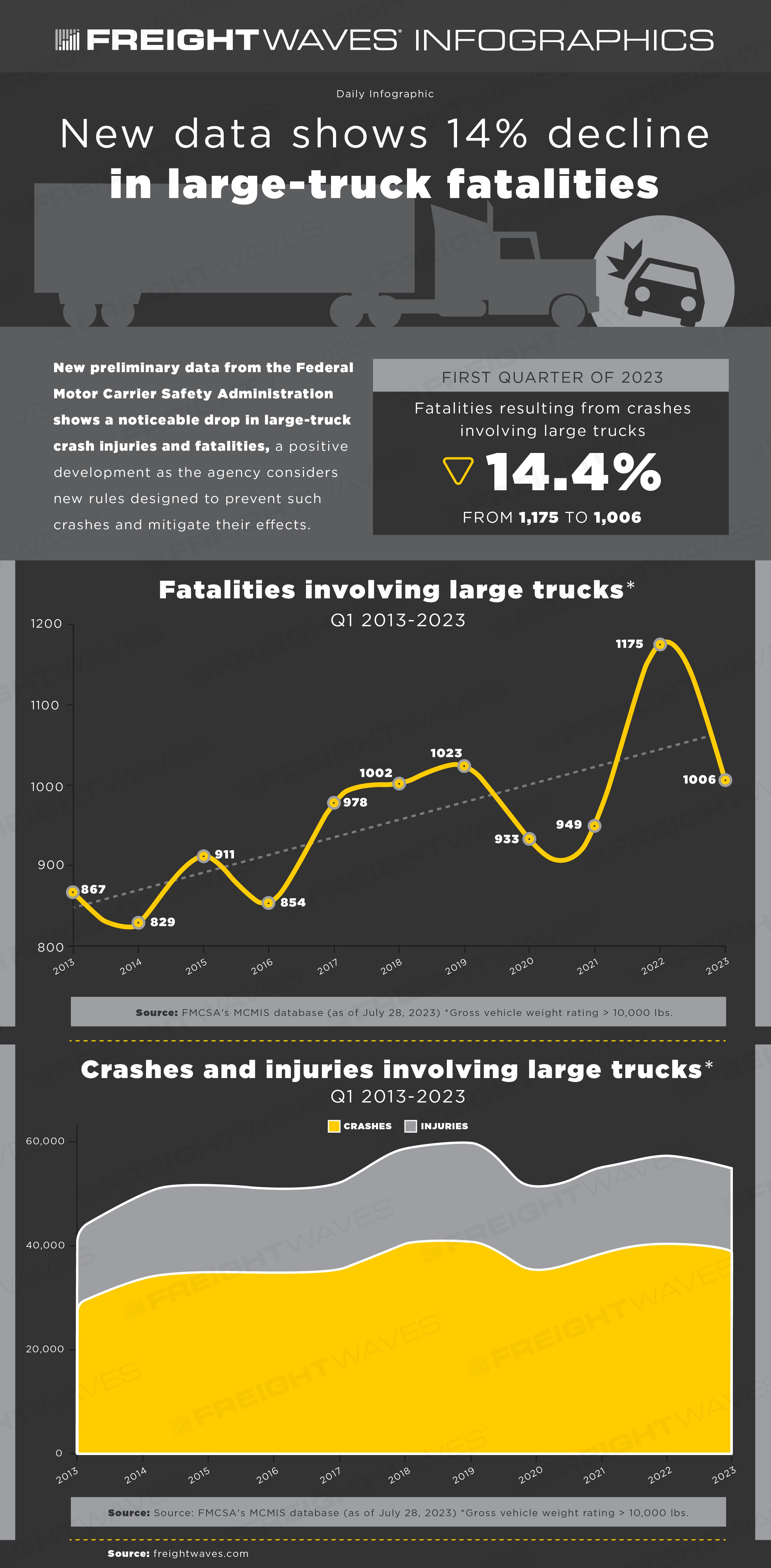
Daily Infographic: New data shows 14% decline in large-truck fatalities
To view more FreightWaves infographics, click here
Mack offers monthly subscription for medium-duty electric truck
SONOMA, Calif. — Mack Trucks is offering an all-in monthly subscription and pay-as-you-go mileage program for its new medium-duty electric trucks, addressing concerns about high upfront costs of acquiring the zero tailpipe-emission vehicles.
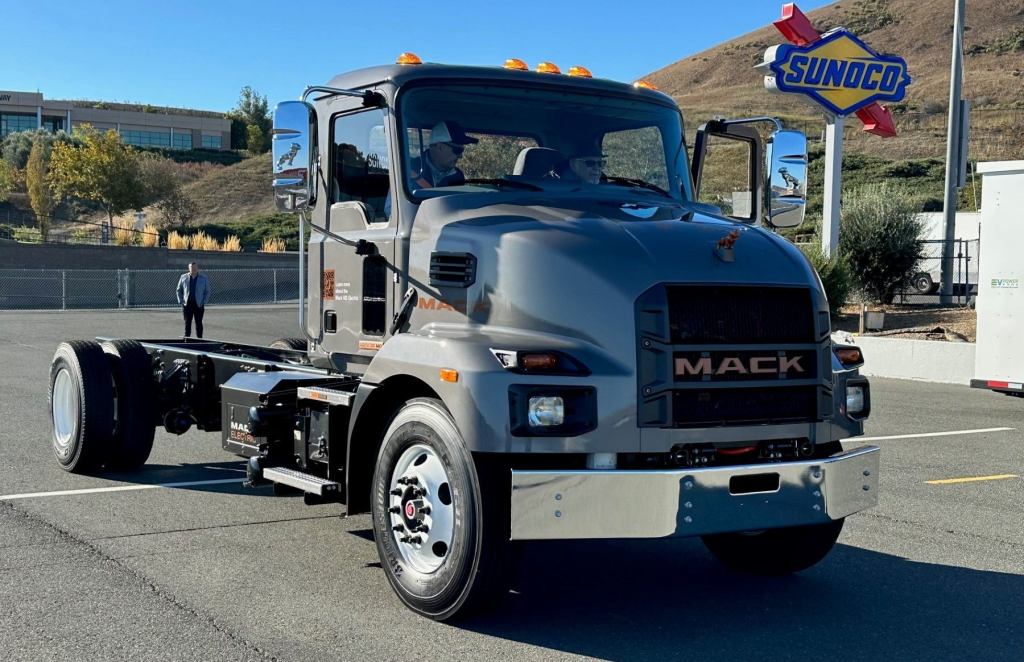
The Volvo Group subsidiary introduced its Mack Financial Services ElectriFi Subscription on Monday during a Mack MD Electric ride-and-drive for reporters at the Sonoma Raceway.
The all-in subscription offerings start at a three-year plan requiring a 1,700-mile monthly commitment. Tiered pricing per mile drops with longer contracts. A customer could renew the subscription at a lower monthly price, buy the truck, or walk away at the end of the contract, said George Fotopoulos, Mack vice president of electromobility.
“The capital investment, as we know, is quite high for an electric vehicle,” he said. “This takes that hurdle out of the equation.”
Total cost of ownership parity with a diesel MD comes at about three years driving 30,000 miles a year. ElectriFi includes the truck chassis and body, alternating current (AC) chargers, annual maintenance and physical damage — but not liability — insurance.
About 70% of MD Electric trucks likely will be upfit as dry or refrigerated box trucks. Stake and dump trucks and tankers are other possibilities.
Mack enters the truck-as-a-service business
The program effectively puts Mack into the truck-as-a-service (TaaS) business. Mack hopes the flexibility will attract business for its Class 6 and 7 electric trucks introduced in March. They go on sale this quarter. Mack won’t discuss how many orders it has but build slots are available into 2024.
Mack shares its parent’s commitment for 35% of the trucks it sells to be electric by 2030. That’s a tall order for the nascent industry selling small numbers of electrics today. The MD introduced as a diesel in 2020 is Mack’s second battery-powered truck. The Class 8 Mack LR Electric refuse truck went on sale in December 2021 after a couple years of testing.
Regulations, notably in California and other states adopting its tough stance aimed at eliminating internal combustion-power trucks in the next two decades, drive creative approaches like TaaS. Multiple startups offer subscription services that include charging. Mack welcomes them.
“Anybody can become a customer of this business model,” Fotopoulos said.
Addressing fleet concerns about electric trucks
Even more than cost, fleets question whether an electric vehicle can do the job as well as a diesel. And they worry about the availability of charging infrastructure.
Including AC charging in the ElectrFi program removes that concern because it allows overnight charging with little infrastructure expense. Faster direct current charging is available but it costs more.
“Putting copper under the ground can be quite expensive,” Fotopoulos said.
Mack Financial Services offers ElectriFi Infrastructure and ElectriFi Lease including advice on incentives. Mack and its third-party partners help customers develop charging station design, installation, construction, hardware and software needed. All-inclusive financing is available, including up to a 60-month loan if Mack Financial funds the trucks.
On the service side, the five-year comprehensive Mack Ultra Service Contract provides bumper-to-bumper service for the MD and LR Electric. The contract includes telematics with battery monitoring; a high-voltage battery performance guarantee; and all scheduled and preventative maintenance.
“ElectriFi Subscription, the other financing options and the Mack Ultra Service Contract were designed to help remove any hesitancy about financing, service and support that customers might experience as they electrify their fleets,” Fotopoulos said in a news release.
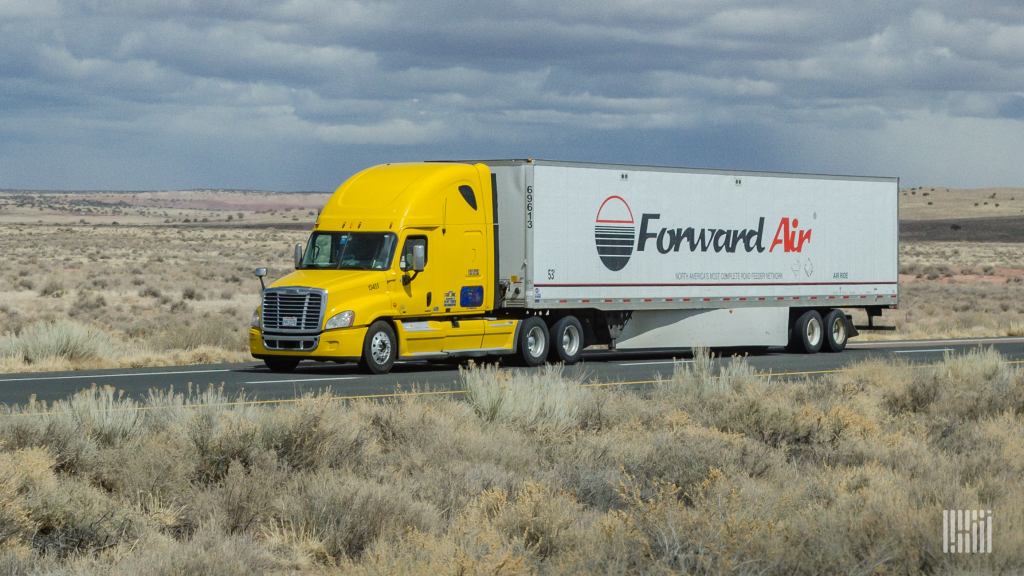
Forward Air reported third-quarter adjusted earnings per share of 99 cents Monday after the market closed. The result was 12 cents light of consensus and 94 cents lower year over year (y/y).
Forward (NASDAQ: FWRD) pinned the miss on soft demand for its noncore intermodal and truckload brokerage services. A news release said the company is accelerating a “strategic portfolio review,” which could include selling some or a portion of those units.
The adjusted result excluded $22 million in due diligence and transaction costs, or 63 cents per share, presumably tied to a planned merger that has become heavily scrutinized by shareholders. Last week, Forward floated the idea of ending the transaction, which shareholders have asked it to do, alleging Omni Logistics has failed to comply with pre-closing requirements regarding access to information.
Omni’s CEO disputed those claims in a Thursday letter to customers.
“We are pursuing this transaction to accelerate our customer-focused strategy of removing layers of complexity and costs from logistics, without sacrificing service,” Omni CEO J.J. Schickel said.
Omni contends it has “fully complied with all obligations of the merger agreement” and that it intends “to enforce that binding agreement to ensure the successful completion of the transaction.”
Forward’s fourth-quarter guidance was also worse than expected.
The company forecast revenue to decline 7% to 17% y/y, implying $423 million at the midpoint of the range. That was below the consensus estimate of $468 million at the time of the print. Adjusted EPS was forecast to a range of 98 cents to $1.02, which was below a $1.13 consensus estimate.
During the third quarter, Forward saw positive sequential trends in its expedited segment, which includes less-than-truckload operations. Revenue was up 4% to $351 million as tonnage increased 3% and revenue per hundredweight, or yield, increased 1% excluding fuel surcharges.
“Precision execution of our revenue growth strategies led to positive volume trends and improved freight quality metrics,” said Forward Chairman, President and CEO Tom Schmitt.
The metrics were less favorable compared to the year-ago quarter, when freight demand was stronger.
The expedited segment’s revenue was off 11% y/y as tonnage was flat and yield excluding fuel was down 7%. However, October tonnage per day is 6% higher y/y.
The unit posted an 89.7% operating ratio, which was 390 bps worse y/y. The LTL portion of the unit reported an 85.5% OR in September “after a sluggish start to the third quarter.”
“We are growing with both our domestic freight forwarder and direct shipper customers,” Schmitt said.
Forward reported a 14% increase in average daily volumes with freight forwarders since the transaction was announced on Aug. 10. Shippers that now work with Forward directly, as opposed to using a freight forwarder, increased by more than one-third y/y in the quarter to more than 240.
Some of Forward’s existing forwarding customers had concerns that its integration of Omni, which is also a freight forwarder and a competitor to those customers, would place them at a competitive disadvantage.
Shares of FWRD were off 2.8% in after-hours trading on Monday.
Forward will host a call on Tuesday at 9 a.m. EDT to discuss third-quarter results.
State of Freight takeaways: From the floor of a very weak trucking market
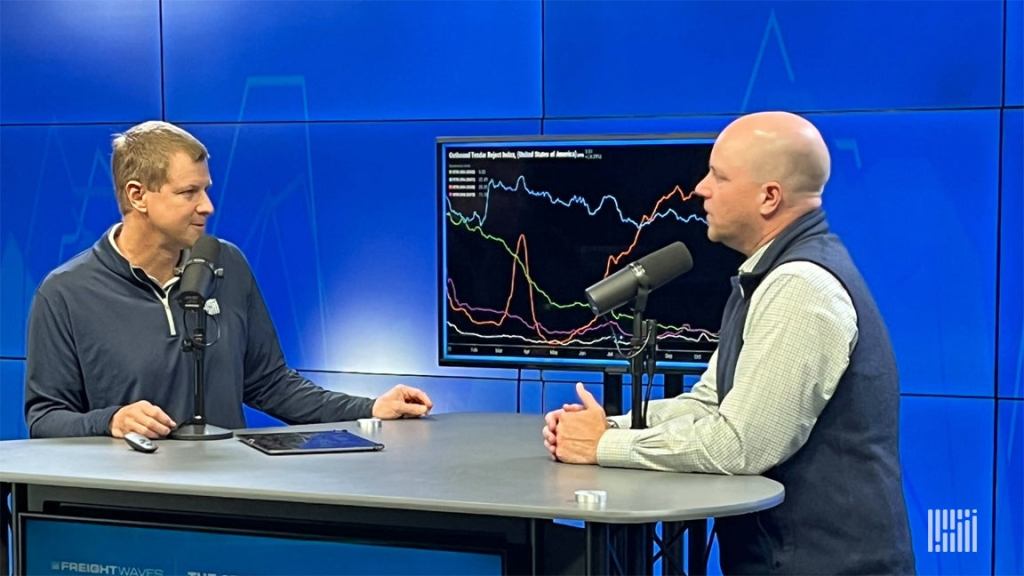
As October is about to roll into November, the State of Freight webinar with FreightWaves CEO Craig Fuller surveyed a market just hit by the stunning collapse of digital brokerage pioneer Convoy and data sets that aren’t showing much of an upturn in the outlook for carriers.
Here are some of the highlights from this month’s session:
The brokerage shakeout developed over time and is now moving fast
Fuller said he cannot recall any previous time when so many brokerages have gone out of business. He cited at least four significant brokers that have shut their doors in the past four months, with Convoy leading the way. But while Convoy may have gotten most of the attention, Fuller said it is brokerages beyond the ones that are part of private equity or venture capital-backed that are seeing struggles. Many of those brokerages had used various debt financing tools “to grow their businesses aggressively,” but with interest rates rising and the businesses slowing down, many have found themselves in violation of loan covenants.
As far as Convoy, Fuller said there had been rumors in the market for many months about troubles at the digital brokerage. “But I think we were all surprised as to how fast that business deteriorated, or at least it looked from the outside like it had deteriorated much faster than expected,” he said.
Bounce back in freight markets still doesn’t seem imminent
Fuller said when times are tough for carriers or brokers, management at those companies often starts “using that as a baseline excuse and you start saying, ‘Hey, it’s OK.’ This isn’t as bad as it could be.” But eventually, when the weak market drags on, the realization comes that “there is something systematically wrong that we need to fix. And I think as a business owner, this is the time to do that.”
When freight markets weakened in early 2022, Fuller said, “I remember thinking that the downturn in freight was probably going to be at most a year.” After that duration, inventory clearing and the need to restock anew would arise. “But it has not happened yet,” he said.
There are more trucking bankruptcies to come
Fuller said the trucking industry “is starting to see the failures pile up. We are certainly reporting on a lot more bankruptcies than we have in the last six months.”
How much does the market have to fall? Fuller said he did not see truckload markets strengthening until another 20% of capacity comes out of the market.
But the capacity issue for the market was built on the fact that the number of trucking authorities granted by the Federal Motor Carrier Safety Administration surged, fueled by both the zero interest rate environment and the strong freight market. “You had a massive capacity expansion cycle unlike anything we’ve ever seen,” Fuller said. Some executives have told him that the current freight market is worse than in the Great Recession of 2008-2009.
Data from FreightWaves SONAR presented during the webinar showed that the net reduction in the number of approved authorities has been relatively muted given the weakness of the market.
The market is not ready to bounce back, Fuller said. “This is the reason the carriers feel the way they do. It is much more painful than what it was during the financial crisis.”
That is likely to be a factor with the start of bid season. “The carriers are looking at some pretty difficult operating conditions knowing they have to be more aggressive,” Fuller said. That will lead to contract rates coming down next year, and the challenging pricing market for carriers is likely to last into the second quarter.
Significant carriers are parking trucks
Capacity reductions are coming not just from independent owner-operators leaving the business. Instead, Fuller said he is hearing reports and seeing evidence in the latest round of earnings reports that larger carriers are taking trucks off the road given the market.
“They would rather have trucks set against the fence, which violates everything I knew about trucking,” Fuller said. “You’re not supposed to do that. The rules are, keep the equipment running, but they’re making the decision to not hire the drivers and not fill the trucks.”
Their conclusion: “We simply can’t make a profit now.”
Fuller and Zach Strickland, director of freight market intelligence at FreightWaves, talked about the third-quarter earnings numbers from Heartland Express (NASDAQ: HTLD), which lost money during the three months.
“Heartland my whole life has been reputable and one of the best operators,” Fuller said. “And it was one of the most fantastic operators in terms of capital efficiency, profitability and operating ratio.” The fact that it is struggling “is just a testament to how difficult the market is right now,” Fuller added.
Is the Freight Market still in limbo – State of Freight Webinar | October 30, 2023 https://t.co/AORhTVE58L
Fuller and Strickland both cited data that showed intermodal rail traffic doing well. And as Strickland noted, that isn’t a sign of increased freight traffic overall. Rather it is intermodal capturing market share from trucks, “and this actually helps explain the dip” in truckload volume, he said. “The rail sector has really had a late blooming this year.”
Although diesel prices are now coming down, they moved up from a low of about $3.79 a gallon in June (per the weekly average retail diesel price from the Energy Information Administration) to a high of about $4.63 a gallon in mid-September. They have since retreated about 20-22 cents a gallon. That sharp rise is always seen as a potential boost for intermodal traffic.
Fuller said part of the reason for the switch beyond the improved fuel efficiency inherent in that form of transportation is that “I have no urgency to move my freight.” The speed of the point-to-point nature of truckload has its advantages, but if a shipper can save 40 to
50 cents per mile moving freight via rail intermodal, and the goods have a less-than-urgent timeline to get where they’re going, this gives a boost to train service.
The third-quarter earnings season showed all publicly traded less-than-truckload carriers experienced some type of bump following Yellow’s exit. If it was a competition, Saia was the winner.
While there’s a little noise in the numbers, the sequential progression from the second to the third quarters is a good yardstick of how Yellow’s $5 billion freight share was redistributed. Yellow had been teetering for years but as tensions rose with its union workforce in the June-July time frame, shippers and 3PLs started moving their freight with other carriers. The third quarter may have not captured the entirety of the event but it is a great representation of what happened.
Also worth noting, private regional carriers and top 5 national operator Estes were likely market share takers in the period, but the market isn’t privy to their results.
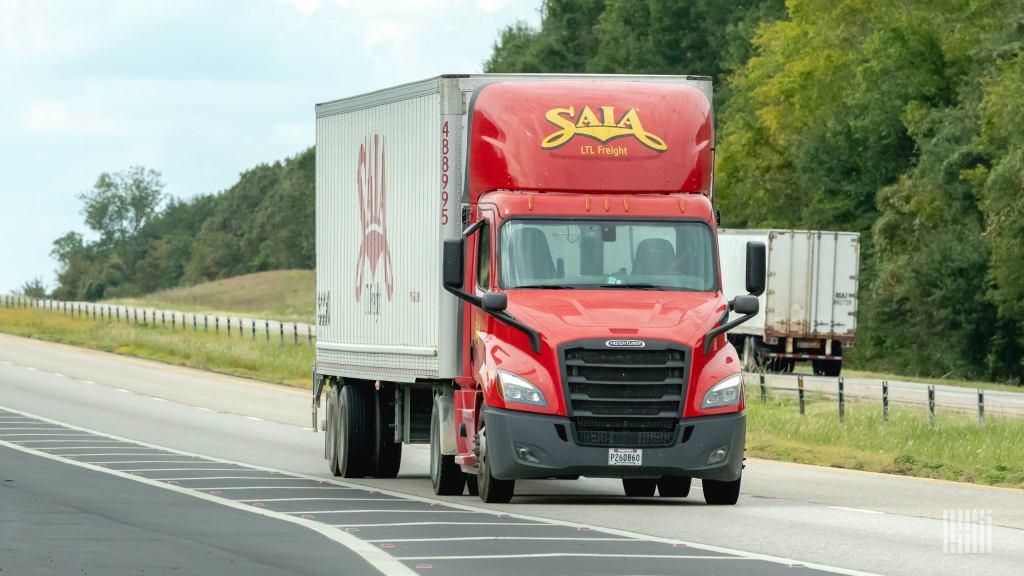
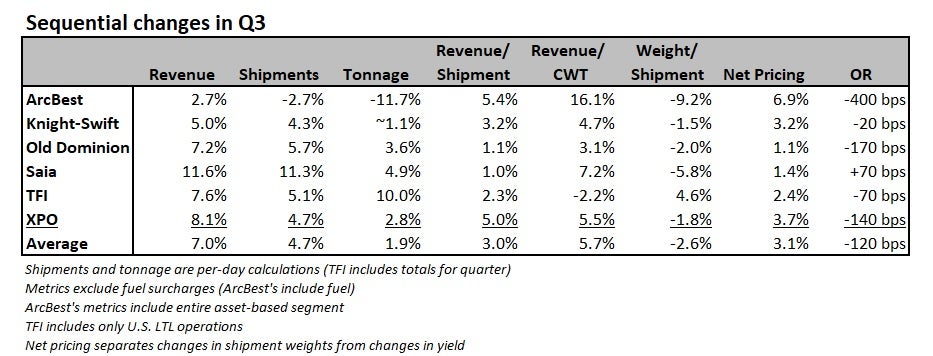
Saia (NASDAQ: SAIA) reported an 11.3% increase in shipments per day from the second to the third quarters. The carrier added more than 1,000 employees in the period, building on an existing head count of roughly 12,000, to accommodate the influx.
The tighter capacity backdrop pushed yields higher.
Its revenue per hundredweight increased 7.2% excluding fuel surcharges. The calculation was bolstered by lower shipment weights, an occurrence seen throughout the industry as the broader industrial and manufacturing complexes have cooled. When accounting for the lighter weights, yield was likely up just modestly on a sequential basis.
The company’s operating ratio — operating expenses expressed as a percentage of revenue (the lower the better) — deteriorated 70 basis points sequentially in the quarter to 83.4%. However, the backslide was modest given the costs it incurred to take on the freight windfall. The quarter also contended with a July wage increase averaging 4.1%.
“SAIA is capitalizing on a once in a generation market share opportunity in the LTL market,” Deutsche Bank (NYSE: DB) analyst Amit Mehrotra said in a Friday note to clients. “This comes with extra costs on the front end, but customers are likely to stay and pay more over time.”
5% is the figure for most
Most carriers saw a 5% sequential increase in shipments during the quarter.
Old Dominion’s (NASDAQ: ODFL) “investing ahead of the curve” strategy allowed it to post a 5.7% increase in daily shipments with minimal disruption to service. The company has grown door capacity roughly 50% through $2 billion of real estate investments over the last 10 years. It typically operates its network with 25% latent capacity, allowing it to take market share while maintaining service commitments to existing customers.
The company recently earned best-in-class honors among national carriers for a 14th straight year, according to an annual shipper survey conducted from June to October.
Higher yields and cost management at Old Dominion led to a 170-bp sequential OR improvement in the period.
The company doesn’t think the freight reshuffle is completely settled either.
“We’re hearing about competitors that are missing pickups,” Old Dominion CFO Adam Satterfield said on a Wednesday call with analysts. “They don’t have the people part of the capacity equation solved and maybe took on too much freight and are starting to have negative implications from their overall service product.”
The comments align with a recent Morgan Stanley (NYSE: MS) survey of shippers and 3PLs that previously used Yellow. Thirty-five percent of those polled said that while they have already placed their freight with a new carrier, they will still be looking to make a change in the coming months.
XPO (NYSE: XPO) said per-day shipment counts increased by more than 1,000 in each month of the third quarter to more than 54,000 per day in September. All in, daily shipments were up 5% from the second to the third quarters and yields moved 6% higher excluding fuel surcharges.
The company used internal cost initiatives and favorable pricing trends to record 140 bps of sequential OR improvement, which was 370 bps better than its historical seasonal trend. Contractual agreements renewed 9% higher in the period, which was nearly twice the level recorded in the second quarter.
Shares of XPO were up 15% on Monday following the better-than-expected report.
XPO said it would also accelerate growth in its network in response to tightening capacity throughout the industry. A two-year plan will add 900 new doors to its coverage map by the first quarter of next year.
TFI International’s (NYSE: TFII) U.S. LTL segment (TForce) recorded a 5.1% sequential increase in shipments. The percentage was a little higher at the peak of the disruption but TFI has seen some slippage of that captured freight in recent weeks. The share gains are coming at a time when TFI is still engaged in an initiative to purge low-margin business from its network.
The segment’s yields were down 2.2% sequentially excluding fuel surcharges but that metric was negatively impacted by a 4.6% increase in weight per shipment. Actual pricing was likely 2.4% higher sequentially. The OR improved 70 bps even with a higher-cost labor contract taking effect Aug. 1.
Knight-Swift Transportation’s (NYSE: KNX) LTL unit recorded a 4.3% increase in shipments from the second to third quarters. Excluding fuel surcharges, yield improved 4.7% but a 1.5% decline in average shipment weight was a tailwind.
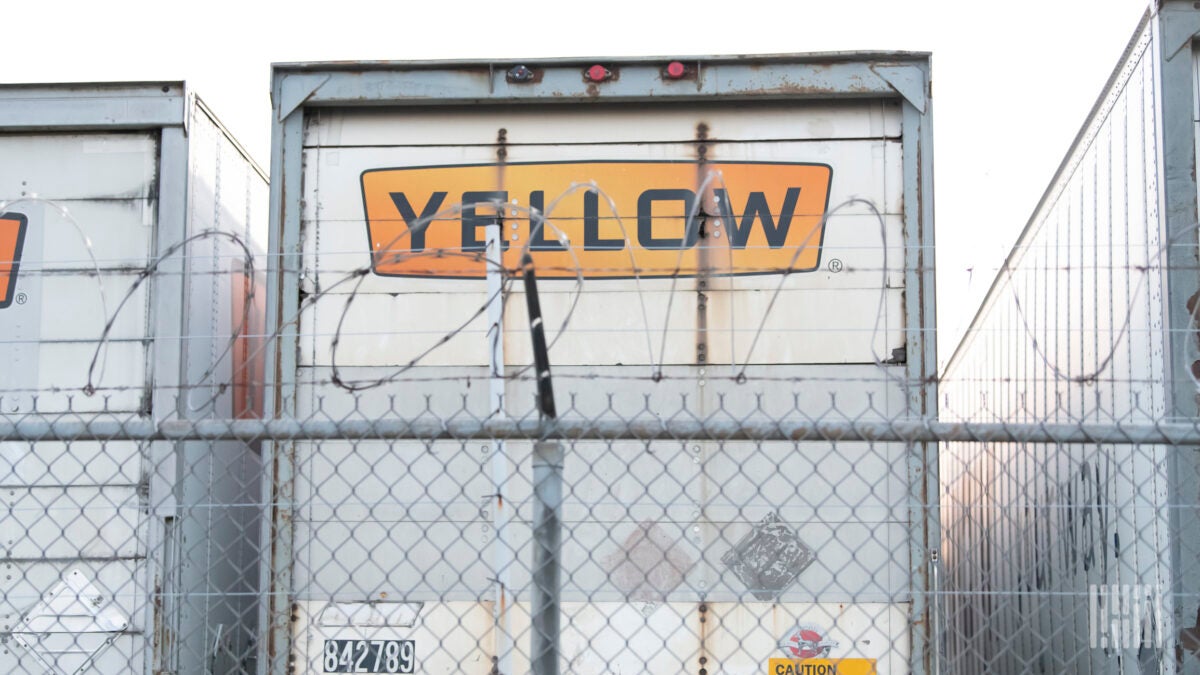
Yellow’s trailers parked along a fence at a shuttered Houston terminal. (Photo: Jim Allen/FreightWaves)
The company’s asset-based segment, which includes LTL carrier ABF Freight, saw shipments decline 2.7% from the second quarter. However, the change is a little misleading as it had been using dynamic pricing tools, which better match available capacity in the network to transactional shipments in the market, to keep loads elevated through the downturn.
The company started moving capacity from transactional customers to cover shipment needs at accounts under contract. Those accounts were diverting freight from Yellow throughout July as it became evident the carrier would fail. When comping ArcBest’s July exit rate to the loads its targeting currently, shipment counts are up roughly 5%. However, among its core accounts, shipments have increased more than 20% since Yellow’s closure.
The segment’s OR improved 400 bps sequentially even though a new labor contract was a 350-bp headwind in the period.
“We’re really targeting a freight profile that maximizes the profitability in our network,” CFO Matt Beasley told FreightWaves.
Will favorable capacity dynamics diminish when Yellow’s terminals reopen?
Bids on the 170-plus terminals Yellow owns are due Nov. 9. In September, a Delaware bankruptcy court approved an order naming Estes’ $1.525 billion stalking horse bid the winner. The agreement sets a base bid for Yellow’s owned terminals. Estes is unlikely to buy all of the properties but it could walk away with a couple of dozen.
Those properties, as well as the 100-plus terminals Yellow leased, could be back in action in the coming months. The new owners will likely want to ramp throughput at the sites sooner than later to start generating returns on those assets. But that doesn’t mean LTL rate cuts are likely.
“We’ve been in a freight slump here, so that’s why we had capacity as a group to fill in the holes for customers. But if you get back to a more normalized industrial environment, we get some growth going again, you get port activity going again, you get benefits of nearshoring, well then that’s another moat around pricing,” said Saia’s CFO Doug Col on a Friday conference call.
Also, some of the sites will likely be acquired by strategic investors and repurposed to other sectors.
“There’s going to be some cases that some of those don’t get returned to the LTL business because maybe the economics make more sense for that to turn into a warehouse or industrial real estate property of some kind,” said Fritz Holzgrefe, Saia’s president and CEO.
Tough freight market hits Echo’s debt ratings, down a notch at S&P
The credit rating of Echo Global Logistics has taken a one-notch downward hit by S&P Global Ratings, with its interest costs rising and its revenue sliding on the back of the weaker freight market.
Moving to B- from B pushes the credit rating of Echo, which was acquired by The Jordan Co. two years ago, further into non-investment-grade territory. The entire class of B ratings is defined as “highly speculative.” At B-, it is six notches less than BBB-, the lowest investment-grade rating on the S&P scale.
Addendum: Moody’s followed suit approximately two weeks later.
Debt rating of 3PL @EchoGlobal has been cut by @MoodysInvSvc, following the action taken earlier by @SPGlobalRatings. Corporate family rating is now B3, equivalent to the B- rating that S&P now has on Echo. Here's our story on the S&P move from last week. https://t.co/2qyo9E2Z5V
S&P Ratings (NYSE: SPGI) did leave Echo’s recovery rating as a “3,” which means there would be a 50% to 75% chance of recovery in the event of a default.
Echo had been a publicly traded company prior to its 2021 acquisition by Jordan Co. Before that, its financial performance was reported every three months. S&P’s move on Echo opens a door to again see how the 3PL is doing, albeit without any information on operating or net profits or loss.
Besides the recovery rating, Echo received another vote of stability from S&P Ratings: The outlook on its B- debt rating was listed as “stable,” which means another downgrade or upgrade in the near to medium term is not likely. “Despite the current freight recession, Echo’s cash position and liquidity resources are sufficient to absorb expected negative free operating cash flow until the freight demand environment improves,” S&P Ratings said in its report issued late last week.
Echo’s debt load relative to its earnings before interest, taxes, depreciation and amortization has risen, a key reason for the downgrade. According to S&P Ratings, the agency had expected that ratio to be in the low to mid-5X range in 2023. Expectations were that organic revenue would decline by 5%, with total revenue stable because of the impact of the May 2022 acquisition of Roadex, a cold chain warehouse and transportation provider.
But S&P now sees debt to EBITDA rising to 7X this year before narrowing back to the mid-6X area next year. And a key reason for that is that revenue this year is expected to decline by 14% to 16%, with a bounce back in 2024 to a positive 3% to 5% range.
EBITDA margins — the company’s EBITDA as a percent of revenue — is expected to be in the 3% to 4% range both years, according to S&P Ratings. But the EBITDA margin in 2022 was 4.7%, and S&P Ratings attributes the decline to the impact from both the Roadex acquisition and the November 2022 purchase of Fastmore, a freight forwarder.
Higher interest rates will mean $19 million in additional interest expense, S&P Ratings said, though it does not provide a figure on what its costs are now. Meanwhile, adjusted EBITDA will be $35 million less than its earlier forecast, again, with no figure on what the $35 million is being taken from.
The freight market will rebound “somewhat” next year, “with capacity beginning to show signs of exiting the market,” S&P said. With contract rates now in place likely to look up at rising spot rates as the freight market improves, that lag means that Echo’s “working capital could be pressured,” which could mean a “use of cash during the initial freight recovery.”
The end result: “The challenging operating and elevated interest rate environment could pressure Echo’s ability to generate meaningfully positive free cash flows (FCF) over the next few years,” S&P Ratings said.
The combination, even in a better freight market, means that “Echo will likely face multiyear headwinds generating free cash flow,” the agency said. FCF will be negative $5 million to breakeven this year and negative $15 million to $10 million next year. That figure is an enormous drop from S&P Ratings’ original call of free cash flow of $55 million to $60 million in 2023 and 2024.
In a statement released to FreightWaves, Pete Rogers, Echo’s CFO, said the company has been cash flow positive in the last 12 months. It has accomplished this “while accelerating investment in both technology and people.
“We have continued to drive profitable market share gains through the freight recession and are well positioned to further leverage the increased investment when the freight market recovers,” Rogers said.
“New awards in Echo’s managed transportation business unit, and full-year revenue contributions from recent acquisitions, were more than offset by softness in its transactions segment as both contract and spot brokerage were weaker year over year,” S&P Ratings said in recapping the current state of business at Echo. In that discussion, S&P Ratings noted that 60% of the company’s business is now contract, though it does not say what it had been previously; that year-on-year load count was down 6.5% through June 30; and gross profit per load was weaker.
The two acquisitions, Roadex and Fastmore, both are suffering revenue declines this year, according to S&P Ratings. “Air and ocean freight forwarding is particularly soft with ocean container rates declining nearly 90% and air cargo rates down 30% year over year through September,” S&P Ratings said.
Given Echo’s ownership by Jordan Co., S&P Ratings does not see it out of the acquisitions game. With Jordan’s backing, “we expect Echo will continue to opportunistically deploy cash and could look to lever up to pursue acquisitions in the future.” But the end result could be that debt levels relative to EBITDA won’t improve, the agency said.