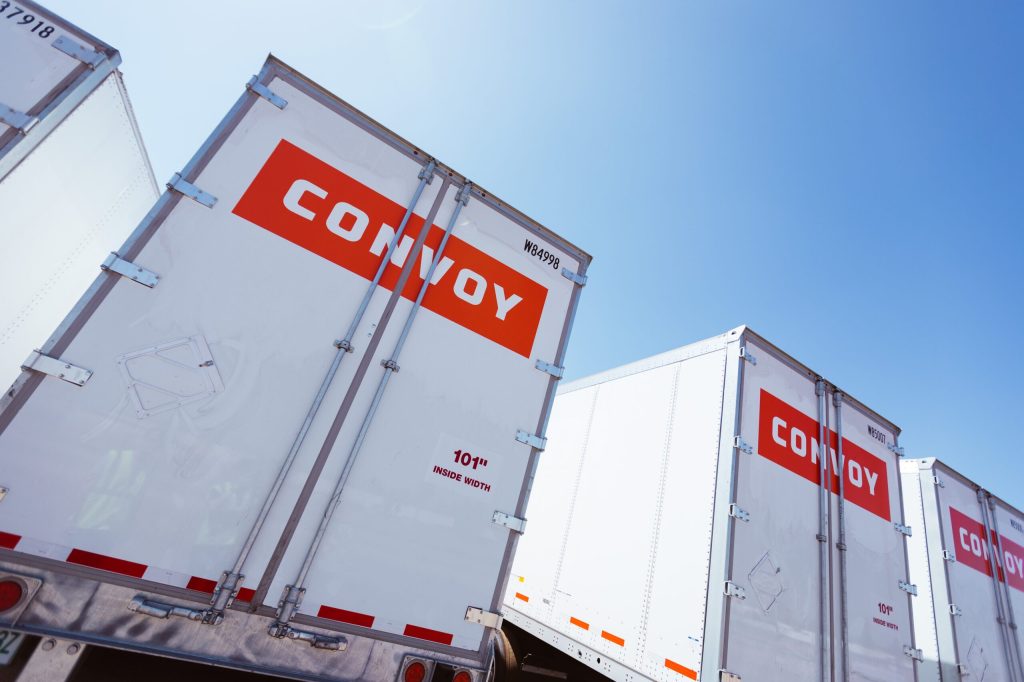
Convoy’s tech focus may have obscured importance of human element

In early 2020, a well-known transportation executive was asked by an investor in digital freight broker Convoy Inc. to determine if its model could be sustained in good and not-so-good markets. The executive, who requested anonymity to speak candidly, evaluated the company and came away skeptical about its prospects.

The executive approached Dan Lewis, Convoy’s co-founder and CEO, with a suggestion: First, hive off a few million dollars in capital to establish some type of an operation in Chicago, the epicenter of brokerage and more than 2,000 miles from Convoy’s Seattle headquarters. Then, hire 10 or so “badass brokers,” supervised by the executive, who knew how to move freight. Once the brokerage operation got off the ground, the technology would be leveraged to support the brokers’ efforts and make them more productive.

Read more: Death from overfunding: An obituary for Convoy

According to the executive, Lewis said he would take the suggestion under advisement. But the sense was that Convoy, which about five years into its existence had already raised many hundreds of millions of dollars and was very much on a roll, believed that it had built a better mousetrap based on sophisticated technology that could supplant traditional brokers. The executive’s suggestions essentially fell on deaf ears.

A person close to Lewis said that he had multiple conversations every quarter with freight executives who proposed ideas or approaches. A dialogue like that one may have occurred, the person said.

The purported decision to prioritize technology in a business so reliant on people to cover loads and deal with exceptions is poignant in the wake of the past week’s events. In a downfall unprecedented in transportation and logistics history, the one-time FreightTech darling went from a valuation of approximately $3.8 billion in the first quarter of 2022 to out of business in a little more than 18 months. Most of its remaining employees were laid off last Thursday. None received severance.

The company would pay health benefits through the end of October, at which time the affected employees could go on COBRA. This was a stark reflection of how bare Convoy’s cash cupboard had become and raised questions about its inability to conserve sufficient cash as a buffer should the freight business turn down, as it has been known to do.

Convoy’s collapse took with it funds from some of the smarter guys in the room, namely Microsoft Corp. founder Bill Gates, Amazon.com Inc. founder Jeff Bezos, mutual fund titan T. Rowe Price and investment firm Baillie Gifford. Convoy had secured $250 million in lines of credit from Hercules Capital and JPMorgan Chase & Co. It also raised money from musical legend Bono, the front man for the group U2. In all, Convoy raised about $920 million. 

Convoy said it would retain some employees to attempt to sell its driver app and its back-end auctioneering algorithms that kept freight moving nationwide with a minimum of human intervention. Over the years, Convoy built software for owner-operators and small fleet dispatchers, and transportation management system portals for its customers, to bring as much of the transaction on-platform as possible so that it could be automated. 

FreightWaves reported late last week that the technology had attracted two potential unnamed bidders. Before Convoy’s collapse, Amazon, Danish maritime and logistics firm Maersk and C.H. Robinson Worldwide Inc. had kicked its tires, according to industry sources. Talks with Robinson to buy the entire company reached an advanced stage before they fell apart, sources said.

A two-pronged story

Convoy’s shutdown is a two-pronged story. The macroenvironment, which is affecting nearly every broker, clearly played a role. Freight demand and rates have pancaked since the high-octane days of 2020 and 2021. A load that could command $300 in net revenue during the pandemic and post-pandemic periods is likely to fetch half that today. That puts intense pressure on broker margins if their costs don’t get reduced and the debt they took on remains on the books.

The 18-month surge in the cost of capital was another broad-based factor. Convoy came of age in a low interest rate environment. Many businesses were venture funded because the bar for returns was as low as the rates themselves. Once the cost of money became far more dear, venture funds faced a higher bar to clear. They began demanding profits from their businesses instead of just growth alone. In a climate of soft demand and prices, many companies were unable to comply and were deemed uninvestable.

“One of the lessons learned from this is that the cost of capital does matter,” said the industry executive, who said the dramatic increase in borrowing costs was the first crack in Convoy’s bursting dam.

But there were issues that were more Convoy-centric. Co-founders Lewis and Grant Goodale were technology-focused executives. Neither had trucking or freight experience other than Lewis’ stint at consultancy Oliver Wyman from 2004 to 2007. With steadfast faith in the company’s disruptive abilities, they may have lost sight of the fact that advanced technology would not guarantee any loads, much less profitable ones, in a competitive market filled with brokers who knew how to solve freight-oriented problems. The “build it and they will come” mindset struggled in a world populated with as many as 16,000 brokers — the approximate high-water mark attained during the pandemic — also working with support from technology.

Convoy had trouble divining its costs and pricing its services profitably, according to sources. Shippers were supportive of a model that could lower their costs. But it didn’t do Convoy’s margins any favors. According to the executive, Convoy broke even or at best eked out small profits even when rates were relatively high. Once rates went into free fall, Convoy was in trouble, according to the executive.

Convoy executives hoped to offset the per-load losses with higher volume in an effort to scale the business. That approach of lowering prices to buy market share works in the less-than-truckload segment of trucking because LTL is a network business that thrives on density, according to two executives. However, it does not work well in a point-to-point business like truckload, which is greatly fragmented and where density is harder to achieve.

Convoy’s model was initially based on building density in critical lanes. Then in late 2019 it pivoted to more of a focus on improving its profitability. The pandemic delayed those efforts. But by late 2020 and into 2021 it had reduced its operating expenses by 50%, according to a person close to the company. 

Convoy’s load-matching technology was geared as much toward owner-operators as it was small or micro fleets. This is unlike other brokerages that focused on micro fleets. Owner-operators are generally not great candidates for backhaul loads because they are lone wolves who drive here, there and everywhere. Small fleets, by contrast, operate inside of networks with locations where they return to regularly. The focus on owner-operators left Convoy out of a potentially large chunk of load generation.

Another factor was the profile of Convoy’s shipper base. Huge brands with big spends were frequent users of the platform. However, they often had payment terms stretching out 90 to as long as 120 days, whereas Convoy had to pay carriers within a matter of days after the loads were delivered. The receivables squeeze put a hit on Convoy’s cash flow, according to the executive.

C. Thomas Barnes, a longtime transport executive who today is an investor in transport logistics companies, said Convoy failed because it didn’t have enough people with insider know-how to counterbalance the new ideas that typify an outsider’s mentality.

“Is there a need for technology? Hell yes!” Barnes said. At the same time, it is vitally important to have traditional problem-solvers on the inside to make everything work, he said. 

Convoy’s failure is a microcosm of a larger problem, Barnes said. Many good outsider ideas go by the board because the insiders’ capabilities to support them are not there or because a balance between the two mindsets hasn’t been struck, he said.

The source close to Convoy disputes that claim, noting that three of the first five top hires came from the freight business. Convoy also hired salespeople and brokers from the industry, especially when it had a carrier sales team, the person said. The false narrative of Convoy not having freight talent was put forth to deter people from doing business with the company, the person said.

Never got there

In the end, Convoy wasn’t big enough, nor did its efforts bear fruit fast enough, to offset the very weak market and the absence of help from the venture funding space, according to the person. The company simply ran out of time, the person said.

Convoy’s demise sparked an outpouring of postmortems on social media. All lamented the human fallout of hundreds of lost jobs. Others thanked Convoy for raising the awareness of technology’s importance in advancing the legacy brokerage business. 

“You pushed us to see technology differently,” Lars Ward, vice president of business development at digital logistics startup FreightVana, posted on LinkedIn last week. “The need for better freight tech is huge and Convoy was chasing a vision” to better connect freight to carriers. 

Convoy’s advancements “challenged other brokers to respond” with their own innovations, Ward wrote.

Matt Silver, a longtime FreightTech executive and investor, echoed those sentiments, writing on the same platform that Convoy’s legacy is that it created an “intense competition amongst the rest of the top freight brokerages” to improve their IT value propositions. 

Silver lauded Convoy’s driver app, which he said “brought a ton of capacity online that was previously offline” and is a reason why the industry has “some sense of capacity availability today.” 
Kuehne+Nagel deploys private freighters to Taiwan for chip industry

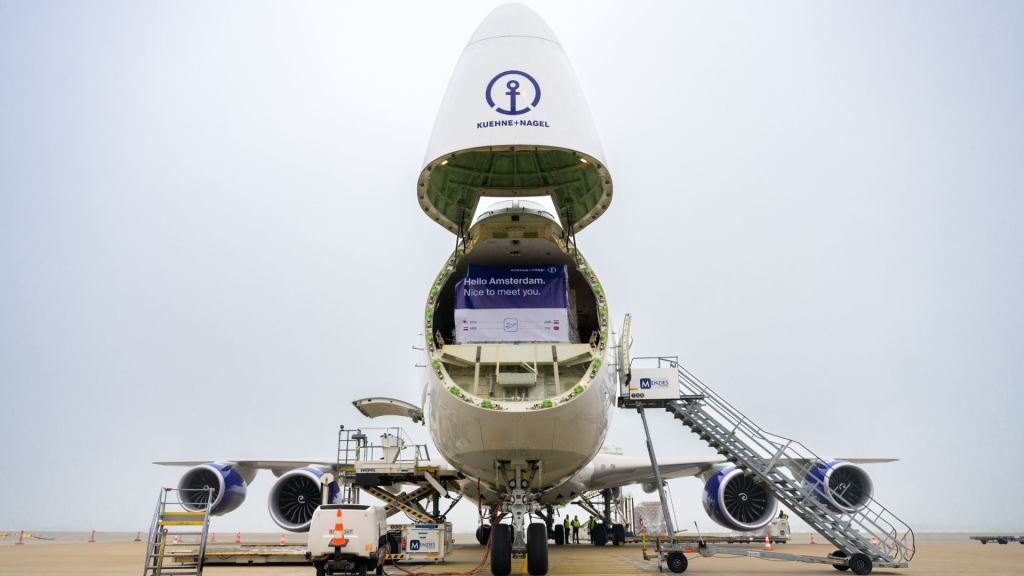
A giant freighter with its nose cone flipped open showing large cargo pallets on the main deck.

Kuehne+Nagel, the world’s largest third-party logistics provider and airfreight intermediary by gross revenue, announced Monday it has added two destinations to its around-the-world air charter service to support increasing demand from the semiconductor industry. 

The Switzerland-based freight forwarding giant deploys two Boeing 747-8 freighters it controls under a dedicated transport arrangement with Atlas Air. One of the freighters will now make two additional weekly routings from Atlanta and Chicago to Amsterdam and from there to Taipei, Taiwan.

Kuehne+Nagel (SIX: KNIN) management last year targeted semiconductors requiring air transport as a new area of growth because the complexity of that supply chain makes it a high-margin business. In December, it offered a specialized product tailored to the unique requirements of the semiconductor industry, including security measures and high quality standards for reliability.

Taiwan is a global hub for semiconductor production, accounting for about 20% of all microchips made in the world. There are many companies in the Netherlands, Belgium and Luxembourg that rely on semiconductors in their products. 

“Developing and offering logistics solutions for the semiconductor industry is part of our strategic Roadmap 2026. By introducing these two new connections, we can support our customers better and facilitate future growth in the sector,” said Yngve Ruud, K+N’s head of airfreight, in a news release.

K+N said businesses in the healthcare and perishables sectors are also expected to be primary users of the new service.

The new route provides twice weekly service to several cities (Amsterdam-Taipei-Hanoi, Vietnam-Hong Kong-Chicago), continuing with a trans-Atlantic loop in primary support of Mercedes-Benz (Stuttgart, Germany-Liege, Belgium-Birmingham,Alabama-Atlanta-Amsterdam).

K+N earlier this year opened a dedicated cargo facility at Birmingham-Shuttlesworth International Airport, a second-tier airport that previously didn’t handle freighters on a regular basis, primarily to support Mercedes-Benz’s Alabama assembly plant.

Competitor DSV has also invested in logistics services for the semiconductor industry, with a special focus on customers in Arizona.

Upgrade at Paris airport

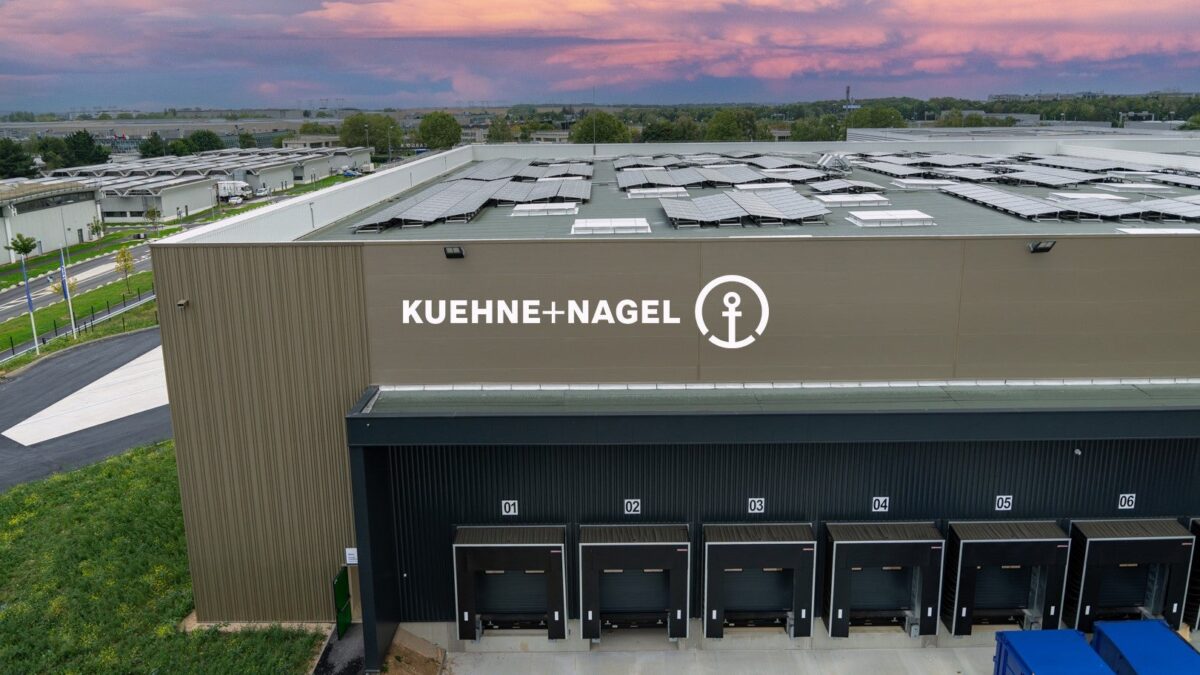
Last week, K+N bolstered its airfreight capabilities by relocating to a larger airside warehouse at Charles de Gaulle Airport in Paris. 

The new hub, which is 2.5 times larger than the previous space and also is located adjacent to the freighter ramp, is able to handle 300 air containers each week from commercial cargo and passenger airlines, the company said. More than 48,400 square feet are zoned for temperature-controlled pharmaceutical and medical shipments, including R&D samples and direct-to-patient medical shipments supported by QuickSTAT, a K+N life sciences logistics subsidiary. 

Kuehne+Nagel’s new airfreight facility at Charles de Gaulle airport in Paris is now open. (Photo: K+N)

Meanwhile, Emirates SkyCargo last week said its airfreight products, schedules, rates and capacity are now available on K+N’s internal transportation management system thanks to a direct software interface. The host-to-host connection allows K+N customers and specialists to quickly look up capacity on any route and book shipments instantly. Emirates said it is the first time it has made its service available on a freight forwarder’s own portal. 

The new connection was first launched in Switzerland and Austria and will open up to users in select countries around the world by the end of the year.

K+N also announced last week it is working closely with ground handling agents Worldwide Flight Services and SATS Group to improve the handling of freight at airport locations. 

Click here for more FreightWaves/American Shipper stories by Eric Kulisch.

(Correction: The rotation of the 747-8 freighter that stops in Taiwan has been changed to reflect more updated information provided by K+N.)

Kuehne+Nagel teams up to make airport cargo handling more efficient

Big freighter era begins at Birmingham airport in Alabama

Broker purge, portable urinals and AI for DOT compliance – WTT

Broker purge, portable urinals and AI for DOT compliance | WHAT THE TRUCK?!?

On today’s episode of WHAT THE TRUCK?!? Dooner is joined by special guest co-host Matt McLelland from Covenant. They’re talking about brokers getting purged, shooting at Cybertrucks, selling sustainability and what went down at ATA MCE 23.

In a world with only one truck parking spot for every 11 drivers, Truck Parking Club is looking to make big changes by providing drivers with safe spots to park at night. Its founder, Evan Shelley, joins the show to talk about the progress Truck Parking Club is making.

Frederic Kauffmann at The NeverRest Project has partnered with HyperloopTT to create Mount Everest’s first sustainable base camp. We’ll find out how it works and why this tech could be life changing for truckers. 

Entertainment logistics professional Phil Hyland talks about the logistics behind putting on TV shows and movies and how the strike has impacted trucking demand. 

ZTrucking founder Estifanos Estifanos shares his founder’s story and the why behind what his company does. We’ll find out if AI can improve carrier compliance with the DOT. 

Plus, orientation excuses, how not to steal an Amazon truck, dads who can arm wrestle, portable gong vs FreightGong and more. 

Watch on YouTube

Visit our sponsor

Subscribe to the WTT newsletter

Apple Podcasts

Spotify

More FreightWaves Podcasts

Ryder acquires IFS to boost supply chain business

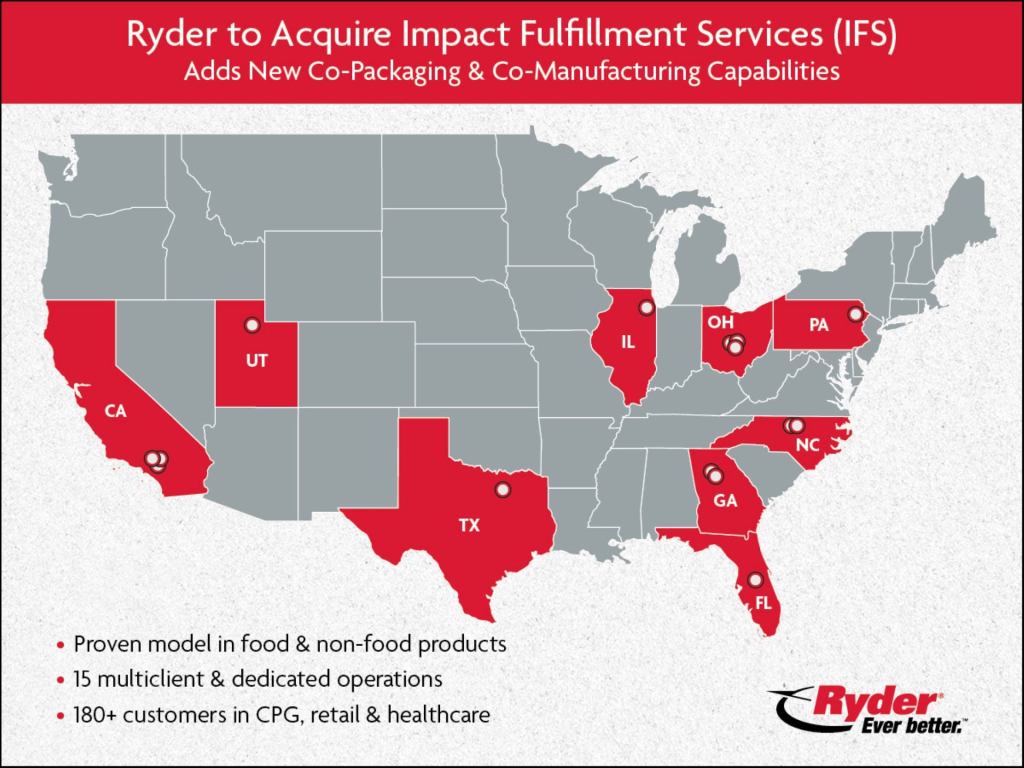
Ryder IFS acquisition map

Ryder System Inc. is acquiring Impact Fulfillment Services Holdings LLC, a contract packaging, manufacturing and warehousing services company with operations in 15 states.

Terms of the definitive agreement reached in the third quarter were undisclosed. IFS also specializes in display engineering, product launches, multichannel programs and club store programs. Ryder expects to close the purchase in early November.

Miami-based Ryder is acquiring all outstanding equity of the company and will keep its approximately 1,000 employees. IFS President Rob LeBaron will join Ryder as vice president of contract manufacturing and packaging.

Ryder expects $250 million revenue boost

Terms will be included in Ryder’s third-quarter filing with the Securities and Exchange Commission. Ryder expects to add $250 million in annual revenue with the deal being accretive to shareholders.

IFS specializes in contract packaging, contract manufacturing and warehousing. Its clients include some of the largest and best-known consumer packaged goods brands in the United States, including retail and health care. 

Ryder gets nine multiclient and six dedicated facilities totaling just under 4 million square feet across Florida, Georgia, Illinois, North Carolina, Ohio, Pennsylvania, Texas, Utah and California.

‘Strategy to accelerate growth in our supply chain business’

“The acquisition of IFS supports our strategy to accelerate growth in our supply chain business, providing Ryder with new capabilities that are complementary to our existing suite of services,” Steve Sensing, Ryder president of supply chain solutions, said in a news release Monday.

Ryder initially will roll the co-packaging and co-manufacturing services into its CPG vertical but sees opportunities across other industries.

IFS has built a blue-chip customer base in co-packing and co-manufacturing in both food and nonfood products. It has a specialty in blending and filling dry powder and viscous products.

“Ryder already serves the top 10 U.S. food and beverage companies. And this acquisition will expand and strengthen our relationships with those customers while also attracting new customers in additional verticals, especially in retail, health, and beauty,” said Darin Cooprider, Ryder senior vice president of CPG.

Opening doors to more industries

IFS customers will benefit from access to Ryder’s capabilities as a fully integrated port-to-door logistics provider, Cooprider said.

LeBaron of IFS agreed.

“As we considered the next step in our growth strategy, it became clear that joining Ryder would open doors in just about every industry vertical while allowing our marquee customer base to leverage Ryder’s comprehensive suite of services,” he said.

IFS founder Todd Porterfeld plans to retire after the merger.

“Thinking about the future, I want to ensure our employees are in a place where they can continue to grow, and our customers are in the best possible hands,” he said. “I believe Ryder is that place.”

Ryder launches technology lab with FreightTech acquisition Baton

Ryder forecasts improved finances despite Q2 earnings decline

Nonleasing activity grows Ryder revenue, but FMS provides the profit

Click for more FreightWaves articles by Alan Adler.

LTL survey: Averitt No. 1 overall, Old Dominion top national carrier

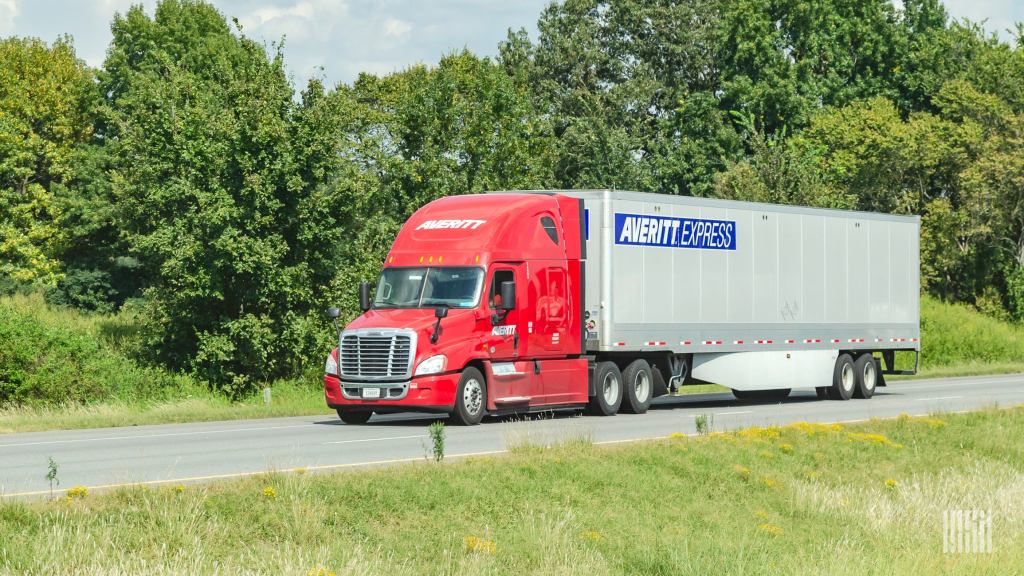
A red Averitt tractor pulling a 53-foot dry van trailer

Averitt Express and Old Dominion Freight Line took top honors in Mastio & Co.’s annual survey of less-than-truckload carriers in the U.S.

Averitt, which has most of its terminals located in the Southeast, was awarded the No. 1 overall spot while Old Dominion (NASDAQ: ODFL) was selected the top national carrier for a 14th consecutive year.

Old Dominion came in third in the overall ranking.

Daylight Transport (No. 2), last year’s winner Peninsula (No. 4) and Southeastern Freight Lines (No. 5) were also in the top five.

The top five national carriers also included Estes, Saia (NASDAQ: SAIA), XPO (NYSE: XPO) and ArcBest (NASDAQ: ARCB). Estes was the No. 2 national carrier again. Saia improved a spot to No. 3, XPO jumped two spots to No. 4 and ArcBest fell two rungs to No. 5.

Old Dominion, Estes and Saia were the only three national carriers to exceed the industry benchmark for the group.

The survey ranks carriers on numerous metrics, including on-time pickup and delivery, shortages, damages, weighing accuracy, transit times, pricing and technology, as well as back-end functions like billing accuracy, claims processing, problem resolution and carrier responsiveness.

Consulting and research company Mastio conducted 1,635 phone interviews from June into October with respondents classified as “key decision makers from major shippers throughout the U.S.” The firm said of the 163 LTL carriers rated, only 22 garnered enough ratings to be included in the report.

Carrier Manitoulin Transport was the overall winner in Canada.

Deutsche Bank (NYSE: DB) analyst Amit Mehrotra said the survey was particularly favorable for Saia, which he believes has room to raise its rates relative to the service the carrier is providing.

“We note, [Saia] moved below the ‘fair value’ band in the 2023 survey, which implies SAIA’s perceived cost is too low relative to its perceived service,” Mehrotra said. “Said another way, the data shows there’s room for much higher prices. This has been a key consideration of our bullish stance on SAIA’s shares, and data in the 2023 survey highly supports our thesis.”

He pointed to “price vulnerability” at FedEx Freight (NYSE: FDX) and ArcBest as he views the companies as “well above the fair value band.” He also said Old Dominion “has moved to the very top” of the fair value band.

Mehrotra said the same metrics showed TFI International (NYSE: TFII) and XPO “towards the middle” of the band.

“We continue to view the data as having the most positive implications for SAIA vis-à-vis prospective pricing power and resiliency; and while the service gap between XPO and ODFL/SAIA remains wide, it has narrowed in the most recent service data,” Mehrotra said.

More FreightWaves articles by Todd Maiden

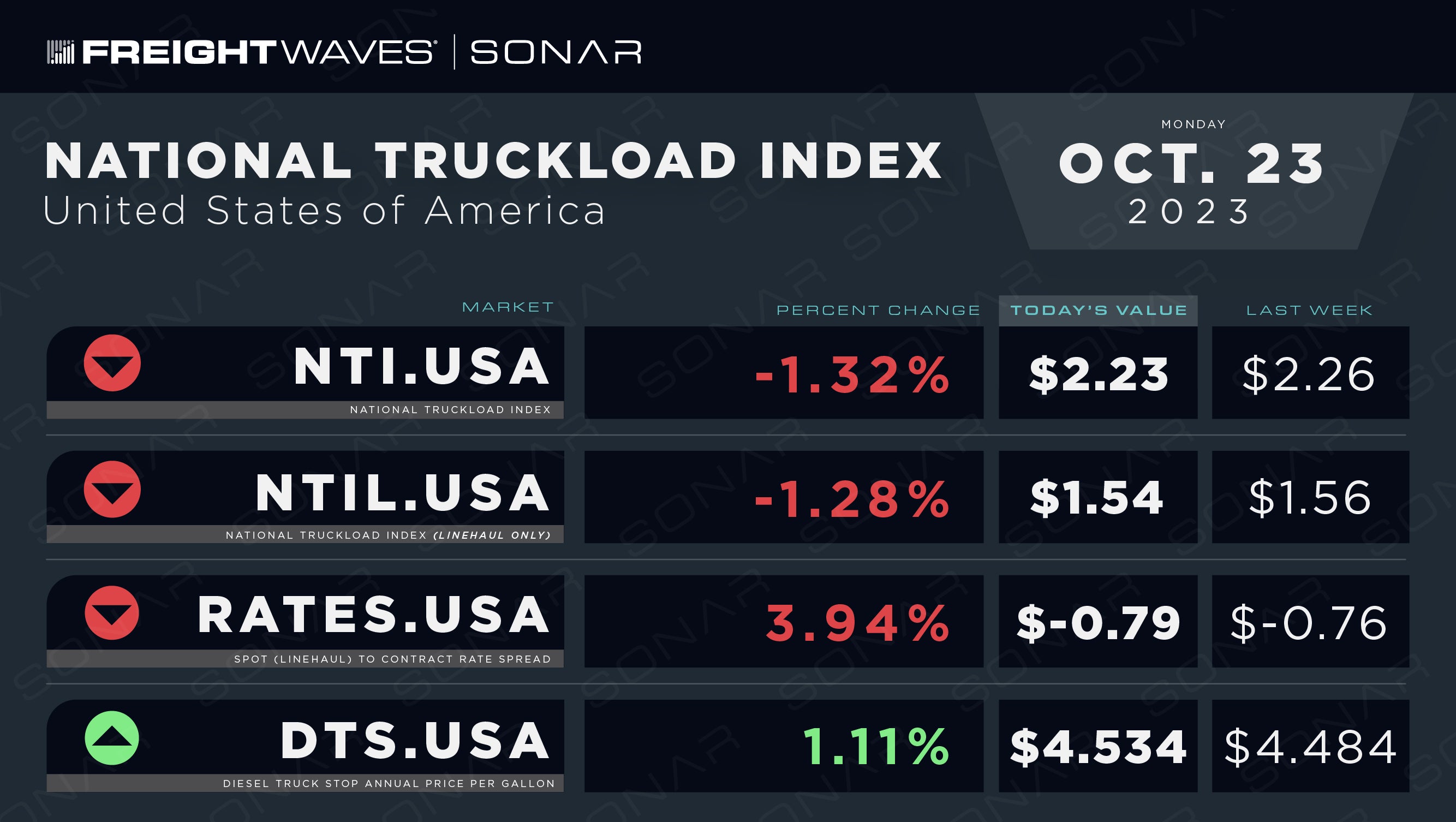
Weekly NTI Update: October 23, 2023


Learn more at SONAR.FreightWaves.com

Port of Prince Rupert strives to increase transloading capacity

The port authority at Prince Rupert is beginning construction on a large-scale logistics facility that could expand the Canadian port’s capacity to handle rail-to-container transloading.

The Ridley Island Export Logistics Project (RIELP) seeks to develop 400,000 twenty-foot equivalent units in transloading service capacity for agricultural, forestry and plastic resin products. The project will also involve expanding the existing Ridley Island Road Rail Utility Corridor so that it will be capable of handling 10,000-foot-long trains while also having direct access to Canadian railway CN (NYSE: CNI). The facility will also have access to the Fairview Container Terminal and the Fairview-Ridley Connector Corridor. 

The facility, which will be built on a 108-acre greenfield development on Ridley Island, is slated to begin operations in the third quarter of 2026. The project will include the full electrification of transload facilities and result in the minimization of truck drayage and optimization of rail — all of which will contribute to broader efforts to decarbonize Canada’s export supply chains, the Prince Rupert Port Authority (PRPA) said. 

Anticipated project funding is approximately CA$750 million (US$540 million) from sources including the PRPA, Ray-Mont Logistics, CN, the Canadian government and the government of British Columbia. Funding of $64.8 million will come from Canada’s National Transportation Corridor Fund, while the province’s Stronger BC program will provide $5 million. 

An existing multiproduct transload facility operated at a temporary location on Ridley Island has proven the concept for export transloading, the port authority said last Thursday.

“The development of this innovative project and its introduction of large-scale export logistics capabilities at the Port will fundamentally improve competitiveness for Canadian exporters, and marks the opening of a new chapter of Prince Rupert intermodal growth. It also demonstrates the strong alignment of our corporate, government and community partners with PRPA’s strategic vision for growing Canadian trade,” Prince Rupert President and CEO Shaun Stevenson said in a news release.

Rob Fleming, British Columbia’s minister of transportation and infrastructure, said, “This investment by the PRPA to future-ready the port is great news for the workers, businesses and communities across the province that depend on strong trade and the reliable movement of goods. With global market dynamics continuing to create challenges for supply chains, forward-thinking projects like this one are helping to make BC’s transportation and logistics network more efficient and more resilient.”

Subscribe to FreightWaves’ e-newsletters and get the latest insights on freight right in your inbox.

Click here for more FreightWaves articles by Joanna Marsh.

Death from overfunding: An obituary for Convoy

The death of Convoy has been one of the biggest stories in both tech and freight media over the past week. While the freight market has suffered a number of major shutdowns, few were as sudden as Convoy’s. 

After all, Yellow was a much bigger company, but it died a very slow death, and because it was a publicly traded company, we all got to watch its journey on life support for many years. Convoy’s story, on the other hand, offers a cautionary tale of a meteoric rise to burnout in just eight years. For most of that time, it was respected, loathed and feared by industry insiders, both wary and weary of how a war chest of capital can disrupt the economics of the industry. 

For a few years, that’s exactly what happened. 

Blitzscaling 

In Convoy’s earliest years, it used venture capital that it raised to “buy market share.” It offered shippers that agreed to be early adopters rates that were cheaper than market — discounted significantly compared to the rates of incumbent players. 

This worked; some would say too well. Convoy was able to scale quickly and garnered significant market share from some major shippers along the way. 

At first, Convoy offered shippers aggressive discounts on their major lanes and then used that wedge to get access to lower-volume lanes. This allowed the company to expand its margins in secondary lanes, offsetting losses in the primary lanes. 

The growth story was impressive and investors became excited about the potential of how big Convoy could become. After all, if this story could play out with more shippers, the company would eventually become a massive multibillion dollar firm — perhaps the biggest logistics firm on the planet. 

Early on, the company focused on blitzscaling — a term coined by Reid Hoffman — which means to prioritize growth at all costs. After all, Hoffman was one of Convoy’s first board members and likely set the tone of its operating playbook. 

In Hoffman’s view, “You must win first prize to survive in the internet era,” because in the internet age, markets are built on “winner-take-all” outcomes. 

Hoffman coined the term after studying high-growth software and platform businesses, where the unit economics were incredibly favorable to the scale of the business. His own experience building LinkedIn and PayPal had informed these lessons. 

In a series of quotes in “Blitzscaling: The Lightning-Fast Path to Building Massively Valuable Companies,” Hoffman characterizes his theories that many observers of the Convoy story will recognize: 

“You don’t necessarily need to have solved your revenue model before deciding to blitzscale. In fact, a key element of blitzscaling is often the willingness of investors to fund growth before the revenue model is proven — after all, it’s pretty easy to fund growth after the revenue model is proven.

“To achieve massive success, you need to have a big new opportunity — one where the market size and gross margins intersect to create enormous potential value, and there isn’t a dominant market leader or oligopoly. A big new opportunity often arises because a technological innovation creates a new market or scrambles an existing one.

“Blitzscaling is a strategy and set of techniques for driving and managing extremely rapid growth that prioritize speed over efficiency in an environment of uncertainty. Put another way, it’s an accelerant that allows your company to grow at a furious pace that knocks the competition out of the water.”

(Photo: Jim Allen/FreightWaves)

Convoy’s management and board believed that cash burn wasn’t a concern. As long as it could grow and expand margins, future investors would bid up the company at even higher valuations. After all, it was going to blitzscale its way to market domination. 

The company was founded and scaled in a period when venture capital was incredibly easy to attain and everyone wanted a piece of disruptive businesses that were displacing incumbent players. Articles that covered the company early on compared its mission to what Uber had done to the taxi industry and many believed that the opportunity for Convoy was even bigger. 

Prospective investors, realizing that the company was subsidizing some of its growth through shipper discounts in the early part of the relationship, looked for a metric that they could get behind. 

Traditionally, freight brokerage valuations are measured on a multiple of EBITDA. But for a company that was prioritizing blitzscaling, investing in its platform and network incentives, that wasn’t possible. 

So the investors that bought into the story decided that gross revenues were a sufficient metric for underwriting. If the company could continue to scale up, margins would eventually increase.

After all, if it prioritized short-term profits, it was sacrificing growth and building out a platform that could displace the incumbent players. 

Nothing but net 

Freight brokerages have historically reported two revenue numbers: gross revenue and net revenue. Traditionally, it was the scale of net revenues that mattered; gross revenue was a vanity statistic that everyone bragged about but was largely ignored.

When venture capital firms (and the growth equity firms that followed) began investing in digital brokerages, the startups somehow were able to convince the investors that gross revenue was the appropriate metric for valuation. That was the first and key mistake; the VCs underwrote the businesses on gross revenues. The second mistake that investors made was treating Convoy like it was a tech company and not a logistics company. 

Years ago, I asked an investor who worked for a very large growth equity firm that happened to be one of C.H. Robinson’s largest investors why he also invested in Convoy. He told me that as Convoy scaled with individual shippers, there were increased margins on the freight. Also, as Convoy increased volume on a particular lane, it drove down the purchased transportation cost.

My conversation with that investor was in September 2018, right after Convoy announced a $185 million capital investment at a $1.08 billion valuation. At the time, I wondered if Convoy benefited from the early phase of a softening freight market, when margins naturally expand for brokers. 

From conversations over the past few years about Convoy, it was clearly understood by industry insiders that Convoy was valued far differently by venture capitalists than was the accepted norm for the industry.  

The group bidding up Convoy’s valuation included some of the most iconic names in technology and Wall Street, including Jeff Bezos, Bill Gates, Marc Benioff, Henry Kravis, Google’s venture arm, Fidelity and T. Rowe Price. 

When the company continued to raise capital at even higher valuations, it created a great deal of bewilderment about how the company could defy the valuation economics of a very traditional — some would say boring — industry. When challenged, defenders would mention Amazon’s or Tesla’s valuations in their early days. In the mind of investors, Convoy had the same breakout potential. 

All of this created a high level of resentment from industry incumbents. But for the investors, Convoy offered a chance to build a business in one of the largest and most fragmented industries on the planet: the North American trucking industry. 

The company ended up raising two more rounds of financing. In November 2019, it raised $400 million at a valuation of $2.75 billion, and in April 2022, it raised an additional $410 million at a valuation of $3.8 billion. 

In addition to raising capital from investors, Convoy also raised debt from banks and financial firms that the company leveraged to achieve even faster growth. 

The company seemed unstoppable. 

(Photo: Jim Allen/FreightWaves)

So what happened?

Over the past few days, I’ve tried to reconstruct the events that led to the sudden shutdown of Convoy. I’ve spoken with insiders at the company to try to understand how the rocket ship could suddenly run out of fuel and crash back to earth. 

According to insiders, in late 2021, Convoy stopped offering incentives to shippers to join its platform. The company recognized that investors were getting weary of the incentives that drove early growth and expected to see expanding margins at increased levels of scale. 

For the past two years, Convoy had higher-than-market gross margins.

In 2022, the company had 17.7% gross margins and year-to-date had 18.1% gross margins. It wasn’t easy for the company to achieve these levels and it required the firm to back away from the practices that provided early growth. 

In fact, Convoy walked away from shippers and blanked on many bids when they required margin sacrifice. Industry veterans will recognize that this sounds like Convoy had become a “real logistics company” with discipline in its bidding process and that would be correct. 

The problem was that sacrificing load volumes also came at the cost of hypergrowth. The company assumed that the high levels of sustained margin would be more attractive to future investors, but that wouldn’t be enough. After all, part of the growth story was now gone. 

Convoy had a very sophisticated data science model and compared its buy-and-sell rates against industry benchmarks. The company was consistently buying below the averages and had locked in higher rates on contracts when rates were much higher. It was marginally profitable on the major long-haul lanes, but made far greater profits on the regional and short-haul lanes, with high win rates. 

According to the insiders, the company was able to achieve this because it had a strong data science and engineering team. 

But that is also partially to blame for its ultimate demise. 

A very large percentage of Convoy’s budget was allocated to technology engineering and data science. The amount was far greater than would be typical of a company of its size. Additionally, when capacity was super tight during COVID, Convoy went forward with a plan to lease approximately 4,000 trailers that were a part of its drop-and-hook program. 

In early 2022, everything seemed to be going right for Convoy. 

Although the freight market was entering a recession, few expected a significant deterioration in the freight economy. Convoy completed a capital raise and had just completed a fully built-out version of its platform, which offered fully digital brokerage. 

According to internal data, the company’s platform achieved 98% automated load matching of all loads (true pricing, negotiation and matching in the open marketplace) via its mobile or web apps and 99% for local/city loads. Drivers used the Convoy app for every step of the job 96% of the time and on-time performance was 94% (within 30 minutes of appointment). 

Convoy’s executive team believed the slowdown in freight would be short-lived. If the freight recession of 2019 was any guide, it would be a slowdown lasting for a quarter or two and then the market would revert back to the mean. 

Plus, market volatility might be a good thing. 

After all, for the past decade, each time the market was volatile, freight brokerages were able to expand market share and could optimize their margins during periods of instability.

Although the company’s very large investment in data science and engineering was high, it was instrumental in the company’s operating and product plans. Management was reluctant to take corrective actions, even though they acknowledged the high operating expenditures and fixed costs were a significant drag on the cash position. They believed that growth would present itself when things bounced back. 

They also wanted to maintain margin discipline, so the company lost freight volumes from existing customers. 

As the freight market continued to deteriorate throughout 2022 and into 2023, reality started to set in. Convoy conducted a series of layoffs, which reduced the operational support teams and an Atlanta brokerage office was closed. 

The trailer program, which had been an early success, had become a significant cash drain by the second quarter of 2023. The daily cost of the trailers, when considering equipment, insurance and maintenance, became an anchor around Convoy’s profit/loss metrics. 

Things continued to deteriorate. The freight market had not only entered one of the worst recessions in history, this freight recession was unlike any other in history.

Gross revenues dropped from $800 million in 2021 to a run-rate of $500 million in 2023. The Convoy hypergrowth story was over. 

Investors, taking direction from public markets, started to sour on non-profitable businesses. Once ignored, unit economics became of utmost importance. Even though Convoy had demonstrated its model was able to achieve margins that were much higher than typical freight brokerages, it wasn’t enough. 

Investors, who had previously been unaware or ignored the realities of freight markets, suddenly realized that freight markets were among the most volatile on the planet and that freight is a commodity — and thus capacity is fungible. After all, shippers could easily find alternatives to Convoy’s services with thousands of other freight brokers in the market. 

The discounts and incentives that Convoy had offered in its earliest days to achieve scale didn’t guarantee shippers would stay loyal to Convoy when the market dynamics changed. 

The blitzscaling model was broken.

It may have worked fine in times of a zero interest rate policy (ZIRP), but those days also were over. 

Convoy was a victim of two realities: a failure to control its own destiny by relying on investors for funding and the violence and realities of the freight market, which are outside of anyone’s control. 

(Photo: Jim Allen/FreightWaves)

Broken valuation models 

One assumption that almost everyone in the industry had is that Convoy had achieved enough scale that it would be impossible to kill it. After all, even if Convoy’s business model failed, someone would want to acquire it for the hundreds of millions in freight across the platform. 

Silicon Valley insiders used to say that Convoy had achieved “escape velocity,” or the idea that the momentum of the business was so great that market gravity wouldn’t hold the company back. 

But the business had raised too much money at valuations that defied reality. 

There was a huge delta between how the VCs were bidding up digital brokerage valuations and how industry incumbents (or acquirers) looked at valuations. 

Venture capital firms plan to eventually sell the businesses they invest in after the company has become very valuable. In order for VC firms that invested in Convoy to get a return, the company’s net revenues would eventually need to be of sufficient scale to overcome the operating expenses of the company, thus generating EBITDA. 

After all, mature freight brokerages always sell for a multiple of EBITDA. 

This meant that Convoy, the highest-profile venture-backed digital brokerage, always had a difficult task: to quickly scale the business to generate enough EBITDA to match its valuation using traditional norms. Otherwise, there would be a massive valuation reset down the line. 

Convoy’s overfunding ultimately killed the business 

Investors had greatly exaggerated Convoy’s valuation in their models and assumed the company was unstoppable, therefore, dooming the company by eliminating the option for a soft landing (death by overvaluation).

Here is the math. At Convoy’s last round of funding, the company was valued at $3.8 billion. It was generating $800 million in gross revenue. At 17% margins, that would equate to $136 million in net revenues. 

All of the operating expenses are below this line. 

Mature brokers sell on EBITDA, but there have been a number of high-growth, mid-stage brokers that have been acquired for net revenues. These firms have sold in the range of two to three times net revenues, which implies that Convoy should have been valued at around $272 million-$400 million at the time of its last funding. It was valued at 10 times more than it should have been. 

When the freight market collapsed, the company had raised so much equity, but it also borrowed money from banks and other financial institutions, taking on a large amount of debt, including a $150 million line of credit from JPMorgan and $100 million in venture debt from Hercules Capital — that there was little flexibility in its capital structure to find alternatives. 

The deterioration of Convoy’s revenues also meant that any metric used to value the company would require a significant rerating. In other words, a growth multiple isn’t possible. 

The board had little incentive to provide bridge funding in order to get the company acquired for 1/20th of the valuation — or worse — of the valuation of its last round. After all, the investors behind the company had bought into a version of the Convoy story that appeared highly unlikely. 

Additionally, the debt holders, traditionally more risk-averse, had zero incentive to fight to protect the company’s equity but wanted to avoid the company running completely out of cash. 

After all, bankruptcy can be expensive. 

That is why lenders have debt covenants in their deal structures — to ensure that in the event of a default the company’s assets can survive long enough to allow for a liquidation and wind-down. 

In technology firms, this means that the servers must stay on long enough for prospective buyers to get a chance to conduct their due diligence and manage a transition of the tech stack to a new platform. 

In recent days, with Convoy out of compliance with its loan covenants, the company’s lenders called in the note, instituting the wind-down process. It was sudden and unexpected for nearly everyone associated with the company. 

Insiders tell me that the executive team had worked diligently for the past few months to find a buyer but ultimately ran out of options. 

Industry incumbents have resented Convoy since its founding because of its ability to secure funding at unsustainable valuations, but that proved to be what ultimately killed the company.

Convoy’s story, while tragic for investors and insiders, should prove cautionary for other founders. Raising money at valuations that are well beyond market norms is appealing, but if growth slows and you’ve burned through the capital, early investors may lose their appetite for future investment. 

In fairness to Convoy, it is not the only venture-backed digital brokerage to face this reality. There will be more failures in the freight tech space over the next few quarters. 

Excess capital is rocket fuel in the early stages of growth and can provide a false sense of security, as it doesn’t force founders to build companies with traditional constraints. That is what happened with Convoy. Management didn’t respond fast enough to changing market conditions when aggressive cost-cutting was necessary. They also had a false sense of security that future investors or an acquirer would provide the ultimate backstop, neither of which happened. 

As Convoy’s founders learned, there is such a thing as death by overfunding.

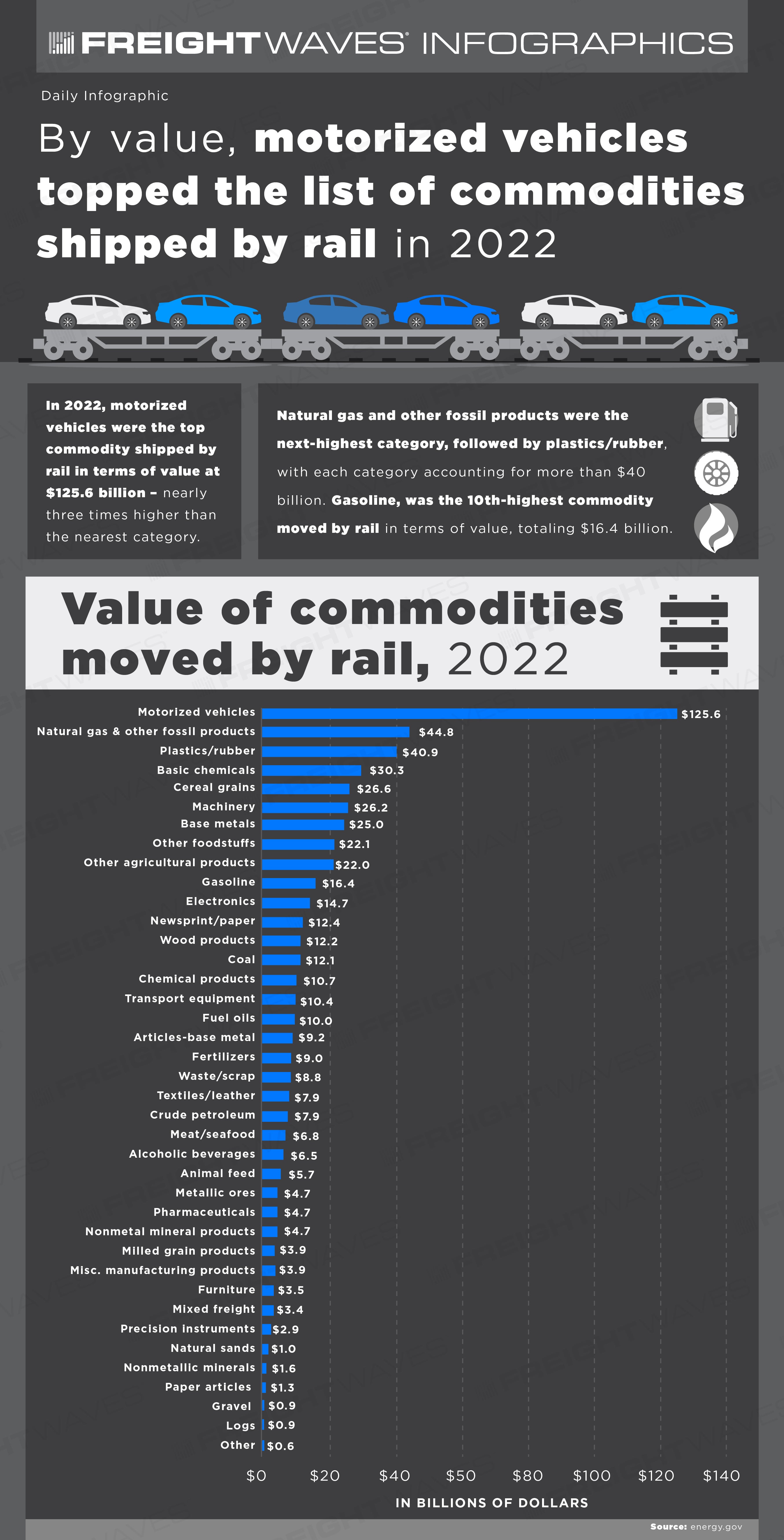
Daily Infographic: By value, motorized vehicles topped the list of commodities shipped by rail in 2022


To view more FreightWaves infographics, click here

Amerijet turns tables on Korean Air for opposing commercial permit

Amerijet, a mid-tier cargo airline based in Miami, has asked the U.S. Department of Transportation to withhold approval for a startup operator of business jets owned by Korean Air to fly to U.S. destinations because Korean Air is blocking its request to offer scheduled service in and out of South Korea.

And it threw a grenade into Korean Air’s $1.4 billion merger plan with struggling Asiana Airlines, saying the Department of Justice should consider the airline’s behavior toward Amerijet as part of its antitrust investigation. 

Korean Air in August objected to Amerijet’s application for scheduled authority, dragging out a process that has lasted nearly seven months and making it more expensive to do business in Korea, the U.S. carrier said in a filing Thursday. Amerijet urged U.S. regulators not to take action on K-Aviation’s request for market access until the Korean Ministry of Land, Infrastructure and Transport (MOLIT) grants permission for it to provide regular service at Seoul Incheon airport.

Amerijet currently operates a route multiple times per week via Seoul as a contractor to Maersk Air Cargo, but the business arrangement faces uncertainty because the Korean government has only issued temporary licenses to operate ad hoc charter flights.

“As a result of Korean’s comments and MOLIT’s inaction, Amerijet has been relegated to operating charter flights to Korea. This requires monthly applications and approvals, which are costly to make and often not given until the last moment. Amerijet’s application for November charter flights is now pending before MOLIT,” Amerijet said in the filing.

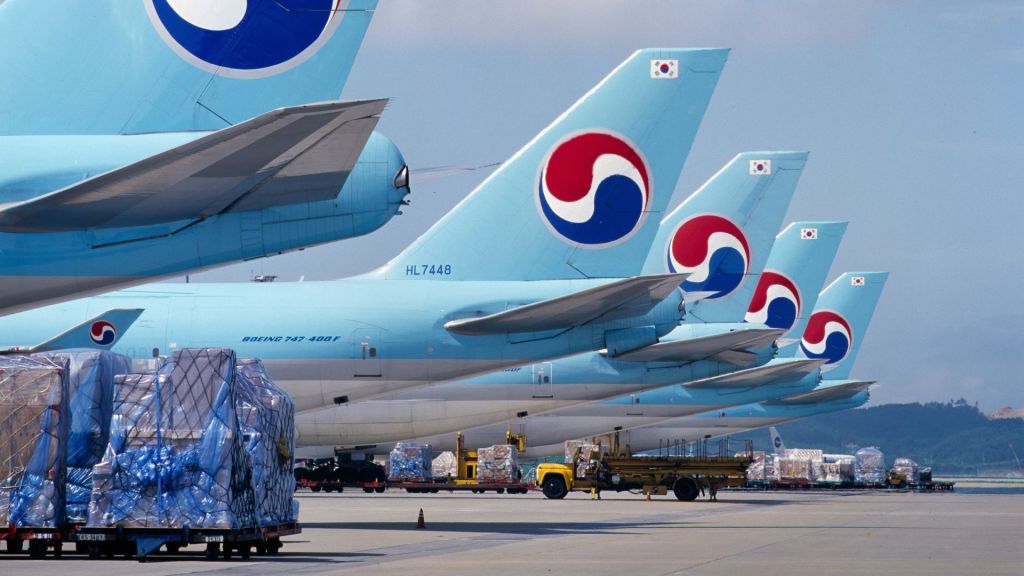
Korean Air has 23 freighters in its fleet, including seven Boeing 747-8s and a dozen 777 aircraft. It is the world’s fifth-largest cargo carrier by volume. It is the third-largest carrier when express parcel carriers FedEx and UPS are excluded. Asiana operates 10 Boeing 747 freighters and one 767.

Amerijet said it began providing all required documentation as early as Jan. 17 and that MOLIT officials have all the information about its ownership structure, aircraft and customer needed to make a decision. MOLIT “is still making redundant/duplicative and unduly burdensome requests for information from Amerijet with no sign of when a decision on Amerijet’s application for scheduled operating authority might be forthcoming,” the all-cargo operator complained, adding it has not been provided a copy of Korean Air’s opposing comments or been allowed to respond to them.

K-Aviation Co. Ltd, established in December 2021 as a subsidiary of Korean Air, applied in September for a foreign carrier permit to provide service 10 to 15 times per year between South Korea and the United States, as well as an exemption from the requirement so it can begin flying while the U.S. Department of Transportation processes its request. 

The Korean government and Korean Air are violating the U.S.-Korea Open Skies Agreement, which commits both countries to give each other’s carriers a level playing field to compete, the Amerijet filing said. 

“It is especially noteworthy that while Korean seeks U.S. approval for its merger with Asiana, it appears to be actively working to thwart Amerijet’s entry into the U.S.-Korea scheduled cargo market. Amerijet urges the Department of Justice to review Korean’s role in delaying MOLIT’s approval of Amerijet’s scheduled cargo license,” Amerijet said in the K-Aviation submission. 

Korean Air in late 2020 agreed to take a nearly two-thirds stake in debt-ridden Asiana at the behest of the South Korean government. 

U.S. and European Union competition authorities are concerned the combined airline would dominate routes to the U.S. that Korean Air and Asiana currently compete on for passenger and cargo traffic. Korean Air has been reluctant to transfer some routes to other Korean carriers as a condition for approving the merger, but Reuters reported last week that Korean is now willing to sell Asiana Airlines’ cargo business and give up routes to four European cities to gain EU approval for the deal. Meanwhile, the Korean Herald on Friday published a story that Asiana’s board of directors will meet at the end of October to decide whether or not to sell the cargo business.

Amerijet’s fleet of Boeing 757 and 767 converted freighters is based at Miami International Airport. (Photo: Eric Kulisch/FreightWaves)

Amerijet accused the Korean Transport officials of throwing up roadblocks to delay a decision on its license request after Korean Air submitted its complaint. The ministry last month asked the airline to resubmit all previous information because it had a staff turnover and needed to start fresh.

The new request is “intrusive and burdensome” because it “unjustifiably calls for Korean language translations of hundreds of pages of technical legal documents, as well as details of financial arrangements between Amerijet and its customer that extend far beyond normal licensing requirements and what is contemplated by the U.S.-Korea open skies agreement,” the Amerijet filing said.  

Being limited to charter flights, Amerijet explained, adds complexity and cost to its business operation. Flights must be requested each month and the availability of operating rights is much more limited than for carriers with scheduled authority. The monthly application process requires legal expenses to be paid each time and Amerijet is not eligible for a waiver of certain airport fees as a charter operator, it said.  

Challenging year for Amerijet

Amerijet began providing crews and operating flights for Maersk Air Cargo, the rebranded cargo airline of ocean shipping powerhouse Maersk, last November. Maersk, which has transformed itself into an end-to-end provider of logistics services, provided Amerijet with three Boeing 767-300 purchased directly from Boeing. Amerijet operates one route three times per week connecting Shenyang, China; Seoul, Korea; and Maersk Air Cargo’s hub at Greenville-Spartanburg International Airport in South Carolina. The other two freighters provide six days of service between Hangzhou, China, and Maersk’s other U.S. hub at Chicago Rockford International Airport. 

Amerijet has grown this decade from a sleepy regional carrier to one with global aspirations, but the 18-month freight recession that has slashed revenues across the logistics industry has been particularly hard on privately held Amerijet. 

CEO Tim Strauss abruptly announced his retirement early this month after a bumpy three-year run. He tripled the size of the fleet to 25 freighters, attracted large customers such as Maersk, hired many executives from outside the company and modernized its IT system. But his approach caused friction with many long-term employees and the airfreight market’s prolonged downturn has cut revenues more deeply than expected.

In June, Amerijet let go 15 office workers as part of an effort to reduce costs in the face of steep revenue declines caused by soft demand and sharply lower rates than last year. Earlier, it closed down its small freight forwarding business, eliminating about 27 jobs in the process, outsourced accounting functions to Trinidad and Tobago, and reduced flight schedules to Brussels, Belgium, and Aruba. Another seven back-office positions that experienced attrition were offshored in September, said Christine Richard, the company’s senior director of marketing.

Richard said Amerijet will increase the frequency of its scheduled Brussels route to twice weekly beginning Nov. 15.

Amerijet has 984 employees, down about 100 people from the year-ago high, according to the latest data from the U.S. Bureau of Transportation Statistics. Some of the difference is likely from new-hire pilots that didn’t successfully make it through the company’s training program.

Click here for more FreightWaves and American Shipper articles by Eric Kulisch.

Contact Reporter: ekulisch@www.freightwaves.com

Amerijet CEO Strauss calls it quits after rocky 3 years

Amerijet lays off workers as freight recession drags on

US, EU object to cargo concentration in Korean Air, Asiana merger