




Daily Infographic: Which country consumes the most oil?

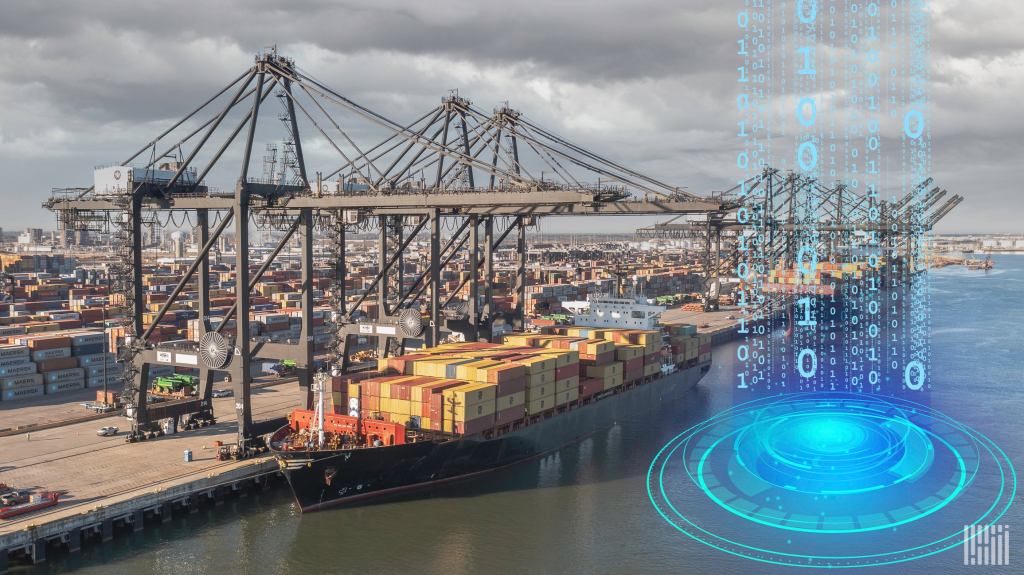
FreightWaves recently chatted with Stefan Kalmund, CEO of technology platform provider Nexxiot, and Werner Fontanive with Deloitte Consulting to discuss a new offering between the two companies called KYX.
The offering, which is based off of Deloitte’s Know Your Client (KYC) and Know Your Cargo services, seeks to increase the data visibility of containers worldwide by tracking the physical location and status of containers alongside the financial aspects related to that container, such as any insurance belonging to that container’s goods. One of the goals of the offering is to help ports and others prevent illicit trade associated with container shipments.
This question-and-answer session was edited for clarity and length.
FREIGHTWAVES: In lay terms, how would you describe this partnership and what’s being offered?
FONTANIVE: Basically, starting backwards, we’re offering a service that puts together the financial streams and the streams of container movements, because at the end of the day, it is more than just track and trace, it’s about fighting money laundering and combating illicit trade. For that, you need a combination of knowing who are the financial players, who are the owners of the shipment and where the physical shipment is. So, we screened the market very carefully, and we looked at all the suppliers out there.
After more than nine months of due diligence of several players in the market, we decided to go into partnership with Nexxiot because we believe that Nexxiot is the only supplier that has not only the technology but also the foundation to build this open standard we are trying to bring into the market.
At the end of the day, it’s bringing a new standard to the market — a new platform — where everyone can participate. But for that, you also need device suppliers that give you secure and manipulable data that is such a quality that can be approved by regulatory bodies, otherwise the entire exercise is senseless. That was in a nutshell the approach why we decided to go down this topic, why we screened the market and why we have decided to go with Nexxiot on this one.
KALMUND: When you think about how goods are being moved around the planet, much of what we need moves in containers. In 2021, over 1.95 billion [metric] tons of cargo was sent via container ship. It’s vital to our lives. It’s really important to optimize the way these shipping containers are being handled. Some of the topics [that Fontavive] addressed, like illicit trade, are usually happening in the port. If you have the ability to protect a shipping container [from being opened] and improve the reporting [about the container’s contents] to the port authorities, then that by definition means that shipping containers can be moved much faster through customs.
There are certain ports in the world which are already starting to implement [procedures where] you can only process shipping containers through those ports if you have a full audit trail at hand. And in order to do that, you need people who are independent — that’s Deloitte’s role — and who understand the requirements for financial records and the requirements of the port authorities. It requires a partner who brings with them the trust that they are independent. And then you also require people who have capabilities in the technology to make it functional. That’s our role.
FREIGHTWAVES: Was the need to address security what prompted this partnership to happen or were there other factors?
FONTANIVE: With the well-established Know-Your-Client [KYC] programs, you only capture 70% to 80% of the problem in financial crime. Twenty percent to 30% happens in the arena of physical movement of goods. So Deloitte, together with the biggest conduct agencies around the globe, decided to close that gap. We wanted to match every container movement with the financial stream.
KALMUND: We’re currently engaged in delivering the largest IoT [Internet of Things] rollout in the maritime space in the industry’s entire history for Hapag-Lloyd. We’re running a global deployment across countries throughout the world. We are digitizing shipping containers including hardware and software. So this collaboration with Deloitte is a natural progression on the work we do with Hapag-Lloyd and numerous other clients too. We’ve seen the incidents [that Fontavive] described so many times: A container goes on a different route than planned, a container is opened at 2 o’clock in the morning in Rotterdam when it shouldn’t be accessed. Or in other instances — for example, kids’ toys were declared in that container but really it contains fireworks.
There’s lots of ways KYX will add value, but ultimately, it’s about protecting the shipments and reducing risk for all the stakeholders. It’s also about protecting the actual ship that transports the goods, of course. You don’t want a fire on your ship from misdeclared cargo like charcoal or scrap rubber. It’s also about protecting the capital and investments behind it and preventing illicit goods from being transported. We have a lot of experience with the technology and Deloitte has a lot of experience in compliance. We felt somebody needed to put these two pieces together — and make it happen.
FONTANIVE: At the end of the day, it’s a big supply chain transparency gain. With this platform, we will have end-to-end transparency on the supply chain — knowing all the participants, knowing all the players, knowing all the vessel operators, rail car operators, knowing where the containers are at every moment in time. I think that is going to make a key differentiator to the industry going forward.
FREIGHTWAVES: Is it a platform that customers can access, that tells you where the container is and the contents of the container and whether it’s been opened?
KALMUND: Correct. The word “platform” can be ambiguous because people interpret it in different ways, but ultimately, it’s a service you buy. And it’s either for specific trade lanes or for specific containers or specific parts of the fleet. Ultimately, what you receive are the insights into that shipment or those shipments, knowing exactly what you just described: that containers can be processed directly through fast lanes or green lanes, like Werner called them, and that the full audit trail is there. Think about borders, like between Mexico and the U.S., or Abu Dhabi, Saudi Arabia and any of the other borders where there could be strong interest for goods to be processed in a very fast way.
And then, certain ports in the world have already declared that by a certain date, they want to ensure that no more illicit goods can be handled. Think about Rotterdam. You probably remember the recent case at the Hamburg port where people have entered the port during the night, trying to open containers and access illicit goods. So, there’s lots of cases and it’s a multibillion dollar issue.
The advantage is, if you fully audit and trace a container for its entire trip, because you have digitized it, there’s obviously also a lot of other things you can put on top. You can suddenly look at insurance for a shipment. And so there’s lots of financial services which are being put on top of KYX.
FONTANIVE: It’s a powerful combination between a service, a utility and a platform. It’s an interaction with multiple players: The bank financing the route of the container, or the bank financing the shipment itself, the entire trade finance connects to the physical movement of the container and is matched on one utility platform or within one service. You have multiple players buying into the same service to create and generate exactly what Stephen outlined: We aim at full visibility and traceability and an audit trail that is strong enough for the authorities to accept as a qualified audit trail.
FREIGHTWAVES: Would this be from end to end, from origination to destination?
FONTANIVE: Yes, it’s end to end because we truly believe the industry will only buy into one platform. Several platforms will never work, so you need one platform that does … all the supply chain demands. It must be end to end and truly global. It doesn’t work if it’s only between Mexico and the U.S. because containers move worldwide. And that’s why you need companies such as Deloitte that have a worldwide and global footprint and you need companies like Nexxiot that are capable of scaling on a global scale.
FREIGHTWAVES: What kind of companies would be interested in this service?
FONTANIVE: We will roll out the service with the large multinational corporations that move goods globally from a production, extraction or production point to a production plant.
Like this, you capture 70 to 80% of the market. … Actually, 85% of world trade is done by the large corporations.
And then, once you have that established, the system will also allow medium and smaller players to join. Normally, they go on routes that have been predefined by the large players in this industry. [The service] works equally good on a national level in the U.S. — on rail services, which is the last large geographical pattern to cover. But also, it would work internationally, with rail service from Germany to China — that rail gateway between Europe and China, for instance. So, it would cover everything from national to truly international.
KALMUND: When it comes to the type of clients [that will use the service], that will continue to evolve. So we’re already working with three groups of clients. Group number one is the port authorities because they have a very strong interest in ensuring that the brand reputation of their own ports is positively perceived, with reducing the amount of illicit trading that goes on for that port.
Group number two are shippers and beneficial cargo owners, because they have a strong interest in ensuring that their goods arrive in time and are not held up by port authorities. This means faster processing, more accurate ETAs and shorter journey time.
And then the third group of clients is the ocean carriers, who actually own the assets (containers and ships) which transport the goods, whether they’re in rail or the maritime space. They have a strong interest in optimizing the way their assets are being used and handled. That’s the first layer, and then there are also potential partners or partner clients — anyone in the ecosystem who will be contributing services to those clients, such as an insurance company that says if you can prove to me that the assets have been handled in a certain way, then the insurance for the car or during that trip will be reduced because you have the full audit trail via KYX.
FONTANIVE: It is not only that you have the full audit trail and you have a reduction in the insurance premiums, but also in the case of an incident, you have full digital claim management because you exactly know at what point in time where was the container, who handled it, who dropped the container. So, you have full digital case management. There are varieties of services in all dimensions horizontally and vertically on the system that will arise as the system grows and as it goes into the public arena.
FREIGHTWAVES: Is there anything else you’d like to share?
FONTANIVE: Yes, apart from winning full transparency, it’s also about helping to reduce carbon footprint. And that is one of the large goals both companies have in mind, [which] is to significantly contribute to systems and services that help in reducing their carbon footprint for every company involved in the system.
KALMUND: I would add one more point. Everyone else who’s tried to do something similar in the past has tried to do it in a very captive way, meaning in a closed system, whereas we’ve opted for an open ecosystem because the more people who are involved, the more all participants benefit. For example, if you have proven that a specific client is really the owner of that shipment, then you know that this record, then that record can also go to everyone else on the same system. It’s not limited to one care, it’s not limited to one industry, it’s not limited to certain players, but the value really comes from making it accessible to everyone in the ecosystem.
Subscribe to FreightWaves’ e-newsletters and get the latest insights on freight right in your inbox.
Click here for more FreightWaves articles by Joanna Marsh.

Tesla CEO Elon Musk said the company’s Gigafactory Mexico project is facing pressure from interest rates and the global economy.
During the company’s third-quarter earnings call with analysts Wednesday, Musk said the company is currently laying the groundwork for construction of the factory near Monterrey, Mexico.
In March, Tesla (NASDAQ: TSLA) announced plans to build a $5 billion assembly plant near Monterrey, where the company will produce a new line of electric vehicles. Musk previously said the EV plant would start production in 2025.
“For Mexico, we’re working on infrastructure and factory design in parallel with the engineering development of the new production [line] that we will be manufacturing there,” Musk said. “I think we want to just get a sense for what the global economy is like before we go full tilt on the Mexico factory. I’m worried about the high interest rate environment that we’re in.”
Aiming to keep inflation under control, the Federal Reserve has raised interest rates 11 times since March 2022, from 0.25% to the current rate of 5.5%.
Musk said high U.S. interest rates are affecting vehicle sales across the country.
“For the vast majority of people buying a car, it’s about the monthly payment, and as interest rates rise, the proportion of that monthly payment that’s interest increases naturally,” Musk said. “If interest rates remain high, or if they go even higher, it’s that much harder for people to buy a car, they simply can’t afford it.”
Austin, Texas-based Tesla reported third-quarter total revenue of $23.4 billion, missing analysts’ estimates of $24.06 billion. The company also reported adjusted earnings per share of 66 cents, versus analysts’ estimates of 74 cents.
A Wells Fargo analyst asked Musk for clarification about Tesla not going “full tilt” on Gigafactory Mexico unless the economy is strong and whether the company could achieve its projected 50% compound annual growth rate without the plant.
“We’re definitely making the factory in Mexico. We feel very good about that, we put a lot of effort into looking at different locations and we feel very good about that location. And we’re going to build it and it’s going be great,” Musk said. “The pressure is really just about the timing …and I’m going to be a broken record on the financial front, it’s just that the interest rates have to come down.”
Musk said he still has “PTSD” from 2007-08, when Tesla was on the brink of financial collapse.
“I apologize if I’m perhaps more paranoid than I should be,” Musk said, “because that might also be the case because I am. I have PTSD from 2008 — 2017 through 2019 are not perfect either. That was very tough going. So you know, the auto industry is also sort of cyclic. It’s because people tend to hesitate to buy a new car if there’s uncertainty in the economy.”
Click for more FreightWaves articles by Noi Mahoney.
More articles by Noi Mahoney
Texas resumes cargo truck inspections at Laredo port of entry
Mexican president blames Texas-run inspections for border delays
Border bottleneck continues, creating huge delays for truckers
On Wednesday, FreightWaves reported that Convoy was winding down operations. Earlier in the morning, I had started writing an article about liquidity issues that some freight brokerages are having or will have. Then the news broke that one of the most iconic freight brokers to come out of the venture era of freight tech funding would fail on the same morning.
Convoy was a victim of a violent commoditized industry that is facing one of its deepest recessions in decades and a sudden change in investor appetite from risk to unit economics.
While many articles will be written in the coming weeks about Convoy, unfortunately, it won’t be the only significant broker to suddenly shut down.
This is unusual.
After all, anyone who has been in trucking knows that asset-based carriers face imminent failure frequently. However, it has been rare for freight brokers to suddenly shutter. Compared to trucking fleets, freight brokers have a lot more flexibility in their business model to adjust to changing market conditions
But we will see many more sizable freight brokers shut down suddenly. And the reason is a significant change in the financing climate.
In an article earlier this week, I wrote about the growth and proliferation of the freight brokerage industry over the past decade. Freight brokers have moved from a small cottage industry to one of the most important forces in freight. A large part of FreightWaves’ success has been driven by the increasing importance that freight brokers play in the industry.
After all, freight brokers are the day traders of the freight market, and as such need up-to-date information about the freight market.
FreightWaves was created at a time when freight brokerages morphed from a small part of the industry to a dominant force. FreightWaves owes a lot of our success to this reality.
But much of the brokerage industry’s growth has been fueled by financing structures, such as venture capital (VC) and asset-based lines of credit. The appetite for venture funding of freight brokerages has been dead for over a year and is partially responsible for the reason Convoy has failed. VC investors have woken to the reality that freight brokerage is not venture-investible.
For those brokers that didn’t use VC funding but financed growth through alternative lenders, the story is different, but the results are the same. These alternative lenders are common across the freight market. Trucking companies use factoring companies to finance their receivables on a transactional basis. Brokers do the same; however, it is often not on a per-transaction basis, but rather on a portfolio of receivables.

Receivables are pledged as collateral against lines of credit, described as an “asset-based line of credit,” or ABL, and this enables a brokerage to grow quickly without having to wait for shippers to pay.
If the market and unit economics are expanding, it’s a very efficient way to grow. For traders in the stock market, it can be compared to using margin to purchase stocks.
If a stock position is increasing in value, you gain a bigger line of credit. The danger, of course, is if you use the line of credit to buy more of the same stock. If that stock collapses, you are in real trouble because your losses will only accelerate on the downside.
The same thing is happening in the brokerage sector. Freight brokers went out and borrowed against their AR portfolios to fuel growth, racking up debt at cheap rates. When the Fed changed the cost of capital, that debt became more expensive. That in and of itself isn’t the problem.
But something else happened to the trucking market.
The average transaction size of loads also collapsed. Loads that generated $3,000 in revenue two years ago now ship for only $1,500 in revenue. Do enough of those transactions and the size of the credit facility starts to collapse.
That isn’t necessarily a problem if brokers had held onto the capital when times were good. But it does become a problem when that capital is used for more growth or to make other purchases. For Convoy, it was to fuel growth. For other brokers, it could be for personal uses like homes, cars, airplanes, yachts, etc.
The capital is now spent, but the debt is still there. And finance companies, aware of the risks of freight volatility, tried to protect themselves by placing covenants into these lines of credit, often benchmarked against margins.
As margins compressed, the covenants were violated, and the financiers became nervous. Now some of them are facing a dilemma: continue to fund the line of credit or call it in. In Convoy’s case, it appears the line of credit was called in.
In recent weeks, FreightWaves has been hearing from sources that a number of midsize freight brokers are in financial trouble. One CEO of a large broker that had discussed potential transactions told me the risk was most pronounced in brokerages that generate $50 million to $250 million in revenues.
A CEO of a major bank with exposure to trucking told me he had three large brokers that are in dire financial shape in their portfolio and he expects them to shutter in the coming months.
These firms have used receivables funding to fuel growth. However, due to collapsing market fundamentals, they have breached their covenants.
The banks that financed these asset-based loans have been trying to play matchmaker for some of these brokers, but their patience is starting to wear thin.
Unfortunately, it will get worse.
The most brutal part of the cycle for a freight broker isn’t a soft market.
It’s when the freight market starts to turn up and spot rates improve, while contract rates remain pressured. This squeezes brokerage margins.
In other words, the spread between spot and contract narrows. When that happens, it hurts the take rate for freight brokers.
A large percentage of contract rates get established during bid season. If conditions are soft at the time of bids, contract rates will fall.
Bid season traditionally starts in mid-October and ends in February. Freight rates have been very soft all year, and there has been no improvement as bid season gets underway.
The overcapacity in the market has kept both spot and contract rates low — on some lanes, as low or lower than in 2019. These conditions will be a significant drag on contract rates during the 2023-2024 bid season. We foresee contract rates dropping further as carriers realize “it’s lower for longer.”
Spot rates, currently at levels where carriers lose money on many of the miles they run, are unlikely to fall much further.
This will compress brokerage margins, exacerbating any financial struggles that brokerages may have.
Therefore, I expect we will see some frantic deals in freight brokerage happen over the next few months as healthier players take out the weaker ones.
I also expect bankruptcies for those firms that are under significant financial stress. Bankruptcies are common in trucking, but it’s usually asset-based carriers that go under.
This cycle could be the first time we see a number of bankruptcies impact the brokerage market.
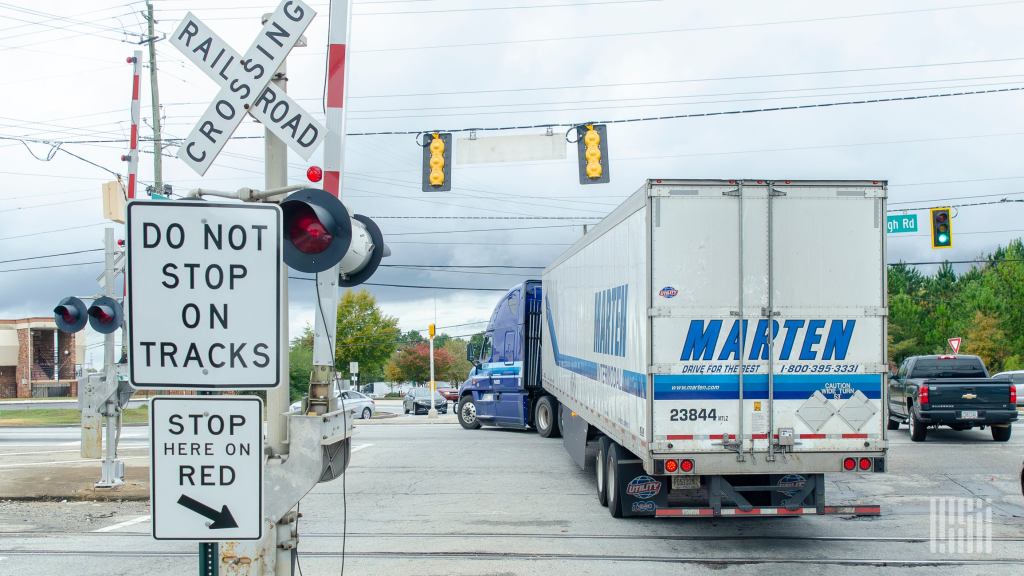
Quarterly earnings for Marten Transport (NASDAQ: MRTN) were those of a truckload carrier facing a far weaker market in the third quarter than a year ago, which itself was starting to retreat from the strong market of 2021-22.
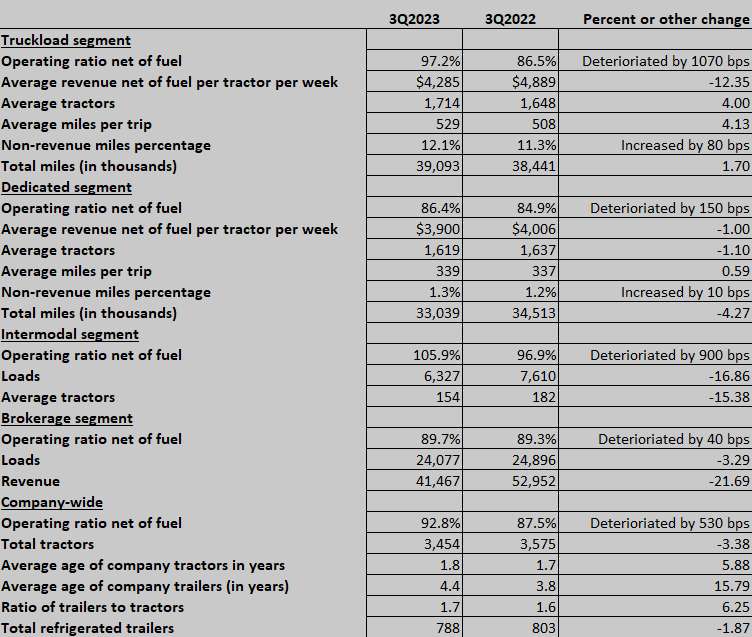
The company’s truckload segment, the largest by revenue, saw its operating ratio net of fuel slide to 97.2% from 86.5% in the corresponding quarter of 2022. Average revenue net of fuel per tractor per week dropped 13.4% to $4,285, though total miles rose to 39 million miles from 38.4 million miles.
Marten’s intermodal segment saw its performance plummet. Its OR net of fuel came in at 105.9%, down from 96.9%, a deterioration of 900 basis points. Unlike truckload, where total miles driven actually improved from a year ago, intermodal saw a significant loss of volume, declining to 6,327 loads from 7,610 loads a year ago.
The bottom line for intermodal was an operating loss of $1 million, down from a profit a year ago of $778,000.
Dedicated’s OR net of fuel also showed a weaker performance, reported at 86.4%, down from 84.9%.
While brokerages through the freight sector are struggling, Marten’s managed to turn in a relatively stable OR even as its total revenue declined. OR weakened only to 89.7% from 89.3% a year ago, on a revenue drop of 21.7% to $41.5 million from $53 million. Loads dropped about 3.3% to 24,077 from 24,896.
Revenue segment by segment beyond brokerage was truckload, $114.2 million, down 11.7%; Dedicated, $101.7, down 7.6%; and intermodal, $22 million, down 31%.
Beyond intermodal, the other segments did turn in operating profits, but they were down significantly. Truckload fell to $2.7 million, a drop of 81.1%; Dedicated fell to $11.3 million, a decline of 13%; and brokerage came in at $4.32 million, a decline of 24.5%.
For the company as a whole, the OR net of fuel was 92.8%, weakening from 87.5% a year ago.
Marten does not conduct an earnings call with analysts. The prepared statement by Executive Chairman Randolph Marten in the company’s earnings release was a recap of the state of the freight market.
“Our earnings this quarter were significantly pressured by the industry-wide weak demand, cumulative impact of reduced freight rates with the resulting freight network disruption, and inflationary operating costs within the current freight market recession,” Marten said.
But in a rarity for public truckload companies, Marten also talked about the price of diesel. Fuel surcharges are generally effective enough that it rarely is brought up by companies in their earnings statements or on calls with analysts, not seen as a headwind or a tailwind.
But Marten said the combination of “record heat and rising fuel prices each month of the third quarter led to an increase in our mile-adjusted net fuel expense of $3.9 million, or 4 cents per diluted share, from this year’s second quarter to third quarter.”
That 4 cents is a relatively sizable amount given that Marten’s earnings per common share were 17 cents, down from 32 cents a year ago.
However, a year earlier in the third quarter, retail diesel as measured by the average of the weekly DOE/EIA price was $5.152 per gallon. This year it was $4.242/g.
Retail diesel as measured by the weekly Department of Energy/Energy Information Administration average retail price rose from $3.767/g on July 3, the first posting of the third quarter, to $4.586/g on Sept. 25, the final posting of the three months.
Salaries, wages and benefits as a percentage of revenue rose to 33.1% in the quarter from 30.7% a year ago. Purchased transportation fell to 17.7% of revenues from 19.8% a year ago.
Marten’s stock in the past year has mostly treaded water, up 3.78% in the last 52 weeks, per Barchart. It closed Wednesday at $19.22 and was little changed in post-earnings trading.
More articles by John Kingston
Marten sees minor pullback from Q1, sharper drop from a year ago
Marten drove more in 1st quarter than last year but made less money
Marten revenue up but net income growth lowest in over 2 years
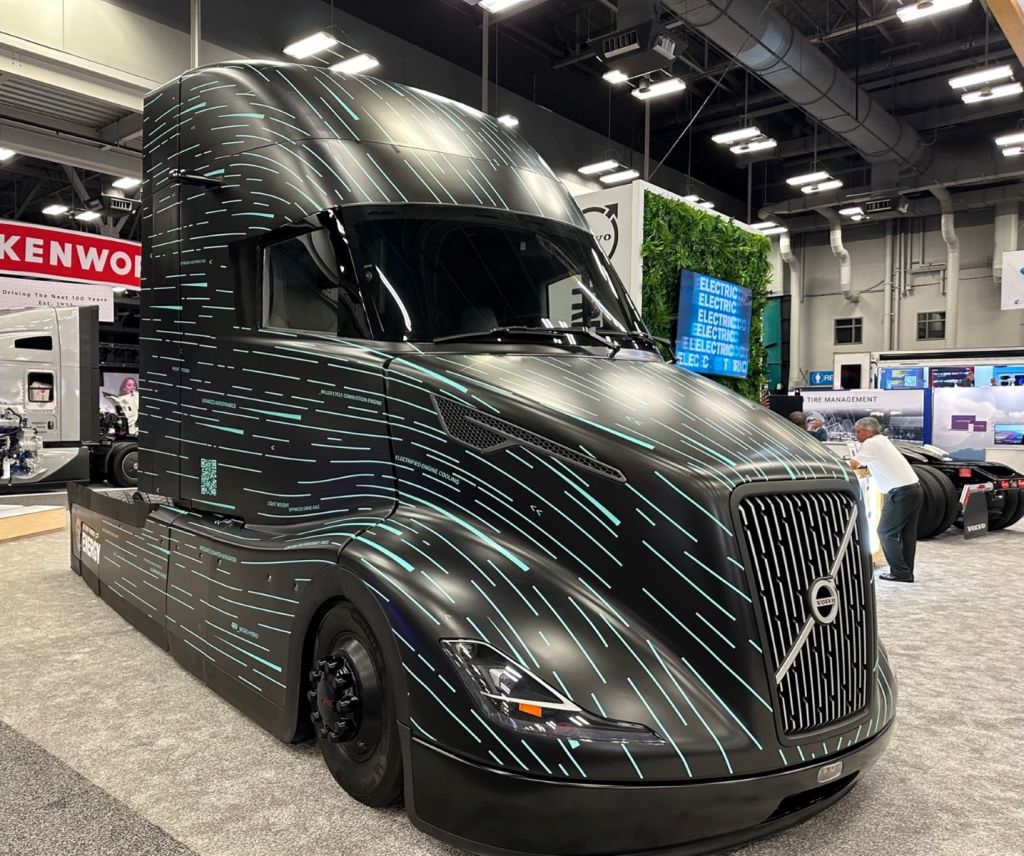
Sweden’s Volvo Group reported slightly higher deliveries but fewer truck orders in the third quarter as it prepares for a slower market in 2024.
Volvo is the first of the four major OEMs to report results for the July-September period, typically the slowest of the year. Paccar Inc., Traton Group and Daimler Truck will report in coming weeks.
“We have successfully mitigated cost inflation with price management and continued to handle disturbances in the supply chain,” Martin Lundstedt, Volvo Group CEO, said in a report on the period.
By the numbers, Volvo reported these year-over-year Q3 figures:
During this quarter, Volvo divested its entities in Russia that had been put on hold since Russia invaded Ukraine. Volvo excluded the SEK800 million loss from adjusted operating income because it would have skewed year-over-year comparisons.
Truck orders declined by 27% to 47,202 vehicles in the quarter as inflated backlogs from pent-up demand are built and delivered. Volvo deliveries increased 4% compared to Q3 2022 to 55,274 trucks.
“We expect our major truck markets to continue to be strong throughout this year as we continue to deliver from our large order books to customers, but forecast lower market levels for next year,” Lundstedt said.
Volvo maintained its North American industry estimate of 330,000 heavy-duty trucks for full-year 2023. It forecast industry sales of 290,000 in 2024.
“We continue to keep a high level of flexibility to manage any mid-term changes in demand,” Lundstedt said.
The slowdown in freight in the U.S. market comes amid a shift from consumer goods purchases prevalent during the pandemic to services like restaurant deliveries and vacation travel.
Thousands of truck drivers who jumped into the business to capitalize on record spot per-mile rates are surrendering their Department of Transportation authorities and either signing on with for-hire carriers or leaving the business altogether.
North American orders decreased by 7% to 17,355 trucks in Q3. Deliveries increased 13% to 15,041 vehicles, reflecting a reduction in the backlog — the time from when an order is placed to its delivery. Volvo Trucksʼ heavy-duty truck market share through August decreased to 9% from 10.3% a year earlier. Mack Trucksʼ market share was flat at 6% compared to 5.9%.
The United Auto Workers struck Mack Trucks for the second time in four years on Oct. 8. Talks resume Thursday toward a settlement after 3,900 union-represented employees rejected a tentative agreement by 73%.
Together, Volvo Trucks North America and Mack Trucks held 15% of the North America market share, trailing market leader Daimler, the parent of Freightliner and Western Star trucks, at about 40% and Paccar, whose Kenworth and Peterbilt models account for about 30% share. Traton’s Navistar International brand is the smallest of the four OEMs.
Volvo touts its early lead in electric vehicles. It booked 1,600 orders — including transit buses — in Q3 for an annual pace of nearly 6,000, small in comparison to diesel trucks but growing. Volvo delivered 1,100 electric trucks and buses during the quarter.
“It takes time, but we see that this is a strong momentum,” Lundstedt said on a call with analysts Wednesday.
During the quarter, Volvo Group, Renault Group and CMA CGM Group agreed to collaborate on zero-emission last-mile deliveries, the fastest-growing segment in battery-electric adoption. Renault and Volvo already cooperate on small trucks. The goal is an all-new generation of electric, software-defined vans combined with end-to-end digital and physical services.
Editor’s note: Adds SEK800 million loss from divesting Russia entities.
Volvo’s SuperTruck 2 adopts European rigid design chassis
Volvo’s fuel cell truck advances but battery-electric is biggest push
Volvo Group surges to Q2 profit record amid signs of a cooldown
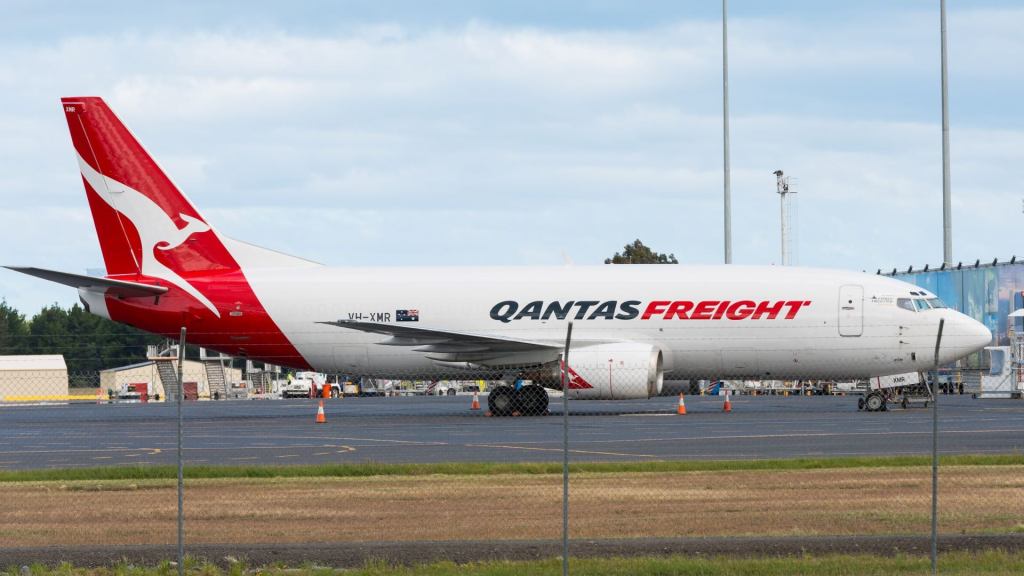
Qantas Freight logistics customers are asking the Australian airline to waive terminal handling and document fees as a way to offset the financial squeeze from a debilitating IT meltdown that has caused extensive shipping delays for more than three weeks.
Another headache cropped up over the weekend when a piece of loading equipment malfunctioned at Sydney airport and slowed cargo movements.
The Qantas Airways cargo division says it has fixed the software glitches that undermined a major systems integration and made a big dent in the shipping container backlog at Australian airports. The entire operation is expected to be back to normal on Saturday. By that time the disruption will have lasted a month.
Shippers aren’t satisfied with Qantas’ response and are asking for a credit, saying they shouldn’t have to pay cargo processing fees when service was so poor for so long.
The Freight & Trade Alliance (FTA), which represents logistics and trade service providers in Australia, “proposed to Qantas Freight that consideration be given to waiving terminal fees for the affected period as a limited form of compensation and show of good faith,” said Tom Jensen, head of international freight and logistics, via email.
Member companies are reporting that many customers are withholding payment of invoices due to severe delays, up to several days in many cases, stemming from the fraught transition to the new operating system. The situation has increased costs, from increased administrative activity to paying idle truckers unable to retrieve shipments, and degraded business functions for many Qantas users. Importers and freight forwarders complain they have not been able to meet delivery commitments and face the potential of losing future business.
Qantas has not responded yet to the FTA’s proposal but is withholding invoices while it works to reconcile charges for freight forwarders. The airline is not charging customers storage fees for stranded cargo during the ordeal.
Shipper and logistics groups have previously said they expect Qantas to compensate customers for expenses incurred by the disruption. The FTA has said that Qantas dropped the ball by not having adequate contingency plans in case the IT rollout backfired.
Qantas Freight operates a dozen cargo jets, including three Airbus A321 converted freighters that fly for Australia Post, four older Boeing 737 converted freighters, and two medium widebodies (an A330-200 and one 767), in addition to managing freight carried on Qantas passenger aircraft.
The cargo division of Qantas Airways switched to a new cloud-based cargo management and booking system on Sept. 24. It quickly began experiencing problems when the system cutover didn’t go smoothly, leaving the airline and customers clueless about where shipments were located in the network, scuppering reservations and forcing all parties to resort to manual communications and data exchange.
Qantas Freight says most freight activity has returned to normal.
The carrier’s terminal in Brisbane is operating smoothly again, and the airline continues to reduce accumulated containers in Melbourne and Sydney. It is targeting a return to normal operations in Sydney by Thursday and in Melbourne by Saturday, according to an online customer update.
With the reduced congestion, Qantas Freight said it is now accepting transhipment bookings again at all stations.
Manual procedures implemented in the early stages of the disruption to keep processing freight have been replaced with digital scanning and certifications, which will allow for more accurate online tracking of shipments, said Qantas.
While ground workers continue to work extended hours to clear the freight backlog, they also are focused on keeping new inbound freight quickly flowing without delay, according to the company. It is giving first priority to shipper-built containers — tendered as complete units by a single customer with contents that don’t require sorting — to open more space in its terminals.
Meanwhile, an elevated transfer vehicle at Qantas Freight’s terminal at Sydney airport broke down on Saturday. The rolling machines are used to lift containers stored in multilevel racks and for on/off truck transfers.
Qantas said it repaired the equipment on Monday and that most of the freight impacted by the outage has been delivered.
Click here for more FreightWaves/American Shipper stories by Eric Kulisch.
RECOMMENDED READING:
Qantas Freight makes progress on cargo pileup
Qantas says freight backlog in Australia could last 2 more weeks
Qantas Freight fumbles IT rollout, stranding cargo shipments
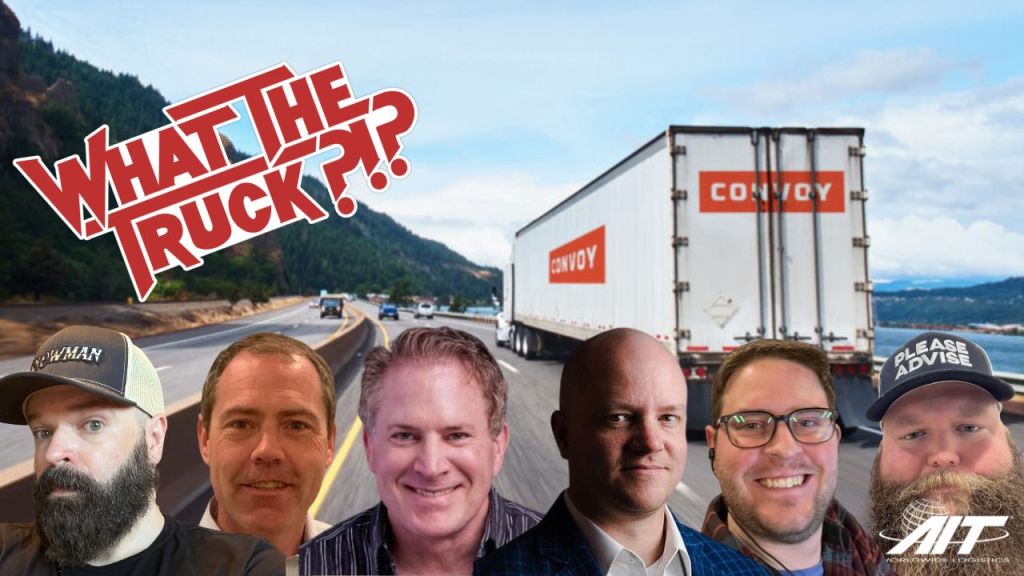
On today’s episode of WHAT THE TRUCK?!? Dooner is joined by FreightWaves Craig Fuller to discuss breaking news about Convoy Inc. potentially shutting down.
Shatranj Capital Partners’ Brittain Ladd stops by to break down supply chain strategy. Who is making the right moves; what went down at Flexport; where is the money going; what M&A needs to happen now; and what companies are about to become zombies if they don’t change?
FreightWaves’ Justin Martin and Thomas Wasson talk about freight’s most unpopular opinions; a trucker organization in need of help; and the worst ways to die at work.
Steam’s Lee Britain explains why his team threw 48 water balloons at Steve Cox. He’ll also let us know how they’ve kept the gongs ringing in a down market.

Editor’s note: A previous version of this story incorrectly referred to the Seattle-based company as Convoy Logistics. It is, in fact, Convoy Inc. and is not affiliated with Convoy Logistics, a freight brokerage based in Crossett, Arkansas, nor it is affiliated with Convoy Systems out of Kansas City, Kansas.
A change is brewing in the next day or two at Seattle-based digital brokerage Convoy, with reports Wednesday of all loads being canceled.
A communication from Convoy representatives to their customers, obtained by FreightWaves, said the company is “taking several necessary steps to prepare Convoy’s business for a transition that we will have more details on in the next 48 hours.”
The message from Convoy said the company could not “answer any additional questions at this time.”
A Convoy spokeswoman issued a brief statement to FreightWaves, also citing potential developments in the next 24 to 48 hours, without elaborating further.
And with that, according to the communication, “all shipments have been canceled from our marketplace.” Convoy said that shippers could “choose to work with the carriers that were booked on canceled shipments directly.” It did provide an email address — cfbsupport@convoy.com — for customers to use if they needed additional support.
FreightWaves has confirmed that the Convoy load board went blank on Wednesday.
Although the market was filled with rumors of bankruptcy at Convoy Wednesday morning — not surprising when all loads are summarily canceled — there has been no bankruptcy filing by Convoy, according to a check of public records by FreightWaves.
In April 2022, Convoy was valued at $3.8 billion after an investment of $260 million in a Series E capital raise. That money came from existing investors Baillie Gifford and T. Rowe Price and $100 million in venture-debt investment from Hercules Capital Inc.
That a big change might be coming at Convoy is not surprising. Most if not all brokerage companies are struggling in the current freight market. But beyond that, Convoy in August hired an investment bank, reportedly Goldman Sachs, to help it explore possible options for its future ownership and capitalization. The list of potential suitors that might acquire or take a stake in Convoy — according to the rumor mill — has included C.H. Robinson (NASDAQ: CHRW), Walmart (NYSE: WMT), Amazon (NASDAQ: AMZN) and Maersk (DXE: MAERB.C.DX).
Besides that development, there has been significant upheaval at Convoy in the last several months. In June, Grant Goodalle, Convoy’s co-founder and chief experience officer, said he was leaving the firm.
In February, Convoy said it would undertake a restructuring. Along with that, the company made an undisclosed number of layoffs, though that has been a persistent theme in brokerages this year.
JP Hampstead contributed to this report.
More articles by John Kingston
Scheduling standards consortium releases API tech standard
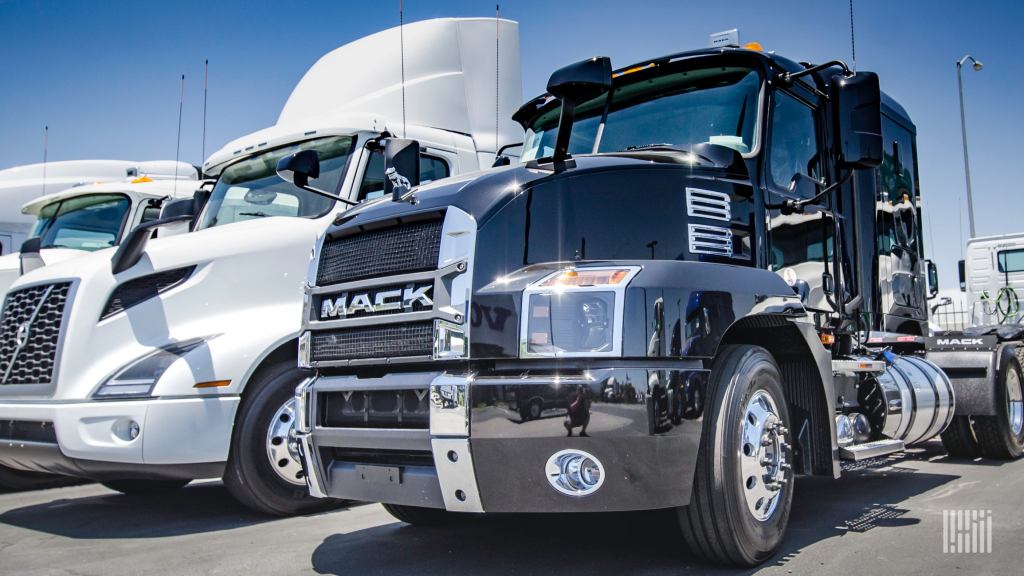
WASHINGTON — Major trucking firms and their supporters have called for repealing a long-standing 12% tax on new tractors and trailers as a way to promote cleaner-burning vehicles, but a California lawmaker argues that the tax is also an inefficient way to prop up the Highway Trust Fund (HTF).
Speaking Wednesday at a House Transportation and Infrastructure subcommittee hearing on ways to cure the ailing HTF, Rep. Doug LaMalfa, R-Calif., agreed with groups such as the American Trucking Associations, the Truckload Carriers Association and the National Tank Truck Carriers that the 12% federal excise tax (FET), instituted in 1917, is a disincentive for buying newer and cleaner trucks.
However, “we also see it’s cyclical,” LaMalfa said, “because truck sales more or less move with the economy, with the amount of goods moving in the supply chain. So it’s not a source of funding that’s as steady as would be under other tax forms. So it’s important that when we have a discussion on the continuity of the revenue in the Highway Trust Fund, we also look at a way to relieve the burden on those who buy new trucks.”
LaMalfa encouraged support for a bill he is sponsoring, the Modern, Clean, and Safe Trucks Act, which would repeal the 12% FET “and distribute that [funding] burden over a wider population.”
Of the $1.4 trillion of tax receipts pumped into the Highway Trust Fund since its inception in 1956, about 8% — $114 billion — has been through the 12% FET on new tractors and trailers, according to testimony from Jeff Davis, a senior fellow at the Eno Center for Transportation, who also participated in the hearing.
Davis testified that Congress continues to give the HTF, which pays for highway and transit projects through revenue raised by gas taxes as well as the FET, “a privileged place in the budget process” while “pretending” that the HTF remains solvent.
“The reality is that the trust fund is only projected to be 82% self-sufficient [in FY2024], with that solvency dipping rapidly until the trust fund is only 60% self-sufficient [in FY2026], and dipping below 50% self-sufficient in 2031,” based on the latest projections by the Congressional Budget Office, he said.
Declining rates of miles traveled, fuel-efficient cars and Congress’ failure to cut spending or increase the gas tax have all contributed to the HTF funding crisis. Lawmakers since 2008 have been covering the shortfall with money transferred from the U.S. Treasury’s general fund, including $118 billion authorized by the Infrastructure Investment and Jobs Act in 2021.
“It’s time to either mend, or end, the Highway Trust Fund,” Davis contended.
“Either cut spending and/or increase user revenues to the point that they meet once again, or abolish the Trust Fund, devote the five existing user taxes back to the general fund, and have highway, mass transit, and highway and motor carrier safety funding fight it out with all other programs through the budget process.”
Officials from Oregon and Washington testified on the success of state-level programs that are transitioning HTF revenue sources away from fuel taxes and instead charging vehicles by the mile instead of by the gallon.