Alvys opens freight AI agents to fleets of all sizes

Fleet of semi-trucks lined up at dusk, illustrating carriers and small fleets using freight AI agents and TMS technology

Alvys introduced Alvys Foundry on Tuesday, an agentic AI platform that lets carriers, brokers and hybrid carrier-brokers build and deploy freight AI agents inside the transportation management system they already run. The Solana Beach, Calif.-based company paired the launch with a second announcement: its TMS is now open to fleets of all sizes, extending a platform built around larger trucking companies to owner-operators and small carriers.

Foundry offers three paths: more than 20 pre-built agent templates, custom agents built and tuned by Alvys engineers, or agents customers assemble themselves. Early targets are the work that still eats dispatch hours, including check-call automation, invoice and settlement prep, and track-and-trace exceptions.

“Over the past year, we’ve watched how our customers were actually adopting AI; where it helped, where it stalled, and where the hype left operators with more tools and more logins instead of more capacity,” said CEO Nick Darman. “Alvys Foundry is the answer to what we saw.”

The launch delivers on the roadmap Alvys laid out with its $40 million Series B in September 2025, a round led by RTP Global. The company has raised $77 million and says the platform moves more than $9 billion in freight a year.

To understand the value of agents, imagine a trucking company that runs two operations at once. The one most known moves the freight. The other proves that freight moved on time, safely and under the right authority. The second involves all the paperwork, and in a post-Montgomery world, may decide who wins the next contract.

Large fleets have the staff for the second operation. They employ legions of specialists to watch federal safety records and dispute shipper service failures before either hardens into a number a customer can see. Small fleets find out what they missed after the damage is done. That is the gap Foundry is aimed at, and Darman told FreightWaves that experience came from personal experience.

The DOT knock that started it

Darman started a trucking company in 2004 while at Georgia State University, spent a few years at J.P. Morgan, and went back into trucking in 2010. Growing that business, he hit a form of fraud he did not know existed.

“Drivers and owner-operators would fraudulently use my signs, my DOT number, my authority, and run freight without my consent. They were racking up violations under my name. I had no idea until a year later, when the DOT knocked on my door for an audit.”

He had 10 to 20 drivers then and knew all of them. Logging into the Federal Motor Carrier Safety Administration portal every morning never occurred to him. Larger carriers have the resources to submit a Request for Data Review (RDR) to the FMCSA. The request is accessed through the FMCSA DataQs system and requires carriers to prove they were not at fault for the crash. It is an ongoing process to submit, process, verify and track DataQs requests — something smaller fleets and owner-operators are most at risk of but least aware of.

“You’re actually being labeled as an unsafe company. But that’s not necessarily the case,” Darman said. “When you look at how some of these owners or entrepreneurs run their companies, they run their companies very safely. But the underlying data on FMCSA doesn’t support the way they run their companies.”

Freight AI agents versus the 24/7 watch desk

The industry’s fix for that problem is headcount, available only to companies that can pay for it.

“They have employees on it around the clock. They log into FMCSA every day to make sure that there’s nothing shady happening,” Darman said. “And when something is happening where a driver that’s not employed by the carrier is being reported on FMCSA, they dispute it right away.”

Foundry replaces the shift with an agent.

“You could  have an agent check an integration with FMCSA,” Darman said. “The moment something doesn’t match the driver records on file, it flags the owner. That way the owner can dispute the record immediately.”

Darman was direct that the use case is still theoretical: “I haven’t used that with anyone yet, but I think it’s such a powerful use case.” The argument behind it is a cost line. “Instead of having employees doing this work for you, you could actually deploy this agent that’s not costing you much,” he said.

On time and on the scorecard are two different things

The same asymmetry runs through shipper relationships.

“Being on time for every pickup and delivery is one thing. Making sure the shipper’s scorecard shows you were on time is another. ,” Darman said. “Those are two different things.”

Small carriers argue the facts, but without data, shippers fall back to their records. “They’re just arguing, ‘Hey, I was on time,’ but [a large shipper] will look at you: ‘Well, I’m sorry. My scorecard shows otherwise,'” Darman said.

Large carriers have treated scorecard maintenance as its own discipline for years, flagging EDI 214 status messages that land outside a delivery window and routing them to customer service teams that recategorize the miss under weather or another excusable code. It is the staff, and not always the service, that shows up in the numbers. Inflated carrier scorecards are an underreported aspect for shippers managing their carrier partners’ performance.

For those disputes, speed often decides whether the dispute lands. “If you do it in real time, the shipper remembers and will always take that off the scorecard,” Darman said. “If you do it too late, then you have a problem.”

Context is the product

Foundry’s claim to differentiation relies not on the agents. Instead it focuses on the operating data underneath them.

“We have the freight context and we understand your lanes. You don’t need to keep up different integrations,” Darman said. “We have the context and therefore there’s no extra login.”

The platform sits on Alvys’ existing data infrastructure, more than 120 integrations, native EDI connections to hundreds of shippers, and a SOC 2-compliant security foundation. Enterprise agreements with model providers keep customer data out of public model training.

Governance ships with it. Agent Shield logs agent activity, keeps actions traceable and routes high-impact decisions for human approval. An intelligent model picker selects the cheapest capable large language model for each task, a hedge against compute costs climbing with usage.

Who holds the keys

Most AI providers entering logistics write the agent logic themselves and keep the operating knowledge in-house. Alvys is handing operators the building blocks and training their teams to assemble agents themselves.

“I lived the other version of this as a trucking company owner,” Darman said. “Vendors got me started, then charged for every customization, every report, every integration. They held the keys, and leaving was a struggle. We are building Alvys Foundry so our customers hold the keys instead.”

One early customer reads the distinction the same way. “Foundry is not AI for show. It is AI with a job description,” said Carlos M. Llanes Jr., founder and CEO of Spartan Carrier Group. “It helps remove the manual friction from freight so our people can stay focused on judgment, service and elite execution.”

Foundry was first shown at a June 17 Customer Advisory Board meeting, where the first customer cohort filled. The waitlist for the second is open.

What separates operators from here, in Darman’s view, is no longer the technology.

“Tech is not going to be the limitation,” he said. “It’s the deep thinkers behind the organization who will set up the SOPs in such a way where you’re going to be the winner. And I believe that AI will now expose who the real workers are.”

Fura acquires Pacific Northwest freight broker

front view of two white tractor-trailers on a highway

Freight broker Fura announced Tuesday that it has acquired High Rise Logistics. The latest transaction marked the seventh acquisition for the Cincinnati-based AI-powered 3PL.

Vancouver, Washington–based High Rise provides flatbed, expedited, truckload and less-than-truckload transportation. It has a large presence in the Pacific Northwest and also offers intermodal, drayage and warehousing services.

Financial terms of the transaction were not disclosed.

Fura is rolling up freight brokers and layering tech and automation into their operations to magnify scale.

“What we’re doing has never been done in logistics — we’re buying great businesses and transforming them at a speed this industry has never seen,” said Jeff Dangelo, co-founder and CEO of Fura. “High Rise is a perfect fit for our roll-up: great customers, a great team, and exactly the kind of business that gets supercharged the moment you put our technology behind it.”

High Rise’s leadership team will continue to manage daily operations, but will now have access to Fura’s tech platform, which provides AI-powered bidding, carrier-sales functions and shipment visibility.

“The logistics world is transforming fast, and we wanted to be able to compete with anyone,” said Denis Russu, High Rise co-founder. “Fura makes that possible — it puts powerful technology in our people’s hands, transforms the customer experience, and lets us scale without the burden of having to innovate on our own.”

Why it matters? Fura is demonstrating a repeatable model for consolidating the highly fragmented freight brokerage industry. Rather than simply stacking businesses and inheriting their overhead costs, they are migrating acquisitions onto a shared AI-powered automation platform to drive lean operations and efficiency.

More FreightWaves articles by Todd Maiden:

Proficient Auto Logistics’ latest deal pushes market share to 25%

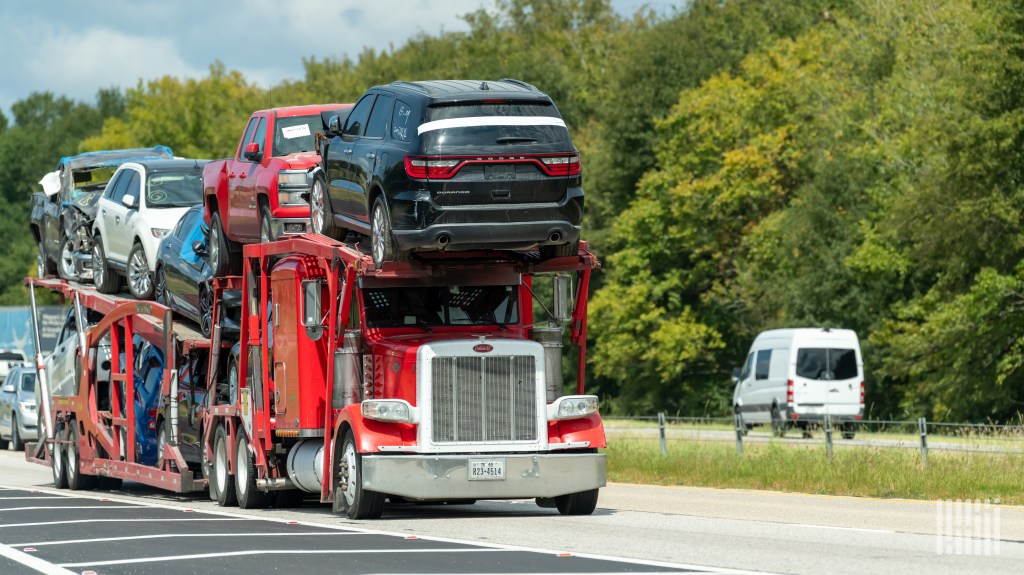
a fully loaded auto hauler on a highway

Proficient Auto Logistics will soon become North America’s largest finished vehicle logistics platform. The car hauler announced Monday after the market closed that it entered an agreement to acquire California-based peer Hansen & Adkins for $130 million.

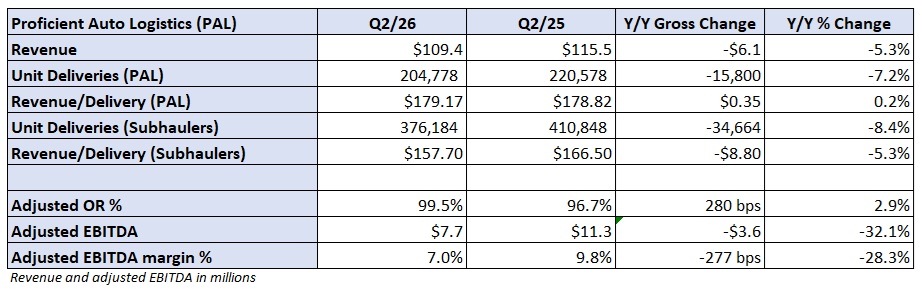
Jacksonville-based Proficient (NASDAQ: PAL) also reported a second-quarter net loss of $3.9 million late Monday. Excluding one-offs, adjusted results were closer to breakeven. Revenue was down 5% year over year to $109 million and its adjusted operating ratio (inverse of operating margin) deteriorated 280 basis points y/y to 99.5%.

The news sent shares of PAL 10% lower in after-hours trading.

Proficient said the deal will add 725 company-owned tractor-trailer units, more than doubling its current fleet, and a little over $400 million of annual revenue.

The combined entity is expected to haul over four million vehicles annually, roughly one-quarter of the new car market. The combined companies generated roughly $835 million in revenue and $60 million to $65 million in adjusted EBITDA over the last 12 months. The deal price implies a 4.8x last 12 months’ adjusted EBITDA multiple (3.9x after expected cost synergies).

The $130 million price tag includes $75 million of assumed debt, with the remainder of the transaction being funded in cash ($52 million) and common stock ($3 million). There is also the potential for a $22.1 million earnout if future EBITDA targets are met. Proficient will offer $75 million of convertible notes through a private offering, proceeds from which will refinance debt.

The deal is expected to close in “mid-August.”

Proficient is forecasting second-half 2026 revenue of $350 million to $370 million and a 97% adjusted OR.

Table: Proficient Auto Logistics’ key performance indicators

Proficient said total vehicle deliveries on the platform were down 8% y/y to 581,000 units during the second quarter. Revenue per delivery was up slightly at the company-owned fleet and down 5% across its subhauler segment. It said deliveries were down because it couldn’t find enough capacity in the market. After several quarters of unfavorable economics, many haulers have been forced to close.

Margins were compressed as customer payment cycles lagged quickly rising fuel and driver costs in the quarter. However, margins improved throughout the period, with June producing a 95.7% adjusted OR.

“In the second quarter, higher fuel, equipment, and driver-related costs increased expenses, and while our discussions with customers are progressing constructively, pricing actions generally lagged cost inflation,” said Proficient CEO Rick O’Dell. “As rate adjustments began to take effect, margins improved each month, strengthening our margin profile exiting the quarter.”

Deliveries were forecast to see a normal seasonal pullback in July and August before improving in the fall. Revenue per delivery is expected to step higher.

“We believe the auto haul industry is at an inflection point. Regulatory pressures, rising operating costs, and the need to attract and retain drivers are reshaping transportation economics and tightening industry capacity,” O’Dell said.

Why it matters? There is only one publicly traded auto hauler. Proficient’s quarterly results provide a rare look at the transportation side of the industry. The announced acquisition highlights a major consolidation move that reshapes market capacity and competitive dynamics.

More FreightWaves articles by Todd Maiden:

Landstar has cut more than 35,000 carriers from approved network

Landstar System has dramatically reduced the number of motor carriers approved to haul its brokered freight, cutting its carrier pool by about 35% over the past four years.

Matt Miller, Landstar’s vice president and chief safety and operations officer, disclosed the reduction during the Jacksonville, Florida-based company’s second-quarter earnings call on July 28.

“Over more than 20 years in brokerage, we’ve always looked for ways to enhance our carrier vetting with people, process, technology, and information,” Miller said. “Over the past four years, we’ve gone from over 100,000 approved carriers in the second quarter of 2022 to just over 64,000 at the end of the second quarter or a 35% reduction.”

Landstar officials said the aim of the reduction was to tighten its focus on safety, security and service. The reduction represents more than 35,000 carriers removed from Landstar’s approved network since mid-2022.

Commercial Carrier Journal first highlighted the size of the reduction. Overdrive, a sister publication of CCJ, reported that Landstar’s effort initially focused on combating cargo theft and freight fraud, with the company deploying enhanced vetting technology, identity checks and stricter compliance measures.

Jacksonville, Florida-based Landstar (Nasdaq: LSTR) is a major asset-light transportation logistics company operating through a network of independent freight agents and third-party capacity providers.

Landstar’s approved carrier pool stood at approximately 64,600 at the end of the second quarter, down another 7% year over year after declining 19% in the first quarter, according to previous FreightWaves reporting.

Miller indicated that the company has no plans to ease its scrutiny of carriers.

“As new technologies and information become available, we’re going to continue to do just that, exactly what we’ve been doing,” Miller said. “We’re always looking for opportunities to drive safety, security, and service.”

Related: Landstar expects to emerge a winner in post-Montgomery world

Carrier vetting takes on greater significance after Montgomery

Landstar’s multiyear carrier purge takes on additional significance following the U.S. Supreme Court’s May ruling in Montgomery v. Caribe Transport II, which widened the potential liability exposure facing freight brokers over the selection of motor carriers.

The ruling has heightened concerns across the brokerage industry about how companies select and monitor carriers, potentially increasing the importance of documented vetting procedures.

Landstar CEO Frank Lonegro said during the earnings call that the company believes federal regulators need to provide clearer standards for the industry.

“We believe greater Federal clarity around carrier vetting and selection standards would help support a more predictable operations, insurance, and claims environment for truck brokers, carriers, and shippers,” Lonegro said.

Landstar reported approximately $10.5 million in unfavorable adjustments to prior-year claims during the second quarter. Three of the five claims responsible for nearly all of that adjustment involved truck brokerage operations.

The company has also said its scale, safety record, technology and insurance programs could become competitive advantages following Montgomery. Landstar recently signed an $18 million Midwest freight broker as an independent agent, and Lonegro said inquiries from prospective agents have accelerated since the Supreme Court decision was released in mid-May.

Landstar CFO Jim Todd said the decision means broker liability cases that previously may have been dismissed on federal preemption grounds could now have to be litigated.

“I think there’s certainly going to be some element of plaintiffs being more emboldened to pursue these cases,” Todd said during the Q2 earnings call.

Landstar nevertheless reported a relatively favorable insurance renewal after the Montgomery decision. Its auto liability coverage was effectively flat at its June 1 renewal, while broker liability costs increased about 3%, according to Miller.

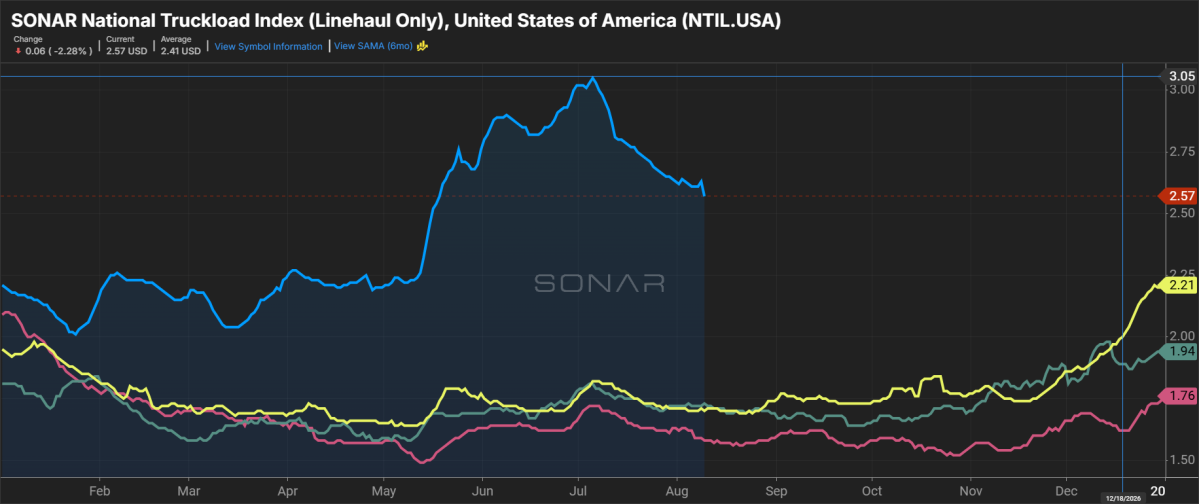
SONAR: National Truckload Index (linehaul only – NTIL.USA) for 2026 (blue shaded area), 2025 (yellow line), 2024 (green line) and 2023 (pink line). The NTIL is based on an average of booked spot dry van loads from 250,000 lanes. The NTIL is a seven-day moving average of linehaul spot rates excluding fuel. Rates remain significantly higher on a y/y comparison in August. To learn more about SONAR, click here.

Fewer carriers enter a tightening freight market

The removal of tens of thousands of carriers from Landstar’s approved pool also comes as the truckload market shows signs of tightening.

Lonegro said truck capacity “tightened significantly” during the second quarter and that conditions that had favored shippers since late 2022 were “shifting rather rapidly in favor of the transportation provider.”

Landstar’s total truck revenue increased 19% year over year to $1.33 billion during the second quarter, while loads increased approximately 2% and revenue per load jumped 17%.

National dry van spot rates — tracked via the SONAR National Truckload Index (linehaul only – NTIL.USA) — shows a seven-day moving average of linehaul spot rates excluding fuel. As of Monday, rates remain significantly higher on a year-over-year comparison from February through August. 

Why it matters: Landstar’s decision to eliminate roughly one-third of its approved carrier network illustrates how safety, fraud and liability concerns are reshaping broker-carrier relationships — and Montgomery could accelerate the pressure on brokers to become even more selective about which trucking companies haul their customers’ freight.

J.B. Hunt celebrates 65 years, rings Nasdaq opening bell

JB Hunt as NASDAQ

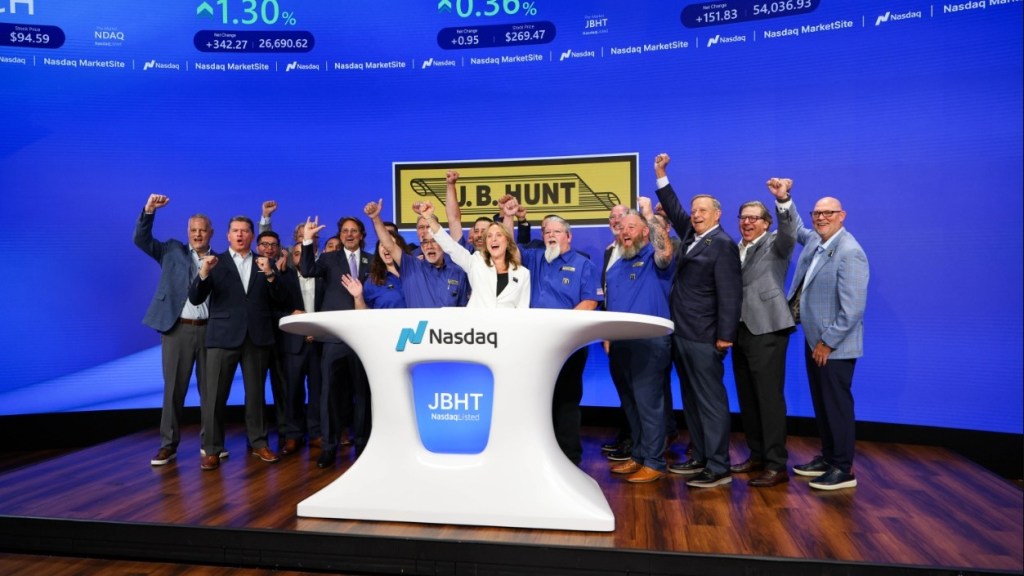
Multimodal transportation provider J.B. Hunt Transport Services celebrated its 65th anniversary by ringing the Nasdaq opening bell in New York City on Monday. Executives from the company were joined by other longtime employees, including drivers, maintenance technicians and office staff.

The Lowell, Arkansas-based company, was founded in 1961 by J.B. and Johnelle Hunt. It has grown from a small trucking fleet into one of the largest transportation and logistics providers in the country. The pioneer of intermodal transportation boasts nearly $13 billion in annual revenue today.

“Sixty-five years is more than a milestone. It reflects the discipline, resilience and commitment of the people who have built J.B. Hunt and continue to move us forward,” said Shelley Simpson, president and CEO at J.B. Hunt.

“Our business has changed many times, but our standard has not: take good care of our people, who take good care of our customers, and that takes care of our business. The same spirit of innovation and adaptability that brought us here continues to guide the people building our future today.”

J.B. Hunt (NASDAQ: JBHT) was invited by Nasdaq to ring the ceremonial bell to signal the opening of Monday’s trading session.

“As the industry continues to evolve, our responsibility is to keep adapting, investing and finding better ways to create value,” Simpson added. “That’s the work our teams are doing every day, and it’s what positions us for the opportunities ahead.”

Why it matters? This milestone reflects the long-term evolution of a major industry player and offers insight into the operational standards that have supported its growth.

Canadian trucker arrested in New Mexico for alleged cabotage violations

U.S. Border Patrol agents arrested a Canadian truck driver in New Mexico after authorities said he was caught hauling freight between two U.S. cities in violation of federal cabotage restrictions.

Border Patrol said Sunday that agents in Las Cruces apprehended the driver for allegedly conducting unauthorized domestic freight operations after determining that he was transporting cargo from Deming, New Mexico, to Los Lunas, New Mexico.

“Admitted. Not authorized to haul,” Border Patrol said in an Aug. 10 Facebook post.

The agency said the domestic freight movement violated the terms of the driver’s nonimmigrant status and that he now faces prosecution and subsequent deportation.

Border Patrol did not identify the driver, trucking company, shipper or type of freight involved in the alleged violation. The agency also did not specify where agents encountered the driver or what charges he could face.

The incident is notable because it involves a Canadian commercial driver at a time when federal authorities have stepped up enforcement of cabotage restrictions involving foreign truckers operating in the U.S.

Cabotage generally refers to the transportation of goods between two points within the same country by a foreign carrier or driver. 

Canadian and Mexican commercial drivers can conduct legitimate international freight movements into and out of the U.S., but cannot pick up freight at one U.S. location and deliver it to another U.S. location.

Border Patrol has conducted several cabotage enforcement actions over the past year, although most publicly announced cases have involved Mexican truck drivers operating near the southern border.

In April, Border Patrol said a Mexican truck driver’s B-1/B-2 visa was revoked after agents determined that he had transported a commercial load of produce from Yuma, Arizona, to Grandview, Washington. The driver was processed for deportation.

In another case announced in May, authorities said a Mexican driver transported commodities from Nogales, Arizona, to Laredo, Texas. Border Patrol said the driver’s visa was revoked and his trailer was towed.

Why it matters: The arrest of a Canadian driver signals that the federal government’s expanding cabotage crackdown is not limited to Mexican truckers and could bring greater scrutiny to foreign carriers conducting freight movements throughout the U.S.

Colis Privé expands last-mile delivery business into Spain and Portugal

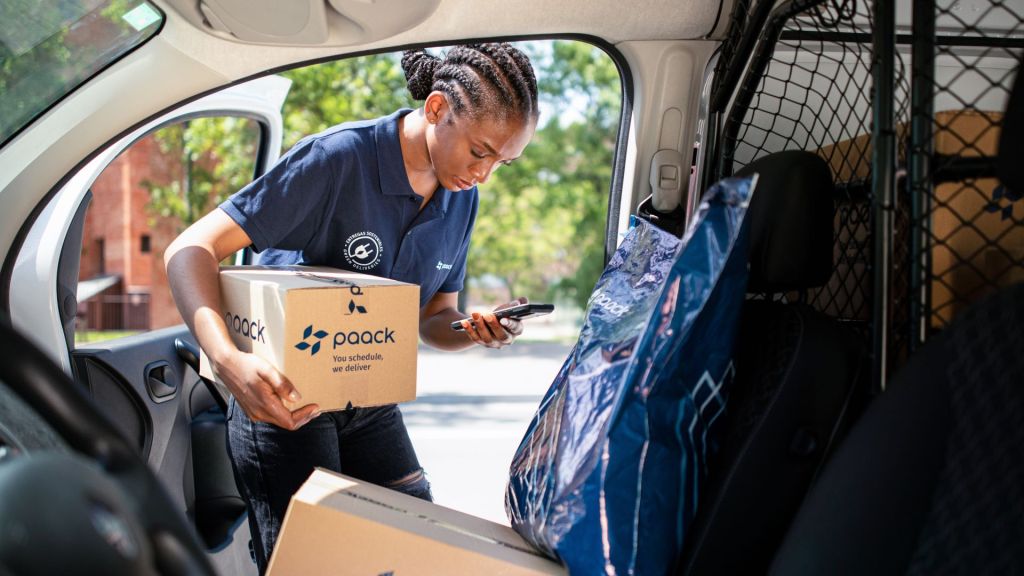
View from inside vehicle of a Paack delivery driver grabbing a parcel from the passenger seat.

Global freight middleman Ceva Logistics has completed the acquisition of couriers Paack Iberia and Paack France for integration into Colis Privé, its European last-mile delivery business.

About 490 employees will join Colis Privé  through the transaction, which aims to strengthen the company’s domestic network in France while enabling it to expand into Spain and Portugal, two fast-growing e-commerce markets, the company announced last week.

Ceva Logistics, part of France-based conglomerate CMA CGM, originally announced the deal in late June

Paack supports retailers with an extensive delivery network (82 transfer centers and more than 5,000 active pickup points) in the Iberian peninsula and six urban delivery stations in France, bringing packages to individual residences as well as out-of-home delivery points.

Based in the Aix-Marseille-Provence metropolitan area, Colis Privé relies on a national network of 56 sorting hubs and operational centers, as well as approximately 5,000 delivery drivers, to deliver parcels across France every day. In 2025, the acquisition of MIPI, which has more than 300 delivery drivers, strengthened its coverage of France’s major metropolitan areas. The company serves leading French and international e-commerce players and is also present in Belgium and Luxembourg.

Click here for more FreightWaves/American Shipper stories by Eric Kulisch.

Write to Eric Kulisch at ekulisch@freightwaves.com.

Cyberattack on Ceva Logistics warehouses in Europe impacts retailers

Penske Lawsuit SHOCKS Brokers: Who’s Liable for Freight?

The latest BLS data shows a surprisingly ‘boring’ month for trucking jobs, with only 100 added. Dive into what this means for fleets and owner-operators, and why the industry might not be ‘overcorrecting’ as feared. We also break down the volatile oil market, current diesel prices, and the complex Penske lawsuit that’s shaking up broker liability. Get the crucial updates supply chain pros need to know.

The Fifth Circuit Court of Appeals has reinstated liability claims against two Penske entities in connection with a fatal 2018 jackknife crash in Texas, dealing a significant blow to carriers and brokers who assumed that tendering a load down the chain extinguished their legal exposure. The six-page ruling has broad implications for how carriers and brokers structure freight transactions and vet downstream partners.

The load — originating from an automotive seat manufacturer — traveled through at least four parties before the fatal accident. Penske Logistics, the asset-based carrier, first received the tender. It passed the load to Penske Transportation Management (PTM), its managed transportation and brokerage arm, which then handed it to Liberty Lane, which in turn brokered it to OK Trans, the carrier whose driver was involved in the crash that killed a motorist.

The Fifth Circuit took two distinct actions. It reinstated PTM as a defendant, citing the U.S. Supreme Court’s Charas v. Trans Air precedent commonly referred to in freight as the Montgomery decision, which eliminated the Federal Aviation Administration Authorization Act’s safety-exception shield for brokers. The court also reversed a Southern District of Texas summary judgment that had protected Penske Logistics from vicarious liability as the employer of the downstream driver.

“When a carrier takes on a load, as it moves down the chain, it still has responsibility. It does not wipe its hands of it.” — John Kingston, citing attorney Mark Blubaw of Benesh

Kingston, a senior journalist who covers freight markets, noted that the ruling — though only six pages — signals that a carrier’s lack of knowledge about re-brokering further down the chain is unlikely to serve as a defense. “Based on my thin reading of what the judge said, I don’t think that’s going to make any difference,” he said.

The case adds to a growing body of Texas litigation reshaping freight liability. Kingston also flagged a separate Texas ruling this week involving Atlas Freight, where plaintiffs attempted to extend shipper liability but were rejected — the second such failed attempt in the state following an earlier Home Depot case. Texas state Supreme Court rulings have generally trended pro-business on liability caps, but federal district and appellate courts in the state have proven less predictable.

The Penske ruling is expected to prompt re-litigation in other brokerage cases where defendants had previously won dismissal under the FAAAA’s safety exception. Kingston said he expects “a lot of others” where brokers previously protected will now be pulled back into active lawsuits and returned to federal district courts for further proceedings.

  • The Fifth Circuit reinstated liability claims against both Penske Logistics and Penske Transportation Management in a 2018 fatal Texas crash case.
  • The court ruled carriers retain vicarious liability as a load moves down a multi-party brokerage chain, even without knowledge of re-brokering.
  • A separate Texas ruling this week rejected shipper liability claims against Atlas Freight, marking the second such defeat for plaintiffs in that state.

Speaker 1 [0:00] Talking about jobs, John Kingston, how you doing, sir?

Speaker 2 [0:04] Not bad, yourself? Doing well.

Speaker 1 [0:07] So let’s talk about the jobs market right now. You are, have been reporting on the jobs market. Tell us, what does it look like in overall jobs and in freight specifically?

Speaker 2 [0:16] Boring, very boring this month. Jobs in truck transportation were up 100 jobs, that’s it. And they, and after all the machinations of the past few months, the number of jobs out there is the same as it was in February. So truck transportation jobs, and remember, that’s an independent owner-operator is not in there. Okay. So I want to make that point, but the number of truck transportation jobs surveyed by the BLS has really, I mean, it’s gone up and down, but it’s where it is. And it’s where it was in July, the same place it was in February. And it’s down from last year.

Speaker 1 [0:48] By the way, John, I think that’s super encouraging because the fear has been, we’ve talked about it frequently on the show, Dr. Miller, Jason Miller, who was on the show a couple of weeks ago, talked about the fact that he believed that fleets were going to overcorrect and hire too many drivers, as they tend to do in these upcycles. It’s not happening. That’s not what the data says. Now, you mentioned the BLS data does not have owner-operators, something we’ve talked about before. But owner-operators are not— I mean, there is a lot of pressure on owner-operators right now in the market because of the regulatory compliance elements. But really, there isn’t a case to be made that the larger fleets are adding trucks according to this data.

Speaker 2 [1:27] Yeah, I mean, I, I would imagine if you really dove into the data and looked over years’ worth, there’s probably got to be some correlation between the number of truck transportation jobs and the number of owner-operators out there, independent owner-operators out there, just because they’re serving the same market. So at a certain point, if you’ve got a really strong market, you’re going to hire more types of jobs that will be reflected in the data, and probably the number of independent owner-operators goes up too. And then conversely the other way as well. So I wouldn’t imagine that there’s a big divergence. in the direction of the numbers between people who are, let’s say, W-2 workers that can get surveyed by the BLS and those who are out on their own.

Speaker 1 [2:06] I think this is great. I’m glad that the industry is not overcorrecting. Like I said, it’s something that the industry has known to do is overcorrect, and it’s encouraging that the cycle may live on longer. We’ve talked about it being a supercycle. Again, I think this is Exhibit A of why we will have a longer cycle. Let’s move on to oil. Tell us a little bit about the state of Hormuz. What are we hearing? What is happening? What’s moving? What’s not moving right now, John?

Speaker 2 [2:33] Well, I think what’s really notable is that whenever there’s a hint that there’s going to be some progress, the market really— you talked about overcorrecting. I won’t say they overcorrect, but they react very strongly to that, more than they do for prospects of nothing happening. So over the weekend, when there were suggestions that maybe we were moving toward a deal, The market, the first couple of days of this week really sold off. The past couple of days, it’s been up. Right now, if it settled right now— let’s say I’m just— when I say it, I mean I’m talking about the price of ultra-low sulfur diesel on CME. If it settled right now where it was, it’d be up about $0.12 in 2 days. So you can see it’s corrected upward as the prospect for peace that we got all excited about over the weekend is starting to fizzle out. But $0.12 is less than a drop. So people, traders just do not want to be caught short if suddenly there’s peace in our time, and they don’t want to be on the wrong side of that trade. So they react rather vehemently to any prospect that maybe this is coming to some sort of end, which, as we know, it really isn’t. Hopefully, it will soon. But the numbers that are going through the straight-up home moves have not shown any significant increase over the last several days.

Speaker 1 [3:47] Now, John, are they biased to the downside? It sounds like they are not, as you talked about, not wanting to be caught. Anytime there’s news of resolution, it looks like they are responding to that, and that’s keeping a lid on oil. Is your view that really as soon as there is true belief and conviction of a resolution, that we’ll see oil prices drop?

Speaker 2 [4:11] I would think in the beginning it would drop, but as you know, I’ve really been pretty consistent. And when I look at the numbers, when I look at the loss of production, the loss of refining capacity, that’s been damaged and is going to take a long time to get fixed. I still think we are facing some resolution— what’s the word I’m looking for, but some resolution that’s going to be bullish. I just still don’t think—

Speaker 1 [4:37] You think price of oil and therefore diesel at some point going to go up? What’s our crack spread, John?

Speaker 2 [4:42] It’s still about, depending on how you measure it, it’s still about $1.75 or something like that. The other thing too is diesel. Diesel on CME compared to gasoline is now like a buck. And that’s incredible. I went back to see when was the last time that diesel was under gasoline. It wasn’t that long ago. It was like spring of 2025. But now that spread is gigantic. And a lot of that is not Middle East. A lot of that is Russia, Ukraine’s ability to continue striking the Russian refining sector, which is very heavily oriented toward making diesel is really having an impact. Remember, it’s one big global market. So the fact that the US does not really consume Russian diesel, or if it does, it’s a very small amount, does not matter. It’s all one big connected waterbed, as I always give my age by talking about a waterbed. But I just can’t help— I love that analogy. You know, a waterbed, if you push it down on one end, the water moves throughout the whole waterbed. That’s kind of like all the diesel market is. Don, you’re dating yourself.

Speaker 1 [5:44] Have you been in a waterbed?

Speaker 2 [5:45] I know I have.

Speaker 3 [5:46] I remember when I was little, people having waterbeds.

Speaker 1 [5:48] They had waterbeds. They were cool in the ’70s and ’80s, I think. I mean, as a kid, you wanted a waterbed until you realized they were really uncomfortable.

Speaker 3 [5:54] Oh my gosh.

Speaker 2 [5:55] I had a fraternity brother who actually slept in one in the fraternity house.

Speaker 1 [5:58] Yeah, really, really kind of nasty after a while, the waterbeds. So, John, real quick on Russia, Ukraine. I mean, it looks like there’s some momentum. The Ukrainians are blowing up these logistics warehouses. across, they’re also blowing up refineries. I mean, in your perspective, I know you’re not a military reporter, but are we seeing, is there a belief in the financial markets and oil markets that Ukraine’s got the upper hand here? Do we believe that there’s gonna continue to be pressure on energy prices related to the Ukraine conflict?

Speaker 2 [6:35] Well, I think that’s what you’ve seen in the diesel price. I mean, you’re not talking about a significant loss of upstream production of Russian production, which has not really been getting hit that much. What’s been getting hit are refineries, and those refineries are constructed to maximize diesel output. So I think that is what you’re seeing here in that spread. The spread on diesel, I think, is only partly related to what’s going on in the Middle East. I think it’s a Russian story. And so yes, in that sense, I think that what’s going on with the price of diesel is very much related to Russia-Ukraine, more so than the Middle East.

Speaker 1 [7:10] Julie, do you watch any of these videos of these like warehouses in Russia being blown up?

Speaker 3 [7:16] No, I mean, I haven’t.

Speaker 1 [7:18] These are like the equivalents of Amazon and the Ukrainians are just, I think they’ve blown up something like 15 so far and there’s only like 40 of them in the entire country that are of the scale they are. It’s absolutely breathtaking across. You can see it on X.

Speaker 2 [7:34] They’re only less scary than the videos you see of these poor people out there naked, whether they’re soldiers or there’s a civilian. There was one of a Ukrainian civilian, he was like a fruit stand seller being chased around by a drone. I mean, the outcome of that is inevitable.

Speaker 1 [7:52] Yeah, it’s really sad. It’s sad the amount of civilian casualties that are related to this conflict. So, So, John, let’s talk a little bit about this Penske lawsuit. Julie, you’ve got some thoughts here.

Speaker 3 [8:04] Yeah. So Cramer’s Slippery Lane, right? I know you’ve been tracking this story and Penske getting pulled back into the lawsuit, not just as a reversal of them being dismissed, but then the vicarious liability angle as well. Do you want to give us some details?

Speaker 2 [8:20] So, I mean, this is sort of a classic case of of a, you know, a fatal crash in Texas in 2018. So remember, you can’t just talk about Penske because Penske’s got multiple companies by that name. They’re all, you know, interwoven and entangled. So Penske Logistics is primarily a carrier. It has a brokerage arm called Penske Transportation, uh, PTM, probably. Um, Jordan Blank, what did I have it as?

Speaker 3 [8:48] Probably if it’s PTM, I would guess it’s Penske Transportation Management.

Speaker 2 [8:53] Yeah, right. Yes, thank you. Thank you. Okay, so, so, uh, when this case first went to trial, 2 things happened. There was summary judgment issued in favor of Penske Logistics, the carrier, on the grounds that it was not the employer of the driver. This, this load from an automotive seat manufacturer got— I won’t say double brokered, but it got moved down the chain twice. Penske Transportation— Penske Logistics got the job. Brogage arm PTM, which gave it to a carrier, which then gave it to another carrier, and it was that carrier whose driver was involved in the jackknife accident that ended up killing somebody. So the carrier, Penske Logistics, was— the move to have them found as the vicarious employer of the driver that jackknifed was unsuccessful, and summary judgment was passed down in the Southern District of Texas. In favor of Penske Logistics. Penske Transportation Management was tossed out of the case under the grounds that the F4A protected it. Of course, the F4A as a protection against brokers went away with Montgomery. So the appellate court, the Fifth Circuit, took it up and they did 2 things. First of all, this is no surprise at all, Penske Transportation Management was kind of put back in the case. Why? Because Montgomery said You can’t do this. Okay, brokers are not being protected by the safety exception in the— in the— or actually, brokers can be pulled in under the safety exception of F4A. And then you also had another decision that reversed the summary judgment on Penske Logistics, the carrier, in which the— in which the court said, yes, they can be found to be vicariously liable for a— for the carrier down the line. They haven’t taken on the responsibility of that load. and then passing it down. So it was a double whammy loss for Penske in this case. And, you know, we’re gonna watch it. There’s gonna be a lot of others, I would imagine, that where a broker was protected and now it’s gonna get put back in and it’s gonna— and the litigation will go like back to the federal district court. And we’ll just kind of watch that.

Speaker 1 [10:58] So much here.

Speaker 3 [10:59] Yeah.

Speaker 1 [10:59] There’s Texas, which has been sort of the epicenter of, you know, the Lupus lawsuit was litigated in Texas, actually. The accident happened in Mississippi, but it was Dallas County. You’ve got Texas. It’s featured— the Warner case was a Texas lawsuit. The Home Depot case that involved Warner was a Texas lawsuit. So Texas is front and center. The idea that Texas is only a business-friendly state is not being proven out in the court systems unless you get to the state Supreme Court. Feels like the state Supreme Court tends to be very, um, call it pro-business, or at least, uh, tends to side on the argument that businesses’ liability is mitigated, which is, I think, encouraging for businesses. But the other idea is that this law— and we were talking about this before we got on air, Julie and I were— is that the parties— there was multiple parties that were passed on. This was not even double-brokered, it was quadruple-brokered, I guess you could describe it. One went from a managed trans business, which is Penske’s sort of core business, to their brokerage arm, then to a carrier.

Speaker 3 [11:58] I Yeah, let’s walk through that chain one more time because I think it’s really interesting. So it was first tendered to Penske Logistics, which is really like their asset. I mean, it’s their trucks, right, as a trucking company, which is why—

Speaker 1 [12:08] Is it the trucking company or is it Managed Trans?

Speaker 3 [12:11] It went from them to their Managed Trans.

Speaker 1 [12:13] Gotcha.

Speaker 3 [12:13] So which is why this whole vicarious liability part was so interesting, because they said that they assumed control and responsibility for the freight. So then the underlying carrier can be considered an employee, right? So it went from Penske Logistics, where it was actually tendered to, to PTM, which is the managed trans, their broker, their, their, um, then to Liberty Lane, who then brokered it to OK Trans, who was involved in the accident.

Speaker 1 [12:42] Go ahead, John.

Speaker 2 [12:42] No, I was gonna say to OK Trans. Yeah.

Speaker 1 [12:45] So, so the question is, if you’re Penske, were you aware, was there awareness at Penske that this was being brokered and brokered and brokered, or was this a a failure in the chain of a carrier that was supposed to have received the load and hauled the load, double brokering, as we know that people are prone to do?

Speaker 2 [13:07] Well, what I— okay, based on— remember something, the decision by the Fifth Circuit Court of Appeals was a grand total of 6 pages, okay? So there’s not a lot of discussion in there, but I would imagine, based on my reading of what’s in there, I think the argument of, hey, we didn’t know this was going on, would probably not stand up in court too well.

Speaker 1 [13:29] Why is that?

Speaker 2 [13:30] The argument— well, because the court made the argument—

Speaker 1 [13:32] why would you say that? Like, what makes you say that?

Speaker 2 [13:35] Because the court makes clear that when— and I spoke to Mark Blubaw of Benesh, and he said this really is a— this is not groundbreaking. This is an accepted part of law that when a carrier takes on a load, as it moves down the chain, it still has responsibility. It does not wipe its hands of it. So even if it didn’t know that it was getting rebrokered From what was that middle one? What lane? Liberty Lane. Yeah. Yeah. From them to OK Trans, the fact that they may not have known about it, based on my thin reading of what the judge said, I don’t think that’s going to make any difference. Wow.

Speaker 1 [14:14] That’s a nice.

Speaker 3 [14:14] And I think the interesting, the other interesting differentiator here is.

Speaker 2 [14:18] Sorry. As long as we’re talking about the week, let’s not forget in Texas. that there was another case involving Atlas Freight, um, this week in Texas where the, uh, the plaintiffs tried to bring them in as a shipper liability and they were shot down. Now that’s the second time in Texas that shipper liability took a blow. The first one was, Craig, you made reference to Home Depot. There was that one and then there was this one. So that’s another— That was an air freight here.

Speaker 1 [14:45] The Atlas Air, as I understand it, John, was an air freight, the air freight operations, right?

Speaker 2 [14:51] Yeah, so anyway, that was one where the trying to extend liability out, uh, did not work.

Speaker 1 [14:56] There was definitely— Supreme Court has ruled multiple times, has been, like I said, they’ve been pro-business, you could argue. Um, they have not had a ton of, um, activism in terms of their allowing these jury awards if you get to appeal, which I think is encouraging, as long as the appeals court, uh, continues and the, the Supreme Court continues to be You know, have have the same representation in terms of of you know judges. I I think the question is going to be what states? I mean these these issues, and you were talking about interesting point. If the broker loses, so if the load is brokered to a carrier, so they think, and that carrier elects to broker it, to your point, John. Chain of custody. You may lose custody as to who the counterparty is, but you’re still responsible, which I think is—I mean—it’s news to me.

Speaker 3 [15:52] I wonder if one of the differentiators here is that it was a carrier who received the load, not a broker. Like in the C.H. Robinson case, it was a broker, and they said that the underlying employee of the carrier was still employed by them. In this case. The vicarious liability is because they were a carrier who received responsibility of the freight. So I don’t know if that distinction of them being a carrier before they gave it off to their brokerage counterpart.

Speaker 1 [16:21] The managed trends business should give them some degree of. I don’t know. We’ll get into it, Matt Leffler, and later in the show, John. Thank you so much, man. We’ll be back.

Trucking Safety Crisis: How ELD Self-Certification is Killing People

Mark Hazelwood breaks down the dangers of unchecked ELD self-certification and the surge of non-domiciled drivers, arguing these factors are not only distorting freight markets but also contributing to highway fatalities. He explains why US enforcement needs to catch up to Canada’s third-party certification model and the huge economic ripple effects for carriers and drivers. This is a must-watch for anyone concerned about the future of trucking safety and fair competition.

The United States has 1,020 electronic logging device providers operating under a self-certification model, compared with just 42 providers in Canada, which has required third-party certification since 2019. That gap, according to Mark Hazelwood — chairman of Conversion Interactive, Echo Flaps, and Assured Telematics — has allowed bad actors to flood the market with manipulable ELDs that let drivers far exceed legal hours-of-service limits, with deadly consequences. The current administration, he said, is moving toward mandating third-party ELD certification, though the timeline remains unclear.

The scale of the disparity underscores why the issue matters to carriers, brokers, and shippers: non-domiciled drivers exploiting manipulated ELDs are logging an estimated 145,000 to 150,000 miles per year, versus the roughly 92,000 to 96,000 miles a compliant driver can legally run. Hazelwood argues that each non-domiciled driver removed from service effectively eliminates the equivalent of 1.5 legal drivers worth of capacity, amplifying the market impact of enforcement actions.

The non-domiciled CDL holder population exploded during the previous administration, Hazelwood said, rising from approximately 170,000 when President Trump left office in January 2020 to 780,000 when he returned in January 2025. He attributed the surge in part to CDL mills that fast-tracked licenses within two to three days without adequate training. FMCSA and DOT have since taken more than 20,000 drivers out of service and revoked 28,000 illegal CDLs, though Hazelwood acknowledged that number alone is not sufficient to meaningfully shift capacity.

“There are about 1,020 ELD providers, and it’s all because we have self-certification on the ELD. In self-certification, it’s like grading your own papers. Guess what? You’re self-certified. You’re now an ELD provider.”

Hazelwood said the administration is expected to announce a move to third-party ELD certification, though he cautioned that full implementation would be difficult to accomplish within 12 months. He noted that Assured Telematics spent millions of dollars obtaining certification in Canada — where it was the first provider certified — and expects comparable costs domestically. He predicted many of the 1,020 current providers would exit the market rather than pursue certification once an announcement is made.

On the driver recruiting side, Hazelwood said Conversion Interactive — which he describes as the largest driver recruiting agency in the country — is seeing rising demand. Rates have been climbing for roughly five to six months, he said, but unlike prior upcycles, carriers are not rushing to add capacity due to the limited pool of qualified drivers, which he believes will help prevent the market from overcorrecting.

Separately, Hazelwood offered a bearish outlook on diesel crack spreads, noting that refiner margins on diesel currently sit at $87 per barrel against a historical norm of $15 to $20. He attributed elevated diesel prices largely to U.S. exports of roughly 2 million barrels per day flowing to Northern Europe to offset refinery disruptions tied to the Russia-Ukraine conflict. He projected crack spreads could fall below $40 within six months and said crude oil prices could return to the low-$60 range once the conflict concludes, potentially with a roughly 20% immediate drop in crude prices when a resolution appears imminent.

  • The U.S. has 1,020 self-certified ELD providers versus just 42 in Canada, enabling hours-of-service manipulation that Hazelwood says is causing fatal crashes.
  • Non-domiciled CDL holders grew from 170,000 in January 2020 to 780,000 in January 2025; each driver removed effectively eliminates 1.5 drivers’ worth of capacity.
  • Diesel crack spreads stand at $87 per barrel — far above the $15–$20 norm — driven by U.S. exports of ~2 million barrels per day to Northern Europe.

Speaker 1 [0:00] Speaking of double brokering and the fraud that continues to propagate this industry, there’s no better person to talk about than Mark Hazelwood, who is on an absolute tear right now. Mark, let’s start with, uh, really what you’re up to. Uh, last time we talked, there’s a lot going on in your life. Uh, what, what is the latest, uh, with you, sir?

Speaker 2 [0:20] Well, first of all, uh, Julie and Craig, thank you for having me. I really appreciate the opportunity and, uh, several things. One of the things that we’ve really been focused on over the last year is really working on the non-domiciled driver and what the non-domiciled driver is doing and has done to the industry really over the last, you know, 7, 8 years since the ELD has come into play. But it’s really expanded itself in the previous administration. And really changed the dynamics of the trucking industry because of the amount of miles that these non-domiciled drivers are driving. And when you look at it, you know, they’re driving 145,000-150,000 miles a year to where a driver doing it legally and doing it by the hours of service can maybe get 92,000, 94,000, really good, maybe 96,000 miles a year. So that’s kind of what we’ve been focused on with the administration. And the administration, I think, is doing a stellar job of looking at all of the different aspects that these non-domicileds, you know, have come in and just manipulated the industry.

Speaker 1 [1:45] So, Mark, you’ve got 3 titles. You’ve got your chairman of Conversion Interactive, Echo Flaps, and Assured Telematics. Can we work through each of those, exactly what each of these do, for those— for our audience who maybe isn’t familiar with them? So let’s start with Conversion Interactive.

Speaker 2 [2:00] Yeah, first, Conversion Interactive, uh, uh, is a company. We are the largest, uh, driver recruiting agency. And not just an agency, we’re more technology than we are agency, uh, in today’s world. And, uh, uh, Joanne, my wife, and I own that with Kelly Walkup. And we have worked diligently to develop Agentic, which is an AI development, and really had some great success with recruiting drivers. And it’s a tough market, and it has turned on a dime. It went from, you know, companies not needing drivers to where today, as As you were talking about earlier, Julie, rates are definitely on the upswing and are going to continue that way as capacity leaves the market. And good capacity is there, but drivers are in high demand. So that’s what we do in conversion.

Speaker 1 [2:59] And Mark, are we seeing the driver market, you know, something we were talking about, the labor situation, concern about the market overcorrecting? You’ve been around this industry for your whole life. Do we think this industry is going to be able to hold off of its temptation to overcorrect?

Speaker 2 [3:18] I believe so. And I think for the first time you’re seeing real capacity leave the market to where, as Julie was talking earlier, you don’t see capacity entering the market. Typically, when you have rate increases like what we’ve seen over the last, let’s call it 5, 6 months, You typically have, and John was talking about this too, carriers adding trucks, adding equipment. I think from a capacity standpoint and from just a driver standpoint, I think it’s a little tough for the carriers to add capacity due to the limitation of drivers. I do think this though, as you get back to where carriers will find that the return is there, they will invest in equipment and invest in drivers and invest in making sure that the supply chain is not disrupted.

Speaker 3 [4:12] So I do want to talk about your other 2 jobs, but while we’re on this topic, I want to keep talking about capacity exiting the market. And you play a personal role and devote your time to enforcement and to, I guess, championing these causes towards pulling pulling unsafe capacity off of our roads. Can you talk a little bit more about that and what you are doing with FMCSA and DOT and how that all plays together?

Speaker 2 [4:37] Sure, we’ve had a meeting with carriers and with the ATA with Secretary Duffy and Administrator Barrs back in December. It was really an important meeting, but it was very constructive, and you can tell that they understand the issues and they’re having tremendous success looking at the industry. And I say this, that they had to have success because the previous administration had been so bad. And actually, I think it was by design to bring so much capacity into the market. And they did so by, you know, Having the CDL mills, you know, fast-track CDLs in the schools, you know, not, not actually training drivers. And it just added so much capacity. If you look, when President Trump left office in January of ’20, there were about 170,000 non-domiciled CDL holders. Don’t know how many of those were driving, but they were holders. When President Trump came back in, in January of 2025, there’s 780,000 non-domiciled CDL holders. So you can see the amount of CDLs that have been issued during the previous administration. And most of those came into the marketplace, and it wasn’t because the marketplace was, as you, as both of you know, uh, that you saw rate increases during that point in time. But how, why were they coming into the market? They were coming into the market because they were manipulating, uh, the ability to, the miles they run, the insurance they carry, everything that they did, uh, they were, they were manipulating I’m not going to— I’m not going to use another word. I’ll use manipulation. But they were manipulating the market to benefit themselves.

Speaker 3 [6:49] So speaking of the number of illegal CDLs, I mean, I think the numbers reported are that Duffy’s team’s taken out more than 20,000 drivers out of service and 28,000 illegal CDLs. That’s not enough to move the market and actually take capacity out of the market. But is it the threat of the enforcement?

Speaker 1 [7:07] No, it’s John Kingston who— and Mark knows this. Probably painfully, he’s bought enough fuel and oil in his life. It’s the incremental barrel that sets the price of the oil.

Speaker 2 [7:19] Like, at the end of the day, is it enough to change the market?

Speaker 3 [7:22] And what do you think it will look like the rest of the year?

Speaker 1 [7:24] Look, we have reported on the fact that capacity has come out. That’s the reason that this recovery is underway. It doesn’t take a lot. It’s the incremental. I mean, Mark, John Kingston, our oil reporter, has been reporting on commodities his whole life. He likes to say it’s not the percentage, it’s the incremental that sets the price of oil. I would argue that truck driver capacity is the same thing. Truck is a commodity. You disagree with that?

Speaker 2 [7:51] No, 1,000%. Every driver that comes out, and really when you take one driver out, Julie, to your point, you’re taking 1.5 out because that driver that you’re taking out, that non-domiciled, has probably run 140,000 to 150,000 miles. Versus versus running 92,000 miles—that’s a major difference. And as the this administration continues to focus on how do these drivers, how do these carriers, how do they manipulate the market? Well, they manipulate it by manipulating their ELD. And you look in this country. There are about 1,020 ELD providers, and it’s all because we have self-certification on the ELD. This administration is going to change that, and they’re going to get a third-party certification. To put that into perspective, Canada has third-party certification, and they have been in the ELD and the certification since 2019. They have 42 providers in Canada. 1,020 versus 42. Why are there 1,020 here? Because in self-certification, it’s like grading your own papers. Guess what? You’re self-certified. You’re now an ELD provider. And so there was a lot of demand for these ELDs, and especially for those that would allow the drivers and/or the companies to manipulate those ELDs so the driver can drive more. But the problem with that is this: they’re killing people. They’re killing people. And you had— you have innocent Americans on the highway, and they’re driving in Florida, California, wherever, Indiana, Pennsylvania, where a state trooper was killed, and they’re being killed by these illegals driving trucks that have not been trained to drive trucks. They haven’t been put through certified schools and they’ve been given a CDL within 2 to 3 days. And in the schooling, self-certification again. We’ve got to get the third-party certification in schools and on ELDs.

Speaker 1 [10:09] Well, I mean, it’s— I mean, as you point out, a lot of these ELD companies are actually based overseas. They’re editing the software. We’ve reported numerous cases where these Chameleon carrier networks happen to own the ELD devices that these chameleon operators are using. And as soon as they get shut down, they just recertify under a different name, software copy paste, real simple. It’s a massive hole. Derek Barr has been totally on this, top cop in the industry, trying to crack down on this, Mark. What are your— in terms of timeline, what are you hearing?

Speaker 2 [10:45] You know, it’s going to take a while, and I don’t know when they will announce that they’re going to third-party certification. I would hope it’s going to be sooner versus later because I think that will wake up those that are manipulating the ELDs. So I do think that they will announce it sooner versus later. But then getting to the point where you actually go through the certification, It— you have to find those that are going to certify. And so the FMCSA will have to find certification process, get through the process, and then have those that are going to be hired to do the certification. And then you have to allow the ELD providers to go through that certification. And, you know, that’s going to take a while. My guess is if we could get that done over the next 12 months, I think it would be a heroic act to get it done in 12 months. I do think this, as you announce and as you start going to certification, I think there’ll be a lot of the ELD providers that have been out there allowing these drivers and companies to manipulate. I think they will leave the market because they know it is coming and they won’t spend the money. And it’s going to be expensive. It’s going to be expensive for me, for our company. to go through this certification. We spent millions of dollars getting certified in Canada. We were the first to be certified in Canada with our ELD, and we know we’re going to spend a whole lot of money to get there, but it has to happen. It has to happen in this industry. It’s got to happen. We can’t have, you know, self-certification on something as important as an ELD.

Speaker 1 [12:35] Yeah, I mean, Derek Barrs and Duffy have so much work to do to clean up the travesty, the economic security and safety crisis that this trucking industry has become, which is quite— it’s quite fortunate that we have an administration and a cabinet secretary that cares about the state of trucking. It’s interesting, when Sean Duffy was first appointed DOT secretary, we had that major air crash up in Washington, DC. It was the first sort of commercial crash that we’d had in over a decade.

Speaker 3 [13:04] And that was like immediately.

Speaker 1 [13:05] It was immediately. It was right at the end of January. I believe. And all the attention was on that. There was a period of time on X where the FreightX folks, the trucking folks were saying, hey, it’s more of the same. Duffy doesn’t really care about trucking. But then there was a lot of fast and furious come May. I mean, it has been almost daily, or certainly every couple of days when we hear Duffy talk about trucking. We’ve never seen a DOT secretary do that. It made it into the State of Union address, probably the first time. Mark, do you ever remember a president talking about trucking during the State of the Union? I certainly don’t.

Speaker 2 [13:40] Never. And when we had our meeting in December, uh, early December, uh, and we met with, uh, Secretary Duffy and Administrator Barr, and, um, uh, Chris Spear went with us, and we left the meeting and he was like, that’s a first. You know, he said, I have never been In a meeting with the DOT FMCSA to where when we left, we said, okay, these guys got it and they’re going to do something about it.

Speaker 1 [14:11] And they’re doing it.

Speaker 2 [14:13] I mean, they’re doing a lot. Yeah, they have this administration. We are so blessed and honored to, you know, to have them. And they really care about trucking and they care about citizens. They care about everyday citizens traveling the interstates, traveling the roads. that they can feel safe. And we’ve got to get the industry back to where it is a safe industry.

Speaker 1 [14:35] I agree with you, Mark Hoare. We’re running out of time. Real quick question. Oil. We’ve got to ask you about energy. You have delivered a lot of gallons to this industry. First of all, do you miss it? Do you miss being in the energy part of the industry? And what’s the state of oil?

Speaker 2 [14:56] First of all, yes, I do miss it. I would be lying to tell you that I didn’t. But yes, I do miss it. Here’s what I see in oil is that it’s especially diesel. And John hit on this very eloquently. But our crack spreads on diesel are $87 today. $87, a typical crack spread and a refiner margin. That’s what crack spread is, refiner’s margin. And you look at it and say, What is typical? What is typical? Typical is $15 to $20, $20 being really, really, really good. Okay, really good. And so $87 is a little bit more than just out the top. And so when you hear President Trump talk about the oil companies, that’s what he’s really talking about and should talk more about the amount of profitability. Now, why is diesel so much more than gas? Gas is $40. On the crack spread, which is still huge. But diesel is being exported. And John talked about this, you know, the amount of refineries that are being affected in Russia and Ukraine. And you got to realize, we’re at 20% consumption on diesel fuel in the United States, 80% gasoline. When you look at Europe, Europe is about 50% to 55% diesel versus gasoline. So it’s a heavy diesel distillate consumer. And so that’s where the diesel is going. We’re exporting now about 2 million barrels a day, and it’s pretty much all going to Northern Europe. And so that’s what’s kind of keeping the price high. I do think, and I’m a little bit bigger proponent of this, that as this conflict ends— and don’t ask me when it’s going to end because I have no idea, but at some point in time it will— now we’re producing about 14 million barrels a day. Probably by next spring we’ll be in the 16 million barrel range. And I think you’re going to see crude in a range somewhere between low side of $62 and maybe Maybe even in the high 50s as it was before it got there. But the demand is really strong, as we know, both gas and diesel. The demand is strong. So when you look at this crack spread, it has got to come down. Do I think it’s going to be $20 in the next 6 months? No, but I think it will be under, under $40. So I think you’re going to have some, some retraction of diesel pricing. Especially with the conflict. And as John mentioned, you’ve never seen anything— the traders react when there’s good news, or you think that this conflict is going to end, you see an immediate reaction and a discount of maybe 20% in the price of crude oil. And I think you’re going to see that really happen when the conflict ends. You’ll get back to where pricing was before the conflict, which is in that, uh, you know, low 60 range to mid 60 range.

Speaker 1 [18:11] So Mark, we’re gonna have to go. Love having you on, man. It’s good to see you. You look great. We’re gonna have you in Chattanooga. Come to Chattanooga for F3. We’ll be friendly here, I promise.

Speaker 2 [18:21] I’m going to you. I just told Asa, I said we need to go.

Speaker 1 [18:25] You got to come down to Chattanooga. Now you’re in Nashville, right? Nashville, yes sir. Yeah, so you left Knoxville. So we’re good to see you

Freight Volumes Down: What the July Jobs Report Means

The July jobs report delivered a surprise: a decline of 23,000 non-farm payrolls, directly impacting the freight market. While unemployment dipped, it was largely due to people leaving the workforce, not finding new jobs. We break down how this, alongside declining Sonar Truckload Rejection and Volume Indexes, signals soft demand. However, contract rates are still rising, and manufacturing is accelerating. Dive into the complex interplay of these economic indicators and what they mean for capacity, pricing power, and the future of freight.

The U.S. economy shed 23,000 nonfarm payrolls in July, far below consensus expectations of 83,000 to 95,000 job gains, according to the Bureau of Labor Statistics report released Friday, Aug. 7. The miss was compounded by downward revisions to May and June that together showed 103,000 fewer jobs than originally reported. While the unemployment rate ticked down to 4.1%, the decline was driven by labor force participation falling to 61.4% — a five-year low — meaning workers left the workforce rather than found jobs.

For the freight market, the most relevant losses were in retail trade, down 19,000 jobs, and warehousing clubs and general merchandise, down 21,000. “Those are shippers generating truckload freight,” said the FreightWaves analyst presenting the SONAR update. Transportation and warehousing employment was flat — neither declining nor adding workers — mirroring what real-time SONAR data are showing on volumes and capacity.

The SONAR Truckload Rejection Index stood at 13.6% as of the update, down from a peak of 17.9% in early June. The SONAR Truckload Volume Index also retreated from its mid-July peak to roughly 11,258. The analyst cautioned against reading the rejection slide as a fundamental shift in market power, noting that the current cycle is driven by a lack of capacity, not weakening demand.

“I wouldn’t overread the rejection slide as a market flip to shippers by any means. The PPI still clearly says that carriers have the leverage. It’s just softened a bit off of that really high recent number from early June.”

The SONAR Freight Pricing Power Index, ticker FWPI, came in at 72 for the week, down from a mid-July peak of 79 but still firmly in carrier-favorable territory. Contract rates continued to rise near their recent highs even as spot rates dipped slightly versus the 30-day average, narrowing the spot-to-contract spread. Rail volumes remained near the top of their five-year range, providing additional support for the carrier-favorable reading.

Manufacturing data offer a counterweight to the soft freight and labor numbers. The ISM Purchasing Managers Index hit 55.6 in July, its highest reading since May 2022 and the seventh consecutive month of expansion. New orders and backlogs both accelerated, and manufacturing added jobs for the first time in 33 months. The analyst said industrial activity should eventually pull freight demand higher, unless shippers are still burning through existing inventory rather than placing fresh orders.

Geopolitical risk adds further uncertainty. DOE diesel prices rose 16.8% month over month amid renewed conflict in the Middle East, raising questions about whether carriers can continue passing higher fuel costs through to all-in spot rates given the capacity environment. Regionally, capacity loosened most quickly in Atlanta and El Paso, while tender rejections remained elevated and actually increased over the prior few days across parts of the Midwest, with Green Bay standing out. The analyst summarized the setup as three economic forces — a weakening labor market, accelerating manufacturing, and stubborn inflation — pulling in different directions, with the Pricing Power Index sitting at their intersection.

  • U.S. payrolls fell 23,000 in July, missing consensus forecasts of 83,000–95,000 gains, with prior months revised 103,000 jobs lower combined.
  • SONAR’s Truckload Rejection Index slipped to 13.6% from a June peak of 17.9%, but the Freight Pricing Power Index remains at 72, firmly in carrier-favorable territory.
  • ISM Manufacturing PMI reached 55.6 in July — highest since May 2022 — signaling potential freight demand acceleration even as current volumes soften.

Speaker 1 [0:07] For today’s Sonar Update, Friday, August 7th, I want to talk a little bit about the overall freight economy and, well, Sonar Freight data, and then the economy as a whole is a little bit of an economic update. There’s not a lot moving in the freight data week over week, so I wanted to zoom out a little bit and look at it a little bit more holistically. And when you do that, this is one of the more interesting weeks we’ve had all summer because freight, manufacturing, and the labor market are all telling us a little bit of a different story. So this is one of the reasons why having real-time data is so important so that you can really watch these things as they develop and rapidly change. The Bureau of Labor and Statistics released the July jobs report this morning showing a decline in 23,000 nonfarm payrolls. So that was a bit unexpected. The consensus was that we’d be adding between 83,000 and 95,000 jobs. And instead, it was reported that we were down 23,000. Unemployment did tick down to 4.1%, but it wasn’t driven by labor force increasing or by people finding jobs. It was driven by labor force participation falling to 61.4%, which is a 5-year low. So people are leaving the workforce rather than finding jobs. to bring that unemployment number down to 4.1%. Also, the May and June numbers were revised. And between those 2, when you combine those revisions, those prior 2 months are 103,000 jobs weaker than were first reported. The losses in jobs month over month were relatively concentrated in a couple of areas. Local government and education was down 50,000, but that’s mostly seasonal noise and really not that relevant to the freight market. However, retail trade As well as warehousing clubs and general merchandise were also both down 19,000 and 21,000 respectively. And the retail number matters because those are shippers generating truckload freight. Then to round it out, transportation warehousing employment was flat, not declining, not hiring either. So kind of what we’re seeing in our current sonar numbers. So let’s talk about that, what sonar is showing on the freight side. So our STRI, Sonar Truckload Rejection Index, is at 13.6%, which is down from that high peak in early June of 17.9%. So we have seen a little bit of a 3-week slide. But again, I feel like this is relatively seasonally normal. STVI, the Sonar Truckload Volume Index, is also declining alongside it. It’s down from mid-July peak. To about 11,258 currently. So it’s relatively normal for those numbers to move in tandem. And as we’ve said all along, this is not a demand-driven tight freight cycle. It is a lack of capacity freight cycle. So capacity did loosen a bit. But again, I feel relatively normal for July and August numbers. We just saw that really high peak early in June that brought the baseline up. Spot rates are down slightly versus the 30-day average, but contract rates continue to rise. They’re near their high. And as you can see in the spot-to-contract spread graphic, They are— that spread is getting smaller. So while spot rates have come down a bit over the last 3 weeks, contract rates are continuing to rise. So that is happening as new mini bids have come out and been put in place and new contracts are being put in place with contract rates rising. If we look at the country regionally, we are seeing capacity loosen in the Southeast, the Atlanta area, and in El Paso the most quickly. But we are also seeing some parts of the country remaining elevated. Green Bay stands out. So across the Midwest, tender rejections are remaining elevated and have actually gone up the past few days. So the bottom line is the The freight data and the jobs data are sort of pointing in the same direction to soft demand, but I think it is relatively normal summer seasonality. And I want to put that a little bit in context with the Sonar Pricing Power Index. So that ticker is FWPI. We also each week produce a detailed article on what is happening with that pricing power index, which gauges really who is holding sort of the balance of power and has the leverage in negotiating capacity, demand, and pricing. And we boil it down into a single weekly score on who has the leverage between shippers and those providers or carriers. So it’s a great article to read each week. It can be found in the FreightWaves Market Monitor. Or it can be found inside Sonar platform under research. So the current reading for the PPI this week is 72. It’s down from a mid-July peak of 79, but it’s still firmly in carrier favorably territory. So it’s easing a bit, but it’s not flipping. Capacity has loosened modestly and the spot-to-contract spread has narrowed. And so that’s the STRI decline we were talking about. But that’s being offset by contractual pricing continuing to remain resilient and begin to rise, as well as rail volumes sitting near the top of their 5-year range. So as we talked about earlier, some of the rejections and volume numbers, I wouldn’t overread the rejection slide as a market flip to shippers by any means. The PPI still clearly says that carriers have the leverage. It’s just softened a bit off of that really high recent number from early June. The other thing that’s pointing to what I believe will lead to some increased demand and a continued tight freight market is the ISM manufacturing data. So the ISM PMI hit 55.6 in July, which is the highest since May 2022 and the 7th straight month of expansion. So new orders and backlogs both accelerated and manufacturing added jobs for the first time in 33 months. So all of this should really create continued acceleration in the industrial activity happening at the exact same time that truckload demand is softening. So while freight demand feels like it has been weak, I believe freight demand is going to have to catch up with what the manufacturers are signaling, or shippers are really still burning through inventory rather than ordering fresh capacity, which isn’t creating that demand yet. Services PMI. Was it 51, 54.1? But services employment fell back into contraction. So that’s another kind of cross-current number that doesn’t necessarily align. But I think services versus the actual industrial manufacturing is less important of a number. And then the last thing that’s sort of throwing a wrinkle into this and that we’re all, we’re all watching is the conflict in Iran escalating and de-escalating and re-escalating. DOE diesel is up 16.8% month over month. So the conflict has flared back up. So we will see what happens there and what that continues to do regarding, you know, spot rates and if carriers continue to have the ability to recoup those fuel costs based on a lack of capacity and really push those rising fuel costs through in their all-in spot rates. So to really close this out, the week’s freight numbers look boring on the surface. Normal seasonally, normal seasonal July and August softening. But underneath, there are really 3 parts of the economy that are pulling in 3 different directions. The labor market is weakening, manufacturing is accelerating, and inflation is, is really refusing to cooperate and is sort of an unknown at the moment because of the war. So freight and the PPI specifically sits right at the intersection of all 3, which is really why it’s worth watching that Pricing Power Index number and taking in all of the context of what is happening in the market and available leverage for carriers versus shippers when negotiating contracts and rates.

Speaker 2 [8:48] So, Julie, obviously a little softness, or we’ll call it cooling, in the month of July and August. But I think as we’ve heard for public earnings, no one is bearish. I think that’s the headline, right? Do we worry about the housing— I mean, the employment market cooling? I think a lot of that is actually encouraging if you’re worried about interest rates, right?

Speaker 1 [9:08] I think the employment is cooling, but it’s not cooling in transportation and warehousing. There’s a little bit of pullback in some retail, but it’s not anything that should affect Transportation specifically. I think other parts can be cooling while transportation is hot and demand is still leaving the market. And there’s been nothing that’s allowing— I’m sorry, capacity is still leaving the market, and there’s been nothing that’s allowed capacity or anything indicating capacity is entering or will be.

Speaker 2 [9:34] Well, I think we’ve talked about that. John Kingston talked about that earlier, is the fact that the employment number hasn’t shifted at all really since February. And then transportation employment, which I find encouraging. I think the fact that the overall employment number is cooling just a bit, tiny bit, not a big number. It’s not anything they should be worried about. It’s actually good from an inflation standpoint, because it will cool a lot of the threatened inflation that everyone’s worried about.

Speaker 1 [9:56] Yeah, I don’t know what is going to happen with that inflation and the Fed with oil and diesel prices and energy prices, employment. It’s kind of a mess.

Speaker 2 [10:07] It’s interesting how the energy market, everyone thought it was going to crater the consumer. It’s not happening. In fact, John Kingston had something he tweeted earlier today about just the number of miles driven, the amount of gasoline being consumed by AAA. They’re not showing any sign that consumers are changing their consumption habits. We talked about that. Consumers spend as much as $400 a month on food between grocery and food delivery. They’re really stretched on higher oil prices or gasoline prices by 60% to 70%. Uh, dollars a month per household, they would stop having their burritos delivered at $28. They’re not doing that.

Speaker 1 [10:44] Is it bad that I think that $400 number feels low?

Speaker 2 [10:46] I mean, it’s all perspective, right? But if you’re gonna—

Speaker 1 [10:51] if you had a choice, I think it depends on how many people are in the household and all of that.

Speaker 2 [10:54] But say gasoline prices are really impacting you, wouldn’t you just stop getting your burritos delivered? $28 for a burrito delivery is a lot of money.

Speaker 1 [11:03] Yes, some people— or I would eat at home. I don’t know if Will would stop getting his food delivered.

Speaker 2 [11:08] He does?

Speaker 1 [11:10] He’s really big on it.

Speaker 2 [11:11] That’s a family discussion.

Speaker 1 [11:12] But I, yes, I would.

Speaker 2 [11:14] You and he need to talk about it.

Speaker 1 [11:15] Because I don’t care that much about what I eat. I just would find something in the pantry.

Speaker 2 [11:17] Yeah, I kind of like getting my food delivered. So. Although not all the time. I kind of prefer it. I just feel like I want to have chain of custody of my food. I want to know what’s been—

Speaker 1 [11:29] They seal it up. The DoorDash food, they seal it up.

Speaker 2 [11:31] Still, chain of custody is important. We know. I don’t want a double broker. I don’t want a double broker.