Cargojet sees strong volumes after 2023 fleet reversal

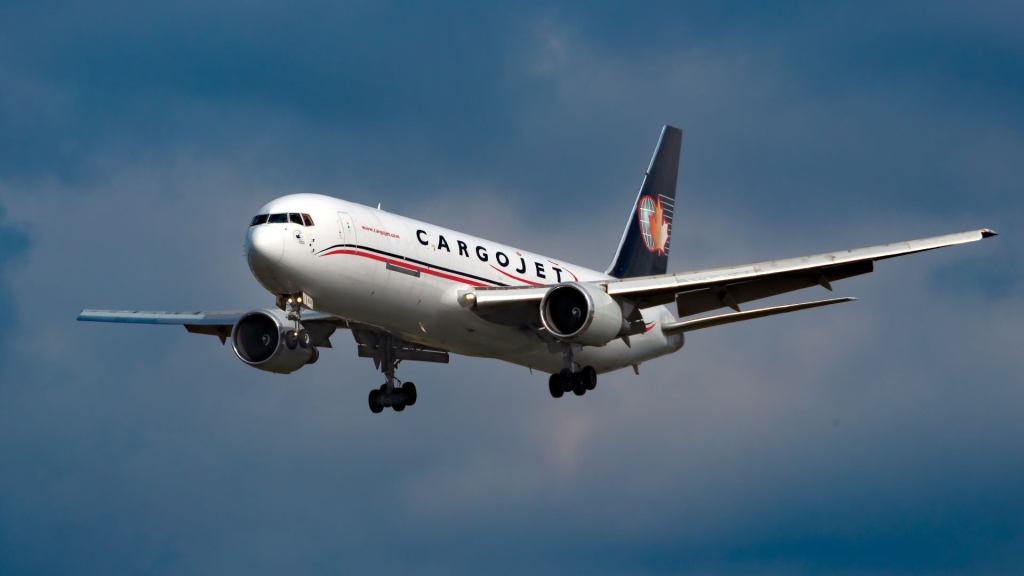
A large jet with blue tail approaches airport straight toward camera with wheels down.

Cargojet on Monday reported a US$25.8 million loss in the fourth quarter mostly related to fuel and noncash charges, capping a rocky year marked by slashed plans for major fleet expansion and a renewed focus on cost management to boost free cash flow and investor returns.

Despite recent retrenchment, the company sounded an optimistic note for 2024 with guidance of mid-to-high-single-digit growth in domestic overnight revenue for the first quarter. Management said that January figures were well above that, which could presage better full-year results if air cargo demand improves, as expected, as 2024 progresses.

The all-cargo carrier operates a domestic overnight network in Canada that supports large express delivery and e-commerce companies, and provides outsourced airlift for dedicated shippers. Its net loss worsened from $1.9 million during the same period in 2022.

Cargojet (TSX: CJT) operating revenue fell 5.75% year over year to $188.7 million, due to a 21% drop in revenue from fuel surcharges but stayed steady for the core flying business thanks to a modest rebound in demand that benefited all carriers in the second half of 2023. Lower jet fuel prices reduced the opportunity to charge additional fees above contract rates. 

Co-CEO Jamie Porteous, in his first earnings call with analysts since taking the top role at the start of the year, said Cargojet is seeing strong demand from customers buying transportation service with dedicated aircraft and crews, as well as ad hoc charter flights. The charter business produced $20 million in revenue during the fourth quarter, which is about $3.5 million to $7 million more than normal. Cargojet has spare 757s that can pick up extra flights or free up larger 767s for other assignments.

Higher demand from DHL Express, for example, meant that Cargojet operated 18 freighters during the recent peak season instead of the 15 that are under contract with the parcel giant, and DHL is retaining the extra aircraft for at least the first half of the year. 

Cargojet’s results were mostly in line with investor expectations. The positive momentum in demand mirrors the continuing signs of stabilization in the broader airfreight market, with preliminary data showing a 10% volume increase in January versus the prior year. 

Cargojet’s full-year net earnings fell $113.5 million, to $27.6 million. Earnings adjusted for interest, taxes, depreciation and amortization fell 9.3% to $222.7 million for the full year. Pre-tax earnings were down 43% to $11.7 million, largely due to interest expense for aircraft. Despite the decline, adjusted EBITDA is double what it was in 2019, before COVID, in large measure due to diversified lines of business such as dedicated contract transportation.

Cargojet reduced fourth-quarter flight activity by 7.4% year over year, which significantly decreased operating costs and, in conjunction with flat operating revenue, helped support profit margins in excess of 30%. Consolidating routes is a major way the airline improves efficiency when planes are not full.

“Given the challenging economic environment we faced, we are very pleased with our Q4 and full year results. 2023 was a transitional year for us as we moved from managing a period of hyper growth during the COVID-19 era to focusing on cost management and preparing the business to face the current economic environment,” Porteous in a statement that coincided with the earnings release.

He expressed confidence Cargojet can easily add 10% to 15% more revenue on the domestic network without increasing flight time.

Management said its continued emphasis on productivity gives confidence it can maintain profit margins.

Investment rethink

Cargojet executives admit they got caught up in the euphoria over sky-high demand and rates fueled by the pandemic, which continued midway through 2022 and led them to invest in aircraft bigger than any previously operated by the company.

But in response to a severe downturn in freight activity that extended until late 2023, and forecasts for the international airfreight market to remain soft for the short-to-medium term, the company unwound $739 million in capital expenditures by reversing course on aircraft investments, including for eight large Boeing 777 converted freighters. 

Last month it sold production slots for four used Boeing 777-200 aircraft it had planned to buy and convert into freighters after abandoning investments in four 777-300s. The airline said Monday it is trying to sell the 777-200s, one 777 simulator and two Beechcraft aircraft purchased for crew transport. It expects to recover the $85.7 million book value of the aircraft and complete the sale in the first quarter.

Cargojet in 2023 sold three 777-300s already purchased and canceled conversion orders for them. It took a $1.7 million loss on the resale of one 777-300 and a net loss of $1.6 million on the other two after receiving an insurance payment for severe hail damage. It also wrote off nearly $1 million related to construction for a 777 hangar that will no longer be used and sold four GE90 engines for $43.8 million.

Late last year, Cargojet said it would try to sell or lease four newly purchased Boeing 757 aircraft that were modified for dedicated cargo use and slowed plans to convert two used 767-200 aircraft to freighters until demand recovers. In Monday’s briefing with analysts, Chief Financial Officer Scott Calver said Cargojet only intends to offload two 757 jets after finding new work for two others in its existing network. Depreciation on the two surplus 757s are having a material impact on the bottom line until the company designates them for disposal. The other two freighters could also be activated if demand recovers faster than anticipated. Keeping the planes is a strong possibility because the market for used 757s is oversupplied and values are low.

Cargojet recently exercised an option to purchase one Boeing 767-300 coming off a lease. The airline now has a fleet of 41 aircraft — up from 34 at the end of 2022. A fleet table shows Cargojet plans one less unit this year after its lease expires and to stick with 40 freighters through 2026 after indicating three months ago that the fleet could rise to 46 aircraft by the end of 2025. But the fleet strategy is subject to change if revenue opportunities increase.

With two 767-200s and one 767-300 scheduled to be converted over the next three years, the planes could end up replacing older aircraft unless Cargojet experiences a spurt of new business and wants to utilize all available aircraft. 

Cargojet hasn’t permanently abandoned its dreams for 777 freighters, said founder and Executive Chairman Ajay Virmani. The company still retains four 777-300 conversion slots with Israel Aircraft Industries and is negotiating to defer them between three to four years, when market conditions are more conducive to growth.

“We don’t want to put it into today’s market where the yields are down and competition from widebody passenger aircraft is very, very substantial. So it will not be prudent to put them in. But since we have done a lot of work [developing technical manuals and feasibility studies], we have developed a lot of infrastructure around it, that keeps us at least looking at when the timing is right,” he said.

Adjustment in capital expenditures and other belt tightening helped Cargojet generate $28 million in free cash flow during the fourth quarter. The company doesn’t expect any meaningful capital expenditures for growth in 2024 and 2025 as it focuses on dividend growth, share buybacks and maintaining low debt leverage. A reduction in inventory levels for spare engines also helped to reduce capital spending on maintenance last year.

Cargojet’s total revenue actually fell an additional $24 million when including a one-time, noncash amortization of a stock warrant issued to Amazon. The warrants, issued several years ago, give Amazon the option to own about 15% of its strategic partner once certain commercial milestones are reached. Calver said the adjustment was made because revenue from new ground operations conducted for Amazon-controlled aircraft in Canada, which now amounts to about $29.5 million per year, does not qualify as an approved business line toward the warrant target.

Click here for more FreightWaves/American Shipper stories by Eric Kulisch.

Sign up for the weekly American Shipper Air newsletter here.

Jetran buys Cargojet rights for 777 freighter conversions
Cargojet reverses course on 777 freighter ambitions

Cargojet founder Virmani passes torch to co-CEOs

Isometric Technologies honors 50 transportation providers with service awards

Performance intelligence platform Isometric Technologies (ISO) announced Tuesday the winners of its third annual service excellence awards, recognizing the top 50 carriers by retailer, mileage band and region.

The ISO Excellence in Service Awards recognize the top 50 carriers based on the ISO Score, a composite performance metric comprising tender acceptance, on-time pickup and on-time delivery. Criteria for winners include having done at least 500 shipments in 2023, hauling for at least one ISO shipper (to qualify for the retail award) or earning an engagement score of greater than 0 on the ISO Scorecard.

The ISO platform compiles service data from over $18 billion in order revenue across various Fortune 1000 CPG, food and beverage shippers, evaluating more than 3,630 carriers.

Awards are categorized by region and retailer, with specific requirements for each, including minimum shipment counts and delivery locations. Mileage bands are defined to distinguish local, short-haul, regional, mid/long and long-haul carriers.

Award winners

The five top carriers by the retailer are Schneider National for Target, Tony’s Express Inc. for Costco, Buchanan Hauling and Rigging for Kroger, and C.H. Robinson for Amazon.

The five top carriers by mileage band are Tanager Logistics for local runs (0-50 miles), Universal Capacity Solutions for short haul (51-150 miles), Edge Logistics for regional runs (151-550 miles), Navajo Express for mid/long runs (551-1,000 miles), and Echo Global Logistics for long haul (1000-plus miles).

The five best carriers by region are Traffic Tech for Canada, Quickway Logistics for the Midwest, Legend Transportation for the West Coast/Southwest, DSV for the East Coast and Uber Freight for the Southeast.

The entire list of winners can be found here.

Also noted in the awards release:

  • Regional scores, in ascending order, are 75.41 for the West Coast/Southwest, 79.33 for the Midwest, 79.47 for the Northeast, 79.51 for the Southeast and 81.76 for Canada.
  • Average tender acceptance fell from 91.66% in Q1 2023 to 87.65% in Q4 2023.

ISO aims to pioneer benchmarking solutions for the freight industry, focusing on service quality assessment. Its platform empowers data-driven decision-making to enhance operational efficiency for shippers and brokers.

“We’ve made several strategic investments and will continue to forge and nurture partnerships to deliver standardized performance measurement and benchmarking to the industry …,” Brian Cristol, co-founder and CEO of ISO, said in the release. “Through initiatives like the ISO ‘Excellence in Service’ Awards, we aim to inspire the adoption of these standards, setting the stage for a future where every player in our global supply chain has a service reliability score, akin to a FICO for Freight.”


Uber Freight begins piloting the Scheduling Standards Consortium’s protocols

CloudTrucks launches new offerings, acquires Shipwell’s brokerage

OTR Solutions acquires back-office automation platform Epay Manager

Knight-Swift names Adam Miller new CEO, Dave Jackson steps down

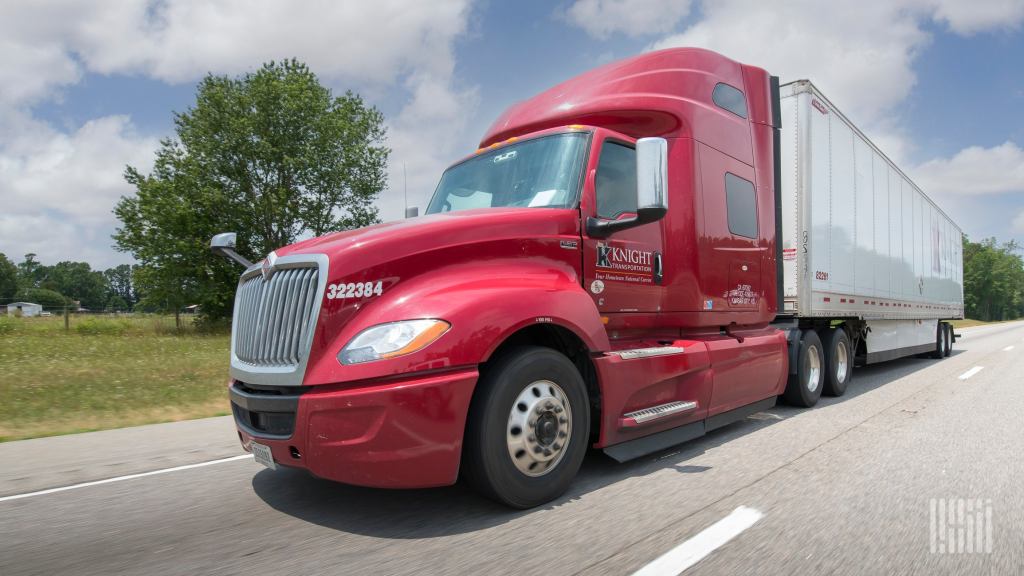
A Knight Transportation tractor pulling a Knight trailer

Knight-Swift Transportation announced Tuesday that President and CEO Dave Jackson has stepped down. He will be replaced by Chief Financial Officer Adam Miller.

The change follows multiple quarters of depressed results, largely due to a prolonged freight recession, but also as the company’s third-party insurance venture has been operating at a loss. The business, which brokers liability coverage to small carriers, has suffered from unfavorable claims developments and has struggled to collect premiums from carriers during the downturn.

The company said on its fourth-quarter earnings call that it initiated a process to exit the business. The unit booked a $71.7 million operating loss during the quarter. Knight-Swift’s adjusted earnings per share fell to $1.72 in 2023 versus a record of $5.03 during the 2022 peak.

Jackson has also left also left Knight-Swift’s (NYSE: KNX) board of directors.

“We are grateful for Dave’s service as CEO over the past nine years, a period that has been transformational for the Company and rewarding for our stockholders,” said Kevin Knight, Knight-Swift’s executive chairman. “Dave will always be part of the Knight-Swift family, and we wish him all the best.”

Miller joined Knight-Swift (NYSE: KNX) in 2002 and has held various roles with increasing responsibilities since. In addition to holding the top finance position, Miller was president at Swift Transportation, and secretary and treasurer of the combined company.

“Adam’s broad strategic, financial, and operating experience during his 22-year career at Knight-Swift has him well-prepared and ready to lead as CEO,” stated Knight in a news release. “During his tenure, he played leading roles in establishing Knight Refrigerated as a major player in its market, integrating Swift after the merger and improving its operations, service and profitability, while overseeing our capital structure and financial performance as Chief Financial Officer.”

Miller said he “will be intently focused on expanding our LTL footprint, improving consolidated margins, and generating free cash flow and stockholder returns.”

Andrew Hess will take over the role of CFO. He was previously the senior vice president of M&A where he was integral in the acquisitions of two less-than-truckload carriers and U.S. Xpress.

Morgan Stanley (NYSE: MS) analyst Ravi Shanker said the “news will likely come as a significant surprise to the Street,” noting the company’s “recent earnings trajectory has no doubt been disappointing,” during what he described as a prolonged downturn.

But Shanker said in the Tuesday note to clients that Jackson “deserves credit” for the company’s diversification into LTL, the U.S. Xpress acquisition and growth in the company’s logistics and intermodal offerings.

“We do not believe this change was precipitated by the discovery of bad news at USX or any other factor that would derail KNX’s current earnings trajectory,” Shanker said. “We believe the sudden and extreme step of a CEO change could be viewed by the Street as the Board showing urgency to put KNX back on a path to normalized EPS, which will be viewed as a positive.”

Satish Jindel, founder and president of ShipMatrix, echoed the sentiment in a statement to FreightWaves.

“I expect this change would lead to greater attention and speed for KNX’s investment in LTL, which has been slow after acquiring AAA Cooper Transportation in July 2021 and MME in December 2021,” said Jindel.

Knight-Swift added 14 terminals since the acquisitions and will be onboarding another 25 locations from defunct carrier Yellow’s (OTC: YELLQ) estate. In total, Knight-Swift could add roughly 35 new service centers to its LTL network this year.

Jackson has been CEO for the past nine years and president for the past 13 years.

“After nearly 24 years at Knight-Swift, it is time for a change and for the next generation to take the baton,” Jackson said. “Adam and Andrew are ready, the timing is right, the company is well positioned, and they have my full support. I look forward to my next chapter and to continuing to make a difference in the community.”

Shares of KNX were down 1.9% Tuesday at 11:52 a.m. EST compared to the S&P 500, which was flat.

More FreightWaves articles by Todd Maiden

White Paper: The State of Freight – February 2024

This monthly report analyzes the current state of the freight market based on critical insights from our SONAR platform. February’s session includes an overview of current freight market conditions and macroeconomic trends, along with a forward look at spring. All insights are provided by FreightWaves’ Craig Fuller, Founder and CEO, and Zach Strickland, Head of Freight Market Intelligence.

The report’s key topics include:

•    How are the new RFP awards performing?

•    Shipper purchasing intentions moving into Q2

•    How long can carriers weather the current market?

This recap is a takeaway from our monthly State of Freight webinar series that offers expert industry insights, previously made available only to subscribers of FreightWaves’ supply chain analytics and high-frequency data platform, SONAR.

To download the full white paper and access our latest insights, complete the form below.

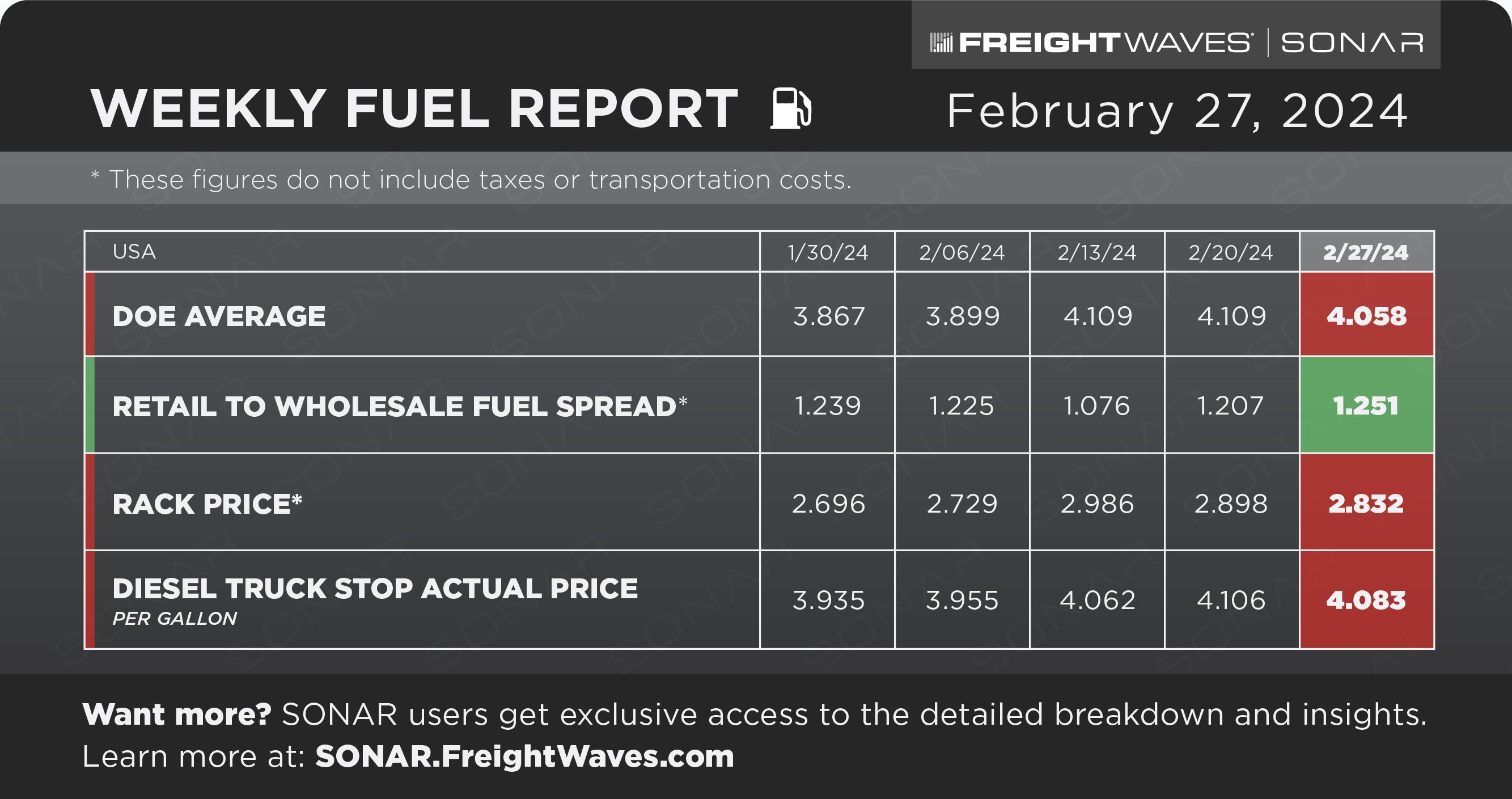
Weekly Fuel Report: February 27, 2024


Learn more at SONAR.FreightWaves.com

Mexico offers attractive alternative for manufacturers exiting China

After experiencing serious port inefficiencies, long coronavirus-related shutdowns and an increasing loss of labor in China, a broad range of manufacturers have committed to moving their facilities away from the country. Many of these companies hope to bring their factories closer to their U.S.-based end consumers, reducing supply chain friction. 

The right combination of proximity and price makes Mexico an attractive choice for these manufacturers. As companies begin their nearshoring efforts, they will need to develop strong relationships with the right cross-border partners to ensure success.

Tri-National has positioned itself to be that partner, boasting over 30 years of nearshoring experience. The company offers multiple Texas border crossing options and provides door-to-door service to and from Mexico without transloading. This allows freight to remain on the same GPS-enabled trailer from origin to destination, saving shippers a significant amount of time, money and frustration.

TNi’s offerings don’t stop there. The company offers warehousing, cross docking, transloading and inventory management in the South Texas area.

“TNi provides short- and long-term storage solutions via our large consolidation and warehousing facility in Laredo,” TNi Director of Corporate Business Development and Logistics Brad Colvin said. “For import or export, we have warehouse space and the manpower to seamlessly cross dock and transload.”

TNi Laredo offers quick access to both the World Trade and Colombia-Solidarity bridges. Additionally, warehousing and consolidation options are available via Tri-National’s Pharr/McAllen facility.

The company’s expansive presence and wide range of offerings — coupled with decades of experience — set it apart from its competitors. Colvin encouraged shippers to look into any potential partner’s expertise before jumping into an agreement.

“Our recommendation is to seek out a shipping partner that has the infrastructure, personnel and expertise to successfully navigate cross-border/nearshoring challenges,” Colvin said. “Flexibility is also a key component. Our facility footprint and our 100% asset fleet affords us the ability to meet the ever-changing needs of production schedules and customer demand.”

Choosing the right — or wrong — cross-border partner has the power to impact virtually every aspect of a manufacturer’s journey into Mexico. While the right partner can make navigating a new work culture and handling customs feel like a breeze, the wrong partner may fail to prepare companies for critical differences between their current and future circumstances, leading to lost revenue and increased red tape.

Demand for cross-border and nearshoring services is growing rapidly. TNi is confident in its ability to continue meeting customers exactly where they are during this influx. 

“Tri-National operates 24/7, 365 days a year,” Colvin said. “We are growing our staffing to keep our services continuously operating without interruption.”

Click here to learn more about Tri-National.

White Paper: Q1 2024 Shipper Rate Report

The Shipper Rate Report—presented in partnership with U.S. Bank and BlueGrace Logistics—is a quarterly publication using freight payment data from U.S. Bank in conjunction with FreightWaves SONAR data sets to create the most in-depth rate and demand outlook for shippers. The insights within this paper are curated by the market experts at FreightWaves and backed by the proprietary data and analytics housed in FreightWaves’ SONAR platform.

Featured insights for Q1 2024 include:

  • Insights from the latest U.S. Bank Freight Payment Index
  • U.S. consumer spending trends
  • Q4 2023 review on rates, volumes and capacity
  • Trucking forecast for Q1 2024

Complete the form below to download your complimentary copy.

BMO’s Q1 earnings show more credit deterioration in trucking industry

There are numerous ways of looking at the quarterly data from Canada’s BMO on the credit health of the trucking sector. None of them are positive.

Canada’s BMO is a major lender to the trucking industry in North America. In the bank’s first-quarter 2024 earnings released Tuesday, BMO’s gross impaired loans and acceptances, where BMO has identified a loan it believes it may be unlikely to recover, soared to CA$230 million ($170 million) up from CA$170 million a quarter earlier and CA$82 million a year ago.

In the best days of the freight market through 2021 and into 2022, that number was less than CA$80 million for four consecutive quarters.

BMO’s (TSX: BMO.TO) first fiscal quarter ended Jan. 31.

The previous high for gross impaired loans at BMO’s transportation group was CA$189 million in both the second and third quarters of 2020. Although the bank of business in the first quarter of 2024 was larger than back in 2020, the size of the impaired loans as a percentage of the bank of business was higher in the just-completed quarter.

Write-offs at the BMO transportation group were CA$31 million. That was up more than CA$50 million from the CA$20 million recorded in the fourth quarter of fiscal 2023. Write-offs were just CA$1 million as recently as the second quarter of 2022.

The CA$31 million in write-offs is not the highest in BMO transportation group history. The figure reached CA$33 million in the third quarter of 2017, when the book of business for the group was just CA$10.1 billion compared to the current book of business near CA$15 billion.


The BMO data lists net impaired loans and acceptances, which are the gross impaired loans (CA$230 million) minus the write-offs (CA$24 million) that have been taken, as CA$206 million. That is up from CA$170 million one quarter earlier and CA$82 million a year ago. 

The size of the book of business at BMO’s transportation group dropped significantly, though from an all-time high.

Gross loans in the transportation sector were CA$14.88 billion, down from CA$15.67 billion in the fourth quarter of fiscal 2023. But the size of the gross bookings was still the second-largest in the history of BMO’s ownership of the transportation group, which it acquired from GE Capital in late 2015, with the prior quarter being the only one with a bigger book of business.

BMO is believed to have more than 10,000 customers in its transportation sector, large and small, so its quarterly report on the performance of the transportation group can be viewed as a proxy for the larger health of trucking credit.

As an example of how much the scope of impaired loans can change in an industry going through volatility, the quarterly earnings of BMO for the first quarter listed oil and gas impaired loans at CA$21 million. In the third quarter of 2020, when the price of oil had plunged at the start of the pandemic, that size of gross impaired oil and gas loans at BMO was CA$761 million. 

More articles  by John Kingston

Live on stage: The complex relationship between a trucking job and life

Pilot’s drop in profits led to lower valuation in final Berkshire purchase

If truckers haul bread and cakes, is their business baking or trucking?

Daily Infographic: Highway-rail grade crossing collisions – Top 25 states


To view more FreightWaves infographics, click here

In quieter diesel market, benchmark price moves down just over 5 cents

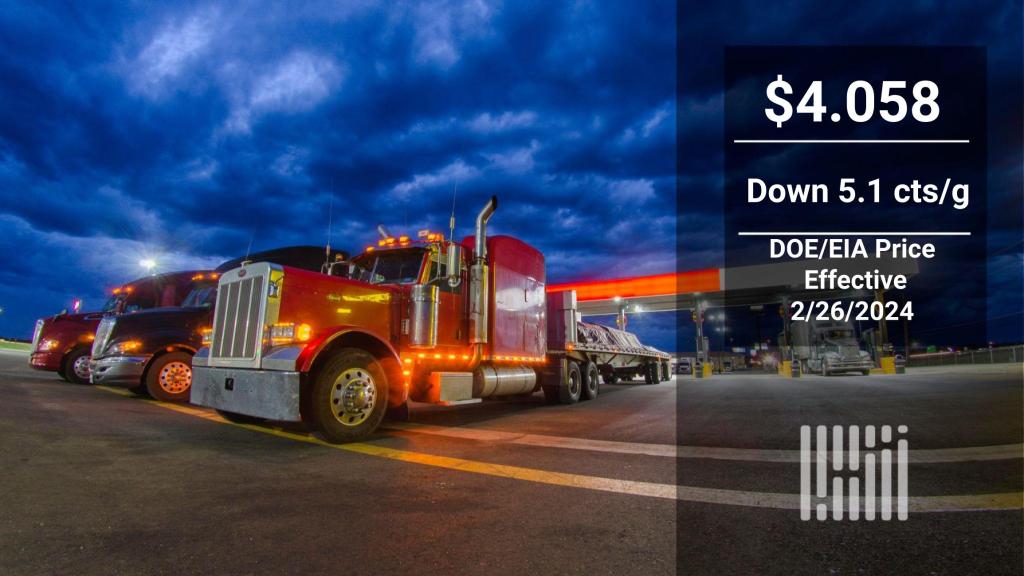
After a big upward move of 21 cents a gallon two weeks ago and a price that didn’t move last week, the weekly Department of Energy/Energy Information Administration average weekly retail diesel price moved down in its latest posting. 

The size of the 5.1-cents-a-gallon drop was somewhat surprising, given other indicators that suggested the decline might be more moderate for the price that serves as the basis for most fuel surcharges.

The small movement in recent weeks, except for the 21-cent barn burner, contrasts sharply with the volatility of the weeks prior to that.

Since an upward 2 cents-per-gallon move on Dec. 25, the changes, up or down besides the 21-cent shift, have ranged from negative 4.8 to positive 3.5 cents a gallon. The 5.1-cent move this week was larger than those other recent changes.

By contrast, during a long run of mostly negative price moves just prior to that, changes were regularly above 5 cents a gallon and a few times reached 9 or 10 cents.

Oil prices in general have been experiencing a run of relative stability. Since the world crude benchmark Brent broke above $82 a barrel on Feb. 9, the daily settlement has ranged from a low of $81.50 to $83.47 a barrel. It’s been a tight trading range.

The trading range in ultra low sulfur diesel (ULSD) on the CME commodity exchange has not been as tight but has been trending more downward. After a brief two-day foray above $2.90 a gallon on Feb. 9 and 12, the downward trend pushed the settlement to $2.6897 a gallon Friday before it popped up 7.3 cents per gallon Monday. 

Although the futures market has been mostly lower in the past week, there has been strength in physical markets in the U.S. In the various regional markets, diesel is traded as a differential to the CME ULSD price, for barrels delivered in a barge or by pipeline.

Many of those markets just a week ago had been trending lower but in some cases have reversed. Diesel on the Buckeye pipeline, which runs from the Midwest into Ohio and Pennsylvania, was minus 8 cents under the CME ULSD price Monday, according to DTN, after being minus 20 cents on Feb. 20.

The Chicago market saw similar strengthening, to minus 14 cents a gallon Monday from minus 25 cents a gallon Feb. 16. The Gulf Coast movement was from negative 0.825 cents a gallon on Feb. 21 to minus 4.75 cents a gallon. 

The Los Angeles market actually weakened, moving from plus 10 cents a gallon on Feb. 13 to plus 2 cents a gallon Monday.

The oil market isn’t getting much news either way to make a significant move. For example, one of the “big” stories Monday — though it wasn’t that big — was that Goldman Sachs increased its forecast for Brent this summer by all of $2 a barrel to $87 a barrel. According to an article from Reuters, Goldman cited its belief that OPEC+ will continue its existing production cuts, which Reuters said would keep the market in a “moderate” deficit.

Its forecast for 2025 is an average of $80 a barrel.

The tension in the Middle East becoming a bullish factor was the underlying theme of an article published by Bloomberg over the weekend that suggested the diversion of oil shipments away from the Red Sea/Suez Canal combination is still out there as a possible upward push for oil prices.

That the diversions could be bullish was always a possibility, though it has not had much impact so far. The concern that it would raise prices comes not from a loss of any supply. Rather, it was always that the longer transit times would take oil off the market for a longer period of time than normal, which works to tighten supply.

In the article, Bloomberg highlighted that the lengthier transit times ultimately mean more demand for tankers and that there is little new supply coming this year.

According to Bloomberg, “just two new supertankers are due to join the fleet in 2024 — the fewest additions in almost four decades and about 90% below the yearly average this millennium.”

“But after owners increasingly started to shun the southern Red Sea, the lack of new capacity is starting to bite: rates have seen spikes, and voyage durations are going up.”

More articles by John Kingston

Pilot’s drop in profits led to lower valuation in final Berkshire purchase

If truckers haul bread and cakes, is their business baking or trucking?

State of Freight takeaways: Is a weak February the bottom of the cycle?