Teamsters ousted at Dr Pepper Wisconsin, face off against Anheuser-Busch

(Editor’s note: a statement from Anheuser Busch received after the article’s original publication has been added.)

The Teamsters have been ousted from representing a group of beverage drivers in Wisconsin while a much larger strike in the beverage world looms.

The union also ended a strike against U.S. Foods in recent weeks with a contract that even the Teamsters for a Democratic Union, a group within the union that is often critical of elected leadership, hailed as a victory. 

The events occurring in such a short period of time are testimony to the fact that the largest union representing transportation workers swings back and forth between victory and defeat. 

And while there have been more victories than defeats of late, the ouster of the Teamsters by three separate groups of workers of Keurig Dr Pepper in Wisconsin was notable in that it was coordinated across more than one facility. 

Votes to decertify the Teamsters have tended to come at individual facilities, like the vote last year to oust the union at the Miami area warehouse of XPO Logistics (NYSE: XPO), the site of the first contract XPO signed with the Teamsters.

The National Right To Work Committee, which works alongside workers looking to decertify existing unions, said workers and drivers and warehouse workers in Oshkosh, Eau Claire and Tomah voted late last month to decertify the Teamsters at those facilities.

What’s notable about the decertification is not just that it occurred at three locations but that the union had been in place for many years, according to Ray Cotts, a Keurig Dr Pepper worker who began the process that led toward decertification. 

Union decertification often takes place among workforces where a representation vote is followed by a lengthy unsuccessful negotiations to produce a contract. Union critics will often cry that decertification votes occur after management drags its feet in negotiating a contract, and then rank-and-file workers see their paychecks shrink due to union dues deductions without any benefits to show for it.

But that was not the case in Wisconsin, according to a statement released by the Right To Work Committee on Cotts’ behalf.

“Local 200 has been representing us for the entire 20 years I’ve been working here, and in that entire time, we’ve had four contracts,” Cotts said in the statement. “All four have been poor. Constantly getting five-year contracts, which are of no benefit to us employees. Poor vacation, poor pay, subpar benefits, no real job protections. Our contract wages were way below standard for our industry.”

That defeat is set against a landscape for the Teamsters that would otherwise be leaning toward successes, but with a big battle coming soon.

The Teamsters wrapped up 2023 — the year it signed a new deal with UPS that consensus held was a big win for the union — with several smaller contract and representation victories.

Celebrating a deal at a big food processor

After a strike, the Teamsters recently signed a new contract at food distributor US Foods (NYSE: USFD). The strike, which began in early January and lasted roughly three weeks at the company’s warehouse outside Chicago, eventually saw sympathy picket lines go up at other US Foods facilities.

Details of the contract were not available. But when the end of the strike and the new deal were announced, the union said it had “achieved significant wage increases, enhanced health benefits, improved pension contributions, and critical safety measures — all without any concessions. In addition, US Foods has retracted its proposal to weaken the standard for terminating our drivers for accidents.”

The normally critical Teamsters for a Democratic Union said of the contract with US Foods that the company had “agreed to significant wage increases, enhanced health benefits, higher pension contributions, and enhanced safety measures. Members gave up no concessions and defeated a company demand to make it easier to fire drivers for accidents.”

US Foods did put out a public statement about the deal, saying it was a five-year agreement. The contract “build[s] on the highly competitive offerings drivers in Bensenville, Ill., currently receive, and includes safety enhancements aligned with the very high priority the company places on associate safety.”

Victory at a Ryder unit

The Teamsters also recently won a small representation election at a unit of Ryder System (NYSE: R). 

According to a National Labor Relations Board posting, workers at the Perrysburg, Ohio, facility of Ryder Integrated Logistics voted in late January to be represented by Teamsters Local 20. The vote was 23-11. (The workers affected total 41. Vote totals can differ from the number of eligible workers due to some workers not voting.)

The NLRB summary of the vote described all the eligible workers as drivers.

A Ryder spokeswoman said Ryder Integrated Logistics is part of the company’s Supply Chain Solutions segment but can also provide dedicated transportation services through Ryder’s Dedicated Transportation Solutions segment. 

The spokeswoman said the company has about 3,700 union members out of 31,900 hourly employees. They are organized by the Teamsters as well as the International Association of Machinists and the United Auto Workers. 

A potentially huge strike at Anheuser-Busch

The next big showdown for the union is coming at Anheuser-Busch, where a strike has been authorized by the workers after the current contract expires March 1.

So far, the two sides cannot agree on whether negotiations are even ongoing; according to a news report from a television station in St. Louis, the headquarters city of Anheuser-Busch, the company says talks are occurring, but the union says they are not. (A page on the company’s website devoted to the Teamsters negotiations does not provide a recent update on the state of negotiations.) 

A statement sent to FreightWaves from the brewer did not directly address the state of negotiations. “Since the bargaining cycle started in September, Anheuser-Busch has consistently and diligently worked to secure a contract that recognizes and rewards our hardworking employees and prioritizes long-term security for the best jobs in the beer industry; as a precautionary measure, we have a robust continuity plan in place to ensure we will continue bringing our industry-leading brands to our valued customers and consumers across the country,” the statement said.

Anheuser-Busch says there are more than 5,000 Teamsters members employed by the company in the U.S. Not all are drivers; workers in the breweries are Teamsters members as well.

Teamsters General President Sean O’Brien, never one to mince words, said in a recent statement that a strike at Anheuser-Busch’s refineries appears “imminent and unavoidable.”

“This company has got to get its priorities straight,” O’Brien said in a posting on the Teamsters website. “With its actions during negotiations this week, Anheuser-Busch made clear it is hellbent on destroying American jobs. They can throw billions of dollars at Super Bowl ads and Wall Street, but they can’t seem to bargain a contract that respects the Teamsters who do the real work inside these breweries. They have a harsh reality awaiting them when Anheuser-Busch breweries are empty, and Teamsters are on the streets.”

More articles by John Kingston

Teamsters celebrate NLRB decision in STG Logistics, see path to greater unionization

Drivers oust Teamsters at Home Depot subsidiary in California

A first for Werner: Small group of workers votes to unionize
Universal Logistics sees potential back-half uptick in freight volumes

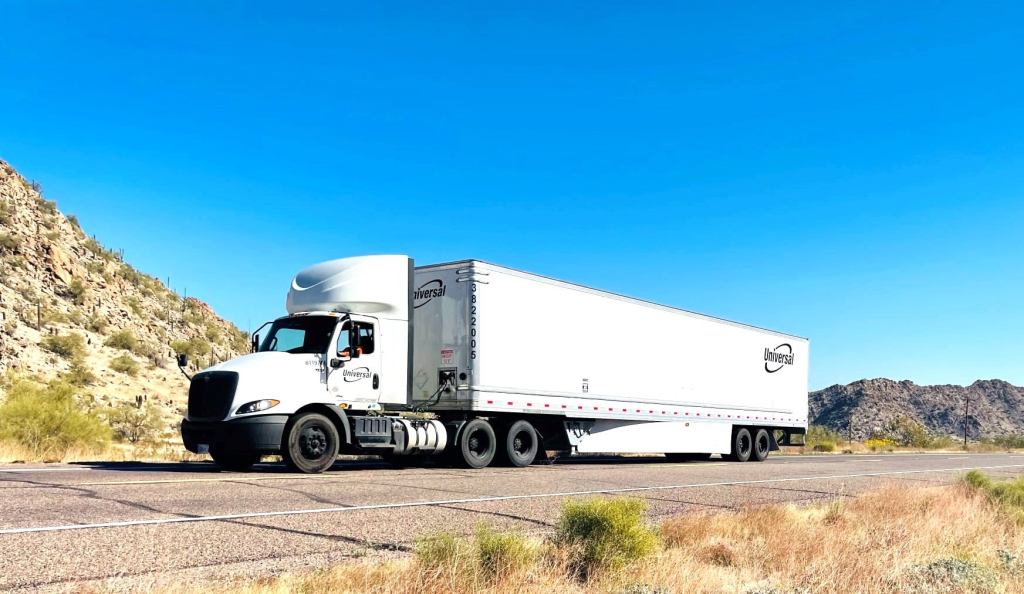
Universal Logistics Holdings Inc. surpassed Wall Street expectations in the fourth quarter, despite revenue decreases across the firm’s trucking, intermodal and brokerage segments.

“The outlook for 2024 remains a bit murky with a variety of signals from various market verticals,” Tim Phillips, CEO of Universal Logistics Holdings, said in a call with analysts on Friday. “We’re not ready to predict a rise in volume from the current environment. We can explore potential pathways through the lens of our customers. The prognostication throughout the earning season favors an uptick in the second half of 2024, which we also believe to be a possibility.”

Universal Logistics (NASDAQ: ULH) reported total operating revenue of $390.9 million in the quarter, a 14.8% year-over-year (y/y) decrease. The company beat Wall Street analysts’ revenue estimates of about $377.3 million.

Fourth-quarter earnings per share was 81 cents, a 36% y/y decrease compared to the same year-ago quarter. Earnings per share exceeded Wall Street estimates of 71 cents in the quarter.

Universal Logistics is a Warren, Michigan-based truckload transportation, intermodal and logistics provider across the U.S, Mexico, Canada and Colombia. The company has more than 10,000 employees.

The company reported fourth-quarter and full-year 2023 earnings after the market closed on Thursday. Full-year operating revenue was $1.66 billion, an 18% y/y decrease compared to 2022.

Revenue from truckload services in the fourth quarter decreased 15% y/y to $46 million, from $54 million for the same period last year. Full-year 2023 truckload revenue came in at $213.8 million. 

The decrease in truckload services reflects a drop in the number of loads hauled, the company said. During the fourth quarter, Universal moved 43,468 loads compared to 45,233 during the same period last year, a 14% y/y decline.

The average revenue per load excluding fuel charges in the quarter was $1,673, a 9% y/y decline compared to 2022. The average number of tractors in the trucking segment declined 7.8% y/y to 828, while average length of haul decreased 5.7% y/y to 399 miles. 

“As a whole, Q4 productions of Class 8 truck plants we service were negatively affected by the UAW strike and estimated to have cost the companies somewhere in the neighborhood of $2.2 million in mixed operating income,” Phillips said.

Universal’s fourth-quarter intermodal revenue decreased 31% y/y to $85.4 million, continuing to be affected by lower import volumes on the West Coast, Phillips said. Full-year intermodal revenue was $375 million, a 37% y/y decrease.

In the fourth quarter, intermodal load count was up 1.8% y/y at 118,553. The number of tractors in the segment declined 22% y/y to 1,830.

“Pricing and volume continue to be the storyline with a slight sequential deterioration of revenue,” Phillips said. “While load count was up 1.8%, this was more than offset by a 19.9% y/y decline in revenue per load excluding fuel, as the market remained extremely competitive.”

Brokerage services decreased 23% y/y to $58.1 million during the fourth quarter due to strong headwinds in the trucking industry, Phillips said. Full-year 2023 brokerage revenue declined 34% y/y to $244 million.

“A sluggish freight environment with a muted peak season led to an extremely competitive spot freight environment in the quarter,” Phillips said. 

Universal Logistics’ dedicated segment reported revenue of $85.5 million in the fourth quarter, a 3% y/y increase. Full-year revenue increased 5.9% y/y to $344 million. 

“In our contract logistics segments, the number of active value-added programs continued to increase and finish the quarter at 71 programs,” Phillips said. “We continue to launch new programs in a variety of verticals.”

For 2024, Universal Logistics’ capital expenditures will be in the $480 million to $500 million range.

“Included in our capital expenditure estimate are two large contract logistics projects that require an upfront capital investment totaling $220 million,” Jude Beres, Universal Logistics CFO, said during the call. “We anticipate making this investment over the course of 2024 in anticipation of having these programs ready for a Q1 2025 launch. These two projects account for nearly half of our total anticipated 2024 guidance.”

Beres also said they are expecting to invest $70 million in strategic real estate purchases and facility upgrades for the company’s terminal network.

“These upgrades will primarily support our intermodal operations,” Beres said. “The remaining $200 million or so will be for rolling stock, which includes tractors and trailers, as well as material handling equipment.”

In January, Universal Logistics announced a $50 million expansion into the greater Roanoke, Virginia, area to increase its market share in the Class 8 truck parts logistics sector.

Universal Logistics announced Thursday that its board declared a cash dividend of $0.105 per share of common stock. The dividend is payable to shareholders of record at the close of business on March 4 and is expected to be paid by April 1.

Universal Logistics HoldingsQ4/23Q4/22Y/Y % Change
Operating Revenue$390.9M$458.7M(14.8%)
Operating income$34.1M$48.1M(29.2%)
Operating margin %8.7%10.5%(17%)
Trucking$75.2M$88.9M(15.5%)
Intermodal $85.4M$123M(30.6%)
Contract Logistics$201.3M$205.5M(2%)
Company-managed brokerage$28.1M$39.5M(29.1%)
Earnings per share$0.81$1.27(36.2%)
Universal Logistics key performance operators.

Amazon and the FTC don’t agree on much

FTC, Amazon far apart on lawsuit issues

(Federal Trade Commission)

It’s clear from the latest on the Federal Trade Commission lawsuit against Amazon that (1) it’s likely to be ongoing for a long time, and (2) the parties don’t agree on much. The FTC asked the court to set a deadline to start the trial in May 2026, while Amazon asked for a December 2026 start date. What takes so long is the massive scale of the information involved — upwards of 100 terabytes’ worth, or the equivalent of 50 million pages.

The FTC says Amazon is abusing a monopoly position that harms consumers; Amazon says it lowers prices for consumers. The FTC wants to depose over 100 Amazon witnesses while the retailer wants it limited to 10. The FTC claims that Amazon illegally destroyed documents, which Amazon denies. Amazon claims that its practices are common in the retail industry, which the FTC disputes. Amazon believes that Project Nessie (the algorithm by which Amazon predicted competitors’ pricing actions in response to its own) should not be part of the lawsuit because it was shut down in 2019 — despite its being the topic of many of the pages of the FTC’s lawsuit.

The FTC is presumably seeking an unwinding of the Amazon practices that it takes issue with. Therefore, if the FTC’s lawsuit is successful, it could result in requirements such as Amazon not being able to punish third-party sellers for refusing to buy advertising space or offering lower prices on competing online marketplaces. Also, Amazon might not be able to require the use of its own fulfillment centers in order to qualify for Prime. Therefore, the lawsuits have implications for Amazon suppliers — currently, many manufacturers of consumables struggle to sell profitably on Amazon due to its myriad of rules and fees.

Cocoa prices break records

(Chart: Barcharts.com Inc.)

Cocoa prices have more than doubled in the past year and are up 37% year to date, breaking all-time records set in 1977. Cocoa supplies are constrained from harsh growing conditions in West Africa, where most cocoa is grown. Challenges have included massive rains, dry spells, pests and diseased crops.

CPG companies that buy cocoa are also major purchasers of sugar, another commodity that remains at historically high levels (although sugar prices peaked in November). For some CPG companies, this will lead to margin pressure and to asking retailers for yet another round of price increases. Barron’s expects that Hershey could face a 30%-90% increase in cocoa costs, depending on its inventory and forward coverage. The company reported earnings last week, and the impact could be seen in its forward guidance. Hershey expects its fiscal 2024 earnings to be flat despite an expected 2%-3% growth in sales due to 200 basis points of expected margin pressure as input costs rise faster than costs are passed on.

Retail prices don’t move as quickly as commodity prices do, so last-minute Valentine’s Day shoppers were not impacted. However, consumers may have sticker shock when it comes time to buy sweets later in the year.

Ocean bookings data suggests continued import volume strength

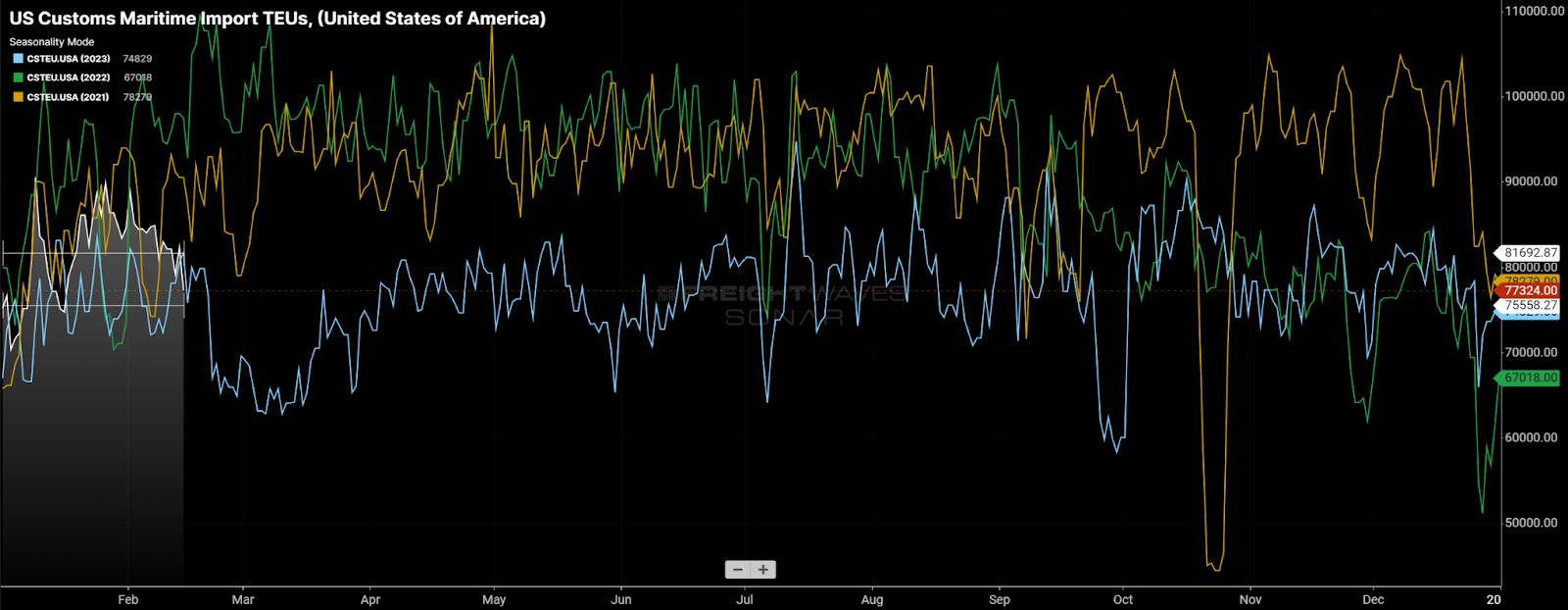
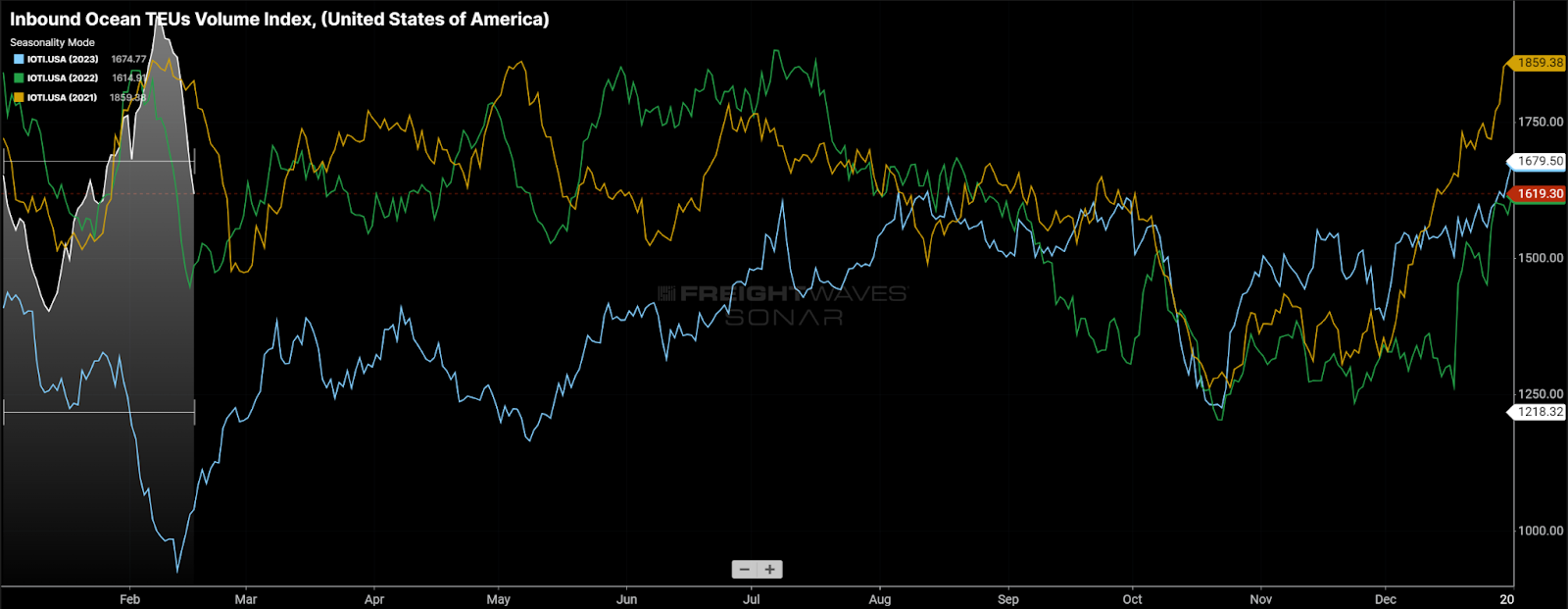
SONAR tracks the volume of containerized imports passing through U.S. Customs via the CSTEU.USA data set and also measures containership bookings at point of overseas origin via the Inbound Ocean TEU Volume Index (IOTI.USA). 

Containerized maritime import twenty-foot equivalent units (CSTEU.USA) are up 8% y/y year to date, and the SONAR Inbound Ocean TEUs Volume Index (IOTI.USA — shown below) is up 38% y/y year to date, against an easy year-ago comp. In contrast to last year, ocean booking volume at point of origin showed a sharp seasonal spike in recent weeks right before Chinese New Year in a manner similar to 2021 and 2022. The healthy bookings volume appears to reflect retailers’ efforts to replenish inventory levels — the retail inventory-to-sales ratio was just 1.17 in December, well below the ratios of 1.4-1.5 that were more normal before the pandemic.

To subscribe to The Stockout, FreightWaves’ CPG and retail newsletter, click here.

Air Canada says freight demand beginning to improve

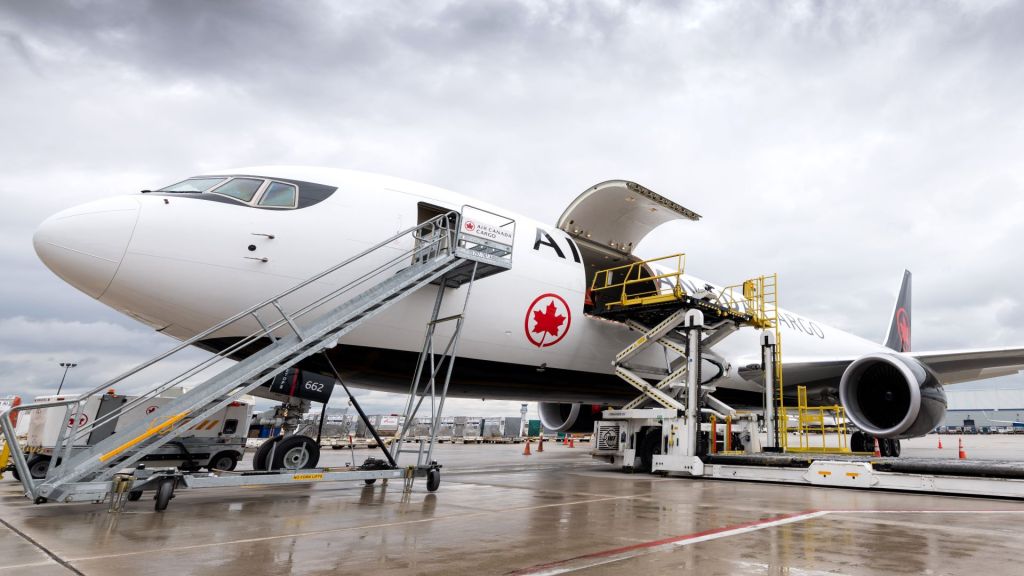
An Air Canada cargo jet with black underbelly gets loaded through side door.

Air Canada expects the slow recovery in cargo volume that began in the fourth quarter to quicken in 2024, aided by the addition of two more freighter aircraft, but doesn’t anticipate gains in pricing power, Mark Galardo, executive vice president for network planning and revenue management, said Friday.

The cargo division within Air Canada (TSX: AC) currently operates five converted and two factory-built Boeing 767-300 freighters. It is scheduled this year to receive two cargo jets converted from passenger configuration, but delivery of a third plane has been delayed until 2025 because of lingering supply chain and labor challenges faced by aerospace manufacturing companies, said Galardo on the company’s fourth-quarter earnings call.

The company nonetheless expects cargo capacity to increase 6% to 8% this year with the addition of the two freighters and more passenger aircraft that also carry cargo. The converted freighters are retired Air Canada passenger jets that are being retrofitted by aftermarket aerospace firms for carrying large containers in the main cabin area.

Cargo revenue fell 15% year over year in the fourth quarter to US$181 million on soft demand and lower yields, Air Canada reported. The three-month period represented an improvement from prior months as the downturn in freight transportation that gripped the air logistics industry for nearly 18 months began to ease. Full-year cargo revenue fell 27% to $682 million.

At the end of 2023, Canada’s flag carrier operated four more 767 freighters than at the end of 2022. Freighters were reintroduced at the company two years ago. Increased freighter operations to Central and South America and to Europe partially offset the year-over-year decline. Air Canada also enhanced its interline cooperation with Emirates SkyCargo, which allows customers to book interline cargo shipments through the Emirates SkyCargo flights, including between the Americas and Southeast Asia and India, through key European hubs. 

“We had a bit of a slower start in January, but as we look into February and beyond we’re starting to see volumes pick up and yields also pick up. And our 2024 assumption on cargo is more volume-driven than yield-driven. So we’re starting to see some positive indicators,” Galardo told analysts. “We’ve taken all the necessary measures to position ourselves to take advantage of the recovery. This includes strategically adjusting our freighter plan so that we can keep focusing on proven overall results for the long term and on maximizing cargo network value for our entire fleet.”

Air Canada in late September canceled an order with Boeing for two 777-200 production freighters because of the reversal in airfreight demand following the pandemic-fueled boom for air transport that lasted until early 2022. It then ordered 18 787-10 Dreamliners, including two that were swapped for the 777 freighters. Management, at the time, reiterated its commitment to operating freighters, saying that it needed to take a more measured approach to fleet expenditures and keep more cash available for other purposes.

Air Canada expects another leap in cargo business when the 787-10s begin entering the fleet in late 2025. But ongoing safety and manufacturing problems at Boeing could upset the delivery schedule. Production flaws have previously prevented customers from receiving Dreamliners on time.

“As we eventually receive the larger 787-10s, taking advantage of global cargo flows through our hubs will become an important lever for further diversifying revenue streams,” said Galardo. 

Air Canada performed well on cargo against its peers during the fourth quarter. Delta Air Lines and American Airlines saw cargo revenue slide 24% during the period, and Korean Air said its cargo sales fell nearly 29%. The percentage change in revenue at Air Canada was on par with the 14.8% decline at United Airlines. On a total dollar basis, Air Canada cargo revenue was less than that of the other carriers. The three major U.S. airlines are much larger than Air Canada but also do not have a dedicated cargo fleet. Delta was the closest to Air Canada at $188 million in revenue.

Overall, Air Canada generated $3.9 billion in revenue, up 11% from the prior year, during the final three months of 2023. But earnings before interest, taxes, depreciation and amortization of $386.4 million came in below expectations. On an adjusted basis, the company lost $32.6 million versus a loss of $162 million the year before. Higher wages, maintenance costs and flying volumes pushed expenses up 8%. Inflation is expected to increase costs another 4.5% to 5% in 2024, offset in part by productivity gains.

(Correction: An earlier version of this story understated Air Canada’s full-year cargo revenue.)

Click here for more FreightWaves/American Shipper stories by Eric Kulisch.

Sign up for the weekly American Shipper Air newsletter here.

Air Canada reaffirms cargo commitment after 777 freighter cancellation

New Air Canada freighters help offset decline in cargo revenue

Running on Ice: Life sciences on the move

Blue Truck on a sheet of ice over a blue background and Running on Ice Logo

All thawed out 

(Photo: Jim Allen/FreightWaves)

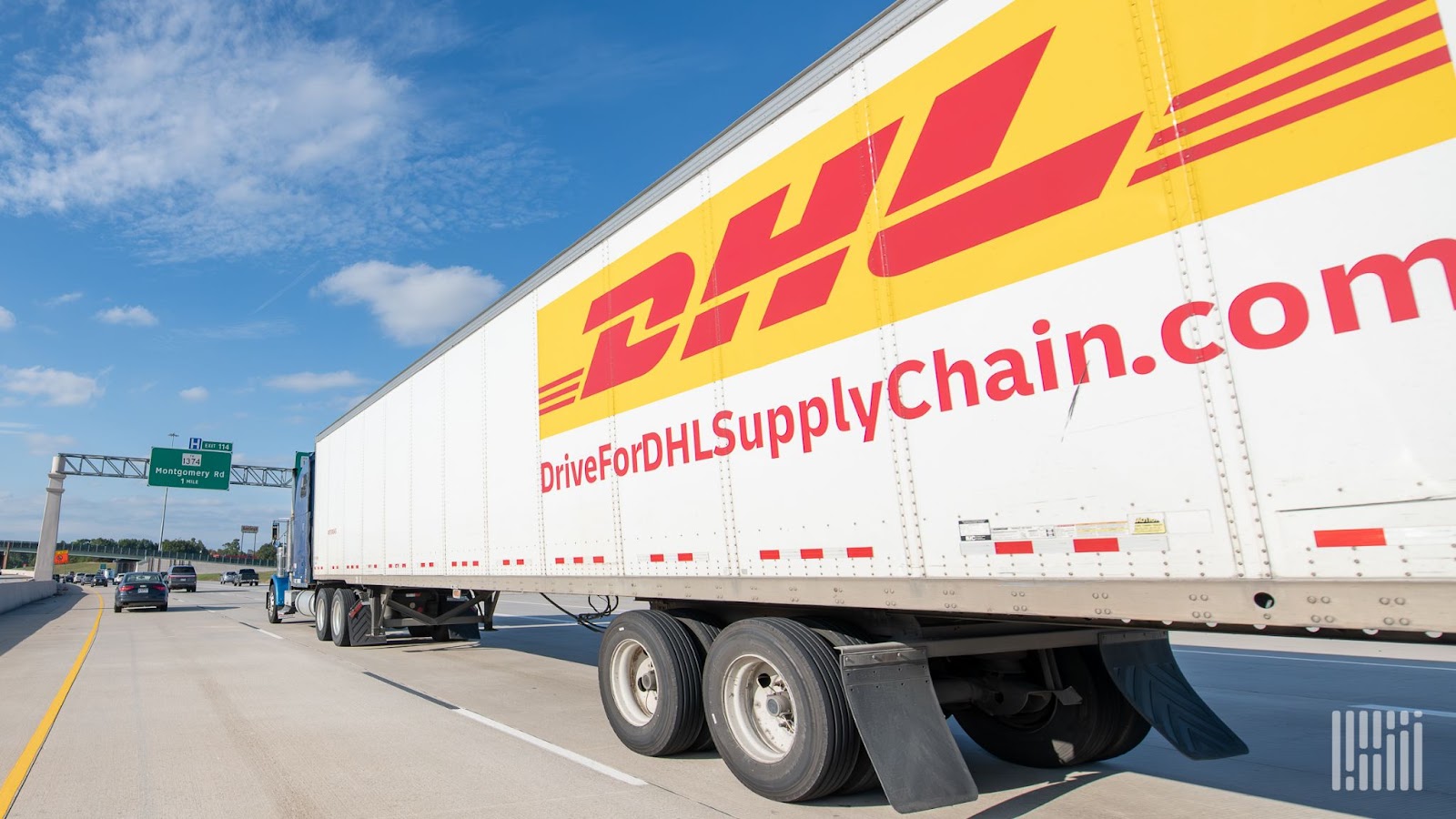
Life sciences as a cold chain development is getting tossed around more and more as the year kicks off. Most recently DHL Supply Chain announced it was investing $200 million to expand health care and life sciences capabilities in the U.S.

This investment will include five more warehouses by the end of the year. The warehouses will be built in Pennsylvania and North Carolina. The two locations were chosen because of the pharmaceutical hubs and research facilities in the surrounding areas.

Jim Saponaro, the president of Life Sciences and Healthcare for DHL Supply Chain, said in a Supply Chain Brain article, “Resilient life sciences and healthcare supply chains are critical to the well-being of communities around the world.”

Temperature checks

(Photo: Jim Allen/FreightWaves)

Valentine’s Day has come and gone, and florists around the globe are breathing a sigh of relief after the delivery of millions of flowers. Long before everyone starts preparing for next year’s holiday, let’s look at what happened to make this year’s go off without a hitch.

Giving flowers to a valentine dates back to the 17th century. King Charles II of Sweden learned the “language of flowers” on a trip to Persia and brought it back to Europe. Thus the tradition of giving red roses to symbolize deep love was born.

Fast forward to 2024. There are nearly 250 million roses grown in preparation for Valentine’s Day every year. From the time the flowers are cut, there is a very small time window to get the flowers to their destinations before they start to wilt.

The main hub for flowers coming to the U.S. is Miami International Airport. Eighty-five percent of cut flower imports enter through the airport, where they are inspected and shipped on refrigerated vans across the country. Ordinarily, there are seven flights a day from Latin America dedicated to flowers for that airport alone. During the Valentine’s Day season, that can increase to 35 flights a day.

It’s high stakes but when it’s February and freight volumes leave a little to be desired, it’s a good gig for reliable carriers.

Food and drugs

From the masterminds of the Taco Bell test kitchen comes the Cheesy Chicken Crispanada. The brand’s take on the iconic empanada is set to hit menus nationwide for a limited time starting Thursday, bringing with it a fusion of craveable flavors. (Photo: Taco Bell) 

Speaking of increasing refrigerated freight hitting the market, for carriers for the Taco Bell world, there is some demand coming down the pipe. Channeling its inner tech bro, Taco Bell held a “Live Más Live” event, where it recognized Taco Bell consumers and announced innovations. Honestly, it’s the biggest flex for any fast food chain, and I am sad to not have attended in person.

This year, Taco Bell announced the following new and returning products: 

  • A new value menu, with 10 items priced at $3 or less – including a chicken enchiladas burrito.
  • A chicken and steak enchilada grilled cheese dipping taco. 
  • Ducle de leche Cinnabon delights.
  • Nacho fries out longer, with the end goal to be a permanent year-round offering. 
  • A secret Aardvark fry sauce collaboration.
  • Customer voting on the Mexi-melt or the caramel apple empanada, with the winner brought back on Halloween.
  • A cheesy chicken Crispanada, available now.
  • A cheesy street chalupa.
  • Chicken nuggets.

As with most of Taco Bell’s new releases, demand rises quickly. Any carrier currently working in or hoping to be in the Taco Bell network for the year should look to get involved now.

Cold chain lanes

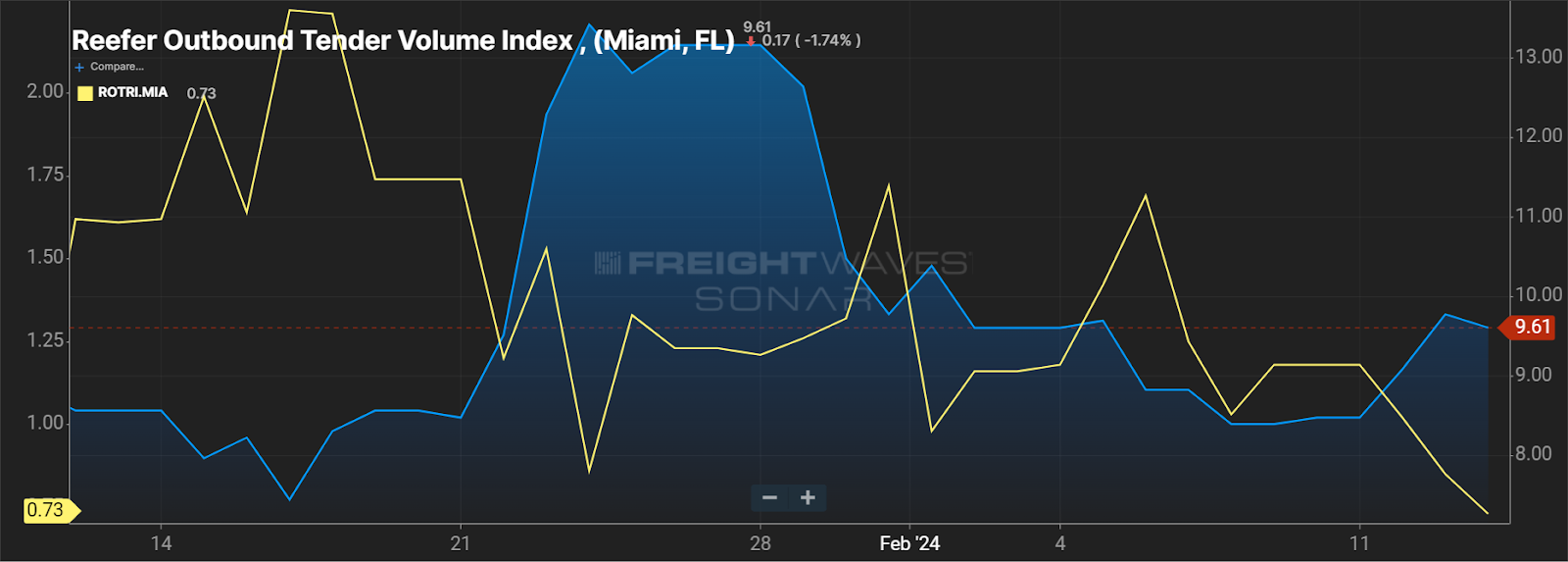
(SONAR Tickers: ROTVI.MIA, ROTRI.MIA)

This week’s SONAR market is none other than the home of all the flowers, Miami. Both reefer outbound tender volumes and reefer outbound tender rejections are on a downward trend. That trend is typical for this time of the year given that we’ve passed Valentine’s Day and demand is returning to normal. Reefer outbound tender rejection levels have dropped 84 basis points week over week, coming in at under 1%. That news should make any shipper happy as almost all reefer freight being tendered is getting picked up.

Is SONAR for you? Check it out with a demo!

Shelf life

Ryder continues shift toward less reliance on leasing, talks up Cardinal

FedEx strengthens commitment to clinical trial supply chain with the launch of ‘FedEx Life Science Center’ in Mumbai

The solution to feeding the world lies in the cold chain

30,000 vaccine doses to be tracked through Rwanda’s cold-chain system

The Light Load: It’s a mad, mad, mad, mad supply chain world

Wanna chat in the cooler? Shoot me an email with comments, questions or story ideas at moconnell@www.freightwaves.com.

See you on the internet.

Mary

If this newsletter was forwarded to you, you must be pretty chill. Join the coolest community in freight and subscribe for more at www.freightwaves.com/subscribe.

Why Matt Silver won’t be buying Coyote; nearshoring; FMCSA vs. predatory leases – WTT

On Episode 683 of WHAT THE TRUCK?!?, Dooner is talking to Cargado co-founder and CEO Matt Silver. Silver just got back from Mastermind and is here to talk about the rise of nearshoring, why he isn’t buying Coyote, cross-border trends and the Cargado story.

Motive’s Hamish Woodrow breaks down their latest freight market report covering carrier contractions, warehouse truck visits, fuel and the overall health of the freight economy. 

Reliance Partners’ Joe Schreiner discusses the implications of New Jersey hiking truck insurance minimums to $1.5 million. Premiums could rise 40%-60% under the new rule. We’ll find out how this will impact capacity, interstate laws and your fleet.

Plus, FMCSA vs. predatory leases, trolling double brokers, maggots on a plane and massive ships.

Watch on YouTube

Visit our sponsor

Subscribe to the WTT newsletter

Apple Podcasts

Spotify

More FreightWaves Podcasts

Motive countersues fleet tech rival Samsara over patent infringement

Fleet telematics provider Motive Technologies is firing back at rival Samsara Inc., filing a lawsuit alleging Samsara copied and used its proprietary technology and patents, including AI dashcam technology.

Motive’s lawsuit, filed Thursday in the U.S. District Court for the Northern District of California, “alleges that for years, Samsara has engaged in unlawful, anticompetitive business practices to copy Motive’s products and technology and to steal its intellectual property.”

“Our action against Samsara stems from their unlawful and anticompetitive business practices, including patent infringement, fraud, false advertising, and theft of Motive’s trade secrets, among other things,” Motive co-founder and CEO Shoaib Makani said in a statement to FreightWaves. “Motive has spent years developing AI to prevent accidents and make our roads safer. Samsara hasn’t been able to build competitive AI solutions and is losing large enterprise customers to Motive as a result. Instead of building a better product, Samsara has resorted to IP theft and anticompetitive practices in an attempt to close the gap.”

The suit also accuses Samsara employees of creating more than 30 fake Motive accounts on its platform, according to the website truthandsafety.com, which was set up by Motive to dispute Samsara’s legal claims.

In a statement, Samsara disputes the allegations lodged by Motive in its complaint.

“Rather than stopping its unlawful conduct, Motive has decided to copy our claims,” Adam Simons, a Samsara spokesperson, said in a statement to FreightWaves. “As demonstrated in our complaint, this is the same copycat tactic Motive uses for its product development. The allegations in Motive’s suit are a deliberate distraction, and we have every confidence in our defense. We remain focused on putting an end to Motive’s ongoing infringement and unlawful conduct to ensure fair competition, innovation, and safety for the entire industry.”

The move comes nearly three weeks after Samsara filed suit in the U.S. District Court for the District of Delaware against Motive, formerly KeepTruckin, alleging Motive copied and used its proprietary technology, engaged in false and misleading advertising, and created fictitious accounts to gain access to Samsara’s connected vehicle platforms.

Both technology companies, headquartered in San Francisco, offer telematics products, including ELDs and dashcams for the transportation and logistics industry.

In a statement about the original lawsuit, Motive called the legal actions taken by Samsara “meritless and anticompetitive.”

Samsara files second complaint against Motive

Samsara filed a second complaint against Motive on Feb. 9 with the U.S. International Trade Commission regarding some of Motive’s products. According to a Samsara spokesperson, the suit “seeks an exclusion order to prevent Motive’s Vehicle Gateway and Dashcam products from being imported into the United States and a cease and desist order to prohibit Motive from selling, marketing, advertising, or distributing its Vehicle Gateway and Dashcams on the grounds that these products infringe certain of Samsara’s patents.”

Motive is embroiled in a legal fight against another safety and fleet technology provider, Omnitracs, which filed suit against the telematics provider in October. The lawsuit centers on 11 patents that Omnitracs says Motive copied from Omnitracs.

Do you have a news tip to share? Send me an email or message me @cage_writer on X, formerly Twitter. Your name will not be used without your permission.

Utah trucking group owners convicted in FedEx Ground fraud scheme
Ohio trucking owner pleads guilty to wire fraud

Penske Logistics slashes over 200 truck driver and warehouse jobs

Texas trucking company files for bankruptcy days before wrongful death trial

Ex-Slync CEO Chris Kirchner guilty of wire fraud, money laundering

In age of AI, data connectivity is more important than ever

A white trailer being pulled by a white tractor on a highway

As a whole, the logistics industry has fully embraced the power of data. Most companies have developed a means of capturing relevant data in the course of their day-to-day operations. Many of those companies have not, however, funneled all that accumulated data into a single system of record (SoR). 

When data is relegated to silos, its use cases are limited. By contrast, when a holistic and well-functioning SoR is in place, data becomes more dynamic and actionable.

Samsara is working to create an SoR specific to physical operations, helping users conceptualize variables like fuel consumption and asset location. The company sees this tool as a fundamental stairstep in the quest for a more connected — and more automated — supply chain. 

FreightWaves spoke to Sean McGee, vice president of product, platform and infrastructure at Samsara, about the company’s offerings. 

FREIGHTWAVES: Samsara is creating the system of record (SoR) for physical operations. What does it mean to be an SoR?

 MCGEE: A system of record is a single place where all the data from your operations lives. It’s a concept that’s well known in the IT world because of players like Salesforce, ServiceNow and Workday. What we’re doing at Samsara is creating a system of record for physical operations. Given the scale and complexity of these environments, there’s a clear need for a singular system that can connect and make sense of data at a large scale. That’s what we’re doing at Samsara. We help our customers aggregate, analyze and act on data across multiple locations and asset types. For instance, understanding how fuel usage fluctuates depending on time of day or idling. Or knowing, in real time, where every vehicle and asset is on the road.

We also help organizations connect Samsara data to other business applications and workflows. It’s common for our customers to save thousands, sometimes millions, of dollars from the insights they uncover. What I find exciting is we’re helping these organizations break down internal data silos so they can unlock new opportunities and improve their bottom line.

FREIGHTWAVES: How is the current macroeconomic environment (doing more with less) accelerating the demand for an SoR?

 MCGEE: ROI has always been part of the picture for customers in operations. They only invest in technology when it’s a clear win. So, high level, I would say our customers have always been focused on doing more with less, and technology is an enabler for that. If you can find a way to save yourself 10% of time by eliminating paperwork, moving to digital workflows, apps, it’s like being able to hire 10% more people. That’s business-moving ROI.

That said, driving better business outcomes is challenging when your data lives in separate, third-party platforms that aren’t able to work together. That’s where the need for a system of record comes in. 

FREIGHTWAVES: What is Samsara currently doing to create a robust platform/open ecosystem?

 MCGEE: We have an entire team dedicated to building and strengthening our platform and ecosystem. We look at it from the lens of: What integrations and partnerships will provide the most value to our customers? Often we turn to our customers for those insights and follow their lead. Many of our initial integrations came from these conversations, and we now have over 260 integration partners on the platform — from insurance providers like Nationwide, to OEMs like Ford, and a wide variety of others like Navistar, Thermo King and RUBICON SmartCity.

In addition to creating these ready-made integrations for our customers, we also focus on making it easy for developers to build net new or custom integrations on our platform. Many of our larger customers have developers in-house and have custom tools that are bespoke to their needs. Samsara’s open ecosystem makes it possible for them to build integrations directly into our platform. Last year our largest customers used six or more API integrations on average, and we expect that to keep growing over time.

FREIGHTWAVES: What benefits are Samara customers seeing from this effort?

 MCGEE: The biggest benefit is a better bottom line. Samsara’s technology provides clear and fast ROI that the C-suite sees within just a couple quarters. When you can show benefit in hard numbers, you’re no longer having a conversation about the cost of a technology but instead the cost savings that comes from it.

For example, we have an LTL carrier in Illinois who saved $500,000 in eight months on fuel reduction. We work with a national infrastructure company who saved $11 million with equipment tracking and asset optimization. And an energy company in Colorado who saved millions by building an integration with their tax provider using our open API.

Our CEO calls it “ROI you don’t have to squint to see” and I love that. Our customers work in cost-intensive industries. Our technology helps them save money, improve safety, retain drivers and reduce emissions. That’s real-world impact that shows up on the balance sheet.

FREIGHTWAVES: Is there anything else you would like to add?

 MCGEE: Everyone right now is talking about AI, what’s possible now and what might be possible in the future. The first step every organization needs to take to set itself up for success is to make sure their systems are connected and talking to one another. Organizations in physical operations have a complicated and data-rich set of variables compared to other industries. Imagine the possibilities that can come just by connecting that data and analyzing it at scale. In the past year alone Samsara processed over 6 trillion data points and 55 billion API calls. We helped prevent over 200,000 crashes and digitized over 220 million workflows. That’s a massive amount of data that led to real-world impact. And advancements in AI are only going to accelerate this further. It’s the organizations who invest in data now who are going to win in the future. That’s a pretty exciting place to be.

Learn more about Samsara here.

Electric trucks find a sweet spot with inbound logistics

Using electric trucks for short, repeatable trips to assembly plants is expanding as more OEMs require suppliers to shush the noise and eliminate the diesel exhaust that accompany delivering incoming parts and components.

How did inbound logistics become a thing in an industry where change most often meets resistance? For their own reasons, stakeholders from sustainability-conscious shippers to regulators and OEMs like inbound logistics as a use case for electric trucks.

Was this newsletter forwarded to you? Click here to get Truck Tech via email on Fridays. And catch the latest in major events and hear from the top players on “Truck Tech” at 3 p.m. Wednesdays on the FreightWaves YouTube channel.

“The reason this is a good early adopter is that the trucks stay close to base. But [they] can get a fair amount of miles, at least for the short return-to-base, heavy-duty day cab tractor segment,” said Mike Roeth, executive director of the North American Council for Freight Efficiency (NACFE).

Ideal use case

During my visit to the sprawling Volvo Trucks North America (VTNA) New River Valley Operations site in Dublin, Virginia, this week, plant communications chief Sally Davies told me VTNA has accumulated 95,000 miles of electric driving on short routes bringing parts and supplies to the plant.

Volvo Trucks North America was early to putting electric trucks to work for inbound plant logistics. It’s been a good experience so far.

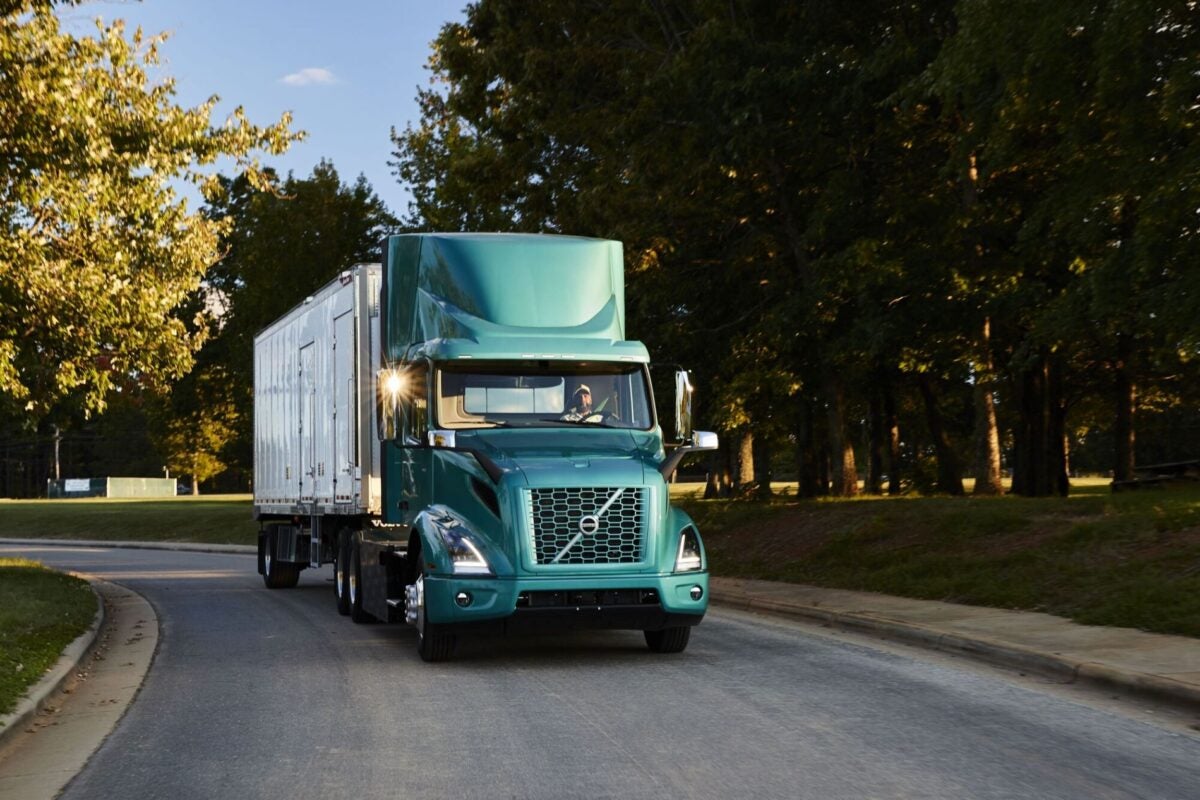
Watsontown Trucking Co. and Camrett Logistics ordered Class 8 VNR Electric trucks in October  2021 and put them into service on round trips to NRV in December of that year. Ryder System Inc. began operating seven VNR Electric trucks, transporting assembly kits of components for heavy-duty Mack trucks to a kitting facility in Pennsylvania.

Volvo Trucks North America began integrating VNR Electric trucks into its inbound logistics supply chain in late 2021. (Photo: Volvo Trucks North America)

‘Manufacturing shuttles’

“We call these manufacturing shuttles,” Roeth said, pointing to Schneider’s execution of electric trucks during NACFE’s Run on Less Electric Depot program last year. Schneider calls this the “next truck up” system. It replaced two-driver slip-seating. “[The driver] returns the truck to the depot, starts charging and jumps into another fully charged truck,” Roeth said. Schneider has 92 eCascadias in its fleet today and a 4.8-megawatt charging facility in El Monte, California, capable of charging 32 trucks at a time.

NFI Industries, an early partner of Daimler Truck North America (DTNA) in piloting Class 8 Freightliner eCascadias, tried this at its Chino, California, depot in early 2020. 

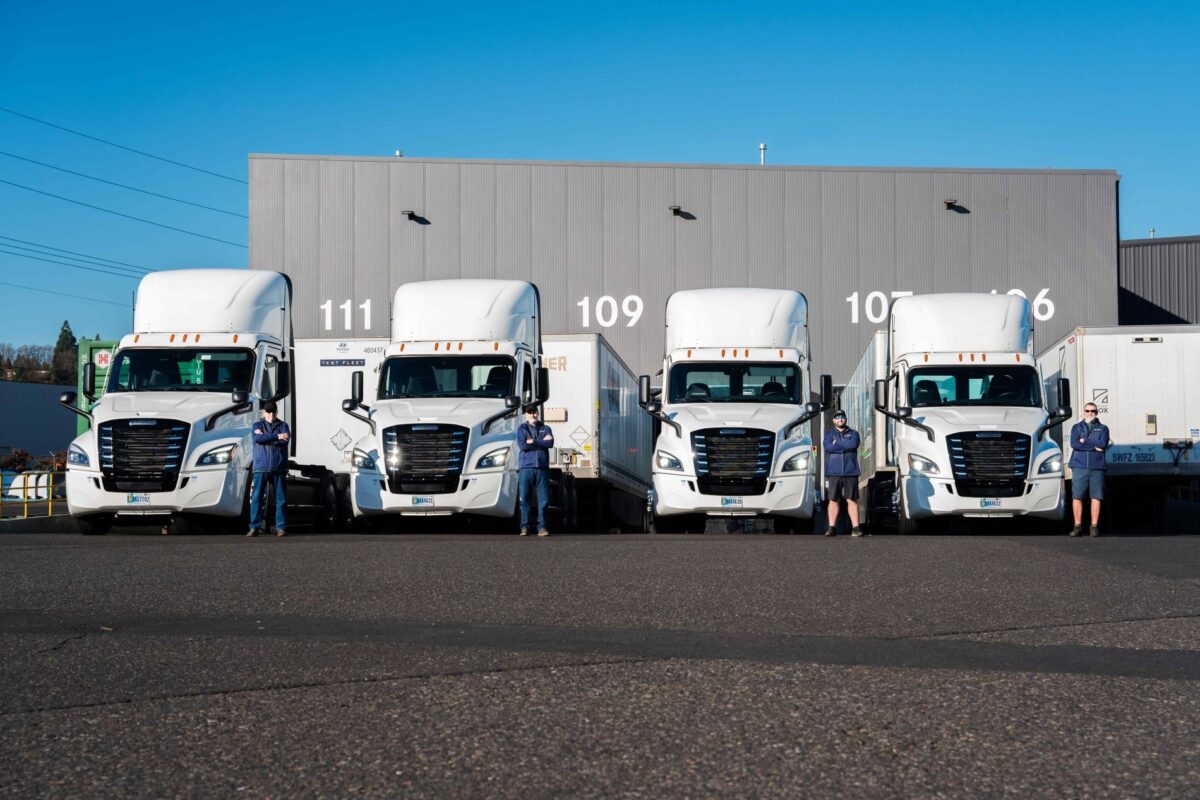
DTNA began integrating eCascadias into its own logistics operations in Portland, Oregon, in November. The trucks use the company’s Electric Island heavy-duty truck charging station that opened in 2021 near its Portland headquarters. The four electric trucks initially deployed pick up parts from Pacific Northwest suppliers and deliver them to DTNA’s consolidation center.

The first four Freightliner eCascadias that entered inbound logistics operations for Daimler Truck North America in November. (Photo: Daimler Truck North America)

‘Sustainable future’

“By integrating electric trucks into our inbound logistics network, we aim to reduce our environmental impact and contribute to a more sustainable future that goes beyond truck development and manufacturing,” Jeff Allen, DTNA senior vice president, operations and specialty vehicles, said in a November news release.

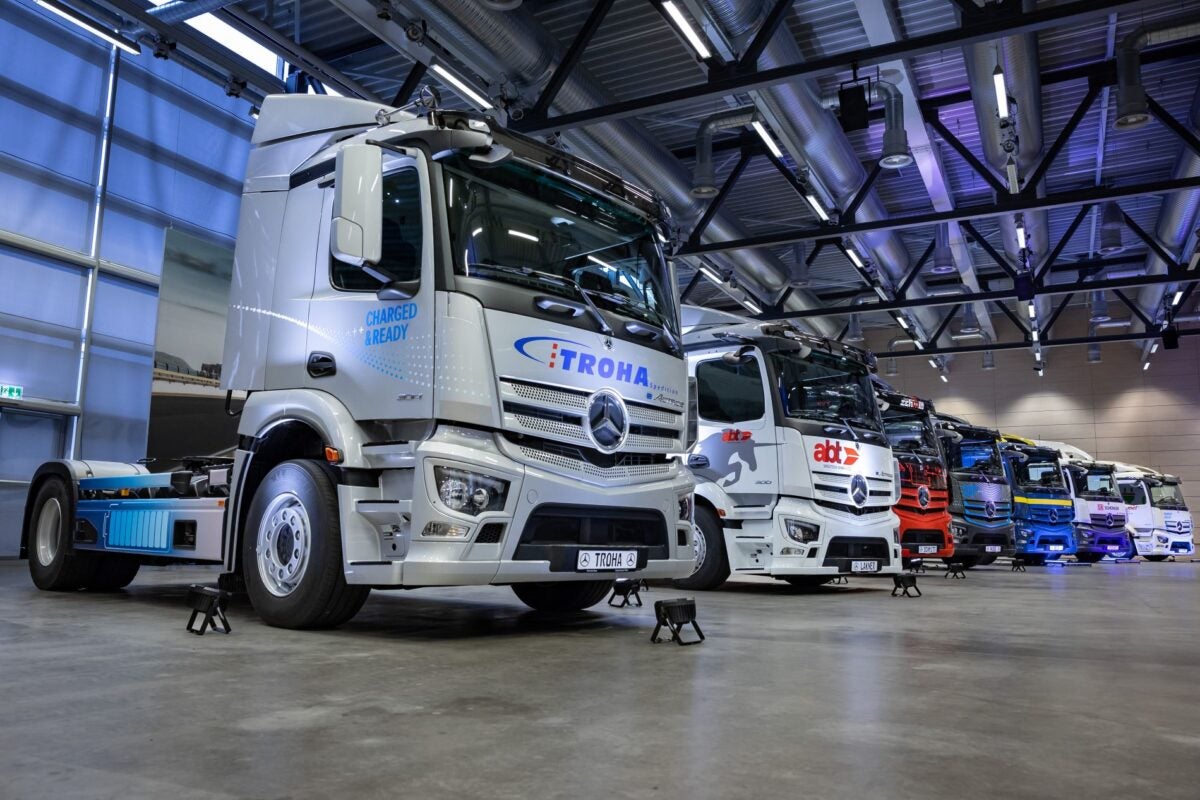
In December, Daimler’s Mercedes-Benz Trucks brand delivered a dozen electric trucks to logistics service. Beginning this quarter, the trucks will complete 50 all-electric inbound logistics runs to its largest plant in Wörth, Germany. The goal is to electrify 100% of delivery traffic to Wörth by the end of 2026.

“Electric trucks can already cover the majority of delivery routes over short and medium distances,” Karin Rådström, CEO Mercedes-Benz Trucks, said in December. “We want to leave the smallest possible carbon footprint across the entire value chain [including] inbound logistics at our Wörth plant.”

Mercedes-Benz Trucks delivered a dozen eActros 300 models in December to logistics suppliers to its plant in Wörth, Germany. (Photo: Mercedes-Benz Trucks)

Is Mack’s $14.5M Roanoke plant expansion a shot at the UAW?

The timing of the $14.5 million expansion announcement at Mack Trucks’ medium-duty plant in Roanoke, Virginia, was curious. Why announce good news at 5:30 p.m. on a Friday? One explanation: awaiting a signoff from Gov. Glenn Youngkin’s office. The state is ponying up a $255,000 grant from the Commonwealth’s Opportunity Fund after all.

Or, maybe it helped keep the United Auto Workers off guard and perhaps avoided a protest at the ceremonial groundbreaking at the nonunion plant. Remember, the UAW struck Mack for 39 days last fall. The union representing 3,900 workers settled for a contract it rejected earlier.

The UAW struck Mack’s main assembly plant near Allentown, Pennsylvania, on Oct. 8. Four other facilities — a remanufacturing operation, parts depots in Maryland and Florida, and the Hagerstown, Maryland, engine plant also went down.

That stopped most Mack Class 8 truck builds and crimped deliveries to Volvo Trucks North America’s plant in Dublin, Virginia. Those losses contributed to Volvo losing six-tenths of a point of North American market share in 2023.

The Mack strike focused more on economic gains and local issues than adding new jobs. The UAW never publicly mentioned bargaining to organize the Roanoke plant, where the expansion to make diesel and battery-electric medium-duty trucks will add 51 new jobs and Roanoke County incentives totaling $842,420.


Nikola to Trevor Milton: No thanks, and pay up

Trevor Milton has become Nikola Corp’s version of the proverbial bad penny. He keeps turning up.The founder of the electric truck maker and energy distribution company is awaiting a surrender date on his four-year federal prison sentence from his October 2022 conviction on one count of securities fraud and two counts of wire fraud.

Once Nikola’s largest shareholder by a mile, his stake, according to the Financial Times, hovers around 4.4%. That’s partly due to the company authorizing new stock that diluted his stake as the shares are sold.

Even though an arbitration in which Milton was ordered to pay Nikola $165 million — mostly to cover a Securities and Exchange Commission fine related to Milton’s exaggerations and lies about the company’s technological accomplishments — Nikola avoided directly criticizing him.

That changed Jan. 26 when MIlton submitted a slate of dissident candidates for independent directors.

“The director nominees have no public company experience, add no skills or experience to the board, and indisputably lack the depth of experience that the current Nikola board members bring to the company,” the company said in a statement

“Mr. Milton … has had zero [company emphasis added] involvement in Nikola’s day-to-day operations since September 2020; however, Nikola continues to suffer harm created by Mr. Milton’s business decisions from over three years ago in his role as founder and executive chairman.”

Oh, and Milton hasn’t paid the $165 million — plus interest — to Nikola, which is “vigorously seeking all legal avenues” to get it. 

Trevor Milton outside federal court in New York in December after his sentencing on wire fraud and securities fraud convictions. (Photo: Matthew Lee)

In California, it’s deja vu all over again

California Gov. Gavin Newsom’s vetoed legislation in September that would effectively ban heavy-duty autonomous trucks in the state. Now, nearly identical legislation is pending in the California State Assembly.

“It’s a commonsense measure that keeps humans on board a truck until we have a plan for our workers and we’re sure that tech bros aren’t jamming unsafe technology down our throats,” State Assembly member Cecilia Aguiar-Curry said at a rally backed by the Teamsters union on Monday.

That’s sounds a lot like last year when Assembly Bill 316 gained support of 90% of Assembly and Senate members before Newsom vetoed it. There was no attempt to override the governor’s veto.

What’s different this time? Conflating some high-profile accidents involving autonomous robo-taxis with what could happen in a crash involving a driverless 80,000-pound truck.

Newsom’s office says it will consider the legislation on its merits.


Briefly noted:

The number of hydrogen stations is dwindling, with Shell the latest to close stations. But commercial truck outlets may replace some of them.

Geotab and Daimler Truck North America are working together to integrate data from Freightliner trucks with Geotab’s advanced fleet management platform.

Cummins is selling the remaining 80.5% of its former filtration business — now called Atmos — and will save about $500 million in taxes in the process.


Truck Tech episode No. 54: Overview of Volvo’s new VNL

Volvo Trucks North America Product Marketing Manager Chris Stadler provides a high-level walkaround of the new VNL, a truck the company says is “designed to change everything.”

Volvo Trucks North America Product Marketing Manager Chris Stadler provides a high-level walkaround of the new VNL, a truck the company says is “designed to change everything.”

That’s it for this week. Thanks for reading and watching. Your feedback and suggestions are always welcome. Write to aadler@www.freightwaves.com.

Have you purchased your discounted tickets for the Future of Supply Chain June 4-5 in Atlanta? What are you waiting for?

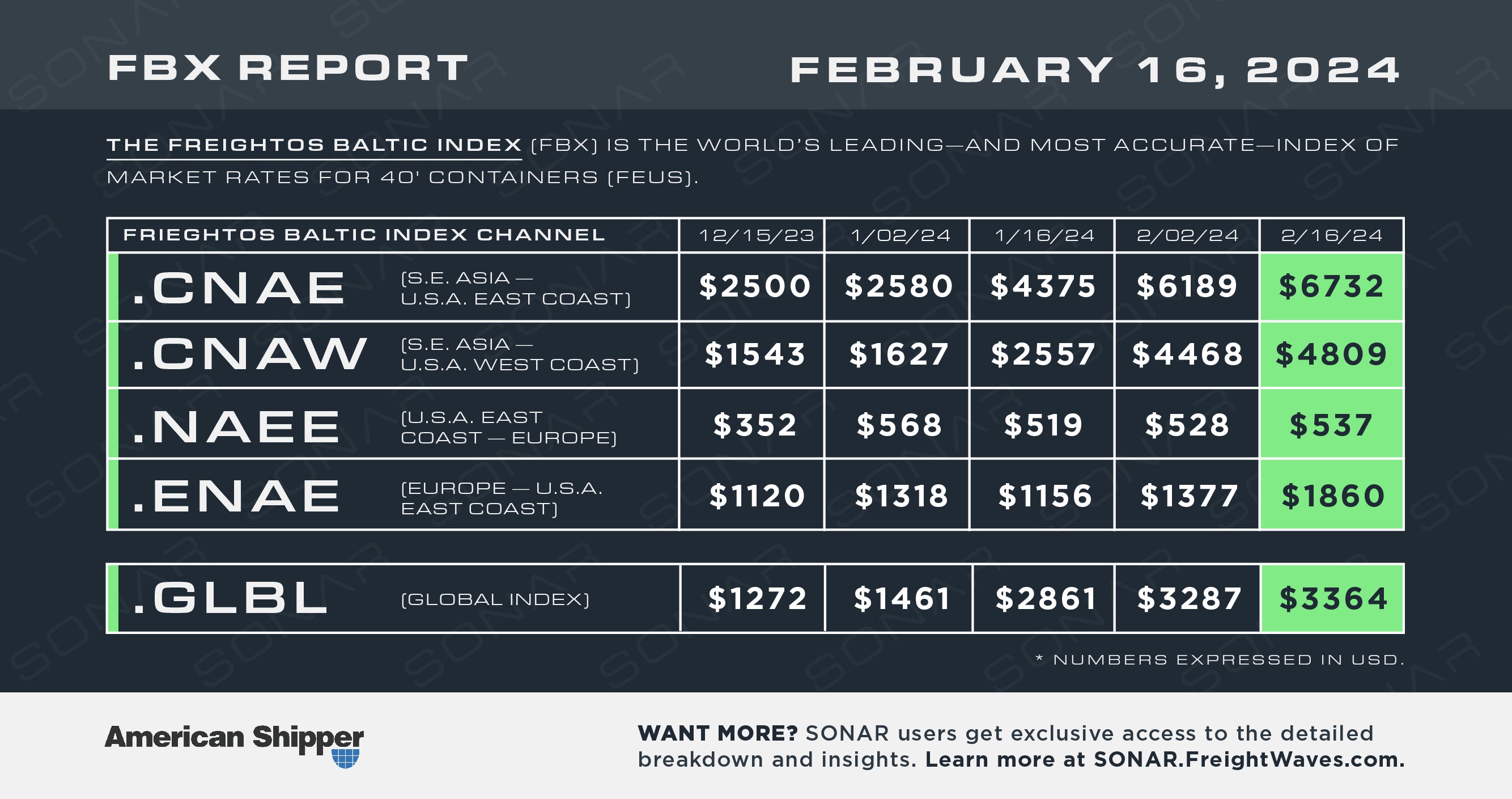
FBX Report: February 16, 2024


To learn more about FreightWaves SONAR, click here.