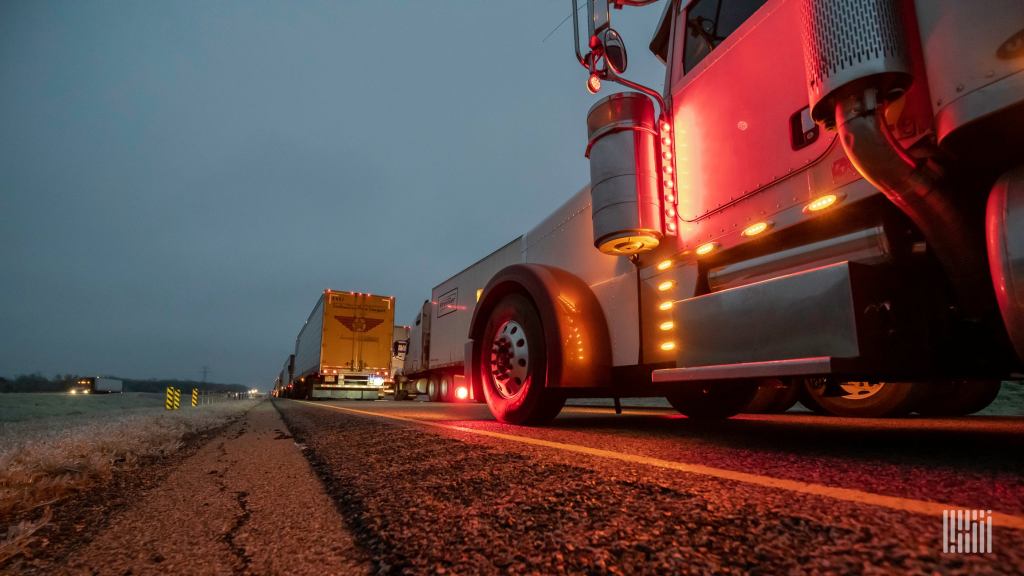
Canadian authorities suspend 2 more trucking companies after crashes

Canadian authorities recently shut down two trucking companies in the Vancouver area in the aftermath of collisions with a vehicle tunnel and a highway sign.

The suspension of carriers TSD Holdings Inc. and International Machine Transport Inc. comes after another company — Chohan Freight Forwarders — was ordered to cease operations after one of its drivers struck an overpass Dec. 28 in Delta, British Columbia.

On Monday, International Machine Transport Inc. was issued an immediate suspension of the carrier’s 20-vehicle fleet after a company driver transporting a wrapped helicopter struck a highway sign at an overpass about 9 miles from downtown Vancouver.

“The driver had received an oversized permit, however the height exceeded what was stated on the permit,” according to a statement from the British Columbia Ministry of Transportation and Infrastructure.

The overpass was not visibly damaged, but the top of the helicopter’s wrapping was torn open, according to CTV News. The accident is being investigated by the British Columbia Commercial Vehicle Safety and Enforcement branch.

Monday’s accident follows another incident involving a tractor-trailer from TSD Holdings Inc., which struck the roof of the Massey Tunnel in the Vancouver area on Jan. 10.

Royal Canadian Mounted Police said the truck initially stopped inside the tunnel after the collision, but then continued driving through before pulling over to talk with a municipal road maintenance crew. The truck driver then continued onward.

Authorities reviewed dashcam footage from a vehicle behind the truck to confirm witness statements and identify the trucking company, which also had its fleet of 20 vehicles grounded pending an investigation by the ministry.

The Ministry of Transportation recorded 17 overpass collisions involving tractor-trailers in 2023.

On Dec. 14, the agency announced new rules and stricter fines for carriers involved in accidents, including the requirement for dump-style vehicles to have in-cab warning devices notifying drivers if their trailers have not been lowered.

Over-height-vehicle fines increased from $115 to as much as $575, the highest in the country, according to a news release.

The ministry suspended 65-truck carrier Chohan Freight Forwarders after one of its trucks crashed into an overpass in the municipality of Delta on Dec. 28.

It was the sixth crash involving Chohan Freight Forwarders and an overpass in the past two years. A Chohan-driven truck struck the same overpass in February 2022.

More articles by Noi Mahoney

Mexico top US trade partner in November, Laredo No. 1 gateway

GXO to shut down Memphis facility, lay off 211 workers

Autonomous truck developer TuSimple going private

Interior of TuSimple driverless truck in China

TuSimple, the first autonomous trucking startup to go public, is voluntarily delisting from the Nasdaq, where its stock has been battered for more than two years and its boardroom strife played out for all to see.

Independent directors of the board chaired by co-founder Mo Chen announced the decision Wednesday in Securities and Exchange Commission filings. The SEC likely would have taken the action on its own since TuSimple shares have traded below the required $1 a share since mid-November. Shares plummeted 57% intraday to 30 cents.

TuSimple was the first autonomous trucking company to demonstrate driverless operations on an open highway. One of its trucks traveled 80 miles with no human on board from Tucson, Arizona, to Phoenix in December 2021.

Two startups — Aurora Innovation and Kodiak Robotics — plan limited commercial launches of driverless trucks later this year in Texas.

Flush with cash

San Diego-based TuSimple has been unwinding its U.S. operations, laying off almost its entire workforce while refocusing operations on China and Japan.

“The benefits of remaining a publicly traded company no longer justify the costs,” TuSimple said in a news release. “The company believes it can better navigate as a private company than as a publicly traded one.”

Unlike other transportation startups, TuSimple is relatively flush, reporting cash and cash equivalents of $776.8 million as of Sept. 30. The company caught up with required financial filings in November when it reported an operational loss of $248.6 million for the first nine months of the year.

The planned Feb. 7 termination of its common stock from the Nasdaq and the Jan. 29 deregistering and delisting mean TuSimple no longer would be required to file public documents about its business, such as SEC forms 10-K, 10-Q and 8-Ks, required when material changes occur.

TuSimple raised $1.1 billion in an initial public offering in April 2021.

“Since TuSimple’s initial public offering, there has been a significant shift in capital markets, due in part to rising interest rates and quantitative tightening, that has changed investor sentiment for pre-commercialization technology growth companies.

“The company’s valuation and liquidity have declined, while the company’s stock price volatility has increased significantly,” the release said. At its peak shortly after going public, TuSimple traded at nearly $70 a share.

Long fall from autonomous trucking leadership

A long fall began in March 2022 when co-founder Xiaodi Hou took over as CEO and chairman, ousting Cheng Lu. Most of Lu’s executive team, including CFO Pat Dillon and Chief Legal and Administrative Officer Jim Mullen, departed in the following months.

An on-highway autonomous failure of a safety driver-monitored TuSimple truck on Interstate 10 near Tucson in April 2022 led to overhauling of safety systems and raised questions about the viability of autonomous trucks.

TuSimple’s problems worsened when directors voted Hou out as CEO in late October 2022. Lu returned as CEO and co-founder Mo Chen took over as executive chairman. He had stepped down in March. Chen and Hou together controlled about 60% of voting stock. Hou transferred his voting rights to Chen, who subsequently fired the independent directors who ousted Hou.

TuSimple and Navistar, which was developing a purpose-built autonomous chassis, ended a 2 ½-year collaboration in December 2022. That was the same month TuSimple laid off 350 workers, followed by 300 more in May 2023.

Strategic review pivots TuSimple toward Asia

The company announced a strategic review of its U.S. business in June. In December, it announced a wind down of U.S. operations, laying off an additional 150 employees.

A new slate of independent directors formed a special committee that decided on the voluntary delisting and taking the company private. Chen agreed to a two-year standstill provision that prevents him from making any TuSimple transaction, such as a sale, without independent directors agreement.

TuSimple was threatened with Nasdaq delisting last year because of its delinquent financial reporting. The company blamed the delay on changing auditors. KPMG quit as TuSimple’s auditor amid the messy boardroom shakeup.

150 more employees laid off as TuSimple winds down US operations

TuSimple prepares to exit US autonomous trucking market

TuSimple stock faces delisting from Nasdaq due to unfiled financial reports

Click for more FreightWaves articles by Alan Adler.

Late-December swoon has analysts cutting Q4 estimates again

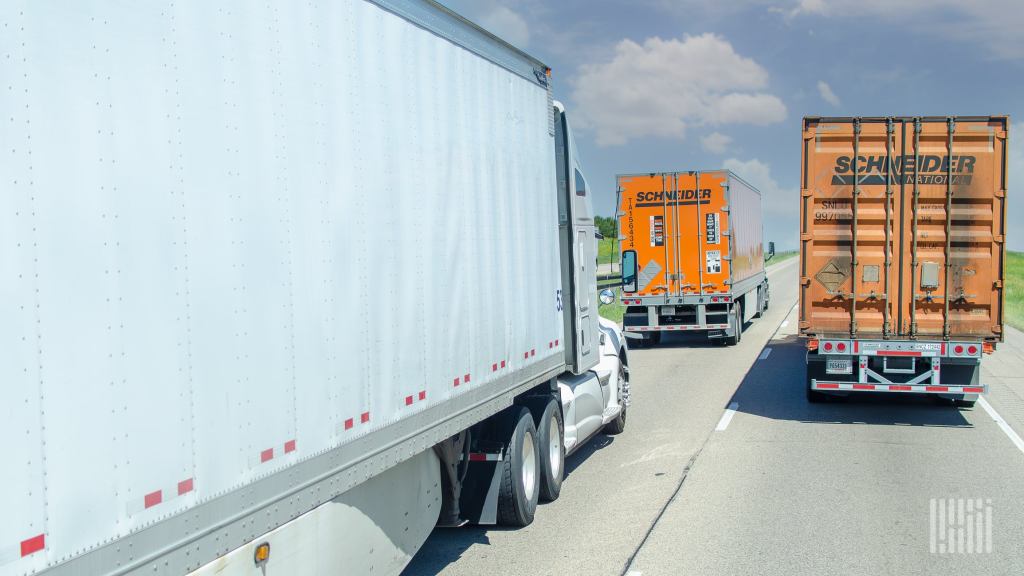
A rear view of two Schneider rigs on a highway

Analysts are cutting truckload earnings estimates again just ahead of fourth-quarter reports, which will start to trickle in later this week. Recent channel checks revealed a notable falloff in fundamentals in the back half of December, dispelling hopes that the quarter would be a transitionary period.

“We understand that multiple companies across multiple sub-sectors across our industry saw a sharp drop-off in on-the-ground activity toward the very end of December, which has the potential to wreck the quarter relative to expectations,” Morgan Stanley (NYSE: MS) analyst Ravi Shanker said in a Tuesday note to clients.

He cut numbers on all of the public transportation and logistics companies he follows, with the TL carriers seeing the largest changes — down midteen percentages or more. He also trimmed estimates for full-year 2024 but by much smaller percentages. The change comes after he published a relatively bullish 2024 outlook a week ago. That report included low-single to mid-single-digit estimate reductions for the fourth quarter, which proved too little as the dust continued to settle.

At the time he acknowledged his call, which is predicated on “an earlier and more robust upcycle in 2024 than the market expects as pressure builds on shippers to restock,” was “out-of-consensus.” Even with the weakness during the last two weeks of the year, his outlook for full-year 2024 remains largely intact, with the caveat that inventory levels may never return fully.

“In fact, we are starting to hear of potential scenarios where inventory levels may never return to prior decade levels as long as interest rates remain elevated with Shippers preferring to limit SKUs and running shorter, faster, tighter supply chains with higher turnover instead,” Shanker added.

Under that scenario, he said modes like trucking and airfreight would benefit if shippers ultimately decide to operate at leaner merchandise levels.

December Cass data also released Tuesday was a mixed bag. The year-over-year declines in shipments and expenditures slowed and TL linehaul rates showed further stabilization in the month. However, the shipments index fell to its lowest absolute level since July 2020.

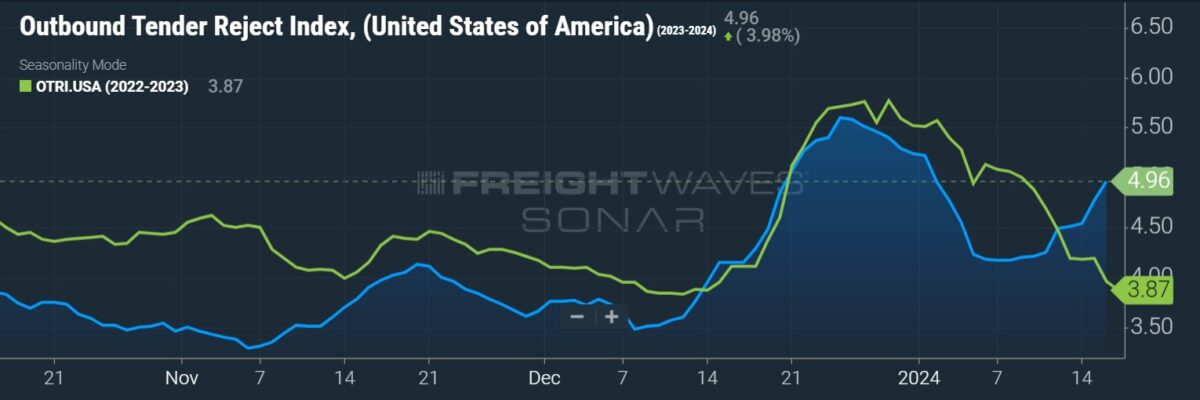
Chart: (SONAR: OTRI.USA). A proxy for truck capacity, the Outbound Tender Reject Index, shows the number of loads being rejected by carriers. Carriers are currently rejecting 5% of all loads tendered under contract compared to cycle highs of more than 25%. To learn more about FreightWaves SONAR, click here.
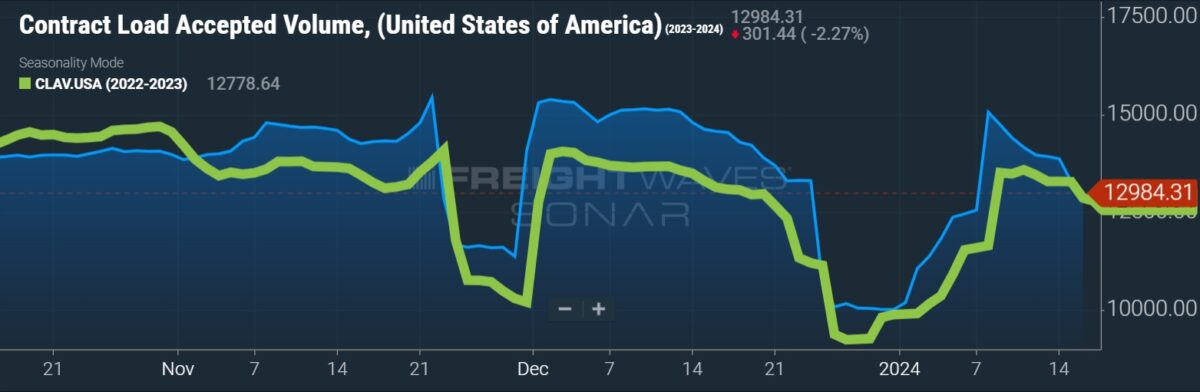
Chart: (SONAR: CLAV.USA) The Contract Load Accepted Volume Index measures accepted load volumes moving under contractual agreements. It excludes all rejected tenders. The index outperformed levels from a year ago for most of December but analysts said channel checks with carriers indicated that volumes were worse than they had modeled.

Susquehanna Financial Group analyst Bascome Majors noted “a slightly more negative 4Q23 peak season for irregular route truckload” was revealed during his recent update calls.

He previously cut fourth-quarter estimates for TL carriers like Knight-Swift Transportation (NYSE: KNX), Schneider National (NYSE: SNDR) and Werner Enterprises (NASDAQ: WERN) by 5% to 21% and full-year 2024 numbers by midteen to high-20s percentages. The latest round of cuts included mostly mid-single-digit reductions to the fourth quarter, with even slighter reductions made to 2024.

He did raise his 2024 estimate for Knight-Swift by 7% to reflect better performance in its third-party insurance business. He believes the unfavorable claims experience and profit degradation the unit has experienced in recent quarters has largely passed. However, his new estimate for the carrier is still 20% below where it was at the end of 2023.

Majors’ updated outlook for 2025 still calls for a notable earnings recovery for the group, with most companies seeing 50%-plus gains after two years of declines.

Multimodal transportation provider J.B. Hunt Transport Services (NASDAQ: JBHT) kicks off the fourth-quarter earnings season Thursday after the market closes.

More FreightWaves articles by Todd Maiden

Benchmark diesel price makes atypical move upward

A move higher in the benchmark diesel price used for most fuel surcharges may prove short-lived, because oil futures markets have resumed their downward slide.

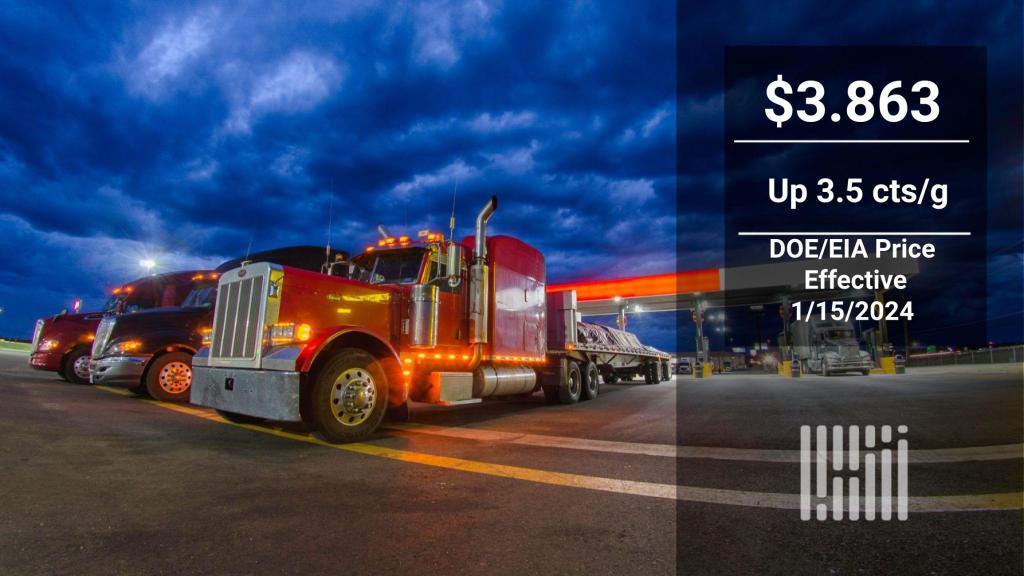
The Department of Energy/Energy Information Administration average weekly retail diesel price rose 3.5 cents a gallon, effective Monday, to $3.863. It was only the fourth increase in the past 17 weeks. 

It came after oil markets showed some reaction in the past two weeks of trading to the continued interruption in shipping through the Red Sea and the Suez Canal, a disruption that forces oil to stay on the water longer than it would have otherwise. In classic economics analysis, that would be considered bullish for the price of any commodity, because it effectively works to lock oil into inventories for a longer period of time. 

There have been days in the past few weeks when the impact of that was seen as a factor in higher oil prices. But overall, oil markets clearly are not accepting a bullish case for oil related to the Red Sea issues.

Since the start of the year, bullish reaction in the price of Brent crude, the global benchmark, has resulted in one-day gains of as much as $3.11 a barrel, as well as daily increases of $1.51, $1.93 and $1.14 a barrel.

But within those two weeks since the start of 2024, there also was a one-day drop of $3.35 a barrel and a pair of declines in excess of $1 a barrel.

And Wednesday, the price of Brent at approximately 9 a.m. EST was down an additional $1.50 a barrel.

The end result is that Brent’s final settlement of 2023 was $78.39 a barrel. On Tuesday, it settled at $78.29 a barrel and was headed even lower in intraday trade Wednesday. 

Ultra low sulfur diesel (ULSD) futures have been somewhat stronger in 2024. Those futures price increases translated rapidly into wholesale price increases, which presumably were a factor driving retail prices higher, as seen in the DOE/EIA price.

A ULSD settlement of $2.5563 a gallon on the final day of 2023 rose in fits and starts to a settlement Tuesday of $2.6606 a gallon. But like crude, it also was experiencing declines Wednesday, with a 9 a.m. price down approximately 4.4 cents a gallon.

Oil markets Wednesday were digesting the monthly oil outlook report from OPEC, which on the surface appeared bullish but had some forecasts that could be interpreted as bearish, and the fall in prices reflected that.

The OPEC report is one of three closely watched global reports that are published in the first 10-15 days of most months: the Short Term Energy Outlook from the EIA, the OPEC report and the International Energy Agency report, which will be released Thursday.

OPEC reduced its estimate of how much oil the market will need from its members by about 500,000 barrels a day. And while the “call” on OPEC crude — which is how it is termed — remains above current OPEC supply and is forecast to be higher in 2024 than it was in 2023, the group has a significant amount of capacity on the sidelines due to cutbacks in output so that any surge in demand could be met easily by the members.

OPEC also mostly held steady its estimate of the growth in supply from non-OPEC nations, with only a small revision downward. It is mostly non-OPEC growth this year from countries such as the U.S., Guyana and Brazil that is seen as the primary driver of oil prices, which by midsummer were threatening to get to $100 a barrel. The peak was about $95 and it has been mostly all downhill since then.

The analysis that oil markets will continue to move toward surplus came on the same day as a key economic report from China. It showed 5.2% growth in GDP last year, with the expectation that much of that growth was from coming out of COVID and that it can’t be repeated in 2024. Chinese economic activity is generally seen as the “swing” side of the demand balance in oil markets.

More articles by John Kingston

Teamsters rack up late-2023 wins, stage significant strike in 2024

Supreme Court rejects review in broker liability case, leaving the issue unresolved

Court rules CRST team drivers must be paid for some hours in sleeper berth

Prologis’ Q4 results in line with analysts’ expectations

Logistics real estate operator Prologis reported fourth-quarter results that were in line with analysts’ expectations. The company’s first take at full-year 2024 guidance was also as expected.

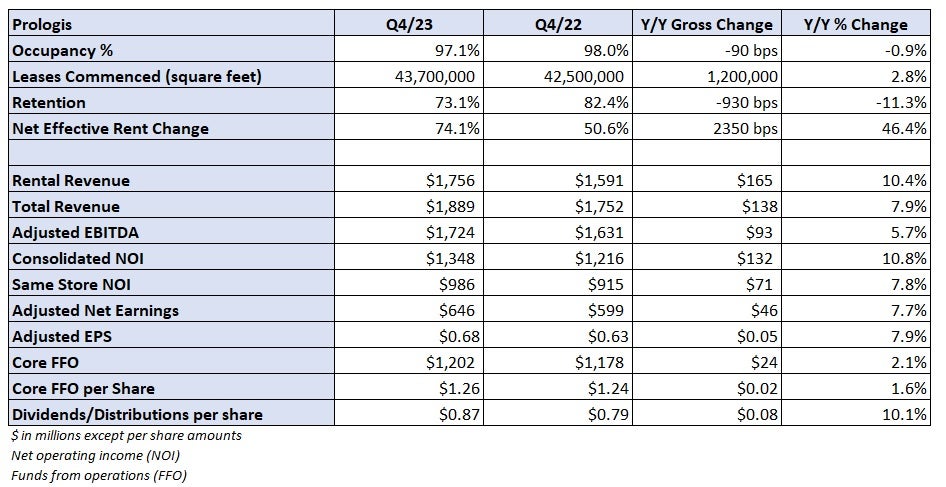
The San Francisco-based company reported core funds from operations (FFO) of $1.26 per share, which was 2 cents higher year over year (y/y). Rental revenue of $1.76 billion was up 10.4%, pushing total consolidated revenue to $1.89 billion, 7.9% higher y/y.

In 2023, Prologis (NYSE: PLD) grew earnings by double-digit percentages for a fourth straight year.

“We closed 2023 adding another year of exceptional performance,” said Hamid Moghadam, co-founder and CEO, in a news release issued Wednesday before the market opened. “While uncertainties remain in the economic and geopolitical environment, we are positive about the outlook for 2024.”

The company’s full-year core FFO guidance of $5.42 to $5.56 per share bracketed the consensus estimate of $5.52 at the time of the print. Excluding net promote, the company’s outlook is $5.50 to $5.64 per share, or 9% higher y/y at the midpoint of the range.

During the fourth quarter, occupancy of 97.1% was flat with the third quarter but 90 basis points lower y/y. The company commenced leases representing 43.7 million square feet of space in the period, a 2.8% increase from the year-ago quarter. Net effective rent change (over the entire lease term) was 74.1%.

The company will host a call Wednesday at noon EST to discuss fourth-quarter results.

Table: Prologis’ key performance indicators

More FreightWaves articles by Todd Maiden

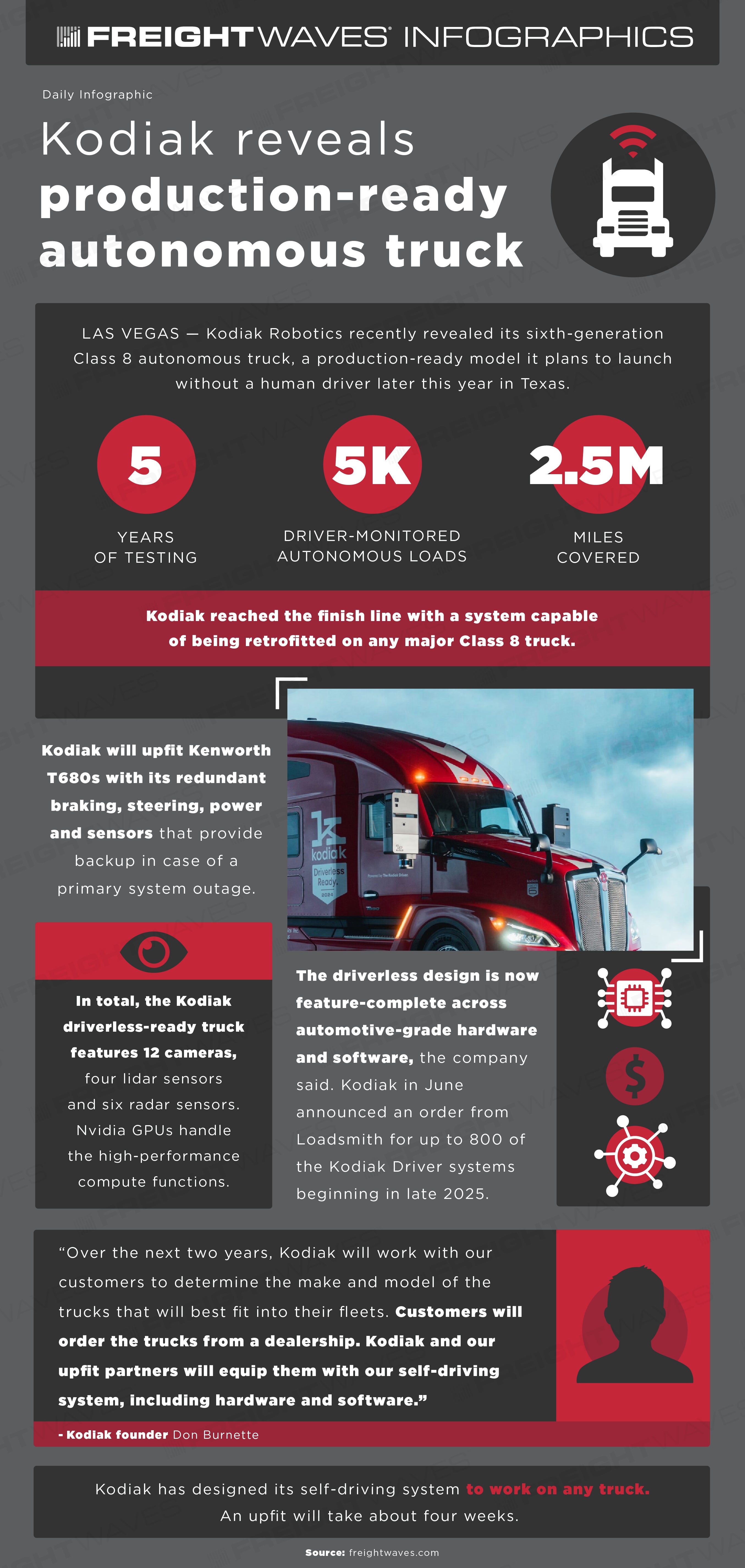
Daily Infographic: Kodiak reveals production-ready autonomous truck at CES


To view more FreightWaves infographics, click here

Former Kansas City Southern chief joins J.B. Hunt’s board

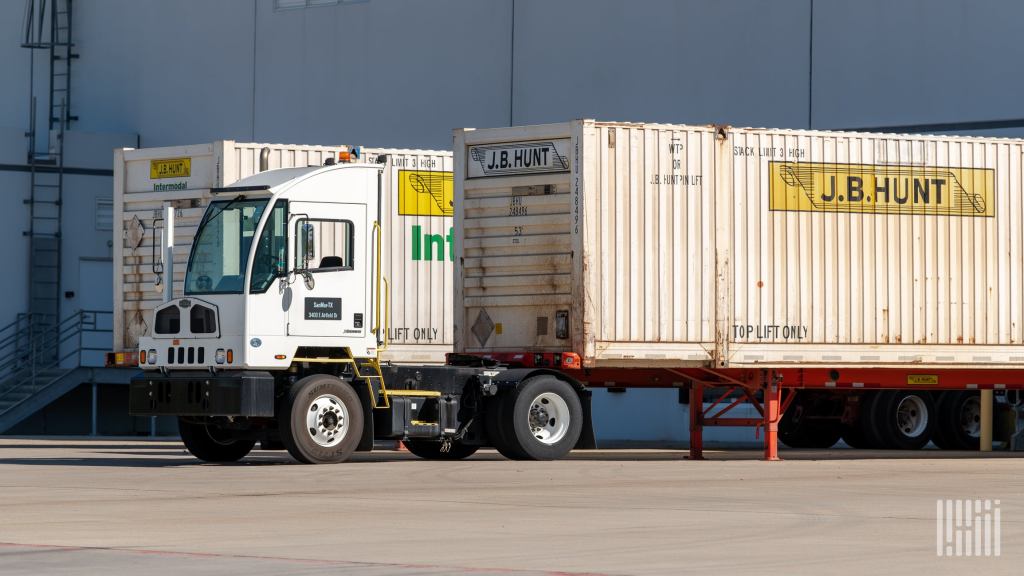
J.B. Hunt intermodal containers with a yard truck at a warehouse

Multimodal transportation provider J.B. Hunt Transport Services announced Tuesday that former Kansas City Southern President and CEO Patrick Ottensmeyer has joined its board effective last Friday. The addition expands the company’s board to 10 seats.

Ottensmeyer’s time at Class I railroad KCS spanned 17 years and included significant growth in revenue as well as improvement in its operating ratio from the high 80s to the low 60s. His time managing the North-South rail corridor witnessed several years of nearshoring investments in Mexico as manufacturers of automobiles, appliances and electronics built massive assembly facilities in the country.

He took the helm at KCS in 2015 and ran the company until its merger with Canadian Pacific was completed last year. He joined the railroad in 2006 as chief financial officer and headed the company’s sales and marketing efforts from 2008 to 2015.

He was the U.S. chairman of the U.S. Chamber of Commerce’s U.S.-Mexico Economic Council from 2019 to 2023 and is credited with helping to form the United States-Mexico-Canada Agreement, which replaced the North American Free Trade Agreement.  

Ottensmeyer’s railroad experience and expertise comes at a time when J.B. Hunt (NASDAQ: JBHT) is making big investments in intermodal capacity.

Two years ago, J.B. Hunt announced plans to grow its intermodal container fleet by 40% by 2025 to 2027. It also announced further collaboration with longtime rail partner BNSF Railway (NYSE: BRK.B), which committed to expanding facilities and equipment capacity to support the joint growth initiative. A few months later, BNSF unveiled plans for a $1.5 billion facility, the Barstow International Gateway, which will serve the ports in Southern California.

The two companies launched a premium intermodal service offering, Quantum, in November.

Ottensmeyer is the third board member J.B. Hunt has added since 2021. He will serve on the board’s compensation and governance committees.

More FreightWaves articles by Todd Maiden

Red Sea conflict worsens, forcing more ship detours around Africa

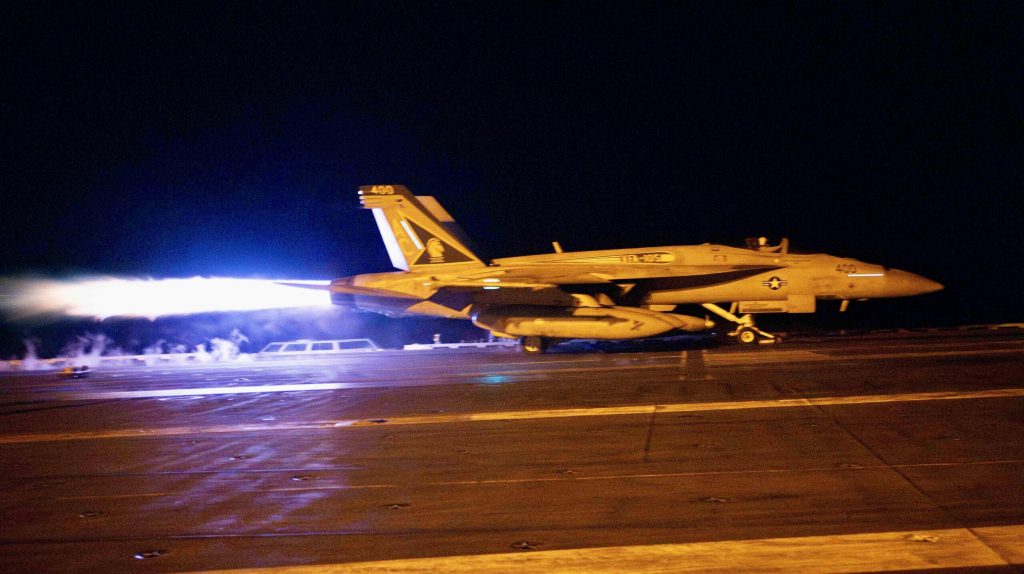
a photo of US jet in Red Sea

U.S. and U.K. airstrikes on Houthi positions in Yemen have not made the Red Sea any safer for shipping. “Red Sea issues are getting worse, not better,” said Stifel shipping analyst Ben Nolan.

The dry bulk carrier Gibraltar Eagle, owned by Connecticut-based Eagle Bulk (NYSE: EGLE), was struck by an anti-ship ballistic missile in the Gulf of Aden on Monday. The Greek-owned dry bulk carrier Zografia was hit by a missile in the southern Red Sea on Tuesday.

Energy shipper Shell (NYSE: SHEL) halted all Red Sea transits on Tuesday, as did the big three Japanese tanker and bulker owners: MOL, NYK and K-Line.

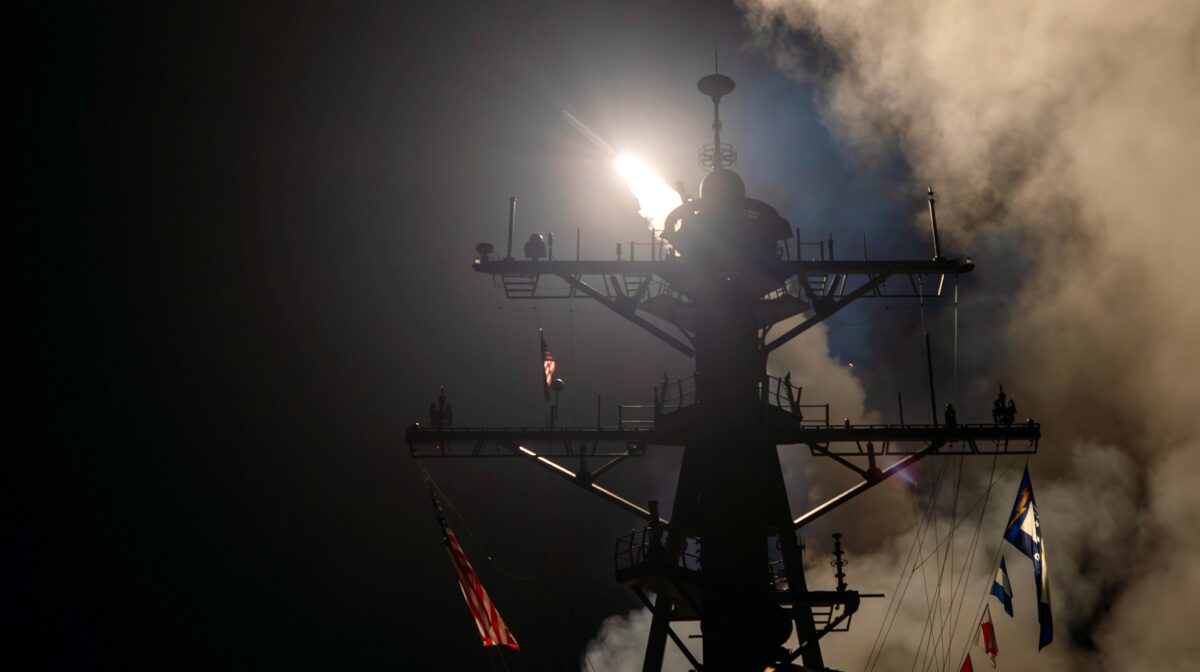
A Tomahawk missile launches from destroyer U.S.S. Gravely on Friday. (Photo: U.S. Navy)

Container-ship diversions around the Cape of Good Hope now appear likely to last for months. Spot rate gains from diversions will almost certainly extend into the period when 2023 annual trans-Pacific contracts are negotiated, pushing up contract rates.

The Red Sea effect on tanker trades remains uncertain, although a tipping point may be very near. If crude and product tankers divert away from the Red Sea and Suez Canal to the same extent as container ships, tanker spot rates should rise, because longer voyages would soak up tanker capacity.

Will tankers follow container ships around Cape?

“There has already been a sharp decline in container ships approaching the Gulf of Aden, which feeds into the narrow Bab-el-Mandeb Strait, and there are likely to be major declines across other shipping segments as well in the coming weeks,” predicted Omar Nokta, shipping analyst of Jefferies, in a client note on Tuesday.

Ship-position data shows container transits down precipitously, tanker transits down modestly, and dry bulk transits down very little if at all.

Container-ship arrivals in the Gulf of Aden were at their lowest level on record last week, down 90% from the 2023 average, according to Clarksons Securities.

In contrast, bulk carrier arrivals in the Gulf of Aden were in line with the historical average, and tanker arrivals were down 20% versus 2022-2023 levels, according to Nokta, who cited Clarksons data.

According to data from commodity analytics group Kpler, the moving average of tanker transits of the Suez Canal had fallen to 14 per day as this week, the lowest level since May 2022 and down from an average of 22 per day a month ago.

In other words, there are detours on the tanker side, which are positive for rates, but still nothing close to what’s being seen in container shipping.

Potential for ‘widespread rerouting’ of tankers

“So far, most tanker owners remain unwilling to commit to a costly rerouting around the African Cape,” said ship brokerage BRS on Monday.

“Since the events of Friday [the beginning of coalition strikes in Yemen], shipping data implies that only a handful of tankers heading from east to west have definitely changed course away from the Red Sea. Most other tankers in the Middle East scheduled to head west appear to be delaying their passage.

“Accordingly, there remains the potential that widespread rerouting could occur over the coming days. If this were to take place, it would provide a significant injection of ton-miles [demand measured in volume multiplied by distance] into the market,” said BRS, which sees the highest potential rate upside for tankers carrying refined products from east to west.

Skyrocketing insurance premiums could tip the scales

Spiking insurance costs could ultimately tip the scales for tankers toward the Cape route, said Frode Mørkedal, shipping analyst at Clarksons Securities.

“War risk insurance premiums for ships have skyrocketed,” Mørkedal wrote in a client note on Monday, prior to the attacks on the Gibraltar Eagle and Zografia.

“In the past few weeks, premiums have increased from 0.1% normally to 0.5% of a ship’s hull value. With the escalation of tensions in the Red Sea, we would not be surprised if insurance premiums increase to 1% of the ship’s value.”

Mørkedal cited the example of a 10-year-old LR2 (Long Range 2) product tanker valued at $60 million. The premium is now $300,000, quintuple the usual $60,000. If premiums rose to 1% of hull value, the cost would jump to $600,000. And on top of insurance, the Suez Canal transit fee for an LR2 is around $500,000.

In comparison, the extra fuel cost of taking an LR2 around the Cape at 12 knots would be $250,000. “Shipowners and charterers may find that rerouting around Africa is more cost-effective than incurring the combined costs of Suez Canal transit fees and insurance premiums,” said Mørkedal.

Richard Meade, editor in chief of Lloyd’s List, a publication that covers both shipping and insurance, wrote late Tuesday that Red Sea premiums have now risen to 1% of hull value, that a “tipping point has been reached,” and that further diversions of tankers and bulkers should be announced within the next 24 hours.

Click for more articles by Greg Miller 

ITS Logistics invests over $30M to join digital visibility platform race

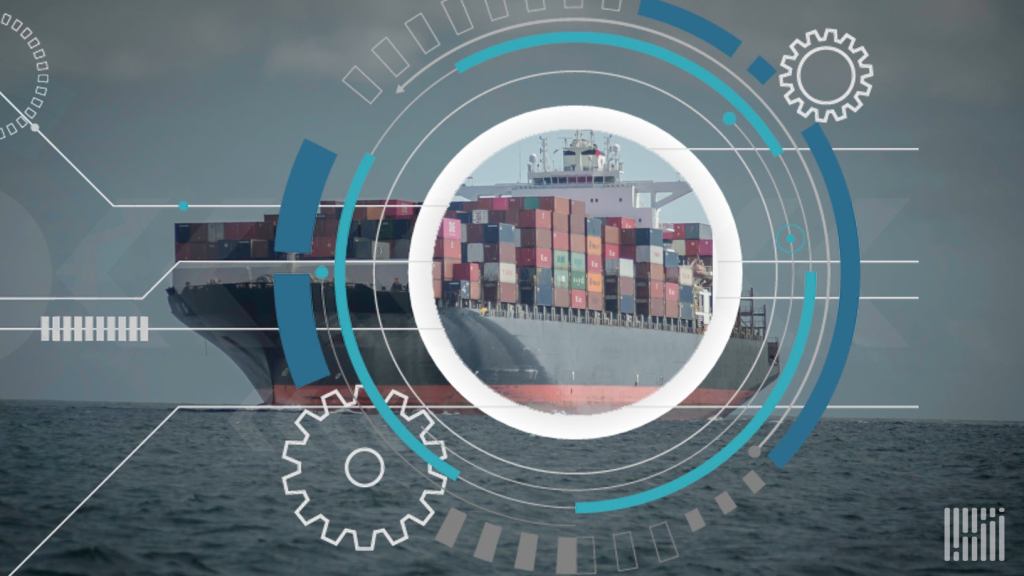
ITS Logistics is entering this digital arena with its container management and visibility platform ContainerAI. (Photo: Jim Allen/FreightWaves)

While the logistics industry is still in the early stages of adopting AI in its supply chain, many companies are investing in digital abilities to expand services to clients. In times of uncertainty, it’s the ability of a logistics company to offer real-time container analysis for clients and provide them with certainty that makes a difference.

The freight recession continues to weed out the diversified logistics companies versus the overhyped, flash-in-the-pan logistics companies that masked themselves as “tech companies.” While valuations of these companies have made them Wall Street darlings, the CEOs who make grand promises can’t shield their companies from the reality that they are one-trick ponies.

The digital arena has been flooded with logistics visibility platforms the past several years. Charmed by the promises they offer, logistics companies pay to access these platforms and use several in order to achieve full visibility of their supply chain.

ITS Logistics is entering this digital arena with its container management and visibility platform ContainerAI. The platform, which is free for clients, offers a full tech stack of digital data that shows a client’s full supply chain from origin to destination. ContainerAI is also available as a stand-alone software-as-a-service offering for any containers that are not managed by ITS.

The 25-year-old logistics company is also a member of the U.S. Department of Transportation’s data-sharing initiative, Freight Logistics Optimization Works (FLOW), and ContainerAI has been integrated into it.

The platform, which took four years of testing, includes ocean voyages, port charges, container dwell time, rail transport and ground logistics.

“ContainerAI equips our team and our customers with the foresight to improve efficiency, reduce costs and avoid demurrage, detention and accessorial fees,” explained Paul Brashier, vice president of drayage and intermodal for ITS Logistics.

The company is doubling down on its digital platform, investing more than $30 million, expanding its tech team in Reno, Nevada, building a new tech office in Chennai, India, and announcing the opening of a new Tech Innovation Center in Silicon Valley.

“While most platforms in this space were brought to market by tech-first companies without a lot of operational experience, our platform was built from the ground up based on our decades of logistical service,” Brashier said.

CMA CGM, Air France-KLM scrap cargo alliance over US market access

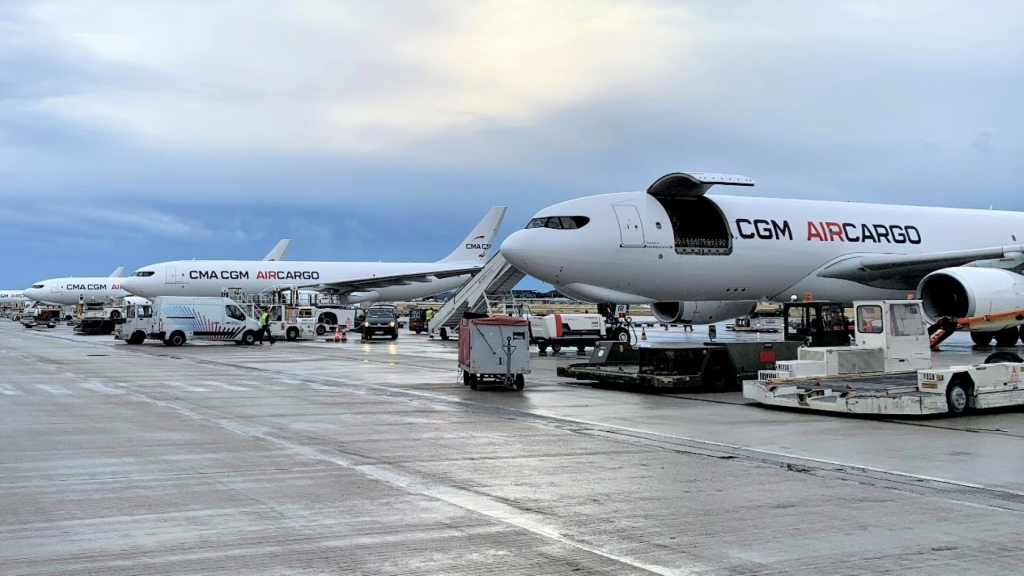
White CMA CGM Air Cargo planes side by side on the tarmac.

Air France-KLM and ocean shipping power CMA CGM, citing regulatory challenges in various nations, have agreed to discontinue their air cargo capacity-sharing agreement one year into a 10-year partnership, the companies announced on Tuesday.

Commercial cooperation between the two airline groups will end on March 31, one year after it began. Air France-KLM’s cargo division and CMA CGM Air Cargo will operate independently after that date, but discussions are underway to recast how the parties will cooperate going forward as independent operators, according to a joint news release. Interline agreements are a common way airlines use partner airlines to move shipments to destinations they don’t service.

“The tight regulatory environment in certain important markets has prevented the cooperation from working in an optimal way,” the companies said.

Several news outlets, including the Financial Times and Reuters, said the air cargo alliance appeared unlikely to receive U.S. antitrust approval to operate North American routes. A big albatross around their application is the Dutch government’s recent effort to cut nearly 10% of takeoff and landing slots at Amsterdam Schiphol Airport to reduce pollution and noise. The Netherlands dropped the proposal late last year after strong industry pushback, but the situation may have made U.S. regulators less inclined to help a Dutch airline, according to the news outlets. U.S. officials had expressed concern about the unilateral nature of the decision and reduction in U.S. flights when such matters would normally be negotiated in the context of the existing U.S.-European Union Open Skies agreement. The U.S. warned the Dutch government that flight cuts could open the door for retaliatory cuts to KLM’s frequencies to the U.S.

Reuters said the deal was also undermined by the weak airfreight market that has gripped the industry ever since the Air France-KLM capacity-sharing agreement was inked in May 2022.

Paris-based CMA CGM Air Cargo began operating in 2022 as the parent company used enormous container shipping profits during the pandemic to broaden its logistics capabilities for large customers. It owns and operates four Airbus A330-200 and two Boeing 777 cargo jets. It also has two 777s on order from Boeing and commitments for four Airbus A350 freighters. The startup airline has also had difficulty building a customer base, as demonstrated by on-again, off-again flights from Europe to the U.S., especially under weak market conditions that persisted for nearly 18 months.

The Air France-KLM Group operates six cargo jets (KLM’s three Boeing 747-400 production freighters, Martinair’s one 747-400 converted freighter and Air France’s two 777-200s). It also has an order with Airbus for eight A350 freighters.

The airlines established their alliance so they could jointly market freighter capacity and combine networks and dedicated services to increase scale and competitiveness. The idea was that the combined offerings would give customers greater choice in destinations, improved transit times and flexibility by utilizing the freighter and passenger belly space of the carriers.

CMA CGM took a 9% share in Air France-KLM when the deal was struck and will remain a shareholder. But the lockup period on the subscribed shares has been adjusted to end in February 2025 and will not be partly extendable until 2028, as originally planned. Under the exit agreement, CMA CGM will step down from the Air France board of directors.

Meanwhile, another airline deal was blocked Tuesday in the U.S. over antitrust concerns. A federal judge blocked a proposed $3.8 billion merger between JetBlue and ultra-low cost carrier Spirit Airlines, ruling that the deal reduced competition and hurt consumers.

Click here for more FreightWaves stories by Eric Kulisch.

Sign up for the weekly American Shipper Air newsletter here

Cargojet reverses course on 777 freighter ambitions

Air cargo market: From ‘doom mongering’ to stability

Air France-KLM forms cargo alliance with French shipping giant CMA CGM