Walmart adds 1.8M homes to Dallas-Fort Worth drone delivery service

This story originally appeared on Flyingmag.com.

The world’s largest retailer just announced what it claims to be the biggest drone delivery expansion of any U.S. company.

Walmart — which uses drones from partners such as Zipline and Wing to deliver within minutes to customers nationwide — on Tuesday said it would add 1.8 million households to its Dallas-Fort Worth service area, which will soon cover three-quarters of the area’s population. According to the retailer, no U.S. company has offered drone delivery to as many households in a single market.

The expansion adds stores in 30 towns and municipalities to Walmart’s existing Dallas-Fort Worth service, which itself is part of a network spanning nearly 40 hubs in seven states.

Zipline and Wing, both of which were recently approved by the Federal Aviation Administration to fly drones beyond the visual line of sight (BVLOS) of an observer, will power the deliveries. The companies’ new permissions — part of an FAA push to grow the industry within the U.S. — will allow them to fly farther than previously permitted.

“Customers will have access to a broad assortment of items from Walmart available for delivery to their home in just minutes,” said Prathibha Rajashekhar, senior vice president of innovation and automation for Walmart U.S. “Drone delivery is not just a concept of the future; it’s happening now and will soon be a reality for millions of additional Texans.”

Walmart said Dallas-Fort Worth customers can expect the buzzing aircraft to arrive in as little as 10 minutes but no more than 30. Across two years of trials, the retailer has completed more than 20,000 deliveries of items such as snacks, beverages and cold medicines, including fragile cargo such as eggs. Thousands of items are eligible for drone delivery, but customers must be within 10 miles of a store offering the service.

With the expansion, Dallas-Fort Worth is shaping up to be Walmart’s largest U.S. drone delivery market initially. But the retailer has an additional 4,700 stores located within 10 miles of 90% of the U.S. population, adding plenty of room for scale when the time comes.

Zipline, which has worked with Walmart since 2021, is actually the world’s largest drone delivery provider by sheer volume. The company has flown more than 60 million commercial miles, completing 880,000 deliveries in the process. Wing, which ranks second on the list, has made about 350,000 deliveries, according to its website.

Tuesday’s announcement added more food and convenience delivery to Zipline’s profile, which largely consists of medical shipments of blood, vaccines and other critical cargo. The company said the expansion will allow it to serve 1,000 times as many Walmart customers. For the past two years, it’s delivered from a store in Arkansas, where it says customers now perceive operations as “totally normal.”

By the time Zipline and Walmart begin an operational pilot later this year, the company expects to have completed tens of thousands of trials with Platform 2 (P2), its next-generation delivery system.

Among other things, P2 will introduce a modified drone, docking, charging and delivery infrastructure for businesses, and an autonomous droid capable of guiding packages to spaces as small as a patio table. It aims to automate more tasks for customers and enable more precise drop-offs than the company’s existing system, which uses a parachute.

P2 is expected to roll out across the U.S. this year — including in Dallas-Fort Worth following pilot flights with Walmart.

“Autonomous delivery is finally ready for national scale in the U.S.” said Keller Rinaudo Cliffton, co-founder and CEO of Zipline. “Zipline is excited to enable Walmart’s vision of providing customer delivery so fast it feels like teleportation. … We’re excited for folks across Dallas-Fort Worth to experience delivery that is seven times as fast, zero emissions and whisper-quiet.”

Like Zipline, Wing, a subsidiary of Google parent Alphabet, has spent the past few years developing its U.S. network with Walmart.

The company has four years of commercial residential service under its belt, including more than a year and a half in DFW. Those operations recently ramped up with deliveries out of two Walmart Supercenters in the suburbs of Frisco and Lewisville, reaching a combined 60,000 households. Wing expects its next expansion to be completed within the year, adding “millions” of customers.

After four months of service in Dallas-Fort Worth with Walmart, customers have been clamoring for more, with the top 25% of customers ordering twice per week on average, Wing said. Sustainability is a value proposition to customers, but so is speed — the company’s drones typically spend just five minutes in the air during a delivery.

Now, range could become a selling point. With its recent FAA approval, Wing can expand its delivery zone beyond the previously enforced 6-mile radius. That means each of its delivery sites will be able to reach more customers.

“Our first few months delivering to Walmart customers have made it clear: Demand for drone delivery is real,” said Wing CEO Adam Woodworth. “The response has been incredible from customers ordering drone delivery from Walmart every day, and it’s a testament to our partnership that we’re now expanding our footprint to bring this innovative delivery option to millions of Texans. If this milestone is any indication, we believe 2024 is the year of drone delivery.”

Zipline and Wing were among the first U.S. firms to receive FAA Part 135 air carrier approval, which allows them to fly drones commercially. Only five companies in the space have those permissions, the others being Amazon Prime Air, UPS Flight Forward and Causey Aviation Unmanned, the partner of another Walmart collaborator, Israeli manufacturer Flytrex.

Drone delivery has not quite reached the mass adoption phase. But with Walmart’s massive expansion, that point is beginning to enter focus.

The key to scale will be the finalization of drone delivery regulations, which are still being developed. The FAA, for example, has proposed final rules for BVLOS operations and is coordinating with industry stakeholders to get it on the books. Until that happens, companies will need to rely on waivers like Zipline’s or Wing’s to start flying.

Those early operations — Walmart’s among them — will help the FAA learn what restrictions may need to be added, removed or modified. In the meantime, less established competitors will continue to languish under heavy limitations. But the hope is that Walmart, Zipline and Wing can give the FAA the confidence to open things up for the rest of the industry.

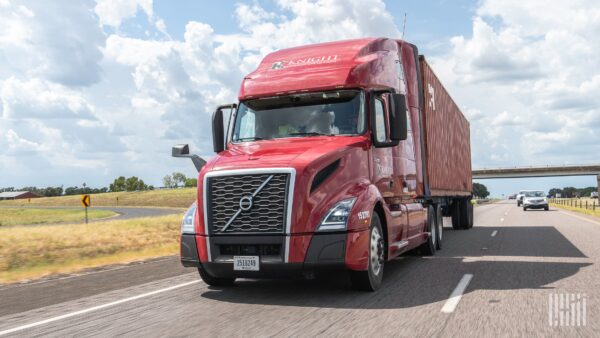
Loaded and Rolling: Freight upcycle may come early, says Morgan Stanley

Freight upcycle may come early, says Morgan Stanley

(Photo: Jim Allen/FreightWaves)

The freight recession may ease earlier than expected, according to recent comments from Morgan Stanley analyst Ravi Shanker. In a call to clients on Monday, Shanker said, “Shippers continue to remain on reorder ‘strike’ while they wait for stronger signals or more favorable conditions on macro but while destocking at the same time, which could lead to everyone wanting to restock at the same time, when the coast clears (or they run out of inventory).”

Shanker believes the freight upcycle will begin as early as the end of Q1 while admitting this prediction was “out of consensus.” His prediction is based on Morgan Stanley’s recently released Q4 2023 shipper survey that showed ongoing inventory destocking at historic levels. Regarding the survey results, FreightWaves’ Todd Maiden writes, “Of those polled, only 5% said they needed to increase inventory levels. Thirty-nine percent of respondents said they would reduce stock levels, which was a notable decline from the cycle-high of 48% that was registered during the second quarter.”

This optimism is most likely not going to be noted in Q4 2023 earnings and guidance in the coming weeks. Shanker predicts management teams’ outlooks will “be a tale of two halves” with the first half of the year clouded by macro uncertainty followed by the back half spurring more constructive commentary. Shanker concludes, “We are more bullish as we believe the pressure to restock is likely to be more intense than carriers or shippers believe. We believe only a black swan event or severe recalibration of macro expectations will push the upcycle into 2025.”

New independent contractor rule ‘Much ado about (almost) nothing’

(Photo: Jim Allen/FreightWaves)

After a yearlong effort, on Wednesday the Department of Labor formally released its final rule effective March 11 on “how to analyze who is an employee or independent contractor under the Fair Labor Standards Act (FLSA).” The new rules are part of an effort by the Biden administration toward rolling back a previous final rule by the Trump administration that was enacted in 2021 before Trump left office. The difference is in the details. The Trump 2021 rule focused on an “economic realities test” created by courts with core and noncore factors to be considered. Under the Biden 2024 rule, the economic reality expands to covering six factors, with a seventh “additional factor” examining if a worker or business is economically dependent on the potential employer for work.

Trucking lobbyists decried the Biden rule, with American Trucking Associations President Chris Spear saying, “I can think of nothing more un-American than for the government to extinguish the freedom of individuals to choose work arrangements that suit their needs and fulfill their ambitions,” In comments issued Tuesday, Todd Spencer, president of the Owner-Operator Independent Drivers Association, wrote, “Truckers are tired of the endless parade of classification rules that do not listen to their concerns.”

Richard Reibstein, attorney with Locke Lord who blogs on independent contractor status issues, is less concerned. FreightWaves’ John Kingston notes, “That apocalyptic view of the rule differs sharply from what Reibstein wrote. In his blog posted Tuesday, he referred back to an earlier statement of his on the proposed rule. ‘Unlike most regulations with hard and fast rules, the regulation was in the nature of an administrative interpretation comprising the Labor Department’s review of existing court decisions and its articulation of a preferred legal analysis … [that] courts would give little if any deference to.’”

Market update: Outbound tender rejection rates settle post-New Year

(Source: FreightWaves SONAR)

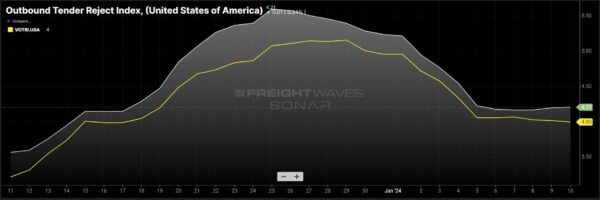
Nationwide outbound tender rejection rates stabilized this week following a brief rally leading up to New Year’s. The Outbound Tender Reject Index fell 56 basis points week over week from 4.77% on Jan. 3 to 4.21%. Dry van rejection rates saw a similar decline, falling 58 bps w/w from 4.58% on Jan. 3 to 4%. Truckload capacity returning to the market is the most likely cause as drivers who took extended holiday time off return to work and fleets reposition assets to cover committed freight. Reefer and flatbed tender rejection rates continue to overperform the average, with reefer at 7.29% and flatbed at 8.76%, respectively, but their share of the overall freight marketplace remains small compared to dry van freight. 

A development to monitor will be ongoing winter weather and storms moving across the U.S. into next week, bringing significantly lower temperatures. The weather may impact truckload operations in the Upper Midwest, Great Plains and Northeast. Spot market rate declines, which normally begin the second week of January, are declining at a slower rate as weather-related volatility may be a factor. Smaller fleets and owner-operators exposed to regions impacted by weather events may reposition assets further south unless primarily customer-routed. The FreightWaves National Truckload Index 7-Day average declined 4 cents per mile in the past seven days, from $2.43 per mile all-in to $2.39 per mile. Removing an estimated fuel surcharge, NTI linehaul rates (NTIL) fell 4 cents per mile w/w from $1.81 on Jan. 3 to $1.77 per mile.

FreightWaves SONAR spotlight: Trucking exits accelerate over the holidays

(Source: FreightWaves SONAR)

Commentary courtesy of the Daily Watch, a newsletter for SONAR subscribers

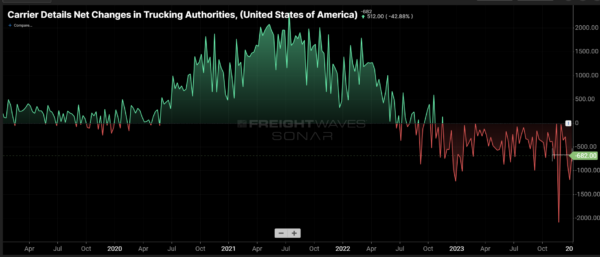
Summary: The truckload market was down over 6,800 operating authorities over the last 10 weeks of 2023. That is compared to approximately 5,500 down through the last 10 weeks of 2022, according to Carrier Details analysis of Federal Motor Carrier Safety Administration data. The takeaway is that the freight recession is continues but is moving toward an end at a faster pace than it was at this time last year from a supply perspective. Most transportation service providers are simply wondering how long they have to hold on in order to come out on the other end — the billion-dollar question. While no one knows for certain when the market will shift, the data says that it is coming. If there were no changes in capacity, then the market shift would be totally dependent on demand conditions changing. Outside of seasonal swings, demand conditions seem relatively stable. Supply-side changes tend to be much slower and carry more momentum, meaning overcorrection is very likely when the market flips.   

‘Leave us alone’: Union labor and trucking (Commercial Carrier Journal)

Supreme Court rejects review in broker liability case, leaving the issue unresolved (FreightWaves)

Kodiak reveals production-ready autonomous truck at CES (FreightWaves)

PS Logistics acquires flatbed, dedicated hauler Buddy Moore Trucking (FreightWaves)

We got too accustomed to peaceful seas (FreightWaves)


DOT tangles with watchdog over $1.5 billion in freight grants (FreightWaves)

Like the content? Subscribe to the newsletter here.

How Australia lost a war with emus

Tracks Through Time

While numerous parts of the world are ensconced in tragic wars right now, a war in Australia’s past offers a stark distinction with some levity.

In 1932, a massive migration of emus wrought havoc on the country’s farmlands, deeply damaging the country’s wheat supply and more. Twenty thousand emus descended on Western Australia in migration, almost decimating farmlands that provided much-needed wheat and supplies to Australia.

Find out more about this crazy war in this week’s episode of Tracks Through Time.

Daily Infographic: US bridges rated in poor condition


To view more FreightWaves infographics, click here

Ree Automotive gets full by-wire electric certification

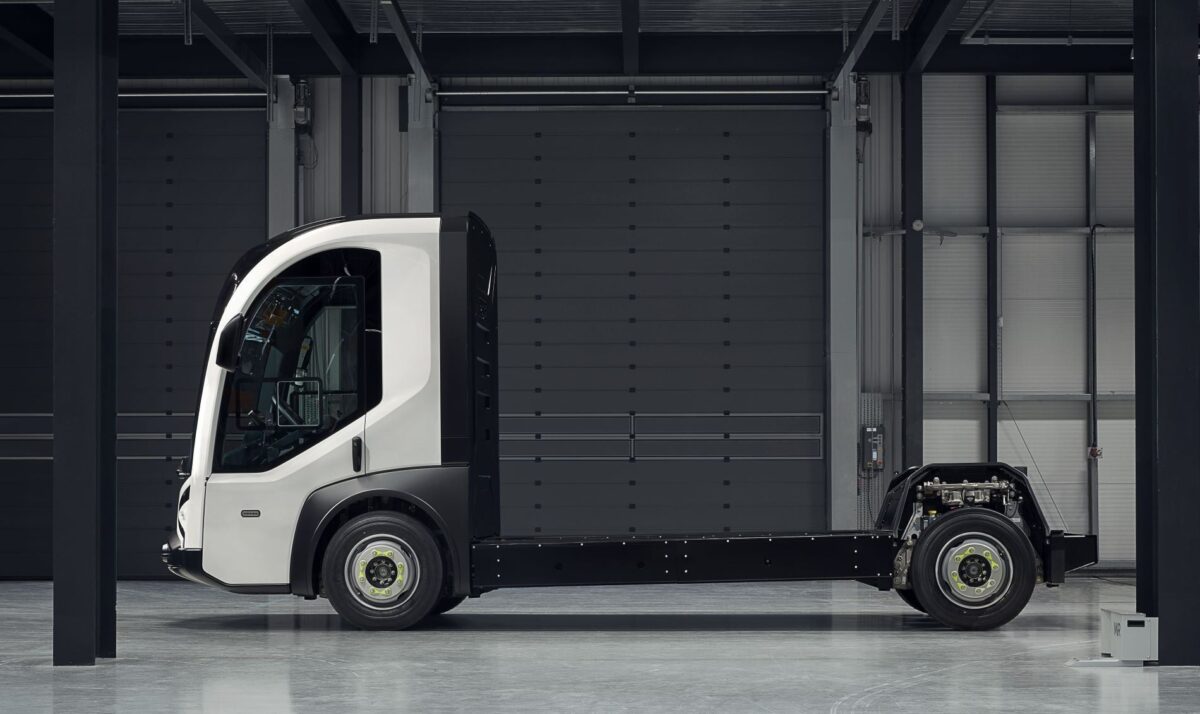
Ree Automotive P7-C chassis cab

Israel-based startup Ree Automotive delivered the first trucks with electronic by-wire technology for steering, braking and driving, achieving certification ahead of legacy automakers.

The Ree P7-C received U.S. Federal Motor Vehicle Safety Standards and Environmental Protection Agency certification for the technology, which eliminates mechanical linkages that transfer force, such as a hydraulic brake pump.

Instead of electric power steering backed by a traditional steering shaft and mechanical pump, Ree provides redundancy through power electronics. Drivers will “feel” like they are steering. Instead, computer programming generates what drivers think they are experiencing. 

“Anytime a company, especially a commercial vehicle company, gets federal approval for a new technology like this, it is significant,” Sam Abuelsamid, principal analyst for Guidehouse Insights, told FreightWaves.

The federal requirements and regulations do not differentiate between by-wire and non-by-wire. British engineering consultant Horiba Mira pre-certified the Reecorner x-by-wire system in 2023.

“We are the first to do it without a full mechanical backup,” Ree CEO and co-founder Daniel Barel told FreightWaves in August. “When the regulators come to us, they say, ‘We don’t care how you do it. When you show us that if your front brake doesn’t work, show us that you can brake.’”

Ree Automotive achieved federal certification for its by-wire electronic steering, braking and driving technology. (Photo: Ree Automotive)

First demonstration trucks going to customers for evaluation

With the certifications in hand, Ree is delivering demonstration trucks including one to Pritchard EV, which will use the vehicle for a roadshow with its fleet customers. More Ree dealers and multiple fleets should receive P7-C for evaluations in coming weeks.

Ree designs its electric vehicle in Tel Aviv, Israel, and builds the electric skateboard chassis in the United Kingdom. Class 3-5 work trucks containing the drive-by-wire system come to the U.S. late this year.

Ree is taking a deliberate asset-light manufacturing approach designed to conserve cash and put just enough vehicles out to create interest for more.

In addition to by-wire operation, Reecorner technology packs critical vehicle components like steering, braking, suspension, powertrain and control into a single compact module positioned between the chassis and the wheel. Four identical Reecorners enable assembly of the industry’s flattest EV platforms that provide more room for passengers, cargo and batteries.

Incentives could exceed $100,000 per truck

The P7-C is eligible for a tax credit of up to $40,000 under the IRS Commercial Clean Vehicle Tax Credit. Stacking of state incentives could bring the total incentive per vehicle to more than $100,000, depending on the customer’s location.

“I believe our Reecorner is a true gamechanger, allowing us to build electric trucks that fleets will want to buy, and drivers will love to drive as we continue to see a strong demand for our work trucks,” Barel said in a news release.

The company said a combination of the Reecorner and by-wire technology enables:

  • Superior maneuverability and cargo-carrying efficiency.
  • Enhanced safety via hardware and software redundancies that take over in case of any system failure.
  • Improved ergonomics with low step-in height and driver-centric cabin.
  • Future proofing for driverless operation and over-the-air software upgrade capability.

“Achieving this certification milestone is a testament to REE’s dedicated team and our determination to bring this technology to market safely,” said Richard Colley, Ree vice president of government and regulatory affairs.

Ree Automotive: Business life during wartime

Ree turns a corner with everything-by-wire technology

Click for more FreightWaves articles by Alan Adler.

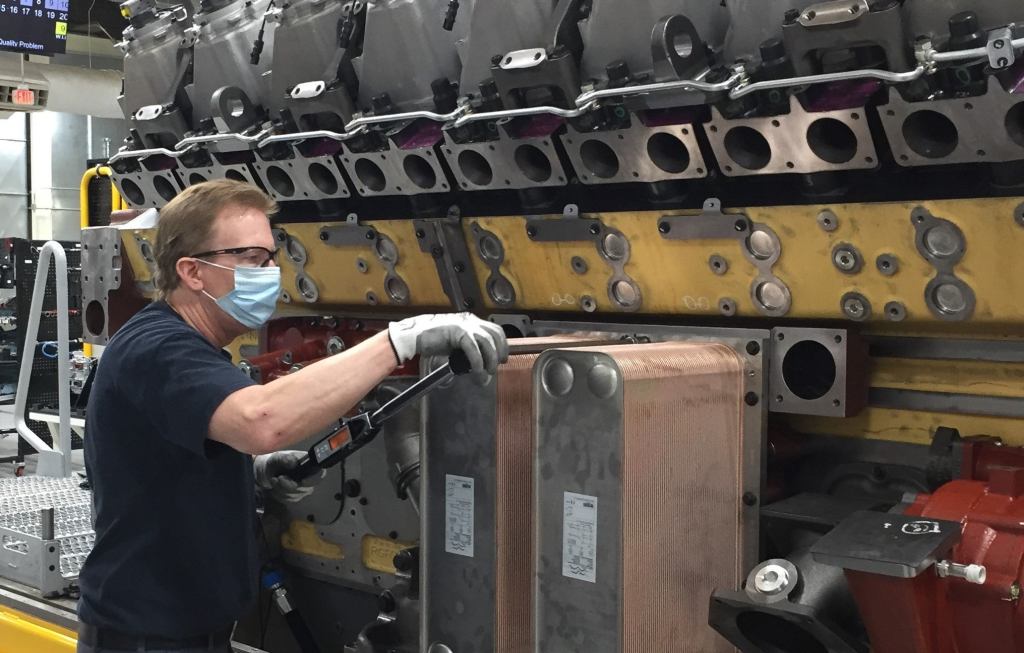
Cummins will pay California $175M over emission-rigged engines

Cummins Inc. will pay $175 million to California over emissions-rigging of Ram truck diesel engines. Along with $33 million for environmental violations and unfair business practices, it brings federal and state penalties to nearly $2 billion.

The Columbus, Indiana-based engine maker and advanced technology provider agreed Dec. 22 to a federal fine of $1.675 billion involving diesel engines in Ram trucks built over a decade. California’s share of the federal fine was $164 million. All told, the state will get about $372 million.

The federal civil penalty was the largest in the history of the Clean Air Act and second-largest fine overall. It followed the $2.6 billion criminal penalty that Volkswagen AG paid for emissions cheating in 2015. That arose from what became known as the “Dieselgate” scandal.

In a 158-page consent decree filed Wednesday in the U.S. District Court for the District of Columbia, Cummins agreed to make software changes at no cost to truck owners.

Emission-defeating software on 97,000 engines in California

The case involves approximately 97,000 engines in California and hundreds of thousands of vehicles nationwide. The California Air Resources Board discovered the defeat device violations in model years 2013 to 2018 Ram 2500 and 3500 trucks with the 6.7-liter diesel engine.

CARB used advanced testing methods and protocols developed to detect software programs that alter or shut down a vehicle’s emissions control system under normal driving operation.The U.S. Environmental Protection Agency partnered with CARB on the investigation, which revealed additional violations in 2019 to 2023 model year Ram 2500 and 3500 trucks.

’Knowingly harmed people’s health’

“Cummins knowingly harmed people’s health and our environment when they skirted state emissions tests and requirements,” California Attorney General Rob Bonta said in a news release. “Today’s settlement sends a clear message: If you break the law, we will hold you accountable.”

Cummins typically is responsible for certifying emissions only on its engines. In the case of the Ram trucks, Cummins certified that both the engine and the overall vehicle complied with federal regulations.

The company admitted no wrongdoing. It said in a statement that it is “looking forward to obtaining certainty as we conclude this lengthy matter.” Cummins reserved just over $2 billion against its fourth-quarter earnings for the federal and state penalties.

Auxiliary emission control devices rarely allowed

Software known as auxiliary emission control devices are allowed only when engine makers tell authorities of their existence in advance of certification. They typically are allowed only to protect the engine.

In this case, Cummins did not disclose the existence of the auxiliary emission control devices. The software changed the engine’s performance to meet rigorous emission standards during certification testing in the lab. But the emission control equipment shut down during real-world driving.

The Cummins engines involved in the case emitted smog-forming oxides of nitrogen (NOx) that were above the legal limit. NOx pollution contributes to the formation of ozone and particulate matter, which can aggravate health problems such as asthma and cardiopulmonary disease. 

Cummins will pay $1.675B fine for engine emissions violations

EPA has questions for Cummins over Ram engines

Click for more FreightWaves articles by Alan Adler.

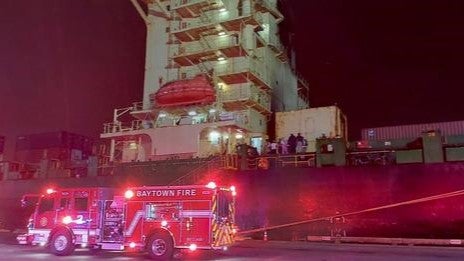
2 dead after fire aboard container ship at Port Houston

Two crew members died and a third was injured after a fire aboard a container ship at Port Houston.

The incident began around 3:30 a.m. Monday. The Port Houston Fire Department responded to a report of a fire on board the M/V Stride, which was docked at the port’s Barbours Cut Container Terminal, port officials said in a post on X, formerly known as Twitter.

The fire reportedly had erupted in the engine room of the vessel with three crew members unaccounted for, according to the Baytown Fire Department

“[Firefighters] arrived on scene and were directed to the vessel’s engine room to perform rescue operations. During the search, Baytown firefighters located the unaccounted crew members. Regrettably, two of them were found to be deceased, while the third was alive,” the Baytown Fire Department said.

The injured crew member was transported to a local hospital in critical condition. No other injuries were reported. 

The fire was extinguished around 4:30 a.m. The U.S. Coast Guard and the National Transportation Safety Board said they are investigating the incident. The ship is still currently at Port Houston.

The M/V Stride is a 27-year-old container ship sailing under the flag of Panama. The vessel is owned by the Athens, Greece-based Danaos Corp., and has a capacity of 2,174 twenty-foot equivalent units.

More articles by Noi Mahoney

Warehousing and fulfillment startup Flexe lays off 99 workers

Private firm strikes $262M deal for 25-building logistics portfolio in South Florida

CBP reopens 4 Southwest ports of entry after weekslong closures

Werner Enterprises taps new president from within

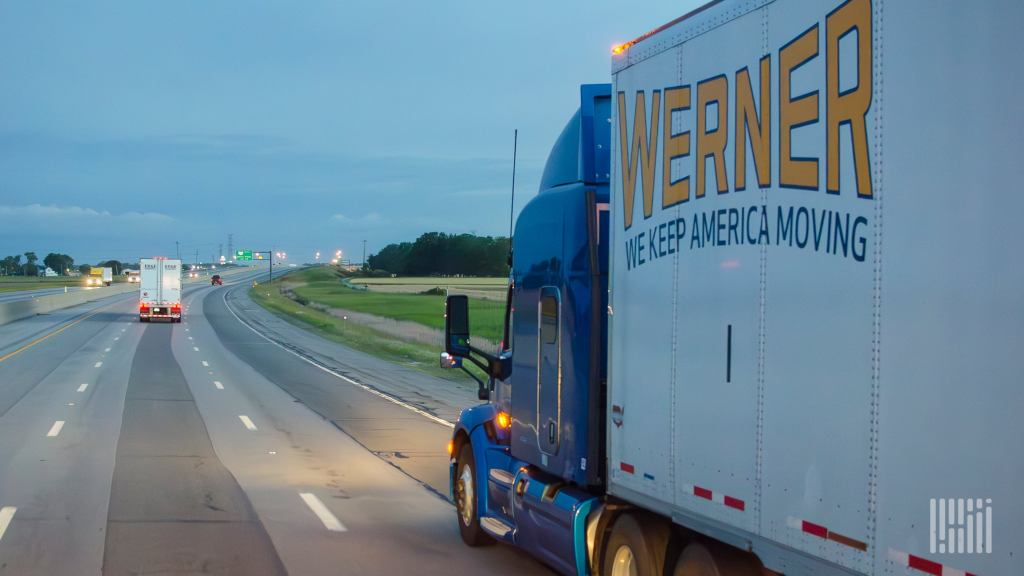
A blue Werner tractor pulling a white Werner trailer at night on a highway

Werner Enterprises announced Wednesday that its chief legal officer, Nathan Meisgeier, will also take on the role of president of the company. The change became effective on Friday.

Meisgeier joined the transportation and logistics company in 2005 as senior counsel of litigation and has served on its executive team since 2016. Most recently, he has overseen the company’s legal, risk, human resources and government affairs functions as executive vice president and chief legal officer.

In addition to his roles at Werner (NASDAQ: WERN), Meisgeier is the chairman of American Trucking Associations’ Legal Reform Advisory Council.

“Since being promoted to Werner’s General Counsel in 2016, Nathan has been a transformative leader across the enterprise, currently acting as Chief of Staff and bringing a remarkable level of integrity and strategic vision to our company,” said Werner Chairman and CEO Derek Leathers.

Leathers, who was the company’s previous president, recommended Meisgeier for the position. The company’s board of directors unanimously approved that recommendation.

“I am honored and humbled to be selected by Derek and appointed by Werner’s Board of Directors to be our company’s next President,” said Meisgeier. “In my 18 years with this great company, I have learned invaluable lessons from many current and former Werner leaders, including both Derek and CL Werner himself.”

Werner stepped down as executive chairman in 2020.

More FreightWaves articles by Todd Maiden

DOT tangles with watchdog over $1.5 billion in freight grants

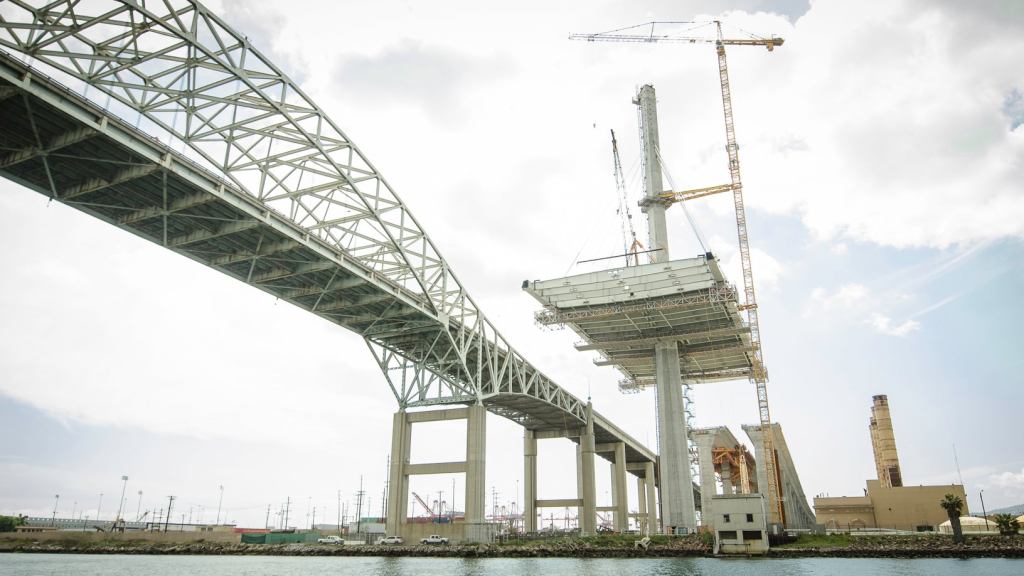
New bridge being built

WASHINGTON — A new federal watchdog report criticizes the U.S. Department of Transportation for not properly documenting how it prioritizes funding for major infrastructure projects involving highways, ports and freight rail — but DOT disagrees with the assessment.

The report, published and sent to Congress on Wednesday by the U.S. Government Accountability Office (GAO), concluded that DOT needs to improve its process for conflict-of-interest screening when evaluating awards for its Multimodal Project Discretionary Grant program. GAO also found that DOT is not clearly defining criteria used to recommend “exemplary” national projects — those capable of generating significant economic benefits — to Transportation Secretary Pete Buttigieg.

While DOT concurred with the first finding, its justifications for award decisions ultimately made by Buttigieg are well documented “and, therefore, decisions by [DOT’s] Senior Review Team to advance applications to the Secretary for award are also well documented,” DOT told GAO in comments on the report’s recommendations.

But GAO responded that a final award, and advancing applications for a final award, are actually two different stages of the grant process.

“Improvements in one stage do not necessarily constitute improvements in the other,” GAO asserted.

“Specifically, while we found DOT improved its documentation of the Secretary’s final award decisions, we continued to find that DOT did not consistently document its rationale for its decisions to advance applications to the Secretary, including why an application was exemplary.

“Clearly defining what constitutes ‘exemplary project’ criteria would enhance the consistency and transparency of the program and provide better information to applicants.”

As federal investments for infrastructure projects have grown — particularly through the Bipartisan Infrastructure Law signed by President Joe Biden in 2021 — DOT has been under heightened pressure from Congress and policymakers to untangle permitting red tape for projects while at the same time ensuring the award process is fair and transparent.

In its most recent round of funding of discretionary grants through the Infrastructure for Rebuilding America (INFRA) program in September 2022, DOT awarded $1.5 billion in grants to 26 projects.

In its study, GAO reviewed DOT’s notice of funding opportunity, evaluation plan and documentation of the 2022 INFRA evaluation process, analyzed application and award data, and interviewed DOT officials. The oversight agency also reviewed the documentation of 50 applications, including the 26 applications that received an award.

GAO noted that DOT has improved some of its processes for evaluating and selecting INFRA applications for awards. For example, it put in place and documented an evaluation process as required by federal guidance. DOT also created a new memo “to better explain the Secretary’s award decisions, which provides insight into why the applications chosen for award were selected over similarly situated applications,” GAO stated.

But the watchdog agency also pointed out that it had made previous recommendations that DOT require INFRA program teams to document their decision-making rationale throughout all levels of review — a recommendation DOT has not yet fully implemented.

“Implementing our prior recommendation along with our second recommendation in this report would better position DOT to defend the overall integrity of its award process,” GAO stated.

Click for more FreightWaves articles by John Gallagher.

Pepsi/Carrefour divide the latest among retail/CPG disputes

Retail, CPG pricing disagreement boils over in Europe

Depending on whom you believe, either European grocer Carrefour stopped selling Pepsi products in certain locations, or Pepsi pulled out and decided to stop selling at the grocer. Whatever the specifics, the parties couldn’t agree on the value of potato chips, and it’s clear that retailers and CPG companies have become even more at odds than usual as commodity prices have fluctuated. Even if the Carrefour impasse persists, it isn’t going to put much of a dent in Pepsi’s financials — some analysts estimate that sales in the impacted countries (France, Italy, Spain and Belgium) represent 0.25% of Pepsi’s total revenue. But the situation reflects the very impactful tension between retail and CPG that the public rarely sees.

What’s more typical is that closed-door disputes result in subtle, but impactful, changes in shelf placement. Retailers’ private-label investments and the pricing of those products are another form of recourse that retailers more typically employ. In this case, I wonder whether the grocer’s decision (if it was, in fact, the grocer’s) to stop carrying Pepsi products was a way to get the public on its side. After all, shoppers tend to blame retailers rather than suppliers for high prices.

A recurring topic on The Stockout, here is a quick summary of the rising tension: Inflation started accelerating in CPG cost structure in early to mid-2021, lead CPG companies to ask retailers for price increases in the subsequent quarters and years that were both more numerous, and of a greater magnitude, than retailers were accustomed to. Retail prices adjusted less quickly than CPG companies’ costs, so CPGs experienced significant margin compression — and margins had already been depressed due to extra supply chain costs associated with COVID. Adding to the strained relationship, most CPG companies last year were reluctant to cut prices even as commodity prices declined, citing cost increases in areas other than traded commodities, such as labor, packaging and processing. That caused retailers to place more onus on CPGs to demonstrate why any further price increases are necessary. The largest retailers have used more aggressive language on their latest round of analyst calls, suggesting that they expect price reductions, or at least very minimal price increases, from suppliers.

Constellation Brands’ beer business continues to face inflationary pressure

In its earnings presentation Friday, Constellation Brands (maker of Modelo and Corona beers in addition to wine and spirits), highlighted numerous cost pressures in its beer business for the current fiscal year (ending February 2024):

  • Raw materials and packaging (55%-60% of cost of goods sold) up high-single digits.
  • Freight (20%-25% of COGS) up high single digits.
  • Labor and overhead (10%-15% of COGS), up high teens. 

Freight costs up high single digits was surprising but may reflect rail costs in addition to truckload since much of the company’s beer is manufactured in Mexico. In addition, it should be noted that those cost comments were largely backward-looking since the company is already in its fiscal Q4.

Import volume ekes out y/y growth in December

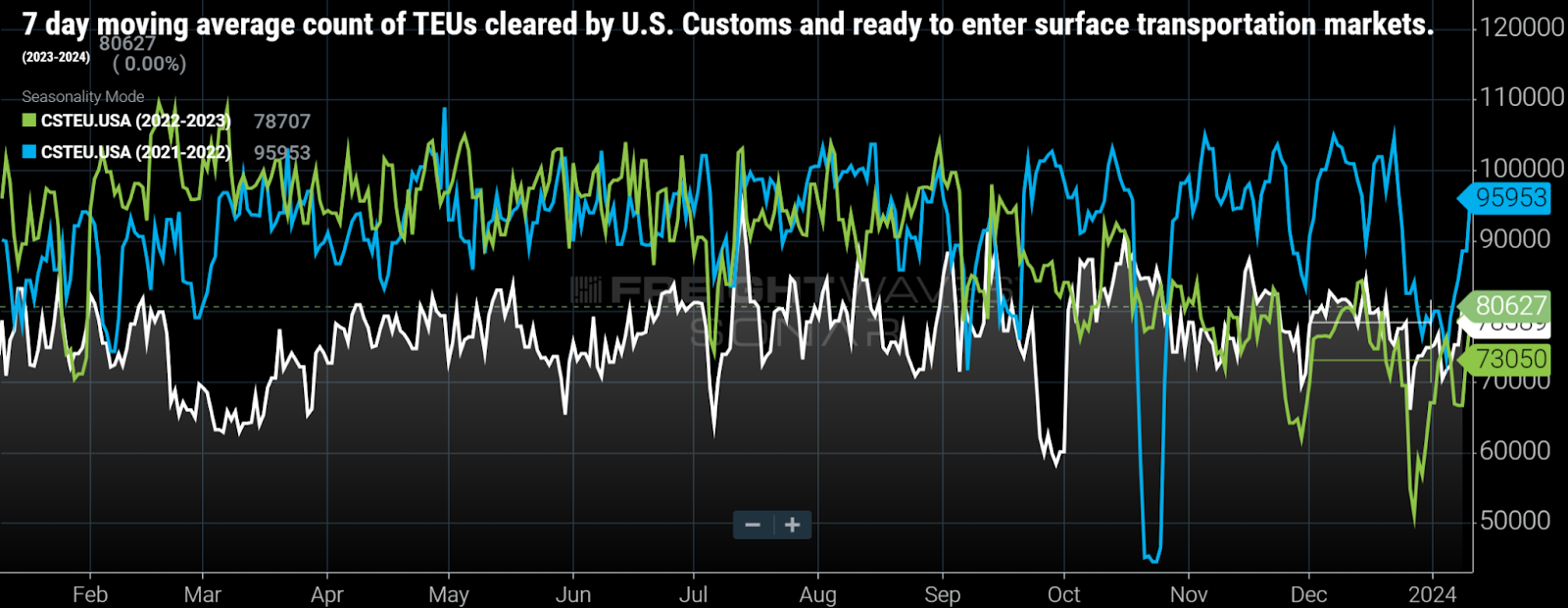
This article by Greg Miller breaks down U.S. import growth in December. Descartes’ data shows December imports up 9.2% y/y, while U.S. Customs data in SONAR shows similar volume growth of 7.4% in the same period. Part of that gain is related to easy year-ago comps, but it was perhaps remarkably stable considering the turmoil in the global shipping markets between the drought at the Panama Canal and the attacks in the Red Sea. Even more counterintuitively, volume comps were stronger in the Gulf Coast and East Coast import markets than they were on the West Coast.

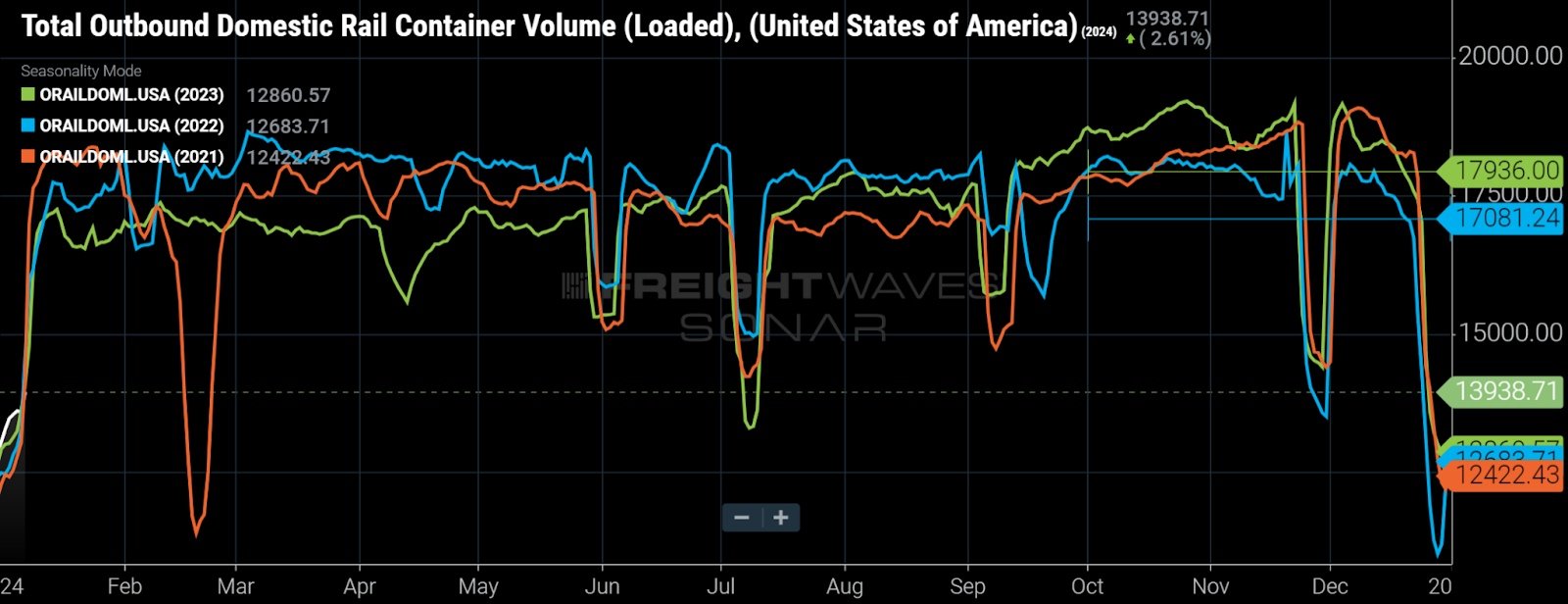
Loaded domestic intermodal volume posts 5% y/y growth in Q4 2023

Contrary to the expectations of most heading into the fourth quarter that there wouldn’t be much of a peak season in intermodal, when considering only loaded 53-foot containers, volume was up a meaningful 5% y/y in Q4. While intermodal service levels have been strong, and 5% y/y growth may represent a positive variance versus some analysts’ expectations, it’s not clear that represented a gain in market share when compared with long-haul truckload volume. The long-haul (>800 miles) truckload volume (LOTVI.USA) contained in SONAR showed a 7.9% y/y increase in tenders and a 7.1% y/y increase in accepted tenders (when considering the increase in the long-haul tender rejection rate from 4.2% in Q4 2022 to 4.9% in Q4 2023). Therefore, it appeared that the fourth quarter was more a story of increased long-haul demand rather than gain of modal share. However, that’s not to say definitively that intermodal lost share because many long-haul truckload volumes are in lanes that are not compatible with rail intermodal. Going forward, for the railroads and their domestic intermodal partners to capitalize on their newly established or expanded partnerships, service levels will be critical for volume growth.

To subscribe to The Stockout, FreightWaves’ CPG and retail newsletter, click here.