FedEx pilots face pay cuts, buyouts as contract talks resume

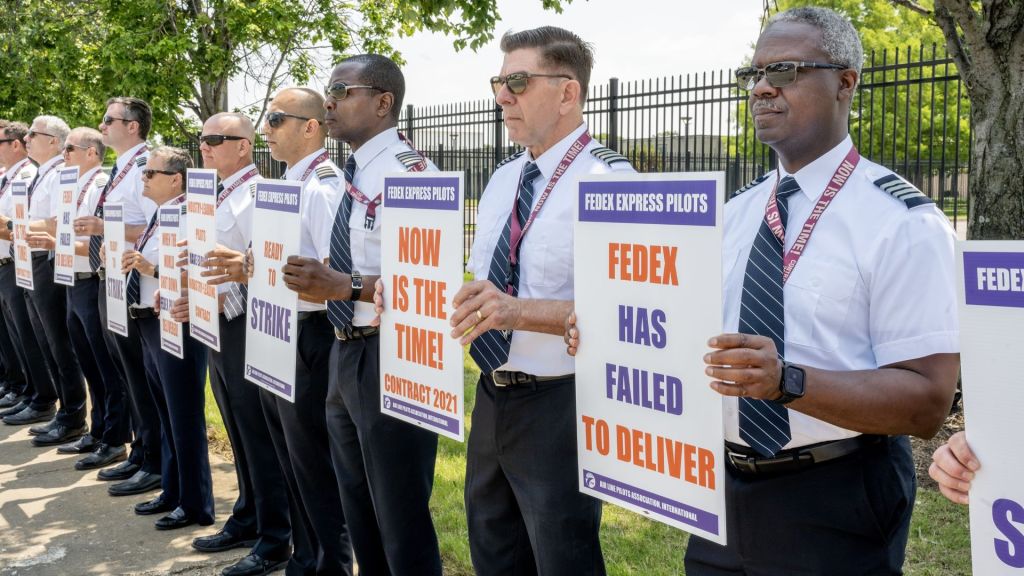
FedEx pilots in white, short-sleeve shirts stand side-by-side holding signs to protest FedEx's contract negotiations.

FedEx Express soon plans to cut the minimum number of flight hours guaranteed to pilots by 13% and push 400 senior crew members to early retirement as quickly as possible to address severe overstaffing amid a prolonged falloff in parcel volumes, according to internal communications obtained by FreightWaves.

An additional 200 to 300 pilots could become redundant late this year if the company, as expected, loses a large chunk of work for the U.S. Postal Service, a senior executive recently told a group of airline employees.

The attempt to shed pilots, who have already absorbed a steep decline in pay, comes as collective bargaining resumes for a new contract.

Management is likely to invoke contract clauses that would allow it to go below the minimum guarantee of 68 flight hours per month when available flying time falls below certain thresholds, said Pat DiMento, FedEx’s vice president of flight operations and training, in a secretly recorded meeting with pilot evaluators that was shared with FreightWaves. Pilots get credit for the minimum number of hours regardless of how many hours are actually flown.

FedEx Express, the largest cargo airline in the world, has essentially been able to pay the equivalent of 200 fewer pilots since the summer by limiting distribution of flight schedules, effectively reducing the current surplus of employees, he said. 

FedEx expects 350 to 450 pilots to accept early-retirement incentives when a deal on a new labor contract is reached, which would allow the company to maintain current minimum credit hours and flight schedules, said DiMento.

In the absence of a tentative contract, the airline would need to reduce the crew list by 200 individuals any way possible to prevent further cuts to pay guarantees. Achieving that figure — through retirement, resignation, leave of absence or offers from competitors — would save the company $50 million per year.

Average daily parcel volume for FedEx Express declined 2%  and global average daily freight pounds fell 18% year over year in the quarter ended Nov. 30. Express volumes were down more than 10% for three consecutive quarters through last February and then shrank at single-digit levels for the remainder of 2023. 

FedEx planners are already noticing a decline in January volumes and removing flight hours they previously expected to operate, the flight operations chief recently told the quality control pilots. It was a friendly audience because they are quasi-supervisors that sit between line pilots and management. 

“Unless we get a new contract, it’s [pilot pay] not going to magically fix itself because I don’t see the economy turning around,” DiMento said.

Addressing labor pressure in down market

Investors were disappointed that major operational savings at FedEx were unable to fully offset lower revenue during the second quarter. Express faces higher labor costs if pilots secure a contract upgrade and newly mobilized mechanics are able to form a union.

Both outcomes are far from certain. 

Workers at Amazon fulfillment centers, Starbucks locations and other businesses have voted in recent years, for varying reasons, against joining a union. And pilots had more leverage a year ago when major passenger airlines scrambled to refill positions after the pandemic as travel demand spiked. Delta Air Lines plans to hire half as many pilots this year as it did in 2022 and 2023 because the pilot shortage has eased, according to Aero Crew News.

Meanwhile, FedEx is now downsizing internal fleet operations to eliminate excess capacity and is looking to shed pilots amid diminishing parcel volumes.

FedEx cockpit crews, represented by the Air Line Pilots Association (ALPA), in July rejected a tentative contract worth $3.8 billion that would have increased pay by 30% over 4.5 years and are back at the bargaining table.

The last round of negotiations, mediated by the federal National Mediation Board, took place Dec. 12-15, and the sides are scheduled to meet again Thursday and Friday. Two more bargaining sessions are set for January.

A majority of FedEx pilots were displeased with the agreement’s level of job protections, back pay, pension options and quality-of-life considerations and the fact that pay increases were below those achieved by passenger-airline counterparts. Pilots at Southwest Airlines, for example, are considering whether to accept a new contract that would raise pilot pay 50% over five years.

After FedEx announced it is accelerating a $1 billion share buyback, ALPA last week said the company should also invest in cockpit crews to provide stability for long-term growth. The union argues pilots deserve to be compensated for the sacrifices and risks taken so the company could earn record profits during the COVID crisis.

Deep division within the pilot group could hamper chances for a quick deal. A slim majority voted to kill the tentative contract, and some wanted to recall the negotiating committee. Those pilots are upset with ALPA for being too accommodating toward FedEx, including in a 2015 contract they say eroded schedule flexibility and other quality-of-life issues. 

Many union members have lost faith in the ability of Capt. Pat May, the chairman of ALPA’s FedEx negotiating committee, to deliver a favorable labor agreement, especially after he did not resign, as promised, when the tentative deal went down last summer, a pilot told FreightWaves. The source asked not to be identified so as not to jeopardize his job or union relationship.  

Pilots over the years left carriers such as American, Delta, United and Southwest for what they believed were better jobs at FedEx.

“Our work rules are well below our passenger peers. Pay and compensation is starting to lag and stagnant. We fly horrendous schedules which affect our health,” the pilot said. “This entire situation may have killed the best airline job in America.”

Hourly pay scales vary by type of aircraft flown and seniority. A widebody (MD-11 or Boeing 777) captain at FedEx makes $277 in the first year and $326.50 with 12 years on the job, according to data compiled by the Air Line Pilots Association. That compares to $345 per hour in year one at Hawaiian Airlines, a new entrant in the freighter space, to fly the Airbus A330. After a dozen years at Hawaiian, a freighter captain can make $376 per hour. Pilots at UPS make $344 per hour, after an initial probation year, and $366 by year 12.

The total value of the FedEx pilot’s tentative agreement last summer compared to American Airlines, Delta Air Lines. (Source: ALPA)

A veteran FedEx captain pulling a typical 80 to 90 hours per month annually makes about $363,000 in pay and benefits, compared to about $396,000 at UPS, according to analysis by Kit Darby, an aviation labor consultant. A senior captain at Delta Air Lines or United makes about $416,000 per year.

DiMento indicated that FedEx plans to offer the same amount of total money to the pilots in this go round as it did in the tentative agreement, but reallocate it differently between retirement, higher pay scales, signing bonuses or other buckets. 

The worth of the contract will be more than last July because higher pay rates and signing bonuses will have accrued since then and will be retroactively covered in the new contract, DiMento explained, 

One of the check airmen, who said he voted in favor of the negotiated contract, questioned if the strategy will work.

“The young guys, their mentality is, ‘We came to this premier airline and we want a premier contract.’ I don’t know if they are going to go for it,” he told DiMento. The total compensation and lifestyle for a veteran FedEx pilot compares very favorably to one at Delta, he added, “but they don’t listen.”

Many pilots were concerned that language prohibiting outsourcing to third-party airlines if FedEx reduces flight hours or furlough pilots wasn’t strong enough in the tentative agreement, but DiMento stressed management wants to maximize use of its own aircraft and won’t seek operating leases when its own pilots aren’t busy. He said fear mongering that FedEx wanted long-term transportation service agreements to replace in-house flying undermined passage of the interim contract

Economic leverage shifts

When the parties began negotiations in 2021 to amend the existing contract, the FedEx fleet was maxed out to meet soaring freight and parcel demand, stoked by people buying goods online rather than services because of social distancing during COVID.

The market has drastically changed since then, with e-commerce growth returning to normal and air cargo volumes contracting for nearly 18 months. FedEx Express was hiring pilots as fast as it could and didn’t forecast the severity of the downturn. The company now has more aircraft and pilots than needed to fly current volumes.

There are about 700 surplus pilots out of 5,800 on the payroll, according to FedEx officials. 

In the fall of 2022, FedEx launched an initiative to take out $4 billion in structural costs, especially in the air network, and redesign the entire parcel distribution network for greater efficiency. The air overhaul could make FedEx Express less reliant on aircraft than in the past.

The air and international unit flew fewer hours in 2023, deactivated aircraft until demand returns, accelerated the retirement of older planes and flew more direct routes. Since the company still has new freighters on order, it’s unclear if the total fleet size will decrease. FedEx last year decided to close three pilot bases in the U.S. and overseas and its Los Angeles airport maintenance facility in 2024. The repair jobs will be sent to Indianapolis.

FedEx is only providing the minimum number of flight hours guaranteed in the existing contract. Pilots are making substantially less money because they have to share a smaller pool of flying assignments. One pilot contacted by FreightWaves said his pay has been cut back 30% this year.

In November, management prodded pilots to consider job openings at PSA Airlines, a regional feeder carrier owned by American Airlines, that offered incentives to attract FedEx and UPS pilots.

The FedEx pilot said he had not heard of any colleagues taking the PSA deal. Pilots said in online chat forums that they considered the request disrespectful to veteran crew members who can go directly to a large airline and enjoy superior benefits. PSA did not respond to a message about the success of the recruiting effort.
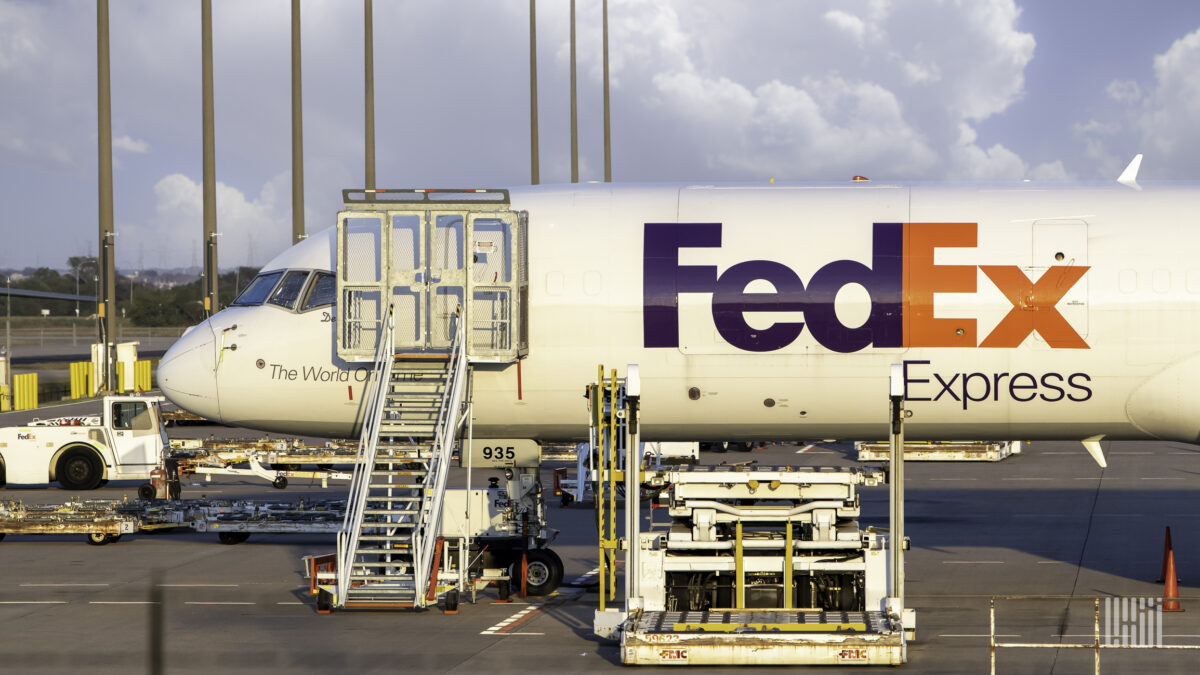
A Boeing 757 freighter parked at Dallas-Fort Worth International Airport. (Photo: Jim Allen/FreightWaves)

Since few pilots have been willing to voluntarily leave so far, guaranteed pay could soon fall to about 60 or 61 hours per month, DiMento told the check airmen. That would effectively reduce pilot rolls by an additional 100 individuals and save FedEx about $100 million per year.

He speculated that it would take a $500,000 exit package today to entice some pilots into early retirement because many near eligibility are holding off until a new contract is in place. Normally, about 140 FedEx pilots retire at the end of each year, but only about 40 captains did so in 2023.

When a contract is finalized, FedEx will make it attractive to retire by waiving the requirement for giving notice of early retirement and enhancing the severance package, said DiMento.

FedEx has to balance a new contract offer against the economic realities it faces. It can’t afford to give pilots $500 million extra to close out a deal, DiMento said, when it’s struggling to generate revenue.

“In this business environment, as a pilot you can’t go in there asking for the world. It’s just not going to happen,” he said.

And, the flight operations chief added, the substantial loss of the existing U.S. Postal Service contract means FedEx will have 200 to 300 more excess pilots by October. The Postal Service is in the third year of a transformation plan that includes migrating most air volumes to ground transportation to save money.

Mechanics mobilize

Meanwhile, FedEx Express mechanics recently launched a campaign to join the Teamsters union.

The organizing effort targets about 5,500 to 6,000 aviation, truck and facility mechanics, and possibly some maintenance workers at FedEx Express, said Teamsters spokesman Matt McQuaid in an email exchange.

Hundreds of technicians have signed authorization cards saying they want the Teamsters to represent them in collective bargaining, the union said in a Dec. 20 news release.

The Teamsters’ goal is to petition the National Mediation Board for a representation election within the next few months, McQuaid said. The NMB will conduct an election if employees or a union is able to collect signatures from at least 50% of workers in a potential bargaining unit. Labor relations for airlines are governed by the Railway Labor Act, which highly regulates bargaining procedures that unions and employers must follow, and facilitated by the NMB.

That means any union has the harder task of winning national support across the country instead of organizing individual facilities at the local level.

“The response has been overwhelming,” said Joe Ferreira, director of the Teamsters Airline Division, in a Nov. 13 letter to workers in which he accused FedEx management of engaging in “an anti-union propaganda campaign that grossly misrepresents the factions of your unionization drive, the National Mediation Board process, and disregards federal law.”

According to ZipRecruiter, the average aircraft maintenance technician at FedEx makes $72,000 per year.

The FedEx campaign comes as the Teamsters have tried for more than a year to organize technicians at Delta Air Lines.

“We’re aware the Teamsters are targeting our mechanics at FedEx Express. We respect the right of our employees to choose whether or not to support such efforts. We are incredibly proud of the culture we have built over the past 50 years that empowers our employees’ voices; values their creativity and contributions; and encourages collaboration that is important to them, their career, and our future,” FedEx said in a statement to FreightWaves.

The Teamsters last year chalked up significant wins in the express logistics sector. An aggressive strategy by new President Sean O’Brien forced UPS to grant big pay increases to 340,000 workers while 1,100 ramp workers at DHL Express’ Cincinnati air hub won their first contract, pending ratification, after a 12-day strike.

Satish Jindel, the CEO of consultancy ShipMatrix, said in an interview that “the Teamsters should look for a better target [than the FedEx mechanics] where the law may not limit them and working conditions and wages are bad.”

Click here for more FreightWaves/American Shipper stories by Eric Kulisch.

DHL Express workers at Cincinnati airport reach deal, end strike
7 hot issues for rail stakeholders in 2024

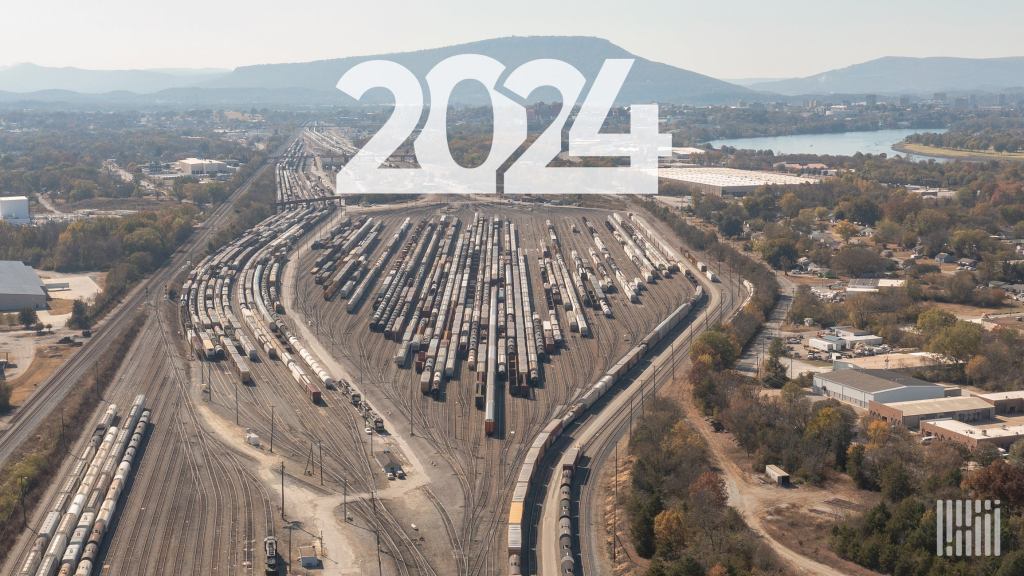
An aerial photo of a rail yard that has several parked trains. The number 2024 is written near the top of the photo.

Railroads, shippers and unions are tracking hot topics ranging from service improvement to government oversight to safety regulations in 2024. Here is an overview.

Reciprocal switching, common carrier obligation

The Surface Transportation Board is continuing work on rail service issues, including finalizing a rulemaking on reciprocal switching in the first half of the year, if not in the first quarter, industry stakeholders told FreightWaves.

Under reciprocal switching, shippers that have access to one Class I railroad can gain access to the network of another at an interchange point between the two railroads.

STB’s proposed rule, announced on Sept. 7, would allow shippers to seek reciprocal switching if the railroad that they have access to fails to meet certain service thresholds. The proposal also would make permanent the collection of first- and last-mile service data from the Class I railroads. This would include data such as industry spot and pull, which addresses rail service at the local level, and on-time performance for manifest trains. STB began requiring the railroads to submit that data regularly following an April 2022 public hearing on deteriorating service.

While shippers generally supported the board’s proposing a rulemaking on the longstanding issue, some had also hoped STB’s proposal on reciprocal switching would address more ways to promote rail competition and incentivize the railroads to better serve their customers. These shippers say the board needs to strengthen how it defines adequate rail service.

“Tying reciprocal switching to poor service is an interesting approach. But the devil is really in the details, and we’re going to need to really make sure we’re not setting up a race to the bottom or a minimum service level,” said Rob Benedict, vice president of petrochemicals and midstream with American Fuel & Petrochemical Manufacturers.

Jeff Sloan, senior director of regulatory affairs for the American Chemistry Council (ACC), said: “The bottom line is that a catastrophe shouldn’t be a measure [for] when you are able to access reciprocal switching when it comes to service issues. Competition more generally should provide more incentives for the railroads to keep service at adequate levels. If you’re worried about losing your business to another railroad, you’re more likely to offer quality service to your customers. It’s really about putting something in place that prevents and heads off problems in the first place.”

Industry stakeholders are also keeping an eye on whether Congress will pass any bills that address revising the definition of the common carrier obligation so that railroads have more clarity on whether they are adequately meeting their obligation to move freight. 

In addition, rail shippers are looking at whether STB will further simplify proceedings regarding rate disputes for larger shippers, as well as how the board will manage its new responsibilities per the 2022 infrastructure law to oversee passenger rail service.

“The overall thing is just keeping freight rail service a priority when we’re not in a service crisis and using this time to actually think through and identify additional policies which would translate into stronger statutory tools for the STB to provide oversight that meets the current market situation,” said Ann Warner, spokesperson for the Freight Rail Customer Alliance. “Shippers do not want re-regulation. … We’re in a highly concentrated, anti-competitive market and it’s the job of the STB to facilitate competition and address that.”

Uncertainties over STB chairmanship and makeup of the board

STB Chairman Marty Oberman, who directed the board to focus on rail service issues, surprised many in December when he announced he would not seek another term on the board. Oberman said he would remain on the board until sometime in 2024.

Oberman’s departure raises several questions for stakeholders: Who will replace him as chairman and whom will the White House appoint to ensure there are five members on the board? And how will his departure impact the board’s momentum for addressing issues such as reciprocal switching?

“We’re going to have to try to get a new chairman in place and someone who will hopefully maintain the same sort of vigor in terms of overseeing the industry,” said Greg Regan, president of the Transportation Trades Department (TTD), which is affiliated with the AFL-CIO.

Said Ian Jefferies, president and CEO of the Association of American Railroads (AAR): “I do expect Chairman Oberman to maintain a very active docket until he leaves the building. First and foremost, the board will be working to finalize its reciprocal switching [rulemaking]. I believe the chair has stated that he would like to get that done by the end of the first quarter. …

“And to the chairman’s credit, he’s been working very hard to maintain consensus. The initial proposal was a five-vote decision. I think the chair deserves credit for balancing very strong views from five very intelligent, sharp, strong-viewed individuals. … But I do believe the board will continue to be focused on service, making sure railroads are delivering for their customers just as railroads are. So we’ll stay engaged over at the STB.” 

What could complicate the appointment of a new board member — as well as the reappointment of STB member Patrick Fuchs as his term expires in January — is the presidential election and if the appointments become politicized, according to Warner.

“I think the most pressing issue is taking steps to ensure a full complement of board members on the STB. I think the concern is that it takes so long for a new board member to get acclimated to the issues, no matter what your background has been or what your professional experiences have been, along with [getting adjusted to] the culture of the Board,” Warner said. “So, I think the concern is trying to find a Democratic person who can be nominated and successfully get through the process, but also is experienced enough to go through a learning curve and go through it fast. I think that is the overriding concern and how much can be done in an election year.”

She continued, “But if you’re looking at [re-nominating and re-confirming] Patrick [Fuchs] and if you’re looking at a Democratic nominee due to Chair Oberman’s retirement announcement, you’re doing that in an election year, [which can be] always fraught with mischief or difficulties. If the Republicans feel that they are going to take the Senate in 2024, then the Republicans aren’t going to want to move much, [whether it’s] nominees or some pending legislation.”

Related links:

Government action to bolster the supply chain and fund infrastructure

Rail shippers also told FreightWaves they are looking at supply chain issues beyond rail, such as rulemakings on the ocean carrier and trucking sides. 

That broader perspective is necessary because “our expectations — and I think even the railroads are looking at this — is that there will be more freight to move next year,” said Scott Jensen, ACC communications director. “We’re looking at a bit of a bumpy patch right now for chemical production, but we’re looking at 2024 as a year when things can pick up. So, the freight rail network will be tested next year.”

While shippers aren’t anticipating a supply chain crunch similar to the one seen in 2021 and 2022 after the height of the COVID-19 pandemic, “there are still concerns about — I hate to use this word but we use it — the elasticity in the system on being able to handle increased demand,” Jensen said. 

Rail shippers are also keeping an eye on how regulators, including the Federal Maritime Commission, will resolve issues surrounding rail demurrage and detention charges at port when the bill of lading originates from the ocean carrier. They are looking as well at whether the European Union’s decision to remove antitrust exemptions for ocean carriers will affect ocean shipments to the U.S.

Meanwhile, the trade associations for the railroads are watching how the federal government grapples with a number of national security and budgeting issues, which could in turn impact either cross-border freight rail operations or funding for federal grants for infrastructure.

On the surge of migrants crossing the U.S.-Mexico border, AAR’s Jefferies said: “We’ve got a very challenging situation on the Southern border with the humanitarian crisis, and we’ve got to make sure that commerce can continue to be able to move as well as we try to manage through what is a very challenging process.”

Said Chuck Baker, president of the American Short Line and Regional Railroad Association (ASLRRA): “We’re so excited about what [the CRISI grants] can do for short-line infrastructure and service and capacity and safety. We really just want to continue to double down on supporting that at the federal level.” CRISI stands for the Federal Railroad Administration’s Consolidated Rail Infrastructure and Safety Improvements program.

Baker continued, “There’s [also] an increasing level of interest in states on supporting short lines and what short lines can do for their freight networks and their industries. There’s more and more states that are putting together meaningful grant programs at the state level for short lines to help with infrastructure, almost like mini [CRISIs]. And then there’s also an increasing number of states … that have a version of the 45G tax credit. So, that’s an exciting development.” The federal 45G tax credit is available to short-line railroads for conducting track maintenance. Congress made the tax credit permanent in 2020.

California’s transition from diesel locomotives to zero-emissions configurations

Freight railroads are also eyeing in 2024 how the federal courts will handle their challenge to an April 2023 decision by the California Air Resources Board that compels railroads to transition their trains operating in California away from diesel-powered locomotives and to zero-emissions power configurations by as early as 2030.

The new rules, which CARB says are aimed at reducing the emissions of locomotives operating in California, have two notable deadlines: Switch, industrial and passenger locomotives built in 2030 or after will need to operate in zero-emissions configurations, while locomotives built in 2035 or later for freight linehaul operations will need to comply with the zero-emissions configurations.

AAR, ASLRRA and others sued CARB in June, saying that interstate commerce makes the viability of CARB’s new mandate challenging.

“We certainly as an industry are focused on the evolution of power in our industry, and whether that’s battery electric, whether that’s hydrogen, whether that’s increased use of biofuels, our railroads are all deep into R&D and demonstration projects, even into revenue service,” AAR’s Jefferies said. “But our view strongly is that you can’t just flip a switch on this. It’s got to be done in a responsible, phased way, not losing sight of the fact that right now, rail is by far the most environmentally efficient way to move goods, and if you want to reduce emissions, let’s get goods off the highway and put them on the rail.”

Said ASLRRA’s Baker: “Ignoring for a moment the fact that we don’t think they are legally justified in making such a rule because we think it’s preempted by federal oversight, CARB’s proposal is an existential threat to many short lines in California. They want two things, neither of which is realistic. One, they want to say that by 2030, no locomotive operated in the state of California can be older than 23 years old, full stop. And if it weren’t such a threat, it would almost be laughable for short lines. There are many short lines who literally only have locomotives older than 23 years old. And they do that because they’re small businesses, running barely viable lines. In many cases they have to run as efficiently as possible to be able to stay in business and continue to serve small-town and rural America.

“We are very, very concerned that that idea could spread to other states and make a bad idea worse, and we’re also concerned about what the EPA may consider doing on a national basis. And so we’re very involved in conversations on all of those fronts. We want to make sure that the conversation on rail and environmental issues starts with how we’re a solution, not a problem.”

2024 as next stage for intermodal collaborations

2023 saw a number of partnerships between rail carriers and others to grow intermodal offerings. Indeed, one of the year’s themes at rail industry conferences was forming collaborations to increase service options and ultimately take volumes from trucks.

This year could reveal how these partnerships — many of which seek to bolster connections between the U.S. Southeast and Mexico, or Mexico with Canada and the Upper Midwest — play out.

The partnerships, announced following the merger of Kansas City Southern and Canadian Pacific (NYSE: CP), include: 

“There are a lot of exciting partnerships, be it between various railroads or between railroads and broader logistics companies, that are coming online. …,” AAR’s Jefferies said. “I think railroads are positioning themselves to compete in lanes that maybe weren’t deemed as competitive between rail and truck historically. But it’s really exciting. And the goal is not to get back to 2018, 2019. It’s to blow right through those numbers and reach new highs.”

Federal action on rail safety

The rail safety bill currently in the Senate has yet to be debated on the Senate floor. The delegation from Ohio and Pennsylvania, as well as senators from other states, introduced the bill last spring following the February 2023 derailment of a Norfolk Southern train in East Palestine, Ohio.

Movement on the bill, as well as any similar legislation in the House of Representatives, may depend on recommendations that the National Transportation Safety Board will provide when it releases its final report on the derailment in the first half of 2024.

In the meantime, FRA has a number of safety-related proposed rulemakings that union leaders and other industry stakeholders are waiting to see.

FRA submitted its final rule on train crew staffing to the Office of Management and Budget this week. The rule could come out in March.

“We’re hoping it’s our year of safety,” said Jeremy Ferguson, president of the International Association of Sheet Metal, Air, Rail and Transport Workers – Transportation Division (SMART-TD). “There’s a lot of exciting things that are probably going to happen, but obviously [the election outcome] next November is going to be crucial to which way we go here.”

Unions leaders are watching FRA for rulemakings on hours of service for dispatchers, train crew certifications and train crew sizes. Train crew size is controversial, with unions calling for a minimum of two crew members for freight trains and rail carriers arguing that safety data doesn’t back requiring more than one.

There are also discussions at FRA related to track inspection and hotbox detectors and related wayside detection.

TTD’s Regan is calling for rules letting first responders know what commodities are being carried by trains passing through their communities should the workers need to respond to a train accident, and he is calling for standardizing the training and certifications of first responders. 

“One of the issues that we always have to contend with is that we have a vast mix of career, full-time firefighters in this country in some areas, and in other areas, they’re almost entirely volunteer,” he said. “And there are oftentimes different training standards and different levels of certifications that happened between the two. … So, standardizing that is an important aspect of this.”

Regan said he and other union leaders will continue to push for the U.S. operations of the Class I railroads to sign on to a confidential federal tip line known as the confidential close call reporting system (C3RS). The tip line would help unions and others understand possible underlying safety issues at a railroad.

“I think that once we get a single railroad engaged in a confidential close call reporting system, I would expect the others to follow suit and get in line there,” Regan said. “But we can’t let that be it. And that’s where I think our focus is. Yes, we’re going to continue to push on C3RS, but we know that is a diagnostic tool more than anything. That doesn’t solve the underlying problem. It helps identify where there might be a breaking point. And so it’s up to us, collectively — members of Congress, regulators, unions — to make sure that the bare minimum is not enough here because that’s not going to solve the underlying problems.”

Addressing safety culture at the railroads seems to be happening in at least a piecemeal fashion. Ferguson noted that SMART-TD received a CRISI grant in 2023 to bolster safety education and training.

“We’re working closely with some of the Class I railroads on big changes as far as safety and culture goes,” Ferguson said, referring to CSX and NS.

Meanwhile, as stakeholders wait for a rail safety bill to be debated in Congress in 2024, ASLRRA’s Baker wants to ensure that short-line railroads would be excluded from some of the regulations, such as those pertaining to crew sizes, pre-departure inspections and locomotive inspections.

Baker would also like to see FRA grant programs such as the CRISI program continue to support rail safety projects, and he would like federal endorsement of the Short Line Safety Institute, a nonprofit that provides impartial assessments to short lines about how they can improve safety.

Short-line railroads “come with the original sin that it’s expensive to maintain them, and they don’t always have the traffic to really justify it,” Baker said. “And so that’s always been Congress’ and the federal government’s interest in supporting short lines. They want these lines to stay viable. And that’s what we want too, and the CRISI grants are just a huge help.

“The biggest cause of accidents is just old rail. It’s just worn out, beat-up rail that are ties that just degrade. … And there’s no magic to fixing that. We can do better and better on inspections, and people focus very, very hard on inspections. But the only way to really fix that stuff is to invest in the rail, invest in the track, invest in the infrastructure.”

Labor contract negotiations

The U.S. operations of the Class I railroads and the rail unions will start negotiations for a new labor contract on Jan. 1, 2025, but preparing for those discussions will take place in the second half of 2024.

The last collective bargaining round, which officially started in January 2020, culminated in a negotiations impasse between two of the largest unions and the rail carriers, with Congress eventually intervening in November 2022 to compel both sides to support the labor agreement and prevent a strike by union members.

“We’re right back where we were basically last year at this time, so it’s going to get interesting quick,” SMART-TD’s Ferguson said. “There’s a lot of things that could happen. We’re hoping we see safety remain a priority for this nation.”

Brendan Branon, chairman of the National Railway Labor Conference and the National Carriers Conference Committee (NCCC), told FreightWaves in an emailed statement in November, “The railroads are committed to working with rail labor, delivering on their promises and maintaining railroading’s place among the best jobs in our economy.” NCCC represents the freight railroads at the bargaining table.

“We hope to extend that positive momentum throughout 2024 and into the start of the next bargaining round. The most recent national agreements provide that opening proposals can be served starting in November 2024 ahead of the January 1, 2025 amendable date,” Branon said. He noted the railroads and the unions in 2023 reached local agreements expanding paid sick leave to more than 90% of all unionized rail employees at NCCC rail carriers.

Subscribe to FreightWaves’ e-newsletters and get the latest insights on freight right in your inbox.

Click here for more FreightWaves articles by Joanna Marsh.

White House warns Red Sea turmoil could hit US economy

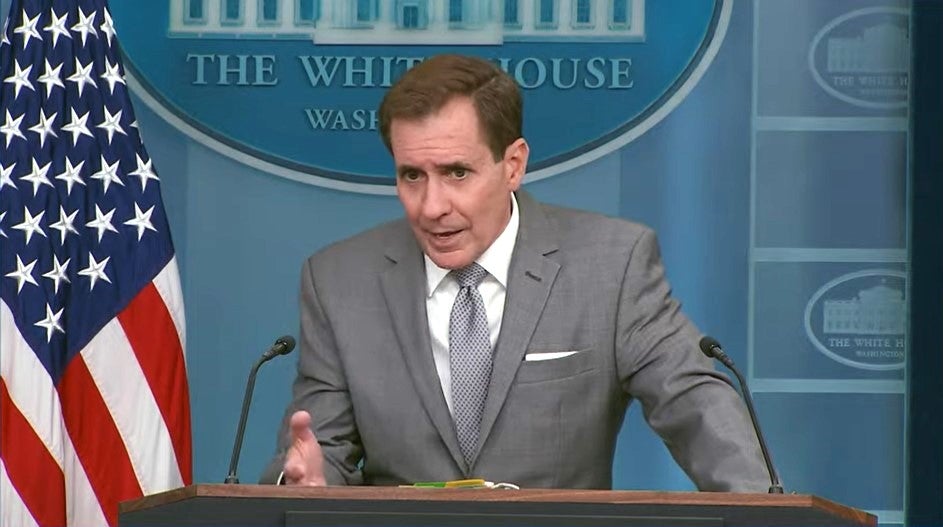
NSC spokesman John Kirby at the White House

WASHINGTON — The White House has warned that the potential for higher shipping costs to affect the U.S. economy amid diversion of ships from the Red Sea will depend on how long Houthi rebels sustain their attacks on commercial vessels.

“If we weren’t concerned, we wouldn’t have stood up an operation in the Red Sea, now consisting of more than 20 nations, to try to protect that commerce,” White House spokesman John Kirby said at a White House press conference on Wednesday, referring to the U.S.-led military force Operation Prosperity Guardian.

“The Red Sea is a vital waterway, and a significant amount of global trade flows through it. By forcing nations to go around the Cape of Good Hope, you’re adding weeks and weeks onto voyages, and untold resources and expenses have to be applied in order to do that. So obviously there’s a concern about the impact on global trade.”

Asked if those impacts will become a “pocketbook” issue for Americans, Kirby responded that the administration is not yet seeing that.

“It would depend on how long this threat goes and on how much more energetic the Houthis think they might become,” he said. “Right now we haven’t seen an uptick or a specific effect on the U.S. economy. But make no mistake. This is a key international waterway. Countries more and more are becoming aware of this increasing threat to the free flow of commerce.”

Kirby, the coordinator for strategic communications for the National Security Council, was at the White House to announce a multinational ultimatum directed at rebel attackers and condemning recent attacks on commercial shipping in the Red Sea. The U.S. and 12 other countries issued the ultimatum.

“These actions directly threaten freedom of navigation and global trade, and they put innocent lives at risk,” Kirby said. “This joint statement demonstrates the resolve of global partners against these unlawful attacks and underlines our commitment to holding maligned actors accountable for their actions.”

The statement points out that nearly 15% of global maritime trade passes through the Red Sea, including 8% of global grain trade, 12% of seaborne-traded oil and 8% of the world’s liquefied natural gas.

Rerouting vessels around Africa’s Cape of Good hope imperils “the movement of critical food, fuel, and humanitarian assistance throughout the world,” it read.

Maersk, the world’s second-largest ocean carrier, announced on Tuesday that it would suspend Red Sea transits indefinitely and reroute ships around the Cape of Good Hope after Houthi rebels launched a missile against one of its container ships on Saturday.

Three major maritime shipping groups — the World Shipping Council, the International Chamber of Shipping and BIMCO — praised the 13-country condemnation of the attacks.

“On behalf of our members and their seafarers and customers throughout the world, the organizations thank these … nations for their strong commitment to defending rules-based international order and to holding malign actors accountable for unlawful seizures and attacks,” the groups stated.

“The shipping associations call on all nations and international organizations to protect seafarers, international trade in the Red Sea, and to support the welfare of the global commons by bringing all pressure to bear on the aggressors so that these intolerable attacks cease with immediate effect.”

In addition to the U.S. the countries warning against further attacks in the joint statement are Australia, Bahrain, Belgium, Canada, Denmark, Germany, Italy, Japan, Netherlands, New Zealand, Singapore, and the United Kingdom.

Click for more FreightWaves articles by John Gallagher.

A look into marine salvage in the ’80s

FreightWaves Classics is sponsored by Old Dominion Freight Line — Helping the World Keep Promises. Learn more here.

FreightWaves explores the archives of American Shipper’s nearly 70-year-old collection of shipping and maritime publications to showcase interesting freight stories of long ago.

In this week’s edition from the November 1984 issue, we take a look at the tumultuous industry of marine salvage.

Marine salvage

You are informed of the emergency late on a Friday night when the rest of the world is just beginning to relax for the weekend. Your assets, in the form of the ship or valuable cargo, are in grave danger after a fire or some other disaster on board. Such a scenario may not be an everyday occurrence, but when it does happen, you may be forced to reassess your future prospects very quickly.

Marine accidents involve a whole group of experts that most people in the maritime industry do not have daily contact with. Because of what they represent, many people would probably prefer to keep it that way. Salvors, marine firefighters, arbitrators, average adjusters, insurers, salvage lawyers, and salvage consultants, however, spend a great deal of time in order to be ready for just such emergencies. When the time comes, they may have a high-pressure situation on their hands, with tempers flaring, fires flaring, and responsibility up in the air and likely to stay that way until it can be brought back down.

The year 1984 has been a high-profile year for marine salvage, between the rash of attacks in the Persian Gulf and Red Sea and the recovery of radioactive containers after the sinking of the Mont Louis in the North Sea. Participants of the Third Symposium on Marine Salvage, held in New York October 1-3, heard from salvors involved in both areas. One speaker, Captain Hans Walenkamp of the Dutch firm Smit International, interrupted his direction of the Mont Louis North Sea salvage operation to address the meeting.

There are at least two distinct challenges involved with any marine disaster. The first job is to resolve the disaster itself and clean up the mess. The second one is to resolve what is often another mess — the claims and counterclaims on responsibility, liability, value, security, etc. There is little doubt that the owner of a vessel in trouble is over a barrel. Time is generally short, quick decisions need to be made, and he badly needs the salvor, yet there is little way of knowing what the salvage costs will amount to ahead of time. It is necessary, therefore, to come to some agreement on which later payment can be based. “Lack of contractual arrangements have, in too many instances, delayed the undertaking of timely salvage operations,” says Alex Rynecki, marine salvage consultant. Rynecki says at some point it is important to act before nothing remains to be solved.

‘No cure, no pay’

Some of the arrangements used include a fixed price based on the scope of work, agreement to U.S. or London arbitration, cost-plus work, and incentive bonus work. Due to the many unknown developments that might follow, one of the most popular is Lloyd’s Standard Form of Salvage Agreement, a well-known “no-cure, no-pay” basis. If salvage is not successful, no payment is made. If it is, the case is later negotiated or arbitrated.

Once the salvor has been contracted, his objective is to reach the site as soon as possible. The largest firms have ships located at a few key points around the globe and are able to fly equipment to these points within a day or two. For many years, the heavy construction firm of Merritt-Chapman and Scott was the major salvor on the Atlantic and Gulf Coasts of the United States. After that firm was liquidated, salvage services were available from a number of other groups with limited resources. Several years ago, the Moran Towing and Crowley Maritime interests combined their resources to form a Miami-based firm known as Ocean Salvors, which now provides a primary service to shipping on two coasts of the United States and in the Caribbean.

Using information about the stranded vessel, such as architectural specifications, materials, cargo, stress factors, and the hands-on knowledge of the crew, the salvor will perform calculations and develop a line of attack. Tactics will obviously vary from case to case.

Who owes whom? 

At the same time the mess is being cleaned up at the site of an accident, resolution of another mess is just getting underway. This is the intricate and complicated task of figuring out who owes what to whom and when. Under international law, the salvage holder holds the hull and the cargo until he receives some security that he will be paid. Although the ship owner is legally bound to post security for the cargo interests, a great deal of time may be lost contacting upwards of 1000 cargo interests if it is a large container ship. He may opt to post the security himself or post it temporarily until it reaches the destination.

General Average

One of the easier arrangements is a General Average agreement signed by the cargo owner accompanied by a cash deposit or underwriter’s guarantee in lieu of the cash deposit. It will often be the job of the adjuster to contact the shipper interests, or consignees, report that a casualty has occurred, notify them that General Average has been declared, ask for copies of the invoices and insurance details, and then verify the insurance. Generally, if any damage is done to the cargo during the salvage operation, a General Average sacrifice is made to which all interests contribute. Assuming the General Average pool is assembled, a settlement on salvage charges must be negotiated. At this point, says Donald O’May, chairman of the British Maritime Law Association on Salvage, “There is an inevitable tendency for salvors to gild the lily and for the salvaged property to minimize to the vanishing point the risks and the services rendered.”

Generally, the solicitors for the two interests will negotiate and try to reach an agreement. If this fails, it will go to arbitration and even an arbitration appeal. The settlement will generally be based on the degree of danger, the value of the assets, and the cost of the operation, among others. A report titled Marine Salvage in the United States issued in 1982 by the National Research Council found that salvage awards by courts or arbitrators as percentages of values saved averaged about 5.7 percent between 1970 and 1980. This was a reduction from about 7.3 percent between 1960 and 1970.

Problems with owners

Several other problems have also beset the industry.

There is an increasing reluctance by many shipowners to accept redelivery of the vessel once the salvor has done his job, some conference participants said.

FreightWaves Classics articles look at various aspects of the transportation industry’s history. Subscribe to our newsletter!

Have a topic you want us to cover? Email bjaekel@www.freightwaves.com.

CVTA: Trucker wages at stake in Florida’s CDL exemption request

Truck driver checking tires.

WASHINGTON — Flexibility sought by the state of Florida in the current CDL training regulations could — if approved by safety officials — cut down on lost wages for drivers, according to driver training schools.

In comments filed Wednesday on Florida’s exemption petition, which was filed with the Federal Motor Carrier Safety Administration last month, Danny Bradford, Commercial Vehicle Training Association (CVTA) chairman, said that the additional flexibility that the exemption would give Florida’s CDL testing program would help address skills testing delays.

“These delays put jobs on hold for 258,744 drivers and resulted in over $1 billion in lost wages for these drivers,” Bradford stated, referring to an independent economic analysis commissioned by CVTA in 2016. This in turn caused an estimated loss of $234 million in federal income taxes and $108 million in state and local sales taxes that would have been generated in the absence of skills testing delays, he pointed out.

Such delays would be even more costly now, Bradford contends, because driver wages have improved since CVTA’s analysis. He cited an American Trucking Associations study showing that driver compensation increased 18% between 2019 and 2021.

Federal regulations require the three-part CDL skills test — pre-trip inspection, basic vehicle control skills and on-road skills — to be administered and completed in that order. If an applicant fails one part of the test, he or she is not allowed to start the next part of the test but instead must return on a different day to retake all three parts.

But as it explains in its petition, the Florida Department of Highway Safety and Motor Vehicles (FLHSMV) wants prospective new drivers — at the discretion of skills testers — to be allowed to continue testing subsequent segments of the CDL skills test if they fail the pre-trip inspection or the basic vehicle control skills segments. The applicant would be allowed to return at a later date to retest only the failed segments.

In supporting the agency’s exemption, Bradford also said that skills testing delays can cause a new driver’s skills to deteriorate.

“The longer an applicant must wait to take a CDL skills test, the further they are from the training they received to prepare for the exam,” he said. “Allowing an applicant to test as quickly as possible and begin their job means they will continue repetition in the skills needed to be a safe commercial motor vehicle operator and will retain more of what they learned in their training.”

The National Tank Truck Carriers (NTTC), which represents more than 500 companies that support or specialize in cargo-tank services, agreed with CVTA, noting that if the petition is approved, skills testers in Florida will be able to devote less time to areas in which drivers have already shown they are competent, increasing the efficiency of the CDL credentialing process.

“Given the well documented commercial driver shortage, it is imperative that we reduce barriers to individuals attaining the proper credentials for operating commercial vehicles,” wrote William Lusk, NTTC director of education and government relations.

Others saw potential safety problems, however. “An applicant failing the pre-trip and then being allowed to continue is not only unsafe but irresponsible,” according to one commenter.

“The FMCSA rules set forth say a pre-trip must be done and the driver must be sure the vehicle is in good operating order prior to moving the vehicle. Allowing the test to continue goes against that rule as well as what the CDL schools are trying to teach.”

Another argued that if new driver applicants are having a hard time learning how to successfully conduct a pre-inspection, “maybe we should toughen up on the instructors to do a better job of training individuals,” the commenter wrote. “I have trained and tested thousands of new drivers, and with proper training, none have failed. It’s all in the training.”

Click for more FreightWaves articles by John Gallagher.

Truck the vote: Getting drivers ready for election season – WTT

On today’s episode of WHAT THE TRUCK?!? Dooner is kicking off the new year by getting drivers ready for the 2024 election season. He’s joined by political influencer Scott Presler, who is on a mission to get every truck driver registered to vote.


We’ll find out everything you need to know to make sure your voice is heard this election season.FreightWaves’ Rachel Premack lays out the top issues in supply chain at the start of 2024 that will set the tone for the year. We’ll also learn how the Red Sea conflict has already doubled shipping rates. 

Big Rig Permit Services’ Clay Gerringer tells us everything we need to know about permits, authorities and trucking taxes in 2024.

FreightWaves’ Justin Martin shares the driver perspective on voting, breaks down a hot dog heist, shares his best winter truck tools and breaks down bowl game and steamship line marketing. 

Watch on YouTube

Subscribe to the WTT newsletter

Apple Podcasts

Spotify

More FreightWaves Podcasts

FRA’s train crew size rule moves forward

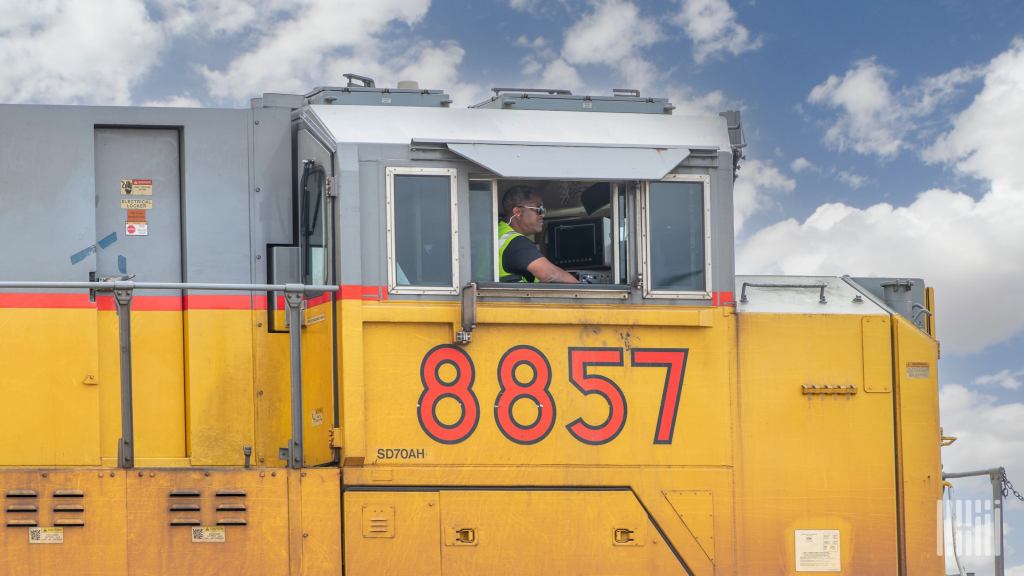
A man sits inside a freight train locomotive.

The Federal Railroad Administration has submitted its final rule on train crew staffing to the U.S. Office of Management and Budget (OMB) for review, with the final rule potentially being released in March, according to OMB’s website.

Prior to becoming a final rule, federal regulations go to the Office of Information and Regulatory Affairs (OIRA), which is within OMB, for review. That review includes ensuring that the final rule is consistent with agency regulatory principles, as well as the policies and priorities of the president. It also checks to ensure that federal agencies considered the final rule’s consequences, including its benefits and costs. 

OIRA’s review may take as long as 90 days, although the review period can be extended once by 30 days. 

The notification about OMB’s review of the train crew size rule doesn’t indicate how the final rule is different from the initial proposed rule from July 2022

Rail unions traditionally support regulation that would require at least two people operating a freight train. A number of states have also passed laws requiring freight train crew sizes of at least two people. But the railroads say such regulation isn’t needed because its safety benefits are unproven, and the regulation may stymie future technological advancements. Short-line railroads also argue that they should be exempt from the rule because many short lines operate on shorter networks where two-person crews may not be needed. 

The notification’s abstract says: “This rulemaking would address the potential safety impact of one-person train operations, including appropriate measures to mitigate an accident’s impact and severity, and the patchwork of State laws concerning minimum crew staffing requirements. This rulemaking would address the issue of minimum requirements for the size of train crews, depending on the type of operations. In an effort to encourage public participation, FRA extended the comment period from 60 to 146 days and held a public hearing on December 14, 2022.”

Subscribe to FreightWaves’ e-newsletters and get the latest insights on freight right in your inbox.

Click here for more FreightWaves articles by Joanna Marsh.

Universal Logistics announces $50M truck division expansion in Virginia

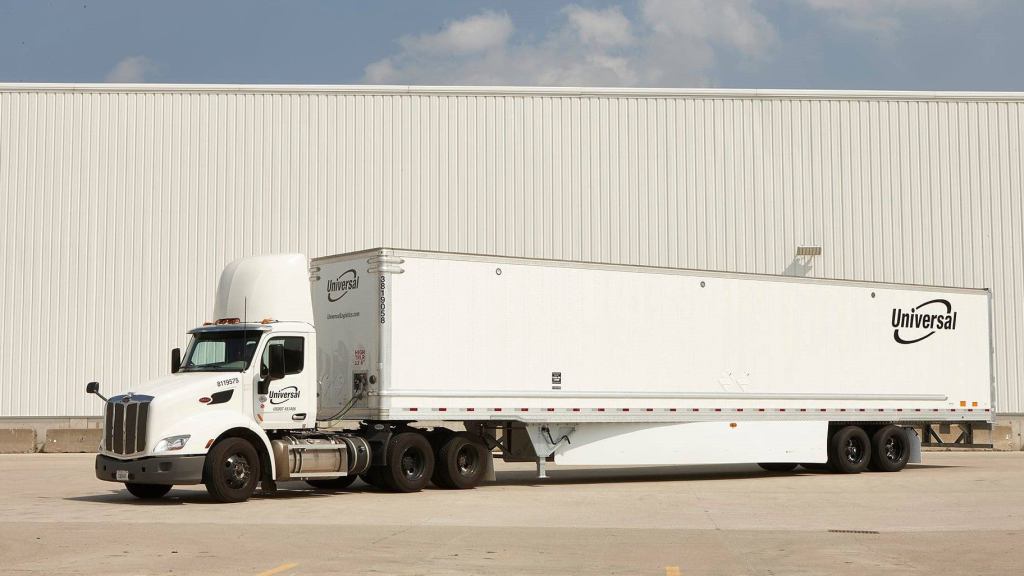
Universal Logistics Holdings Inc. announced a 254,000-square-foot expansion in Roanoke, Virginia, to support its Class 8 truck parts subassembly division.

The $50 million expansion to the company’s Lee Highway building will create 45 direct jobs and “will be instrumental in catering to the growing demands of the heavy truck industry,” said Universal CEO Tim Phillips.

“Our expansion in the Roanoke region represents an exciting phase for Universal’s heavy truck division as we fortify our commitment to delivering top-tier services within the logistics and transportation sectors,” Phillips said in a news release

Warren, Michigan-based Universal Logistics (NASDAQ: ULH) provides truckload, brokerage, intermodal, dedicated and subassembly parts services in the U.S., Mexico, Canada and Colombia. 

Universal Logistics Holdings is part of the Moroun family’s logistics conglomerate, which also includes the Ambassador Bridge in Detroit. 

The Roanoke expansion is scheduled to be completed in 2025.

Universal Logistics Holdings Inc. did not say which Class 8 truck manufacturers the Roanoke facility will be servicing. Company officials did not immediately return a request for comment from FreightWaves.

Mack Trucks has a production facility in Roanoke, while Volvo Trucks USA operates the 1.6 million-square-foot New River Valley Class 8 truck assembly plant in Dublin, Virginia.

In July, General Motors announced a new electric vehicle parts logistics facility in Detroit, which will be managed by Universal’s subsidiary, Logistics Insight Corp. The facility, which will create 400 jobs, is scheduled to open by the end of 2024.

Universal Logistics also operates a 1 million-square-foot parts sequencing plant in Detroit for Netherlands-based automaker Stellantis. The facility employs more than 500 people.

More articles by Noi Mahoney

US, Mexican partnership to expand international rail-car ferry service

Canadian trucking company suspended after multiple overpass crashes

Thieves spirit away 19,000 bottles of tequila from US distributor

Improving rail service key to growing intermodal volumes: Consultant

A train hauling intermodal containers travels next to a forest.

Intermodal rail in 2024 is likely to still face pressure from the trucking market; however, market conditions for the overall freight transportation market also appear to be returning to pre-pandemic patterns, and so providing good rail service will be key in enabling intermodal rail to compete, according to Matt Muenster, chief economist for Breakthrough, a transportation management technology provider.

“Railways will likely experience headwinds in growing intermodal shipping in 2024, especially in the first half,” Muenster told FreightWaves. “I think one of the most prominent headwinds is their level of competitiveness with trucking. Dry and refrigerated truckload linehaul rates have decreased substantially over the last year and a half or so. Because truckload rates have fallen, intermodal shipping isn’t particularly competitive, relative to the pre-pandemic environment.” 

He continued, “On the positive side, railroads are improving service. We’ve seen train speeds increase and dwell times decrease year over year, which is helpful.”

In talking with shippers, the issue of intermodal rail’s costs “comes up first and foremost,” with intermodal rates having a more compressed per mile savings than truck. As a result, truck rates are presently more competitive than intermodal rates, and intermodal providers may be challenged in growing their volumes in the near term, Muenster said. 

“We expect truck rates to rise next summer and intermodal rate increases to lag the truckload market. The lag in intermodal rate price growth will widen the gap between truckload and intermodal rates,” he said. 

“Ultimately, as we approach the second half of 2024 and beyond [and] as long as the U.S. economy can maintain its current trajectory to a soft landing, then the difference between truckload and intermodal rates will again widen and make those economics more attractive and bring more freight onto the rails,” Muenster said. 

The challenge in intermodal rail being able to compete with trucks for the first half of 2024 comes amid a backdrop of normalizing market conditions in the sense that 2024 will be more in line with pre-pandemic supply and demand patterns, he said.

“Demand for goods is not overheated by a significant shift from service spending and fiscal stimulus, and inventories are not in a state of dramatic surplus because of supply chain disruption and the post-pandemic shift in consumer spending toward services,” Muenster said, explaining that these factors create a more balanced freight market. 

The importance of good rail service

For intermodal volumes to really grow, service must be key, Muenster said.

“Shippers expect a certain level of service. Railways will need to provide evidence of continuous improvement in their service levels after the experience of the past five years or so to gain trust and grow intermodal volumes,” he said. 

Mike Baudendistel, a market expert and head of intermodal solutions for FreightWaves, echoed Muenster’s remarks about providing good rail service, although Baudendistel observed that shippers still found incentives to utilize intermodal rail in the second half of 2023, as seen by rising volumes. That increase may be due to improved rail service, he said.

ntermodal volume picked up in the second half of 2023 despite the loose truckload market. (FreightWaves SONAR) To learn more about FreightWaves SONAR, click here.

“While shippers generally expect a savings of 10%-plus when using rail intermodal as compared to truckload, service is often the determining factor for modal selection. During the service meltdowns in 2021, shippers were pulling their containers out of intermodal yards to truck them. That was a ‘missed opportunity’ where intermodal lost market share despite the tight truck market,” Baudendistel said. 

But “this past year, amid improved service levels, many shippers used intermodal more heavily despite the loose truckload market,” he continued. 

“The truckload market will again tighten at some point from a combination of capacity exits and demand improvement, but the associated higher truckload rates will only support intermodal volume if intermodal service levels are adequate,” Baudendistel said. “Intermodal service levels are solid now, but how service holds up in the face of a potential disruptive event remains an open question.”

Still another factor that has affected intermodal rail’s growth prospects is that intermodal service availability into cities is constrained, particularly for cities that are not historically big intermodal destinations, Baudendistel said, noting that recent partnerships, such as the Quantum service between J.B. Hunt (NASDAQ: JBHT) and BNSF (NYSE: BRK-B), could address that issue.

“The Class I rails have [also] announced several collaborative partnerships to expand their intermodal reach. Those announcements have made me more convinced that intermodal is truly a growth area than I was a year ago,” Baudendistel said.

Recent partnerships seeking to bolster links between the U.S. and Mexico, and the U.S. Southeast and Mexico in particular, could provide intermodal rail providers with an opportunity to grow market share, according to Muenster and Baudendistel. 

“Mexico has become the largest source of imports for the U.S., overtaking China in 2023 and likely the foreseeable future as imports from China as a percent of U.S. imports continue to decrease. These North American trade lanes, particularly from Mexico, have provided an opportunity for shippers to achieve resilience,” Muenster said. 

What also could support intermodal rail volumes is the push for companies, including shippers, to adopt more sustainability initiatives, which would include looking at which transportation modes produce fewer emissions, Muenster said.

“As intermodal service and safety improve, shippers will begin to consider the emissions savings,” Muenster said. “Our clients, who are shippers across numerous industries, including food and beverage and consumer packaged goods, are already contemplating mode choice based on total emissions. In some circumstances when the cost is comparable, the shipper will be internally obligated to pursue the movement of goods with fewer emissions.”

However, one unknown in the upcoming years will be how labor negotiations will go between the craft unions and the railroads. Negotiations for a new labor contract officially kick off in January 2025. While the process takes years, the most recent negotiations became so contentious that Congress and White House eventually intervened in November and December 2022.

“It will be interesting to see how shippers respond to those negotiations and the amount of goods they’ll convert to the railroads. But I still think the most prominent factor in the slow growth for intermodal is just the competitive nature of where truckload and intermodal rates presently sit,” Muenster said.

Subscribe to FreightWaves’ e-newsletters and get the latest insights on freight right in your inbox.

Click here for more FreightWaves articles by Joanna Marsh.

How Echo Global Logistics is mastering temperature-controlled shipping

From chocolates melting in the heat to pharmaceuticals degrading in the cold, the delicate balance of temperature-controlled shipping is a dance Echo Global Logistics has worked hard to master.

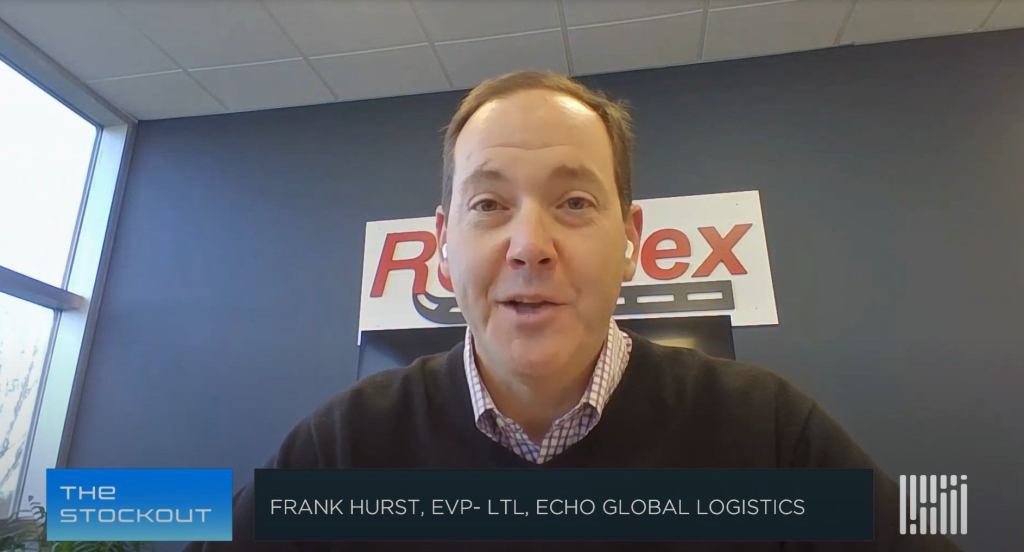
Frank Hurst, Echo’s executive vice president of less-than-truckload, has been a big part of that work. He joined FreightWaves’ Mike Baudendistel and Grace Sharkey on a recent episode of The Stockout to discuss some of the challenges in the refrigerated LTL segment, as well as Echo and Roadtex’s road map for the future.

Within this space, Hurst explained, even minor temperature changes can have major consequences. He emphasized Echo’s commitment to precision and reliability in a mode that requires both.

Echo’s approach to temperature-controlled logistics

Echo’s acquisition of Roadtex led to a significant enhancement in the company’s capabilities within the temperature-controlled logistics sector.

When managing perishable items, precise temperature control is critical. Roadtex’s robust infrastructure, which includes temperature-controlled warehousing and a reefer fleet, has been integrated into Echo’s logistics framework. That means Echo can now offer clients a more diverse range of shipping solutions that focus on maintaining a 45-to-60-degree Fahrenheit range.

“We understand that it can be somewhat daunting delivering into mass merchants and big-box retail,” Hurst said.

The challenges go beyond standard logistical tasks and delve into strict appointments, required arrival dates (RADs) and rigorous quality standards.

For Echo, this means not only managing the transportation of goods but also ensuring that each step of the logistics process aligns with the specific needs and regulations of these retailers.

Hurst said that means the process must involve a meticulous approach to scheduling and meeting RADs, or there can be a heavy price to pay. Fines and chargebacks from retailers for noncompliance with these standards can significantly impact the total cost of transportation.

Navigating the freight market and positioning for the future

Echo’s approach is not just about moving goods from point A to point B. It’s about comprehensive supply chain management.

“One of the big differentiators is for shippers to look at their total cost of transportation,” Hurst said. “Not just the move itself, but to include their inventory levels, to make sure that they’re expediting the time from their shipping dock to the shelves for the consumers.”

With a network of more than 50,000 carrier partners and a technology-driven platform, the company is well equipped to respond to market shifts while upholding high service standards.

Additionally, the potential for consolidation opportunities in reefer LTL is an area where Echo has innovated. Hurst discussed how Echo’s acquisition of Roadtex has enhanced the company’s ability to consolidate LTL shipments into truckload where feasible.

This not only optimizes transportation efficiency but also addresses the service-sensitive nature of reefer shipments. Additionally, Echo is exploring the viability of refrigerated intermodal transport.

In short, Echo feels its suite of solutions is poised for continued growth. As Hurst noted, Echo is not just responding to current market conditions but is proactively shaping its services to meet the future needs of the logistics industry.