The views expressed here are solely those of the author and do not necessarily represent the views of FreightWaves or its affiliates.
With 2024 just a few days away, I’m looking forward to what the new year has in store. At the same time, it allows us all to reflect on 2023. But most of all, it’s a way to give thanks to an industry that has provided so much insight, collaboration, networking and passion.
Here are a few of my observations looking back at 2023 and my predictions for 2024.
2023 was another year full of challenges, disruptions, some endings, as well as new beginnings.
Personally, I began a new journey in August when I started my own advisory company.
But as an industry, we observed some larger companies, which had received a lot of private equity backing, go out of business. We even saw some large logistics providers going bankrupt. But at the same time, we also identified a lot of new startups gaining traction and becoming more visible in that same complex and challenging market.
In hindsight, 2023 was a reset year in many ways. Rates hit rock-bottom and it forced companies to focus on survival. With that came a hunger to change the way things were done. In some cases, that meant letting go of people. In others, that meant more adoption of technology. And for some, it was a combination of both. We will continue to see this appetite increasing in 2024, which will have a positive impact on the further adoption of logistics technology.
As an industry, we came together, which was witnessed not just at the networking at some of the larger events like Manifest or FreightWaves’ F3: Future of Freight Festival. Behind-the-scenes, there was a lot more communication going on between established players partnering for survival, as well as startups collaborating to gain insight to become more efficient in order to grow their enterprises.
I expect 2024 will bring more collaboration and with great events as well as logistics community groups like Ballast, we all can contribute to connecting and become a tighter community.
All of that gives me confidence that we are well positioned to hit the ground running in 2024. Don’t get me wrong, 2024 will have its own challenges, and although we are on the way to economic recovery, it won’t be a walk in the park.
The past year has hardened as well as prepared us and equally allowed us to collaborate in a way that we can beat any obstacle that is going to be thrown at us in the next year.
My professional and personal wish is that 2024 will be filled with industry collaboration and positivity that will allow us as an industry to grow, strengthen and lead us to success for all.
Our nation is counting on the logistics industry to continue providing the services that bring materials and products to every industry, to deliver the food that we have on our tables and mostly to remain that key function that is core to supply chains all over the world.
So let me finish off my last article of the year by thanking the women and men on the front lines: our drivers as well as the folks in dispatch and operations. And finally, to the managers and executives: keep the faith and stick in there. People are relying on the logistics industry.
Thank you and have a great start to the new year.
Look for more articles from me every week on FreightWaves.com.
About the author
Bart De Muynck is an industry thought leader with over 30 years of supply chain and logistics experience. He has worked for major international companies, including EY, GE Capital, Penske Logistics and PepsiCo, as well as several tech companies. He also spent eight years as a vice president of research at Gartner and, most recently, served as chief industry officer at project44. He is a member of the Forbes Technology Council and CSCMP’s Executive Inner Circle.
SoCal warehouse emissions rule, and possible impact on trucks, upheld by judge
A rule regulating emissions at Southern California warehouses, which the state’s trucking industry viewed as akin to a zero-emission vehicle (ZEV) mandate, has been upheld by a federal district court.
In a ruling earlier this month, Judge John Kronstadt of the Central District of California rejected claims in a lawsuit filed by the California Trucking Association (CTA) that a warehouse emissions rule approved in May 2021 by the South Coast Air Quality Management District (SCAQMD) was preempted by the Federal Aviation Administration Authorization Act (F4A). The law has been a key point of argument in several legal cases involving the transportation industry on one side and the state of California the other, including litigation surrounding independent contractor law AB5.
The CTA was later joined as a plaintiff by airline trade group Airlines for America (A4A). Its arguments were similar to those of CTA, though it cited the Airline Deregulation Act (ADA) as having set federal law that it believes preempted certain state actions. Its interest in the case is that airline cargo operations into Southern California make heavy use of the network of warehouses served by the area’s busy ports and airports.
In their lawsuit, both plaintiffs said they believed the warehouse emission requirements would require changes in operations, primarily through the purchase of ZEVs or near-zero-emission vehicles (NZEV) that could impact “prices, routes or services,” the three-headed standard in both F4A and ADA that the respective federal laws say state action can not impact.
“CTA and A4A argue that the rule is preempted because it is related to the control of emissions from vehicles and engines … and its purpose and effect is to mandate the purchase of ZE and (near) ZE trucks,” Kronstadt said, summing up the plaintiffs’ key argument.
But the CTA and A4A pleadings were rejected, along with the CTA and A4A requests for summary judgment in the suit.
The warehouse rule sets standards for emissions at the facilities and then awards points for steps taken to reach those goals. There are points awarded for such things as using ZEVs within the facility and its grounds, being visited by ZEVs making deliveries or picking up cargo, or putting solar panels on the roof. There also is an option to buy points that can be used to meet the individual warehouse mandate. There is no ZEV mandate in the rule.
Each warehouse has a WAIRE Points Compliance Obligation (WPCO) under the program. WAIRE stands for Warehouse Actions and Investments to Reduce Emissions.
In his decision, Kronstadt said there had been indications of warehouses increasing ZEV use as a result of the warehouse rule by companies seeking to meet their WPCO target. “But many did not,” he wrote. The judge’s decision ticks off a long statistical summary of, among other things, how many warehouses earned WPCO points using ZEVs, how many earned points by being visited by ZEV vehicles and how many hit their WPCO target all or in part by purchasing points.
There is little doubt that the rule does appear to have incentivized the purchase of ZEV or NZEV trucks. Kronstadt, citing state data, said preliminary reports suggest that more than 87% of the WPCO points earned by warehouses in the early months of the program came from the use of ZEV or NZEV vehicles. “But a meaningful minority of approximately 13% of the total points earned were earned by taking other actions,” Kronstadt wrote.
In a commentary on the decision, the law firm of Latham & Watkins noted that the court’s decision was that the WAIRE rule was not preempted by F4A or A4A because “it relates to a facility by facility review of indirect sources of emissions.”
“The court reasoned that if the District sought to regulate truck emissions, (it) would make the WPCO dependent on the number of miles traveled by the trucks visiting the warehouse.” But the emissions score given to an individual warehouse is dependent in part on the number of visits to a warehouse, not the miles traveled by the truck to get there. A truck making a visit to a warehouse from a port or airport a mile away is viewed under WAIRE as the same data point for compliance purposes as a truck coming from 50 miles away, even though the emissions related to the two trips are significantly different.
Ultimately, the law firm wrote, “the court recognized that trucking operations are integral to an air carrier’s integrated delivery system, but held that the (SCAQMD rule) is not preempted by F4A or ADA because it has only an indirect connection to motor carrier prices, services and routes.”
The best cover designs from American Shipper’s 1990s magazine issues
FreightWaves Classics is sponsored by Old Dominion Freight Line — Helping the World Keep Promises. Learn more here.
The global shipping publication American Shipper launched in 1974 with the goal to serve the needs of all players involved in international shipping, providing important information to shippers, carriers and third parties.
Founded by late maritime journalist David A. Howard, the magazine began as the Florida Journal of Commerce until Howard saw a need for a national publication focused on shipping. He relaunched the publication as American Shipper in May 1974. This was decades before the internet would take the publishing world by storm, so American Shipper was a monthly printed magazine for all things international shipping.
FreightWaves acquired American Shipper in 2019, and it serves the global shipping industry to this day — now in a digital capacity.
There is much to be said for the efficiency and convenience of online journalism, but creative and enticing cover images that beckon readers to open print publications’ pages also have great appeal. FreightWaves manages the archives of American Shipper and each week posts an article from the early days of the magazine as a flashback. In these archives, beautiful, funny and sometimes just plain weird cover images start off each issue.
We’ve compiled some of our favorites from the 1990s, the third decade of the publication in its print form.
This artistic illustration from March 1990 plays on terminology used during the Cold War. (Photo: American Shipper)
Barbies made for a unique cover of this issue from June 1990. (Photo: American Shipper)
A stork carrying a baby over a cityscape is an eye-catching image from the July 1991 issue. (Photo: American Shipper)
This illustration from the November 1991 issue takes us back to the days when funny political comics were prominent. (Photo: American Shipper)
This illustration from the September 1992 issue is a fun take on the phrase “too many cooks in the kitchen.” (Photo: American Shipper)
This “watchdog” on the September 1994 issue doesn’t look to us like he is about to bite. (Photo: American Shipper)
This cover from February 1992 has us scratching our craniums. (Photo: American Shipper)
The Rubik’s Cube on the cover of the January 1998 issue is the perfect nostalgic throwback. (Photo: American Shipper)
The September 1999 issue is the embodiment of a post-New Year’s Eve bash. (Photo: American Shipper)
The March 1999 illustration of a container trying on clothes is both adorable and humorous. (Photo: American Shipper)
Check out the best cover designs from the 1980s and 1970s of American Shipper’s archives.
Have a topic you want me to cover? Email me at bjaekel@www.freightwaves.comor follow me on Twitter.
Navigating the brokerage landscape in 2024
The rapid integration of technology, coupled with disruptions in the transportation market in recent years, has generated an opportunity for freight brokerages to broaden their services and offer shippers a consultative approach to logistics.
In a recent interview with the leaders of remote staffing solutions provider Zelh Logistics, President Jeff Ogren and Vice President of Sales Chris Fields explained the changing dynamics of logistics providers.
While discussing technology’s impact, Ogren and Fields endorsed a balanced approach, recognizing the positive influence of digital freight brokers and advanced systems. They addressed talent challenges, advocating for selective hiring to decrease turnover.
Looking ahead, they predict a future marked by increased transparency, dynamic pricing and a transition to proactive supply chain approaches.
Questions and answers have been edited for clarity and length.
FREIGHTWAVES: How has customer satisfaction changed in the brokerage industry?
FIELDS: The quick adoption of technology has changed the overall experience between brokers and their customers. Everyone assumes technology will fix everything. Yet what we have noticed is the more your organization runs towards technology, you see less human interaction. I think that factors into overall customer satisfaction and driver relationship retention.
One of our most requested roles has been night dispatch because drivers who have spent most of their days on the road still enjoy talking to someone. They don’t want an automated text message with a pickup number or delivery appointment time. They want to form a real relationship with the broker.
FREIGHTWAVES: What role can technology play in improving operations at logistics companies?
OGREN: Technology has come a long way over the last decade. All of these Ubers for freight came along and I think all of them were great improvements to our industry. They weren’t truly disruptive, they were just improvements to the way freight was transacted and moved between parties. Transportation management systems have come a long way — integrations and the ability to have API connectivity changed the game.
I think we also need to remember the difference between what I would call digitalization versus automation. You can digitize a lot of functionality within a broker but it’s still hard to fully automate the transportation transaction.
Overall, we need to meet in the middle. Let’s create a low-cost augmentation where you still have a human intervention with experience but at a low cost to do a lot of back-office functionality. That for me is the middle ground.
I have also found that now, whether it’s startups or brokerages that have been around for a long time, we have to think more about their burn rate when considering technology investments. It is no longer grow at all costs. We must be more efficient with our resources and cognizant of your overhead.
FREIGHTWAVES: What challenges does the industry face in attracting and retaining talent?
FIELDS: I was at TQL for 15 years and it was a revolving door there towards the end. It doesn’t feel sustainable to me to bring in a new class every two weeks of 25 recent college graduates knowing that they won’t last three months.
I think you need to be more selective in your hiring. In 2008 and 2009, the landscape was different. You had to show up and bring some value to get a job in this industry. I think we need to go back to that and expand on that. Let’s get real talented employees in data, technology, sales and accounting or back-office work.
Churn is so high in this industry. That’s why we pride ourselves in the single-digit turnover we provide. We properly go through the vetting of candidates to make sure it is the right person for this job function before we start any kind of agreement or arrangement with our clients.
Also, let’s be a little bit more efficient in how we hire and think about costs.
How can brokers enhance their scalability through technology adoption or integration? As they explore avenues for a successful exit and consider private equity firms’ focus on EBITDA and potential earnouts, there’s a growing imperative for a review of your organization, prompting an examination of opportunities to improve scale at every level.
FREIGHTWAVES: What does the future hold for logistics providers?
OGREN: The first things that come to mind are more transparency with rates, dynamic pricing and pricing analytics. I think we will see more certainty, as the transparency forces the rest of the industry to be more compliant and changes the behavior of how customers choose their vendors.
I don’t think this change will happen tomorrow but I do think that’s what data is starting to do, because we are starting to use it more than ever before.
This change will also put more pressure and accountability on freight brokers to provide a more robust suite of offerings for their customers.
Shippers are not transportation experts. That’s why they leverage different brokers and carriers to handle billions of dollars of freight. I think Convoy and Uber Freight both created solutions through deep conversations with shippers to become more connected.
We are no longer slanging freight or just trying to find a carrier to match this load. Now it’s about how we get smart with our relationship with customers.
On the flip side, shippers are asking more for end-to-end solutions as well since the Uber Freights of the world have guided them to become more efficient.
FIELDS: On those thoughts, I think one day we will replace this carrier rep mentality and behavior to just go after big commission checks.
There should be full transparency between the shipper and the brokerage and as you take more freight, there’s more certainty there will be a flat, lower rate across the board. I do not think every logistics provider will be able to provide that because they may not have the capabilities to do so.
Brokers need to open up about their carrier network capabilities and make sure they are providing shippers with tools on their behalf. Brokers should be subject matter experts and must walk shippers down a proactive supply chain approach to have more success.
Trucking M&A was tepid again in 2023 as freight demand slowed. Interest rates stepped higher, which proved a hindrance to deal financing, and tightened credit markets were met by still lofty valuation expectations from sellers.
Through the first week of December, transportation and logistics deal flow was off 2% year over year following 2022’s notable pullback, according to supply chain M&A advisory firm Left Lane Associates. However, companies generating significant cash flow did use M&A to offset weak organic growth.
There were some notable deals in trucking during the year, however. Here’s a recap in chronological order.
Knight-Swift acquires U.S. Xpress
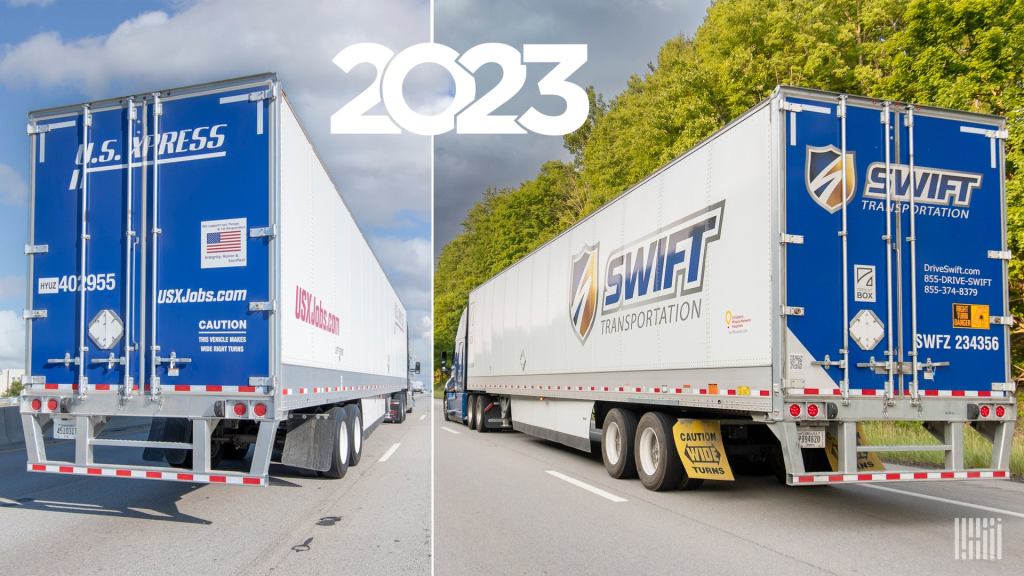
After amassing a nearly $1 billion less-than-truckload platform through two separate deals in 2021, Knight-Swift Transportation (NYSE: KNX) got back to its truckload roots in March, announcing the acquisition of carrier U.S. Xpress in an $800 million-plus deal.
The transaction was booked at nearly 14 times trailing 12 months’ adjusted earnings before interest, taxes, depreciation and amortization, but closer to just 5 times on a forward-looking basis inclusive of deal synergies.
Knight-Swift’s management team has again put its operational chops to the test. It acquired struggling and highly leveraged Swift Transportation in 2017. That $6 billion merger created the largest fleet in the nation. While not as large, U.S. Xpress presents a difficult challenge as it had been operating at a loss.
U.S. Xpress is expected to add $2.2 billion in annual revenue to Knight-Swift’s platform, most of which comes from an asset-based fleet of 7,200 tractors (1,000 of which were provided by owner-operators at the time of the deal) and more than 14,000 trailers. Knight-Swift is now expected to produce $10 billion in revenue with a combined TL fleet of more than 24,000 tractors and 96,000 trailers.
Knight-Swift cut its full-year 2023 earnings guidance when it reported second-quarter results in July. The change was in part due to an expected negative impact from the integration of U.S. Xpress (closed on July 1). By the third-quarter report in mid-October, however, it told investors that the integration was ahead of schedule. The company said it had already achieved a $100 million annual run rate in cost and revenue synergies, with a line of sight to a $120 million run rate by year-end.
The acquisition is expected to produce an operating profit in the first half of 2024 and be accretive to full-year earnings per share. U.S. Xpress is expected to add $1 to EPS by 2026.
Schneider National (NYSE: SNDR) made an M&A splash again in August, acquiring dedicated carrier M&M Transport Services. The deal added 500 trucks and 1,900 trailers, most of which operate in the Northeast, Midwest and Southwest.
Financial terms were not disclosed but Schneider said the deal would be immediately accretive to earnings. The transaction pushed Schneider’s dedicated fleet to nearly 6,500 tractors and $1.5 billion in revenue.
The company plans to acquire a dedicated carrier every 18 months in addition to organic fleet additions of 300 to 500 trucks annually (net of customer churn). The dedicated unit has accounted for 58% of Schneider’s 2023 year-to-date TL revenue.
Schneider acquired two dedicated carriers in 2022. It added Midwest Logistics Systems and its 900 tractors operating throughout the central U.S. in a $263 million deal, and regional operator deBoer Transportation, which onboarded 160 tractors.
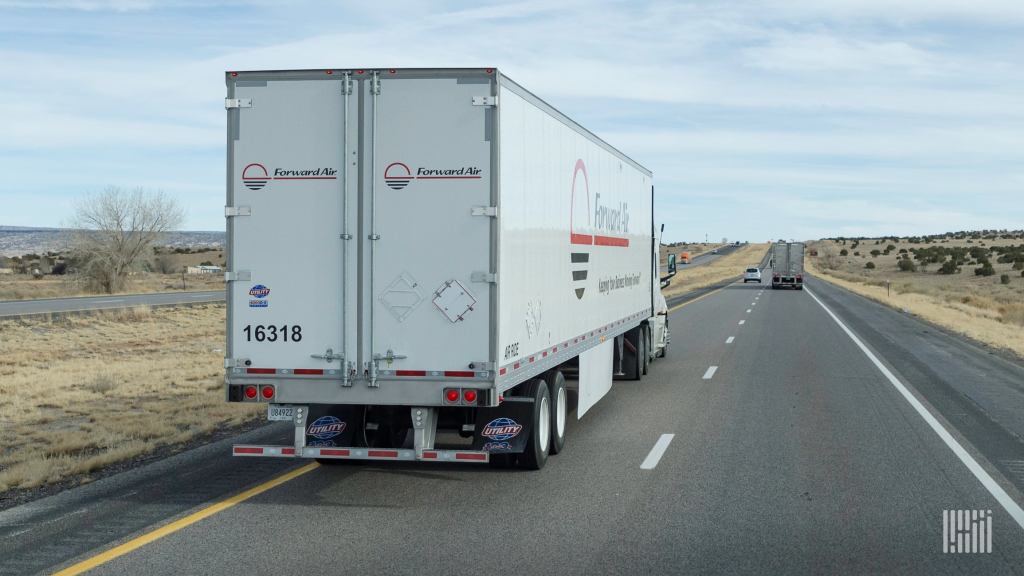
Forward Air (NASDAQ: FWRD) shocked Wall Street in August when it announced plans to merge with freight forwarder Omni Logistics in a $3.2 billion deal (roughly 18 times trailing adjusted EBITDA excluding deal synergies). The strategic merits of the acquisition, the large price tag and the fact that shareholders would not be given a vote ahead of closing were some of the reasons the stock sold off more than 40% following the announcement.
The debt-and-equity transaction would be 38% dilutive to existing shareholders and push the asset-light LTL provider’s debt leverage (net debt-to-trailing 12 months’ adjusted EBITDA) to roughly 4 times at closing.
Some of Forward’s large, institutional holders have openly criticized the merger and called on the company to terminate the transaction. A group of smaller shareholders have attempted to block the deal in a Tennessee court, claiming damages and saying they should be given a vote. Shares of Forward haven’t materially rebounded since the sell-off.
Forward originally said the addition of Omni, which is currently one of its forwarding customers, would allow it to remove the middle man and sell directly to shippers, thereby bolstering margins. Some of Forward’s longtime customers have questioned the deal’s impact as it positions Forward as both linehaul service provider and direct competitor. However, Forward said it has been able to grow volumes with those legacy forwarders since the announcement.
More recently, Forward alleged Omni had failed to meet certain pre-closing requirements and that the updated financial projections it provided were worse than expected. Forward has asked a Delaware court to let it out of the deal.
Omni maintains it has completed all prerequisites and that Forward is intentionally misconstruing its forecasts as a way to back out of the deal. It has asked the court to force Forward to the closing table.
A hearing on the matter is set for Jan. 19.
The deal price is currently closer to $2.6 billion given the sell-off in Forward’s shares.
2 terminal auctions rake in nearly $2B for Yellow’s estate
The liquidation of defunct LTL carrier Yellow continues. In early December, the sale of 130 terminals netted the estate nearly $1.9 billion. Two weeks later the sale of 23 leased locations brought in $83 million.
Several LTL carriers have swooped in to take possession of the shuttered sites.
XPO’s (NYSE: XPO) $870 million acquisition of 28 terminals has been the largest of Yellow’s asset sales so far. All told, the deal added roughly 3,000 doors to XPO’s network of 17,000. The additions aren’t expected to be fully incremental as the carrier will be relocating operations to bigger and better terminals in some markets. XPO estimates that the transaction will net it 10% to 15% more doors.
A closed Yellow terminal in Houston. (Photo: Jim Allen/FreightWaves)
Estes, which started the process with a more than $1.5 billion stalking horse bid for all of Yellow’s properties, has agreed to acquire 29 sites valued at $284 million. Saia (NASDAQ: SAIA) rounds out the top three bidders with commitments for 28 terminals at $244 million.
Proceeds from Yellow’s liquidation have exceeded the roughly $1.7 billion in debt held by secured lenders and the hedge funds providing bankruptcy financing. The estate is in the process of settling claims from unsecured creditors.
There are still 118 leased properties to be sold as well as 46 terminals that the company owns. The sale of its 12,000 tractors and 35,000 trailers through auction houses continues.
Hub Group acquires Forward Air’s final-mile segment
Forward sold its final-mile operation to Hub Group (NASDAQ: HUBG) in December. The $262 million price tag for Forward Air Final Mile, which primarily arranges the delivery and installation of large appliances, included 46 locations and more than 640 employees. The segment generated $289 million in the prior 12-month period ended Sept. 30.
The transaction came amid uncertainty around Forward’s potential merger with Omni Logistics. The move could be viewed as an effort to clean up the balance sheet to make room for the debt load it would take on if that transaction were to proceed. However, Forward recently said it was undertaking a strategic review of its portfolio of businesses and potentially unloading operations not fully supportive of its growth initiatives in the premium LTL market.
Hub Group said the deal more than doubles its final-mile revenue and further diversifies its non-asset-based logistics offerings. It said the transaction will be immediately accretive to earnings in 2024.
TFI International (NYSE: TFII) announced a week before 2023 ended that it would buy flatbed truckload carrier Daseke (NASDAQ: DSKE) for $1.1 billion. The serial acquirer also said it was exploring a spinoff of its TL unit, which would create two separate publicly traded companies.
The purchase price represented a 69% premium to Daseke’s share price, valuing the entity at just under 6 times its 2023 adjusted EBITDA forecast.
A rollup of flatbed fleets, Daseke completed more than 20 acquisitions since being founded in 2009. The company grew from just 60 tractors generating $30 million in annual revenue to nearly 5,000 units and $1.8 billion in revenue. More recently, it had been undergoing a multiyear cost-cutting initiative to improve results and reduce its debt burden.
Under the deal, Daseke would continue to operate its various brands and report financial results through TFI’s TL unit. The deal would double the size of TFI’s TL offering, which has its management team contemplating a spinoff, with one company focused solely on TL and the other providing LTL, logistics, and package and courier services.
The acquisition is expected to close in the second quarter and be accretive to earnings in 2025.
Forward Air expanded its expedited LTL footprint by buying Land Air Express for $56.5 million in January. The deal added more than 200 drivers and 300 power units, operating out of 25 terminals primarily located in the central U.S. The transaction was expected to add $84 million in annual revenue at the midpoint of the guidance range.
Forward Air trailers being loaded at a warehouse. (Photo: Jim Allen/FreightWaves)
ArcBest (NASDAQ: ARCB) culled its product menu by selling its roadside and preventive maintenance unit, FleetNet America, to Cox Automotive for $101 million in February. FleetNet generated $343 million in revenue during 2022 with adjusted EBITDA of $7.7 million, implying a 13x trailing EBITDA multiple. The deal generated an after-tax gain of $51 million.
Covenant Logistics (NASDAQ: CVLG) acquired Arkansas dedicated poultry hauler Lew Thompson & Son in April for $100 million plus a potential earnout of up to $30 million. The carrier operates a fleet of 235 trucks and 400 trailers. The purchase price implied a valuation of 5 times adjusted EBITDA.
Mullen Group (TSX: MTL) added 400 trucks and 950 trailers when it acquired LTL and TL provider B. & R. Eckel’s Transport in May. The combination of the two Canadian carriers added CA$85 million ($64 million) in annual revenue to Mullen’s base of roughly CA$2 billion ($1.5 billion). The CA$44M ($33 million) price tag wasn’t large compared to other deals in the space, but it added a notable amount of equipment. It also advanced Mullen’s acquisition strategy of investing in companies with a strong regional presence and fleets that serve the energy sector.
Canadian transportation and logistics provider Titanium Transportation Group (TSX: TTNM) made its first acquisition in the U.S. In July, it acquired Georgia-based TL carrier Crane Transport. The $60 million deal included 200 trucks, two terminals and a trailer rental pool of 600 units.
Liquid tank hauler United Petroleum Transports (private) announced the $65.9 million acquisition of Patriot Transportation (NASDAQ: PATI) in November. Patriot subsidiary Florida Rock & Tank Lines hauls liquid and dry bulk commodities out of 19 terminals and other satellite locations with a fleet of more than 300 tractors and 400 trailers. The combination of the two companies creates a top 10 bulk tank carrier with over 1,000 drivers and more than 30 terminals in 11 states across the southern U.S.
Notable deals involving private companies
A large, regional LTL carrier was created in June when New York-based RIST Transport announced the acquisition of Massachusetts-based AMA Transportation. The combined operation has 15 terminals in the Northeast. The two had been operating as carrier partners over the past two decades.
Private equity firm ZS Fund acquired dedicated contract carrier Lily Transportation in July, which it paired with existing portfolio company Transervice Logistics. While the companies continue to operate separately, the transaction aggregated a much larger dedicated and brokerage platform touting 2,600 total employees (more than 1,750 dedicated drivers) managing 27,000 pieces of equipment out of 185 locations.
Mexico-based carrier Jaguar Transportation was acquired by a group of private equity firms led by Luminus Management in July. The cross-border operator has a fleet of more than 775 tractors and five trucking terminals across Mexico. Jaguar was previously a subsidiary of defunct U.S. carrier Celadon.
Private equity firm I Squared Capital created a 55,000-unit trailer leasing portfolio in September by combining Star Leasing with Commercial Trailer Leasing (Star Leasing was previously combined with North East Trailer Services). The combined entity now provides dry vans, reefers, liftgates and chassis throughout the U.S. through long-term leases.
Chassis pool manager Consolidated Chassis Management (CCM) was acquired by Oaktree Capital in October. CCM was previously owned by a group of 10 container shipping companies known as Ocean Carrier Equipment Management Association. The deal provided CCM with the funding to launch a new chassis pool, South Atlantic Consolidated Chassis Pool (SACP 3.0), which provides 45,000 units at more than 75 locations in Alabama, Florida, Georgia, North Carolina and South Carolina.
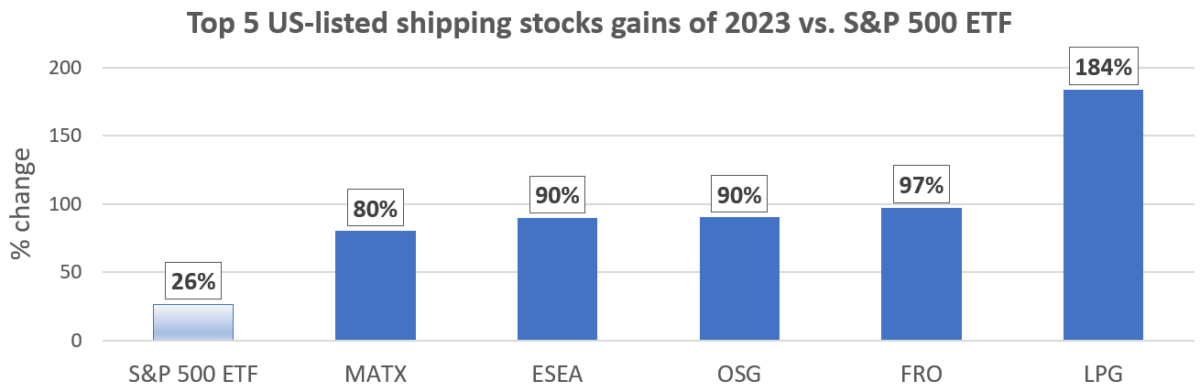
As 2023 draws to a close, the oft-predicted recession is still nowhere in sight and the S&P 500 index is flirting with a new all-time high. It was a strong year for ocean shipping stocks: They performed even better than the broader market.
FreightWaves ranked 2023 shipping stock performance based on the change in the adjusted closing price (adjusted for dividends) on Wednesday versus the adjusted closing price on Dec. 30, 2022.
To put results in context, U.S.-listed shipping stock performance was compared to the SPDR exchange-traded fund (ETF) that tracks the S&P 500 index (NYSE: SPY).
The final tally shows some surprises at the top.
Top 5 shipping stock gains of 2023
No. 1 — Dorian LPG (NYSE: LPG). The winner, by a long shot, is Connecticut-based Dorian LPG. Its adjusted share price surged 184% this year. That’s more than seven times the gain of the S&P 500 ETF.
No one would have predicted Dorian taking the crown at the beginning of 2023. Dorian transports liquefied petroleum gas — propane and butane — in very large gas carriers (VLGCs). Sentiment on the VLGC sector was weak as this year began, given the high number of newbuildings due for delivery.
Change Dec. 30, 2022 vs. Dec. 27, 2023. (Chart: FreightWaves based on adjusted closing price data from Yahoo Finance)
No. 2 — Frontline (NYSE: FRO). Shares of tanker giant Frontline doubled this year, rising 97%.
The company, founded by shipping tycoon John Fredriksen, is currently taking delivery of 24 very large crude carriers (VLCCs; tankers that carry 2 million barrels of oil) purchased from Euronav (NYSE: EURN) for $2.35 billion.
As a result of this transaction, which will boost fleet capacity by 58%, Frontline “will completely dwarf all publicly listed tanker competition,” said Pareto Securities analyst Eirik Haavaldsen in October.
No. 3 — Overseas Shipholding Group (NYSE: OSG). OSG spun off its foreign-flag tankers into International Seaways (NYSE: INSW) after emerging from bankruptcy in 2014, leaving OSG with its Jones Act tankers and barges. (Jones Act vessels serve legally protected U.S. coastwise trades.)
OSG is not a high-profile name in shipping equity circles. It has a small market cap ($383 million, compared to Frontline’s $4.46 billion) and limited analyst coverage. Yet its shares quietly rose 90% this year, more than any other U.S.-listed crude or products tanker company save Frontline.
No. 4 — Euroseas (NASDAQ: ESEA). Founded by Greece’s Aristides Pittas, Euroseas is a small player that had previously operated a mixed fleet of dry bulk ships and container vessels. Pittas split the fleet in 2018, hiving off the bulkers into Eurodry (NASDAQ: EDRY) and turning Euroseas into a pure-play container-ship lessor.
No. 5 — Matson (NYSE: MATX). Stocks of almost all container shipping lines have been under heavy pressure this year as incremental capacity from newbuilding deliveries outweighs transport demand. The worst performer among larger U.S.-listed shipping names across all vessel segments is Israeli liner company Zim (NYSE: ZIM). Zim’s adjusted share price is down 19% in 2023.
And then there’s Matson, whose share price is up 80%. Matson’s stock hit a new 52-week high on Dec. 22. With the exception of March-April 2022, at the peak of the supply chain crisis, Matson’s share price has never been higher.
“Unicorns do exist — just look at Matson,” said Stifel analyst Ben Nolan in October.
Matson’s market cap of $3.85 billion is more than triple the market cap of Zim, despite the fact that Zim’s fleet capacity is nine times higher. Matson operates in protected Jones Act trades, as well as in the China-West Coast international trade, where it offers expedited service that competes with air cargo.
Restrictions on both the Panama and Suez canal routes are making Matson’s niche China-West Coast service even more attractive.
Tanker stocks
FreightWaves also analyzed 2023 shipping stock performance by vessel sector, calculating average sector performance on a market-cap-weighted basis.
Sentiment on tanker stocks was ebullient at the beginning of 2023. There was even talk of a new “super cycle.” But only a few tanker stocks lived up to those very lofty expectations. Share performance of owners of product tankers — vessels that carry gasoline, diesel, jet fuel and other refined products — has been particularly disappointing.
Beyond Frontline and OSG, the biggest tanker share-price gains were posted by Teekay Tankers (NYSE: TNK), up 73%, and Nordic American Tankers (NYSE: NAT), up 61%. Both companies own Suezmax tankers (with capacity of 1 million barrels), a vessel category benefiting from reroutings due to the Russia-Ukraine war.
Change Dec. 30, 2022 vs. Dec. 27, 2023. (Chart: FreightWaves based on adjusted closing price data from Yahoo Finance)
This year’s smallest tanker-stock gains were posted by product-carrier owners Scorpio Tankers (NYSE: STNG), whose adjusted share price rose 17%, and Ardmore Tankers (NYSE: ASC), with a gain of just 7%.
Tanker shares overall rose 48% on a market-cap-weighted basis, almost double the S&P 500 ETF. However, Frontline heavily skewed this average. Excluding Frontline, the remaining tanker owners’ shares rose 33% — not much higher than the broader market.
Container-ship lessor stocks
Companies that lease container vessels to shipping lines continued to report hefty profits this year despite the end of the supply chain crisis and the normalization of freight rates.
These shipowners locked in most of their fleets on multi-year charters at the peak of the COVID-era boom. That shielded this year’s returns from downside. Furthermore, liner companies have surprised analysts and brokers by continuing to book new charters at lease rates higher than pre-COVID levels, despite newbuilding deliveries.
Euroseas’ stock rose the most, but it has the smallest market cap in this group, at just $223 million.
Greece’s Danaos Corporation (NYSE: DAC) is the largest U.S.-listed player in this segment, with a market cap of $1.44 billion. Its share price rose 47% this year, close to double the gain of the S&P 500 ETF.
Change Dec. 30, 2022 vs. Dec. 27, 2023. (Chart: FreightWaves based on adjusted closing price data from Yahoo Finance)
Greece’s Costamare (NYSE: CMRE) had the smallest gain, at 19%. This company also owns a large dry bulk fleet, and its share performance was likely lowered by exposure to that segment.
U.S.-listed container-ship lessors’ average stock gain was 37% in 2023, outpacing the broader market.
Dry bulk stocks
The dry bulk sector is more exposed to the Chinese economy than any other shipping segment.
According to Jefferies, spot rates for Capesizes averaged $16,500 per day from Jan. 1 through Thursday, up only 2% versus the same period last year. Rate for Panamaxes (65,000-90,000 DWT) averaged 11,000 per day, down 43% year on year. Rates for Supramaxes (45,000-60,000 DWT) averaged $11,300 per day, down 49% year on year.
Rhode Island-based Pangaea Logistics (NASDAQ: PANL), an owner of midsize bulkers, is the best-performing U.S.-listed dry bulk stock of 2023, up 68% through Wednesday. Pangaea’s stock reached its highest level since 2014 on Thursday.
Change Dec. 30, 2022 vs. Dec. 27, 2023. (Chart: FreightWaves based on adjusted closing price data from Yahoo Finance)
Greece’s Seanergy (NYSE: SHIP), which has a fleet of 17 Capesizes, came in second, up 56%. Its stock hit a new 52-week high on Wednesday. (Seanergy’s share price has also been buoyed by stock purchases by shipping magnate George Economou, who has emerged as an activist investor in recent months.)
The year’s worst performer among larger U.S.-listed bulker owners is Greece’s Diana Shipping (NYSE: DSX). Its adjusted closing price fell 14% in 2023.
Overall, U.S.-listed dry bulk stocks rose an average of 19% this year, underperforming the S&P ETF gain of 26%.
Omni alleges Forward CEO withheld, destroyed requested docs
A letter to a Delaware court overseeing a dispute between potential merger mates Forward Air and Omni Logistics says Forward and its CEO, Tom Schmitt, “wrongfully withheld” requested documents from board meetings discussing the transaction.
“In short, it is not credible that after two custodial interviews, a motion to compel, and a partial production of calendar entries in response to that motion, Mr. Schmitt was under any misimpression that his cache of highly relevant notes was not required to be collected for counsel’s review and produced,” a Dec. 20 letter from Omni’s counsel to the Delaware Court of Chancery stated.
It said the documents were provided just hours after Schmitt submitted a court-ordered “note taking and destroying practices” affidavit and that some items continued to be destroyed after he was instructed not to.
“We also do not accept Mr. Schmitt’s claims about the daily destruction of his daily calendar entries, which, by his own admission, continued after he received a litigation hold notice,” the letter said. “That daily destruction of documents continued through a critical period in which Mr. Schmitt participated in regular board meetings and discussions about the transaction and plans to avoid the transaction.”
All told, more than 1,300 pages of Schmitt’s handwritten notes and other items pertaining to the merger have been handed over to Omni.
A group of shareholders is attempting to block the deal, claiming damages and saying their rights as stockholders were breached when they weren’t permitted a vote.
Other shareholders have openly criticized the debt-and-equity transaction, claiming the price tag is too high — roughly 18 times trailing adjusted earnings before interest, taxes, depreciation and amortization excluding deal synergies. The deal would be 38% dilutive to existing shareholders, and Forward would be required to take on $1.4 billion of Omni’s debt, pushing leverage to roughly 4 times adjusted EBITDA at closing.
Forward has asked the court to let it out of the deal, claiming Omni failed to meet pre-closing conditions and that its recent financial targets were worse than expected. A recent Securities and Exchange Commission filing from Forward showed Omni’s EBITDA was slightly negative in the first nine months of 2023 compared to EBITDA of more than $100 million in the same period of 2022.
Omni has said it has met all requirements and that Forward is misusing its “no growth” projection as a way to exit the deal following backlash from investors. It has asked the court to force Forward to the closing table.
A hearing on the matter is set for Jan. 19.
“As will be shown at trial, these newly produced documents contain critical evidence relevant to the parties’ dispute, including evidence of what actually happened at Forward Air’s board meetings that is not reflected in the formal board record,” the letter read.
The deal price is currently closer to $2.6 billion given a 40% sell-off in Forward’s stock.
Forward has provided no update on the interest and fees it is incurring as part of the deal’s financing. Interest expense, after netting out interest earned in an escrow account, on $725 million of 9.5% notes issued in early October is roughly $100,000 per day. Fees to retain lender commitments for a $1.125 billion term loan facility were set to increase to nearly $310,000 per day after Nov. 23.
FreightWaves didn’t receive a response from Forward or Omni prior to this publication.
Like so many within the industry, Horton fell into trucking by accident. When he received a job offer from JobsInLogistics.com, he thought it was too good to be true and refused it outright.
In other words, when opportunity knocked, Horton was late in answering the door.
Given his firsthand experience, then, the importance of matching the right candidate to the right position is something that he has come to understand during his time in the industry. Even so, despite nearly a decade spent in trucking, Horton still regards himself as a “novice.”
When reflecting on the lessons he has learned in 2023, Horton summarizes them as “eye-opening and challenging.” The softer freight environment led to a slowdown in hiring among carriers, though this trend is beginning to reverse.
Looking forward to 2024, Horton anticipates a slow and potentially painful recovery in Q1 that might pick up steam in the following quarter. “Hopefully, we will begin to see a turnaround in Q2 that will lead to 2024 being a positive year, when all is said and done.”
For carriers to be able to take advantage of this recovery, however, they first need to ensure that their hiring needs are met. And to hire effectively, Horton argues, they need to be fully transparent with their hiring partners.
“Just because you are needing to hire a Class 1 CDL driver in Indianapolis,” he states, “does not tell the whole story.
“Why are you needing to hire this driver? Is it due to growth? Is it due to attrition?” These types of questions, Horton notes, open a conversation that could ultimately maximize driver retention.
When putting together hiring strategies with carriers, it is vital to recognize the simple truth that different approaches will meet the needs of different carriers.
Nevertheless, Horton does see some broader trends at work as the industry continues to modernize. For instance, an increasing number of carriers need their drivers to be more technologically savvy in order to navigate their different operating systems and safety equipment.
This need for tech-savvy drivers could be easily met by recruiting from a younger generation of candidates. To do so, however, Horton contends that recruiting firms need to meet them on their turf.
One of the most popular methods of reaching out to younger generations is through social media, wherein a company might post or repost a funny video with its logo visible.
Whatever the strategy, Horton stresses that it is important to cultivate positivity when recruiting. “You can have the biggest dumpster fire in the world, the rails are coming off, the whole nine yards, but — when the day is said and done — you can still maintain a degree of positivity and walk away from a negative experience with a positive outlook.”
Part of this positivity can be found in recognizing how success in one sector of this industry is linked to success in another.
“We win together and we fail together,” Horton asserts. “Personally, I am absolutely a fan of winning.”
Truck driver apprehended after 3-hour standoff on Texas highway
A three-hour standoff between a truck driver and Houston law enforcement ended Wednesday after SWAT team members ripped apart the tractor-trailer to apprehend the man.
Harris County Sheriff Ed Gonzalez identified the truck driver as Trinidad Cutshall, 42, who has been charged with felony evading. Gonzalez said law enforcement is still investigating if Cutshall is the vehicle’s owner or a company driver — or someone who made off with the truck.
The incident began around 1 p.m. when a deputy sheriff officer saw the tractor-trailer parked in the middle of Interstate 10 in East Houston, according to Gonzalez.
“When the officer turned on his overheads, the truck driver proceeded to drive forward, going at a high rate of speed and then he started doing some evasive action, changing multiple lanes and swerving in and out of different lanes,” Gonzalez said during a news conference Wednesday.
The truck was eventually disabled by spike strips, which caused the truck to slow down and stop along the shoulder of the highway. Deputies surrounded the vehicle, but Cutshall reportedly refused to turn off the engine and get out of the truck.
“We attempted numerous things, from non-weapons, nonlethal methods, to eventually verbal commands and negotiations to no avail,” Gonzalez said. “He appeared to be behind the wheel in a glaze, just running the truck, revving the engine, as if he was still driving.”
Harris County officers used a Rook, a Humvee-like vehicle with a mechanical arm, to tear open the back of the truck’s cab. Afterward, they sent a police dog in to confront Cutshall, who reportedly still refused to surrender.
Cutshall eventually surrendered around 4 p.m. after sheriff’s officers fired several rounds of tear gas into the truck’s cabin.
“Eventually we were successful in gaining entry into the cab and eventually physically pulling him out,” Gonzalez said. “From his unresponsiveness … it appears that he might have been heavily impaired.”
The standoff between Cutshall and authorities closed off eastbound traffic on the highway for several hours. Gonzalez said Cutshall did not appear to have any weapons and no one was hurt during the incident.
Young 3PL set to add 20 jobs in 2024 despite difficult market
Waggon Founders Robert Rajfer and Tyler Sala set out to create a 3PL characterized by integrity and a genuine dedication to best-in-class customer service. After a successful fourth quarter, the company is looking ahead to its 2024 goals – from growing its expedite capabilities to establishing itself as a go-to partner in the food and beverage, HAZMAT, and other high-value spaces.
In order to accomplish these goals, Rajfer and Sala are looking to add a number of like-minded logistics professionals to their sales and customer success teams. In total, the company plans to add 20 jobs in the coming year.
For those interested in positions at Waggon, understanding what the company means by “best-in-class customer service” is key.
“Everyone says they are customer focused, but no one talks about what that actually means,” said Pat Stradinger, vice president of customer success at Waggon.
Rajfer defines having a “best-in-class customer experience” as being readily available, offering fair but competitive prices and having an owner’s mindset. He noted that it is crucial for the entire organization to live by the same set of customer-first values, not just the leadership team.
Above all, it is important for Waggon’s new hires to be curious and excited to learn.
“I found a lot of success in my career in the early days when I became more curious,” Sala said.
Curious people possess a natural desire to look deeper, making them more inclined to seek knowledge about how the supply chain works on a global scale.
Sala calls this shift in perspective moving from A to B thinking to A to Z thinking. Waggon wants to hire A to Z thinkers.
In addition to being curious and devoted to customer service, all Waggon teammates should be excited about helping build a company from the ground up. This task requires a much higher level of grit – and a much more developed ability to wear multiple hats within the organization – than needed in more corporate positions.
“We’re looking for the gritty individuals, the people who have been in the trenches,” Stradinger said. “We want to know our customers are interacting with experts.”
Waggon wants to hear from people who resonate with this description – especially curious, gritty logistics professionals who have a solid foundation of industry knowledge and a desire to create something new.