Drone delivery firms Zipline, Wing prepare to ramp up service

This story originally appeared at Flyingmag.com.

Drone delivery firms Zipline and Wing — the two largest providers in the world by sheer volume — are looking to extend their dominance.

Zipline on Monday announced plans to significantly expand a medical drone delivery initiative within the U.K.’s National Health Service (NHS) in collaboration with Apian — which, interestingly, partnered with Wing in August. The program will roll out in the fall of 2024.

“Today, 3,000-pound gas vehicles driven by humans are used to deliver 3-pound packages billions of times per year,” said Keller Rinaudo Cliffton, CEO and co-founder of Zipline. “It’s expensive, slow and bad for the environment. This decision means that the NHS can start to transition delivery to solutions that are 10 times as fast, less expensive and zero emission. This service will be delivered at a fraction of the cost of the existing solution and will help drive financial savings to the NHS in the longer term.”

Meanwhile, Wing, a subsidiary of Google parent Alphabet, announced last week that the Federal Aviation Administration approved it for beyond visual line of sight (BVLOS) operations without visual observers (VOs), or humans who are stationed below the flight path to keep an eye on the drones. Coincidentally, the approval is a summary grant based on BVLOS exemptions the regulator awarded in September to four firms — including, you guessed it, Zipline.

Zipline expands to UK

As of mid-December, Zipline drones have made more than 850,000 deliveries. The company says it completes a trip every 70 seconds. Zipline got its start operating in sub-Saharan Africa before expanding to the U.S. and Japan, picking up customers such as Walmart, Pfizer and Cleveland Clinic. But it hasn’t yet reached the U.K.

The firm hopes to change that by working with the NHS, Europe’s largest employer, and Apian, a health care logistics provider co-founded by a team of former NHS doctors. Apian’s flagship product is an automated, on-demand delivery system that will allow Zipline to easily fulfill orders placed by the NHS.

The new service will provide on-demand drone delivery of prescriptions, wound care and other medical products to more than 30 hospitals, general practitioners and care homes across the region.

“I’ve seen firsthand the impact that running out of supplies can have on patient health outcomes,” said Dr. Christopher Law, medical director and co-founder of Apian. “Health care should benefit from on-demand delivery, much like consumers now do in their personal lives. Delivering critical products with drones, where and when they’re most needed, will improve supply chain efficiency and give doctors, nurses and clinicians more time to focus on the most important thing — their patients.”

Zipline will build a hub for the service near the Northumbria Specialist Emergency Care Hospital in Northumberland, England. From there, its autonomous, fixed-wing drones — or Zips, as the company refers to them — will travel up to 130 square miles round trip in most weather conditions, floating packages gently to the ground using parachutes.

The Zips use technologies, such as artificial intelligence and an acoustic detect and avoid (DAA) system, to navigate around tall buildings or other aircraft. Each is equipped with redundant safety systems and supervised by trained personnel, who can track flights and intervene when needed.

Zipline intends to centralize inventory of the NHS’ most frequently ordered products: prescription medicines, wound care products and joint replacement implants, to name a few. These will be flown to Hexham General Hospital, Wansbeck General Hospital, Haltwhistle War Memorial Hospital and other regional health facilities within minutes of receiving an order.

Eventually, the partners expect to deliver to “significantly more” health facilities. According to Zipline, the service should help providers move away from last-minute logistics to reduce the number of canceled procedures, which could reduce wait times. It’s expected to launch next year with Northumbria Healthcare NHS Foundation Trust.

“This expansion with Zipline and Apian is an exciting next step as we strive to improve services for the hundreds of thousands of patients we serve,” said James Mackey, CEO of Northumbria Healthcare NHS Foundation Trust. “We believe this innovative technology could be used to improve health care outcomes, save money and eliminate supply chain complexities, and we’re keen to get started.”

Wing — which primarily delivers items such as food, wellness products and household essentials — is working with Apian to add its own drones to U.K. medical logistics networks. The two plan to deliver pharmacy items, lab samples and medical devices and supplies in South Dublin, Ireland, as early as this year.

However, the Alphabet subsidiary remains heavily focused on the U.S. market.

Wing sheds operational restrictions

As Zipline adds a previously announced Wing partner, Wing is leveraging a previously announced Zipline approval to bolster its own operations.

The company on Friday said the FAA approved its DAA tech for BVLOS operations without VOs, allowing its drones to use ADS-B instead. The new permissions extend to the airspace above Dallas, where Wing serves customers within a 6-mile radius out of a Walmart Supercenter in the suburb of Frisco.

The firm said the exemption will allow it to remove VOs across Dallas and similar airspace around other major U.S. cities. Following Zipline’s landmark flight last month, Wing will be one of the first drone delivery providers to fly unencumbered by VOs.

“Overall, the FAA’s approval for DAA and recognition of broader strategic deconfliction and [uncrewed traffic management] applications will allow us to operate more efficiently and work toward scaled operations nationwide,” Wing wrote in a blog post. “Starting with communities across the Dallas-Fort Worth area, this action supports our path toward expanding our service across the U.S.”

Wing’s approval is a summary grant, which is essentially a streamlined authorization for a “copycat” company with similar infrastructure, aircraft and technology to those that have already been approved. In lieu of a final rule on BVLOS operations, the FAA expects to use summary grants to enable early services without overbearing restrictions. Amazon Prime Air, for example, is another recipient.

It’s unclear which of the initial approvals Wing piggybacked off of to obtain its new permissions. But of the four firms to receive exemptions, Zipline’s is the most similar — it too was permitted to replace VOs with its DAA system in a few key markets.

“Our holistic approach to BVLOS flight has been used for commercial deliveries on three continents for several years,” Wing said in its blog post. “It is grounded in avoiding potential conflict before flights ever take off and utilizes in-flight DAA to add an additional layer of safety. Wing has demonstrated the effectiveness and safety of this approach with operational flight data, extensive simulation, and flight test.”

While not as flashy as an international expansion, the removal of VOs could be a big deal for Wing. Without the need to station humans on the ground, the company could greatly expand its delivery range while lowering operational costs. It’s one of the few paths to scale available to industry players, which are just beginning to turn visions of drone-filled skies into reality.

The updates from Wing and Zipline may also have implications for smaller industry players and startups. Having each made several hundred thousand deliveries, the two firms already have a leg up on the competition. Now, the rich are getting richer — and lesser-known rivals may need to do even more to catch up.

US top importer of Christmas trees, decor from China, Vietnam, Mexico

The United States is the biggest global importer of Christmas trees, lights and decorations each year, spending billions of dollars annually to get into the holiday spirit.

China dominates the global market and supply chain for decorations and artificial Christmas trees, with other countries, such as Cambodia and Mexico, also exporting a significant volume of holiday goods to the U.S. every year.

Globally, China shipped almost $10 billion worth of Christmas trees and decorations abroad in 2022, with the U.S. as its biggest customer, according to Statista. The U.S. imported $3.17 billion worth of Christmas decorations from China in 2022.

In addition to China, the U.S. also sources most of its Christmas lights and candles from other Asian countries every holiday season, including $374.6 million for Christmas tree lights from Cambodia, according to the U.S. Census Bureau.

“China led the way with 89.8% of the U.S. total imports of Christmas decorations,” according to a recent study from the Census Bureau. “Cambodia … [accounted for] 66% of the total U.S. imports of LED Christmas tree lights.”

The United States imported over $374.6 million worth of Christmas lights from Cambodia in 2022. (Photo: Shutterstock)

From Vietnam, the U.S. imported more than $1 billion worth of tapered Christmas candles in 2022, representing almost 50% of the Asian country’s total Christmas candle market.

The Christmas ornament trade is also big business in Mexico, which exports everything from poinsettias to Christmas tree ornaments to holiday candies to the U.S. and other parts of the world.

Each year, the towns of Tlalpujahua and Chignahuapan in central Mexico produce more than 150 million blown-glass Christmas tree ornaments, the majority of which are exported to the U.S., as well as to cities across Central and South America.

Marta Guerrero, the tourism director for the Mexican state of Puebla, where Chignahuapan is located, said at a recent press conference that Chignahuapan Christmas tree ornaments are shipped as far as Rome, Miami, New York and Los Angeles.

Both Tlalpujahua and Chignahuapan have built their economies around the production of Christmas ornaments, with over 400 workshops producing products year-round.

Mexican officials have estimated that exports of Christmas ornaments from Tlalpujahua and Chignahuapan generate as much as $20 million a year.

In addition, Mexico exports more than 20 million poinsettias each year to the United States, as well as to Japan and countries in Europe, generating over $50 million in sales annually.

More articles by Noi Mahoney

CBP halts rail operations at 2 Texas ports of entry

Mexico averaged 57 thefts a day from cargo trucks in Q3

The top US-Mexico business stories of 2023

Transport Canada contributes $14M to Winnipeg airport cargo expansion

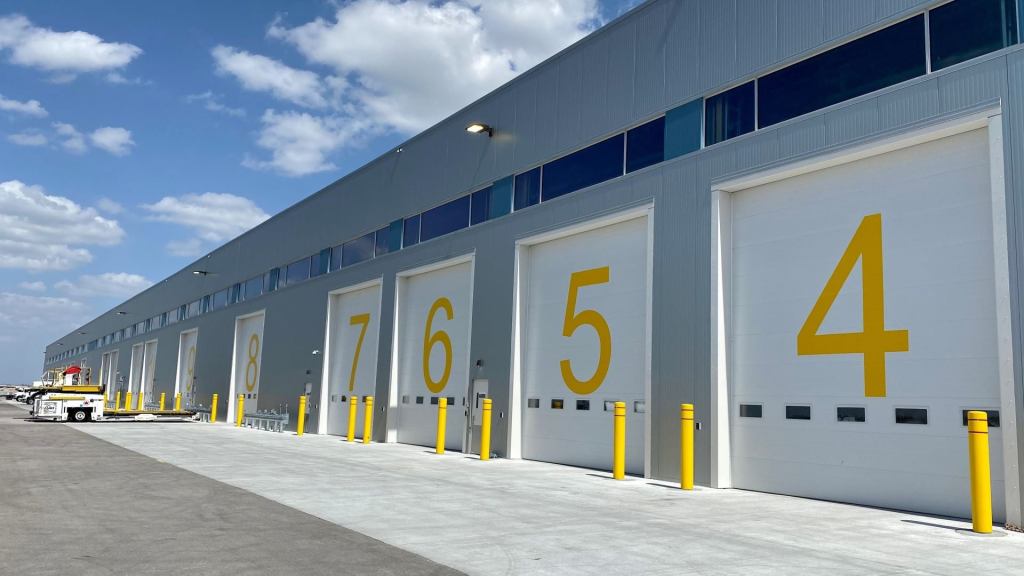
Dock doors at an airport painted with big yellow numbers, seen at an angle.

Winnipeg Richardson International Airport plans to commence construction of an $87 million multitenant air cargo logistics facility in April with the help of additional funding from the government of Canada. 

Transport Canada on Tuesday announced it has invested $14.5 million to boost Manitoba’s global trade connections through increased cargo capacity and efficiency. The federal government previously pledged $22.4 million for the project in 2019. 

Winnipeg is the third Canadian airport this year to receive an investment from the federal Trade and Transportation Corridors Initiative, a merit-based program designed to make Canada’s trade corridors to international markets more reliable and efficient. The government has allocated $3.5 billion over 11 years to modernize roads, bridges, airports, rail lines, port facilities and supply chain capabilities.

Officials say Winnipeg needs to expand its cargo campus because the number of freighter movements has increased each year since 2016 in response to demand for goods.

The new cargo terminal will have 142,500 square feet of space and the advantage of being closer to freighter parking positions, which will speed processing and support quick distribution to customers. It will also feature a cold-storage area for perishable goods.

“With today’s investment, we’re improving the Winnipeg James Richardson International Airport to handle more cargo,” said Dan Vandal, Canada’s minister of northern affairs, in a statement. “This initiative will not only boost trade flows but also improve accessibility and affordability of goods in remote and Northern communities and help grow Manitoba’s economy.” 

Work on the redevelopment of Winnipeg airport’s cargo area began in 2022 with extensive construction on the airfield and demolition of the former Air Canada Cargo building. As part of the project, the apron will be expanded and current tenants will be relocated.

Major express carriers with parcel sorting facilities at the airport include DHL, FedEx, UPS and Purolator. Other all-cargo operators at Winnipeg airport include Cargojet, Chrono Aviation, Skylink Express and Morningstar Air Express.

The airport authority in 2020 opened a 96,000-square-foot ground services equipment building, giving greater proximity to flights for previous tenants of the cargo campus that exclusively handle cargo on passenger aircraft while freeing up valuable space for all-cargo operators on the campus.

Winnipeg airport is located near rail networks operated by CN, Canadian Pacific and BNSF, as well as the TransCanada Highway. Highways also connect the airport to the U.S. market, 60 miles to the south.

Cargo traffic, as measured by gross takeoff weight, has been relatively flat year over year compared to many airports worldwide that have experienced large drops in volume.

Transport Canada in August awarded $69 million to Toronto Pearson International Airport to turn an underutilized office building into an airside cargo complex and $8 million to help carrier Canadian North double the size of its cargo terminal at Ottawa International Airport. 

Click here for more FreightWaves/American Shipper stories by Eric Kulisch.

New Calgary airport property owner shifts focus to air cargo

9th Circuit panel will hear Uber/Postmates case on AB5

An 11-judge panel will hear California’s appeal of the AB5 case known as Olson, a suit that earlier this year led to a victory for Uber and Postmates in their battle against the state’s independent contractor classification law.

In a brief order issued Monday, the Court of Appeals for the 9th Circuit vacated the three-judge appellate decision from March that partly reversed a lower court decision in the Western District of California. 

The order issued by the Court of Appeals did not say what the judges’ vote was in favor of accepting the state’s request for a hearing before a full panel of 11 randomly selected judges. It did say arguments would be presented in San Francisco during the week of March 18, 2024. 

The lower court had rejected all the claims made by Uber (NYSE: UBER) and Postmates. Postmates had been a separate delivery company until it was acquired by Uber in 2020, after the initial lawsuit was filed. The named plaintiffs in the case, Lydia Olson and Miguel Perez, were drivers for Uber and Postmates.

The decision handed down by a three-judge panel in March was notable primarily for its reasoning that Uber and Postmates had been denied equal protection of the law in the process that led to the California approval of AB5, state legislation that required companies that hire independent contractors to reclassify them as employees. Equal protection of the law was the only claim by Uber and Postmates that the appellate panel backed; it supported the lower court rejection of other arguments.

The panel cited the statements of then-Assemblywoman Lorena Gonzalez, now a state labor leader but the key driver in turning AB5 into law, as evidence that the move to more tightly define when a worker can legitimately be considered an independent contractor was an effort targeted at gig drivers like those at Uber. 

Among those many statements, the original complaint in the case filed in late 2019 cited a Los Angeles Times story that quoted Gonzalez as saying she “is open to changes in the bill next year, including an exemption for musicians — but not for app-based ride hailing and delivery giants.” Many of those exemptions have since been granted, either in AB5 or follow-up  legislation, AB 2257.

And in the complex legal landscape over AB5, the March appellate court decision putting the Olson case back into the lower court was then cited by the California Trucking Association and the Owner-Operator Independent Driver Association in a revised filing over its own ongoing legal battle against AB5. The CTA/OOIDA argument also cited statements by Gonzalez that the plaintiffs said showed the California trucking industry was targeted along with gig drivers.

(On Wednesday, two days after the en banc decision was handed down, attorneys for state Attorney General Rob Bonta and the Teamsters, which is an intervenor allied with the state, filed a document with the lower court in the CTA/OOIDA case noting the Ninth Circuit’s decision. The argument that the earlier decision regarding equal protection of the laws, which the CTA and OOIDA cited after that decision came down, could possibly be impacted by vacating the three-judge panel’s decision.)

AB5 is built on the foundation of the ABC test found in the Dynamex state court decision from April 2018 regarding worker misclassification. The ABC test sets up a three-pronged test to help regulators and courts determine if a worker can legitimately be considered independent or should be considered an employee.

For both the trucking and gig worker sectors, the B prong has the greatest disruptive potential. It says a worker can be considered independent if he or she “performs work that is outside the usual course of the hiring entity’s business.” But if the “usual course” of business is trucking or moving people around in personal cars, hiring outside workers to do that can create a conflict with the B prong.

The decision by the 9th Circuit Court of Appeals to hear the Olson case en banc comes as the trucking industry awaits the outcome of a request by CTA and OOIDA for a new injunction to block AB5 from being implemented in the state. 

That lawsuit was filed in late 2019 in the Southern District of California by CTA (OOIDA was added as a plaintiff later) and on New Year’s Eve of that year, Judge Roger Benitez handed down an injunction blocking its implementation in trucking because of concerns AB5 might have been preempted by a federal law, the Federal Aviation Administration Authorization Act. AB5 went into effect for the rest of the state on New Year’s Day 2020.

Benitez’s injunction was overturned by a three-judge appellate court panel in April 2021. Enforcement was stayed while the CTA took the case to the Supreme Court for review, which was not granted. 

AB5 was implemented in trucking. But the CTA case, which was not withdrawn but instead was sent back to the original court, now lives on in the same courtroom before Benitez, who heard arguments for a new injunction in November. California’s trucking sector awaits word on that decision.

More articles by John Kingston

Court kills CARB’s $30 reefer truck fee but refrigeration unit rules intact

California asks EPA for waiver to implement Advanced Clean Fleets rule

GlobalTranz wants Supreme Court to punt on broker liability issue

Autonomous trucking 2023: Leaders emerge amid exits and entries

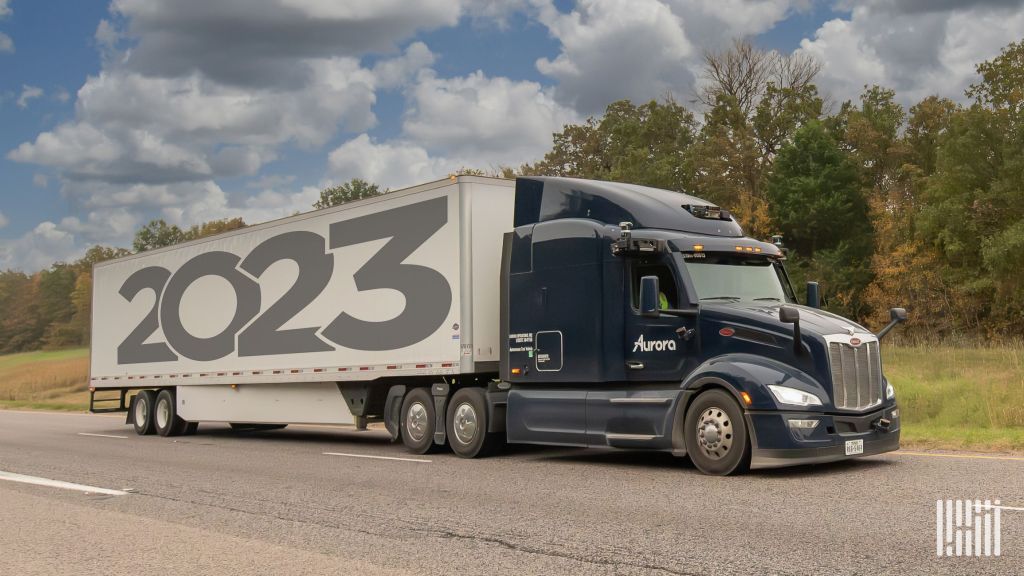
Aurora Driver-enabled Peterbilt Model 579

The shakeout in autonomous trucking struck in full force in 2023, leaving three leaders targeting commercial routes without humans in the cab and a couple of late entries on the periphery.

Embark Trucks became the first to fall in March, laying off 70% of its San Francisco-based employees and prompting an emotional goodbye from co-founder Alex Rodrigues.

Rodrigues and mid-20s co-founder and college buddy Brandon Moak stood to garner hundreds of millions when Embark went public via special purpose acquisition merger with Northern Genesis Acquisition Corp. in November 2021.

“I’m sorry that myself and Brandon weren’t able to find a way,” Rodrigues wrote in an email to employees. “You are an amazing team and it has been the highlight of my life to get to work with all of you.”

Embark spent most of the $314 million received in its SPAC. Investors redeemed $300 million in shares at the last minute, depriving Embark of additional working capital. Embark had no manufacturing partner, marketing its robotic driver system as an OEM-agnostic add-on.  

Venture capitalists and investors who loved the promise of autonomous technology when borrowing was cheap refocused on profits when the cost of money rapidly rose. Embark’s  financial prospects dimmed after a 1-for-20 reverse stock split in August 2022. The company’s share price had drifted below $1, exposing it to delisting from the Nasdaq.

With no one coming forward to lend Embark money, the company considered liquidation before selling itself in May to Applied Intuition, an autonomous simulation business, for $71 million in cash.

Embark provided an autonomous-equipped truck to Knight-Swift just months before winding down operations. (Photo: Embark Trucks)

Waymo chooses robotaxis over trucking

As Alphabet Inc., the parent of Google, looked for ways to cut costs, its “other bets” found themselves vulnerable. Waymo Via, the commercial trucking arm of the ride-hailing company Waymo, found itself repeatedly in the crosshairs. Layoffs beginning in March ended with the practical shutdown of the trucking startup in July while work continued on robotaxi programs in several cities.

But Waymo had to tread lightly because of a relationship with market-leading Daimler Truck. Waymo continues to work on a redundant chassis for the Freightliner Cascadia involving mechanical backups for key systems like steering, braking and low-voltage power. 

Waymo left open the possibility of returning to the trucking space, but all projects save for Daimler were shelved.

How much Waymo is working with Daimler is unclear. Daimler’s independent subsidiary, Torc Robotics, received a test version of the redundant chassis in November. It plans for driverless commercial trucking in 2027.

TuSimple looks east

Perhaps the most unexpected departure in the autonomous shakeout was that of TuSimple, acknowledged as a leader from the time of its 80-mile driver-out pilot in December 2021. That might have been the last good thing to happen at the San Diego-based startup with separate operations in China.

The layoff of 25% of its U.S. workforce a year ago preceded a second round of cuts in May, just weeks after TuSimple celebrated 10 million miles of supervised autonomous driving in the U.S. That was followed by the start of a “strategic review” in late June, when TuSimple said it might leave the U.S. market to focus on China and Japan.

In early December, TuSimple pulled the plug, keeping just enough U.S. workers to wind down operations in the first quarter of 2024. Finances at TuSimple remain strong: The company had $776.8 million in cash, cash equivalents and short-term investments at the end of the third quarter.

The impetus to focus on China may have come from co-founder Mo Chen, who has businesses there. He also controls 59% of TuSimple’s voting stock. The pivot away from U.S. operations follows the December 2022 breakup with Navistar International after a 2 ½-year manufacturing partnership and reverses plans to sell or spin off TuSimple China operations. In fact, the company has accelerated autonomous testing in China and Japan.

Clearout makes Aurora Innovation a defined leader

The clearout of Embark, Waymo Via and TuSimple left Aurora Innovation, invigorated by more than $800 million in new capital, and privately held Kodiak Robotics vying for the mantle of leadership. Both plan to commercialize driverless routes in Texas by the end of next year.

“At a time when markets remain uncertain, raising such a large amount from some of Wall Street’s most sophisticated investors demonstrates the market’s belief in Aurora’s progress and our ability to commercialize autonomous vehicles at scale,” a company spokesperson said in an email to FreightWaves in July.

Aurora has established transfer hubs in Houston and south of Dallas, where it runs scores of hub-to-hub driver-monitored autonomous loads weekly. Aurora, led by O.G. Chris Urmson as CEO, has methodically checked off its list of imperatives to safely remove the human driver. 

Aurora said in April that its system is “feature complete” and all that remains is validation and improving performance.

The Pittsburgh-based company partners with OEMs Paccar Inc. and Volvo Group in redundant chassis development. They have backup capabilities to steer and stop in the event of a critical component failure. The trucks also pull to the side of the road, known as fallback, when they encounter a problem.

Kodiak Robotics exhibits leadership, too

Kodiak made headlines throughout the year, first by hiring former USA Truck CEO James Reed as its chief operating officer and de facto mentor to CEO Don Burnette, a former graduate assistant to Urmson at Carnegie Mellon University.

Burnette worked for Urmson in the Google Self-Driving Car Project that became Waymo before launching Kodiak in 2018 with Paz Eshel, who took a position early this year with General Motors to help build out its hydrogen energy business.

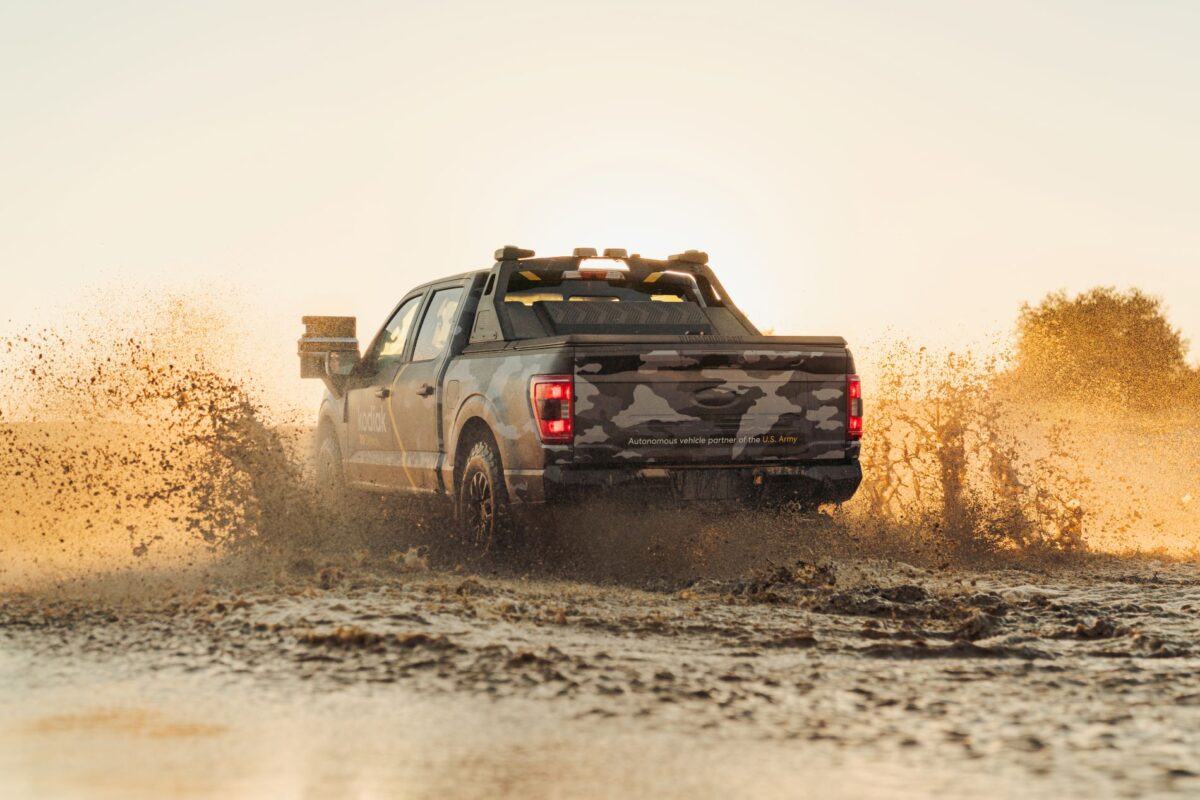
Kodiak’s finances are opaque because the Mountain View, California-based startup is private. But it ended the year showing a prototype of its Kodiak Driver autonomous system on a Ford F-150 pickup truck prototype for the military. Kodiak received a grant for up to $50 million from the U.S. Department of Defense a year ago to apply its technology to the armed forces.

A Ford F-150 prototype with Kodiak Robotics autonomous driving system. (Photo: Kodiak Robotics)

“Finding applications of technology that can apply to a military use case simultaneously with a civilian and commercial use case is the future, because that’s where the efficiency is,” Burnette told FreightWaves in early December.

As for raising more money, Burnette is optimistic if circumspect.

“The conversations are certainly turning more positive,” he said. “The whole community is starting to ease up. And this is a momentum-driven business. When investors think other investors are poised to jump, that kind of creates a little bit of a springboard effect.”

Torc Robotics’ deliberate approach also looks like a winner

Being an independent subsidiary of Daimler Truck means Torc Robotics doesn’t have to worry much about resources. Sure, CEO Peter Vaughan Schmidt must be as accountable as he was when he ran global autonomous operations for the German truck maker. He oversaw the March 2019 deal that brought Torc into the Daimler fold.

Since taking over as CEO in October 2022, Schmidt has driven the discipline that separates a small growth company from one whose scaling plans resemble those of its parent company. Test routes with safety drivers and engineers cover 1,000 miles from Phoenix to Oklahoma City. C.R. England and Schneider are early participants.

Torc sees commercialized autonomy from the Mexico border to as far north as St. Louis as its initial driverless route in 2027. But it is letting Daimler’s loyal customer base make that call. Torc’s unparalleled advantage is access to Daimler’s customer base.

What about the other guys?

If the leadership picture for Level 4 high-autonomy trucking is becoming clearer, it is not yet complete.

Two AI-focused startups — Waabi Innovation and Stack AV — are just getting started. 

Waabi partnered with Uber Freight in a 10-year deal to test its Waabi Driver system. To be fair, Uber Freight partners with multiple autonomous trucking startups as it seeks to share a rich database of route density while adding supervised autonomous capacity to what CEO Lior Ron said is 100 companies in queue to try moving freight autonomously.

Stack is run by former Argo AI autonomous passenger car founders, including Brian Salesky. Its specific plans remain opaque, but the 70 years of combined robotic vehicle experience among its founders suggests Stack could be a force to be reckoned with.

Backed by Japan’s Softbank with $1 billion — according to a local business development official in Pittsburgh where Stack is headquartered — resources are not in question. Salesky declined to confirm that figure to FreightWaves.

On the middle mile and in the distribution yard

There is more to the autonomous trucking landscape than on-highway freight movement. 

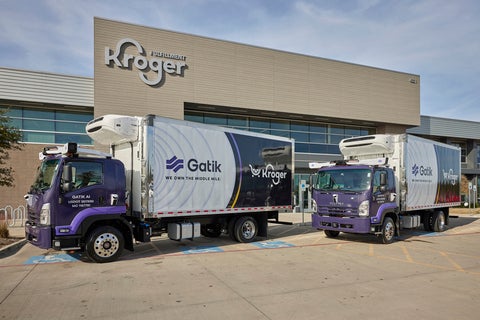
Gatik, another Mountain View startup, continued to dominate the short-haul middle mile for autonomy, adding regular operations for grocery giant Kroger in the Dallas area and signing Northwest Arkansas-based Tyson Foods to a three-year contract in September that could lead to expansion to as many as 40 of Tyson’s distribution markets.

Unlike Class 8 autonomy, Gatik has practically no competition in driverless distribution routes.

Gatik began regular autonomous short-haul operations for Kroger in the Dallas area in December. (Photo: Gatik)

Autonomy also works in the distribution yard. Startup Outrider not only raised $73 million in a Series C round in January, but it continued to add features to driverless yard tractors and an autonomous ecosystem focused on safety in moving and positioning trailers.

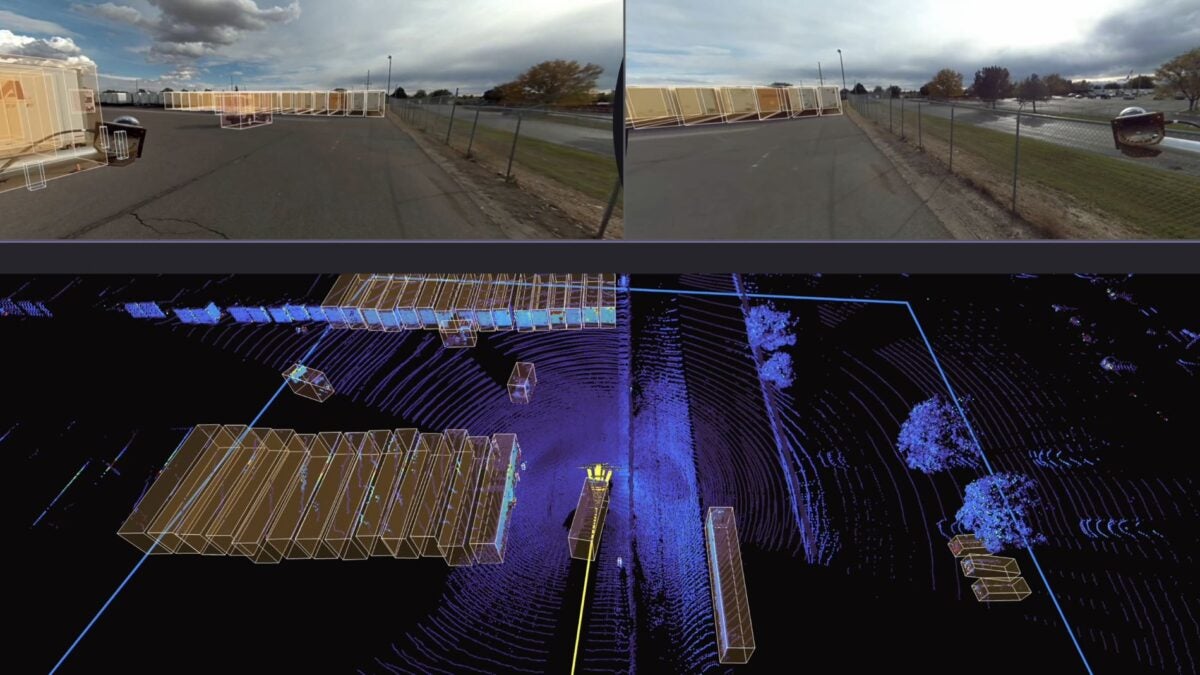
Outrider’s yard automation solution now understands, anticipates and interacts with fixed and moving actors in the yard. The updated perception system allows Outrider to achieve critical safety and performance objectives for commercial driverless operations in 2024.

Outrider’s perception system sees fixed and moving objects in the distribution yard. (Photo: Outrider)

Aurora Innovation raises $820M in fresh capital

Gatik robot trucks will haul Tyson chicken, sausage and hot dogs

Kodiak Robotics makes autonomous pickup for the military

Click for more FreightWaves articles by Alan Adler.

Daily Infographic: Texas company aims to help keep returns out of landfills


To view more FreightWaves infographics, click here

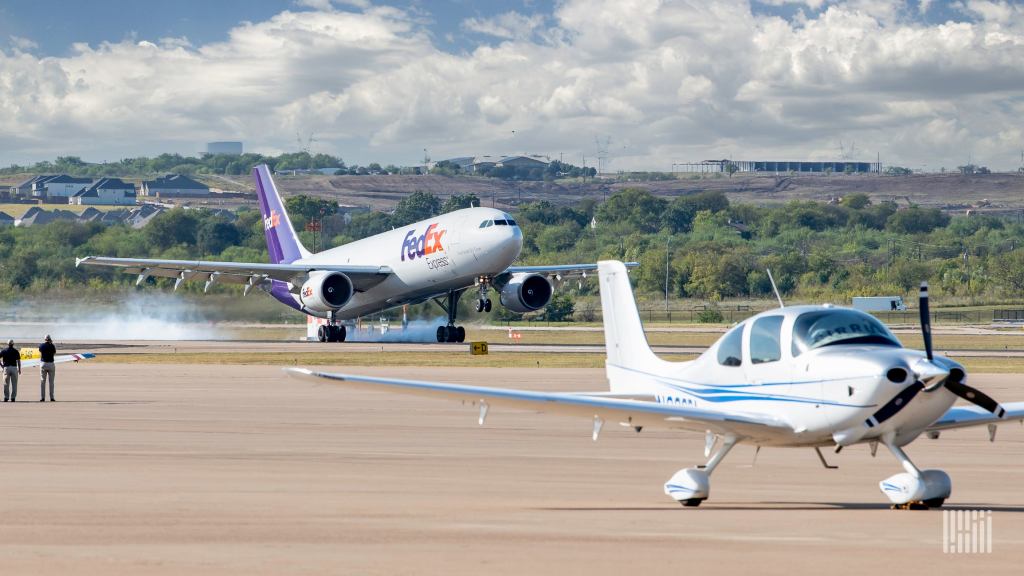
FedEx hopes new color-coded air network will shore up profits

FedEx Corp. announced Tuesday evening a restructuring of its FedEx Express international air network in an effort to boost its largest unit’s sagging profits amid continued macro weakness.

The tri-color initiative, as the name implies, will divide the network into three colors: Purple will focus on priority deliveries of packages. Orange will emphasize the deferred package and air freight segments, where much of the air shipment density lies, and will be handled through FedEx’s (NYSE: FDX) nonurgent sortation network.

Packages and freight moving under both colors will be serviced by the company’s air fleet, with the yellow network tied into FedEx’s ground operations, including FedEx Ground and less-than-truckload unit FedEx Freight in the U.S. The tie-in with the surface infrastructure, in the manner it is being brought to market, is a first for the company.

The third color, white, will incorporate the airlift of what will be FedEx’s air partner network.

The company has talked about this change in broad strokes before. However, it is believed to be the first time it has codified it with a brand initiative. The goal is to match the profit profiles of each international air shipment with the right delivery mechanism, executives said.

The announcement comes as the unit struggles to find its footing amid a weak macro environment that isn’t expected to improve through the remaining approximately six months of the 2024 fiscal year. In fact, the company lowered its full-year revenue forecast to what will be a single-digit decline instead of flat growth year over year.

On a non-GAAP basis, FedEx Express’ second fiscal quarter operating margin came in at 1.7%, about half the margin reported in the second quarter of fiscal 2023. The company’s overall margin for the 2024 quarter was about three times that of the Express unit. The overall margins were bolstered by a nearly 11% margin at FedEx Ground, the company’s U.S. ground network.

Express is being buffeted on multiple fronts: A global downturn in industrial production has hit demand, especially for international air freight. Budget-conscious shippers are trading down to cheaper but lower-yielding air services. Fuel and delivery surcharge revenue is down year over year. The U.S. Postal Service, a big Express customer, is diverting domestic air packages to ground from air. At the same time, it requires Express to maintain certain service requirements, which is a cost headwind for the carrier. The current contract expires Sept. 29, 2024 and FedEx executives have said there will need to be significant changes in contractual terms for FedEx to consider renewing it.

Express revenue fell 6% year over year. That, along with a 4% revenue decline at FedEx Freight, are microcosms of the stagnant macro climate the company finds itself in. For the quarter, revenue of $22.2 billion was down $600 million from the year-earlier period.

The company upped its full-year guidance for diluted earnings per share, now saying it will come in at a range of $15.35 to $16.85 per diluted share from $15.10 to $16.60 per diluted share.

Adjusted operating income rose 17% due to efficiency improvements and a more profitable revenue mix. Adjusted net income came in at $1.01 billion from $820 million.

The news at FedEx Express was not received well by the financial markets. Three hours into after-hours trading, FedEx shares were down nearly 10% from the day’s closing levels.

(An earlier version incorrectly stated that one of the colors in the FedEx Express air network was yellow. It is orange.)

UP to customers: Urge Congress to help reopen US-Mexico rail crossings

Union Pacific wants customers to urge Congress to pressure U.S. border officials to provide a timeline for when freight rail operations might resume at U.S.-Mexico border crossings at El Paso and Eagle Pass, Texas.

U.S. Customs and Border Protection announced Sunday that effective at 9 a.m. EST Monday, cross-border freight rail operations at three bridges connecting Texas and Mexico would be suspended in response to increased migrant smuggling operations in the region. El Paso has two railroad bridges, one each for BNSF Railway and Union Pacific, while Eagle Pass has one rail bridge that serves both railroads.

In a Tuesday customer notification, Class I railroad Union Pacific (NYSE: UNP) said it has no idea when the suspension will be lifted. It asked customers to reach out to their congressional representatives for help.

“At this time, the Department of Homeland Security does not have an estimated time of reopening. These locations represent 45% of cross-border shipments on Union Pacific and include goods critical to the U.S. economy,” UP said, adding that each day that the border is closed, it causes UP to place embargoes on more than 60 trains or nearly 4,500 rail cars. An equivalent number is being held in Mexico, according to the railway.

“The longer this closure is in effect, the more difficult it will be for cross-border trade to resume. We estimate that the overall economic impact of the border closure is more than $200 million each day,” UP said. “We encourage you to contact your elected officials to share your concerns regarding the CBP Agency closure of train traffic and request a timeline for reopening. If you have any relationships with Congressional offices or Executive Branch Agencies, please reach out to them as well.”

As UP asked customers to lobby government officials, more trade groups have joined calls asking CBP to lift its suspension.

Joni Casey, president and CEO of the Intermodal Association of North America (IANA), which represents over 1,000 intermodal freight transportation providers and suppliers, said in a Tuesday release that “while acknowledging the ongoing border issues, it is imperative that the flow of freight remains unencumbered throughout these challenges. The reopening of these border crossings is vital to reinstating the essential flow of trade between the U.S. and Mexico.”

IANA also said it supported statements from the Association of American Railroads on Monday calling for an immediate reopening of both rail crossings.

The National Grain and Feed Association and the North America Export Grain Association said in a joint statement Monday that CBP should reopen the rail crossings immediately as “the North American market and grain trade supply chain are deeply intertwined. The closure of these two crossings is impacting the flow of grain and oilseeds for both human and livestock feed to one of the United States’ most important export markets and trading partners.”

The groups also pointed to data from the U.S. Department of Agriculture that shows rail represents 64% of grain and oilseed exports to Mexico.

“We are deeply concerned by the developing situation and request that CBP work with us, the railroads and other federal partners to develop a common sense and expedient solution that reopens this critical mode of agricultural transportation for the U.S. and North American markets,” the two groups said.

CBP previously closed the Eagle Pass gateway in September because of a surge in migrants attempting to cross the border in South Texas.

Subscribe to FreightWaves’ e-newsletters and get the latest insights on freight right in your inbox.

Click here for more FreightWaves articles by Joanna Marsh.

DHL Express workers at Cincinnati airport reach deal, end strike

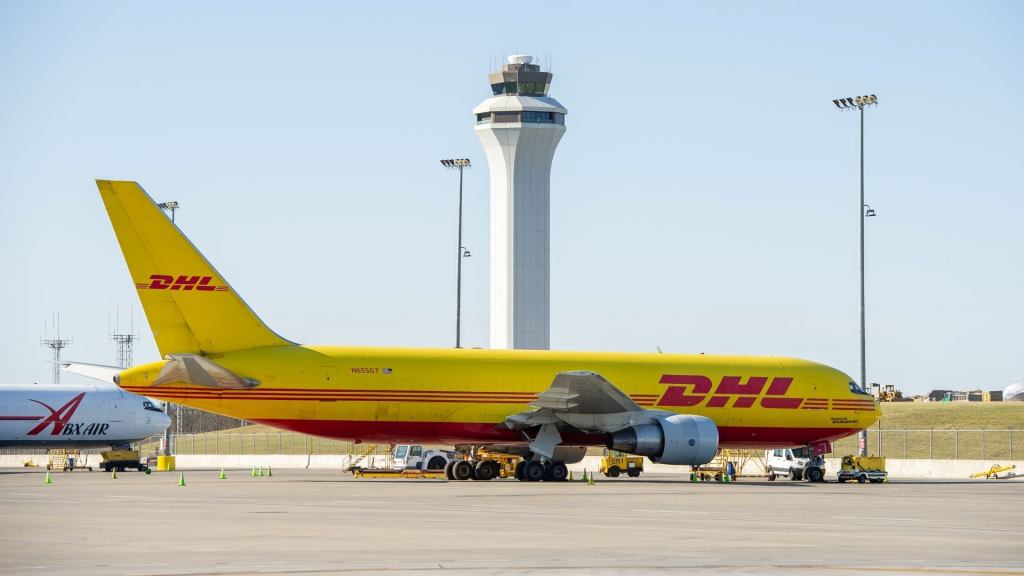
A large yellow DHL jet sits on the tarmac with an airport control tower in the background.

DHL Express has reached a tentative deal with ramp workers at its Cincinnati air hub, ending a 12-day strike and sympathy action by Teamsters members at other locations across the United States that caused parcel delays during the busy gift-giving season.

The Teamsters union announced Tuesday that negotiators tentatively settled a dispute over a new contract. Striking workers at Cincinnati/Northern Kentucky International Airport (CVG) are working their regular shifts Tuesday, said union spokeswoman Kara Deniz.

Front-line DHL employees must still approve the deal struck by their leadership. No ratification date has been set yet.

Terms of the contract were not released but included improvements on workplace safety, higher pay and better benefits, according to a Teamsters news release.

About 1,100 CVG ground operations staff in April joined Teamsters Local 100, which began talks on an initial contract in July. The union accused DHL Express of not addressing safety hazards that led to injuries, underpaying workers and unlawfully attempting to prevent union organizing. It filed dozens of unfair-labor-practice reports with the National Labor Relations Board.

“Picket lines established by Teamsters Local 100 were honored and held down all over this country, making clear to DHL and employers everywhere that Teamsters solidarity is a force to be reckoned with,” said union President Sean O’Brien. “DHL tried hard to divide us. The International Brotherhood of Teamsters stepped up and fought back. This tentative agreement is a testament to the intestinal fortitude of the rank-and-file.”

After talks broke off on Dec. 7, DHL officials said they would not return to collective bargaining until January.

Last summer, O’Brien was able to win a new contract for 340,000 UPS package sorters and drivers hours before a potentially damaging Teamsters strike was scheduled to start.

DHL Express rerouted some freighter aircraft and reassigned other workers to mitigate the effects of the 12-day work stoppage, but some shipments were still disrupted. The expansion of the work stoppage to other locations in a show of support for the CVG workers led to undelivered packages piling up at Seattle-Tacoma International Airport and Boeing Field, according to local KOMO News.

Click here for more FreightWaves/American Shipper stories by Eric Kulisch.

DHL Express workers extend picket lines across US

DHL Express workers begin strike at Cincinnati air hub

Court kills CARB’s reefer truck fee, but refrigeration unit rules intact

(Editor’s note: after publication of this article, CARB supplied FreightWaves with additional information about the TRU mandates. This latest version reflects those changes, including information on the fees.)

A California environmental regulation on diesel-powered truck refrigeration units (TRUs) that is set to expand on Dec. 31 will proceed without a registration fee after the California Trucking Association prevailed in a court battle against the fee.

The fee was to be only $45 per diesel-powered TRU or applicable facility and $23 per zero-emission TRU, according to a spokeswoman for the California Air Resources Board (CARB). And its defeat does not change the fact that in other regards the next steps in the rule, known as the Airborne Toxic Control Measure for In-Use Diesel-Fueled Transportation Refrigeration Units, will take effect in less than two weeks.

CARB refers to it as the TRU ATCM.

The push toward zero-emission vehicles (ZEVs) in the state under two separate pieces of legislation will take two similar steps at the close of the year: All new trucks registered in the state’s drayage registry must be zero-emission vehicles, a requirement under the Advanced Clean Fleets (ACF) rule; and operators of refrigerated trucks — but not trailers — must start down the road to full zero-emission technology, part of the TRU ATCM. The TRU ATCM also encompasses such units as refrgierated rail cars and containers.

In a question-and-answer document, CARB spells out the distinction it makes between trucks and trailers in the TRU ATCM: Truck TRUs are “diesel-powered refrigeration units that are mounted on or in a truck cargo box that is permanently attached to a truck.” CARB says that definition does not include detachable trailers.

The regulations regarding truck TRUs going into effect Dec. 31 are that fleets with four, five or six trucks must have at least one vehicle that is a ZEV. For fleets with seven or more trucks, 15% must be ZEVs.

This year’s requirements begin a progression that on Dec. 31, 2024, will ramp up to one ZEV for fleets with two, three or four trailers, two ZEVs for five- or six-truck fleets, and 30% ZEVs for fleets with seven or more trucks.

Mandates get stricter annually until a 2029 requirement. At that point, it’s effectively a 100% mandate: one ZEV for a one-truck fleet and two ZEVs for a two-truck fleet, rising to six for six and 100% for fleets with seven or more vehicles. (The CARB compliance table has one through six vehicles as separate categories but it’s all one rule by 2029).

As for trailers, containers and rail cars, no new operating mandates for refrigerated trailers go into effect Dec. 31 now that the fees have been put on the shelf. However, there is a new requirement impacting out-of-state TRUs that operate in California: They now must report their TRUs to the state.

No plans for ZEV refrigerated trailers

The TRU ATCM does not contain any ultimate zero-emission requirements for what are described as nontruck TRUs: trailers, rail cars and shipping containers. Instead, emissions from those sources are to be curtailed primarily through steps that went into effect a year ago.

A new particulate matter (PM) rule that went into effect Dec. 31 last year impacted newly manufactured nontruck TRUs. It required the diesel engines on those units to meet certain standards regarding PM emissions. There were also new rules on the types of refrigerants used in the units.

To help compliance with that rule, the state also has barred OEMs from selling into the state TRUs that don’t meet the PM standard, beginning with the 2023 model year. 

That requirement has echoes of the state’s Advanced Clean Truck rule, which is a mandate on OEMs and their sales of ZEVs into the state. The ACT and ACF are designed to work hand in hand, leading to a ZEV-only future by 2045.

To phase out older, dirtier diesel-powered TRUs, the rule also mandates that all TRUs of the 2022 model year or earlier implement a compliance method to meet what CARB calls the in-use performance standard — basically the PM standard — by Dec. 31 of seven years after the engine’s model year. As an example, CARB says a 2018 engine must be brought up to a PM standard for nontruck TRUs by Dec. 31, 2025.

That means that Dec. 31 would be a type of deadline for vehicles with a 2016 model year date or earlier if they are still on the road.

Court sees agency overreach

In the case in state Superior Court in Fresno that led to the suspension of the fees, Judge Robert Whalen ruled that CARB did not have the authority to implement such a charge.

“Taxes are often a hard, but necessary, pill to swallow when it comes from our elected officials,” Whalen wrote. “But at least with an elected official we can express our displeasure on election day. It is a jagged pill when the tax is imposed by an unelected group such as CARB, which the public cannot remove.”

“What, if any authority, does the CARB have to collect fees as part of their amendments to the [TRU ATCM]?” the judge asked in his opinion. “If the authority is not provided for by the Legislature and the Governor … it will not stand.”

In a letter posted to its website, CARB acknowledged the court decision and said it would not be collecting the fee. It said it would continue to issue compliance labels for TRUs that are compliant with the law but could not get it all done by Dec. 31. 

More articles by John Kingston

Refrigerated trailers California’s next emissions target; NDustrial gets ready

California asks EPA for waiver to implement Advanced Clean Fleets rule

California trucking regulation flies under radar as first deadline looms