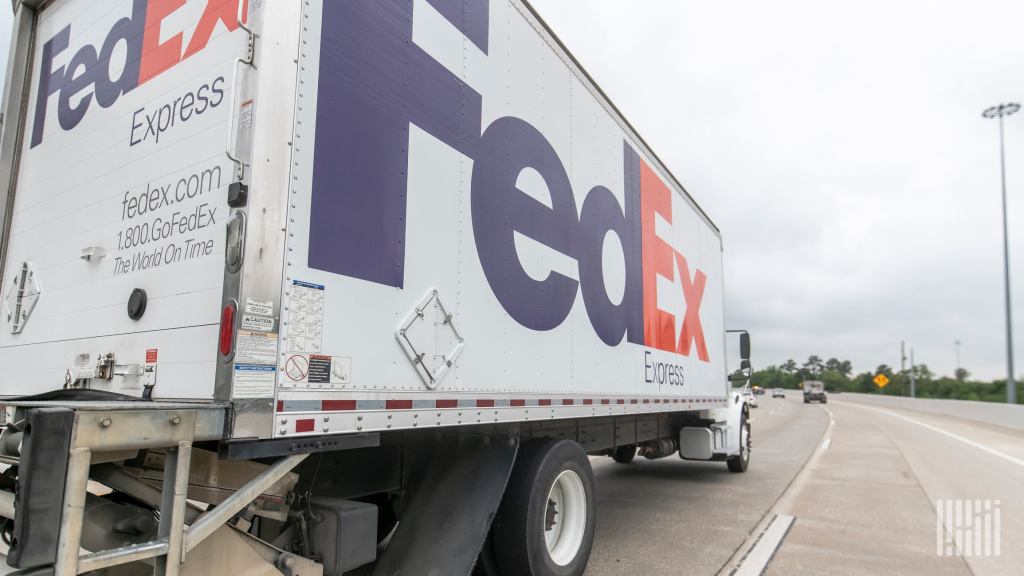
FedEx Corp. late Tuesday cut its fiscal 2024 revenue forecast, saying it now expects a single-digit year-on-year revenue decline instead of flat revenue.
The revision, included in its fiscal second-quarter financial results, sent shares plunging more than 8.5% in early after-hours trading.
The company (NYSE: FDX) upped its full-year guidance for diluted earnings per share, now saying it will come in at a range of $15.35 to $16.85 per diluted share from $15.10 to $16.60 per diluted share.
For the quarter, revenue of $22.2 billion was down $600 million from the year-earlier period, as the company continued to grapple with sluggish demand. Adjusted operating income rose 17% to $1.42 billion due to efficiency improvements and a more profitable revenue mix. Adjusted net income came in at $1.01 billion from $820 million.
FedEx Express, the company’s air and international unit, posted lower operating income due to lower revenue. The revenue drop was a result of reduced demand, lower delivery surcharge revenue and a shift toward lower-yielding services.
FedEx Ground, the company’s U.S. ground parcel delivery unit, posted higher operating income due to higher volumes and yield improvement.
FedEx Freight, the company’s less-than-truckload unit, posted an increase in operating income despite a decline in revenue due to fewer shipments.
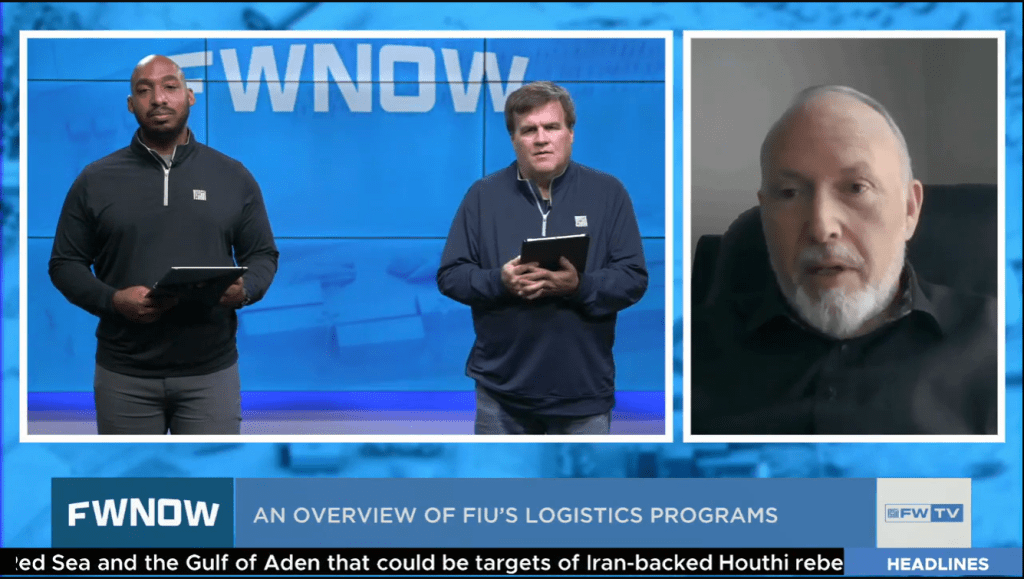
How FIU Business is guiding next generation of logistics professionals
One of the primary challenges facing any educated workforce is a lack of real-world industry experience among students and recent graduates.
And while logistics is certainly not exempt from this challenge, Michael White and his colleagues at Florida International University College of Business are actively solving it. White, executive-in-residence at FIU Business, is offering his decades of experience in the air cargo sector to students.
“What we’re trying to do,” White said about his mission at FIU Business, “is to bring reality back to the classroom.”
While many students might enroll in business school without much business acumen, White encountered the opposite problem early in his career: He was without a clear career path after entering the industry, lacking a broader understanding of how all the links of the supply chain fit together.
The true benefit of a program like FIU Business’, then, is the coupling of a theoretical understanding of supply chains with experiential learning. FIU Business’ partners encompass a wide and multimodal swath of the logistics industry, enabling students to take part in paid internships while pursuing a degree.
Such partnerships tend to benefit all involved, White argues. “The industry is looking for new blood. When you have the opportunity to be involved with the students, you realize that they’ve got a lot of new ideas.”
A common refrain among professionals in the logistics sector is that they were either born into it or stumbled into it. FIU Business instead seeks to recruit passionate and bright individuals to supply chain management by raising awareness of the industry and its advantages. No small part of this effort can be found in the college’s outreach to high school students.
“Some might say that the logistics world is not so exciting,” White said, “but we do things that make the world turn.”
Gulf Coast ports record varied results in November volumes
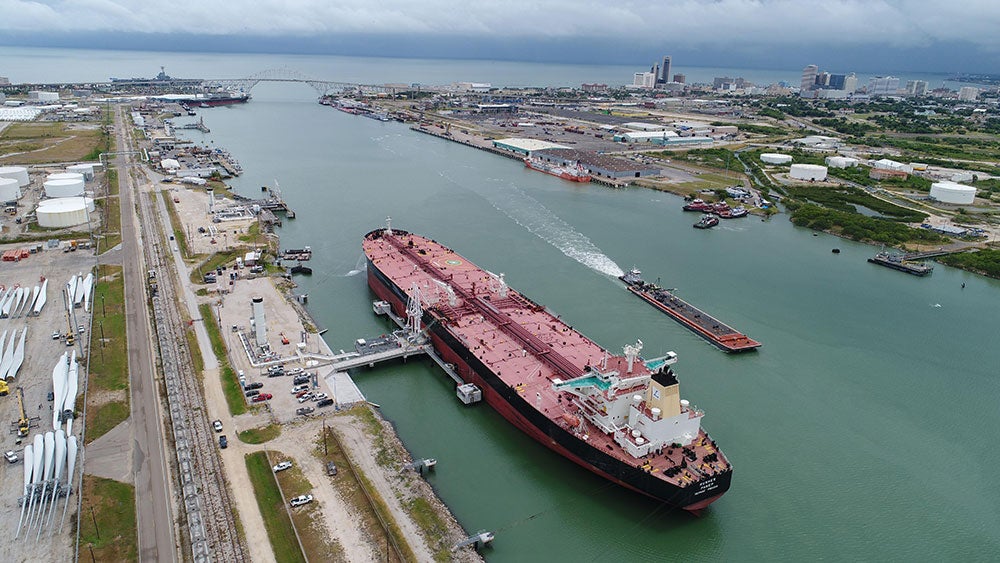
Ports in both New Orleans and Corpus Christi, Texas, saw freight flow increases in November as shipments of crude oil and plastics continued to be in demand across the global market. Port Houston saw declines in container volume during the month.
Port Houston sees 15% decline in container volume
Port Houston saw decreased container volumes in November, recording a 15% year-over-year (y/y) decline to 297,622 twenty-foot equivalent units.
Imports of steel declined 16% y/y in November to 266,955 tons. Steel imports were down 14% at 4 million tons in the first 11 months of 2023 compared to the same period in 2022.
Roger Guenther, the port’s executive director, said while overall TEUs and steel imports are down this year compared to 2022, he considers 2023 a successful year for the port.
“We’re winding down another year, another strong year, steady in 2023. Compared to three years ago, it’s a very, very strong year,” Guenther said during the Dec. 12 port commission meeting. “There’s been some decreases in things like grain and plywood that were coming in last year.”
Total import tonnage was down 19% y/y to 2.1 million tons, while export tonnage was down 13% y/y to 2.3 million tons.
“Steel, we know that’s cyclical, we had a heavy year last year, but it’s still a very strong year in terms of average volume that we handle on steel,” Guenther said. “Overall for the year, imports are down about 8% or 9%, but our exports, loaded containers, the resin chemicals, the things that we export, agricultural goods, are up 8% for the year.”
Guenther also said the port’s volume of empty container exports was down about 20% for the year.
Empty container exports plunged 41% y/y in November to 35,239 TEUs, while imports of empty containers rose 25% y/y to 8,356 TEUs.
Loaded exports in November fell 2% y/y to 116,396 TEUs. Loaded imports fell 16% y/y in November at 137,631 TEUs.
Ship calls for November were up 4% y/y to 678 vessels. Barges calling Port Houston increased 7% y/y to 262.
“Overall, it’s a great year on loaded cargo moving and still delivering good service levels to our customers,” Guenther said.
Plastic resins, chemicals and coffee boost container volumes at Port of New Orleans
The Port of New Orleans saw a 32% y/y increase in container volumes in November, recording 40,651 TEUs.
Containerized shipments were led by exports of plastic resins and miscellaneous chemicals, as well as imports of coffee and organic chemicals.
Total breakbulk tonnage for the month was 40,553 short tons, compared to 158,995 short tons in November 2022, representing a 74% y/y decrease. Port officials said steel was the top breakbulk commodity for the month.
Container volumes year to date in New Orleans are up by 11.5 % compared to the same period last year.
“Our top export commodity, plastics, has double-digit growth year to date,” port spokeswoman Kimberly Curth told FreightWaves. “Calendar year to date, we have seen 89 more vessel calls than last year, representing a 32% increase year over year in our weekly service vessel calls.”
The port handled 8,729 Class I rail car switches in November, a 27% y/y decrease. The port handles switching operations for the six Class I railroads that operate in New Orleans: BNSF Railway, CN, CSX, Kansas City Southern, Norfolk Southern and Union Pacific.
Crude oil demand helps Corpus Christi see gains in November
The Port of Corpus Christi saw a 1% y/y increase in total cargo to 16.1 million tons in November, led by exports of crude oil.
The port handled 10.1 million total tons of crude oil during the month, a 1% increase compared to the same year-ago period. Exports of crude oil for November topped 9.4 million tons, just a 0.1% increase over last year.
Shipments of petroleum totaled 4.8 million tons during November, an 8% y/y decrease. Exports of petroleum were at 3.79 million tons for the month, a 7% y/y decline.
Dry bulk cargo increased 58% y/y to 644,870 tons in November, while bulk grain shipments rose 246% y/y to 272,408 tons.
Liquid bulk shipments rose 200% y/y to 60,886 tons. Breakbulk cargo rose 293% y/y to 27,577 in November.
The Port of Corpus Christi had 624 ship calls in November, a 2.6% y/y increase from 2022, including 440 barges and 184 ships.
New Calgary airport property owner shifts focus to air cargo
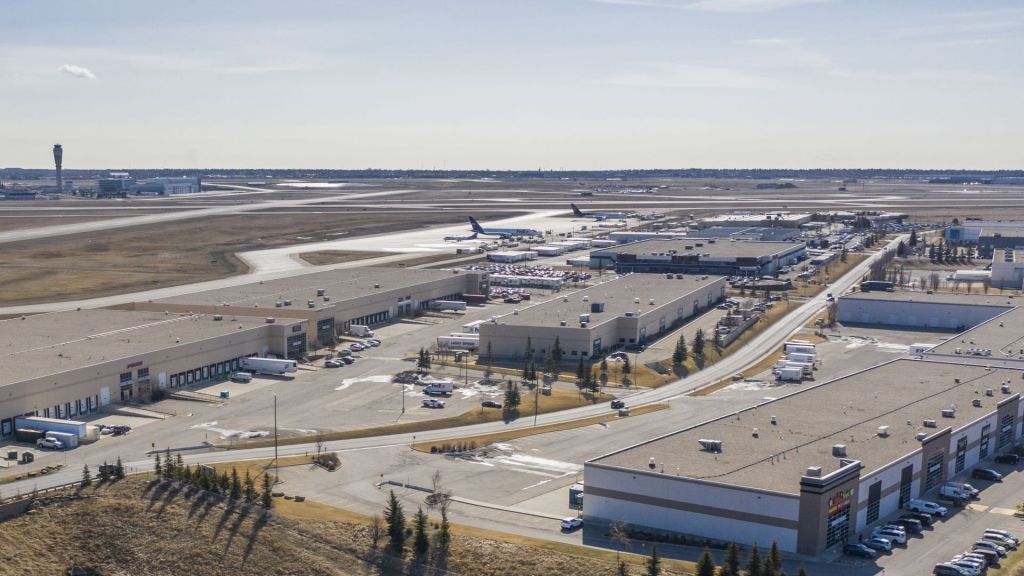
A jungle gym, indoor go-kart track and other mismatched businesses will eventually be moved out of a logistics complex at Calgary International Airport in Alberta to make way for cargo operators that can utilize the airside access for its intended purpose — moving commerce — according to the property’s new owner.
Realterm, a global investment manager focused on logistics infrastructure and a developer of cargo real estate at airports, last week announced it had acquired control of more than 502,000 square feet of industrial property adjacent to the Calgary airfield. According to public records, Realterm assumed the ground lease in a deal with Great West Life and will make payments to the airport authority for 49 years.
Calgary International Airport is the fourth-busiest airport in Canada and handles three-quarters of air cargo in the province of Alberta.
Three of the five buildings in the logistics center sit along the tarmac and have the capability to host freighter aircraft. In the 13 to 15 years since they were built, none of the facilities have had dedicated air cargo tenants, said Alexi Lachambre, Realterm’s vice president of investments.
Instead of leveraging airport infrastructure, Great West Life appeared to cast a wide net beyond aviation users. Other tenants include a FedEx Ground station, an in-flight catering company, and an aircraft maintenance, repair and overhaul provider.
When leases for space occupied by go-kart and other nonaviation businesses come up for renewal, Realterm plans to find tenants that need the convenience of operating at an airport.
“We’re gonna purposely market them towards aviation users who we think are better for those buildings,” Lachambre said in a phone interview.
Buying the facility at a much lower cost than having to build from scratch will enable Realterm to make cargo space available to potential customers at a much lower cost, he said.
Calgary airport has two full cargo terminals that support passenger and all-cargo airlines, as well as dedicated air transfer stations for FedEx Express, UPS and Purolater.
Lachambre said the air logistics center, which is close to a regional north-south highway, gives other air cargo providers the ability to quickly set up their own operations with direct ramp connections between cargo jets and a warehouse. Interest in cargo infrastructure at Calgary is high, he added.
Realterm said it will make investments to improve the warehouses for airfreight operations as needed.
Check Call: Might have missed the 2023 mark a little
Welcome to Check Call, our corner of the internet for all things 3PL, freight broker and supply chain. Check Call the podcast comes out every Tuesday at 12:30 p.m. EST. Catch up on previous episodes here. If this was forwarded to you, sign up for Check Call the newsletter here.
(GIF: Tenor)
Well well well, look at how the turntables have turned. It’s coming near the end of the year, which means it’s time to look at predictions I made last year and roast myself accordingly.
Last year my hot predictions for 2023 were: “This year sustainability will continue to be at the top of shippers’ requirements. The days of ESG programs are here and those who are caught with nothing will not fare well. The market will more closely reflect that of 2018 and 2019. 2020 and 2021 will be outlier years, and after this market correction it will be more business as usual. Lastly, labor problems will remain, especially the longshoremen contract for the West Coast. That might rival the threatened rail strike in terms of disruptions to the national supply chain.”
Needless to say, this wasn’t 100% accurate.
The market was more similar to freight markets of 2018 and 2019 but also left a lot to be desired in terms of rates and capacity, whereas 2018 and 2019 weren’t as rough in the rate department. Especially when it comes to the number of bankruptcies and struggles in the industry, 2023 for sure was worse than 2018.
Labor problems are half-right. The longshoremen secured a contract, with minimal long-term impacts, but the United Auto Workers made the Detroit Three car manufacturers feel the pain from failed negotiations before securing a contract. That’s without getting into the issues with Yellow and the Teamsters and UPS and their union. It was a big year for unions and labor disputes. Right on the money there.
A prediction that was more than a little off the mark was on sustainability and environmental, social and governance programs. As budgets became tighter and companies looked to curb extraneous spending, ESG programs that weren’t already established weren’t something everyone was ready to jump on board with.
Personally, I am looking forward to a rapid growth of ESG programs in 2024, but as long as the market remains tight, it will take a lot of low-cost barriers of entry to make significant headway in this area.
As for 2024 predictions? We’ll make those next week after the holiday.
SONAR Ticker: WRI – Map
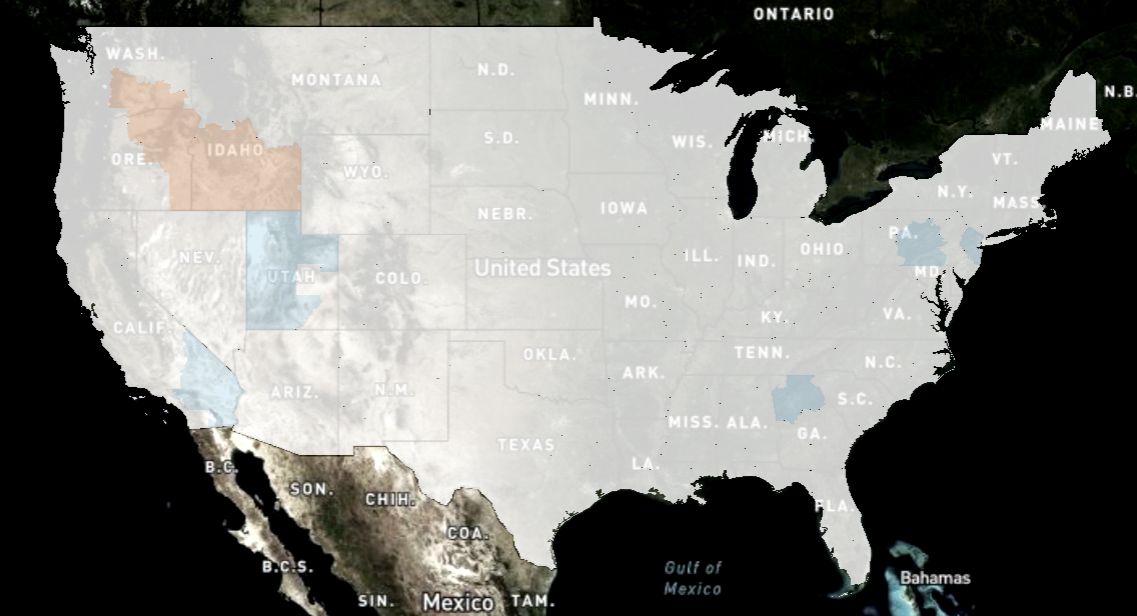
Market Check. The Weighted Rejection Index (WRI) is the product of Outbound Tender Market Share (OTMS) and Outbound Tender Rejection Index Weekly Change (OTRIW) for an individual market. This helps prioritize tender rejection rates by market size. In redder markets, capacity is loosening, whereas it is tightening in blue markets. Not exactly a hotbed of freight volume, Salt Lake City is seeing some capacity tightening week over week — a trend that will start to develop over the next week as various markets prepare for drivers taking a break for the holidays. While right now there is plenty of excess capacity for markets, it’s something to watch out for in some of the larger markets as it could impact spot rates.
Who’s with whom? Closing out the year the way it started, with labor disputes, seems like the only appropriate way to end 2023. Everyone and their union seemed to have labor issues this year, and DHL Express workers are the latest to join the trend. DHL Express workers represented by the Teamsters union have walked off the job at several U.S. locations in solidarity with ramp workers who went on strike a week ago at Cincinnati/Northern Kentucky International Airport (CVG).
What started as one location has naturally expanded to more as members of the Local 100 in Boston, Detroit, Miami, Los Angeles and San Francisco have refused to cross picket lines established by CVG workers.
This is a slightly surprising move since workers just joined the Local 100 in April. Among the reasons workers are striking are safety concerns and alleged union-busting activities.
DHL has developed contingency plans to accommodate the workers on strike and still ensure that customers’ freight still gets where it needs to go — especially as DHL Express is the expedited arm of the business so packages cannot be late.
Trailer orders plunge 38% in November compared to October
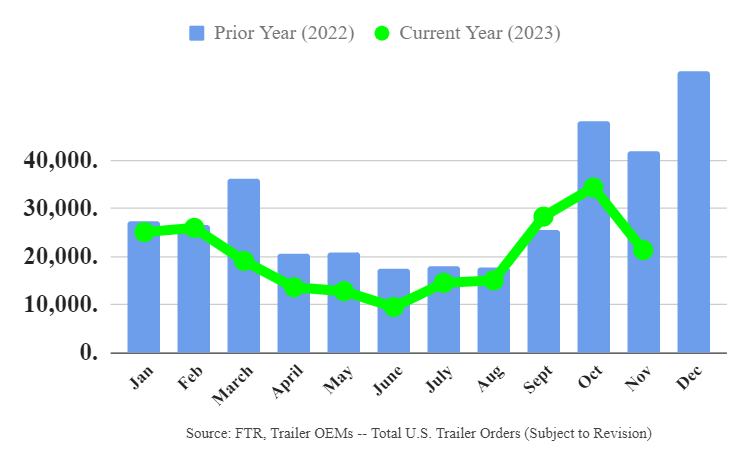
Trailer orders tanked in November, falling 38% from October accompanied by the lowest production rate since last year.
But the retrenchment to 21,362 units still left November orders 7% above the average for 2023. Orders in November 2022 were 45% higher than last month.
Manufacturers produced 23,770 trailers in November, down 12% from October and 9% year over year. A drop in production after October is normal, and the average monthly build is still healthy at more than 27,200 units, FTR Transportation Intelligence reported.
“With orders coming in under production levels, backlogs in November fell slightly, shedding almost 2,500 units to end at just over 140,000 units,” FTR Chairman Eric Starks said in a news release. The backlog-to-build ratio increased to 5.9 months, the length of time a typical order placed today would take to be completed.
Trailer orders ‘in line with historical average’
“This ratio is in line with the historical average prior to 2020 and suggests the industry is moving towards a pre-pandemic level of stability,” Starks said.
OEM Wabash said during a third-quarter earnings call Oct. 25 that its first-to-final-mile portfolio would offset softer near-term demand for dry vans. Easing of customer demand for goods following a surge during the pandemic has led to low spot rates, excess capacity and drivers surrendering Department of Transportation authorities sought when spot rates hit record highs.
The number of trailers ordered over the past 12 months decreased to just above 276,700 units, FTR said.
ATA truck tonnage index falls an unadjusted 5.1%
Separately, the American Trucking Associations reported Tuesday that its advanced seasonally adjusted For-Hire Truck Tonnage Index decreased 1% in November after increasing 0.8% in October. Without seasonal adjustment, the predominantly contract-freight index fell 5.1% in November compared to October.
“We continued to see a choppy 2023 for truck tonnage into November,” ATA Chief Economist Bob Costello said. “It seems like every time freight improves, it takes a step back the following month. While year-over-year comparisons are improving, unfortunately, the freight market remains in a recession.
“Looking ahead, with retail inventories falling, we should see less of a headwind for retail freight, but I’m also not expecting a surge in freight levels in the coming months,” Costello said.
On Monday, during a very rainy day in New York City, I met with Bozeman to answer just that. He spent 45 minutes answering my questions on how he’s going to reinvent the massive freight brokerage C.H. Robinson.
Robinson is in need of a turnaround plan. The freight brokerage failed to fully capitalize on the massive upcycle in freight in 2020 and 2021. Instead, Robinson appeared to just run up its costs. Robinson’s previous CEO, Bob Biesterfeld, had admitted that Robinson hired too much during the freight bubble of the early 2020s. When demand suddenly and precipitously declined in the spring of 2022, Robinson was caught with too many employees and too few loads to move. Analysts have also pointed out that, under Biesterfeld, Robinson invested massively in technology, with results that weren’t commensurate.
The rest of 2023 has proved to be brutal. In the first nine months of 2023, compared to the previous year, income from operations dropped from $421 million to $63 million, an 85% decline.
Robinson’s board deliberated for months, it seems, on who would be the next CEO, as FreightWaves’ Mark Solomon reported. Insiders told Solomon that former UPS COO Jim Barber was a likely pick.
So many were likely surprised when Robinson plucked Bozeman instead. He’s an outsider to Robinson and the traditional freight brokerage world alike. However, he has served in executive roles at Ford (NYSE: F), Caterpillar (NYSE: CAT) and Harley-Davidson (NYSE: HOG). Perhaps most notable is his five years at Amazon (NASDAQ: AMZN), where he built the retailer’s middle-mile delivery network.
Robinson’s stock dropped 6.4% on June 5, when the freight brokerage announced Bozeman as its next CEO. As Susquehanna’s Bascome Majors pointed out, that may be because “a clear ‘slash and burn’ hire would have driven a short-term pop, and Mr. Bozeman’s resume doesn’t fit that narrative (on paper at least).”
While insiders may have questioned Bozeman’s lack of Robinson background, it seems that having something of a “beginner’s mind” to deep-seated issues in brokerage could be more conducive to actually getting those problems solved. As he said at one point in the interview, Robinson’s culture has “gone from admiring problems to solving problems.”
I wanted to know more about Bozeman’s long-term plan to rebuild Robinson. The gist is that the company isn’t shying away from technology investment yet — but it will seek to lower head counts. Still, Bozeman doesn’t think that deep knowledge can be entirely replaced by technology. That would be good news for Wall Street and Robinson’s 15,500 employees alike.
This interview transcript has been edited for clarity and condensed.
Bozeman is new to Robinson, but he’s not new to transportation – or freight brokerage!
FREIGHTWAVES: Obviously you’ve had a long career at Amazon, Caterpillar and Harley-Davidson, but you’re new to the brokerage side. What’s the competitive advantage around being in the shipper space for so long and then now coming into the brokerage side?
BOZEMAN: There’s a few things here. Sharpening my knife at Harley-Davidson, it was getting into good Midwestern engineering, manufacturing and honing your skill set around people development, people leadership and then execution. Those were my early days. That played on both the product and operation side, so you had that kind of balance.
Going to Caterpillar, it would’ve been pulling in that global mindset, but also driving sharp financial bottom-line type of execution. I launched the lean execution operational excellence. This would have been starting to hone the skills of the lean talents within Caterpillar. I spent three and a half years in the executive office of Cat. I had the logistics part within Caterpillar as well, so dealing with all of the big steam shippers. I was responsible for that logistics arm at a big level, but as you say from a shipper perspective.
Then going to Amazon was interesting in taking on that mission of building out its middle mile. It was kind of a hybrid of building this asset-light versus asset-medium type of world. The asset-light, where the brokerage part came in, was building out Relay and standing up Amazon Freight, Amazon shipping and the technology that goes with that. Those are really the basic building blocks of connecting freight from origin to destination. That’s what the technology play was on Relay.
The more asset-heavy part is we procured almost 67,000 trailers within Amazon. That’s what you see going on the road today, both power and trailers. Having that understanding of the asset side plus building out the technology on what you would call the asset-light side really started to form my experience around that space.
Ford was a short stop — getting back into more of the product and global customer service, in which you really start talking about the next level of electrification and things of that nature.
Bring all of that together and you come into Robinson. That culmination of experience really has you familiar with the asset shipper side, but also that asset-light side and understanding.
Some things don’t change and it’s really about that execution. As I tell the team, it’s inputs and outputs. Understanding those predictable inputs will drive you into predictable outputs. That’s what a lot of my experience has been in driving into that. I think it’s proven really quite convenient coming into Robinson with that.
One big area of Robinson’s comeback is technology, but the story has changed from ‘automated freight brokerage’ to large language models
FREIGHTWAVES: I read in the initial announcement of your appointment to the position that you have a background in “reinventing complex operating models.” What needs to be reimagined or looked at again at C.H. Robinson?
BOZEMAN: It’s a tough market right now, and I would almost say it’s a complex market. Coming off of the pandemic, you have different buying patterns from end users to different shipping patterns.
With the advent of large language models, how do you reinvent and think about that? We’re actually starting to do that.
In our world, unstructured data is a big deal. We have 500,000 unstructured data points that come at us daily. You look at that and say, “Hey, what are you going to do about that?” We’re not just talking about large language models, we’re doing them, and I’m a big proponent of driving that. I’m all for technology and really driving things.
Using this generative AI and large language models, we’re able to now start tapping into those 500,000 unstructured data points.
Robinson is aiming to quote freight in less than a minute, even if you send an email
BOZEMAN: We have 100,000 customers. Some of those customers are not going to have the technology needed to plug right into us and have that instant connection. So they send us an email — unstructured data point. Typically, you would have humans having to go and parse that information out, make it correct, so it can plug into our system and be actionable.
Say we can quote by using this large language model. It’s able to see that email, parse that information out, jump into Navisphere, jump back out and do a quote in less than a minute, which is where our bar is.
I think you can see in the industry that a total digital solution is not the business model that works here. Freight is hard and it’s hard because of disruptions. [You have to have] people, who have experiences and deep relationships and technology, which is a force multiplier. It allows our people to take away that unstructured model activity so they can just be working on customer-facing strategic solutions. That’s a way of reimagining different things.
Robinson also wants to deepen its customer relationships and offer more services
BOZEMAN: I think another example I would give you is just kind of reimagining how we show up as an organization, as a company. Our competitors don’t have all of the elements we have to solve sophisticated logistical solutions for customers.
Global forwarding, customs consolidation and warehousing, surface transportation, taking all of those things and reimagining how we stitch those together for the customer to generate more value, it takes a different conversation than what we’re doing.
Now, I am pleased that 50% of our revenues as you know comes from our customers who use both Global Forwarding and NAST [North American Surface Transportation] services. That’s great, but I also say that there’s some we’re probably leaving on the table.
As I go out — and I’ve spent this last six months talking to investors and customers and employees — customers will say, “Dave, we love Robinson. We love that you guys work with us and the solutions.” But they’re desiring even more solutions and for things that they don’t even know. We can provide that and I think it’s a competitive advantage that our competitors may have a slice of what we do.
Bozeman is going through all of Robinson’s portfolios … but we had to ask a few follow-ups to nail down the big fixes he’s looking at
FREIGHTWAVES: Are there any sort of departments where you’re looking and thinking, “OK, we need to restructure this from top to bottom”? Or there’s something economically or physically that doesn’t seem to be clicking here?
BOZEMAN: I’m pretty pragmatic when I go through and diagnose across the portfolios and across people, across products and processes. I would say that there’s products and processes that I looked up and said, “We need to redo this.” You have to say why, you don’t just redo it to just redo it. It’s about solving specific problems.
I have gone in and there are some things that we look at and say, “Hey, those processes are either not solving the problem that they were intended to solve, we’re not fast enough in softening or we’re not inventive enough.”
We’ve looked at a number of those things and I’m pretty happy that the culture is kind of shifting now. It’s a culture that has kind of gone from admiring problems to solving problems. It goes back to my tech days of identifying problems fast, innovating fast and executing fast — because time is money in our business.
As you look at the various portfolios, you just go through top to bottom and it’s really just about solving, identifying problems, putting them on the table. Every company has this issue and can get better at it. It’s identifying the root cause of your problems no matter how ugly they are, but putting them on the table and then solving them with the proper debate and the proper innovations. We’re moving to that culture to do that. It’s something that I require. That’s my bar.
Dave Bozeman. (Courtesy of C.H. Robinson)
FREIGHTWAVES: Is there any sort of example portfolio that comes to mind that you’d be able to share where these sorts of problems have been diagnosed and solved or are in the process of being solved?
BOZEMAN: For all of our areas, there’s something to be solved. There’s something in NAST that we have to solve, obviously. Global Forwarding, managed services, Robinson Fresh, there were things in there that we had to solve all the way. In our managed service business is our 4PL. We feel really good about the 4PL space that we’re in. We’re looking at that to see what’s the maximum breadth that we’re getting out of that business and what we’re doing. I love the stickiness of it and what customers desire for.
In NAST, obviously that’s the big part of the company. We’re truckload, LTL, ocean and air. In NAST, there’s a tremendous amount of things that we’re going through and really shoring up, everything from our technology stack and the speed that we use that technology stack on to processes, to technology adoption. Small changes in NAST are big changes for the company. The good part is that people feel really good about it. You could start off and it’s uncomfortable, but uncomfortable turns to excitement when we really see what can change as we’re doing it.
In Global Forwarding, we’re looking at our lanes. It is an ever-changing marketplace right now with nearshoring happening. We have to think about how we adapt and maximize our efforts around the constantly dynamic world economy. There’s a move to get more nearshoring. We have to adjust how we service that for customers and we are servicing that and I think we’re in a position to do that.
Robinson is doubling down on requiring carriers to embrace visibility — but some within the company were hesitant at first
FREIGHTWAVES: Is there any sort of example in NAST you could point out?
BOZEMAN: Visibility is huge for us. Traceability was a big one within NAST, and it was actually one that was one that the company was a little hesitant on. Why? Because in order to have our carriers, and we have a lot of carriers, to do business with us on our platform, and you want visibility, you have to put in rules and you have to be pretty straightforward on those rules.
The natural nervousness around that is if you do that, you have people fall out because they don’t want to adhere to some of those rules.
Ultimately, I always say, “Build a product that you can be proud of and stand on that product.” We built a product that we could be proud of and then we could stand on our product. We made the call to say, “This is what’s going to be required for you to do business on our platform.”
Well, listen, the next day the sun rose and the world continued.
I would venture to say that people like the change and they like doing business with us on that. And what did that do? It gave a tremendous amount of execution on track and trace and visibility, which is obviously something good for customers and what they would desire as far as feature sets.
FREIGHTWAVES: The track and trace question is interesting because I’ve definitely heard that hesitancy from folks on the carrier side as well as on the broker, shipper and tech side. But at a certain point, if people want this technology, something’s got to happen.
BOZEMAN: For us at scale, it’s really, really important. If you’re a customer, we can let you know where your product is, but more importantly the disruptions that may happen. We’re now tracking about 98.2% confidence that we can tell customers if their product is going to be on time, because we could see disruptions.
Let’s say the border is locked down and there’s something going on. If we have to switch to an air mode, we move to an air mode. If we have to switch to a different port, we’ll switch to a different port. Giving that visibility to customers, they’ve told us that’s very, very important and extremely valuable.
Bozeman says a large language model would allow Robinson to worry less about attrition
FREIGHTWAVES: Having this email sent to some sort of large language model, what does that look like? What’s an example situation where maybe that email would get lost or not used and, instead, C.H. Robinson can use that and sort of reimagine some process differently?
BOZEMAN: One of the things I’ve said is that we’re going to have a 15% improvement in productivity this year. We were at 18% at the end of the third quarter. We feel good that we’re going to be at 15% at the end of the year, but we’re also saying we’re going to carry that momentum into 2024. We’re going to do another 15%.
Now, it’s not like the world is getting sunnier out there. We’re fighting through a freight recession and we’re going to do that, but we’re still going to drive another 15% productivity. That gives you a CAGR of 32% in a couple of years and we’ll continue to go from there.
How are we able to do that? Taking away a lot of that unstructured data work. Now, if a human has to do it, and we’re really good with our people, you’re still going to have mistakes. It is time. You’re going to have people going back and figuring things out.
By having and leaning into large language models and letting it do that work, our people are then able to be freed up and focus on the customer-facing strategic problems.
More importantly, that allows us to think differently on our attrition. We don’t have to backfill on a number of different things, we can take resources and put them into other areas that are of importance. It just allows the company to be more efficient. You’re seeing that show up in our numbers that we’re putting out there, but that’s a huge part of it.
[NOTE FROM FREIGHTWAVES: Robinson reported a head count of 15,577 as of Sept. 30. That same date last year, Robinson employed 18,045. The biggest reduction in head count came from North American Surface Transportation, or NAST.]
Bozeman breaks down how exactly the large language model works
FREIGHTWAVES: Let’s say I’m a carrier. I email a broker saying I’m delayed because I ran out of hours. Would an email like that be deployed or incorporated into this large language model?
BOZEMAN: Flip it the other way. First of all, that does happen, but it’s probably going to happen on a chat that comes in. The person on the desk is seeing that chat and they can respond to that chat. It could come in on an email and we could process that, but let me give you a better example.
When someone comes in and they say, “Hey, I need a load to go from North Carolina to New Mexico,” they send an email because they’re a medium-sized customer and they’re putting an email in that says, “Hey, I’d like a quote on North Carolina to New Mexico.”
That quote has to have a number of different elements in order to make it a bookable load. You have to have certain numbers in there, things about the carrier.
When they send an email, before someone would take that email, they may have to print that email out. They’d have to then go look and they’d pull out a highlighter and say, “Let me have to carry a number here. Oh, let me bounce that up against their history and what they did. Oh, go to the process. Let me go in and see what we have available for a quote.”
The amount of time when you say, “OK, now let’s send you an email back on what that quote is,” versus now doing this in under a minute with a large language model is game changing at our scale.
FREIGHTWAVES: So instead, the large language model would instantly reply saying, “How many years have you been in service? What’s your insurance, this, that or the other?”
BOZEMAN: It’s going to go in even more than that. If you ever did business with us before, it’s going to find it, it’s going to put your numbers in there, it’s going to put in all the background information. It will send you back and say, “Hey, this is the quote for that origin destination.”
You’ll obviously be able to confirm your key identifying information, and it even has the ability to kind of do that in a conversational manner.
But people are still important!
BOZEMAN: I don’t want you to walk away from it thinking that that’s everything. We have fantastic, awesome people that then use this technology to assist, and I do these things called gembas, which in the lean world means “go see” or “go see the work.”
I’m looking to see what are the error states? What’s the life of a load? What’s the work that we’re actually doing in detail where I could ask questions?
It was a bit odd that the CEO was sitting at a terminal for two hours with someone. But to show you this example, we had a wonderful employee out in our Chicago area. He had all of his screens, and he was talking to me, “Mr. Bozeman, this is what I’m doing.” He said, “Excuse me, pardon me, I have to book this load.” And he did it very fast and he turned to me and he kept explaining what he was doing. In our conversation 30 seconds later, he said, “Pardon me, I have to remove that load.” I said, “What do you mean? Why did you have to take that off?” He said, “Because it won’t fit.” And I said, “What do you mean it won’t fit?”
He said, “No, it’s a loose load. I know this carrier. I know this load, and as I was thinking about it, it won’t fit. And when they show up, then that’s just going to cause double payment, waste, frustration for the customer.”
At that moment, I thought about it and I said, “That’s the power of people and technology.” If I had just let an algorithm do that, it would’ve booked that load and it would not have had the experience and understanding of a unique situation or disruption, and this is why a digital-only play doesn’t work in this industry.
Bozeman reveals his comeback plan in under 2 minutes
FREIGHTWAVES: If you could summarize C.H. Robinson’s comeback plan, in one to two minutes, how would you summarize it?
BOZEMAN: We’re using the power of technology, the power of process development and product development to put us in a position to satisfy demand while keeping a very competitive cost basis. That gets us a wonderful return for investors, it gives us value for customers and solutions for customers, it gets us engagement and rewards for our employees and it gets us an awesome experience for our carriers.
We are in a really strong pole position for when the market pivots. Bringing a lean focus in the company has been strong. It’s something that I like and I’m trained in. But having the company really grab that and drive better problem solving, better execution, faster clock speed, all only delivers better value, more wallet share out of customers, more solutions for customers and better returns for investors and our employees. That’s how I would sum that up.
How coaching can keep drivers safe during the holidays and beyond
The days between November and January are often dubbed the “happiest time of the year,” but this time span can also be the most dangerous for drivers. Increased traffic, tight delivery timelines and drunk driving all lead to more hazardous conditions for truck drivers.
Samsara data shows that hard braking and speeding increase significantly around the holidays, often as much as 20%. These behaviors tend to be more common in heavy traffic; they are also high predictors of future crashes. When these driving behaviors are combined with distracted driving, the chances of a future crash skyrocket.
“With dense traffic conditions and holiday traffic, it is more important than ever for customers to understand and proactively manage safe driving behaviors,” said Samsara VP of Product Ingo Wiegand.
How are logistics companies prioritizing safety over the holiday season? We sat down with Goce Tusevski, general manager and co-owner of Globe Logistics, to understand its approach. Based in New Jersey, he’s no stranger to congested roads, especially during the holidays. Here are two benefits Tusevski called out and one key learning he wants to pass onto others.
Benefit 1: Engaged drivers and lower turnover
“Safety is our No. 1 goal. Without it we cannot continue growing,” Tusevski said.
That’s why he recently decided to bring on a new technology partner to improve driver safety and help Globe Logistics expand.
“Technology moves fast and I wanted to be sure we had a partner who would help us take advantage of the latest innovations,” he said.
After narrowing the field down to Samsara and Motive, Tusevski eventually went with Samsara based on positive feedback from drivers about Samsara’s driver app and mobile experience management. “This was definitely a deciding factor for me,” he said. “A driver-friendly app translates to fewer problems and fewer calls to the office.”
Samsara’s virtual coach feature, which provides video-based coaching insights to drivers directly within the mobile app, was also a big selling point. In addition to providing drivers with more autonomy, driver coaching makes it easy for managers to personalize the coaching experiences at scale.
“It’s this combination of AI- and worker-focused solutions that’s so powerful, improving road safety, as well as driver engagement and retention,” said Wiegand. “Organizations looking to get ahead are focusing on the driver experience to attract and retain top-of-the-line talent to their fleets.”
Benefit 2: Safer drivers and reduced costs
When highway crashes are caused by passenger vehicles, high-quality dashcams allow professional truck drivers to prove their innocence. This can save the individual driver’s career, while simultaneously protecting fleets against nuclear verdicts and massive insurance price spikes.
“Nuclear verdicts are a huge issue in the industry. When a crash happens, it’s always assumed the truck is at fault,” said Tusevski. “Dashcams protect our drivers’ professional reputation as much as our bottom line.”
At the same time, understanding each driver’s individual safety profile — and stopping negative behaviors in their tracks — is critical to creating an overall culture of safety within a fleet. “Since we implemented Samsara into our fleet, we get a complete picture of what a driver looks like on the road. We haven’t had one at-fault accident since implementing,” said Tusevski.
Safer drivers and video evidence are why insurance companies are also turning to dashcam technology to provide a consistent and accurate way to measure and decrease customer risk over time.
“Customers who are referred to Samsara by an insurance partner often receive a 15-25% discount because of the safety and risk management improvements that come from Samsara data,” Wiegand said.
Fleet safety pays for itself
What key learning would Tusevski want to pass onto others considering a fleet safety program of their own?
“Look for a solution that’s easy to use, innovative and integrates with your existing systems,” he said. “Make the decision for yourself but, for us, switching to Samsara has absolutely paid for itself.”
BWT Logistics acquires International Express Trucking
Warehousing and transportation provider BWT Logistics announced Tuesday it has acquired International Express Trucking.
IET is a regional 3PL based in Lowell, North Carolina. It offers air and ocean transportation services as well as domestic trucking and warehousing. The asset-light operation has six power units and 12 drivers, according to Federal Motor Carrier Safety Administration data.
Atlanta-based BWT is a portfolio company of Bluejay Capital Partners, which primarily invests in transportation and logistics companies.
Financial terms of the transaction were not provided.
“My team and I are excited to partner with BWT and Bluejay in this new chapter of growth for our company,” said Howard Shope, IET president and CEO. “IET’s customers and employees will benefit from access to BWT’s national network of warehouses and transportation, as well as its strengthened suite of services and technology.”
The deal will expand BWT’s contract logistics offering and network of more than 30 dedicated and multi-tenant warehouses. Shope will join BWT as senior vice president of operations and will retain “a meaningful ownership stake” in the operation.
“This is an important step in our long-term expansion plan for BWT,” said Josh Putterman, managing partner at Bluejay Capital Partners. “We will continue to support the team in its geographic and service line growth through both organic and strategic partnerships.”