Convoy autopsy continues: Panel sees capacity issues, lack of discipline

NEW YORK — The movers and shakers who descend on New York City each December to talk about the role of private equity and venture capital in transportation did so this year against a backdrop of a major development this year: the collapse of venture capital-funded Convoy.

That shocking disappearance became the lead topic of discussion at the first panel of the Investing in the Transportation & Logistics Industry Conference earlier this month sponsored by the transportation practice of the Benesch Law Firm.

Moderator Marc Blubaugh, the head of the transportation group at the firm, asked panelists chosen to talk about innovative technology what happened at the digital brokerage that had made such a huge mark on the trucking industry in just a few years. The panelists had no shortage of observations.

As the CEO of a more traditional 3PL impacted by Convoy, Echo Global Logistics CEO Doug Waggoner saw firsthand how a well-funded digital brokerage operated. And while he said the Convoy technology was “very good, I would even say gold-plated,” he also saw shortcomings in its market position. 

From left to right: Marc Blubaugh, Benesch; Doug Waggoner, Echo Global; Kendra Tucker, Truckstop; Tobenna Arodiogbu, CloudTrucks. (Photo: Benesch)

Convoy’s strength was in “short-haul regional freight,” Waggoner said. “They really weren’t playing with the big carriers so they never had the capacity.” 

Waggoner said the average length of haul at Convoy was about 350 miles; at Echo Global, it is about 760. “So it’s two different markets.” 

Echo’s internal classifications divide up the carrier pool into five tiers, according to Waggoner. Owner-operators would be in the lowest tier; big carriers like Knight-Swift (NYSE: KNX), which he cited by name, would be tier 5. The best pricing Echo gets is from those tier 5 carriers. 

“The big carriers are more sophisticated in how they price,” he said. “So as long as we’re smart and know where to look, we can get the best pricing.” 

Waggoner said the rates Echo gets from those tier 5 carriers are often 50 cents per mile less than the broader market. “So Convoy had a disadvantage right there.” 

The discussion on Convoy and venture capital had an underlying theme: VC funding is great but it can be like a rocket spinning out of control if not managed well.

Kendra Tucker, the CEO of Truckstop, said she looked at the Convoy collapse with “a lot of compassion and empathy because it was a business with a lot of passion and good intention.”

But she said that Convoy, founded in 2015, was in a position to get more funding during a period between 2017 and 2022 with “transportation really becoming quite sexy. VCs started to get in and that didn’t apply just to Convoy.” It resulted in a valuation that at one point topped $3 billion. 

But the money was fast and loose. Tucker said “one of the things that makes third-party logistics providers really great is the discipline with which they run their business. And venture capital is not necessarily known for that.”

Waggoner said, “I think they got a lot of the VC hype that comes with being a tech startup and having big-name investors,” including Bill Gates and Jeff  Bezos and money managers T. Rowe Price and Baillie Gifford.

Tobenna Arodiogbu, the CEO of CloudTrucks (whose own VC-backed company has had to fight off reports this month of financial troubles), said for all venture capital-based investors, “there is a very thin line between success and failure. Like, change a few things here and there, change rates a little bit and maybe you’ll be a really large brokerage.”

Arodiogbu said the biggest lesson he takes away from the Convoy collapse is that “things change very rapidly and we should change things very rapidly as well.”

Specifically for Convoy, Arodiogbu said that as markets softened, “they didn’t cut their research and development costs fast enough.” And that failure to do so goes to the earlier statements about discipline.

The positive legacy of Convoy, Arodiogbu said, is that it forced gains in technology throughout the industry. “It forced everyone else to be really aggressive on how much they have to invest in technology,” he said. “And that’s benefited everyone.”

But even with all the praise for its technology that Convoy received (with Flexport buying the company’s technology stack following the Convoy closure), Waggoner suggested it was not unique. “It wasn’t like you could do a lot of things that our technology doesn’t.” 

More articles by John Kingston

California asks EPA for waiver to implement Advanced Clean Fleets rule

GlobalTranz wants Supreme Court to punt on broker liability issue

Monthly trucking employment report steady after lots of volatility

Prologis sees faster interest rate declines as inflation eases

The world’s leading logistics real estate developer is making a big bet that interest rates will decline next year faster than the consensus estimate, moves it said will unlock significant institutional capital that’s been waiting on the sidelines.

In its annual projection for the year ahead, Prologis Inc. (NYSE: PLD) said it expects inflation to slow more quickly than expected, giving the Federal Reserve more latitude to cut the federal funds rate — the rate banks charge each other for overnight loans — deeper than it or even the markets are anticipating. 

The current federal funds rate sits at a range of 5.25% to 5.5%. The Fed’s projections made last week indicate a pivot to three to four rate cuts in 2024, bringing the rate down to the 4.5% to 4.62% range. Market participants believe there will be deeper cuts than that next year as inflation continues to slow appreciably. Prologis’ forecast tends to lean toward the market view.

In its forecast, Prologis said that the 10-year Treasury yield, the mechanism often used to benchmark the cost of real estate loans, will fall below 4% in 2024. As of Monday morning, the yield on the 10-year note stood at 3.91%.

Prologis predicted that the rate cuts will be back-loaded into the second half of the year. This in turn will encourage “institutional dry powder” to reenter the market as the capital markets cycle begins to turn. Institutional funds, which generally drive logistics real estate development, have mostly been parked on the sidelines amid what had been an 18-month spike in borrowing costs.

The rapid rise in interest rates, which Prologis Chairman and CEO Hamid R. Moghadam has criticized on several occasions as being overdone, has led to a dramatic decline in construction project starts. Prologis expects that the decline in global construction starts to intensify in 2024 to hit the lowest level since the 2008 financial crisis. 

The U.S. vacancy rate could climb to the high 5% range as projects currently under development are delivered, according to Prologis, which said vacancy rates will eventually drop into the 4% range as additional capacity is absorbed.

In an email to FreightWaves, Prologis said it arrived at its interest rate forecast after analyzing cost and pricing trends throughout the supply chain, as well as supply and demand factors. The company said discretionary spending on travel, entertainment and housing could slow appreciably in 2024, if not enter into deflationary cycles.

Among Prologis’ 2024 projections is a reversal in the global freight recession, paced by double-digit growth in port and truck traffic. Latin American rents will grow at more than double the global average, led in part by an increase in production nearshoring. Vacancy rates in Mexico, currently under 2%, will remain tight in 2024. Supply will be capped by limited access to sufficient power sources, especially for new manufacturing-related requirements.

Technology advancements will drive up energy requirements in logistics facilities, incentivizing owners to double solar capacity, Prologis predicted. Logistics warehousing demand in China will rise to its second-highest level on record, the company forecast. 

Cap rate compression will occur in U.S. and European markets but go the other way in Asia, Prologis said. Cap rates are inversely related to market pricing; thus when cap rate compression occurs, prices increase without a relative increase in rental income.

Like every broad-based forecast, not all of Prologis’ 2023 projections panned out. U.S. rent growth rose 7% during the year, not the 10% that Prologis had forecast. E-commerce leasing this year proceeded at a moderate pace and was not the second-most active year on record (after 2021) that the company had predicted. Demand for solar warehouse capacity was held back by supply chain issues and did not grow as rapidly as Prologis had forecast.

Air China Cargo welcomes first Airbus A330 converted freighter

An Air China Cargo plane sitting on the tarmac next to a hangar.

The cargo subsidiary of Air China has received the first of eight used Airbus passenger aircraft that are being retrofitted to transport shipping containers on the main deck.

Elbe Flugzeugwerke, an Airbus joint venture company that specializes in aftermarket engineering projects, announced Friday that licensed contractor Aircraft Maintenance and Engineering Corp. (Ameco) converted and delivered an Airbus A330-200 to Air China Cargo. 

It is the first time that Air Cargo China will operate the A330-200. The national flag carrier currently has three Boeing 747-400 and nine Boeing 777 freighters. Air China Cargo is expected to dispose of four Boeing 757-200s that have not been in service for several months. It operates two domestic routes and 14 international ones, with its main base in Shanghai. Hong Kong-based Cathay Pacific has a 24% ownership stake in the cargo airline.

EFW publicly disclosed for the first time that Air China Cargo early this year signed a contract for the passenger-to-freighter conversion of eight A330-200s. Air China, which revealed its intentions in a securities filing last April, is discontinuing use of the widebody aircraft in its passenger fleet and transferring them to its cargo division. A second aircraft is already undergoing conversion in the production hangar, EFW said. The rest of the planes are expected to be delivered in 2024 and 2025.

Ameco is the largest provider of maintenance and overhaul services for aircraft in China. It signed a partnership agreement in November 2022 to install EFW-designed conversion kits at its facility in Chengdu.

The A330-200 converted freighter has a gross payload of 61 tons at a maximum range of 4,200 nautical miles. It is more suited for heavier, general cargo while the -300 is the preferred choice for lighter e-commerce shipments because of its extra volume. 

EFW has set up new conversion sites in China, Turkey and the U.S. to meet rising demand for cargo reconfigurations. Conversion facilities were swamped with orders for the past three years, but airline and lessor interest has slowed to a trickle this year because of the prolonged downturn in air cargo shipping. 

Sichuan Airlines last summer became the first Chinese airline to operate an A330 converted freighter after it was converted in Shanghai by another airframe modification specialist on EFW’s behalf. 

Click here for more FreightWaves/American Shipper stories by Eric Kulisch.

Sichuan Airlines accepts 1st A330 converted in China for cargo

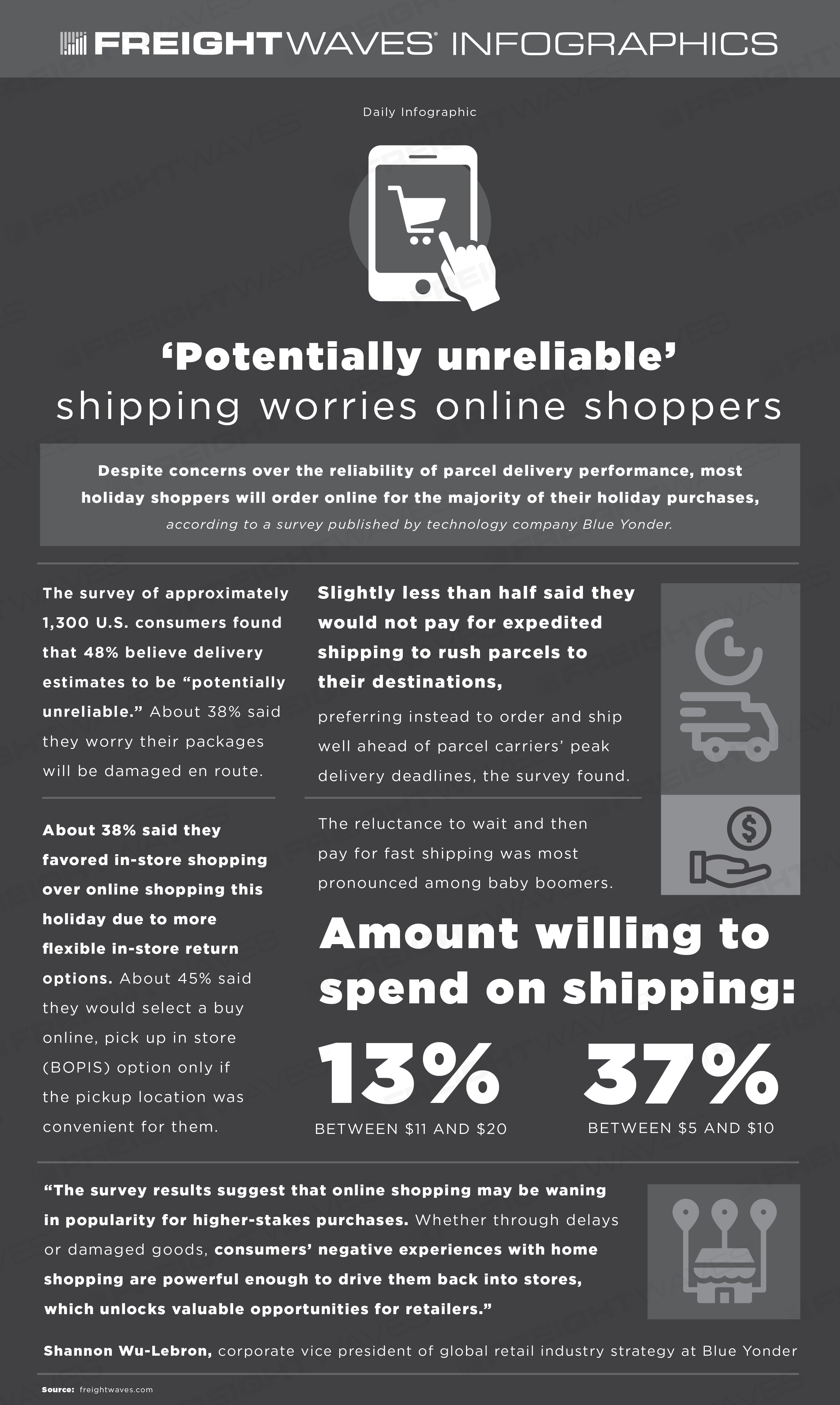
Daily Infographic: ‘Potentially unreliable’ shipping worries online shoppers


To view more FreightWaves infographics, click here

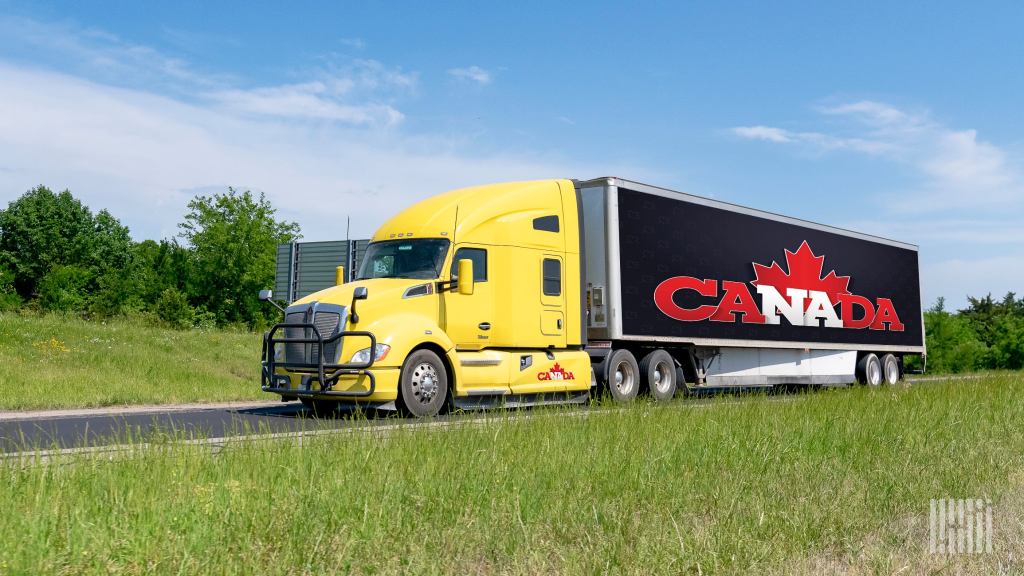
Top US-Canada supply chain stories of 2023

In 2023, the Canadian commercial transportation industry witnessed everything from strikes at ports in British Columbia to protests from truck drivers fighting for unpaid wages to one of the biggest railroad mergers in North American history.

With 2023 coming to an end, FreightWaves has compiled the five biggest stories that shaped the Canadian transportation industry this year.

Canadian Pacific’s $31 billion acquisition of Kansas City Southern approved by regulators

The Surface Transportation Board approved Canadian Pacific’s plans to merge with Kansas City Southern in March, with the two Class I railroads combining to create a freight rail system linking all of North America.

Shareholders of CP and KCS approved the $31 billion merger in December 2021. The rail merger is one of the largest over the last several decades. Southern Pacific and Union Pacific railroads completed a $5.4 billion merger in 1996 that created the largest railroad network in the  U.S. at the time. 

The merged company, known as CPKC, aims to shift approximately 64,000 truckloads annually from North America’s roads to rail. CPKC offers single-line rail options facilitating the flow of goods among Canada, the U.S. and Mexico.

Canadian Pacific’s $31 billion merger with Kansas City Southern was finalized in March, creating a freight rail system linking all of North America. (Photo: Jim Allen/FreightWaves)

“CPKC is the only railway connecting North America and has unrivaled port access on coasts around the continent, from Vancouver to Atlantic Canada to the Gulf of Mexico to the Port of Lazaro Cardenas on Mexico’s Pacific coast,” CPKC said in a news release

After the merger was finalized, CPKC quickly announced several more partnerships, including agreements with Schneider National and Knight-Swift Transportation for intermodal services using the company’s Mexico Midwest Express daily premium single-line intermodal rail service.

Other Class I railways announced similar north-south freight railway partnerships following the CPKC merger, such as Canadian National, Union Pacific and Ferromex.

CN is also partnering with maritime and logistics services company Crowley to provide integrated rail and ocean service from Mexico, to the U.S. Midwest and Canada via the Port of Mobile in Alabama.

Dockworkers at Canada’s West Coast ports launch strike

On July 1, more than 7,400 dockworkers represented by the International Longshore and Warehouse Union in Canada went on strike after negotiations with the British Columbia Maritime Employers Association (BCMEA) failed to reach a new labor contract. 

The strike, which lasted about a month, disrupted container traffic at two of Canada’s busiest ports in Vancouver and Prince Rupert, key export gateways for the country. The contract dispute also paralyzed logistics operations and supply chains across Canada and the U.S.

Rob Ashton, president of the International Longshore & Warehouse Union Canada’s Longshore Division, talks with workers on strike at the Port of Vancouver in July. (Photo: ILWU Canada)

Some $12 billion in freight was stranded off Canada’s coast during the work stoppage, according to CNBC. CPKC also reported that it lost about $80 million in revenue from the strike.

ILWU members were seeking wage increases, an end to ports contracting out work and job protection against the effects of automation.

BCMEA and ILWU Canada eventually negotiated a new labor contract on Aug. 3, but the impact of the strike was felt throughout the rest of the year.

Canadian trucking officials call for an end to Driver Inc. ‘scam’

Top officials in the country’s commercial transportation industry came together in May to call on the federal government to crack down on a tax-avoidance business model known as Driver Inc.

The scheme involves a trucking company telling a driver who does not own a truck to register as a corporation and sell its driving services to the carrier, according to officials.

Canadian Trucking Alliance, Teamsters Canada, Quebec Trucking Association and several logistics operators said Driver Inc. is a tax scam. Employed by a growing number of companies, it uses misclassification of employees to avoid paying taxes and other withholdings.

“The trucking industry is facing an existential crisis due to a labor abuse and tax avoidance scheme,” Stephen Laskowski, president of the Canadian Trucking Alliance, said at a May 17 news conference. “We need the Canada Revenue Agency and the Labour Program to tackle these issues with the enforcement resources this crisis needs. We need substantial audits on carriers involved in the Driver Inc. scam.”

The Manitoba Trucking Association (MTA) said it’s estimated that Driver Inc. is costing the Canadian government as much as $1 billion annually

In July, a group called Justice for Truck Drivers held a rally outside Toronto’s federal labor program office to bring attention to wage theft in the trucking industry. Justice for Truck Drivers includes 42 people who said collectively they are owed more than $300,000 in unpaid wages from several different carriers who allegedly were using the Driver Inc. model, according to workers’ advocates.

Canadian cities create laws to crack down on illegal truck parking

The communities of Caledon and Brampton continue to fight commercial transportation companies that they said are evading laws on parking and storage of trucks and equipment within city limits.

The two Toronto-area communities are located in the region of Peel, considered the heart of the trucking industry in the area. Peel is in Ontario, a province in east-central Canada that borders the U.S.

Approximately $1.8 billion worth of goods moves through Peel every day, carried by some 68,000 commercial vehicles, according to a 2019 study

In Caledon, owners of over 56 properties have been charged with illegal truck parking and storage since 2020.

Caledon officials said they have identified over 180 properties with suspected illegal trucking operations in the town and that they intend to go after all of them. In 2021, Caledon created a land-use enforcement task force, which includes two dedicated officers.

In 2021, Caledon successfully litigated local construction firm Darzi Holdings Ltd., eventually resulting in the company receiving a $1 million fine for contempt of court.

“Our enforcement strategy has always tried to achieve compliance voluntarily by working with the landowners,” John DeCourcy, Caledon’s manager of municipal law enforcement, told FreightWaves. “Unfortunately, this does not occur, and we’re forced to try and achieve compliance through the courts.”

Canada adds millions in federal funding to train, recruit new truckers

The Canadian government announced $46 million to help train and find jobs for up to 2,600 new truckers and other supply chain industry workers earlier this year.

The funding went to the nonprofit Trucking Human Resources Canada’s Career ExpressWay Program, which will give participants training and on-the-job work experience to prepare them for a career in the trucking sector.

Canadian employers are seeking to fill more than 1 million job vacancies, with truck driver positions totaling 26,900 of those, according to a news release

The Canadian Trucking Alliance forecasts that the country’s industry will have a shortage of 55,000 workers over the next several years.

The government has also opened up its Express Entry immigration program to truck drivers from other countries, allowing foreign truckers the opportunity to apply for permanent residency.

More articles by Noi Mahoney

The top US-Mexico business stories of 2023

Borderlands: Texas company aims to help keep returns out of landfills

Texas border wait times spike as CBP agents moved to immigration duty

Borderlands: Mexico averaged 57 thefts a day from cargo trucks in Q3

Borderlands is a weekly rundown of developments in the world of United States-Mexico cross-border trucking and trade. This week: Mexico averaged 57 thefts a day from cargo trucks in the third quarter; second rail bridge proposed for Texas port of entry; Arizona plans to expand truck parking along highways; and Holt Truck Centers opens facility in North Texas.

Mexico averaged 57 thefts a day from cargo trucks in Q3

Thieves targeted more cargo trucks carrying auto parts and pharmaceutical goods across Mexico during the third quarter, according to the latest report from Overhaul.

The Austin, Texas-based supply chain visibility firm recorded 5,239 cargo thefts in July, August and September, a 7% year-over-year increase compared to the same period in 2022 and a 1.2% increase from the second quarter.

The daily average for cargo thefts in Mexico during the third quarter was 56.7 incidents.

“The three most stolen product types in the third quarter were food and drinks (29% of all cases), miscellaneous goods (11%) and building and industrial materials (10%),” Overhaul said. “The most significant increases corresponded to the categories of auto and parts (7%) and pharmaceuticals (6%).”

In the auto and parts category, Overhaul said 54% of stolen goods consisted of automotive parts and liquids, while 29% were tires, and 17% were assembled vehicles.

“Most of the [auto and parts] crimes were recorded in the central Mexican states of Guanajuato (33%) and Puebla (17%),” Overhaul said.

In comparison, Overhaul’s data showed a total of 123 cargo thefts were reported during the second quarter in the U.S. The states with the highest rates of theft were California, Texas and Georgia.

The most common method for cargo theft in the second quarter involved stealing from trucks while in transit (73%), followed by unsecured parking lots (22%), truck stops (2%) and overnight carrier facilities (2%).

During the quarter, Mexico’s National Public Safety System reported that 81% of cargo thefts involved violence, Overhaul said.

“Criminals will approach their victim via surprise attack … while in transit, multiple vehicles will either come together and force the drivers to stop or criminals will shoot at the unit,” Overhaul said. “Criminals are typically armed and use violence to threaten the driver.”

Overhaul said stolen loads are usually taken to warehouses until the merchandise can be distributed and sold on black markets.

Second rail bridge proposed for Texas port of entry

Short-line rail operator Green Eagle Railroad is seeking federal approval to build a 19.12-mile rail and highway bridge connecting Piedras Negras, Mexico, with Eagle Pass, Texas, according to Trains Magazine.

The rail-highway bridge would divert Union Pacific and BNSF traffic off the current bridge and create a corridor linking rail yards on both sides of the U.S.-Mexico border.

Green Eagle Railroad anticipates that it will serve 15-18 trains per day based on current traffic flow, the company said in a filing with the Surface Transportation Board. The company said the bridge could alleviate rail and truck traffic congestion and reduce cross-border wait times at the Eagle Pass port of entry.

The border rail and highway bridge would include 1.3 miles of double track between Union Pacific’s Clark’s Park Yard and a new double-track span over the Rio Grande, followed by a 17.7-mile single-track line to Mexico-based railroad Ferromex’s Rio Escondido Yard in Piedras Negras.

Green Eagle Railroad is a subsidiary of Eagle Pass-based Puerto Verde Holdings

Arizona plans to expand truck parking along highways

The Arizona Department of Transportation (ADOT) is creating a statewide commercial truck parking plan that recommends expanding parking at existing rest areas and adding three new facilities along state highways.

ADOT is seeking public input to help plan the construction of 842 truck parking spaces in 10 locations along interstates in areas with the greatest needs, according to a news release. 

The plan recommends first adding parking to three existing rest area locations — Burnt Wells (103 spaces), Meteor Crater (140 spaces) and a new safe lot near Willcox (127 spaces) — based on the $32 million in funding currently available through the National Highway Freight Program.

The draft statewide truck parking implementation plan is available for review. Comments can be provided on the plan through azdot.gov/TruckParkingComments or by email at mpdplanning@azdot.gov.

Holt Truck Centers opens facility in North Texas

Holt Truck Centers recently opened a truck dealership and service facility in Wichita Falls, Texas.

The Wichita Falls location will have approximately 12 employees, with six service bays in a 12,000-square-foot facility, according to a news release.

The facility is the company’s 15th location across Texas and Oklahoma. The most recent expansion comes after Holt acquired five Summit Truck Group dealerships in Oklahoma in January 2022. 

San Antonio-based Holt Truck Centers provides full service, rebuilds and parts for all makes and models of on-highway trucks. The company also sells new and used on-highway trucks and trailers.

More articles by Noi Mahoney

The top US-Mexico business stories of 2023

Borderlands: Texas company aims to help keep returns out of landfills

Texas border wait times spike as CBP agents moved to immigration duty

PHOTOS: Christmas at the Sierra Garden Post Office

Sierra Garden Post Office

PTF rural carrier Sebastian Mykitin’s LLV is packed full of holiday packages ready for delivery. Mykitin works at the Sierra Garden Post Office in Roseville, California.

Sierra Garden Post Office

Sierra Garden Post Office

Truckload supply and demand on collision course in 2024

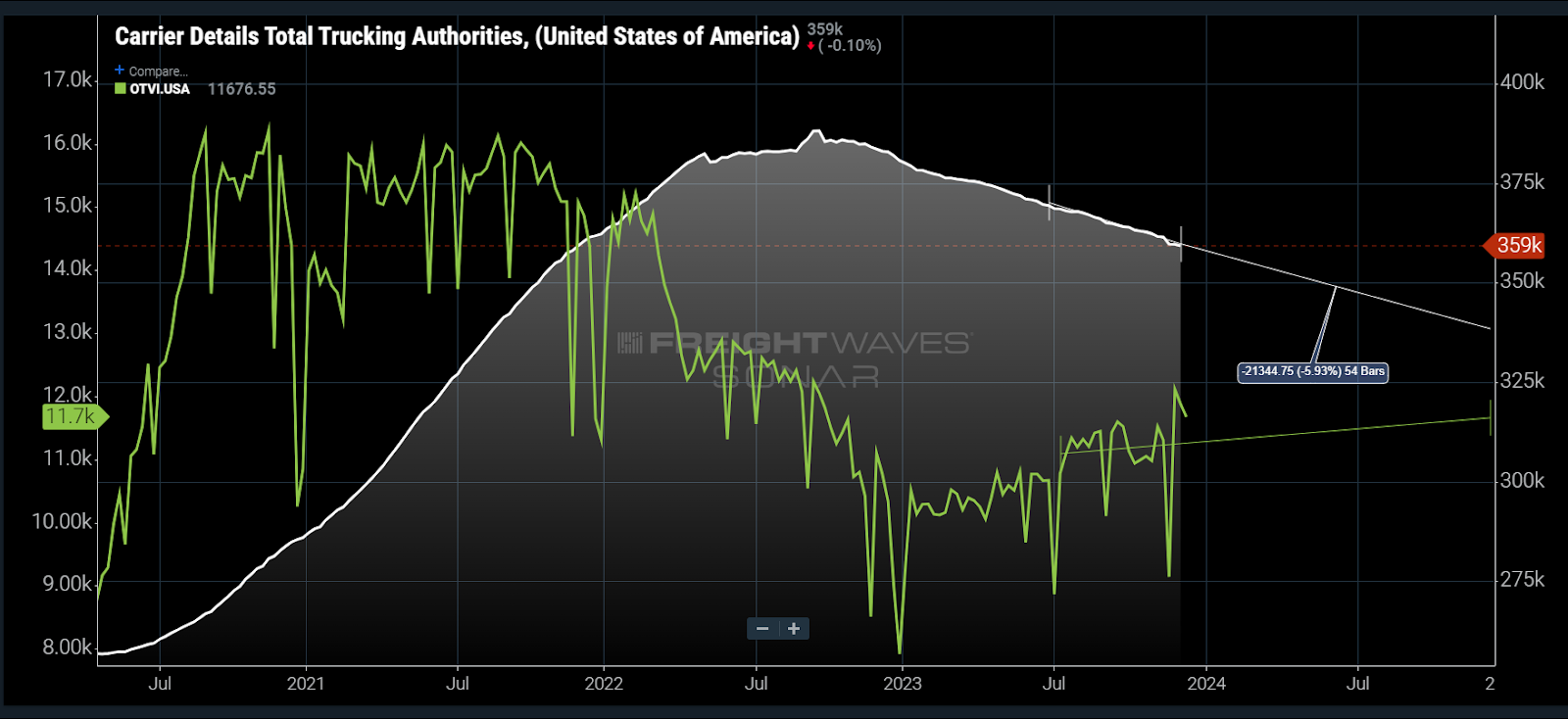
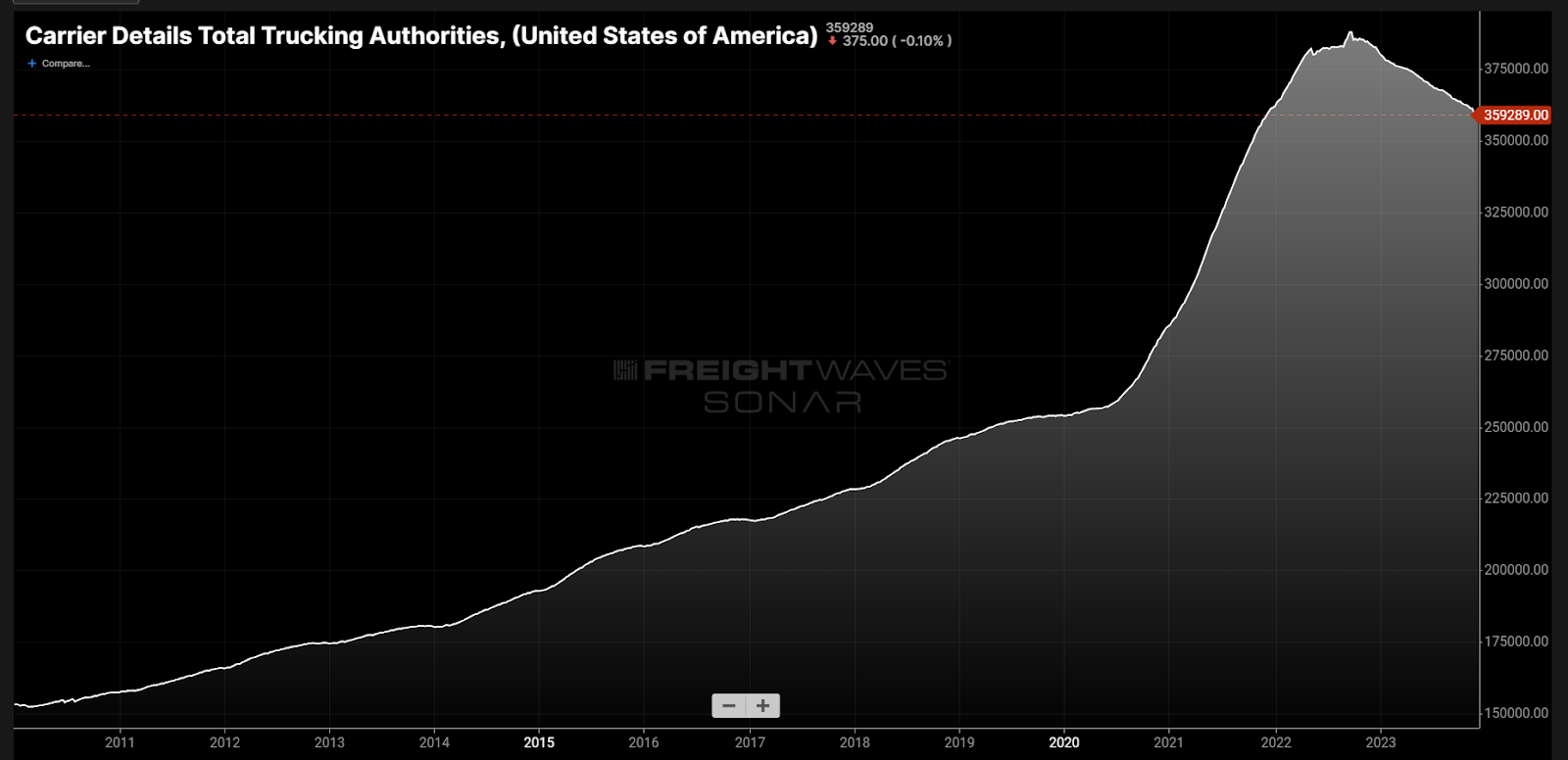
Chart of the Week: Carrier Details Total Trucking Authorities, Outbound Tender Volume Index – USA  SONAR: CDTTA.USA, OTVI.USA

Trucking demand is up while capacity is down since this time last year. This statement by itself means that the transportation market is healthier, but it also suggests that 2024 should be better in aggregate as the gap between supply and demand narrows quickly. 

Truckload demand is barely a shadow of what it was during the pandemic, but it has been growing throughout most of 2023. This fact has been invisible to most carriers and 3PLs, which continue to deal with a massive glut of oversupplied capacity thanks to a record number of entrants in 2020-21 according to Carrier Details Total Trucking Authorities data set. 

Tender volumes are averaging over 10% higher year over year this December and have been growing steadily since last winter. Outside of October, daily tender volumes moved higher, suggesting that economic demand for goods has grown. 

On this past week’s Freightonomics episode, Zac Rogers, an associate professor of supply chain management at Colorado State and co-author of the Logistics Managers’ Index (LMI), suggested that the demand growth was a product of both inventories having been rightsized versus this time last year and growth in consumption. 

While he admits that there is some ongoing concern about consumer health, the numbers are what they are. Anthony Smith, FreightWaves’ chief economist, responded to his concerns with a resounding “never bet against the American consumer.” 

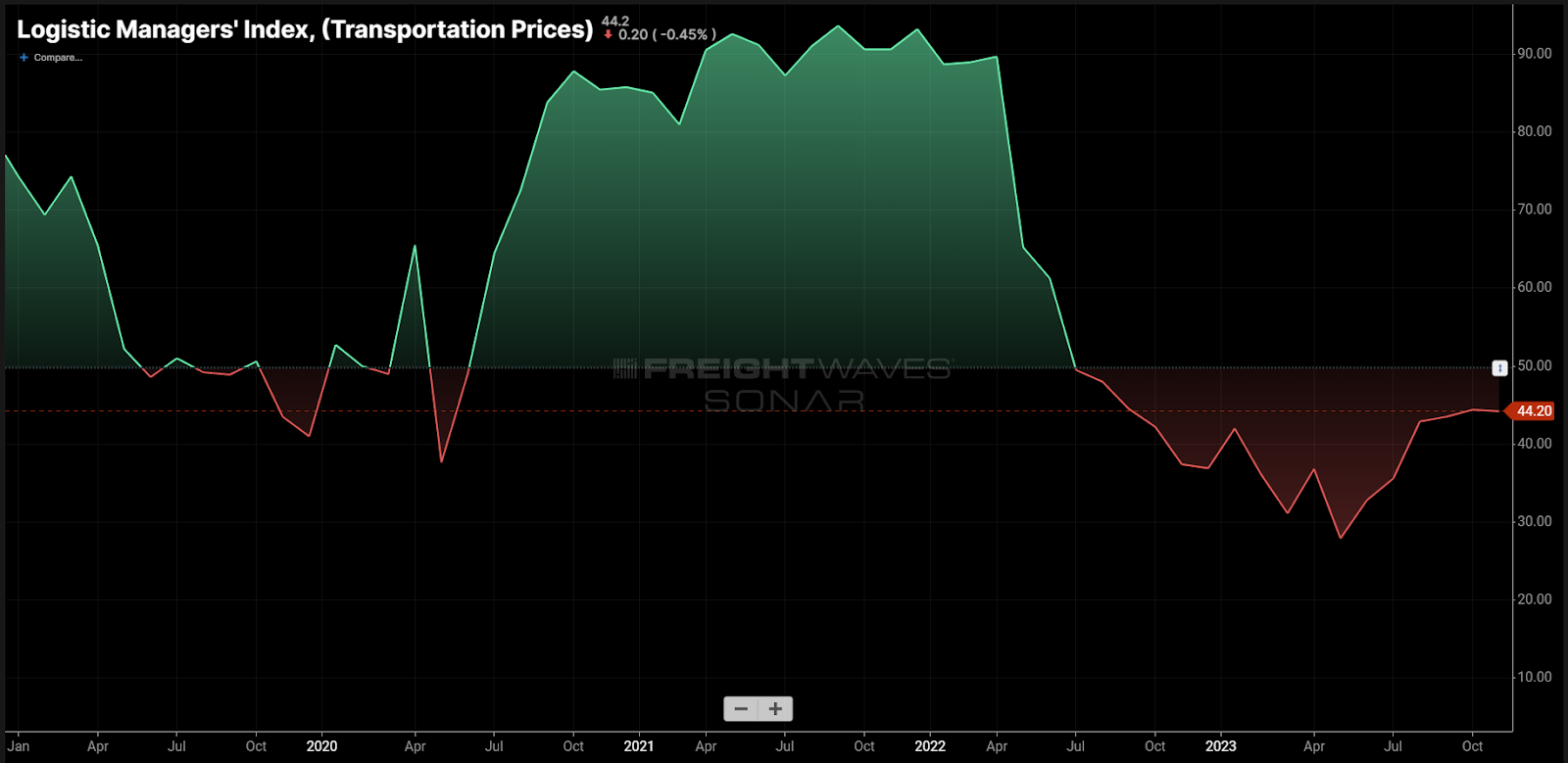
Possibly the most shocking revelation was in the LMI outlook of transportation prices by respondents. The LMI is divided up into multiple measures of logistics activity such as transportation and warehousing prices and capacity. Values above 50 indicate expansion while values below 50 are contractionary. 

The transportation pricing component has averaged a value of 38 in 2023 and has been showing below 50 since the summer of 2022. Respondents to the November survey showed a reading of around 64 for prices in 2024, indicating that most expect rates to have bottomed. 

While every forecast is an opinion on some level, the data does suggest that the supply of capacity and demand for its use is moving back toward equilibrium at a relatively fast clip. 

Looking at the past 13 years of Carrier Details Total Trucking Authorities data, there has never been such a strong downward trend. This of course is following the historic growth rate — the definition of an economic bubble

FreightWaves CEO Craig Fuller stated in this past week’s State of Freight webinar that the risk is growing for shippers in 2024. Taking an overly aggressive approach to cost cutting would be much more risky than last year. No capacity is guaranteed. Even the strongest carriers feel this level of market downturn. 

While Fuller admitted that he does not definitively know that the market will turn, there are several LMI respondents that feel similarly that there will be noticeable signs of tightening by the end of next year.  

Economically speaking, there are still questions, but the answers are coming into focus with time. At the very least, the U.S. has economically overachieved versus many expectations, which does provide hope for the “soft landing” many have wanted. 

Unfortunately, the solution to the freight market means that several first have to lose. This has been the case for many sectors post-pandemic. But this too is passing.

About the Chart of the Week

The FreightWaves Chart of the Week is a chart selection from SONAR that provides an interesting data point to describe the state of the freight markets. A chart is chosen from thousands of potential charts on SONAR to help participants visualize the freight market in real time. Each week a Market Expert will post a chart, along with commentary, live on the front page. After that, the Chart of the Week will be archived on FreightWaves.com for future reference.

SONAR aggregates data from hundreds of sources, presenting the data in charts and maps and providing commentary on what freight market experts want to know about the industry in real time.

The FreightWaves data science and product teams are releasing new datasets each week and enhancing the client experience.

To request a SONAR demo, click here.

Why attacks on container ships caused container stocks to jump

photo of a Navy ship protecting container ships

Risks to container ships and their crews are escalating by the day in the Red Sea — and with that rising danger comes the prospect of higher shipping rates.

Amid Friday’s attacks and growing evidence of route delays and diversions, the share price of ocean carrier Zim (NYSE: ZIM) spiked 18% in more than quadruple average trading volume. Shares of Hapag-Lloyd surged 16%. Maersk’s stock closed up 8%.

It’s yet another example of how bad things — wars, viruses, weather disasters — can equate to potential upside for shipping, or at least, the perception of future upside.

“Approximately 30% of container volumes transit the Suez Canal and make up about half the traffic through the canal by weight,” said Stifel analyst Ben Nolan on Friday. “Rate increases are often announced but not usually successful in a loose market. However, if ships do avoid the Suez Canal, the market could easily tighten enough to support the rate increase.”

Attacks target ships of Maersk, Hapag-Lloyd, MSC

More container ships are expected to divert to the much longer route around Africa’s Cape of Good Hope, given the threat at the Bab-el-Mandab Strait in the Red Sea. The big question is whether current ad hoc ship diversions will translate into sustained service reroutings.

Longer routes require more ships to maintain weekly service, which can offset some of the current rate pressure due to newbuilding deliveries.

Yemen’s Houthi rebels hit the OOCL-chartered vessel Number 9 on Dec. 3. On Thursday, the Houthis fired a missile at the Maersk Gibraltar. They attacked Hapag-Lloyd’s Al Jasrah and Mediterranean Shipping Co.’s MSC Palatium III on Friday.

“Following the near-miss incident involving Maersk Gibraltar yesterday and yet another attack on a container vessel today, we have instructed all Maersk vessels in the area bound to pass through the Bab al-Mandab Strait to pause their journey until further notice,” said Maersk.

Hapag-Lloyd also paused transits through the strait on Friday. CMA CGM followed suit on Saturday. MSC, the world’s largest liner operator, said Saturday that the MSC Palatium III has been removed from service due to fire damage, and that all MSC transits of the Suez have been canceled, with some MSC ships already rerouted around the Cape of Good Hope.

Both Asia-Europe and Asia-US markets exposed

The Asia-Europe and Asia-U.S. trades are the world’s two largest container shipping markets. The Asia-Europe market is directly affected by security issues at the Bab al-Mandab Strait, and the Asia-U.S. trade is much more affected now than it would be normally.

Panama Canal transit restrictions due to low water levels began heavily curtailing transits of larger container ships in November. In response, multiple Asia-U.S. services have already diverted from Panama to the Suez Canal.

Now, some of those ships that diverted to the Suez Canal may divert yet again, to the Cape of Good Hope.

The voyage between Shanghai and New York is 17% longer via the Suez Canal than the Panama Canal, and 37% longer via the Cape of Good Hope than the Panama Canal, according to distance calculator Sea-Distances.org.

Some ships in the Asia-Europe trade will also divert around the Cape. The distance between Shanghai and Rotterdam, Netherlands, is 32% longer via the Cape of Good Hope than via the Suez Canal.

The voyage from Shanghai to Rotterdam is actually longer going westward and using the Cape than going eastward and using the Panama Canal, traversing both the Pacific and Atlantic oceans.

Asia-Europe rates rising in December

The situation for container lines looked particularly dire only a few weeks ago.

Many Asia-Europe annual contracts renew on Jan. 1. Spot rates were exceptionally weak in October and November. If spot rates didn’t improve very soon, annual contracts would likely reset much lower.

The good news for ocean carriers is that Asia-Europe spot rates are up significantly this month, even prior to potential upside from the latest events in the Red Sea. Spot rates are still relatively weak, but they’re much improved from October and November, enhancing carriers’ negotiating hand in contract talks.

The Freightos Baltic Daily Index (FBX) for China to the Mediterranean has risen 73% from late October through Thursday, to $2,367 per forty-foot equivalent unit. The FBX China-North Europe Index is at $1,461 per FEU, up 37% over the same period.

The Drewry World Container Index (WCI) for Shanghai to Genoa, Italy, has risen 44% between late October and the week ending Thursday, to $1,697 per FEU. The WCI assessment for Shanghai to Rotterdam is at $1,442 per FEU, up 26%.

chart of container spot rates
Orange line: FBXD China-Med rate change vs. Oct. 27. Green line: WCI Shanghai-Rotterdam. Purple line: FBXD China-North Europe. Blue line: WCI Shanghai-Genoa. (Chart: FreightWaves SONAR)

The more container ships that divert around the Cape of Good Hope, the better the prospects for both spot and contract rates in the Asia-Europe market — as well as the trans-Pacific market, courtesy of Panama’s travails.

Container-ship lessors could also benefit

It’s not just container freight rates that stand to gain from Red Sea disruptions. The need for more ships to serve longer routes could also support future demand and leasing rates in the ship charter market.

“The problematic situation in the Red Sea and the resulting ad hoc vessel diversions to the Cape route have not yet led to a notable increase in tonnage demand,” said Alphaliner on Tuesday. “[But] should these problems continue into 2024, they will certainly boost tonnage demand, since carriers will have to factor these longer trips into their schedules and fleets.”

Commenting on ship-chartering prospects for next year, Alphaliner said, “The outlook for the market in 2024 is obviously uncertain, considering the large number of newbuildings of all sizes due to hit the water.

“Various trading disruptions such as the water-level problems at the Panama Canal, with reduced daily ship transits, and terror attacks in the Red Sea could … play a role in reducing overcapacity, with carriers having to use additional ships to bypass the problematic areas.”

Click for more articles by Greg Miller 

DHL Express workers extend picket lines across US

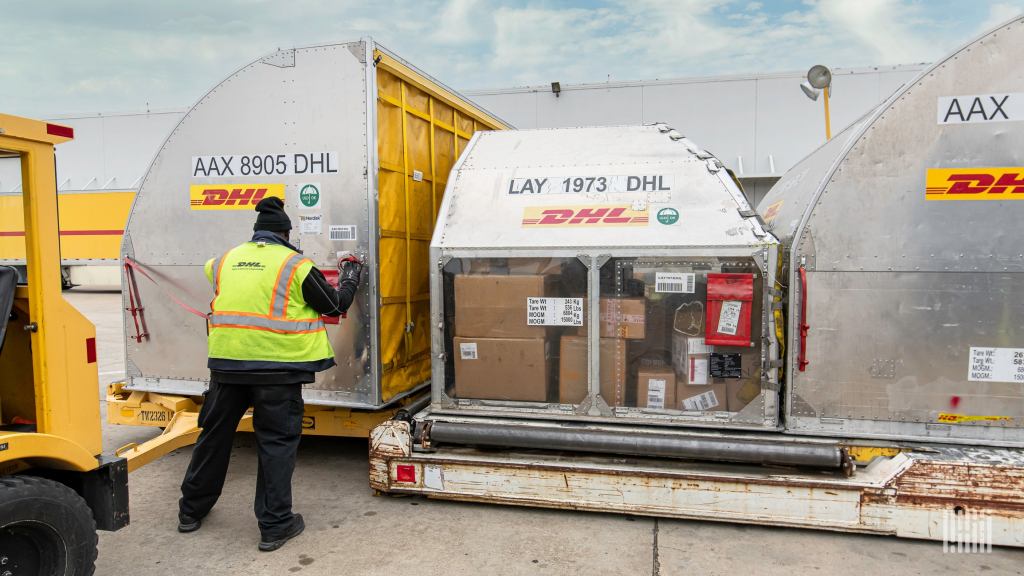
A DHL worker with a yellow vest arranges air containers on the tarmac.

DHL Express workers represented by the Teamsters union have walked off the job at several U.S. locations in solidarity with ramp workers who went on strike a week ago at the company’s giant airhub at Cincinnati/Northern Kentucky International Airport (CVG).

Members of Local 100 in Boston, Detroit, Miami, Los Angeles and San Francisco have refused to cross picket lines established by CVG workers at those locations, according to social media posts and a news release on Thursday. Exactly how many workers are off the job could not be determined.

The Teamsters represent more than 1,100 DHL employees who load and unload freighters at CVG, and 6,000 workers nationwide. Workers voted in April to join Teamsters Local 100 after a yearlong campaign and began collective bargaining for their first contract in July. They went on strike Dec. 7 after demands for better pay and safety conditions as well as an end to alleged union-busting activities were not met.

The labor action comes at the busiest time of year for parcel carriers, who are in the final sprint of delivering online purchases and personal gift exchanges in time for the holidays.

DHL brought in temporary workers and managers to pick up some of the labor slack in Cincinnati and diverted cargo jets to other gateways in its air network in an effort to maintain service schedules. The CVG hub processes 130 daily flights and is the base for 60 aircraft. Eighty percent of all shipments from the Americas transit via the CVG hub.

“As pickets expand to even more cities in the coming days, DHL will feel the pain even more profoundly. Instead of playing games, I strongly recommend that DHL rectify their unfair labor practices, return to the bargaining table, and begin negotiating with us in good faith immediately,” said Local 100 President Bill Davis in the news release.

DHL has said it won’t resume bargaining until January.

“DHL Express has seen job actions by members of the Teamsters union at different sites in the U.S. during the week and has proactively deployed contingency plans to ensure that our customers receive the high service levels they expect from us at this important time of the year for their businesses. We have maintained normal operations across our network, including our CVG hub, while working to minimize the potential disruptions that can typically occur within our industry during peak season, due to weather, volume surges, etc.,” the company said in a statement to FreightWaves.

“We are proud of the DHL Express team members who continue to support our customers at this critical time of the year for their businesses. We remain committed to bargain in good faith with the employee representatives at CVG,” it added.

DHL employs more than 4,000 people at the Cincinnati hub.


Click here for more FreightWaves/American Shipper articles by Eric Kulisch.

Contact reporter: ekulisch@www.freightwaves.com 

DHL Express diverts freighters from Cincinnati hub as strike precaution