Environmental groups sue BNSF over grizzly bear deaths

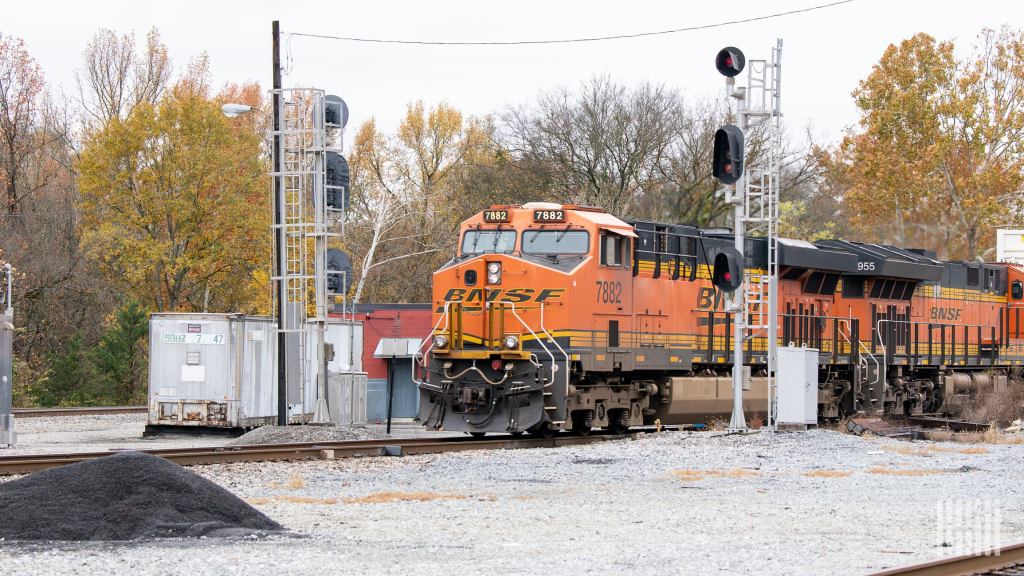
Two environmental groups are suing western U.S. Class I railroad BNSF because its trains allegedly kill grizzly bears on federally protected grounds in Idaho and Montana, violating the Endangered Species Act.

Santa Fe, New Mexico-headquartered WildEarth Guardians and Hailey, Idaho-based Western Watershed Project said Thursday that BNSF should change operating schedules or train speeds to prevent deaths of grizzlies along 206 miles of rail in the Northern Continental Divide Ecosystem (NCDE), located in and near the Northern Continental Divide and the Cabinet-Yaak regions. The NCDE also crosses multiple national forests and is on the southern border of Glacier National Park. 

While BNSF has been seeking to develop a habitat conservation plan (HCP) that would mitigate grizzly bear deaths, the plan doesn’t include steps to change schedules or speeds, the environmental groups said in a release. The U.S. Fish and Wildlife Service also has yet to approve BNSF’s HCP or an incidental take permit, they said. These permits can be sought when a non-federal entity believes their otherwise lawful activities may result in the taking of endangered or threatened animal species, according to the U.S. Fish and Wildlife Service.

Furthermore, BNSF will add the Montana Rail Link to its network, which could threaten grizzly bears further. 

“We are extremely disappointed that, after all these years, BNSF has refused to change its business practices to prevent the unnecessary deaths of Montana’s iconic grizzlies, resulting in the tragic deaths of three bears just this fall,” Sarah McMillan, wildlife and wildlands program director at the Western Environmental Law Center in Missoula, Montana, said in a release. Western Environmental Law Center filed the suit Thursday in the Missoula division of the U.S. District Court for the District of Montana.

“When a company chooses to operate in the epicenter of key habitat for a threatened species, it must take some responsibility to adapt practices to minimize its impacts on these animals,” McMillan continued. “It is truly ludicrous for BNSF to kill at least 63 threatened grizzly bears with no tangible action from the U.S. Fish and Wildlife Service, the agency in charge of protecting endangered and threatened species. The draft incidental take permit allowing BNSF to kill even more bears annually than it has on average to date is appalling.” The lawsuit gives 2000 as the starting date for when the environmental groups began tracking grizzly bear deaths. 

In addition to lowering train speeds to lessen the odds that a grizzly will be struck by a train, the environmental groups are asking the for the installation of train-triggered warning systems, such as flashing lights and bell sounds, and the installation of electrified mats near a trestle and motion-sensor alarms that would prevent a bear from entering a trestle.

The groups also want BNSF to prevent the leakage or spillage of grain from rail cars as well as monitor tracks so that other livestock don’t go onto the tracks, to prevent that livestock from also being killed and thus tempting the bears to go for the animals’ carcasses.

FreightWaves reached out to the U.S. Fish and Wildlife Service for comment.

BNSF (NYSE: BRK-B) told FreightWaves that while it doesn’t comment on specific lawsuits, it has “been working closely with stakeholders, including the U.S. Fish & Wildlife Service, Montana Fish Wildlife and Parks and the Blackfeet Nation to eliminate avoidable grizzly bear mortalities since the 1990s.” BNSF also developed an HCP, and a draft of that plan was published in January 2021 and is before the U.S. Fish and Wildlife Service for review. 

According to BNSF, the HCP includes the following measures:

  • Removing spilled and leaked grain and carrion from track structures.
  • Reducing/removing vegetation that might attract grizzlies.
  • Providing funding for additional grizzly bear managers for Montana Fish, Wildlife & Parks and the Blackfeet Nation.
  • Providing funding for radio collars, bear-proof garbage bins, electric fencing and grizzly bear awareness programs. 

“BNSF’s goal is to eliminate avoidable grizzly bear mortality and maintain compliance with the Endangered Species Act,” BNSF told FreightWaves on Friday.

The issue of bears getting on train tracks is not new; both passenger trains and freight trains have had to grapple with the issue, according to 2019 research from the University of Alberta. In that research, scientists sought to develop a warning system to teach bears to avoid trains by focusing on how and why bears visit railway tracks.

A 2022 paper from the University of Alberta confirms that research on preventing bears from getting on train tracks — or getting bears off the tracks before a potential collision with a train — is ongoing. 

“The combination of train-triggered warning devices on curving portions of track and directional speakers that amplify train sound on straight sections of track could be a cost-effective, environmentally sensitive, and highly salient method for alerting wildlife to the presence of trains to prevent train-wildlife collisions,” said a May 2022 paper from the Department of Biological Sciences at the University of Alberta titled “Novel approaches for mitigating wildlife-train collisions in montane areas.” The paper also referred to research on similar topics occurring in Sweden and Poland. 

“The signals must be audible with sufficient distance to facilitate escape behaviour, but not so loud that they impose sound pollution or dangerous sound levels,” the paper said. The university department also published another related research paper in 2022.

Meanwhile, Canadian office Parks Canada and Canadian Pacific Kansas City (NYSE: CP) undertook a joint grizzly bear research initiative supported by Parks Canada, the University of Alberta and the University of Calgary. The initiative kicked off because of grizzly bear deaths involving trains at the national parks at Banff and Yoho.

A page on CPKC’s website also mentions the initiative, saying that it was first launched in October 2010 with a $1 million grant from CP and it lasted five years.

Subscribe to FreightWaves’ e-newsletters and get the latest insights on freight right in your inbox.

Click here for more FreightWaves articles by Joanna Marsh.

Drilling Deep: Is the truck parking squeeze easing?

On this week’s Drilling Deep, Chris Oliver at Trucker Path discusses a recent finding from his company’s enormous data stream: Parking seems to be getting a little easier to find. 

And prices are set by supply and demand. In his oil market commentary, host John Kingston notes that while there has been a lot of focus on supply in recent weeks, the demand picture into 2024 has been a key reason for the slide in oil prices.

More articles by John Kingston

A very WHAT THE TRUCK?!? Christmas

On today’s episode of WHAT THE TRUCK?!? Dooner is ringing in the holiday cheer and closing out on a great season of the show with some amazing guests.

Wreaths Across America’s Courtney George stops by. Each December with the help of hundreds of volunteer trucking companies and professional drivers, Wreaths Across America is able to honor our nation’s fallen through wreath-laying ceremonies at more than 3,000 participating locations across the United States.

Brown Dog Carriers Graig Morin is running loads for Wreaths Across America. We’ll learn how they got involved and why they say this is their most meaningful delivery.

Qued’s Tom Curee shares a brand new Christmas song that celebrates the industry. We’ll also learn what’s good in supply chain workflow automation, artificial intelligence and machine learning. 

FreightCaviar’s Paul-Bernard Jaroslawski, LostFR8’s Reed Loustalot and The Armchair Attorney close out the year with their picks for top stories, memes, and madness that drove the supply chain in 2023. 

Plus, Vivek goes to Iowa 80; NBA player gets into trucking; and all the holiday spirit you can handle. 

Watch on YouTube

Subscribe to the WTT newsletter

Apple Podcasts

Spotify

More FreightWaves Podcasts

UPS hikes ground, SurePost fuel surcharges; FedEx lowers its levy

It seems like you can’t tell parcel-delivery diesel fuel surcharge moves without a scorecard these days.

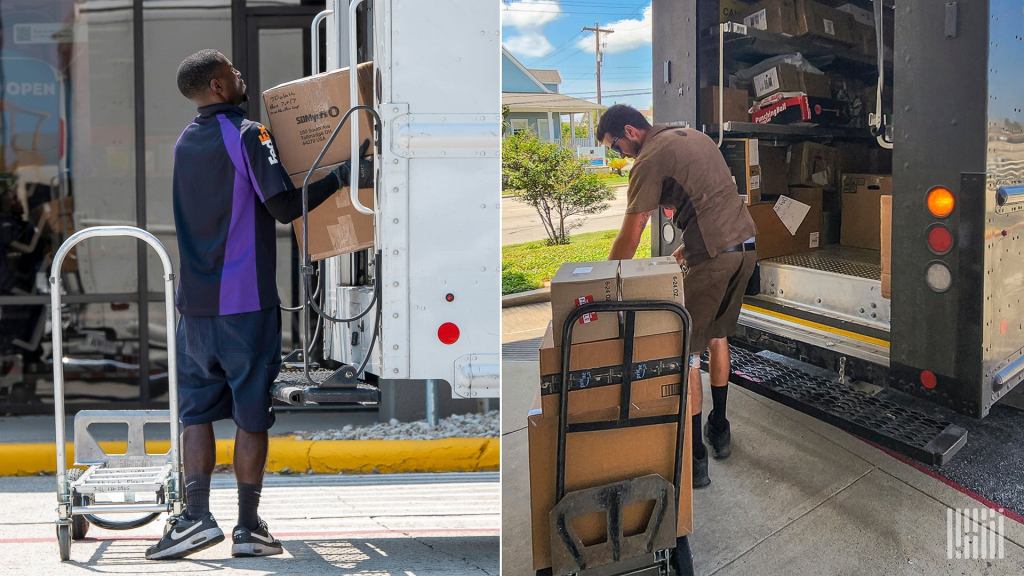
UPS Inc. (NYSE: UPS) will raise its weekly domestic ground delivery surcharge to 15.75%, effective Monday. This comes after UPS had reduced its weekly levy from 15.5% to 15% the week before. The levy also applies to UPS’ SurePost service managed in conjunction with the U.S. Postal Service, where UPS inducts massive parcel volumes deep into the postal network for last-mile deliveries to residences.

Meanwhile, archrival FedEx Corp. (NYSE: FDX), which had hiked its surcharge 100 basis points to 16% for the week starting Dec. 11, cut its levy on ground deliveries by 50 basis points to 15.5%, effective Monday. Last week, FedEx Ground raised its diesel fuel surcharge by 100 basis points to 16%.

The carriers’ fuel surcharges apply to base rates and to any add-on charges known as accessorials. 

The back-and-forth of surcharge pricing comes amid a continuing decline in diesel pump prices, based on weekly data published by the Department of Energy’s Energy Information Administration (EIA). As of Monday, the nationwide on-highway diesel fuel price stood at $3.987 a gallon, down more than 10 cents a gallon from the prior week and the lowest level since the end of July.

UPS and FedEx (NYSE: FDX) index their diesel levies to a band of prices established the week before by the EIA. FedEx Ground adjusts its surcharges for every 9-cents-a-gallon move in the EIA’s nationwide diesel price. For example, FedEx’s upcoming levy is based on an EIA-established price that is at least $3.91 a gallon but less than $4 a gallon. 

UPS, FedEx and other parcel delivery carriers have wide latitude as to when they adjust diesel and jet fuel surcharges. In recent years, surcharges have remained elevated despite world price fluctuations that have headed south. Analysts who follow the fuel surcharge market have said that surcharge levels stay higher long after prices have dropped, allowing the carriers to reap additional revenue on each transaction.

It’s beginning to look a lot like … 2021?

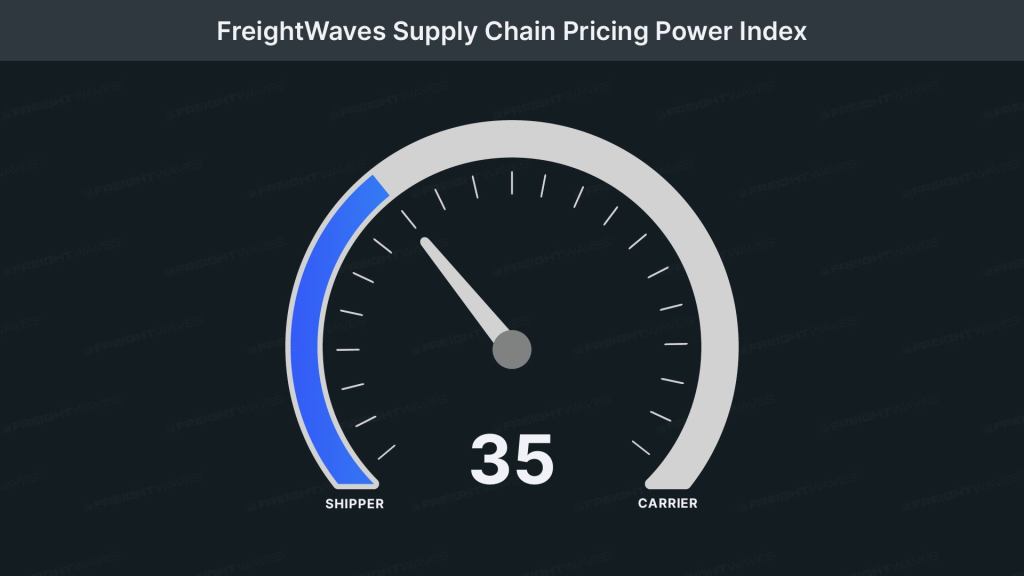
This week’s FreightWaves Supply Chain Pricing Power Index: 35 (Shippers)

Last week’s FreightWaves Supply Chain Pricing Power Index: 35 (Shippers)

Three-month FreightWaves Supply Chain Pricing Power Index Outlook: 35 (Shippers)

The FreightWaves Supply Chain Pricing Power Index uses the analytics and data in FreightWaves SONAR to analyze the market and estimate the negotiating power for rates between shippers and carriers.

This week’s Pricing Power Index is based on the following indicators:

Bulls in a china shop

At the time of writing, December is on track to have a remarkably constant pattern of freight demand. In fact, tender volumes began to outpace 2020 earlier this week and are now marching toward favorable comparisons with 2021, the year of the greatest freight market in recent history. Of course, this robust volume is held primarily within the contract space, meaning that carriers that are mostly exposed to spot freight are not necessarily raking it in. 

But this constancy is, in large part, due to the widespread shift among shippers to just-in-time inventory strategies. In other words, should a large amount of capacity suddenly leave the market — say, at the start of next year — those carriers remaining will be well positioned to recoup significant amounts of pricing power.

Tender volumes are well above year-ago levels:
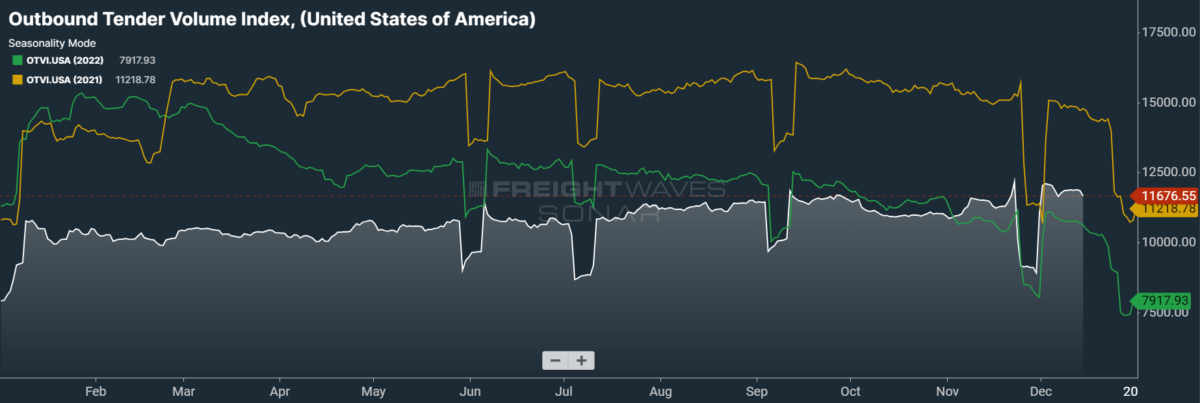
SONAR: OTVI.USA: 2023 (white), 2022 (green) and 2021 (orange)
To learn more about FreightWaves SONAR, click here.

This week, the Outbound Tender Volume Index (OTVI), which measures national freight demand by shippers’ requests for capacity, is up 1.74% week over week (w/w). On a year-over-year (y/y) basis, OTVI is up 11.54%, though such y/y comparisons can be colored by significant shifts in tender rejections. OTVI, which includes both accepted and rejected tenders, can be inflated by an uptick in the Outbound Tender Reject Index (OTRI).

Accepted volumes are outpacing those of 2022:
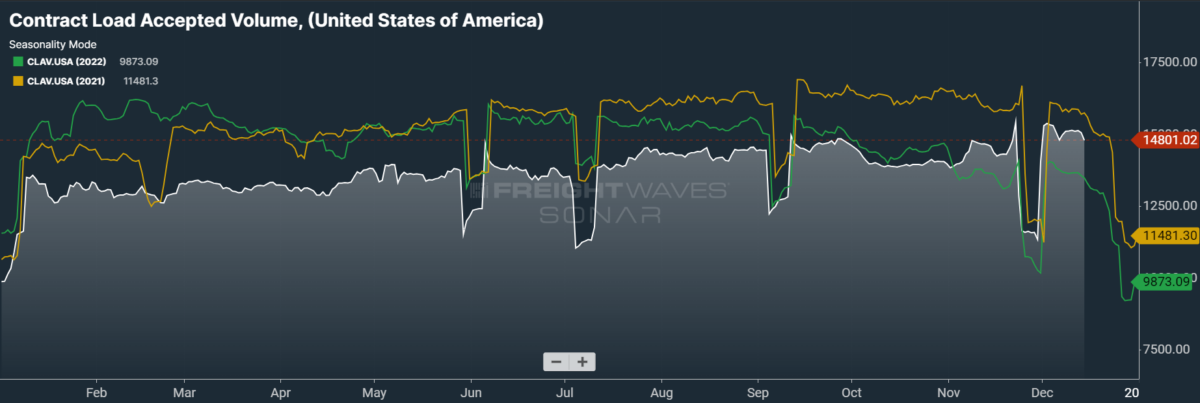
SONAR: CLAV.USA: 2023 (white), 2022 (green) and 2021 (orange)
To learn more about FreightWaves SONAR, click here.

Contract Load Accepted Volume is an index that measures accepted load volumes moving under contracted agreements. In short, it is similar to OTVI but without the rejected tenders. Looking at accepted tender volumes, we see a rise of both 1.7% w/w and of 11.02% y/y. Gaining distance over the previous year implies that actual freight flow is recovering from this cycle’s bottom.

In recent months, I might have been confused for a Federal Reserve cheerleader simply because I was hopeful that the economy could cool without freezing into a recession. But a recent and abrupt pivot in the Fed’s messaging has me removing my pom-poms so that I can instead scratch my head. At the start of the month, Fed Chairman Jerome Powell declared that “it would be premature … to speculate on when policy might ease.” This firm reticence is something we have come to expect from the Fed, which has liked to posture hawkishly even while holding rates steady.

But in remarks made following this week’s meeting of the Federal Open Market Committee — in which the FOMC held rates to no one’s surprise — Powell confessed that rate cuts have begun “to come into view” and that the possibility of cutting rates “clearly is a topic of discussion … for us at our meeting.” For all intents and purposes, Powell might have popped a bottle of bubbly while standing underneath a banner that said “MISSION ACCOMPLISHED.” 

While it should be stressed that I am no economist, I similarly believe that rates are due to come down soon before the whole economy grinds to a halt. Yet the question remains: What did the Fed see over a two-week period that made it switch to such a nakedly dovish stance? In this period between reticence and jubilance, there were a few releases: namely, data on the jobs market, supply- and demand-side inflation, consumer sentiment and economic activity in the services sector.

Data from the labor market in November revealed a surprise to the upside, with job gains of 199,000 in the month — both above October’s gain of 150,000 and consensus growth forecasts of 183,000. While these gains were boosted by the return of striking workers from the auto sector and entertainment industry, most analysts agreed that it was a strong report that all but deferred the possibility of a rate cut to Q3 at the earliest. Most importantly, the unemployment rate came in well below expectations, dipping from 3.9% to 3.7% against fears that it would tick up to 4% (and, in so doing, trigger a well-known recession indicator).

Demand-side inflation also reared its ugly head in November, with the Consumer Price Index up a modest 0.1% m/m and 3.1% y/y. The core CPI, which excludes goods with volatile pricing like food and energy, proved a bit stickier as it rose 0.3% m/m and 4% y/y. But the real issue lay with “supercore” inflation, or core services less housing, which has been the Fed’s preferred metric of gauging progress in its fight against inflation this cycle. Not only was the supercore CPI up a concerning 0.5% m/m, but it also inched higher than the critical 4% y/y level.

Per analysis from the Institute of Supply Management, economic activity in the services sector expanded for the 11th consecutive month in November, with almost every surveyed industry noting signs of a nascent recovery. Moreover, the University of Michigan’s Index of Consumer Sentiment surpassed expectations in its December reading, rising to a scorching 69.4 against a consensus forecast of 62.

While the above economic data — again, all of which was released in that two-week period of the Fed’s pivot from hawkishness into dovishness — does not support a pivot in messaging, it did receive positive news about supply-side inflation. November’s release of the Producer Price Index, which tracks inflationary pressures faced by producers across a number of industries, saw the headline index tumble to a gain of only 0.9% y/y, the lowest such rise since June. Even more welcome was the core PPI reading cooler than expected, as it fell to its lowest y/y gain since January 2021.

Nevertheless, there is a real debate to be had whether the single leading indicator of a cooling PPI is substantial enough to counterbalance the hotter-than-expected data from the labor market, consumers’ sentiment and supply-side inflation.

Markets see steady growth across the board:
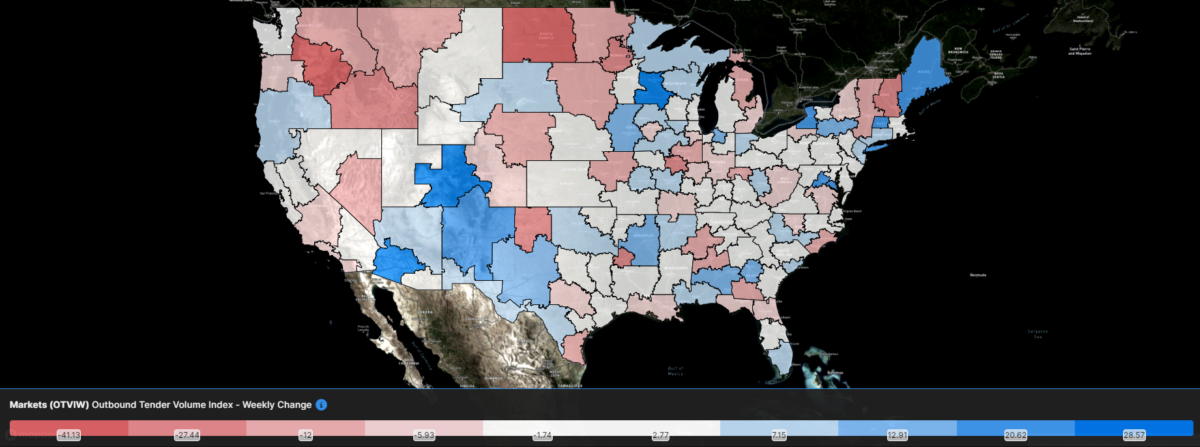
SONAR: Outbound Tender Volume Index – Weekly Change (OTVIW).
To learn more about FreightWaves SONAR,
click here.

Of the 135 total markets, 78 reported weekly increases in tender volumes, with many of the gains relegated to the Southwest and Upper Midwest.

US gains influence in oil markets

Oil market analysts are firmly convinced that oversupply will dominate the market in the early months of next year, with some executives labeling the growth in domestic production as “the main reason” why oil prices continue to be so soft. According to the International Energy Agency, the U.S. has accounted for 80% of the expansion in global supply in 2023, with much of the growth occurring in Texas’ and New Mexico’s Permian region. This trend is not expected to reverse any time soon: One executive of a major exploration and production firm forecast that U.S. output could reach 15 million barrels per day within the next five years. For context’s sake, the U.S. produced an average of 13.27 million barrels per day in November.

All said, this news nearly precludes a shock to energy prices this winter, which should keep retail costs of diesel down. More broadly, removing the threat of another round of energy-fueled inflation — which kick-started the current cycle back in February 2022 — bears positively on economic health going forward.

Contract rates dip headed into December:
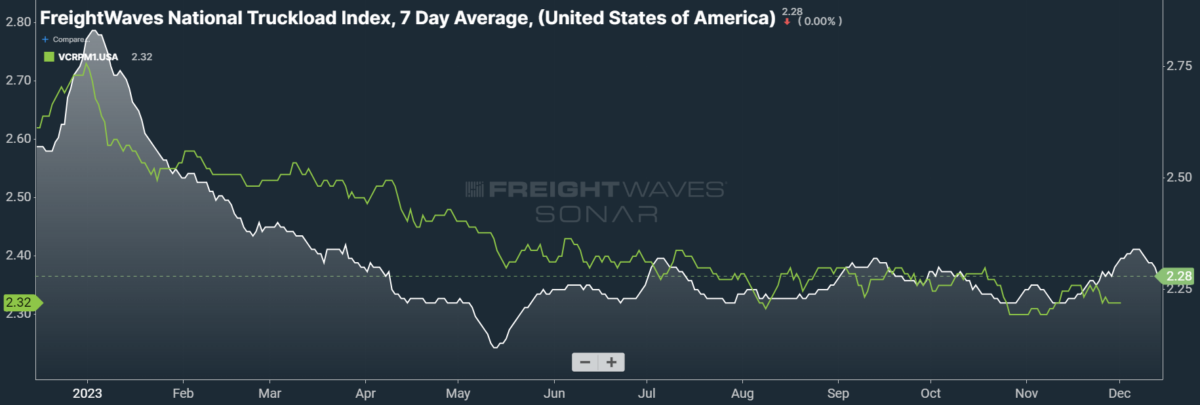
SONAR: National Truckload Index, 7-day average (white; right axis) and dry van contract rate (green; left axis).
To learn more about FreightWaves SONAR, click here.

This week, the National Truckload Index (NTI) — which includes fuel surcharges and other accessorials — fell 6 cents per mile to $2.28. Falling linehaul rates were only partially responsible for this week’s losses, as the linehaul variant of the NTI (NTIL) — which excludes fuel surcharges and other accessorials — fell 4 cents per mile w/w to $1.69.

Contract rates, which are reported on a two-week delay, have lost all of their gains made over Thanksgiving. As contract rate data extends into December, we see a slight decline before the inevitable holiday boost. Bid season is ongoing, however, and shippers still possess plenty of unused pricing power. For the time being, contract rates — which exclude fuel surcharges and other accessorials like the NTIL — are down 2 cents per mile w/w at $2.32.

SONAR: RATES.USA
To learn more about FreightWaves SONAR, click here.

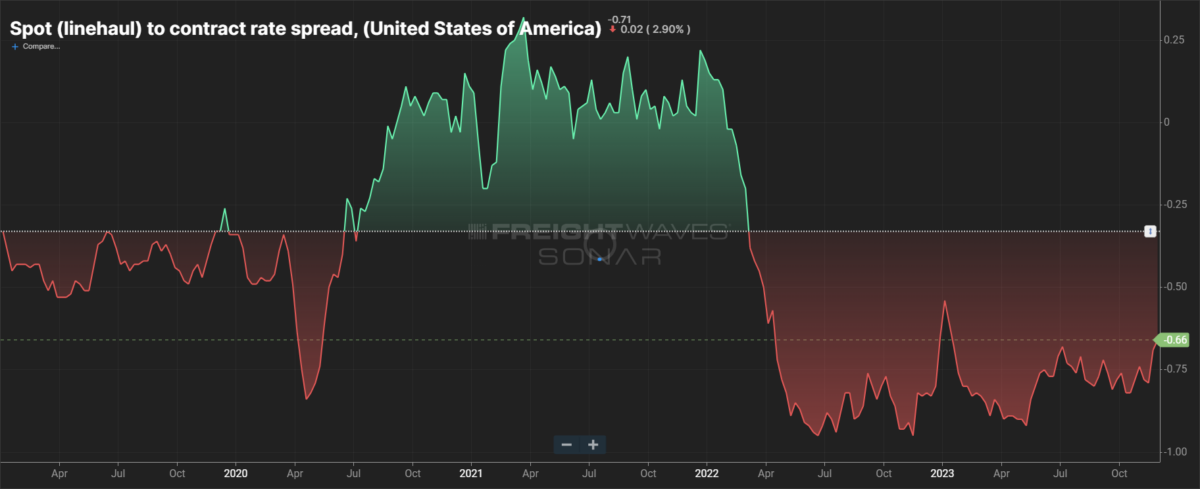
The chart above shows the spread between the NTIL and dry van contract rates, revealing the index has fallen to all-time lows in the data set, which dates to early 2019. Throughout that year, contract rates exceeded spot rates, leading to a record number of bankruptcies in the space. Once COVID-19 spread, spot rates reacted quickly, rising to record highs seemingly weekly, while contract rates slowly crept higher throughout 2021.

Despite this spread narrowing significantly early in the year, tightening by 20 cents per mile in January, it has remained wide throughout most of 2023. As linehaul spot rates remain 66 cents below contract rates, there is plenty of room for contract rates to decline — or for spot rates to rise — in the coming months.

SONAR: FreightWaves TRAC rate from Los Angeles to Dallas.
To learn more about FreightWaves TRAC, click here.

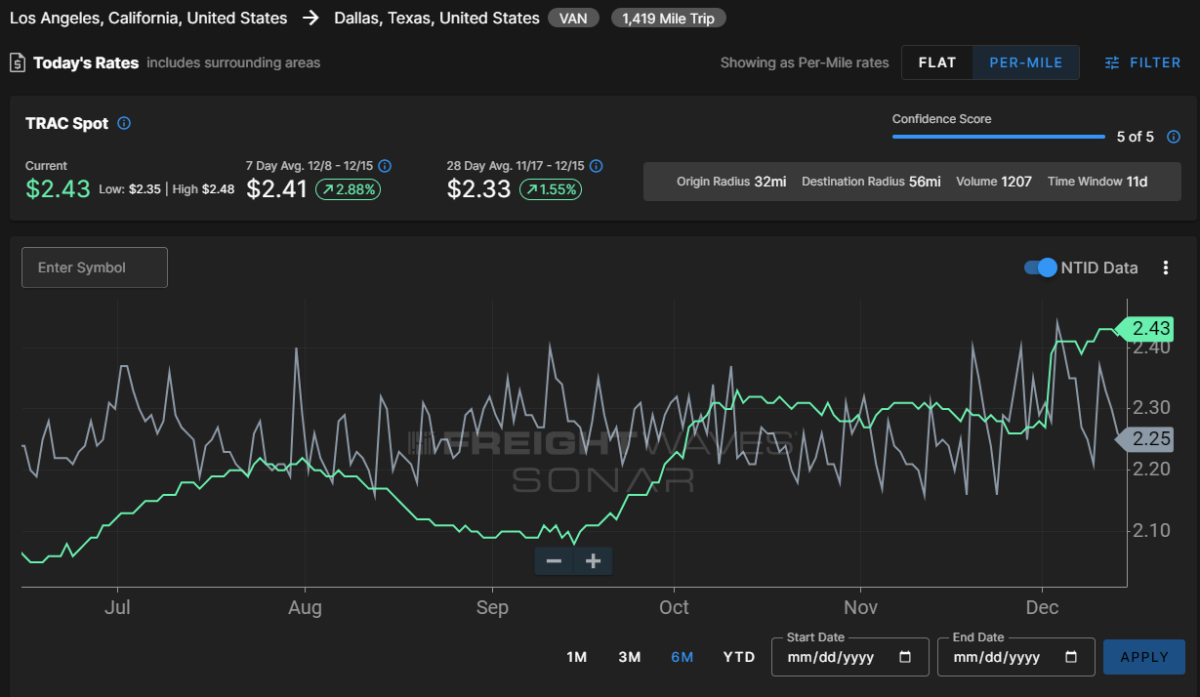
The FreightWaves Trusted Rate Assessment Consortium (TRAC) spot rate from Los Angeles to Dallas, arguably one of the densest freight lanes in the country, continues to benefit from holiday pressure. Over the past week, the TRAC rate rose 4 cents per mile w/w to $2.43 — setting a new year-to-date high. The daily NTI (NTID), which has fallen to $2.25, is again being outpaced by rates along this lane.

SONAR: FreightWaves TRAC rate from Atlanta to Philadelphia.
To learn more about FreightWaves TRAC, click here.

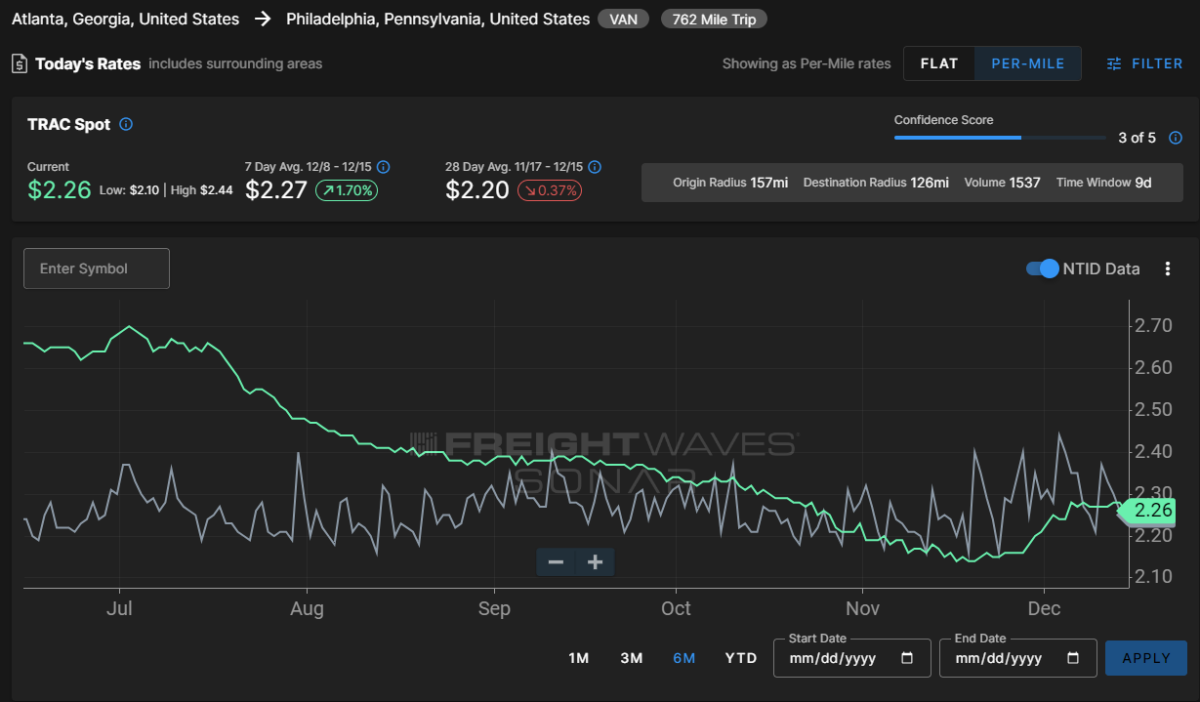
On the East Coast, especially out of Atlanta, rates saw a stark reversal of November’s losses but are still well below their Q3 average. The FreightWaves TRAC rate from Atlanta to Philadelphia fell 2 cents per mile to $2.26. After plateauing well above the national average during the summer, rates along this lane declined sharply at the end of July, lacking any positive momentum until recently.

For more information on FreightWaves’ research, please contact Michael Rudolph at mrudolph@www.freightwaves.com or Tony Mulvey at tmulvey@www.freightwaves.com.

Can intermodal rail increase its market share by 25% by 2030? 

A rail yard with parked intermodal containers and railcars.

Despite U.S. intermodal containers traffic trending lower on a cumulative basis in 2023, intermodal rail is still a viable way to not only compete against the trucking market but also to support the long-term growth of the North American freight rail industry — provided that the industry and its stakeholders be willing to take some risks to ensure the success of rail, according to a report from consulting firm Supply Chain Ecology and commissioned by environmental group Environmental Defense Fund (EDF).

The report, Decarbonizing Long Haul Freight: A study on intermodal rail as a viable option for freight decarbonization, sought out a number of industry experts and came up with five recommendations:

  1. Integrate short-line railroads into the Class I railroads’ network via haulage agreements.
  2. Develop more intermodal hubs, which can be used by short lines to enable more rail-to-truck transfers.
  3. Utilize advancements in freight technology, including autonomous rail cars and technology that promotes improved traffic management.
  4. Develop freight intelligence tools that enable shippers to see service reliability and costs-related data.
  5. Update service standards via measures such as allowing the Surface Transportation Board to define the common carrier obligation.  

While the report recommends some actions that rail shippers have historically supported, these actions don’t have to be at odds with Wall Street investors tracking the profitability of the Class I railroads, authors of the report argue. Rather, these two communities — along with the railroads themselves and federal regulators and Congress — can consider implementing these recommendations as a way to support wider business-related trends, particularly ensuring sustainability along the supply chain.

FreightWaves discussed the report with Andrew Howell, senior director of sustainable finance at EDF, and Bill Loftis of Supply Chain Ecology. 

This question-and-answer session has been edited for length and clarity.

FREIGHTWAVES: Can you introduce yourselves? How did you come across researching this topic?

HOWELL: I work on the sustainable finance team [at EDF], which is working with the financial sector to try to encourage action on energy transition that is science aligned and gets us there as fast as we can. 

We’re a large environmental organization looking at lots of different aspects of climate and the energy transition. And one of the most carbon-intensive sectors in the United States is transportation, and it’s an area that we work on a lot. We often work with experts on how to encourage this very tricky, difficult transition to reduce the emissions from transportation, which is a big source of emissions. We were working on trucking specifically: How do you decarbonize trucking? That’s probably going to involve mostly moving to electric trucks. And how do you make that happen? 

Well, one of the key ingredients is encouraging both the operators of those trucks but also the companies that use those trucks — the shipping companies — and get them to ask more often for lower emissions in trucking, basically having them demand that some of their goods get shipped on EV [electric vehicle] trucks. And one strategy for us has been asking for that through the financial community — getting the investors of these shippers to say, “Hey, you should ask for lower emissions in trucking.” 

So that was the first big piece of work we did with Bill. We [then] switched to a new piece of work that followed a specific strategy of decarbonizing your trucking footprint, which could be involving intermodal. That was an idea that was brought to us, and the more we looked at it, the more we agreed that this was a great opportunity. And there are things that are happening right now, in real time, which could make this an even better opportunity that’s ripe for the taking. So Bill led this work for us.

The target audience — there are many different audiences for this work, from policymakers to the rail companies themselves to the intermodal operators and then also to the finance community. Basically, as finance providers, you should be asking for a greater focus on intermodal rail as a solution, particularly for those long-haul, hard-to-electrify routes over longer distances. So that’s the framing for this backdrop.

LOFTIS: I’ve been a supply chain management consultant for my entire career and got introduced to EDF probably a decade ago with one of Andrew’s colleagues.

We were working really hard on how to electrify trucking, and about the same time, research was starting to form saying that there are certain duty cycles where it’s going to be a lot harder to electrify than others. And it was that point that I said, “You know, Andrew, there’s been a conventional solution, and that’s intermodal as an energy-saving as well as an emissions-saving mode. It’s not new, but with everything changing these days, it’s something worth revisiting.” 

So that’s what kicked off this report. There was some research saying it is going to be a couple years, a decade plus, and [EV trucks would be] so expensive and all that kind of stuff. The idea that there might be something to be had much more immediately made a lot of sense. And so that’s what we focused on in the report.

FREIGHTWAVES: How has the report been received so far?

HOWELL: I think there’s skepticism out there about the potential for rail to change its trajectory. As the report shows, rail intermodal has been losing share over a number of years. An increased focus on service and essentially very short delivery times has been the expectation for a broad range of customers, and I think there’s a perception out there that it’s hard for rail to compete. 

And that is what I think makes this report interesting. It’s trying to address that perception. It’s saying maybe that perception is not necessarily wrong but there are some ingredients out there that we see that could help rail make a comeback. And because the environmental savings are so significant, that obviously is going to be a tailwind for rail. But I think there’s a certain sort of skepticism since the rails are not new and intermodal has been around for a long time.

LOFTIS: I was comforted in that the advisers that we pulled onto the project are experienced veterans. Larry Gross [an intermodal consultant] was an adviser to the project. Jim Hertwig was an executive at both Class I and Class II rail companies. I wanted that inclusion to make sure we weren’t saying things that might not be feasible or might not be possible. There’s not a whole lot of rocket science here, but there are some norms to current behavior that would need to change and they were very open to the idea. Their input drove a lot of the ideas in the project.

FREIGHTWAVES: Was there anything that surprised you as you produced the report or are there any findings that you’d like to emphasize?

LOFTIS: One of the things that struck me more than anything else is just the overwhelming benefit of rail, drop in the fact that it’s been overlooked. I mean, you can go down the list of benefits and rail just wins. And it’s weird that it has been overlooked. But to me, that was a big, big, strong takeaway, and it’s like this research needed to happen and be broadcast to let more people know about it.

We dug into the economics of shortline versus Class I rail economics, and we confirmed through some examples the idea that costs can be competitive with truck in shorter, less dense lanes. That’s viable now. It’s not for every single lane but there are a lot more opportunities for rail to compete costwise with truck if we include the short line. So that kind of detailed analysis we went through the rigor of preparing, and so far, it seems to be proving itself out in a number of cases. 

It was [also] a substantiation or validation that there’s really a dearth of data to enable good, informed mode decisions. There’s a lot more shooting from the hip if you will. They truly don’t have predictable information on reliability. … So I think that when in doubt, there will be a default to truckload because they don’t have the reliability data from a marketplace perspective that would put them in a position to try out a new lane. Right now the only data they have is what they’ve experienced. But I know in some of my previous client work, transportation lanes are changing all the time. I did a big network bid for a national shipper once, and we monitored the bid after the fact. That was a case where there was a stable product, a national network of 3,000 or 4,000 lanes, and guess what? Three months after the bid was let, 10% of the lanes that they served were brand new. 

So the reality in transportation is that changes are happening all the time, and without good data to make informed decisions, we don’t have a powerful reason to go to intermodal. We need to find a way to get that out in the marketplace and that’s a big missing piece of the expansion equation. So part of it is the new scope: Can we integrate the short lines and the Class Is in a win-win way so that we broaden and get more lanes exposed to intermodal? The other is to have better data and better service from the intermodal providers. If we could get those pieces plugged into the ecosystem, then we should expect expansion.

HOWELL: One of the challenges that jumped out to me that’s a problem but it’s also something that you can address through money is that the number of intermodal hubs has declined. The network of hubs where you actually move freight from a truck onto the rail system has declined. But also the hub [needs to be at] the right location. You’ve seen the dramatic growth of the warehouse network around the U.S. Those hubs have not kept pace, and so you really need more intermodal hubs. That is like an ingredient that would be enormously helpful. 

And there is money — infrastructure money that’s out there that could potentially be used for that purpose and bring major benefits.

The other interesting piece is that there is a technology element to this as well. There are some interesting innovations. One of the ones that Bill pointed to is Parallel Systems. They make these bogies, basically driverless trains. That’s pretty exciting to think that this could be an amazing technology. You don’t really think about rail as being a hotbed of innovation, but there actually is some stuff that’s going on which could help unlock some of these opportunities. 

FREIGHTWAVES: What are some of the perceptions that need to change so that rail intermodal can be more fully utilized?

LOFTIS: That’s a good question. It’s just things like, how do you make intermodal a preferred choice? That’s one of our things. How do we make that happen? It’s not a preferred choice for a lot of shippers. There’s just a default to truck. So how do we change the mindset to make that happen? I would call that somewhat of a norm that needs to be explored. 

There are other things, like the fact that the short-line rails are, for the most part, excluded from the intermodal ecosystem right now. There are a few integrations, but not near the scale of the relative truck makeup. Short lines are 27% of North America’s track, but intermodal is 1% of their volume, so that’s just a business mix norm that hasn’t been integrated yet.

FREIGHTWAVES: The investor community has been focused on operating ratio and the freight railroads’ efforts to reduce costs as a means to improve OR. Do the recommendations you’ve made conflict with the focus on OR or precision scheduled railroading?

HOWELL: I would say this does offer the opportunity to shift the mindset around rail. This focus on operating ratio is a signal that rail is seen by investors as similar to other industries in decline. That type of margin focus has also characterized the tobacco industry, for example. And so you’re looking at an oligopolistic industry with not a whole lot of growth opportunity, where the only way you can really squeeze value out of a company is to focus entirely on costs. And you bring down costs below at that margin [and] pay out big dividends.

The reality is the paradigm for rail could be a bit different and contain more of an element of growth. Make it a lot more interesting, probably. That could positively impact the way that you value the industry, but it would require an adjustment away from this sense that you have to take costs out of the system wherever you can. 

You have to almost put on blinders and think that if you invest in these companies — with opportunities to shift some of the freight moving through other methods onto rail, take advantage of the significant spare capacity that is currently in the system, use technologies so you can utilize those pockets of spare capacity existing with Class II and Class III operators  — that there are a lot of really exciting opportunities.

But it is a bit at odds with how this industry is viewed right now by investors. And that’s one thing we’re trying to do, which is to say actually, this could be more about growth and it doesn’t need to be purely about margin to the exclusion of all other concerns. 

LOFTIS: One of the things that strikes me about the rail industry is it’s a capital-intensive industry, and probably one of the most valuable things that the railroads own are their tracks and their right-of-way. So what we are calling into question is, what if we could integrate [the network] such that the short lines bring more volume on those tracks? And, you know, in any capital-intensive industry, the more volume you can put on the tracks, the more profitable it’s going to be. 

So I’m not so sure the idea of this integrating the carriers conflicts with the gross profit margins of the Class Is, to be quite honest. I think that [opportunities are] looming out there. … You’ve got a huge opportunity for volume expansion for the rail companies if they can finesse it. So I’m not sure there’s a competition or conflict around their 40% profit margins.

Subscribe to FreightWaves’ e-newsletters and get the latest insights on freight right in your inbox.

Click here for more FreightWaves articles by Joanna Marsh.

Running on Ice: The government meets supply chain

Blue Truck on a sheet of ice over a blue background and Running on Ice Logo

Hello, and welcome to the coolest community in freight! Here you’ll find the latest information on warehouse news, tech developments and all things reefer madness-related. I’m your controller of the thermostat, Mary O’Connell. Thanks for having me!

All thawed out 

(Photo: Shutterstock)

Temperature-controlled supply chains have an unusual ally in the form of the U.S. House of Representatives. Didn’t have that on my 2023 bingo card. A bipartisan bill focused on the supply chain was unanimously passed through the House Committee on Energy and Commerce as the Promoting Resilient Supply Chains Act. The bill was introduced by Reps. Lisa Blunt Rochester, D-Del., and Larry Bucshon, R-Ind.

The main objective of this act is to establish a supply chain resiliency program within the Department of Commerce to map, monitor and promote U.S. supply chains in critical industries and emerging technologies, as well as encourage the development and competitiveness of U.S. productive capacities and manufacturing.

As the nation saw during the pandemic and even after it, there are some glaring holes in some of our most critical industries that need to be filled. From drug shortages and toilet paper shortages all the way to infant formula shortages, the House of Representatives and the White House Council on Supply Chain Resilience are seemingly determined to make these shortages a thing of the past. 

Temperature checks

(Photo: Jim Allen/FreightWaves)

An all too familiar story is playing out at Americold: the aftermath of a ransomware attack. The attack happened in April and affected nearly 130,000 people. Now that the investigation has been concluded, it showed the personal information of many people was leaked online. 

The attack has been credited to a group called Cactus. This group is exploiting vulnerabilities in Virtual Private Networks to gain access to large companies. According to a The Record article, “The gang was responsible for 16 attacks on industrial entities tracked by Dragos [an incident response firm] in the third quarter of 2023 — representing about 7% of all attacks.” 

The rise of cyberattacks across the entire logistics industry is only going to continue in the new year. It’s more crucial than ever to ensure that any and all security measures are up to date. 

Food and drugs

(Photo: Blue Apron)

Coming in chilly to a refrigerator near you is a new twist on premade meals. Blue Apron is taking its meal kits and removing the work to offer premade meals that stay fresh and are never frozen. Blue Apron is aiming to be a one-stop shop for customers from meal kits to heat-and-eat meals as 62% of customers were interested in subscribing to a service with more than one meal solution, according to a news release.

According to the news release, “Blue Apron’s Prepared & Ready meals will be available to order now as part of a subscription through the website and mobile app, or without a subscription starting on January 8, 2024 through Blue Apron’s Market. Prepared & Ready will also be available to purchase at Wonder stores in New York and New Jersey at the end of January.”

These meals are coming at the perfect time as they will be available the second week of January and there are carb-conscious, high-protein and 600 calories or less meal options to help those with resolutions stay on track. 

Cold chain lanes

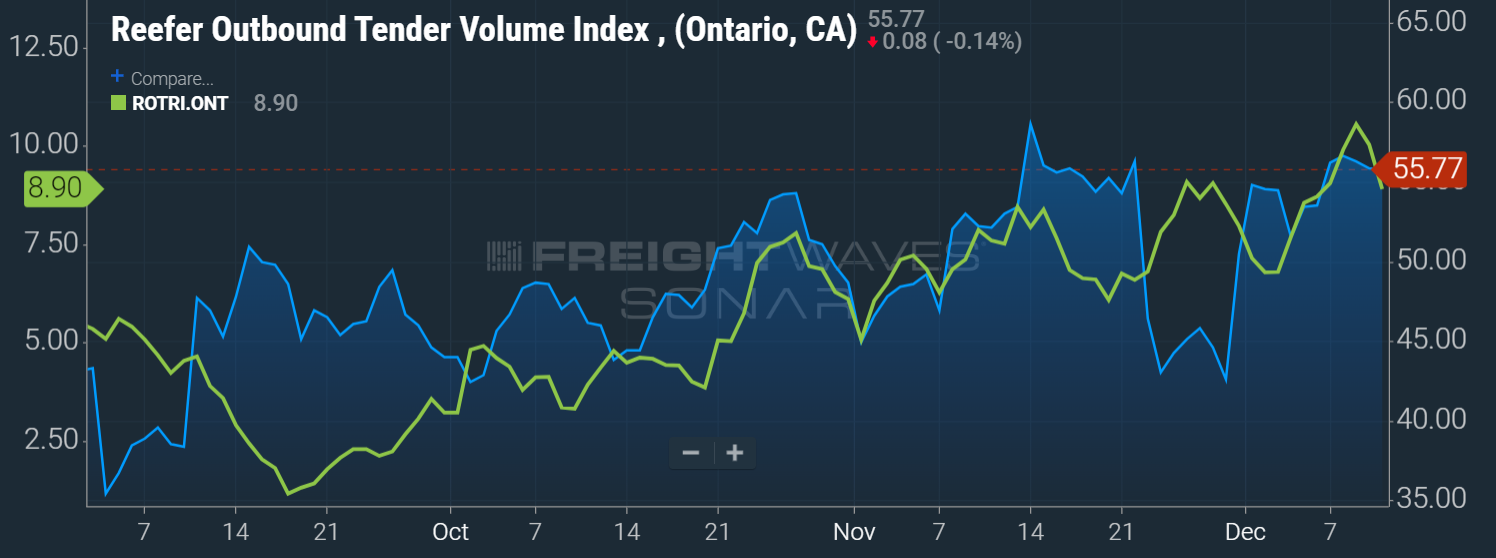
SONAR Tickers: ROTVI.ONT, ROTRI.ONT

This week’s reefer market is one of the top freight markets in the country, Ontario, California, near the ports of Los Angeles and Long Beach. Having spent some time out of the spotlight, Ontario is looking to reclaim some of the freight volumes lost as a result of long wait times and uncertain labor markets. 

This week reefer capacity in Ontario is loosening as both the Reefer Outbound Tender Reject Index and the Reefer Outbound Volume Index are falling. The ROTRI has dropped to 8.9% rejections but is still up 121 basis points week over week as last week was a catch-up and rebalancing week following the Thanksgiving holiday. The national average ROTRI is at 7.39%, which indicates that spot rates coming out of Ontario will continue to be higher than most other markets.

Is SONAR for you? Check it out with a demo!

Shelf life

Delivering energy-efficient cold storage solutions across Africa

One-Plate frozen meals become popular in Japan with new recipes, reasonable prices

Emergent Cold LatAm raises US$ 500 million for next phase of investment in refrigerated logistics

Mediport gets behind active cold chain network

‘We need everyone on this journey’: How PepsiCo is reducing water use in its supply chain

Future-proofing the pharma cold chain

Wanna chat in the cooler? Shoot me an email with comments, questions or story ideas at moconnell@www.freightwaves.com.

See you on the internet.

Mary

If this newsletter was forwarded to you, you must be pretty chill. Join the coolest community in freight and subscribe for more at www.freightwaves.com/subscribe.

American Industrial Transport completes acquisition of SMBC Rail Services’ assets

A train of railcars passes through a railroad crossing.

American Industrial Transport (AITX), a full-service rail car lessor with offices in St. Charles, Missouri, and Maumee, Ohio, has completed the acquisition of rail car assets previously owned by SMBC Rail Services.

AITX is a subsidiary of ITE Management, a transportation and infrastructure investment firm headquartered in New York City. AITX and ITE Management announced plans to acquire the rail car assets from SMBC Rail Services in November. SMBC Rail Services was affiliated with SMBC Americas Holdings, which in turn is part of SMBC Group, a global financial group headquartered in Tokyo.

The acquisition adds more than 50,000 rail cars to AITX’s fleet, bringing the company’s rail car diversified leasing portfolio to nearly 120,000 rail cars. 

With the acquisition came changes in AITX’s leadership. Michael McCarthy, who served most recently as CEO of SMBC Rail Services, has been named as AITX president. McCarthy also served in SMBC Rail Services’ commercial leasing and portfolio management business, and he has held senior positions at GE Rail Services and GATX.

“I am incredibly excited to join and help lead the American Industrial Transport team. It is a top organization with a focus on customer service, safety, and quality. As supply chains continue to become more dynamic, we hear from freight shippers that they want trusted partnerships with full-service leaders, like American Industrial Transport,” McCarthy said in a Friday news release.

Texas Howard was named chief operating officer. He will be responsible for overseeing U.S. and European fleet and repair operations, engineering, quality assurance, environmental health and safety, and human resources. Howard was president of AITX for the last 15 months. 

“With these additions to our fleet, operations, and leadership team, we are further positioning AITX for greater success by leveraging skills and experiences of the combined teams,” Howard said. “Working alongside Michael and the rest of the AITX team, I could not be more excited about our next chapter of continued growth.”

Subscribe to FreightWaves’ e-newsletters and get the latest insights on freight right in your inbox.

Click here for more FreightWaves articles by Joanna Marsh.

Turkish Airlines picks Airbus over Boeing for widebody freighter order

Close of a Turkish Cargo jet as the nose lifts up on takeoff.

Turkish Airlines has signed a purchase agreement for five all-new Airbus A350 widebody freighters, the companies announced on Friday, closing the order gap with Boeing in the next-generation, large freighter segment.

The news comes a week after Cathay Pacific ordered six A350 cargo jets

Airbus has received 50 orders for the A350 freighter from nine customers following its launch at the Dubai Airshow two years ago. Boeing has 55 orders from five customers for the next-generation 777-8 freighter, 34 of which are from Qatar Airways. Boeing hasn’t received an order for the large cargo jet since October 2022.

Cargo airlines have been much slower this year to invest in new aircraft because of the severe downturn that has gripped the air cargo industry for the better part of two years.

The A350s were part of an order for 220 Airbus aircraft, including 150 A321 and 65 A350 passenger jets. Turkish Airlines operates a large mixed fleet of Airbus and Boeing aircraft, but the A350 is a new aircraft type for the carrier.

Turkish Airlines is a combination carrier that moves cargo with passenger aircraft and dedicated freighters. It is the seventh-largest cargo airline by traffic carried, according to figures from the International Air Transport Association. The freighter fleet consists of eight Boeing 777-200s, 10 A330-200s and six leased aircraft, including two Boeing 747-400s.

Turkish officials have openly talked this year about plans for major cargo expansion. In 2021, the company opened a mega-cargo terminal at Istanbul Airport. 

Airbus did not give a delivery timeline for Turkish Airlines’ A350 freighters. It has previously said the aircraft, which is currently under development, will reach the first customer in 2026. Boeing is targeting 2027 for first delivery of the 777-8.

The A350F features the largest main deck cargo door. More than 70% of the airframe is made of advanced materials. Airbus claims the lighter airframe and efficient Rolls Royce engines produce a 20% advantage in fuel burn and CO2 emissions over the legacy Boeing 777. 

 Click here for more FreightWaves/American Shipper articles by Eric Kulisch.

Contact Reporter: ekulisch@www.freightwaves.com 

Cathay Pacific places order for 6 Airbus A350 freighters

Turkey stretches wings as center for air cargo activity

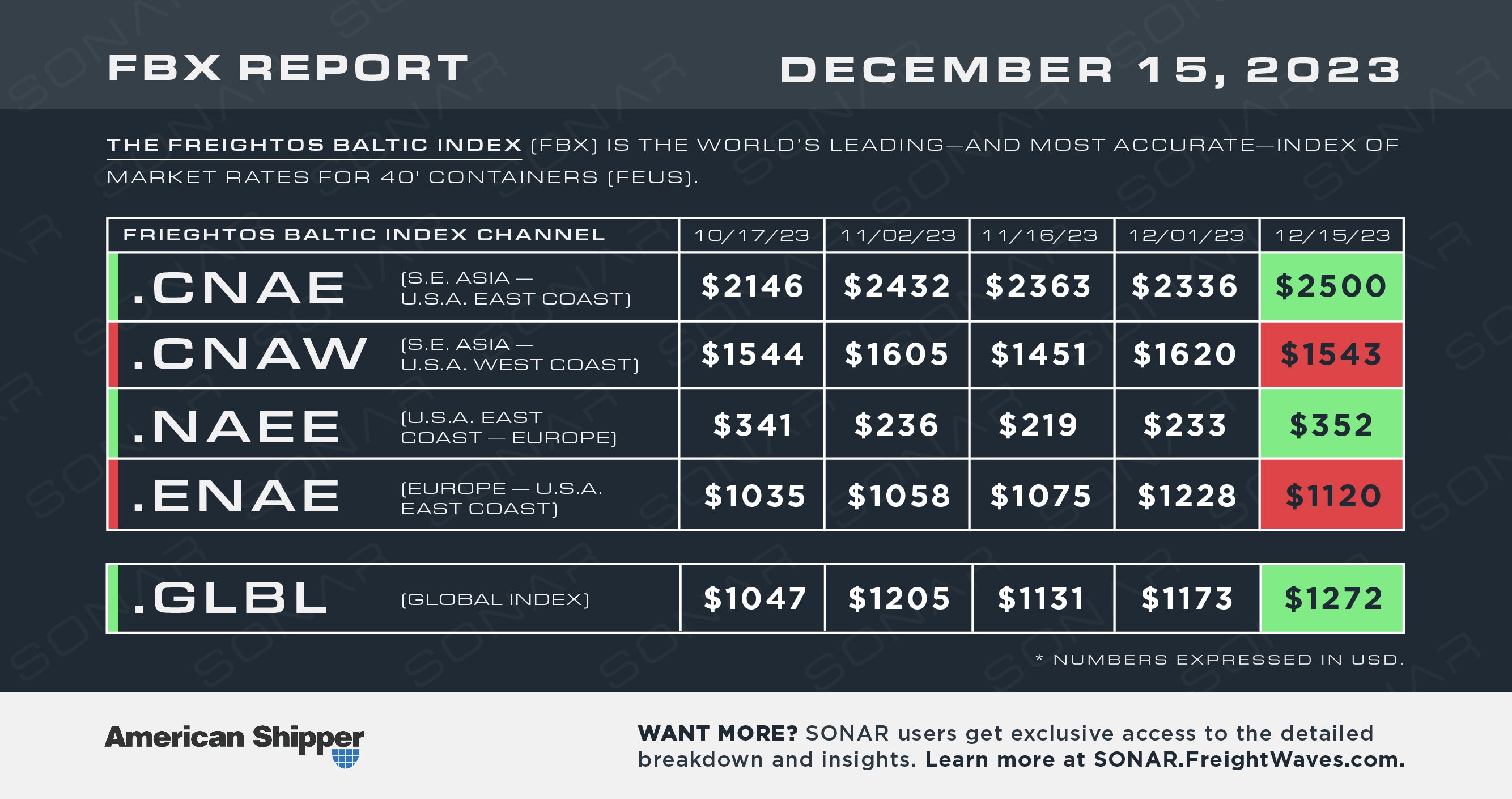
FBX Report: December 15, 2023


To learn more about FreightWaves SONAR, click here.