Electrolyzers only scratch the surface of midcentury hydrogen demand

Even as manufacturing of electrolyzers grows, the hydrogen-making devices barely address the potential for hydrogen used in trucking and a host of industries. Cummins Inc. is doing its part.

Cummins has been investing globally in hydrogen-making electrolyzers as part of its Destination 2050 decarbonization plan. But even its aggressive approach won’t meet the midcentury demand for hundreds of millions of kilograms a year.

Hydrogen, a naturally occurring gas, is the most abundant substance in the universe. It emits only water vapor when burned. Green hydrogen is created using a process called electrolysis. Electricity from renewable sources is used to split the hydrogen molecules from the oxygen molecules in water emitting greenhouse-gas emissions.

Hydrogen could contribute more than 20% of annual global emissions reductions by 2050, according to McKinsey & Co. research. 

That is a stretch target for even the most aggressive hydrogen equipment producers like Accelera by Cummins.

“We’re in the process of scaling up,” Andreas Lippert, Accelera by Cummins’ recently named vice president of electrolyzers, told me. “We’ve made these commitments in terms of manufacturing plants. We have about 300 megawatts of backlog up to 2026 in North America alone.”

Aggressive ramp-up

Accelera’s biggest single output of hydrogen is 10 tons per day. That might roll up to 360,000 tons a year. Industries from steel to ammonia use 70 million tons of hydrogen a year. Cummins’ largest current project is the 20-megawatt proton exchange membrane electrolyzer plant in Bécancour, Canada. 

Commissioning is underway for a 25-megawatt plant with Florida Power & Light. Accelera also is working with German multinational chemical company Linde GmbH on a 35-megawatt electrolyzer installation at Niagara Falls where hydropower creates the electricity needed to make green hydrogen.

“If you believe even half of what McKinsey puts out there as 350 to 400 million tons a year by 2050, it’s a huge, huge space,” Lippert said.

Andreas Lippert, vice president of electrolyzers at Accelera by Cummins. (Source: Cummins)

Conversion amid irony

The company is converting more than 25% of its plant in Fridley, Minnesota — where President Joe Biden visited in April — to make electrolyzers. Is it ironic that the rest of the facility assembles diesel-powered generators, which detract from rather than help Cummins’ climate change ambitions?

“What is helpful to keep in mind is not to be so picky,” Lippert said. “We have to pursue every possible option if we really want to get to the goal of net zero by 2050. And so for Cummins, all of these things play together.”

Even as Cummins focuses on a future where fossil fuels recede in importance, they remain in the picture for a long time.

Cummins electrolyzer production is scaling up. (Photo: Cummins)

Avoiding making the good the enemy of the best

Making green hydrogen from renewable feedstocks like solar and wind power doesn’t mean it will end up being used that way.

“We can’t necessarily control every electron that comes into the electrolyzer,” Lippert said. “Florida Power & Light [has] a huge solar park. It’s solar power going in and hydrogen coming out. And that is being blended into combustion turbines to provide greener electricity, storing it in the form of hydrogen and making it available at a different time.”

Accelera avoids making the good an enemy of the best. If all-green hydrogen is the best, then green hydrogen blended with other feedstocks is the good.

“We’ve had a project with Enbridge in Canada that’s been running for quite a while where they’re blending [hydrogen] in. It is a meaningful step to decarbonize,” Lippert said. “Part of our Destination Zero message is, ‘Start today, even if it’s smaller steps.’ Cumulatively that has more impact than waiting on a magic technology at a future date.”  

Electrolyzers and fuel cells: Opposites attract

An electrolyzer uses electricity and water to make hydrogen. It is the opposite of a fuel cell, which uses hydrogen to make electricity from hydrogen. But they can work together.

“The key where this electrolyzer fuel cell combination does come in is if you have lots of renewable power that you then can convert and buffer in the form of hydrogen and then run the fuel cell on that hydrogen to provide peaks of charging,” Lippert said.

Consider multiple megawatt charging stations addressing battery-electric and hydrogen-powered fuel cell trucks. Stationary fuel cells, like those planned by fuel cell developer Hyzon Motors, could charge overnight and provide power during peak periods when utilities assess demand charges. 

“The electrolyzer and fuel cell combo makes sense if you have a lot of wind power at night, which is the case in a lot of regions,” Lippert said. “So you can store that wind power through the electrolyzer in hydrogen [and] smooth that curve.

“You actually need a very thick artery for some of these charging stations, and the grid just doesn’t have it. So you need to create large amounts of power in a very decentralized way with these EV charging stations. You need a way to get energy there. Hydrogen could be a way to address that.”


Briefly noted:

Electric commercial truck charging network service provider Greenlane and Uber Freight will collaborate to accelerate development of public charging infrastructure.

The $650 million public charging infrastructure joint venture of Daimler Truck North America, BlackRock and NextEra Energy Resources will collaborate with Uber Freight. (Photo: Greenlane)

The Eaton Cummins Automated Transmission Technologies joint venture is making the Endurant XD series automated transmission available in certain Daimler Truck Western Star and Freightliner models.

Milence, the $593 million electric truck charging joint venture of Daimler Truck, Traton Group and Volvo Group announced in 2021, has opened the first phase of a charging hub in the Netherlands.

Our Next Energy (ONE) has named Paul Humphries as CEO, succeeding co-founder Mujeeb Ijaz. He will become chief technology officer of the Novi, Michigan-based energy storage technology company.

Bloomberg New Energy Finance reports that electric vehicles and fuel-cell vehicles are expected to avoid almost 1.8 million barrels of oil a day in 2023, or about 4.1% of road transport sector demand. CleanTechnica has more here

Cheema Freightlines will use the Virtual Vehicle connected vehicle platform from Platform Science on its fleet of more than 500 trucks in the Western U.S.

Isuzu Motors has invested in an $85 million Series C funding round for Israeli startup Foretellix, which uses artificial intelligence to test the safety of autonomous vehicles.

The Ford Otosan joint venture in Turkey is reading an F-Max heavy-duty fuel cell truck for testing and it may explore fuel cells in delivery vans in the U.K., according to CleanTechnica.

And finally — though not in time for Christmas — Lego is offering a 503-piece building set based on the Mack LR Electric refuse truck. Looks pretty cool for those of us over 8 years old. 

After a massive brick undertaking of a full-size Mack Anthem in Australia, Lego is offering a more manageable LR Electric refuse hauler in January. (Image: Lego).

Truck Tech Episode No. 45: TruckWings takes flight as part of ConMet

The future of the TruckWings cab-to-trailer gap closing technology looks bright with the acquisition by ConMet.


That’s it for this week. Thanks for reading. Click here to get Truck Tech via email on Fridays. And catch the latest in major events and hear from the top players on Truck Tech at 3 p.m. Wednesdays on the FreightWaves YouTube channel. We value your feedback. Please write to me at aadler@www.freightwaves.com with comments and story suggestions.

Merry Christmas and Happy New Year. Truck Tech will return to your inboxes on Friday, Jan. 5, 2024.


Sleep smarter, drive safer — Taking the Hire Road

On this week’s episode of Taking the Hire Road, Jeremy Reymer, founder of DriverReach, is joined by Dr. Abhinav Singh, a board-certified physician with decades of experience in the field of sleep medicine.

When trying to impress upon his patients the importance of proper sleep hygiene, Singh often found himself recommending literature written by others. One day, a patient asked him why he had yet to write a book on the subject.

Thus was the genesis of “Sleep to Heal: 7 Simple Steps to Better Health,” a book in which Singh draws upon illustrative and instructive examples from his storied career in medicine. 

Given that the average life expectancy of a CDL driver is a mere 61 years, Singh’s message is all the more relevant to truckers.

“I look at sleep as the chassis of a truck on which the entire structure of your health is built,” he says. Indeed, Singh’s writing is peppered with colorful analogies that drive home the importance of sleep. 

In one of the most descriptive ones, he likens a full eight hours of sleep to an elevator proceeding upward. “The longer you sleep, the further you go up, getting deeper and more restorative sleep until you reach the penthouse. And who doesn’t like being in a penthouse?”

In the first few hours of sleep, your body fights infections and repairs muscle tissue, among other processes. This task is a messy affair, leaving behind debris like histamines from the biological battles.

The second half of a good night’s rest, then, is when the body begins to clear out the remnants of earlier battles, which can be harmful if left unchecked. But this cleanup can be arrested by disturbances to sleep, even those that are seemingly normal.

“Snoring is like potholes on a road,” Singh explains. “Are they common? Yes. But while every pothole doesn’t break your truck, certain potholes are worse than others. As the snoring gets worse, the impact to the car hitting them is higher.”

Snoring is caused by vibrations at the back of one’s throat, each of which jolts the sleeper’s body with a shock of adrenaline that interrupts the sleep cycle. And, like hitting potholes repeatedly, it matters little whether the truck is maintained regularly — eventually, parts start to break down as the chassis is continually rocked.

Initially, the symptoms of sleep apnea do not seem severe: “dry mouth, headaches, frequent bathroom breaks, fatigue, judgment errors.” But as a person is deprived of sleep over time, it begins to take a major toll. “Over the next decade, apnea’s effects become heart attacks, strokes, rising blood pressure … the list goes on.”

Given the severity of these later symptoms, it is alarming that roughly 1 in 3 people do not get enough sleep, while nearly 20% of people suffer from sleep apnea. Of those 20% who have apnea, 80% are undiagnosed.

The risk factors are higher in truckers, who tend to be older males with a sedentary lifestyle. “There is almost a 300% higher risk of accidents on the road if you have untreated sleep apnea,” making it all the more important for drivers to check in regularly with a physician.

Early in his career, Singh encountered a lot of pushback from truckers who would wind up in his office. When he asked why these patients came to him, “the standard response would be, ‘I don’t know why I’m here.’” Patients would often shift the blame to others like their duty examiners or federal regulators.

Happily, in recent years, the benefits of sleep medicine have spread like wildfire among truckers via word of mouth. After a mere 60 days of treatment, symptoms rapidly begin to alleviate, to which Singh has only one question:

“Doesn’t it feel like you’ve been driving with the hand brakes up all the time, and now someone has finally lowered them?”

Click here to learn more about Sleep Vigilante.

More from Taking The Hire Road:

Lesson on reaching trucking’s next generation

Lessons from across the pond

Show up for yourself to show up for others

Haslam payments to Pilot execs won’t be issue in Berkshire Hathaway trial

The legal battle between the Haslam family and Berkshire Hathaway over the valuation of Pilot Travel Centers will not include the impact of payments made by the Haslams to their loyalists still working at the truck stop giant.

That’s the bottom-line impact from a decision handed down Wednesday by Vice Chancellor Morgan Zurn of the Delaware Chancery Court as the legal battle over heads toward a Jan. 8 trial. 

At stake is the valuation of the remaining 20% of PTC — as the court refers to Pilot Travel Centers — that remains in the hands of the Haslam family. In January, Berkshire Hathaway bought a 41.4% stake in PTC from the Haslam family that, combined with the 38.6% stake it acquired from the Haslams in 2017, gave it control of the company. 

The Haslams have an annual first-quarter window that if exercised — what the legal documents refer to as the “put right” — would sell the remaining 20% of PTC to Berkshire. 

If it isn’t exercised in 2024, the put right then slides to 2025 and continues in future years. But various statements in the legal documents filed in the case strongly suggest the Haslam family plan is to exercise the put right next year.

The formula for determining the value of PTC is 10 times earnings before interest and taxes, with some adjustments. That is not at issue. More broadly, the litigation is over whether a shift in Berkshire Hathaway accounting to what is known as “pushdown accounting” would effectively reduce the value of PTC for determining the value of the put right.

The more immediate question before Zurn was private payments reportedly promised to several executives still at PTC by Jimmy Haslam, son of the founder. Berkshire Hathaway said those payments were leading those executives to take steps that might boost PTC earnings in the short term, thereby aiding the valuation of the put right and boosting the size of their payments, but damaging it in the long run.

The initial lawsuit filed by the Haslam family does recount a conversation with Berkshire Hathaway CEO Warren Buffett in which Buffett reportedly said the PTC valuation would be calculated under the initial terms of the agreement, which did not include pushdown accounting. 

The crux of Zurn’s decision was that while the payment promises from Jimmy Haslam do exist — that does not appear to be an issue in the legal battle — it isn’t relevant to the  Haslams’ arguments because that focuses on the impact of the accounting change.

Citing earlier precedents, Zurn said the Chancery Court has found in other cases that “a plaintiff’s wrongdoing lacked a sufficient nexus to a breach of contract claim where the wrongdoing did not relate to the plaintiff’s rights or the defendant’s obligations under the relevant agreement.”

Berkshire Hathaway attorneys charged that the Haslams — who filed the suit as Pilot Corp. — had “unclean hands.” That legal term is defined by the Legal Information Institute as “the principle that a party’s own inequitable misconduct precludes recovery based on equitable claims or defenses. A party who has violated an equitable principle, such as good faith, is described as having ‘unclean hands.’”

But Zurn rejected the Berkshire Hathaway argument that the payments were relevant to the question of the accounting changes at Berkshire and how they might impact the value of the put right. 

The “allegations” about the payments “add context to the tug-of-war over PTC’s 2013 EBIT that motivates this lawsuit,” Zurn wrote. But beyond that, “neither Pilot’s (the Haslams) goal nor its context can provide an anchor for an unclean hands defense: the anchor must catch on Pilot’s claims.”

Payments undertaken by Jimmy Haslam “do not inform Pilot’s rights or Berkshire’s obligations” under the agreement to value the remaining 20%, according to Zurn. But the court in earlier precedents has “found that an unclean hands defense lacks a sufficient nexus where the plaintiff’s claim and alleged wrongdoing related to separate agreements,” which Zurn sees in the relationship between the question over accounting and the payments. 

Zurn said he had “taken the Berkshire allegations as true and made all inferences in their favor, yet still [concluded] their defense could not prevail as a matter of law.”

According to the original counterclaim by Berkshire Hathaway, Jimmy Haslam, at a March dinner, told several executives who were still at PTC  that he would pay them “large, one-time bonuses” in lieu of a company-run incentive program that was not going to operate past 2022 and which had paid many of the executives a substantial sum in its final year. And while some media accounts have described the payments as “bribes,” that word does not appear in any of the litigation.

Haslam never informed Berkshire management about the plan, nor did he inform the people running PTC who came out of the Berkshire side of the combination, according to the Berkshire counterclaim.

Berkshire’s objection: “Haslam’s illicit promise of secret bonuses thereby distorted PTC executives’ financial interests to be aligned not with PTC’s interests, but with those of a minority owner anticipating selling its remaining stake.”

More articles by John Kingston

1st peek at Pilot’s finances after Berkshire Hathaway ownership grows

19 MEX centers, with Pilot branding, temporarily shut by operator bankruptcy

Amid industry turmoil, picking right log tech partner more important than ever

By Bart De Muynck

The views expressed here are solely those of the author and do not necessarily represent the views of FreightWaves or its affiliates.

The supply chain industry has faced a series of challenges over the past few months, including Convoy’s shutdown and the recent layoffs at FourKites. While these events create an impression of widespread instability in logistics technology, that’s not the case — there’s plenty pointing to how the industry is continuing to grow. 

I have encountered more innovation across the entire logistics ecosystem this year than I have ever before. It shows how supply chain companies are digitizing their processes from procurement to payment and how picking the right log tech partner is vital.

A recent study by McKinsey shows that technology investments in logistics continue to grow. 

“Some 87% of shippers reported maintaining or growing their technology investments since 2020, and 93% said they plan to maintain or increase their spending over the next three years,” the study says. The study also shows that shippers and providers are moving beyond foundational technology into the next frontier of productivity which come from leading-edge solutions such as real-time transportation visibility, robotics, network digital twins and real-time insights. 

And although we read negative news stories daily and we see occurrences of events in the logistics industry such as strikes, bankruptcies, layoffs at tech firms, security incidents, weather events, etc., there are also many positive things that occurred in the last year. The logistics industry, now more than ever, is an incredibly connected network of companies and individuals who are extremely passionate about this industry and will work countless hours to move this industry forward.

Private equity (PE) and venture capital (VC) money might not be as accessible as a few years ago, but there are plenty of opportunities where these companies will continue to invest in new technology as witnessed by a continuously increasing number of startups. These FreightTech startup founders are equally passionate and motivated to create new or improved solutions to improve the efficiency of the industry and to create capabilities we have not seen before.

This has become abundantly clear when talking to both investors but also to founders of startups.

As for the larger VC- and PE-backed tech companies, we have seen several close shop such as Convoy or Slync. But we have also seen the same in the non-tech side with companies like Yellow Corp. Most recently, we saw leadership changes at Flexport in which the CEO got ousted. Similarly, we saw a management shakeup at FourKites with several executives being made redundant and a 15% layoff in its global workforce. This all creates the perception of a lot of instability in the market even when others are continuing on their growth trajectory.

It also increases the importance of picking the right solution partner or what I like to call the right “value creation” partner. 

No longer should tech vendors think in terms of selling solutions but rather think of selling value creation mechanism enabled by their platforms. But equally important, as companies start this journey with this partner, are other factors such as the vendor’s financial stability, its workforce that can support the project, its culture, its ethical standards and its physical global presence.

What is equally important to investors is the moral compass of the CEO, the ability to attract the right talent, being able to execute on strategic sales plans and the partnerships with key technology providers and trusting that the right leader is in place long enough to see those plans through. The right log tech partner won’t rely on gimmicks to sell your product but will prove its value in droves by helping you overcome the obstacles you’ll inevitably face.

End users should continue investing in technology to enable their supply chains to attain a higher velocity. This in turn will help with the many points of friction that exist today and the increasing new events that will occur in the future. Visibility will remain a key to providing not only transparency but create insights that will go beyond supply chain execution and will assist companies in better overall planning.

The key to success of these technologies is picking the right partner that will walk alongside your digital transformation with the vision and the runway to be around for the long run.

About the author

Bart De Muynck is an industry thought leader with over 30 years of supply chain and logistics experience. He has worked for major international companies, including EY, GE Capital, Penske Logistics and PepsiCo, as well as several tech companies. He also spent eight years as a vice president of research at Gartner and, most recently, served as chief industry officer at project44. He is a member of the Forbes Technology Council and CSCMP’s Executive Inner Circle.

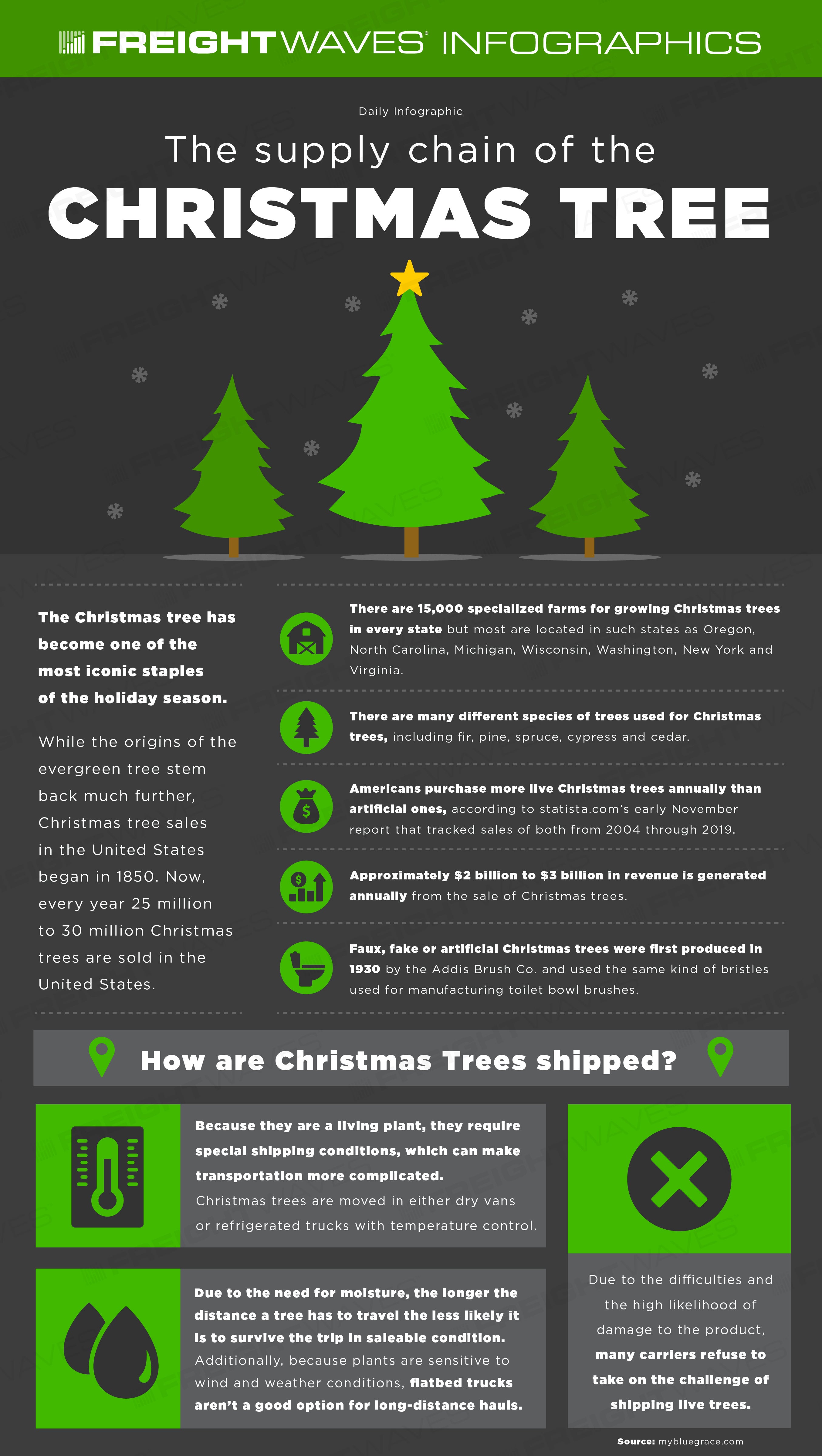
Daily Infographic: The supply chain of the Christmas tree


To view more FreightWaves infographics, click here

Swiftair to add 1st A321s to freighter fleet

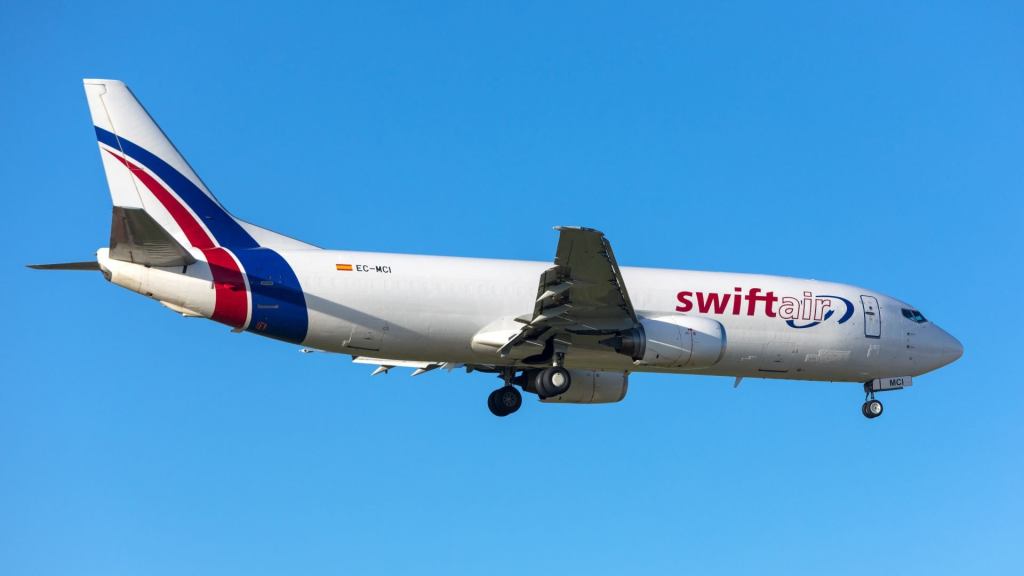
A Swiftair cargo jet flying with wheels down as it approaches an airport with wheels down.

Spanish cargo airline Swiftair has signed a lease agreement with mega-lessor AerCap for two Airbus A321 aircraft converted from passenger configuration to carry freight containers. 

It’s the rare case this year of an airline investing in more freighters. Most cargo operators have paused, and in some cases, rolled back expansion plans because of the downturn in cargo demand in rates since early 2022.

Swifair has 43 aircraft, most of which are freighters, but the A321 is a new aircraft type for the company.

The used aircraft will be retrofitted by Airbus affiliate Elbe Flugzeugwerke GmbH at partner ST Engineering in Singapore and delivered to Swiftair in April and June, the companies announced Wednesday.

Swiftair said the airplanes will replace older aircraft in the fleet and fly on behalf of an international logistics customer. The aircraft will be dedicated to one of the large integrated express carriers, Cargo Facts previously reported.

Madrid-based Swiftair provides outsourced cargo and passenger operations, including aircraft and crews, for airlines, express delivery companies, postal services and non-governmental organizations across Europe, north Africa and west Africa. 

Swiftair’s fleet includes 21 ATR 42 and ATR 72 aircraft, nine legacy Boeing 737 and seven 737-800s converted freighters and three Boeing 757 converted freighters, according to aviation databases.

In 2022, AerCap placed a firm order with EFW for 15 Airbus A321-200 passenger-to-freighter conversions, with an option for a further 15 conversions.

 Click here for more FreightWaves/American Shipper articles by Eric Kulisch.

Contact Reporter: ekulisch@www.freightwaves.com 

GlobalX Airlines defies cargo trend with fleet strategy

Air cargo market: From ‘doom mongering’ to stability

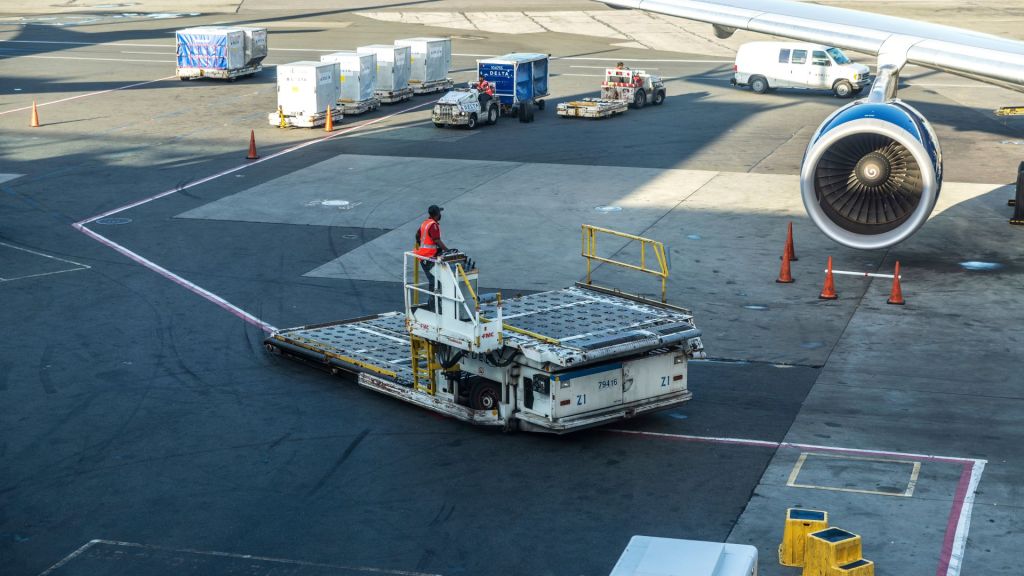
A worker maneuvers a cargo dolly near an aircraft with shipping containers lined up on the tarmac behind.

The air cargo market is experiencing an unexpected bounce during the traditional peak shipping season culminating the year, fueled by e-commerce exports from China, but revenues for air logistics companies could be lower even if strengthening demand carries over into 2024, according to industry experts.

Still, the vibe in industry circles is that the worst of the freight recession is in the rearview mirror, with next year bringing welcome stability even if it takes until late summer for a full-throated recovery to take hold.

“There’s overall shipper confidence that the market will be more predictable and more consistent. There’s more trust going into next year and as a result I think you’ll see more semiannual or annual contracts. That’s a really good signal that the market is starting to stabilize and shippers have confidence that supply and demand are going to be more balanced,” said Zeid Houssami, global head of airfreight at Flexport, in a webinar on Wednesday for the logistics firm’s customers.

The International Air Transport Association (IATA) recently forecast that airfreight volume will grow 4.5% in 2024, building on this year’s second-half momentum. Shipment traffic will contract 3.8% in 2023 after declining 8.2% last year, it said, as global supply chains stabilize and there is less need for fast delivery. 

Other analysts anticipate air cargo volumes will increase 1% to 3%, in line with economic projections.

But continued growth in cargo capacity from passenger aircraft reentering service after the pandemic to meet travel demand, stagnating international trade and competition from ultra-low maritime cargo rates will continue to put downward pressure on rates, offsetting the demand gain. That translates into less revenue for airlines and logistics providers, the industry group said.

About half of global cargo volume — not including shipments transported by integrated express carriers — is being carried in the lower hold of passenger aircraft, as it was before the pandemic forced a shift to freighters.

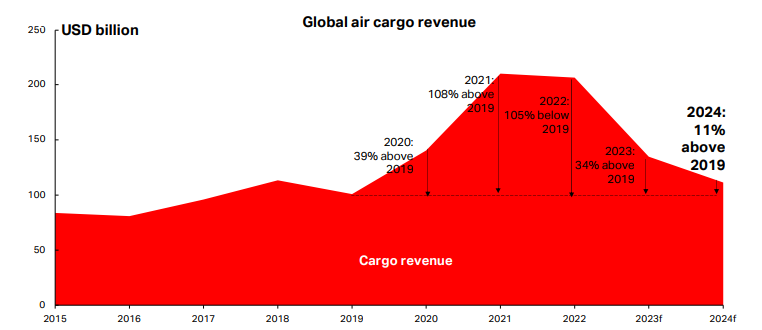
Air cargo revenue for airlines is expected to be higher than 2019 levels. (Source: IATA)

IATA estimates airline cargo revenues will fall 35% in 2023 to $134.7 billion, about $8 billion less than in its outlook presented last June, and slide to $111 billion next year as average unit pricing for air cargo deteriorates further. Yields fell more than 32% this year and will drop another 21% in 2024, it said.

Despite yield erosion, global cargo revenues will still be 11% higher than in 2019.

With combination airlines in full recovery mode and focused on their primary business, the cargo share of total airline revenues will revert to 12% after more than doubling during the pandemic because of the supply shortage, said IATA. 

Fourth-quarter surge

Current market conditions have buoyed hopes that the air cargo industry will finally begin a full recovery from the freight recession that began in early 2022, although ongoing economic uncertainty suggests progress may not be sustainable.

Peak-season demand is still lower than usual, but weather disruptions and temporary decreases in passenger flights have constrained cargo capacity as demand from online shoppers surges, driving up rates on key routes. 

Global volumes jumped 5% year over year (y/y) in November on the strength of low-cost e-commerce exports from China to Europe and the United States, marking the fourth consecutive — and most robust — month of growth after more than a year of tightening, according to freight data providers Xeneta and World ACD. IATA, which reports on a lagging basis, said cargo traffic measured in distance traveled increased 3.8% in October.

High-frequency data from several market intelligence firms indicates the market has stayed in positive territory through early December, with growth up 3% y/y. 

The trend line is tempered somewhat by the fact that current growth figures look good compared to the third and fourth quarters of 2022, when the air cargo market began its steeper dive. 

Meanwhile, cargo capacity is running 15% ahead of last year and is back to 2019 levels, with Asia accounting for 40% of the overall capacity growth after its delayed opening from the pandemic. 

In the past four weeks, capacity rose nearly 2%, with a 5% increase in freighter capacity and an 18% surge on China-U.S. routes as all-cargo operators relocated equipment to take advantage of the hot market, according to consulting firm Accenture Cargo. 

Higher demand helped to push the global fill rate for aircraft to 60%, based on volume and weight metrics, which is on a par with last year’s level, Xeneta said.

Some of the largest quantities of airfreight are coming from fast-fashion house Shein and online marketplace Temu. Fulfillment of direct-to-consumer orders is the primary reason aircraft out of Hong Kong and southern China are mostly full and rates have taken off. Consumer electronics are also moving extensively by air in recent weeks, air logistics companies say.

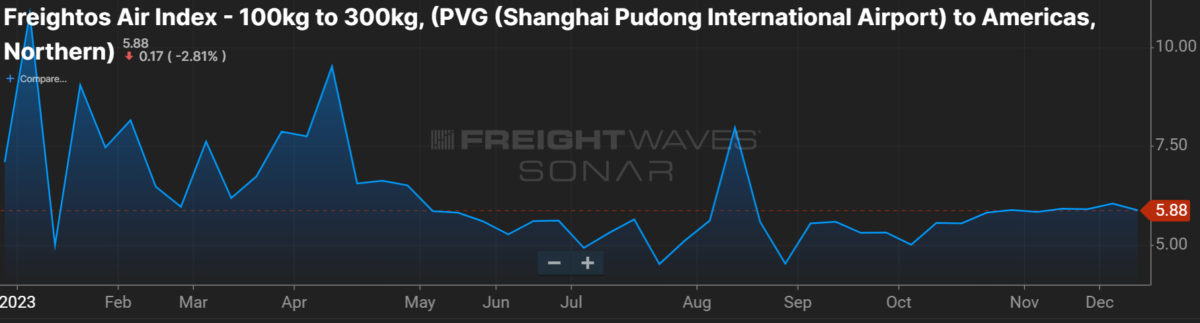
The first positive shift in load factors since May 2021 is reflected in rates out of Chinese gateways to North America, which have outperformed historical peak season activity by low single digits, with rates having risen 40% during the past three months.  

According to the TAC Index, global airfreight rates have surged 21.2% in the past five weeks, cutting the y/y deficit to 10%. As recently as the end of August, rates were still about 40% lower than in 2022. The price to ship by air out of Hong Kong is 12% above the level a year ago, with rates out of Shanghai up 18% y/y, as of last week as producers and U.S. importers fight for space on the trans-Pacific lane.

Rates are now 43% higher than pre-pandemic levels in 2019.

“There was a lot of doom mongering heading into the fourth quarter. We’re not seeing that,” said IAG Cargo CEO David Shepherd on the STAT Media podcast Cargo Masterminds. “The market has gotten tighter, load factors have improved, and yields have stabilized and increased, which is what you’d expect.” 

IAG is the umbrella company for several airlines, including British Airways and Iberia.

Spot rate in U.S. dollars for mid-weight cargo bookings from Shanghai, China, to North America. (Chart: FreightWaves SONAR)

But shipping prices have started to cool in recent days, indicating that the e-commerce-driven increase in demand may be starting to subside as holiday shopping wraps up. Some observers, however, expect the e-commerce boom to last until the Lunar New Year holiday in early February.

And while trunk lanes out of China have been booming, air exports from North America continue to be softer than last year in early December. 

“Seasonality means volumes are up, admittedly slightly more than we expected, but the figures also look better than they really are because November last year was disappointing for airlines and forwarders alike. More than anything else, what we saw this November was air cargo’s growing dependency on e-commerce,” said Niall van de Wouw, Xeneta’s chief airfreight officer, in the monthly report. 

He questioned whether Shein and Temu will be able to generate similar volumes in the future if they eventually raise shipping prices to levels necessary to make a profit, which could undercut quantities of goods moved by air.

Stifel equity analyst Bruce Chan also cautioned about reading too much into this year’s spike in e-commerce activity, much of it aimed at Black Friday and Cyber Week sales.

“We think it is too early to extrapolate this trend to a broader economic recovery. For one thing, we believe some of the cyber activity, at least in the U.S, was a product of attractive ‘door buster’ deals. Moreover, broader retail sales performance was much more muted and, net of inflation, were likely even slightly more negative year over year,” Chan wrote in a monthly column for the Baltic Air Freight Index.

Xeneta’s analysis of spot rates versus seasonal rates also shows that the general cargo market, aside from e-commerce, still faces weak demand. Volumes for specialized commodities such as high-tech, valuables, pharmaceuticals and perishables are actually up 3% to 4%. 

Forecast: Partially cloudy but stable

Consensus thinking within the logistics sector is that air and ocean volumes are poised for substantial growth in 2024 because the global economy has defied expectations of a recession, inflation is receding and retailers have drawn down excess inventories, clearing the way for new factory orders. 

The International Monetary Fund forecasts global trade, which includes services, will grow 3.5% next year.

But there are signs that global economic resilience is fading. Many experts now believe strong economic conditions won’t appear until the third quarter.

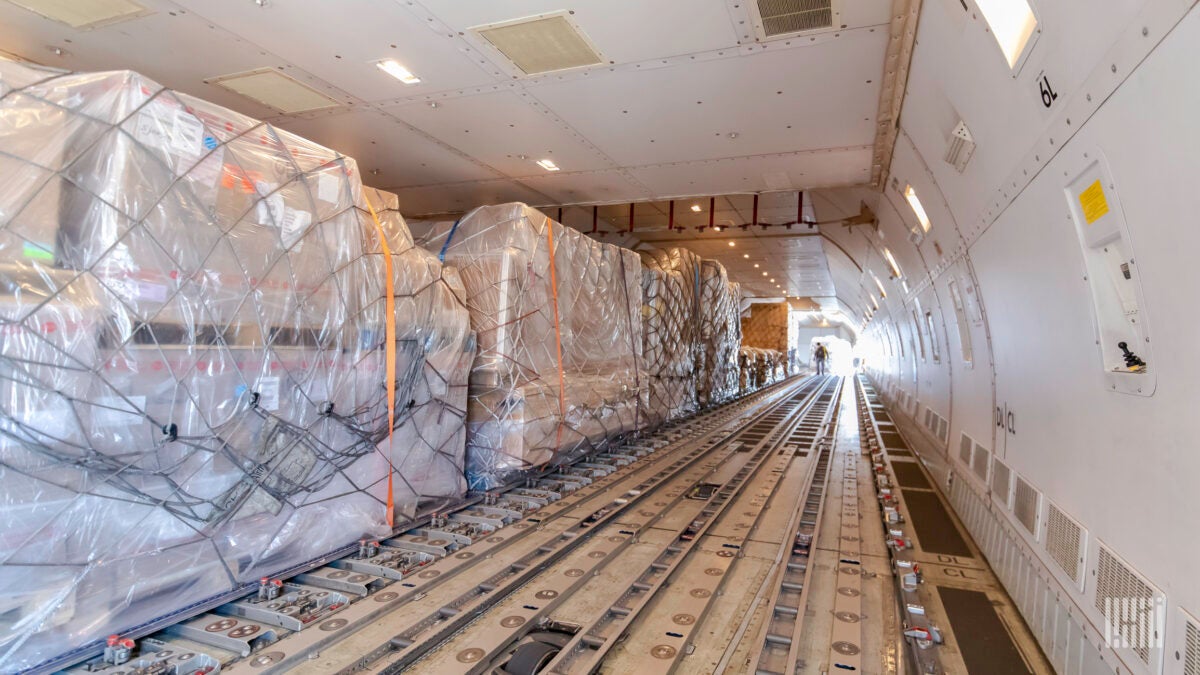
Pallets of freight are loaded in the main deck of a Boeing 747-400 freighter. (Photo: Jim Allen/FreightWaves)

Surveys of manufacturing output and export orders for major economics remain below the threshold indicating growth. Manufacturing orders in the U.S. remained in contraction territory during November, according to the Institute for Supply Management.

U.S. consumers are acting more cautious in the face of higher interest rates and dwindling household savings, according to retailers. And they’ve become more value-oriented, limiting discretionary purchases unless there is a promotion or discount. The National Retail Federation forecasts core holiday retail sales – excluding autos, gasoline and restaurants – will increase between 3% to 4% from Nov. 1 through Dec. 31, but some economists predict weak consumer spending in the first half of 2024.

The economic outlook from Oxford Economics is for global GDP of 2% in 2024 versus a consensus estimate of 2.3% and down from 2.6% growth this year. U.S. economic output is expected to fall from 2.4% to 1%. Among the potential drags on growth are a sputtering Chinese economy, U.S. consumers using up excess savings, protectionism and the lag effects of higher interest rates pushed by the U.S. Federal Reserve that are designed to cool growth by making borrowing more expensive. U.S. consumer confidence is rising, but consumers are feeling negative in the European Union, surveys show.

Jason Miller, a professor of supply chain management at Michigan State University, recently noted on LinkedIn that apparel and commercial equipment wholesalers have still not fully rebalanced inventory levels, which will continue to limit the recovery of airfreight for the time being.

Many experts predict most of the global economic slowdown will occur in the first half of 2024, with activity heating up in the following months. IHS Markit is calling for growth to start the year at 2.1% and rise to 2.7% by the end. Exports, industrial production and retail sales are expected to tick up in 2024. 

Analysts say global airfreight capacity will likely continue to outpace market demand next year with growth of 3% to 5%, especially in Asia. International airlines operating to China at the end of October, for example, only offered half the number of seats they did during the same month in 2019.  A temporary visa exemption for citizens of five European countries may also spur passenger travel to China, as the U.S. and China work to resolve diplomatic differences over further access for their respective airlines. Shipping rates could dip if capacity increases and demand softens at the same time. 

If an influx of passenger flights to China materializes, a portion of the freighter fleet will likely shift to underserved markets such as Vietnam and India, which have limited direct capacity into North America and Europe.

A sign the air cargo market is gradually returning to health is the increased reliance on longer-term contracts. When consumers concentrated spending on goods during the pandemic, many logistics companies reserved large blocks of aircraft space or even leased their own freighters to guarantee capacity. Demand plummeted last year as economies reopened and people could spend on services again, which left logistics providers with dead space that they heavily discounted to attract business and contributed to the sharp downturn in rates earlier this year.

Flexport’s Houssami said the market should be much less volatile next year because the pendulum shifted from 70% procurement in the fixed market, or block space agreements, during the pandemic to 30% fixed and 70% spot transactions in 2023. 

“Next year we’ll see more of a normalized market environment. I think most forwarders will look to leverage a more stable procurement portfolio of about 50% fixed, or BSA, and about 50% spot. So as a risk-mitigation strategy, forwarders are going to continue to balance both,” he said. But van de Wouw warned in Xeneta’s 2024 outlook that forwarders are selling long-term contracts and buying volume on the short-term spot market, which incentivizes them to not honor the contracted service if rates spike. He said the parties need a mechanism to adjust the contract rates when circumstances dictate.

January could be fairly strong for air cargo leading up to the Chinese New Year as companies look to push out inventory before the market slows down for a few weeks before picking up in March and transitioning to a traditional seasonal pattern for the remainder of the year, Houssami added.

Alex Fuller, UPS’ director of marketing for international airfreight, anticipates a strong rebound for air cargo, with rates dipping in the first quarter and staying relatively flat through June before rising substantially in the back half of the year. 

There is “a strong possibility” of big peak season surcharges and rate hikes in the fourth quarter of 2024, he said during a company webinar in November.

Air cargo’s anemic peak season nothing to celebrate

Cargo revenues to fall $65B in 2023, airline group says

The logistics of the Boston Tea Party

Tracks Through Time

In 1773, a group of an estimated 116 patriots snuck into Boston Harbor and dumped what today would be worth $1.7 million of the East India Company’s tea into the water. But what was the logistics behind the operation? Find out in this week’s episode of Tracks Through Time and learn other lesser-known facts about the famous protest. 

State of Freight: Strong volume, stuck OTRI and caution for shippers in ’24

A freight market in which demand remains healthy and truckload rates remain stuck in a relatively narrow range showing little ability to break out to a higher level was the focus of FreightWaves’ final State of Freight webinar for 2023.

Zach Strickland, FreightWaves’ director of freight market intelligence, kicked things off in his discussion with FreightWaves CEO Craig Fuller on Thursday by noting something that might be missed in a market of spot truckload rates that seem stuck near a bottom: Demand isn’t all that bad.

Here are some of the takeaways from Thursday’s webinar. 

There’s not much sign of a freight recession when volumes are considered

In a year in which carriers large and small would describe the market as weak or worse, volumes actually have held up. 

“Underlying all this has been actually a pretty decent demand-side environment,” Strickland said, referring to the Outbound Tender Volume Index (OTVI) from SONAR. “I think when we talked about this recently, we were almost kind of like, ‘This is weird. It shouldn’t be this way because normally supply and demand is a little bit more in balance in a tighter market.’”

Fuller agreed that the demand for freight has been far stronger than might be indicated by financial benchmarks such as rate per mile for truckload transportation.  

In discussion of the “freight recession,” Fuller said some people have said to him, “Wait, volumes are actually pretty good. How do you describe this as a recession?” That leads to a question of definition and what exactly constitutes the freight market. “There’s so many different definitions of it, but I think we have to look at it from the state of volume,” he said. 

And when that perspective is taken, the picture of a freight recession is not as clear. “Financial hedge funds understand what we’re seeing,” Fuller said. “Volumes have been strong and the economy has been stronger than any of us really would have guessed.”

But the OTRI is saying something different

As Fuller said after discussing the strong volumes on the demand side of the ledger, “for freight professionals, it doesn’t feel that way. And the reason it doesn’t feel that way is the market has been oversupplied with capacity.”

That led to Strickland putting up a chart that showed the increase in the Federal Motor Carrier Safety Administration’s granting of authorities. Since December 2019, authorities granted by FMCSA have risen about 40%, Stricikland said, but volumes are up about 14% during that time. 

“This is not measuring trucks, it’s measuring operating authority growth,” Strickland said. “So this to me kind of displays the story of the freight market environment, possibly better than any other at this point because we have this huge glut of capacity.”

Fuller noted, “Carriers have taken about every piece of freight that they have been offered.” 

The end result is that the Outbound Tender Rejection Index (OTRI), which measures contract loads rejected by carriers in a routing guide and thus is a strong benchmark of available capacity, remains below where it was a year ago, according to Strickland. On Thursday, the OTRI was 3.76%. A year ago it was 3.86%.

There are reasons to believe current conditions may be coming to an end

Fuller said the U.S. economy in general has been stronger and volumes have held up. “What happens if the market continues to bleed out capacity and there is a capacity problem?” he asked. 

Shippers should probably be “playing a little bit more on defense than we have talked about in prior conversations,” Fuller said. Because even though capacity is still plentiful, freight market history shows that “there have been times when the capacity situation has changed so fast in terms of pricing.”

A capacity crunch could emerge by the second half of 2024, according to Fuller, who added he is “not calling for it.”

Given that, contract negotiations in the first half of 2024 could be “probably the last set of reductions shippers will give to their carrier base, because the cycle would be largely over with,” Fuller said.

Government has played a role in keeping volumes relatively strong

The Inflation Reduction Act (IRA) “has really driven a lot of money into the economy,” with a particular emphasis on manufacturing, Fuller said. And it wasn’t just a short-term hit. “We could continue to see more capital coming into the economy from these projects” that were enabled by the legislation.

In a recent meeting with a group of CEOs, a presenter from the European automotive industry said the IRA was “the most important driver of nearshoring and reshoring in history.” Its structure is leading to more automotive manufacturing in the U.S. as well as energy transition products such as battery plants. “I came out of there pretty bullish on what this means from a nearshoring and reshoring aspect that I don’t think we think about a lot,” Fuller said.

The salad days spurred by COVID are not likely to return

Asked by a webinar participant whether the type of linehaul rates that the truckload industry reveled in during the slow COVID recovery would return, Fuller said that the industry then “reached peak truckload. I don’t think we’ll see $4-per-mile rates for many years.” 

Strickland agreed “that was an anomaly. Hopefully you enjoyed it while you had it.”

More articles by John Kingston

Takeaways from State of Freight: A surprising volume increase in July

State of Freight takeaways: Low rates, low OTRI mask market improvement

The State of Freight: 5 takeaways on Yellow’s fate and a UPS strike

Coyote offers ‘voluntary separation’ program to high-level employees

Freight broker Coyote Logistics is looking to again reduce its workforce as it struggles with a dramatic freight downturn that has squeezed revenue across the brokerage sector.

The staff reductions are expected to target those in senior manager and director roles, according to a person familiar with the matter. Affected employees will have the opportunity to accept a severance and leave voluntarily, the person said.

In a statement, Chicago-based Coyote said that to “support current optimization initiatives, a small number of employees are being given the opportunity to pursue voluntary separation.” It did not respond to queries as to how many employees might be affected.

A Coyote spokesman said that “since this is a fully voluntary program, it is each employee’s decision if they wish to stay with the organization.”

The person said, however, that those who don’t take a separation package would eventually be laid off.

Any departures would represent the fourth round of staff reductions this year at Coyote. The company previously announced layoffs in January, May and September.

According to LinkedIn data from September, Coyote’s total headcount was down 7% over the past two years and down 2% over the past six months.

Coyote operates under the Supply Chain Solutions unit of UPS Inc. (NYSE: UPS).