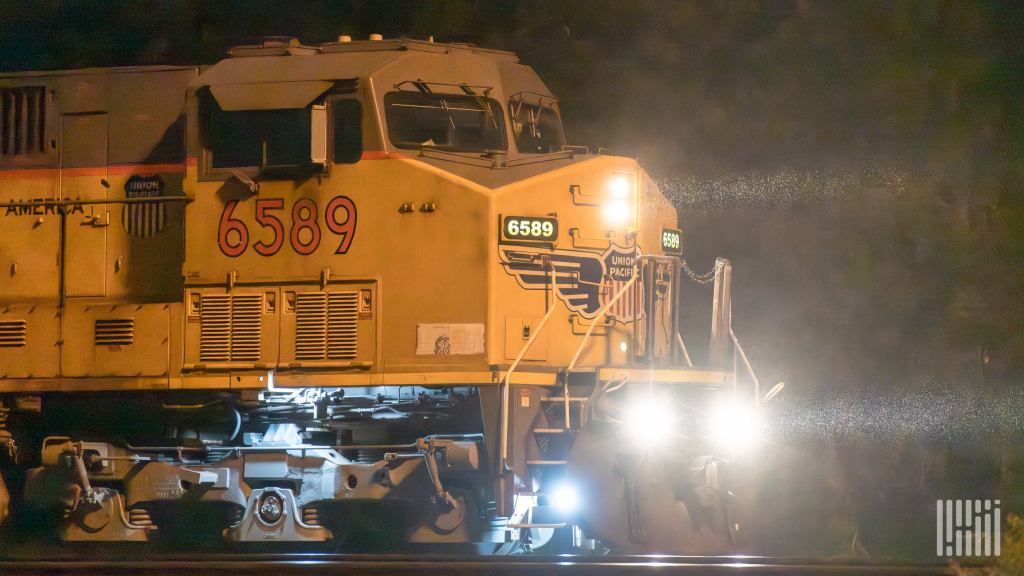
Maintenance-of-way rail union and Union Pacific tussle over furloughs

Debate about furloughs at Union Pacific and how many employees could be affected continue to play out in the public arena following a recent industry conference where Surface Transportation Board Chairman Marty Oberman called out Union Pacific leadership.

The Brotherhood of Maintenance of Way – Employes Division (BMWED) sent two letters to the STB: one on Oct. 27 before the RailTrends conference in November hosted by Progressive Railroading and independent Wall Street analyst Tony Hatch and one letter after the conference dated Nov. 22. 

At that conference, STB Chairman Marty Oberman sharply criticized UP’s decision to use furloughs, while UP President Beth Whited defended her company, saying that the railway’s normal maintenance program is on track and assuring the audience that UP would continue to meet rail service needs.

In BMWED’s two letters to STB, the union said UP (NYSE: UNP) was eyeing furloughing anywhere between 1,180 and 1,350 employees. Widespread disruptions on UP’s network during the first three quarters of this year, such as Tropical Storm Hilary in Southern California, have prompted UP to cut back on spending for budgeting reasons, including deferring some capital projects until 2024, according to BMWED, which is affiliated with the International Brotherhood of Teamsters.

Industry historically furloughed on a roughly seasonal basis until the railroads came under fire from federal regulators because of possible links between diminishing head count levels and deteriorating rail service. They are different from layoffs because furloughs imply that a worker may return to his or her job after a period of time, whereas layoffs imply that a person was let go from a company.

The Nov. 22 letter to the board from BMWED President Tony Cardwell and three union general chairmen also said UP hasn’t implemented large furloughs since 2015.

“While Union Pacific has assured the [Surface Transportation] Board that it is attempting to increase its workforce to improve resiliency (and foreswore future reliance on furloughs at the embargoes hearing, at the first whiff of a decline in profits (from record levels), Union Pacific has resorted to furloughs that are unprecedented in recent memory,” the letter said. “Union Pacific’s ability to recruit and retain skilled and highly qualified workers will be hindered by its cavalier treatment of its current workforce. The furloughs will agitate and destabilize the workforce, delay planned maintenance, impose unrealistic work expectations on Maintenance of Way employees, and undo the recruitment efforts of 2023.”

Cardwell’s Nov. 22 letter referred to and questioned Whited’s remarks at the conference, saying that maintenance-of-way (MOW) employees were discouraged from using vacation time during the holidays. The time off in December is not a reward but a furlough, he said.

“When Union Pacific imposes layoffs, it is not ‘allowing’ employees to take off work,” Cardwell said.

UP told FreightWaves on Monday that it could not pin down how many employees could be affected because a variety of circumstances play into furloughing decisions, including which positions are seasonal, when people go on vacation and whether people decide to seek employment elsewhere on the railroad instead of returning to their own jobs. The railroad also said that furloughs are a temporary work stoppage that occurs when work is not available but that UP intends to bring furloughed workers back to ensure it can continue to meet service and safety standards.

The Western U.S. Class I railroad pointed FreightWaves to a statement that it provided during the conference on the furloughs, which was that “accusations that Union Pacific does not invest in its infrastructure and maintenance are untrue. This year alone, the railroad will spend $3.7 billion on capital investment, of which a significant portion is allotted for maintenance. 

“As part of the capital planning process, we are temporarily reducing some seasonal track maintenance positions. These seasonal shutdowns allow us to realign the work based on the upcoming year’s capital plan. Not all impacted jobs will result in employees being furloughed. Furloughs depend on a number of factors, including remaining paid time off, the number of open jobs and employee preference.”

Meanwhile, BMWED spokesperson Clark Bellew told FreightWaves on Monday that UP has indicated that it could furlough about 1,350 MOW employees. That number is concerning particularly because it could include not only newly hired employees but also long-tenured employees who have expertise and experience, Bellew said. BMWED, which is scheduled to meet with UP this week, is also uncertain how many furloughed employees will actually return to UP. 

“It’ll be well worth watching if they bring back all 1,350 (we don’t expect they will because this is part of the [precision scheduled railroading] strategy). They might offer to bring some back but people can’t be out of work for months in limbo when they have bills to pay, so they will look for other work and write UP off,” Bellew said in an email. “They’ll claim they tried to bring back everyone but they know full well they will lose some employees and that is what they want. That saves them money.”

BMWED brings furlough debate before STB

BMWED had reached out to STB in part because it argues that UP’s proposed plan to cut back on spending — which BMWED views as a means to lower UP’s operating ratio — could also adversely affect service levels, which is an issue that the board has been monitoring

OR is a metric that investors sometimes use to gauge the financial health of a company, with a lower OR implying improved financial health. The unions, including BMWED, have accused the Class I railroads of seeking to achieve lower OR as the impetus for the railroads’ implementation of precision scheduled railroading (PSR), a method adopted by the Class I railroads to streamline operations and lower costs.

BMWED argued that the furloughs also reflect a trend of diminishing headcount at UP within the last 10 years. While the Class I railroads have furloughed in the past, “historical patterns clearly demonstrate that significant workforce reductions through systematic furloughs tend to have enduring circumstances,” said BMWED’s Oct. 27 letter to STB.

This graph compares the total monthly total of maintenance-of-way employees working at Union Pacific with overall UP head count over the same time period. UP and other Class I railroads submit monthly employment data to STB. The left y-axis reflects the number of MOW employees at UP while the right y-axis reflects total employees at UP.

UP “told the STB this year that they would increase workforce and they are brazenly and recklessly doing the opposite. They have not completed their scheduled planned track maintenance projects they set at the beginning of this year. They have work to do to get the track up to snuff, but that requires more investment than PSR is willing to devote,” BMWED’s Bellew said Monday.

“These types of furloughs haven’t occurred in the industry in several decades. They were once fairly common on a seasonal basis, but these carriers are so consolidated now that they can simply reassign production to the southern regions of their territories to avoid winter weather disruptions. U.P. is a 32,000 mile territory in 23 states. There is work to be done. Important work to ensure that they keep trains upright and communities safe,” Bellew continued.

While STB hasn’t formally responded to the letters aside from Oberman’s remarks at RailTrends, the board is monitoring the situation.

Unions also critical of Class I railroad head count levels 

The specter of furloughs comes as labor attorney Richard S. Edelman submitted a separate and unrelated filing last week to STB about the Class I railroads’ consistently lower head count levels since the four main U.S. Class I railroads each individually adopted measures related to PSR, if not PSR itself, starting in 2017.

While head count levels have risen at the four main U.S. Class I railroads last year and this year, they are still hovering around levels seen at the onset of the COVID-19 pandemic in May 2020, according to monthly employment data that the railroads submit to STB.

However, these reductions in head count levels have “far exceeded the reductions in carloadings,” which means that “the reductions in numbers of employees has significantly increased the responsibilities (and attendant extra work time) for the employees who remain,” Edelman said. 

The “Big 4” Class I railroads — UP, BNSF, CSX and Norfolk Southern — “have asserted that they have made strides in improving service and have increased employment; and they have rejected criticisms of their safety record, claiming that the number of derailments has been reduced in comparison to the number of derailments in the early 2000s. … [But] with respect to employment and service, the Big 4 are like a high jumper who sets the bar a foot off the ground, steps over it and awards himself/herself a medal,” Edelman said in his filing last Tuesday. 

“The increases in employment have been minuscule in comparison to prior reductions in employment; and the improvements in service have taken service on some carriers from bad to substandard and others from abysmal to bad,” he said.

Edelman also argued that the industry’s interpretation of Federal Railroad Administration’s data showing a decrease in train derailments since 2000 is flawed because that data doesn’t reflect the reduction in train starts. Rather, Edelman argued that STB and others should look at FRA data on accidents/incidents per million train miles, which accounts for fewer but longer trains and shows that incidents have increased over the last decade. 

“The Unions respectfully urge the Board to continue to press the railroads on the adequacy of the service they provide, and the adequacy of their workforces to provide levels of service that satisfy their common carrier obligations. The Unions again urge the Board to do all it can to enforce service standards and the common carrier obligation, and to advise Congress if the Board feels that it currently lacks sufficient authority to remedy service problems and enforce the common carrier,” Edelman said.

Edelman’s filing was submitted to Ex Parte 770, the proceeding on urgent issues in freight rail service.

In addition to representing BMWED before the board, Edelman also represents the Brotherhood of Railroad Signalmen; the International Association of Sheet Metal, Air, Rail and Transportation Workers – Mechanical Division; the International Association of Boilermakers; the International Association of Machinists and Aerospace Workers, District #19; the National Conference of Firemen and Oilers – 32BJ/SEIU; the Brotherhood of Locomotive Engineers and Trainmen affiliated with IBT; and the Transport Workers Union of America. 

When asked about Edelman’s filing, the Association of American Railroads directed FreightWaves to its filing from July 7 to EP 770.

In that filing, the trade association representing freight railroads said that “the past decade has been the safest in railroad history,” with the hazardous materials accident rate down 76% from 2000 and the accident rate for Class I trains traveling on railroad mainlines down 48% between 2000 and 2022. 

AAR also pointed to climbing employment totals, saying in its July filing that May was the 16th straight month in which the number of train and engine employees grew. 

“While more hiring needs to and will be done, railroads are confident they will continue successfully recruiting the next generation of railroad workers to meet the nation’s rail freight demand,” AAR said.

Subscribe to FreightWaves’ e-newsletters and get the latest insights on freight right in your inbox.

Click here for more FreightWaves articles by Joanna Marsh.

Is LTL booming; OpenTable for box trucks; 2024 freight outlook – WTT

On today’s episode of WHAT THE TRUCK?!? Dooner is joined in-studio by guest co-host Matt McLelland of Covenant. Matt is talking about his Cybertruck preorder, decorating trucks for the holidays and where sustainability is headed in 2024.

Rocket Shipping’s Gabe Pankonin is here with a narrative violation. His company just set record revenue in November and he’s here to share how to win in a down market. 

OpenTable for box trucks? That’s what Grafton Elliott at Onward Delivery does. We’ll find out how Onward helps four of the top 10 big and bulky brokers in the nation get through peak season. 

What’s the freight market going to look like in 2024 and will the beatings continue until morale improves? Averitt Express’ Kent Williams breaks down a 2024 market outlook, nearshoring, being a top performer in LTL and giving back to the community. 

Plus, holiday toy drives; trucking’s favorite Christmas movie; Mother Nature versus freight; a semi-truck Christmas tree stand; and did the college playoff system get it right?

Watch on YouTube

Subscribe to the WTT newsletter

Apple Podcasts

Spotify

More FreightWaves Podcasts

UPS to quadruple size of Hong Kong airport express facility

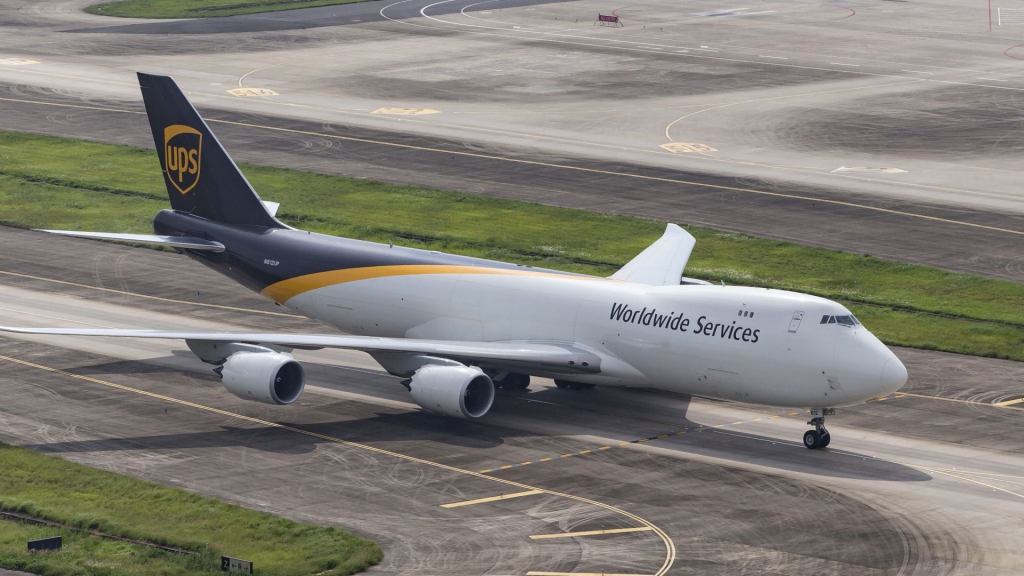
Overhead view of brown-tailed UPS jumbo jet moving along runway.

UPS said Monday it will develop a large express cargo hub at Hong Kong International Airport that will improve shipping service and connectivity in the South China and Asia-Pacific regions. 

The Hong Kong airport authority agreed to lease UPS a 215,000-square-foot parcel for the fully automated air hub, which will have better access to freighter aircraft carrying imports, exports and transshipment cargo.

UPS (NYSE: UPS) said the facility, which will be about four times larger than its current airport locations, is expected to be completed in 2028 and have an annual package throughput of close to 1 million tons. The project will allow the integrated parcel company to collapse two existing operations in into one on airport operation, creating significant operational efficiences.

Officials did not disclose how much the project will cost.

DHL Express last month finished the third phase of its Hong Kong hub, which has an annual capacity of 1.1 million tons. DHL has spent more than $400 million on the facility since its inception 19 years ago. 

The investments demonstrate how express integrators continue to plan for long-term growth in the Asia-Pacific region, especially to accommodate e-commerce demand, even though the current air cargo market is in a slump. 

Expanding Hong Kong into a global distribution point from a simple feeder node when it already has a hub at nearby Shenzhen International Airport underscores how large the South China region is for trade and parcel shipping.

“Hong Kong continues to be an engine of growth and a critical part of UPS’s global smart logistics network,” said Daryl Tay, president of UPS North Asia District, in a news release. “This new hub, along with our existing operations at Shenzhen Bao An Airport, demonstrate our continued commitment to Asia.”

The automated facility will be able to sort 15,000 packages per hour, about five times more than the current building, with the aid of six-sided camera barcode scanners and computerized tomography X-ray technology. 

UPS said it will optimize its existing operations in Hong Kong by streamlining some smaller and separately located facilities

Click here for more FreightWaves/American Shipper stories by Eric Kulisch.

DHL Express upsizes Hong Kong facility

Viewpoint: What Red Sea attacks mean for shipping

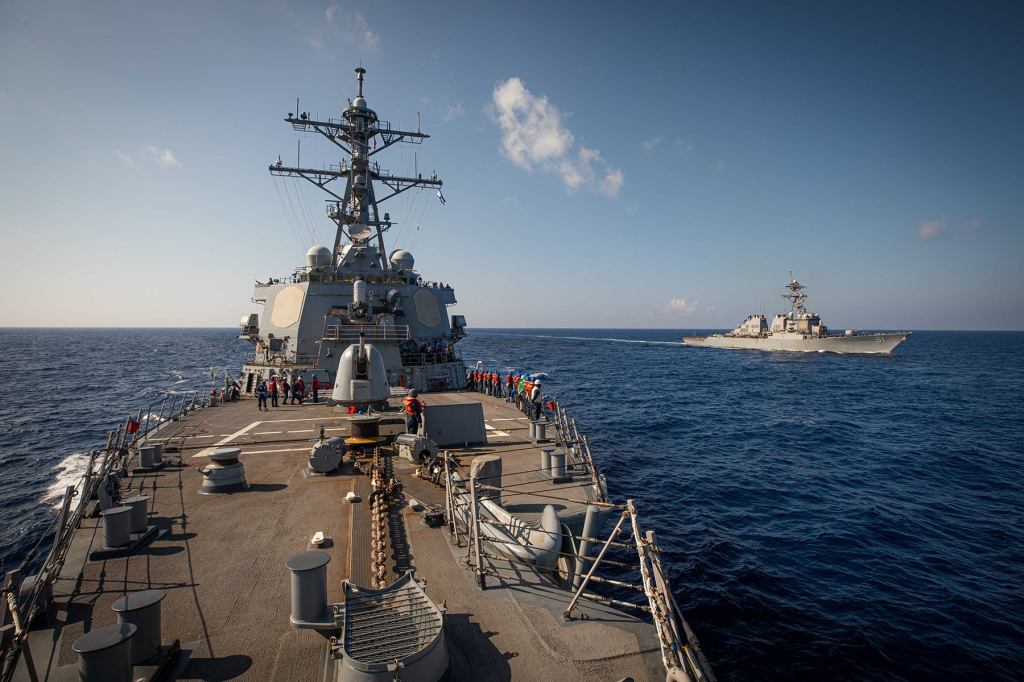
Geopolitical tensions and attacks in the Red Sea have increased since the commencement of the Israel-Hamas conflict. Iran-backed Houthi rebels have focused their attacks in the Red Sea and Gulf of Aden on any merchant shipping that they believe is affiliated with Israel. Following this weekend’s four attacks on three civilian ships near Yemen, the U.S. Navy destroyer USS Carney responded, thrusting the security of trade into the spotlight.

The Red Sea is the superhighway to the Suez Canal. Judah Levine, Freightos’ head of research, said the Suez Canal sees 50-60 vessels transiting each day for about 19,000 each year, including about 30% of global container traffic. 

The Suez has seen an increase in U.S. energy and grain exports as well as U.S. eastbound container imports as the Panama Canal drought restrictions are constricting the flow of trade.

The biggest source of worry is the timeliness of the Houthis vessel data. A Houthi military spokesperson confirmed it targeted a container ship with a drone and another bulk grain vessel because it claimed both vessels were linked to Israel. One, however, was not. Houthis reportedly had outdated information, according to maritime security firm Ambrey.

According to the U.S. Central Command (Centcom), the bulk vessel — Number 9 — that was attacked Sunday is owned by U.K.-based Castle Harbour and operated by U.K.-based Bernhard Schulte Shipmanagement (BSM) and not connected to Israel. The operator appeared to change from Zim in November 2021, according to Ambrey. MarineTraffic shows the vessel left Singapore on Nov. 22 and was slated to go through the Suez Canal this Wednesday.

Ambrey has advised company security officers to assess whether their vessels were owned or managed by an Israel-affiliated company within the last year. But the Israel connection seems to go to the individual level.

Centcom reported that another one of the four vessels attacked was the Bahamas-flagged Unity Explorer. While owned and operated in the U.K., the Israel connection is among its management. Unity Maritime is controlled by Danny Ungar, the son of Israeli shipping businessman Abraham “Rami” Ungar. In November, Ungar’s shipping company, Ray Car Carriers, had its 5,100-unit car carrier Galaxy Leader hijacked by the Houthis.

Unity Explorer is a dry bulk ship that was loaded with grain from the U.S. Cargill grain elevator and transported from the Gulf of Mexico. The vessel left Nov. 2 bound for Singapore and traveled through the Suez Canal approximately six days ago, according to MarineTraffic.

In a statement following the attacks, Centcom said, “These attacks represent a direct threat to international commerce and maritime security. They have jeopardized the lives of international crews representing multiple countries around the world. We also have every reason to believe that these attacks, while launched by the Houthis in Yemen, are fully enabled by Iran. The United States will consider all appropriate responses in full coordination with its international allies and partners.”

But given the misidentification by Houthis of the Number 9, should any ocean carrier that was once linked to Israel consider itself a target because the militants may be working with old information? Does this also mean we could be looking at a war risk premium for vessels traversing the Red Sea and Gulf of Aden if we see more of these attacks?

What this means for trade

War stokes inflation and these attacks can only add to the threat of more war risk premiums. There is currently a war risk premium for vessels going to Israel. In light of the latest attacks and the misidentification of a vessel by Houthis, we may see the war risk premium expanded throughout the Red Sea and Gulf of Aden. This will only add to the inflationary pressures of using this trade route. 

The Suez Canal Authority recently announced an increase of 5%-15% in transit fees, taking advantage of the increase in vessel traffic as more ocean carriers avoid the Panama Canal.

“As we saw in the Black Sea, continued attacks on maritime vessels may lead insurance companies to initiate a ‘war risk’ premium for vessels transiting the Red Sea and the shipping lanes south of Yemen,” said Alan Baer, CEO of OL USA. “If initiated, carriers may have no choice but to pass this additional cost onto exporters and importers the world over.”

When it comes to trade, it has to flow regardless of the situation. Operators will have vessels change course for safety. 

Levine said there have been a handful of examples of Israeli-owned vessels diverting from passage through the Suez Canal and instead sailing around Africa’s west coast and Cape of Good Hope.

“This includes two car carriers, two container vessels operated by Danish carrier Maersk and at least one container vessel by Israel’s Zim Lines,” he explained. “For ships heading to Israel from Asia, the route around Africa is significantly longer — about 7,000 nautical miles and 10-14 days — than via the Suez Canal. This route also incurs higher fuel costs but avoids Suez Canal fees, which are between $400,000-$700,000 per transit and are set to increase by 15% in January 2024.”

Freightos data shows rates from some Chinese origins to Israel have climbed between 16% and 36%.

“This is suggesting that the war is leading to higher costs for carriers and higher prices for their customers,” Levine said.

To mitigate risks, some Israeli ports are closed because of missiles being launched in the area. For those carriers that cannot find war risk insurance, the Israeli government is offering supplemental insurance. This is nothing new, Israel has offered it for years. The Ukrainian government has also offered war risk insurance for vessels that may not be able to secure the extra coverage.

Levine said Zim is alone among the carriers in introducing a war risk insurance premium of between $20 and $100 per container since the start of the war. 

VC-backed CloudTrucks exits factoring business to focus on core offerings

CloudTrucks CEO Tobenna Arodiogbu has announced that his company is exiting the factoring business and will be transitioning its current customers with their own authority to RTS Financial in the coming weeks to focus on its core business offerings, Virtual Carrier and Flex. 

This news comes amid rumors on social media that the Dallas-headquartered company was shutting down after truck drivers using CloudTrucks’ business services received emails about Overland Park, Kansas-based RTS Financial taking over its factoring business. 

In an interview with FreightWaves, Arodiogbu was quick to quash the rumors, stating that VC-backed CloudTrucks made a business decision to “really double down and focus on [our] Virtual Carrier and Flex [offerings] and decided to stop growing the factoring business.”

In July 2022, FreightWaves’ Grace Sharkey reported that CloudTrucks had launched fintech offerings for truck drivers who use its Virtual Carrier leasing program, which included CT Credit, a Visa business card that avoids high-interest rates and fees, and CT Cash, a nonrecourse factoring solution that leverages a Visa Cash card.

“There are no changes to CT Credit,” a CloudTrucks spokesperson said. “We will no longer be offer factoring as a stand-alone service through CT Cash to companies operating on their own authority. CloudTrucks’ Virtual Carrier customers will still receive their instant payments, on-the-job cash advances and fuel discounts directly on CT Cash through our Visa partnership.”

As of publication, a representative with RTS Financial did not respond to FreightWaves’ request seeking comment.

Arodiogbu said in January, more than a year after launching CT Cash factoring services in September 2021, that CloudTrucks made the decision to stop bringing on new customers to its factoring products.

“Our Virtual Carrier and Flex products are still up and running and our transition to RTS will enable us to invest more in those offerings,” Arodiogbu told FreightWaves.

“When we started CloudTrucks, the focus was Virtual Carrier, where we are the trucking carrier,” Arodiogbu said. “We have owner-operators leased onto our authority, and then we help them manage their business from that point on. So they are actually under CloudTrucks’ authority. And you know, we’re a fully functioning trucking carrier.”

According to the Federal Motor Carrier Safety Administration’s SAFER website, CloudTrucks, which updated its MCS-150 form on Friday, has 240 power units and 250 truck drivers. This number is down by about 120 trucks and drivers listed on the CloudTrucks MCS-150 form that was updated in June. 

However, Arodiogbu declined to comment on the number of trucks and drivers operating under CloudTrucks’ authority as it’s a “privately held company.”

He added that no employees have been laid off since June, when CloudTrucks, like many other FreightTech companies, were forced to make cuts as a result of the declining freight market. 

“We’re very well capitalized. We raised funding to continue to operate the business,” Arodiogbu said. “We’re very long-term focused. We made cuts early in the year when we saw that the market was in a really bad place. We are not seeking additional funding at the moment and are very well capitalized and we will go out for funding if we need to, at any point in the future.”

Founded in 2019, CloudTrucks has raised more than $141.5 million, including $115 million in Series B funding in November 2021 in a deal led by Tiger Global. The company is now valued at about $850 million.

Besides Arodiogbu, CloudTrucks’ co-founders are Jin Shieh and George Ezenna.

Do you have a news tip to share? Send me an email or message me @cage_writer on Twitter. Your name will not be used without your permission.

Click for more articles by Clarissa Hawes.

FreightWaves’ Grace Sharkey contributed to this report.

Kodiak Robotics makes autonomous pickup for military

Kodiak Robotics delivered a prototype of an autonomously equipped Ford F-150 pickup to the U.S. military, showing it can adapt its robotic driving system to a light-duty vehicle as well as a heavy-duty truck.

The F-150 upfitted with the Kodiak Driver contains both the autonomy hardware and software required to operate a military ground vehicle. The vehicle is designed to handle complex military environments, diverse operational conditions and operate in areas where GPS is sketchy. 

The vehicle designed to handle off-road variables like rocks, dust, mud and water also operates with remote controls when necessary.

“Kodiak’s new autonomous vehicle shows the maturity and portability of our autonomous system,” Don Burnette, Kodiak founder and CEO, said in a news release. “We have built a comprehensive autonomous system that can be integrated into any vehicle, from a Class 8 truck, to a pickup, to a next-generation defense vehicle.” 

To date, RRAI has developed most of the autonomous-driving technology used by the military in follow-the-leader applications as part of the Army’s Defense Innovation Unit goal of developing demonstrator prototype autonomous ground vehicles.

Dual-use technology

The dual-use potential of Kodiak’s autonomous technology attracted a contract valued at up to $50 million from the U.S. Department of Defense in December 2022.

The integration of the Kodiak Driver into the light-duty F-150, the nation’s bestselling pickup truck, took less than six months.

U.S. Secretary of Defense Lloyd Austin listens to a representative from drone company Skydio who attended a presentation of Kodiak Robotics’ autonomous driving system on a Ford F-150 pickup adapted for military use. (Photo: Kodiak Robotics)

The versatility of Kodiak’s modular and vehicle-agnostic autonomous system helped the speed of the project. The vehicle runs the same software as Kodiak’s autonomous long-haul trucks and features Kodiak DefensePods, an adapted version of Kodiak’s modular, swappable SensorPods.

A technician can swap out a DefensePod in the field in 10 minutes or less. No specialized training is required.

Purpose-built ground reconnaissance

Kodiak will build and deliver two off-road-capable vehicles based on the Ford F-150. Testing began at a military base in November. Once testing is complete, Kodiak plans to put its autonomous system into a purpose-built ground reconnaissance vehicle for military use.

Before testing the F-150 vehicles, Kodiak used its semi-trucks to test its autonomous system in off-road environments, which helped improve its on-road long-haul trucking technology by learning how to deal with dust, rocks and other small obstacles.

“Dual use is the key,” Burnette told FreightWaves. “Finding applications of technology that can apply to military use simultaneously with civilian and commercial use cases is the future. That’s where the efficiency is. That’s where the iteration is.”

Kodiak plans to launch driverless semi-trucks in Texas in late 2024. It has been covering more than 70,000 miles a month in driver-monitored trucks.

Related article:

Kodiak Robotics gets $49.9M Army contract for off-road autonomy 

Click for more FreightWaves articles by Alan Adler.

Saia holds on to Yellow’s freight

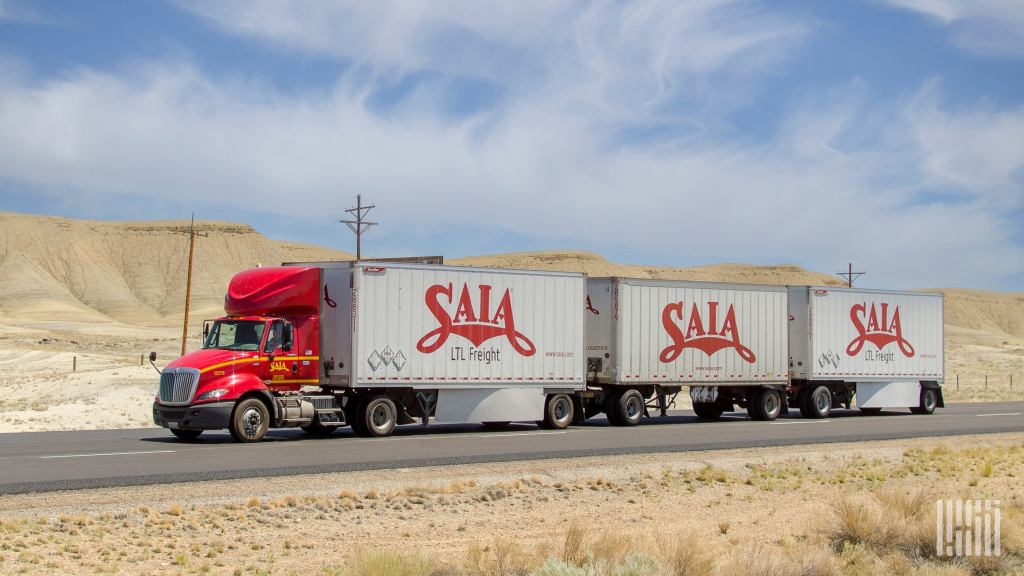
A red Saia tractor pulling three Saia trailers

Less-than-truckload carrier Saia appears to be holding the volume influx it received following the shutdown of Yellow.

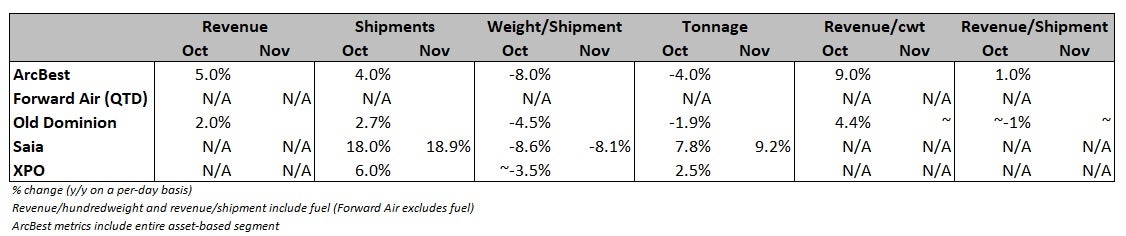
The company reported a 9.2% year-over-year (y/y) increase in tonnage per day during November, which followed a 7.8% increase in October. The acceleration was in part due to softer comparisons to last year. Saia recorded y/y tonnage declines of 3% and 7.1%, respectively, in October and November of 2022.

Saia’s (NASDAQ: SAIA) 2023 fourth-quarter tonnage increases were driven by high-teens growth in daily shipments, which were partially offset by weight per shipment declines of more than 8%.

October had some impact from a cyberattack at Estes, however, some of the carriers that saw a bump in volumes due to the event said that the freight had flowed back to Estes by the end of the month.

Saia’s current growth rates imply tonnage will be down by roughly 5% in the fourth quarter, which is a little bit better than normal seasonality.

“While the acceleration in volume is partly comp related (and we expect another acceleration in December due to even easier comps), today’s announcement does support the view that SAIA is holding on to the majority of its market share gains despite its focus on price and profitability,” Deutsche Bank (NYSE: DB) analyst Amit Mehrotra told clients in a Monday morning note.

Saia’s tonnage was down 13.2% y/y last December. Less-than-truckload demand turned negative at the end of the 2022 summer with the y/y declines accelerating to close the year.

“We also didn’t see anything surprising in weight per shipment trends from October to November vs. what we would normally expect (down 0.6% sequentially), which further supports the view that SAIA is holding on to its market share gains,” Mehrotra continued. “December volumes will also be important, given the company’s GRI [general rate increase] takes effect today (December 4).”

Yellow’s exit has prompted some carriers to implement annual GRIs ahead of schedule. Saia’s recent announcement of a 7.5% increase was 100 basis points higher than its prior GRI and the implementation came two months earlier.

Table: Company reports

Saia saw the biggest sequential increase in shipments among publicly traded carriers during the third quarter, the first reporting period following Yellow’s collapse. Saia responded by adding more than 1,000 employees to its existing head count of roughly 12,000. It has also been adding terminals and equipment in certain markets to accommodate the share wins.  

During the third quarter, Saia’s tonnage per day was up 6.7% y/y as shipments increased 12.2% and weight per shipment was down 5%. The company doesn’t disclose yield metrics in its intraquarter updates but revenue per hundredweight excluding fuel surcharges was 8.4% higher y/y in the third quarter.

The broader industrial complex, which generates roughly two-thirds of the freight moved through LTL networks, remains in decline. The Manufacturing Purchasing Managers’ Index remained unchanged at 46.7 during November and below the neutral threshold of 50 for a 13th straight month. The new orders component of the index did improve 2.8 points to 48.3.

Soft demand throughout the industrial sector has been a primary headwind for LTL shipment weights.

More FreightWaves articles by Todd Maiden

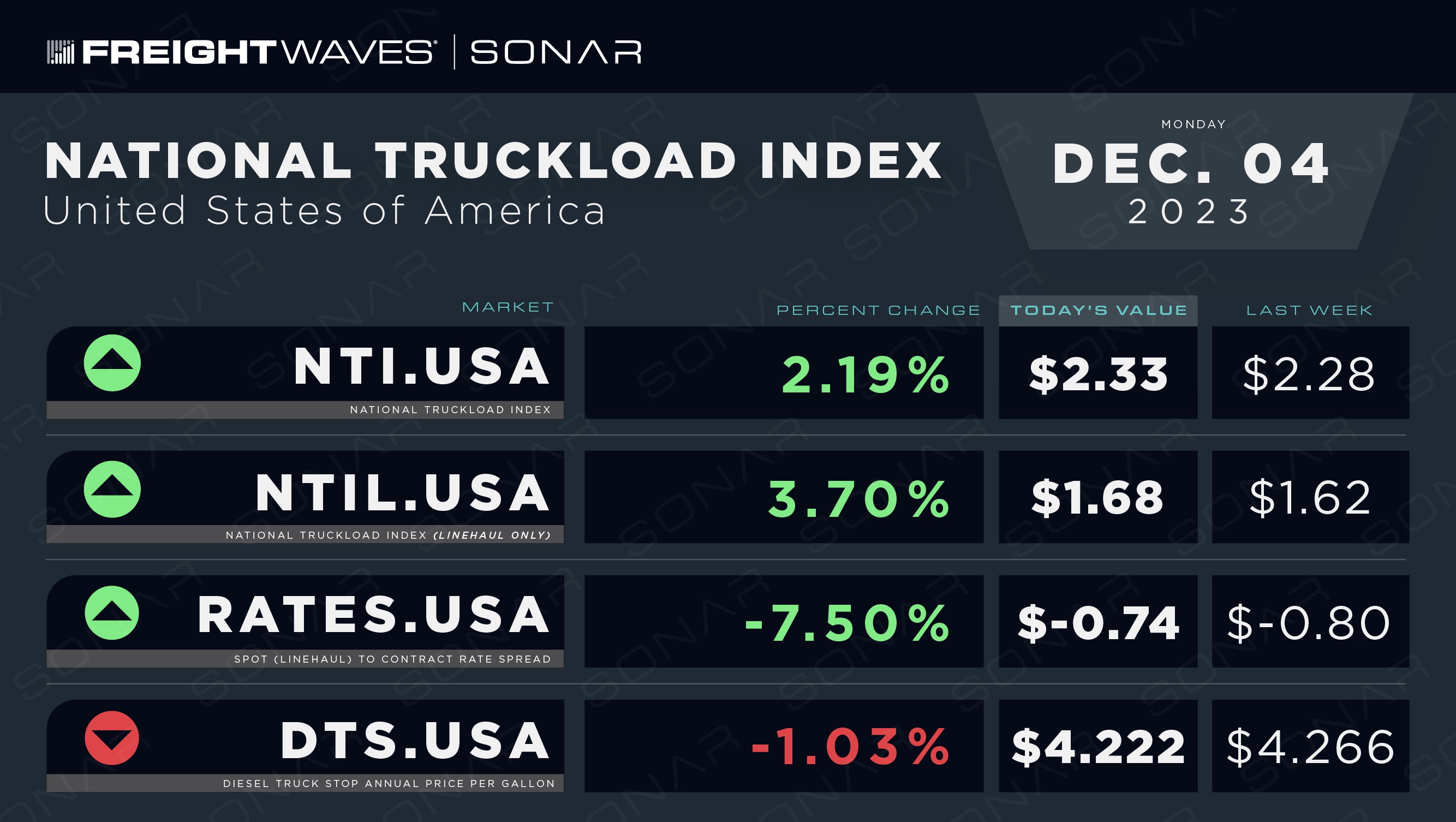
Weekly NTI Update: December 04, 2023


Learn more at SONAR.FreightWaves.com

Tackling supply chain friction to achieve high-velocity supply chain operations

Companies across the supply chain have been laser-focused on improving visibility and increasing efficiency to lower costs and improve customer experience in recent years. In the process, all of these companies have come up against a familiar foe: friction.

“At a high-level, you can think of friction as the aspects of supply chain operations that slow us down, create delays and result in human error,” project44 Senior Director of Product Marketing Eric Fullerton said. “It’s all the elements that make supply chain professionals’ jobs more difficult than they need to be.”

On a day-to-day basis, friction is characterized by manual processes, inefficient workflows and high volumes of human effort. As supply chain leaders look to optimize operations and plan for the future in a down market, this friction stands in the way of transforming their supply chains from cost centers to revenue generators. 

“Even more than macro-trends, the primary challenge supply chain professionals face is the clunky tools and disconnected systems they use to get their jobs done,” said Fullerton. “Many of the solutions in use today were built for a different era and to solve fundamentally different supply chain ecosystem problems. These systems are rigid and fragmented – the result is many screens and siloed activities. To solve this, teams often revert to using complex spreadsheets to bring technology together, which creates even more challenges down the line. What teams need is something that brings new value while enhancing – not discarding – the technology investments they have already made.” 

While every aspect of the supply chain is affected by friction, these frustrating factors can have a particularly detrimental impact on visibility, transportation execution and facility management and last mile logistics. 

Manual track and trace is one of the many ways friction is introduced into the supply chain. These activities require a significant amount of human time and energy, while simultaneously providing subpar insight into shipments.

With manual track and trace, it is virtually impossible to provide an accurate ETA. It is even more difficult to access real-time insights into a shipment’s status and location as it moves through its transportation journey.

“It gets more complex when trying to gain a clear view of your in-motion inventory,” Fullerton said. “This requires a haze of complex calculations and fuzzy math, referencing your order management system and TMS to attempt to translate shipment events into inventory and orders. Before you know it, unexpected delays and exceptions emerge, clouding your visibility further.”

Transportation Execution

Friction is also created by common challenges encountered while moving goods, namely damaged cargo and unforeseen fines. These issues can take a serious toll on a company’s bottom line while simultaneously creating delivery delays that impact customer relationships.

“Overcoming these obstacles to restock and reship requires a dynamic transportation execution system,” Fullerton said. “However, friction strikes again. Inconsistent carrier performance, time-consuming processes to identify optimal lanes and visibility gaps turn transportation into a herculean task.” 

These issues often stem from a lack of actionable data. When shippers do not have access to accurate and holistics carrier performance analytics, it is impossible for them to make partnership decisions based on important critical details like on-time percentage for a given region or potential carbon impact.

Transportation execution is a sticking point for companies of all shapes and sizes, but it can be especially difficult when it involves to last mile delivery.

“As complexity rises, so do exceptions. Demanding consumers expect accurate, frequent order updates,” Fullerton said. “Fall short, and your call centers become overwhelmed, your customer service teams get swamped, and solving each request becomes a costly endeavor.”

Facility Management

No area of the supply chain is more plagued by friction than facilities. Yards and terminals are brimming with manual, error prone processes and reliance on paper for documentation, turning them into supply chain choke points. 

Current processes make yards expensive to run and inefficient to operate, said Fullerton. Scheduling and managing appointments is ineffective and there is limited ability to prioritize trailers and labor organization is inefficient, resulting in high overhead costs. The inability to identify which spots are open in which docks and the manual gate in process often results in trucks sitting in gates not knowing where to go, adding 4-5 hours of unnecessary latency.”

The High-Velocity Solution

Friction in one area of the supply chain creates friction in other parts of the supply chain. Overcoming these obstacles requires a truly modern and innovative approach to supply chain management.

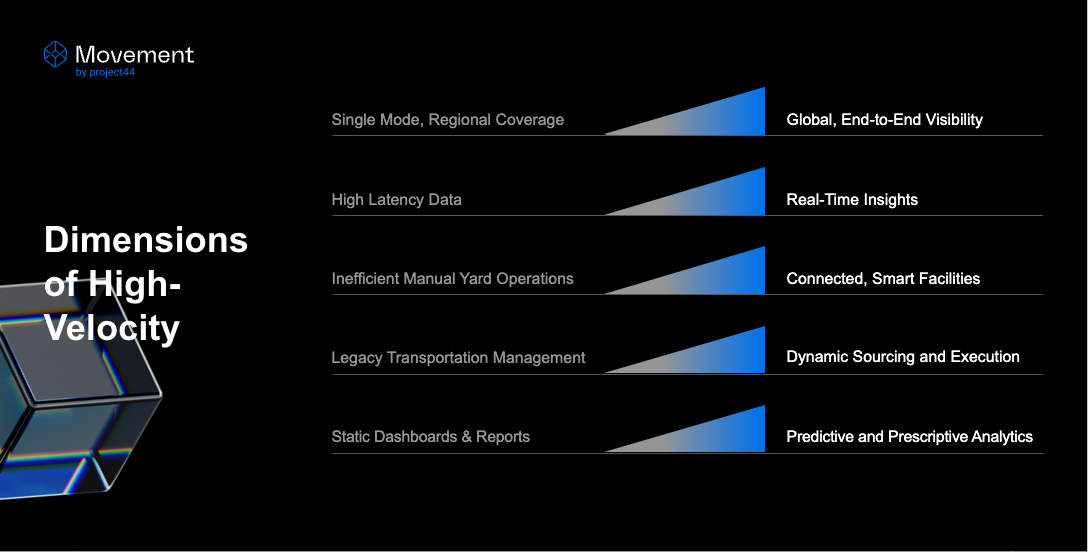
“I think it’s fair to say that friction will never be fully eliminated from supply chain operations,” said Fullerton. However, there are tremendous opportunities to reduce friction where possible, targeting key points across the supply chain that will have transformational impact. At a high level, that means applying AI and workflow automation to these friction points to improve efficiency. Specifically, that could mean being able to view every shipment on every mode in every region, automatically connected to orders with SKU level detail, or fully automated gate in gate out processes combined with automatically unified appointment management informed by truckload ETAs to streamline facility operations. Or a centralized way to instantly access automated, instantly bookable spot and contract rates with metrics such as tracking percentage, on time percentage, or carbon emissions. By using technology to pull out the unnecessary friction from outdated processes – that’s what will give teams the ability to act quickly with confidence. Or in other words, achieve high-velocity supply chain operations. how teams can operate at high-velocity.”

project44 has worked to create a high-velocity supply chain solution with its Movement platform, which enables shippers to redefine their supply chains through next-level visibility, machine learning and greater connection. 

A screen shot of a computer

Description automatically generated

“Even more than being able to achieve key goals such as increasing revenue through better CX, decreasing supply chain cost, and increasing cash flow – modernizing and digitizing supply chain operations to enable teams to work with high-velocity will result in supply chain being a more attractive and compelling profession for the next generation of talent, said Fullerton. A technology-forward generation is not going to choose an industry or profession that heavily relies on paper to accomplish their daily tasks.”

Click here to learn more about turning your supply chain into a competitive advantage with project44

Jacobs leading takeover of software company as he readies next move

Brad Jacobs has chosen the vessel for his next act.

The man who put together the XPO freight conglomerate and then sold it off in pieces to leave behind the LTL-focused XPO, stand-alone 3PL RXO and contract logistics company GXO is leading a $1 billion investment in a company called SilverSun Technologies, which is publicly traded on the Nasdaq (NASDAQ: SSNT). Jacobs remains executive chairman of XPO (NYSE: XPO) and nonexecutive chairman of GXO (NYSE: GXO) and RXO (NYSE: RXO). 

Jacobs is making the investment through his investment vehicle, Jacobs Private Equity (JPE). According to an announcement released Monday, JPE will invest $900 million in SilverSun and a group of other investors, which includes private equity firm Sequoia Heritage, will invest the other $100 million.

The $1 billion investment is for a software company with a market capitalization that isn’t even $20 million and its existing business will be spun off into a stand-alone operation. What remains will be a publicly traded company that, as JPE said in a news release, “will become a standalone platform for significant acquisitions in an industry to be announced soon, along with the Company’s new name.”

The spinoff is expected to be completed in two to four months.

Jacobs, in earlier statements about his next move, did say he intended to be involved in a publicly traded company as he prefers public markets to private capital.

The acquisition of SilverSun appears to have strong parallels to how Jacobs got XPO rolling in 2011. He acquired Express-1 Expedited Solutions with a $150 million investment and built that into XPO. One key difference is the activities Jacobs acquired with Express-1 were in the industry that he stayed in through XPO. What SilverSun does is not relevant to his plans. 

SilverSun says on its website that it “is involved in the acquisition and build-out of technology and software companies engaged in providing best of breed management applications and professional consulting services to small and medium size businesses (SMBs) in the manufacturing, distribution and service industries.”

In its prepared statement, JPE spells out a series of steps that will result in JPE and its minority investors ultimately owning approximately 99.85% of the company. The existing shareholders of SilverSun will receive a $2.5 million cash dividend, funded by the JPE deal, and the existing operations will be spun off into a company named SilverSun Technologies Holdings. The current management at SilverSun will stay in place at the new company, its core business will continue and the deal is structured so its shareholders are in position to benefit from growth at JPE.

After the spinoff is completed, Jacobs will become CEO and chairman of the remaining company, which at that point will have no ongoing activities. And with a platform in hand, Jacobs’ next round of investments and activities can commence with the backing of a publicly traded company.

Jacobs is scheduled to address the Economic Club of New York on Dec. 11 in a midday fireside chat. There have been suggestions he will provide more details of his plans at that time.

Besides logistics, he has created other companies in equipment leasing (United Rentals), waste management (United Waste Systems) and energy brokerage (Amerex).

More articles by John Kingston

BMO’s transportation sector data suggests trucking credit markets worsening

Petroleum hauler Patriot being sold to United at solid premium

Will Supreme Court resolve conflicting rulings on broker liability?