The most wonderful time

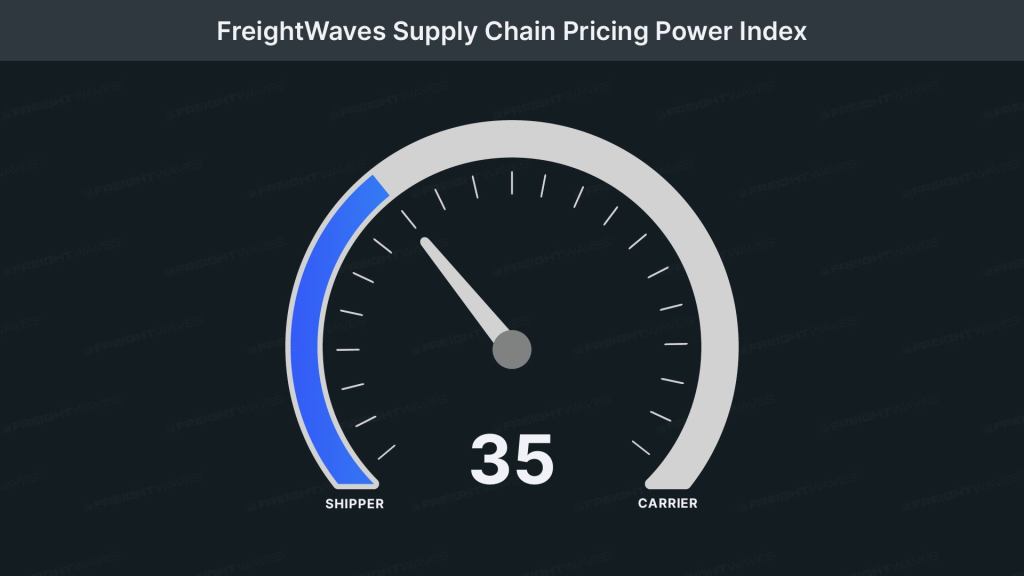
This week’s FreightWaves Supply Chain Pricing Power Index: 35 (Shippers)

Last week’s FreightWaves Supply Chain Pricing Power Index: 35 (Shippers)

Three-month FreightWaves Supply Chain Pricing Power Index Outlook: 35 (Shippers)

The FreightWaves Supply Chain Pricing Power Index uses the analytics and data in FreightWaves SONAR to analyze the market and estimate the negotiating power for rates between shippers and carriers.

This week’s Pricing Power Index is based on the following indicators:

All’s well that ends well

Signals from the Outbound Tender Volume Index (OTVI) will be a bit erratic until next week, as the holiday noise from Thanksgiving is currently skewing volume levels. Since OTVI is calculated as a seven-day moving average, and since freight demand on Thanksgiving was effectively absent, the recent dip should not be alarming.

In fact, tender volumes were effortlessly outpacing 2022 levels in the run-up to the holiday and came within spitting distance of 2020 — the second-best year for freight demand on record. Yet volume trends as a whole will be largely insignificant during the remainder of the year, as December is a very soft month for demand. Instead, the direction of tender rejections and carrier rates will be the metrics to watch.
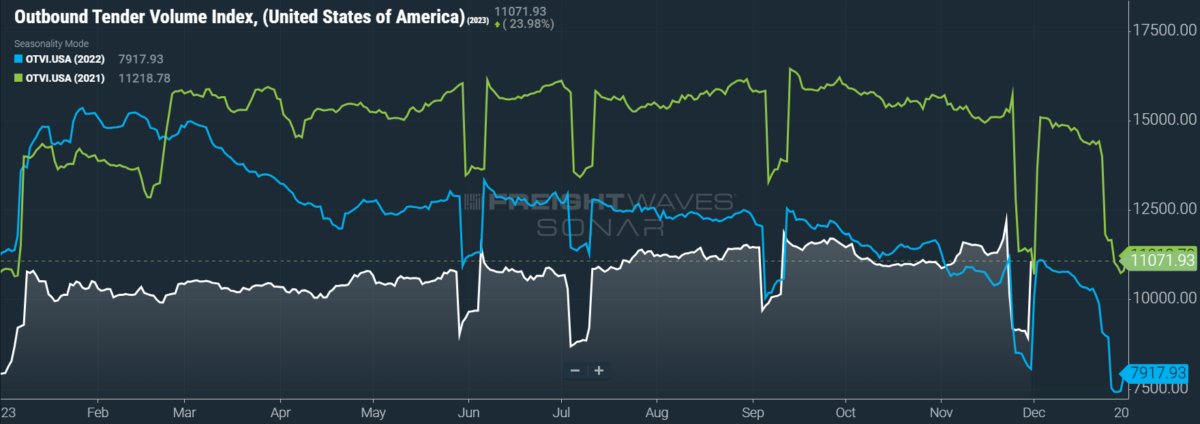
Tender volumes are finally above year-ago levels:
SONAR: OTVI.USA: 2023 (white), 2022 (blue) and 2021 (green)
To learn more about FreightWaves SONAR, click here.

OTVI, which measures national freight demand by shippers’ requests for capacity, fell an unsurprising 1.51% on a two-week basis as holiday noise devalues comps made against last week’s data. On a year-over-year (y/y) basis, OTVI is up 9.76%, though such y/y comparisons can be colored by significant shifts in tender rejections. OTVI, which includes both accepted and rejected tenders, can be inflated by an uptick in the Outbound Tender Reject Index (OTRI).
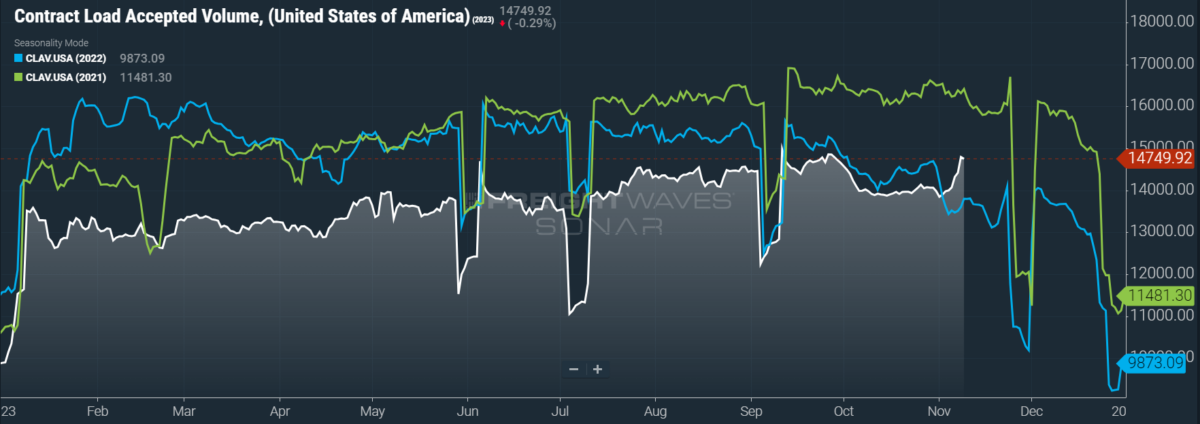
Accepted volumes are outpacing those of 2022:
SONAR: CLAV.USA: 2023 (white), 2022 (blue) and 2021 (green)
To learn more about FreightWaves SONAR, click here.

Contract Load Accepted Volume is an index that measures accepted load volumes moving under contracted agreements. In short, it is similar to OTVI but without the rejected tenders. Looking at accepted tender volumes, we see a fall of 21% on a two-week basis and a rise of 10.44% y/y. This narrowing y/y difference implies that actual freight flow is recovering from this cycle’s bottom.

Bad news came from the goods economy in October, as personal consumption on goods fell 0.2% from the month prior, while durable goods spending fell 0.5% over the same period. These drops are disappointing because of the strength seen during September, when durable goods spending rose 1.1% on a monthly basis. That said, consumers continue to save at a relatively low rate (the personal savings rate edged up to 3.8% from 3.7% previously), which supports a picture of persistent consumption.

Recent data from Bank of America reveals a confidently strong start to the holiday shopping season. Consumer spending on holiday goods was up 4% y/y on Black Friday, a comp made even more remarkable by the fact that core goods inflation was flat y/y in October. In other words, growth in real spending and thus real consumer demand is comfortably higher than it was in 2022. 

Looking ahead to the Federal Reserve’s next meeting in mid-December, it appears likely that the target federal funds rate will remain unchanged and that policy is at its tightest level for this cycle. Fed Gov. Christopher Waller recently stated that “something appears to be giving, and it’s the pace of the economy.” While rate cuts are not probable until late Q2 or early Q3 of next year, December’s meeting could herald a shift in the Fed’s attitude toward interest rates: namely, that its default bias pivots from hawkishness to dovishness. Easing interest rates will certainly help the consumer, which in turn provides a tailwind to the goods economy and truckload markets.
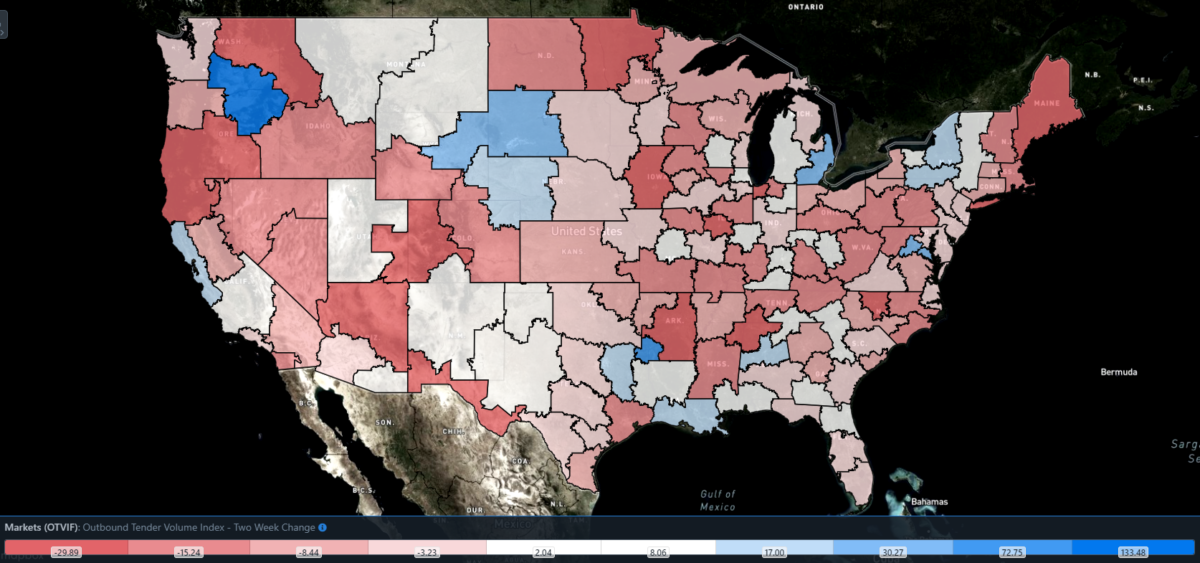
Markets recover from Thanksgiving nap:
SONAR: Outbound Tender Volume Index – Two Week Change (OTVIF).
To learn more about FreightWaves SONAR,
click here.

Of the 135 total markets, only 46 reported increases in tender volumes on a two-week basis, as the strongest performances were scattered across the country.

Gas, break, dip

After an appreciable bump around Thanksgiving — albeit one that failed to match the highs of 2022’s spike — tender rejection rates quickly began to slide at the end of the month. OTRI very well might be headed to early November’s low of 3.29%, which was its lowest reading since early August. If last year’s trends hold, OTRI will continue to decline until mid-December, at which point it should rise from holiday tightness.
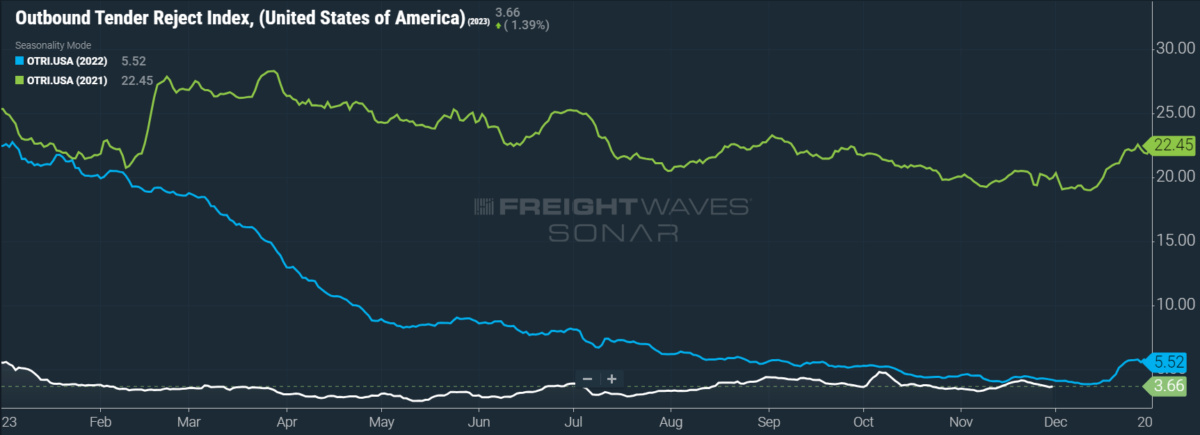
OTRI loses holiday gains at a fairly quick pace:
SONAR: OTRI.USA: 2023 (white), 2022 (blue) and 2021 (green)
To learn more about FreightWaves SONARclick here.

Over the past week, OTRI, which measures relative capacity in the market, fell to 3.66%, a change of 30 basis points from the week prior. OTRI is now only 44 bps below year-ago levels.
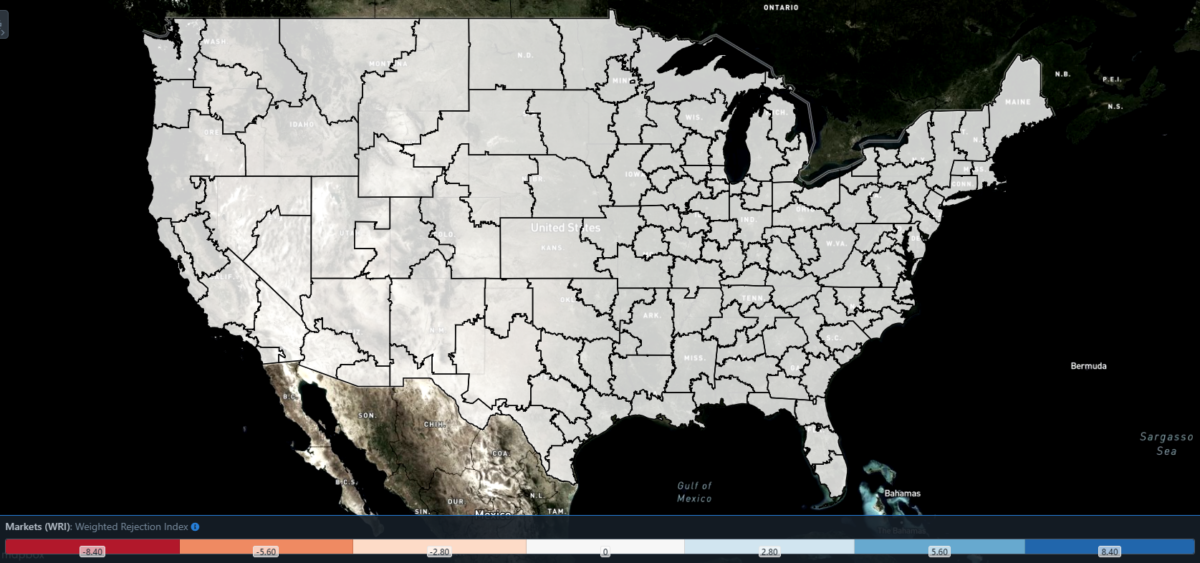
Capacity trends were mostly unremarkable this week:
SONAR: WRI (color)
To learn more about FreightWaves SONAR, click here.

The map above shows the Weighted Rejection Index (WRI), the product of the Outbound Tender Reject Index – Weekly Change and Outbound Tender Market Share, as a way to prioritize rejection rate changes. As capacity is generally finding freight this week, no regions posted a blue market, which are usually the ones to focus on.

Of the 135 markets, 51 reported higher rejection rates over the past week, though 34 of those saw increases of only 100 or fewer bps.

Oil cartel stumbles after unforced errors

Oil markets had an unusual reaction to some unusual circumstances. Last week, OPEC’s meeting was delayed over disagreements among the member states as to the size and distribution of proposed cuts to production quotas. On Thursday, it was announced that OPEC+ had not changed its production targets for Q1 2024. Instead, individual members had agreed to voluntary cuts totaling roughly 2.2 million barrels per day. Of those known, Saudi Arabia agreed to extend its current 1 million bpd cut, while Russia agreed to deepen its cut from 300,000 to 500,000 bpd.

All else being equal, news of production cuts should goose oil prices and therefore prices of distillate fuels like diesel. But the chaotic nature of OPEC’s announcements betrayed a potential disunity at the heart of the cartel, leaving oil markets with little confidence that the group could meaningfully influence prices. As such, domestic oil prices slid further from late September’s peak of $94 per barrel, currently trending at $76 per barrel. Retail diesel prices similarly gained some distance from September’s high of $4.61 per gallon, starting December at a national average of $4.25 per gallon.
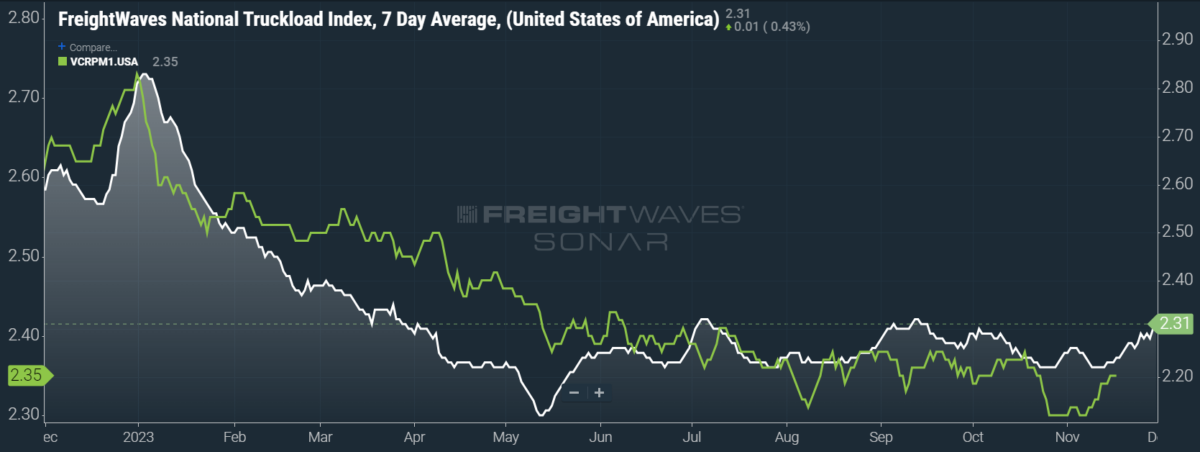
Contract rates bounce back from recent tumble:
SONAR: National Truckload Index, 7-day average (white; right axis) and dry van contract rate (green; left axis).
To learn more about FreightWaves SONAR, click here.

This week, the National Truckload Index (NTI) — which includes fuel surcharges and other accessorials — rose 5 cents per mile to $2.31. Falling fuel prices could not undo the gains in linehaul rates, as the linehaul variant of the NTI (NTIL) — which excludes fuel surcharges and other accessorials — rose 6 cents per mile w/w to $1.66.

Contract rates, which are reported on a two-week delay, are still shaking off a brutal dip from late October and early November. But while those losses have largely been reversed, contract rates are still trending a few cents lower than their Q3 average. Bid season will continue over the next few months, and so the ultimate floor for contract rates has yet to be found. For the time being, contract rates — which exclude fuel surcharges and other accessorials like the NTIL — are up 3 cents per mile w/w to $2.35.
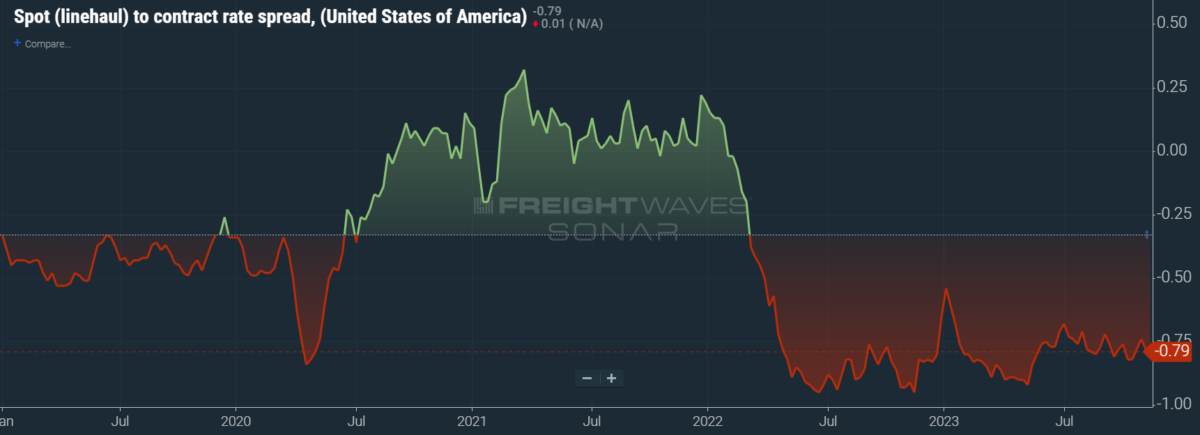
SONAR: RATES.USA
To learn more about FreightWaves SONAR, click here.

The chart above shows the spread between the NTIL and dry van contract rates, revealing the index has fallen to all-time lows in the data set, which dates to early 2019. Throughout that year, contract rates exceeded spot rates, leading to a record number of bankruptcies in the space. Once COVID-19 spread, spot rates reacted quickly, rising to record highs seemingly weekly, while contract rates slowly crept higher throughout 2021.

Despite this spread narrowing significantly early in the year, tightening by 20 cents per mile in January, it has remained wide throughout most of the year to date. As linehaul spot rates remain 79 cents below contract rates, there is plenty of room for contract rates to decline — or for spot rates to rise — in the final month of the year.
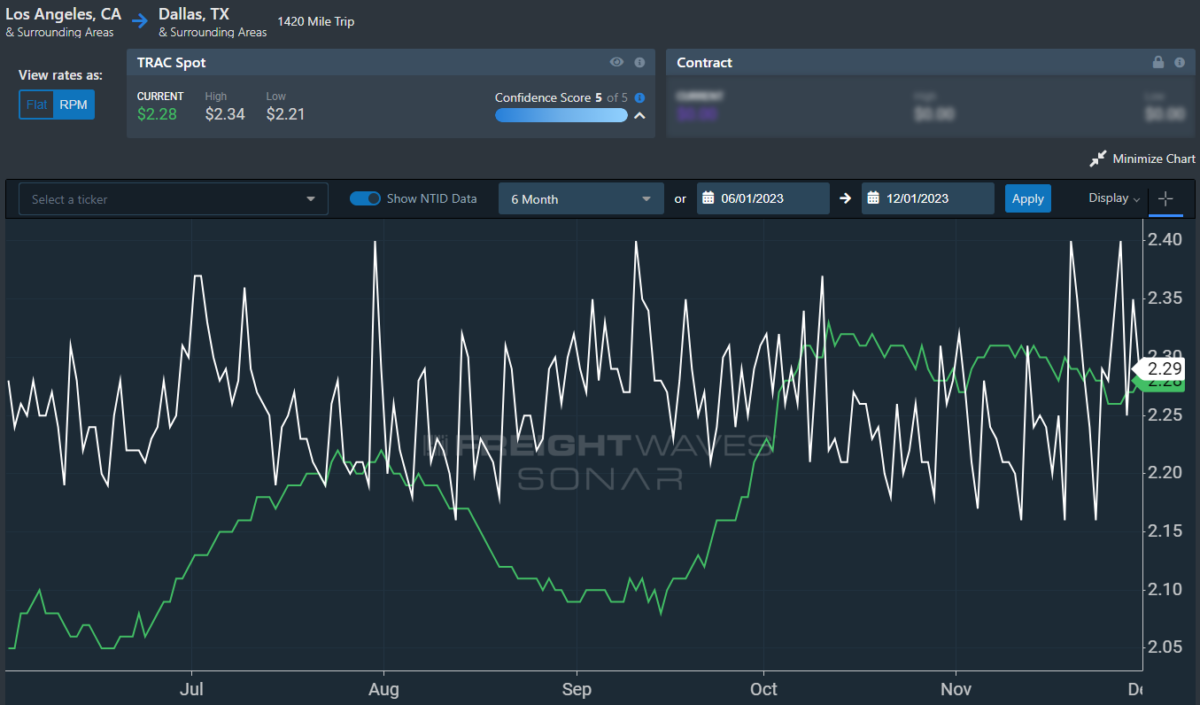
SONAR: FreightWaves TRAC rate from Los Angeles to Dallas.
To learn more about FreightWaves TRAC, click here.

The FreightWaves Trusted Rate Assessment Consortium (TRAC) spot rate from Los Angeles to Dallas, arguably one of the densest freight lanes in the country, is still recovering from a recent dip. Over the past week, the TRAC rate remained unchanged w/w at $2.28 — lingering near its year-to-date high of $2.39. The daily NTI (NTID), which has risen to $2.29, is again outpacing rates along this lane.
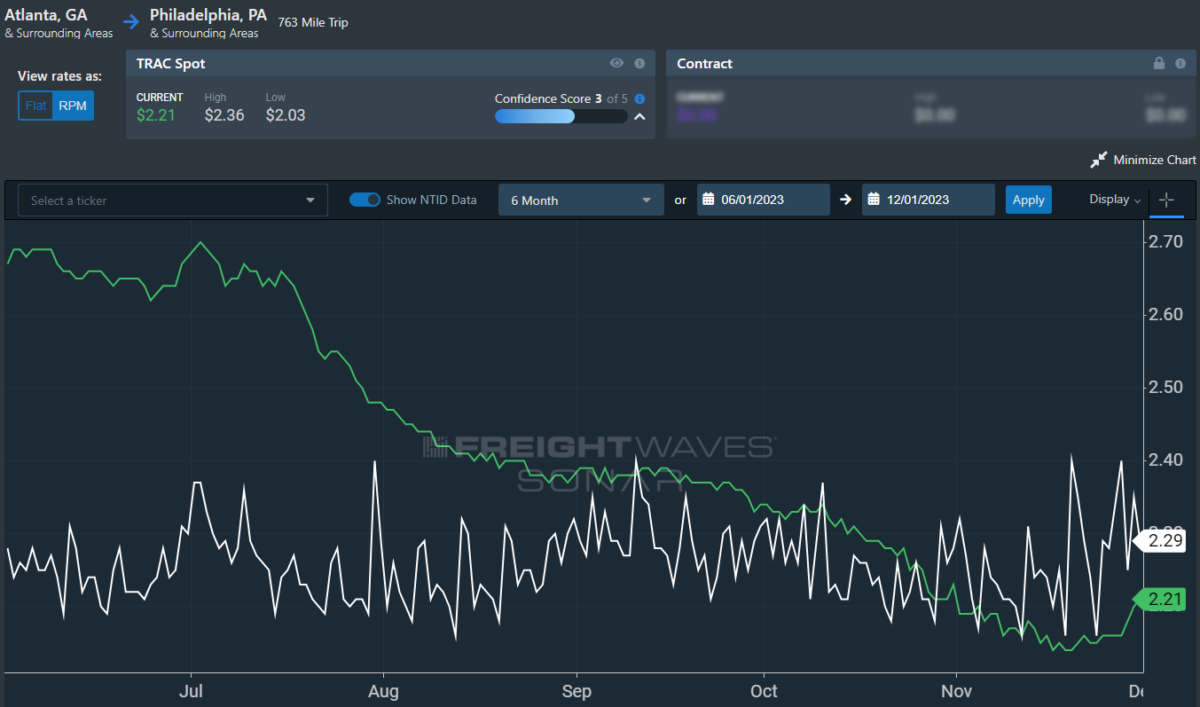
SONAR: FreightWaves TRAC rate from Atlanta to Philadelphia.
To learn more about FreightWaves TRAC, click here.

On the East Coast, especially out of Atlanta, rates saw a stark reversal of November’s losses but are still well below their Q3 average. The FreightWaves TRAC rate from Atlanta to Philadelphia shot up 6 cents per mile to $2.21. After plateauing well above the national average during the summer, rates along this lane declined sharply at the end of July, lacking any positive momentum until recently.

For more information on FreightWaves’ research, please contact Michael Rudolph at mrudolph@www.freightwaves.com or Tony Mulvey at tmulvey@www.freightwaves.com.

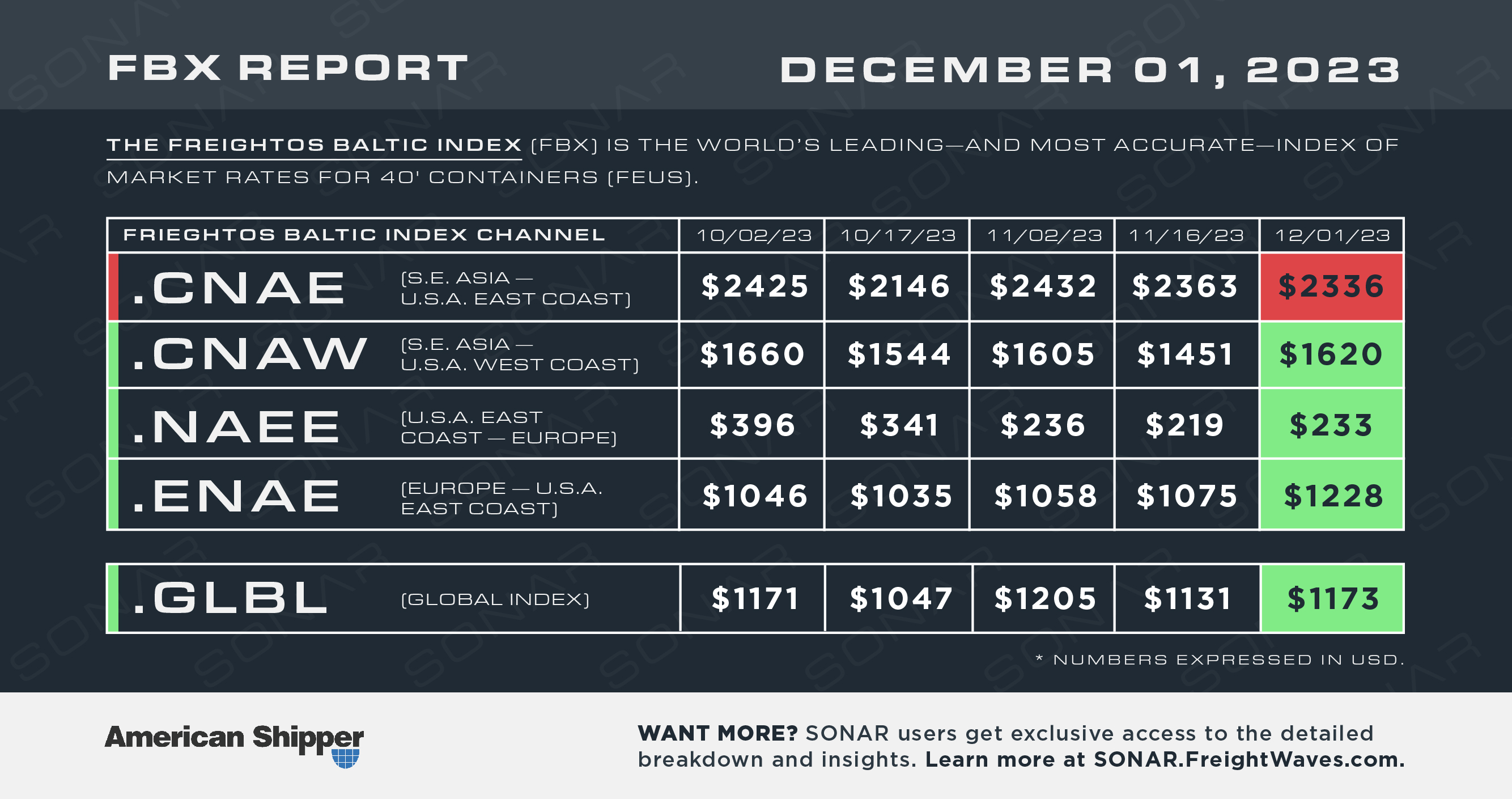
FBX Report: December 01, 2023


To learn more about FreightWaves SONAR, click here.

Fresh thinking about the electric grid holds possibilities  

It is easy to simply state a problem and offer no solutions. For example, where are we going to get the electricity to power the transition to electric heavy-duty trucks? One potential answer is to look at the electric grid differently. 

Common wisdom holds that the outdated and constrained electric grid cannot support the scaling of electric trucks. Looking at the grid’s current use supports that. 

Electrifying just the long-haul portion of the U.S. trucking fleet would require 10% of the nation’s electric power generation, according to a December 2022 study from the American Transportation Research Institute. 

That assumes the status quo. When utilities calculate limits on a new interconnection, engineers consider the potential load from all customers on a circuit. They assume these loads will happen at the same time. 

They rarely do. Some customers use more electricity during the day. Some use more at night.

Opening up the grid with software controls

Southern California Edison (SCE) is planning a two-year pilot program that could make more power available by thinking about the grid differently. A customer like electric infrastructure developer Forum Mobility could use specialized software called a load control management system (LCMS).

An LCMS would allow a charging depot to get an interconnection that would modulate the power it draws from the grid depending on grid conditions. It would get greater access to electricity in times of plenty and less when other customers are maxing out. 

This process would allow interconnections of charging depots more quickly. The assumption is it would lower ratepayer costs by increasing throughput through the existing grid infrastructure.

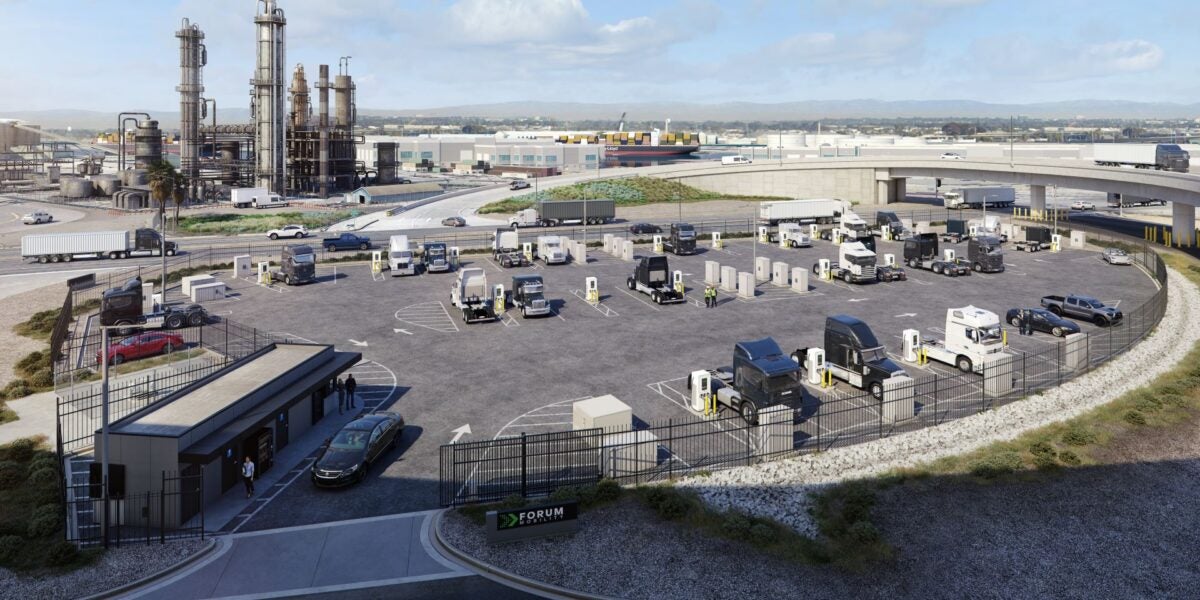
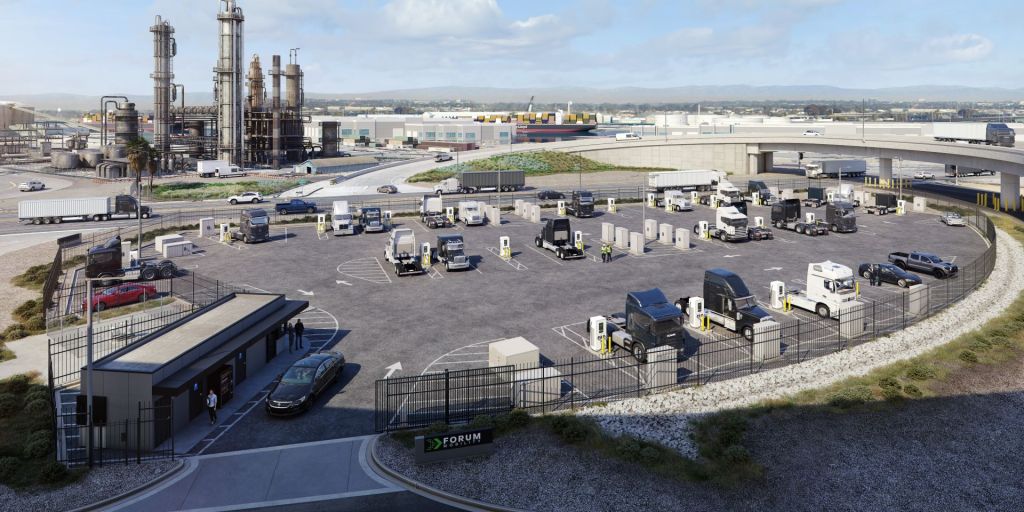
Forum on Thursday announced a 9-megawatt charging depot at California’s Port of Long Beach. The facility adjacent to the Long Beach Container Terminal. will require as much power as a large sports facility. Forum expects energy flowing to the site will be capable of charging more than 200 trucks a day by the third quarter of 2024.

A rendering of Forum Mobility’s 9-megawatt charging facility that will open in late 2024. (Image: Forum Mobility)

Simultaneous charging for 44 trucks

The Long Beach charging depot will offer 19 dual-port 360-kilowatt chargers and six 360-kW single-dispenser chargers. They will be able to charge 44 trucks at the same time with the ability to charge an electric Class 8 truck in about 90 minutes depending on battery size. 

“That’s just several hundred trucks a day. We need [to charge] thousands and thousands of trucks a day,” Matt LeDucq, CEO of Forum Mobility, told me this week before Thursday’s announcement of the Long Beach facility.

“Incremental generation that happens on-site is going to be pretty valuable and pretty necessary. I think that the good news is there’s still sites like the one that we have here and we have more depots coming that look exactly like this one from a power perspective.”

New role for public utility commissions

Pilots like the one that SCE is planning require lobbying, education and advocacy with public utilities commissions.

“Utilities can’t be proactive without the public utilities commissions letting them be proactive,” LeDucq said. “Utilities commissions have to acknowledge that they’re going to have a new role in how things play out over the next couple of decades.”

Looking at creative ways to get more out of the existing grid could forestall expensive upgrades that typically raise rates for residential customers.

“The grid has never been used as a major fuel source for transportation. And so the way that tariffs are constructed today might not be the way that tariffs need to be put together in the future. And that’s complicated,” LeDucq said. “How do you make a tariff for commercial charging that doesn’t unduly hurt the residential customer?”

An intelligent approach to grid operations by utilities and rate-setting public utility commissions could make a difference.

“Just because a line has 1 megawatt of capacity on it doesn’t mean that it always has 1 megawatt of capacity on it. It only has one megawatt of capacity when the grid is most constrained. If we can get our grid more intelligent, that very line that has 1 megawatt capacity probably has 5 or 6 or 7 megawatts for the vast majority of the year.”

Growing demand for power

Startups like WattEV, TeraWatt, Voltera and Zeem Solutions and established carriers like Scneider and NFI Industries are in queue for multiple megawatts of charging power. Then there’s Greenlane, a $650 million joint venture of Daimler Truck, NextEra Energy Resources and Black Rock Alternatives, targeting Southern California for charging sites.

NFI expected to have a state-subsidized charging site in Ontario, California, for its electric drayage trucks up and running by this time a year ago. The latest estimate is February 2024.

Forum announced a 4.4-acre site in Livermore in Northern California in June. Planning began 18 months ago for the newly announced Long Beach site.

“Lead times of electrical equipment tend to drive the schedules of these projects,” LeDucq said. “So for Livermore, that project chugs along. We’ve got our switchgear and transformers being manufactured now.”

Forum’s target customer remains small trucking fleets and owner-operators who could be shut out of electrification if the grid runs out of available electricity before they move to electric trucks. Forum and others should have been working on infrastructure expansion years ago, LeDucq said.

“There’s a pretty good argument that we are a little bit out of step with a few things,” he said. “Infrastructure takes a long time and we need to get out ahead of the market.”

Matt LeDucq, CEO of Forum Mobility (Photo: Forum Mobility)

Slowing California’s Advanced Clean Trucks roll

The American Trucking Associations this week cheered the decision by Connecticut to withdraw from a plan to ban gasoline-powered vehicles by 2035. 

“The tide is turning as state officials across the country wake up to the reality that California’s electric-truck mandates are bad policy that carry serious political consequences,” ATA President and CEO Chris Spear said in a news release.

“As Connecticut, North Carolina, and Maine have realized, blindly following California’s sure-to-fail approach is not the only option,” Spear said. “Ensuring the necessary infrastructure is in place and allowing for a range of technological solutions to prevail, rather than one-size-fits-all mandates, is how we succeed together on the road to zero emissions.”

This is the mantra of the Clean Freight Coalition (CFC). The ATA was a founding member when the lobbying group began operations in March.

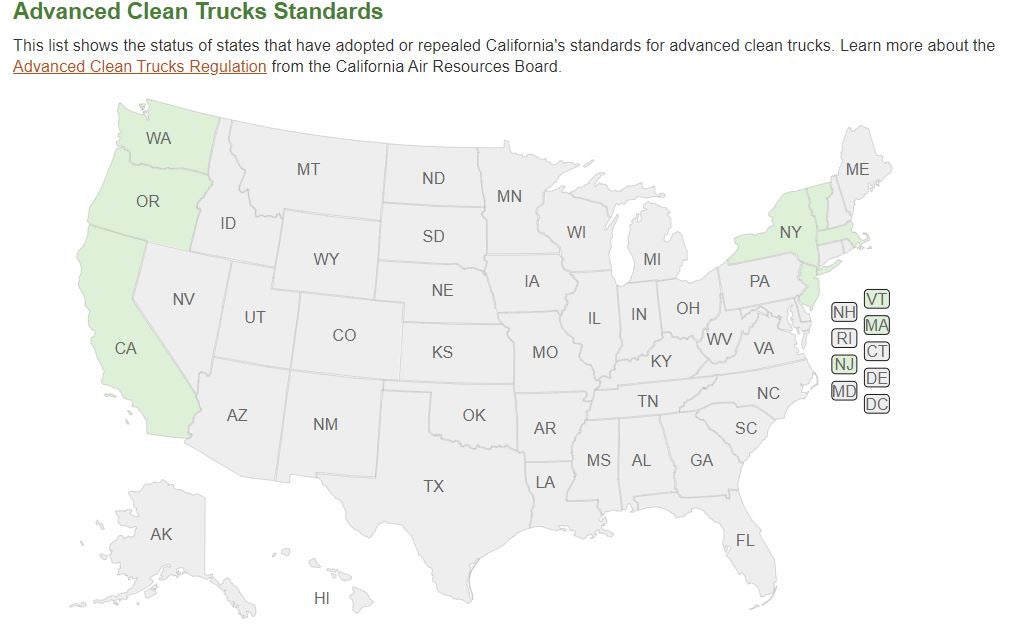
Seven states — Oregon, Washington, Colorado, New York, Massachusetts, New Jersey and Vermont — have adopted the California rules. Several others are considering signing on. 

The map shows states that have adopted California’s Advanced Clean Trucks rule. Colorado also has adopted the standards. (Source: U.S. Department of Energy)

With the first of the Advanced Clean Trucks and Advanced Clean Fleets rules taking effect in January, the battle against the rules is intensifying.

The California Trucking Association has sued to delay implementation of the ACF. The Engine Manufacturers Association cut a deal with the California Air Resources Board to delay implementation of new rules on oxygen nitrates (NOx) emissions in exchange for staying on the sidelines of legal challenges to those rules.

The EMA quietly quit the CFC just before negotiating with CARB.

(Save the date: Clean Freight Coalition Executive Director Jim Mullen will be my guest on Truck Tech next Wednesday at 3 p.m. on the FreightWaves YouTube channel.)


Briefly noted …

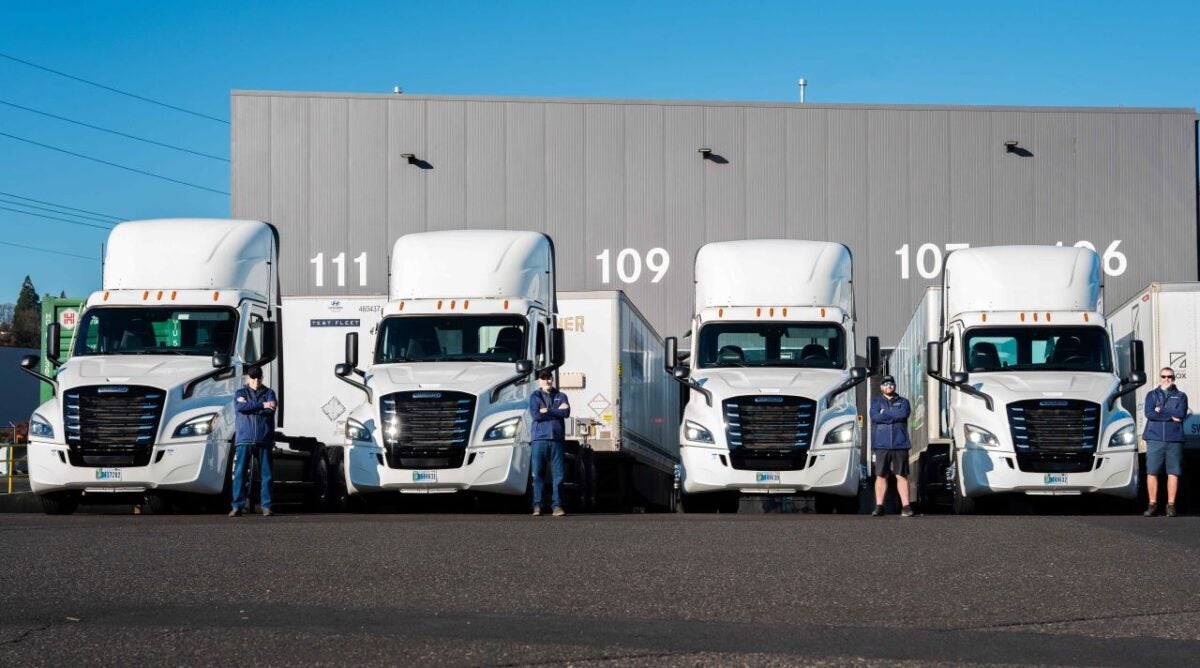
Daimler Truck North America will use Freightliner eCascadia electric trucks for its inbound logistics, a move Volvo Trucks North America implemented in December 2022.

Daimler Truck North America is putting battery-electric Freightliner eCascadias to work handling inbound logistics in the Pacific Northwest. (Photo: Daimler Trucks North America)

Hyundai Motor will demonstrate its Xcient fuel cell truck in the United Arab Emirates of Sharjah and Dubai.

BYD produced its 6 millionth battery-electric vehicle at its Zhengzhou factory in China. The company makes Class 8 electric truck models in California.

The Volvo FH Electric heavy-duty truck became the first electric truck selected as International Truck of the Year.

Autonomous middle-mile logistics pioneer Gatik was named on Fast Company’s Next Big Things in Tech list in the Robotics and Automation category.

Peterbilt assembled the 750,000th truck at its Denton, Texas, plant. The manufacturing facility opened in 1980.


Truck Tech Episode 43: Waabi looks to AI to leapfrog autonomous competitors

Raquel Urtasun, founder and CEO of Waabi Innovation, talked about all things AI in autonomous trucking.


That’s it for this week. Thanks for reading (and watching). We value your feedback. Please write aadler@www.freightwaves.com with comments and story suggestions. Click here to get Truck Tech via email on Fridays. And catch the latest in major events and hear from the top players on Truck Tech at 3 p.m. Wednesdays on the FreightWaves YouTube channel.

BMO’s transportation sector data suggests trucking credit markets worsening

The fiscal fourth-quarter earnings of major trucking lender BMO, the former Bank of Montreal, appear to show a sudden and significant weakening of trucking credit metrics.

BMO’s transportation bank of business — its gross loans and acceptances — rose to approximately CA$15.7 billion ($11.6 billion) in the quarter, its highest on record. But within that rising book of business, gross impaired loans climbed to CA$170 million, up from CA$113 million a quarter earlier — a more than 50% increase — and up from CA$73 million one year ago. That’s almost a 133% increase in the last 12 months.

An impaired loan is one in which a lender believes it is unlikely that it will collect full repayment of principal and interest. Its increase could be seen as reflecting that more borrowers within the more than 10,000 transportation clients at BMO — at least 90% of which are trucking companies — are suddenly finding themselves struggling to stay current on their payments.

Although the size of impaired loans at BMO is rising, the fourth-quarter figure is not a recent high. In 2020’s third and second quarters, impaired loans were CA$189 million. But that was in the middle of the pandemic.

Pre-pandemic, during the weak freight market of 2019, the highest number was CA$149 million in the fourth quarter. 

The growth in impaired loans was easily the most dramatic change in the BMO quarterly report. BMO’s position as a major lender to the industry can be seen most clearly at several industry meetings, where its ubiquitous booth is front and center as conference attendees walk into an exhibition hall. Its role as a major trucking lender dates back to its purchase in late 2015 of General Electric Capital Corp.’s Transportation Finance business. At the time BMO made the purchase, it described the GE unit as the largest lender to the trucking sector.

Actual write-offs of bad loans in the transportation sector rose to CA$20 million from CA$16 million in the third quarter. A year ago, they were CA$3 million. That figure is still below some of the pandemic numbers and even pre-pandemic numbers, when between the fourth quarter of 2019 and the final quarter of 2020, write-offs ranged from CA$23 million to CA$35 million. 

While the rise in impaired loans signals trouble, the problems appear to be new enough that BMO has not greatly increased the allowances it has set aside for potential losses. In the fourth quarter, that figure was CA$20 million. One quarter earlier, it was slightly less than that at CA$18 million and was CA$17 million in the second quarter.

A write-off takes the loan off a bank’s balance sheet. An impaired loan or an allowance keeps the loans on the balance sheet as assets until there is some resolution in the loan’s status. Loans in which allowances have been created are in the CA$170 million figure for gross impaired loans.

One notable comparison is the allowances taken by the bank as a percentage of the loans that are impaired fell to its lowest level in several years, suggesting the impairment is growing at a pace faster than BMO’s decisions and processes to create allowances. 

In the fourth quarter, allowances of CA$20 million were 11.7% of the impaired total of CA$170 million. 

The only quarter in the last two years with a comparable ratio was the third quarter of 2022, when even though the freight market was beginning to implode, BMO had allowances of CA$8 million against impairments of CA$72 million, for an 11.1% ratio. For the other quarters of the prior two years, that ratio was as high as 18.9%. The ratio was 18.7% in the third quarter.

More articles by John Kingston

STB’s Oberman rips into Union Pacific CEO Vena

Estes execs recap hack experience in unusual video presentation 

Freight rail execs seeing some green shoots for beleaguered sector

The president’s plan to strengthen US logistics

By Bart De Muynck

The views expressed here are solely those of the author and do not necessarily represent the views of FreightWaves or its affiliates.

After the industry has been talking about supply chain resilience for years, President Joe Biden on Monday convened the first meeting of his newly launched Supply Chain Resilience Council. (See the White House fact sheet.) The goal of the council is to “strengthen America’s supply chains” and “lower costs for families.” The council announced 30 actions to improve access to medicine and needed economic data and other programs tied to the production and shipment of goods. Although the council includes the who’s who of the different government bodies and agencies, where is the participation of the industry, the folks who know what is going on and can help solve these issues?

I like the way the White House is seeing the importance of supply chains, something folks within the industry were always aware of but somehow others never noticed until COVID hit. According to the White House, “robust supply chains are fundamental to a strong economy. When supply chains smooth, prices fall for goods, food, and equipment, putting more money in the pockets of American families, workers, farmers, and entrepreneurs.” 

It is great to see the U.S. government continuing its focus on the U.S. supply chain in its efforts to further reduce inflation, which was partly caused by kinks in the supply chain. Inflation has decreased from 9.1% at the high in June 2022 to most recently 3.1%. And although companies are faced with inflation and higher logistics costs — the U.S. Business Logistics Cost increased by 19.6% in 2022 — the president referred to companies using “price gouging.” 

Overall, supply chain companies have witnessed lower profit margins and reduced cash flows in the past year, which is quite contradictory to the so-called price gouging that should result in higher profits. Even the shipping lines that were making record profits during COVID have seen rates tumble and as a result had to do cost-cutting including massive layoffs. Supply chain costs have increased from higher wages due to labor shortages and labor disputes, higher insurance rates, disruptions from strikes, higher cost of raw materials due to geopolitical impacts, etc. So, while I don’t agree with the president’s observation, I do agree that the government needs to step in to help improve infrastructure and collaborate with supply chain organizations to improve the overall health of the industry.

As part of its actions to strengthen the supply chain, the government plans to establish new partnerships with private-sector stakeholders to “avoid bottlenecks, shorten lead times for customers, and enable a more resilient and globally competitive freight network,” the White House said in a statement.

And the plans go beyond the U.S. Several initiatives focus on global efforts to boost the supply chain, including partnerships with the European Union, Japan and South Korea to establish an early warning system for semiconductor supply chain disruptions.

The United States is also seeking emergency trade pacts with Canada and Mexico, while strengthening trade throughout the Western hemisphere through the Americas Partnership and several other international efforts.

And technology will play a large role in this endeavor as well. New cross-governmental supply chain data-sharing capabilities and cross-government partnerships will be put in place to improve supply chain monitoring and strategy. The Department of Commerce’s new, first-of-its-kind Supply Chain Center is integrating industry expertise and data analytics to develop innovative supply chain risk assessment tools and is coordinating deep-dive analyses on select critical supply chains to drive targeted actions to increase resilience. There are many opportunities to work with the industries to leverage visibility data platforms like project44 or Mojix and risk management tools like Everstream Analytics.

Additionally, Commerce is partnering with the Department of Health and Human Services to assess industry and import data that can help address foreign dependency vulnerabilities and points of failure for critical drugs.

The Department of Transportation’s Freight Logistics Optimization Works (FLOW) program, a public-private partnership that brings together U.S. supply chain stakeholders to create a shared, common picture of supply chain networks and facilitate a more reliable flow of goods, is announcing a new milestone.

The participants are beginning to utilize FLOW data to inform their logistics decision making, helping to avoid bottlenecks, shorten lead times for customers, and enable a more resilient and globally competitive freight network through earlier warnings of supply chain disruption.

These new analytical capabilities will enable the council to coordinate a more complete, whole-of-government critical supply chain monitoring function.

Exciting times are ahead, and I predict that if government and industry can work side by side, we will see a lot of progress in 2024. As the economy will seek to recover as well in 2024, this should set the entire industry up for success in 2025.

Look for more articles from me every Friday on FreightWaves.com.

Bart

About the author

Bart De Muynck is an industry thought leader with over 30 years of supply chain and logistics experience. He has worked for major international companies, including EY, GE Capital, Penske Logistics and PepsiCo, as well as several tech companies. He also spent eight years as a vice president of research at Gartner and, most recently, served as chief industry officer at project44. He is a member of the Forbes Technology Council and CSCMP’s Executive Inner Circle.

White Paper: State of the Industry – December 2023

The December 2023 “State of the Industry Report” — presented in affiliation with Ryder — shares an in-depth overview across the trucking, maritime and intermodal markets, as well as what to expect in the coming weeks. The data contained within the report provides breakdowns of capacity, volumes and rates.

In this report, you will find:

  • The truckload market is becoming increasingly sensitive to holidays, but momentum has largely stalled.
  • The intermodal market has cooled, but the slowdown is largely caused by international empty volumes declining.
  • The maritime market remains challenged as there was no clear peak season and booking volumes have continued to decline
  • Macroeconomic picture remains a challenge, but the Fed has taken a wait and see approach when it comes to raising interest rates further
  • Retailers are largely cutting forecasts for holiday sales, a worrisome sign as the consumer remains pressured leading into Q1.

Download the complimentary report today to access the full insights.

Daily Infographic: Amazon to sell cars online, starting with Hyundai


To view more FreightWaves infographics, click here

Another Panama Canal red flag: Spiking product tanker rates

a photo of a tanker transiting the Panama Canal

Yet another signal on the Panama Canal situation is flashing red: Spot rates are surging for product carriers — specialized tankers carrying diesel, gasoline and jet fuel — that transit the waterway.

America is the world’s largest exporter of refined petroleum products. The west coast of South America is a traditional destination and the Panama Canal is pivotal to this trade. Alternate routes are more than twice as long.

Since the Panama Canal Authority (ACP) began heavily restricting reservation slots at the start of November, waiting time for ships without reservations has dramatically increased — and spot rates for medium range (MR) product tankers using the canal have skyrocketed to record highs.

According to price reporting agency Argus, the U.S. Gulf-Chile rate reached $121 per ton of cargo on Tuesday, up 92% from Nov. 1. The U.S. Gulf-Peru rate hit $113 per ton, up 105% from Nov. 1.

“Both are the highest levels since Argus began reporting those assessments in 2012 and 2015 [respectively],” said Nick Watt, head of Argus freight pricing services, in comments sent to FreightWaves.

chart of spot rates of tankers transiting Panama Canal
Rates are converted to $/ton from lump sums assuming 38,000 tons of cargo. (Chart: FreightWaves based on Argus data)

Transit delays squeeze tanker supply

Looking back at Argus’ historical data, there is no precedent on these routes for the run-up in rates during November. In past years, rates have increased only moderately, or decreased, during this month.

“The transit delays are squeezing tanker supply available in the Gulf by slowing their return to the Atlantic Basin,” explained Watt. “With about a third of U.S. refined products exports reaching Latin America’s Pacific coast — Chile, Peru, Ecuador and Mexico’s west coast — that’s a significant number of tankers being held up on the way back.

Vessel-tracking data from MarineTraffic showed 20 product tankers waiting at the Pacific entrance to the canal on Thursday.

“Vessels without booked transit slots are waiting up to four weeks to transit the canal’s lock system. Tanker operators are charging premiums to carry cargoes across the Panama Canal because they know they’ll have to either wait in line or secure a transit slot on the return journey,” Watt said, noting that a transit slot for an MR product tanker can cost as much as $1 million.

Tanker ‘migration’ factors

The cure for high prices is high prices. The historic rates being achieved by MRs in the U.S. Gulf-to-west coast route should attract more tankers, bringing rates off their peak.

“Looking ahead, the canal delays are likely to continue well into next year, but U.S. Gulf Coast rates may retreat as tanker operators ballast across the Atlantic from Europe to capitalize on the high-earning journeys in the U.S. Gulf,” said Watt.

On the other hand, Atlantic Basin vessel supply is usually “balanced” by product tankers migrating from the Pacific Basin. The Panama Canal crisis may stymie this option.

Rates for MRs in the Pacific Basin are much lower than in the Atlantic. According to Clarksons Securities analyst Frode Mørkedal, “The sustained strength [in MR rates] is primarily due to market tightness in the Atlantic region. The Pacific market tells a different story, with rates significantly lagging behind.

“A key factor contributing to the subdued Pacific market compared to last year is the reduced volume of Chinese exports, a consequence of the absence of additional export quotas.

“Although there is a significant difference in earnings between the Atlantic and the Pacific, the Panama Canal disruptions make it harder for vessels to ballast from Asia to the U.S.,” said Mørkedal.

Vortexa analyst Mary Melton made the same point in a market commentary on Nov. 24. “Panama Canal congestion could create global fleet distribution rigidity” and “uncertainty for MRs migrating to the Atlantic Basin,” she wrote.

“Moving forward, fleet inflexibility looks likely, as repositioning and migration may be more difficult.”

Click for more articles by Greg Miller 

Forum Mobility adding electric truck charging depot to Long Beach port

A growing number of planned electric truck charging depots in and around the Port of Long Beach in California is barely scratching the surface of the expected need to keep battery-electric trucks moving to match the uptime efficiency of diesel trucks.

Forum Mobility on Thursday announced a 9-megawatt facility adjacent to the Long Beach Container Terminal. When energized in the third quarter of 2024, the facility will be able to charge more than 200 trucks a day. Forum is part of a $400 million joint venture with CBRE Investment Management and Homecoming Capital.

Nine megawatts is equal to the power needs of a major sports stadium.

“Everybody knows that over the next decade, this is an inevitable transition that’s going to happen. And that charging infrastructure is going to be lacking,” Forum CEO Matt LeDucq told FreightWaves. “Those of us who have that charging infrastructure now are going to have a really good asset.”

The California Energy Commission estimates California needs 157,000 medium- and heavy-duty chargers — 53 a day — by 2030 to meet proposed regulations like the Advanced Clean Truck and Advanced Clean Fleet rules.

Forum building a charging network near key locations

Forum is building a network of charging depots at the ports, along freight corridors and near distribution centers to serve owner-operators and carriers of all sizes, the company said in a news release.

The Port of Long Beach is Forum’s landlord. The port also supports a changing depot activated by another startup, WattEV, earlier this year.

Chino, California-based Talon Logistics Inc. secured dedicated chargers for five Class 8 electric trucks. It has locked up charging certainty that might elude fleets that delay transitioning to electric trucks.

“FM Harbor couldn’t be more convenient — 7,000 trucks a day go into the Port of Long Beach. Our fleet will be one of the few able to charge right next to the terminals,” Talon CEO Emmanuel Carrillo said.

Simultaneous charging for 600 trucks over next 10-20 months

Forum is equipping its FM Harbor location with 19 dual-port 360-kilowatt chargers and six 360 kW single-dispenser chargers. They will be able to charge 44 trucks at one time. Depending on the size of its battery, a Class 8 electric truck could charge in about 90 minutes.

Forum plans charging for 600 trucks simultaneously at eight charging depots over the next 10-20 months.

“Is it getting crowded at the Port of Long Beach, in and around from up [Interstate] 710 out to the Inland Empire? The answer is no,” Leducq said. “You need so much charging infrastructure. We’re doing a couple hundred trucks, hopefully a little bit more than that at our facility at the port. What we’re doing now is a little drop in the bucket.”

In addition to dedicated charging, Forum offers a truck-as-a-service (TaaS) option in which drivers or fleets can access truck and charging services for a single monthly payment.

Forum Mobility in $400M JV for electric truck infrastructure

Real estate investors surge into electric truck charging

Drayage is electrifying — Net-Zero Carbon

Click for more FreightWaves articles by Alan Adler.

CSX facing class action lawsuit over Kentucky derailment

A class action lawsuit has been filed against Eastern U.S. Class I rail carrier CSX over the train derailment that occurred in eastern Kentucky the day before Thanksgiving.

The lawsuit, filed Wednesday with the U.S. District Court for the Eastern District of Kentucky, alleges that local community members experienced symptoms such as difficulty breathing and sore throats because two rail cars carrying molten sulfur derailed and caught fire, resulting in the spread of toxic fumes in the area. 

The derailment, which occurred at 2:33 p.m. EST on Nov. 22 just north of Livingston, Kentucky, in Rockcastle County, involved 16 rail cars, including the two that spilled molten sulfur, according to CSX. No injuries from the derailment were reported.

CSX and emergency responders subsequently extinguished a fire that occurred as a result of the derailment. The spilled sulfur caught fire, releasing sulfur dioxide into the air, according to the U.S. Environmental Protection Agency, which went to the derailment site to conduct air quality monitoring. The fire burned overnight until it was extinguished Thanksgiving morning. EPA said that there were no more reports of sulfur dioxide detections in the air after the fire was extinguished.

But that concern about sulfur dioxide being in the air prompted public officials to a voluntary evacuation order, which was later rescinded after the fire was extinguished. Kentucky Gov. Andy Beshear also declared a state of emergency to provide the local area with access to additional resources, including help from Kentucky Emergency Management and the Kentucky National Guard.

Lawsuit argues CSX should have been more proactive in preventing wheel bearing failure

CSX said Sunday that a failed wheel bearing appeared to be the cause of the derailment based on its investigation. The rail carrier hasn’t released further details into what might have caused the failed wheel bearing and how the wheel bearing actually failed, although it told FreightWaves that the investigation into the derailment is still ongoing.

But the class action lawsuit asserts that wayside detectors should have detected any problems with the wheel bearing, particularly if the wheel bearing was overheated. 

“Because of CSX’s alleged recklessness and negligence in monitoring the train’s wheel bearings, they’ve created a potentially deadly environment for all residents living in the surrounding area of Rockcastle County,” Jean Martin, an attorney with Morgan & Morgan, the firm filing the lawsuit, said in a Wednesday news release. 

“First responders to this catastrophe worked diligently for 24 hours to extinguish the fire, while putting themselves at risk of being exposed to potentially deadly chemicals and toxins. We will hold all those accountable for this disaster responsible for their negligence, and will secure justice for those whose lives and homes have been endangered,” Martin said. 

According to the release, plaintiffs are seeking relief such as medical monitoring, punitive damages, damages related to emotional distress, loss of property value and increased risks of future illness. The suit says there are more than 100 class members, and the amount in controversy exceeds $5 million, excluding costs and interest. 

The health of wheel bearings has been in the limelight this year because an overheated wheel bearing appeared to be the cause of the Feb. 3 derailment of a Norfolk Southern train in East Palestine, Ohio. That incident rattled the local community because it also included the derailment of rail cars carrying vinyl chloride. NS and officials decided to vent those rail cars out of concerns that an explosion could occur from the chemical reactions occurring inside those cars. The venting of the rail cars caused a large plume of smoke at the derailment site.

Wednesday’s lawsuit also contends that CSX should have spaced wayside detectors more closely on its network in order to improve detection of the wheel bearing failure.

Following the train derailment in East Palestine, public attention turned to the discrepancies among the Class I railroads over the spacing of wayside detectors, with some arguing that the spacing was too far apart in some areas of the nationwide network. The rail industry responded by saying that the railroads plan to install additional hot bearing detectors on their networks, with a goal of achieving an average spacing of 15 miles. 

“Before the derailment, the train passed a railroad trackside detector and then traveled approximately 21 miles before the wheel bearing completely failed. The train was still two miles away from the next trackside detector,” the lawsuit said. “Across CSX’s networks in the eastern United States, the detectors are an average of 14.9 miles apart. According to CSX, however, on less traveled tracks the detectors are sometimes farther apart, as was the case here.”

In addition to claims that the derailment caused the release of toxic fumes into the area, the suit also alleges that CSX didn’t properly perform inspections of the rail car and its wheels and brakes, nor did it ensure that qualified employees were performing the inspections or that the rail carrier was following procedures required by federal regulations. 

The news release from the law firm also said it is involved in a lawsuit against NS over the East Palestine derailment and it has “successfully litigated” against major corporations in cases such as the 2010 Deepwater Horizon oil spill involving BP, the 2015 Porter Ranch gas well blowout in California and the Merrimack Valley gas explosions in Massachusetts in 2018.

In response to the suit, CSX told FreightWaves in an email: “CSX is reviewing the allegations in the lawsuit. We pride ourselves on being a safe railroad and in the rare occurrence of an incident like the one in Livingston, KY we respond quickly, prioritizing safety and supporting recovery of the community. We appreciate the partnership of the Rockcastle County first responders and the U.S. Environmental Protection Agency for their quick response, and the Red Cross and local businesses that worked with us as we provided food, lodging and expense reimbursement throughout our recovery efforts. CSX will continue to provide support for the community.”

Following the East Palestine derailment, federal regulators, the railroad industry and other stakeholders such as shippers and the railroad craft unions engaged in sometimes public discussions about workforce training and who should be held liable when incidents occur on rail cars that are transported by the railroads but owned by rail shippers.

Some of these discussions became fodder for the railway safety bill that’s currently in the Senate, while others served as the basis for safety advisories from the Federal Railroad Administration. The rail industry also said the industry would be taking steps to bolster rail safety.

Subscribe to FreightWaves’ e-newsletters and get the latest insights on freight right in your inbox.

Click here for more FreightWaves articles by Joanna Marsh.