




Weekly Fuel Report: November 21, 2023

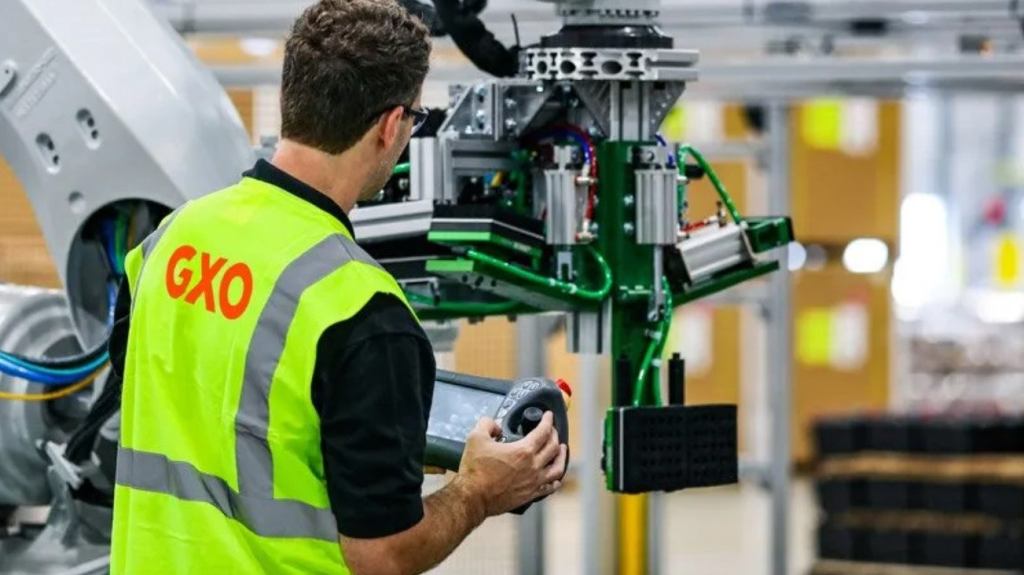
Contract logistics provider GXO Logistics Inc. (NYSE: GXO) said it plans to close a facility in Groveport, Ohio, a suburb of Columbus, and lay off 192 employees.
In a notice sent to the state last week, Greenwich, Connecticut-based GXO said the facility will close on Jan. 15. Layoffs will begin on that date and will be completed within 14 days, GXO said.
Under the 1988 Worker Adjustment and Retraining Notification (WARN) Act, employers with more than 100 employees at a location must give authorities 60 calendar days’ notice of a facility closure and job layoffs.
There was no mention in the GXO letter as to why the facility is ceasing operations. Often, logistics providers close a facility due to loss of business from the main customer using the location.
GXO has announced facility closures in the past 12-18 months In Texas and Wisconsin.

The close of 2023 is likely something many in freight transportation will celebrate.
Carriers were perhaps the hardest-hit group this year, as surplus capacity in the market pushed down their pricing power. Shippers enjoyed greater pricing power over carriers and have shed most of the excess inventory from last year.
FreightWaves and Echo Global Logistics partnered to survey industry professionals in the supply chain, including shippers, carriers, 3PLs/brokers, and others, to gauge their perceptions on market indicators, the state of consumer spending and predictions, upcoming budgets, and the digital tools they plan to implement.
Complete the form below to access this 2024 outlook.
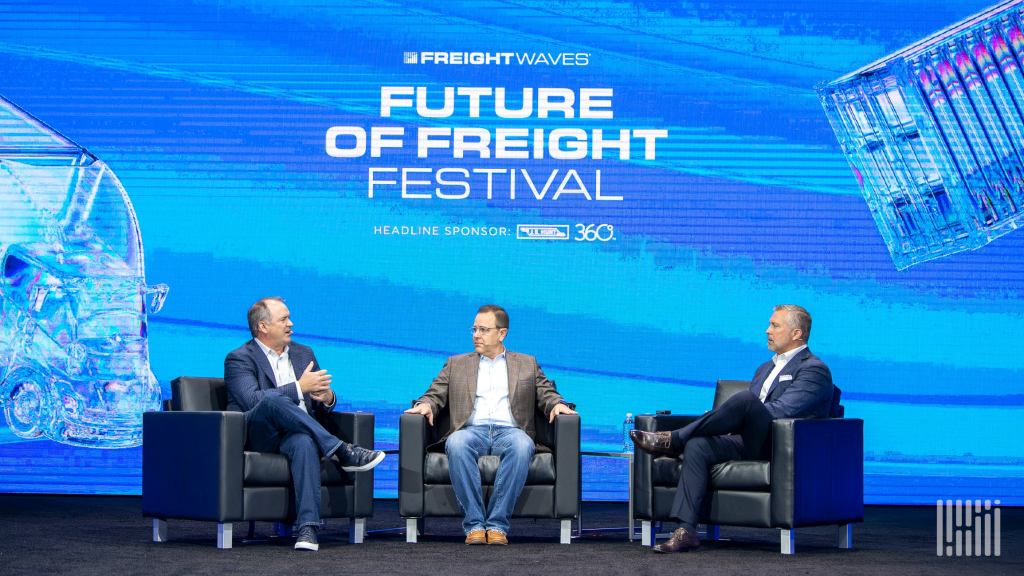
J.B. Hunt and BNSF Railway are heralding a new era in freight transport with the reintroduction of Quantum, an improved intermodal service unveiled at FreightWaves’ F3: Future of Freight Festival in Chattanooga, Tennessee, on Nov. 7.
Quantum, which builds on a decades-long collaboration, pledges to accelerate delivery times and ensure higher consistency in service, offering a competitive edge in the logistics industry. With this initiative, the companies are hoping to capture a segment of the market that has remained elusive: those needing the stability of trucking coupled with the economic and environmental benefits of rail.
By promising a 95% on-time delivery rate and boasting a new operational center to monitor and manage freight movement continuously, Quantum is positioned as a synthesis of tradition and innovation — poised to expand the boundaries of intermodal transport.
On Tuesday morning, executives from both companies met to discuss their vision for the industry. For J.B. Hunt, it was Spencer Frazier, EVP of sales and marketing, and Darren Field, EVP and president of intermodal. For BNSF, it was Thomas Williams, group president of consumer products.
The vision for Quantum emphasizes a transformative approach to intermodal freight transport. Central to their strategy is the expansion of capacity, as demonstrated by the J.B. Hunt container fleet’s projected growth to as many as 150,000 containers by 2027, and BNSF’s development of the Barstow International Gateway. This reflects an assertive posture on improving the scalability and efficiency of operations.
Quantum appears to be a nexus where technological advancement meets strategic infrastructure growth. The technological integration, particularly the idea the companies’ “clouds talk to each other,” underscores a push toward a more connected and data-driven operational model.
“It takes people, process and technology together to execute on our commitment for our customers,” Field said.
The firms’ collaborative ethos goes back decades, to when J.B. Hunt partnered with Santa Fe Railway (now BNSF) on the first iteration of Quantum. The new venture shows a commitment to this pursuit of a unified, customer-centric service model. The idea is that it can now mature into an effort to recapture market share from trucking, as indicated by the focus on lanes traditionally dominated by road transport.
“We have long seen a huge amount of business out there where we thought intermodal could be the right answer,” Field said. “But customers have been hesitant for a host of reasons. And so what can we do that’s unique in the market and gain their trust?”
Both companies attest to having a foundational commitment to providing exceptional customer experiences through their intermodal products. The announcement in March 2022 of a capacity expansion initiative was a testament to this commitment, particularly in response to customer frustrations over service experiences.
Both companies have focused on foundational investments as a springboard for quality service enhancement. BNSF has injected over $2 billion in expansion capital since 2019, resulting in significant infrastructure improvements. These include 90 miles of additional mainline track for consistent train service, expansion of loading tracks at intermodal facilities, and thousands of new parking spaces to accommodate growth.
“[We’re adding] capacity to handle additional volume and capacity to handle that additional volume more consistently over time,” Williams said.
Quantum entails a proactive and customized approach to addressing customer needs, particularly for those shipping scenarios where intermodal was previously avoided due to higher perceived risks. The implication is a service that rivals the simplicity of trucking with the benefits of intermodal’s lower carbon footprint and cost efficiency.
By scaling capacity, streamlining operations and leveraging data and technology, J.B. Hunt and BNSF are positioning Quantum not only as a response to contemporary logistics challenges but as a pioneering service that could potentially shift the dynamics of North American supply chains.
The Barstow International Gateway project is a significant element in the strategy to bolster the Southern California freight corridor. Details emerging about this expansion highlight its potential to transform logistics in the region. The project aims to develop a state-of-the-art facility that could act as a central hub. This expansion is part of a larger vision to meet growing demands and to alleviate congestion in key ports, which is critical given the corridor’s status as one of the busiest entry points for goods into North America.
The planned intermodal expansion into the Phoenix and Denver markets appears designed to tap into the growing industrial and consumer bases within these regions. By extending their intermodal services, both companies hope to capture new business opportunities and provide more comprehensive coverage. This expansion is part of a calculated effort to broaden their footprint and respond proactively to evolving supply chain dynamics in North America.
The so-called Intermodal Innovation Center in Fort Worth, Texas, is poised to become a pivotal hub for advancing analytics and operations research. It’s an investment in a centralized planning that draws on both companies’ strengths. Field said J.B. Hunt has embedded employees with BNSF in the Fort Worth planning center.
Notably, the companies are working together on advanced analytics algorithms to optimize moves from pickup to train loading. Concrete positive results are already being seen, like at the BNSF facility in Alliance, Texas, where Williams said they were seeing a reduction of about 20 miles of hostler driving distance for each loaded train.

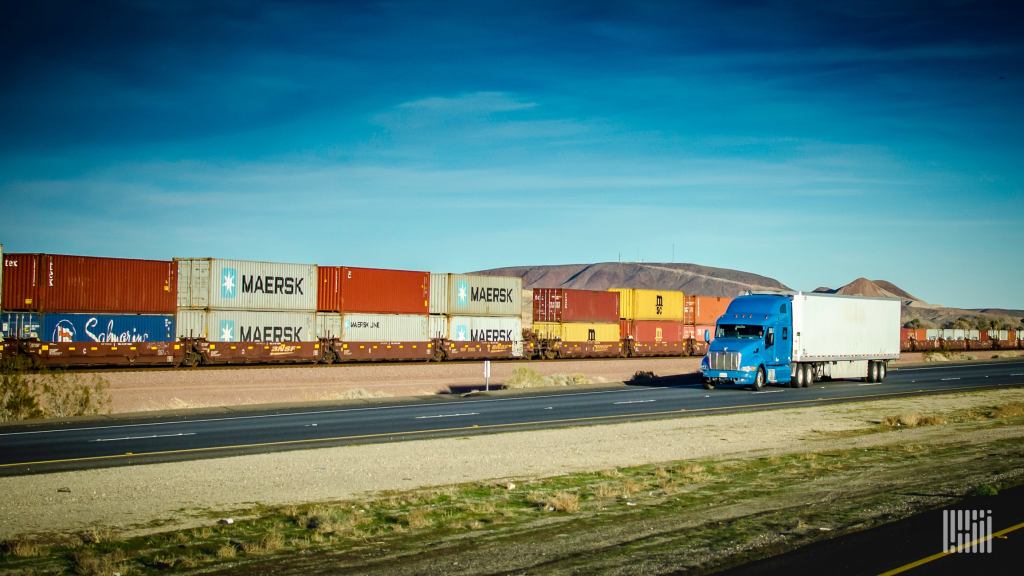
New York — The RailTrends conference for 2023, last week’s gathering of many of the industry’s operating executives as well as those who finance, analyze or try to sell goods and services to the sector, had a cautiously optimistic tone that rail may soon be able to start to snag some market share from the trucking industry.
It’s not a meeting at which unbridled optimism is usually present. Rail has not seen significant organic growth at the expense of 18-wheelers for a long time. That time span might be viewed as forever, if you have listened to some of the speakers at RailTrends over the years.
Whereas the meeting in 2022 seemed almost like a gathering of people who thought an exorcism might be in order, after railroads failed to capitalize on one of the greatest freight markets ever and had a huge number of complaints about bad service to boot, RailTrends 2023 might mark at least a turnaround in outlook that would still need to be backed up by actual performance. RailTrends is organized by independent Wall Street analyst Tony Hatch and Progressive Railroading.
What has been lost was starkly laid out by Rob Cannizzaro, COO of the Intermodal Association of North America (IANA).
According to Cannizzaro, intermodal rail has lost about 1.4 million intermodal loads since 2017, which translates to about $3.5 billion in revenue.
Keith Creel, president and CEO of Canadian Pacific Kansas City Southern (CPKC), came to the meeting as the CEO of the merged Class I railroad between its two namesakes (NYSE: CP), a deal that was not concluded by RailTrends a year earlier. He said the combined railroad, which stretches from Mexico into Canada — the only Class I that can make that claim — is creating competition.
“This industry is getting stronger as a result,” he said. “Not just us. I think if you look across the board at every railroad, we’re in a better place today than a year ago. There’s motivation, there’s excitement, there’s energy and there’s investment.”
Specifically, Creel said the Midwest Express intermodal service that was announced in May to provide four-day service between Chicago and Mexico has been turning in a performance that has exceeded that goal on average by several hours.
Referring to other competing services between the U.S. and Mexico that have been announced in the last year, Creel said these expansions were signs that “competition is undoubtedly changing and driving a stronger industrial network to the benefit of the customer and commerce.”
Creel said CPKC has “a very robust pipeline plan for next year, and the following year, there’s no shortage of demand.” But he cautioned that while he saw the road map to more growth, “if you get ahead of yourself, and you’re putting too much traffic on your network, you destroy your value proposition.”
Another change from the 2022 meeting is that a year ago, railroad and union negotiators had agreed upon a contract but the road to ratification had plenty of bumps in it before full worker acceptance. That didn’t come for several weeks after the meeting.
Ian Jefferies, president and CEO of the Association of American Railroads, noted that difference between this year’s RailTrends conference and last year’s. “In the weeks following [the 2022] conference, we were able to get [contracts] across the finish line.”
He called it the “richest contract for our employees,” with provisions on leave that “created much more work-life balance.”
Even Adrienne Bailey was positive. The partner at Oliver Wyman’s rail consulting group, a fixture on the agenda at RailTrends, has been strongly critical of the rail sector at earlier gatherings. Although her address was about “green propulsion,” the use of alternative fuels in power units, she prefaced her remarks by saying that she hoped “by next year I will be talking about the shining successes” of the industry after reviewing positive steps taken in the past year.
Chuck Baker, on the same panel as Jefferies, is the president of the American Short Line Rail and Regional Railroad Association. He said it’s “been a rough, I guess I would probably say, about six years at this point.”
But he also said that “you’re starting to see a lot of green shoots in the industry. It feels like we’re turning a corner.”

This index of rail volume from SONAR shows a recent upturn.
There were several references during the conference to recent gains on the rails.
Beth Whited, president of Union Pacific (NYSE: UNP), echoed that view of recently stronger markets, saying the railway was having “a really very strong run through about the end of September, maybe even into early October.” And while grain and coal shipments have slowed recently, Union Pacific had a “really strong” October in both its industrial and premium divisions.
It was the address by Joe Hinrichs, president and CEO of CSX (NASDAQ: CSX), that sounded more like some of the gloomier forecasts of the past. Its themes were familiar: Good service is necessary for growth and we’ve got a long way to go.
Hinrichs lamented that railroading is the type of activity that many people have had a “love affair” with “and somehow we lost that.” That fact has made it more difficult to attract and retain talent.
Another result is that railroads’ reputation (damaged in part by the February accident in East Palestine, Ohio, that was mentioned several times over the course of the meeting) has taken a hit, with the industry sometimes being seen as “bad guys,” Hinrichs said.
Part of the solution for safety and technology shortcomings is more and better cooperation, Hinrichs said.
“What in our railroads’ DNA inhibits us from working together on stuff like that?” Hinrichs asked. That the fate of the railroads is linked is obvious. Every railroad has derailments and when they occur, “we all feel the effects of that.”
Even if that could be overcome, “the standards are too low in this industry for customer service.” And if better service were provided, “a lot of our problems would go away,” Hinrichs said.
“We should want our customers to be enthusiastic about doing business with us to be excited about their business,” Hinrichs said. “And the standards we set for that bar are too low in our industry.”
More articles by John Kingston
STB’s Oberman rips into Union Pacific CEO Vena
Estes execs recap hack experience in unusual video presentation
3PLs get fresh legal win in fight to block liability in truck accidents

As if a 50-page motion for probation was insufficient, convicted Nikola founder Trevor Milton is asking his trial judge to let him use testimony from a failed arbitration case with the company to add to his plea for leniency.
Nikola opposes that idea.
Milton now faces sentencing Dec. 18 on three federal fraud convictions related to lying about the technical accomplishments and prowess of the electric truck company he founded in 2015. It was the fourth delay in his sentencing.
Defense attorneys and prosecutors agreed it should be pushed out again. U.S. District Judge Edgardo Ramos in New York agreed to the reset.
A jury found Milton guilty in October 2022.
Milton’s defense lawyers asked Ramos to allow use of testimony from a recently concluded arbitration case between Milton and Nikola. Arbitrators ruled Milton should pay the company $165 million. Part of that would cover a $125 million Securities and Exchange Commission fine. The company agreed to pay that amount in December 2021 for Milton’s misdeeds.
They want arbitration testimony by current CEO and former Chairman Steve Girsky, former CEO Mark Russell, former CFO Kim Brady, and others.
Following a hearing last Thursday on a protective order Nikola sought in June 2022 to protect company secrets and conversations spilling out in Milton’s trial, the defense asked for the arbitration material so Milton could file an addendum to his plea for probation. In the letter to Ramos on Monday, they said Nikola did not respond.
“The attempt to tie this request to Milton’s sentencing so as to generate urgency is contrived … witness statements in another proceeding that Milton lost do not go to the issues … at sentencing,” Nikola attorneys wrote to the judge. The arbitration testimony remains non-public.
Ramos asked both sides to provide him an update on their discussions by the end of the day Tuesday.
Editor’s note: Updates with Milton sentencing delayed to Dec. 18.
‘Ambitious dreamer’ Trevor Milton seeks probation instead of prison
Nikola founder loses bid for a new trial
Indicted Nikola founder wants to use company conversations in trial
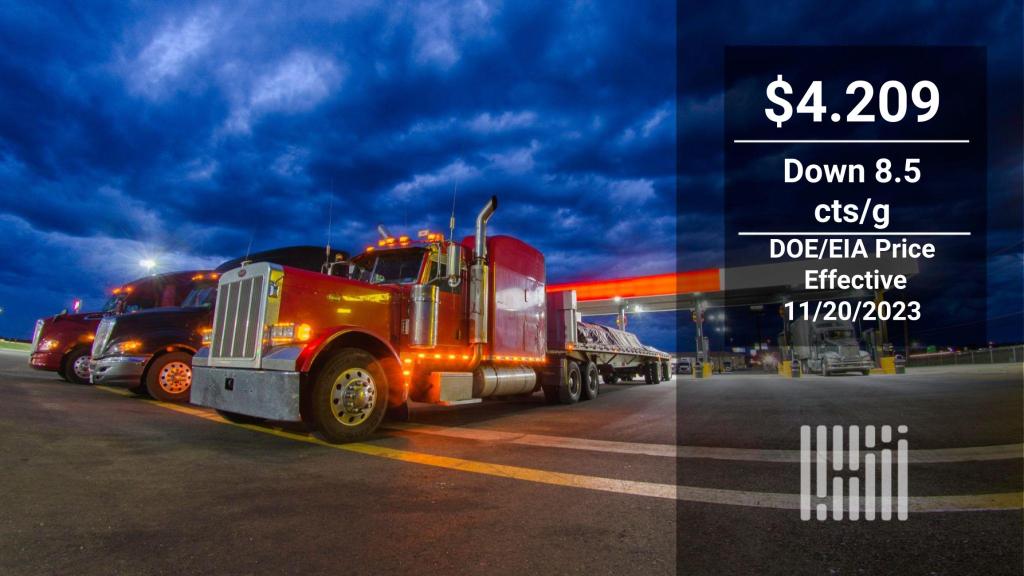
The average price of diesel at the pump is showing nothing but down arrows, according to the report of the Department of Energy/Energy Information Administration (DOE/EIA) average weekly retail price.
The price used for most fuel surcharges was posted Monday at $4.209 a gallon. That is down 8.5 cents in the past week and 38.4 cents since a recent high on Oct. 2. It’s also down 33.6 cents per gallon in the past four weeks, the current streak of declines, and in the past year, it’s down $1.024 a gallon.
Retail prices, as usual, are catching up to earlier declines in the futures market, which then are generally quickly reflected in wholesale markets.
From a settlement of $3.1767 a gallon on Oct. 17, the price of ultra low sulfur diesel (ULSD) on the CME commodity exchange plummeted to a recent low settlement of $2.7191 a gallon on Nov. 9.
It moved up and down over the next several days. But then after settling Thursday at $2.7502 a gallon Thursday, ULSD moved up the next two days, settling Monday at $2.8495 a gallon, an increase of almost 10 cents since the Thursday settlement.
The upward movement the past two trading days is generally believed to be driven by the possibility of more output cuts coming from a meeting Sunday of leading oil producers.
OPEC+, a large group of oil exporters that includes the members of OPEC as well as some non-OPEC countries led by Russia, will meet that day. There have been two significant cuts by the members of the group earlier this year: an OPEC+-wide reduction in April that totaled about 1.16 million barrels a day and then a further reduction by Saudi Arabia alone of 1 million barrels a day that began in July.
Markets have been pushed higher by speculation that given the supply/demand balance in the global oil market that has pushed global benchmark Brent down below $80 a barrel at times — far from any sort of unofficial $100-per-barrel target — Saudi Arabia might not only extend its reduction into 2024, which is expected, but might cut further.
The march to $100-per-barrel Brent, which got up above $95 a barrel by the end of September, has been thwarted mostly by higher crude output from some of the OPEC+ members, such as Iran, as well as higher production in several other nations, like the U.S., Brazil and Guyana.
Demand, meanwhile, is healthy. In its latest monthly report, the International Energy Agency said global demand in 2023 would be 102 million barrels a day, an increase of 2.4 million barrels per day. That figure was an increase of 110,000 barrels a day more than its estimate in the October report. But when it comes to the price of oil, the supply gains appear to be negating that increase in demand.
One factor that has not yet been able to boost oil prices is tight inventories, particularly in diesel. The latest weekly report of the EIA on ULSD inventories, for the week ended Nov. 10, showed them to be about 86% of the seven-year average for the second week of November.
But that isn’t necessarily the case everywhere. Argus Media last week reported that middle distillate inventories in the refining and storage hub of Singapore were recently at a two-year high.
In an interview Monday on CNBC, Amrita Sen, the director of research at the Energy Aspects consultancy, said movements in inventories are also impacting markets. “Right now, with higher interest rates, nobody wants to hold any inventory,” Sen said. “So I think we’ve seen more destocking as well.”
The destocking is bearish because it is putting more supply on the market or eliminating demand that might otherwise go to build up stocks. But the tight inventories themselves then become a bullish factor.
More articles by John Kingston
STB’s Oberman rips into Union Pacific CEO Vena
Estes execs recap hack experience in unusual video presentation
3PLs get fresh legal win in fight to block liability in truck accidents
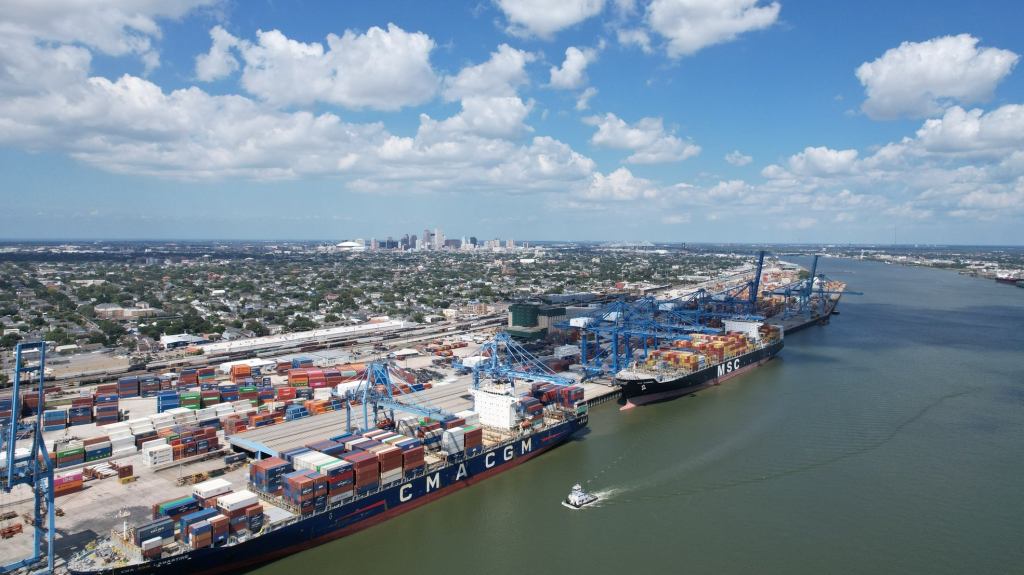
Container freight flows and crude oil shipments declined slightly in Houston and Corpus Christi, Texas, during October, while container traffic rose at the Port of New Orleans, helped by movements of steel and rubber commodities.
Port Houston saw container cargo volume slip for the third consecutive month.
The port processed a total of 366,208 twenty-foot equivalent units in October, a 2% drop from the same month in 2022.
Loaded exports in October reached 126,011 TEUs, a 6% year-over-year (y/y) increase, boosted by shipments of resins, according to a news release. Loaded imports fell 4% y/y in October at 174,929 TEUs.
Empty container imports surged 52% y/y in October to 12,321 TEUs, while exports of empty containers fell 17% y/y to 52,947 TEUs.
Imports of steel were down 1% y/y at 292,403 TEUs, while exports fell 661% to 39,873 TEUs.
Total tonnage through the port is down 7% year to date compared to 2022, at 42 million short
tons. Steel volumes were down 13% from January through October compared to the same year-ago period.
Auto import units increased 50% y/y in October, the port said in a news release.
Port Houston also recently completed the Wharf 6 project at its Bayport Container Terminal. The new berth is equipped with three ship-to-shore cranes, which will add capacity for both import and export customers, officials said.
“We are excited to announce the arrival of the first vessel at [Wharf 6], which symbolizes a bright future for the port and the culmination of more than five years of planning,” Roger Guenther, executive director at Port Houston, said in a news release. “This addition was a significant infrastructure investment and demonstrates our commitment to creating a dependable and efficient terminal environment for our customers.”
Bayport Container Terminal’s Wharf 7 is slated to be commissioned in 2025, the same year reconstruction of the port’s Barbours Cut wharves 5 and 6 will be completed. Bayport’s Container Yard 7 project includes the construction of 45 acres of a concrete bulk terminal for increased container storage.
The Port of Corpus Christi posted its first y/y decline in total shipments in 2023 during October, handling 16.5 million tons, a 1.8% decrease from the same period last year.
Total shipments of crude oil also recorded the first y/y decline in 2023 during October, marking a 0.5% y/y decrease while handling 10.234 million tons compared to 10.284 million tons in October 2022.
Exports of crude oil totaled 9.72 million tons, a 3% increase compared to the same year-ago period. Imports of crude oil fell 41% y/y to 510,253 tons.
Petroleum shipments decreased 2.4% y/y to 5.32 million tons. Exports of petroleum totaled 3.9 million tons during October, a 9% y/y decrease.
Dry bulk cargo decreased 16% y/y to 491,136 tons, while chemical cargo volumes totaled 206,123 tons in October, a 31% y/y decrease from 2022.
Shipments of bulk grain increased 35% y/y to 160,750 tons.
The Port of Corpus Christi had 446 barge calls during the month, a 13% y/y decline. Ship calls during October totaled 202, a 7.3% y/y decrease compared to 2022.
The Port of New Orleans saw increased container cargo volumes during October, helped by imports of steel, rubber and coffee. Top container exports during the month included plastic resins and chemicals.
Container cargo totaled 41,934 TEUs in October, up 3% compared to the same month last year.
The port recorded breakbulk tonnage of 107,235 short tons in October, a 29% y/y drop. The majority of breakbulk cargo consisted of steel and rubber imports, port officials said.
The port handled 8,804 Class I rail car switches in October, a 70% y/y decrease. The port handles switching operations for the six Class I railroads that operate in New Orleans: BNSF Railway, CN, CSX, Kansas City Southern, Norfolk Southern and Union Pacific.
Click for more FreightWaves articles by Noi Mahoney.
More articles by Noi Mahoney
ITS Logistics making big moves in Lone Star State
Houston may restrict cargo truck movements inside city limits
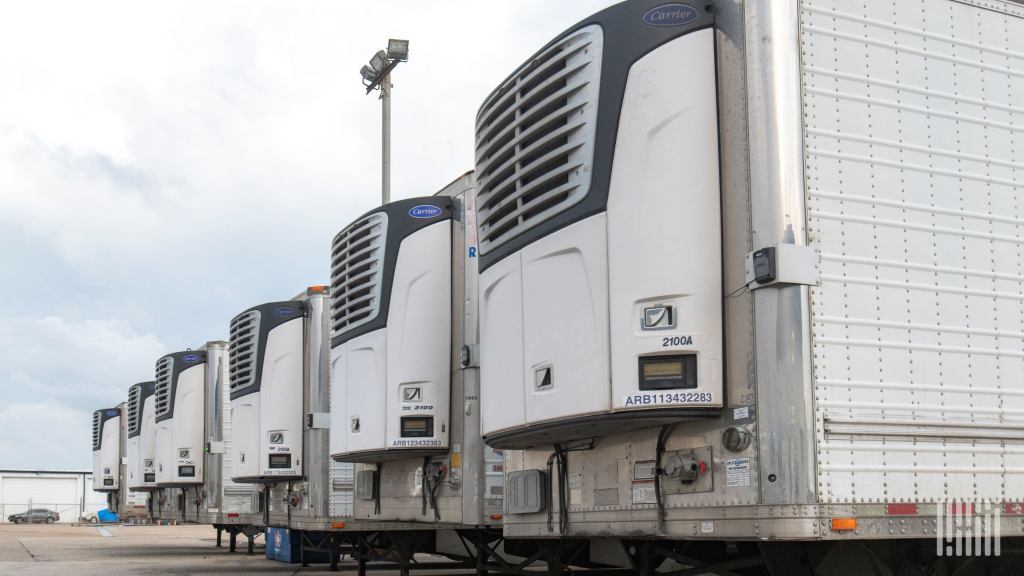
Improving orders for specialty trailers mostly account for two consecutive months of improving equipment bookings. The pace of dry and refrigerated trailers orders lagged.
October U.S. trailer net orders rose by more than 6,000 units over September, their highest level since December 2022. Still, the 34,400 orders reported by FTR Transportation Intelligence were down about 21% compared to October a year ago.
Manufacturers built about 4% more trailers in October than September. But trailing net orders mean backlogs rose for the second consecutive month and for only the second time this year. Orders over the past 12 months totaled 294,000 units, FTR said.
“Order increases in October for most specialized trailer types greatly outperformed dry van and refrigerated van trailers,” FTR Chairman Eric Starks said.
Backlogs relative to production levels overall are in line with normal levels historically. But the backlog-to-build ratios for dry and reefer van trailers remain elevated and should support current production levels, Starks said.
Lower ratios for specialty trailers like tankers and flatbeds could portend future production cuts.
ACT Research said preliminary October orders of 35,300 point to the backlog growing by about 7,300 orders to 146,100 units when complete counts are in for the month. That equates to a five-month wait for delivery of a new trailer.
“The data continue to provide mixed messages, with cancellations remaining elevated, driven primarily by the platform and tank segments, even as backlogs remain at healthy levels in general and particularly in the specialty segments,” said Jennifer McNealy, ACT director of commercial vehicle market research and publications.
ACT’s preliminary order figure of 35,300 came in slightly lower than FTR, but adjusted for seasonal factors, the estimate was just 26,200 units. ACT pegged the year-over-year order decline at 26%.
“While this certainly continues the positive momentum for the industry that began last month, two months of robust orders does not guarantee the full year,” McNealy said. “It’s still early in the new year order season to call.”
Class 8 catch-up largely over as replacement iron drives orders
Rush Enterprises keeps momentum in softening Class 8 aftermarket
