Increased consumer spending not enough to end trucking bloodbath

truck driver

Ohio resident Matthew James Collins hauls frozen food around the Midwest — onion rings, ice cream and the like. On a recent October morning, Collins was trucking through a snowstorm in Minnesota. 

He wasn’t carrying much. Collins recalled when he ran this route last year, he would regularly move 22 skids of frozen foods (a type of pallet) for four different corporate accounts. Now he’s moving just 12 skids for two clients.

The health of the trucking industry is typically a good gauge for how the U.S. economy at large is faring. That’s not the case right now. Economists remain stunned by how much stuff Americans are buying amid historic inflation and interest rate hikes. At the same time, the trucking industry is embroiled in a meltdown that’s slamming operators large and small.

“It doesn’t even seem like the broader economy even knows we’re in a recession,” said Steve Troyer, president of California Midwest Xpress, a 30-truck fleet. “But we’re in a good one.”

Americans are spending a larger chunk of their income on durable goods than they did before the pandemic, according to Goldman Sachs research. The U.S. economy saw “blockbuster” growth in the third quarter of 2023; it was the biggest surge in nearly two years, and attributed in part to increased consumer spending. Around 72.6% of the nation’s freight by weight is hauled by semi-truck. If Americans are buying so much, why aren’t truckers seeing a boon?

This trucking bloodbath is particularly gory 

Trucking is a highly cyclical industry. During good times, manufacturers deliver more equipment to trucking fleets that want to expand and capture that surfeit of business and profits. Individuals open their own trucking fleets too. 

The boom time typically lasts for under a year. Inevitably, so much capacity enters the industry and depresses rates again. Whatever trend outside of trucking that was spurring all of that new demand usually runs dry too. That means too many trucks and not enough freight to move. 

The federal government tracks the number of trucking authorities created or shut down every month. Authorities are often put out of service after they fail to pay insurance premiums. In typical upcycles, a few hundred net trucking authorities are created, then a few hundred net trucking authorities are destroyed when the market flips less than a year later. 
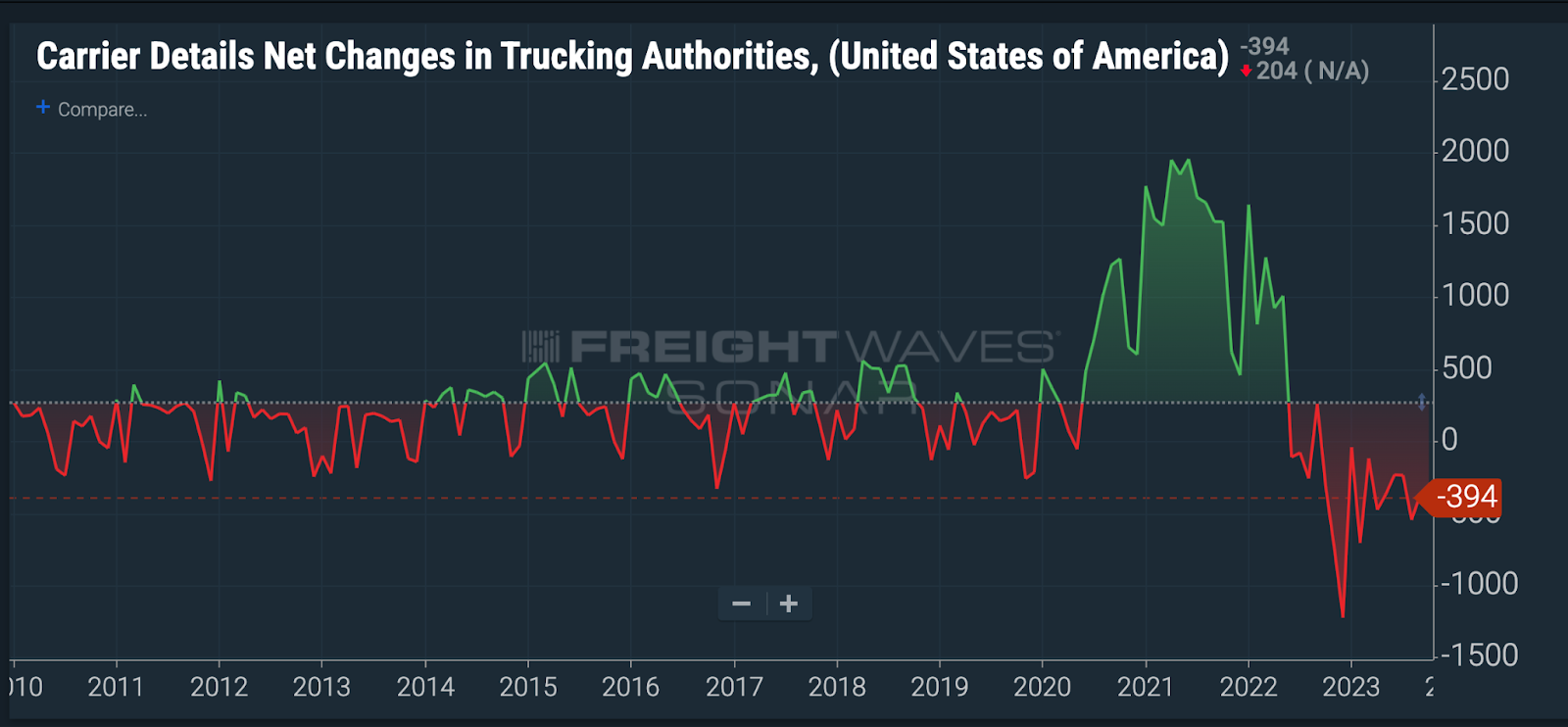
Tens of thousands of trucking companies were created during 2020 to 2022. The overwhelming majority were just one driver. (Source: FreightWaves SONAR)

The most recent freight upcycle quashed that pattern. The upcycle began around June 2020, when the federal government approved about 500 net trucking authorities. That reached a fever pitch in the summer of 2021, when around 2,000 net trucking authorities were created in a single month. It wasn’t until June 2022 when the cycle turned and net trucking authorities flipped back to negative. 

The pandemic trucking boom lasted twice as long as a typical upswing. And each month created many times more trucking companies than a typical red-hot trucking month.

There’s still a massive excess of trucking authorities, according to federal data. In January 2020, there were around 255,000 authorities. Now there are around 363,000 authorities. Most of these businesses are small fleets with fewer than 10 drivers.

Tens of thousands of those new carriers have already shut down. According to a FreightWaves analysis of federal data, an estimated 35,000 new trucking companies shuttered in the fiscal year ending Sept. 30. For the 10 years before that, the average number of out-of-service orders was 15,585.

Average per-mile spot rates for trucking fleets have hit $1.54, down 11.6% from 2022 and 34.4% from 2021, according to the FreightWaves National Truckload Index. At the same time, the costs of fuel, replacement parts, insurance and other key inputs have soared. 

Brian Carle, a New Mexico truck driver who has his own authority, said jobs are so scarce and poorly paid right now that he has to save up just to get an oil change. His gross earnings this year will be about 33% less than they were in 2021 — but the cost of everything, like repairs, diesel and routine maintenance, has soared.

“Everything I’m paying for, I’m not getting paid more for,” Carle said. “Something’s gonna break.”
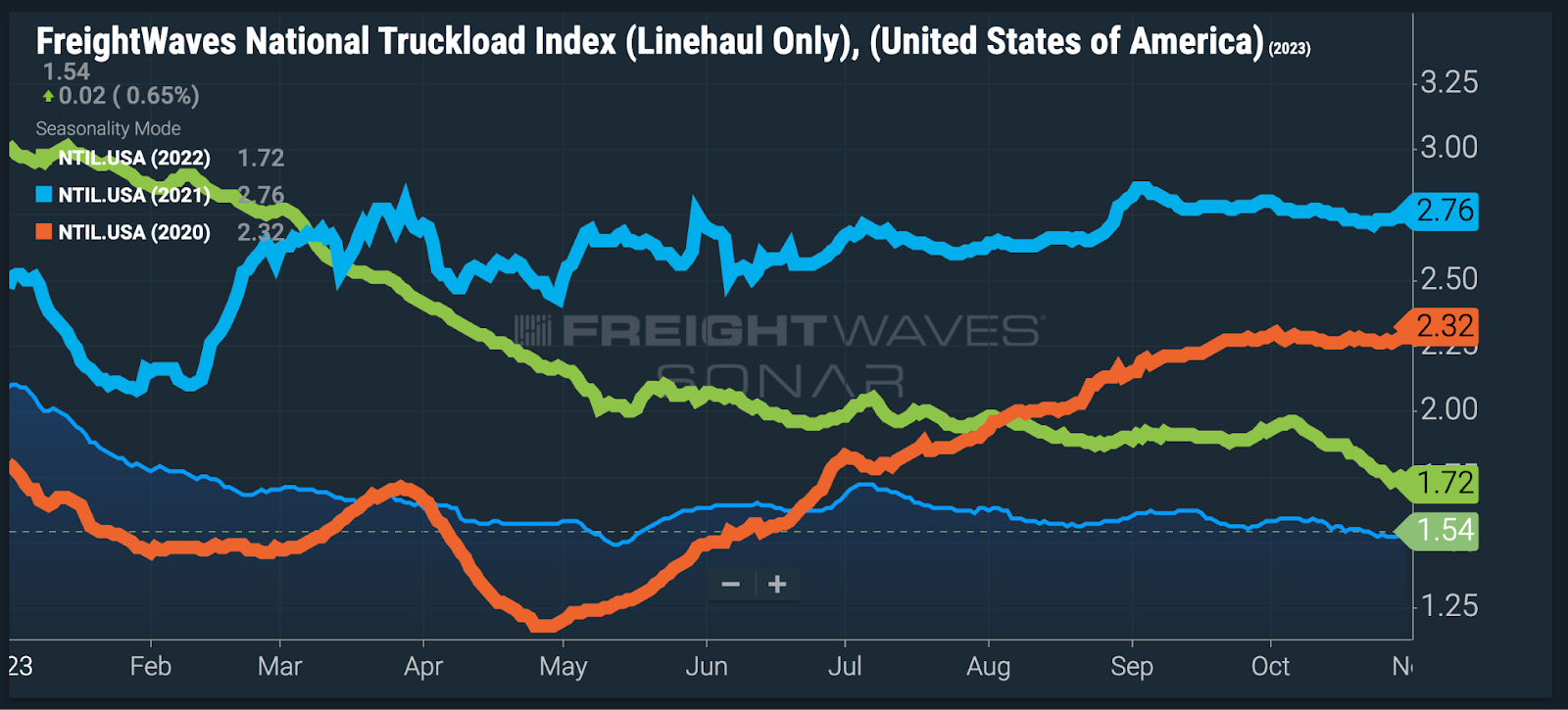
Truckload rates are low for this time of year. (Source: FreightWaves SONAR)

Reflecting that, trucking carriers are only rejecting some 3.5% of contract loads, according to the FreightWaves Outbound Tender Reject Index. That’s even lower than 2019 and 2022, two challenging years for truckers. 
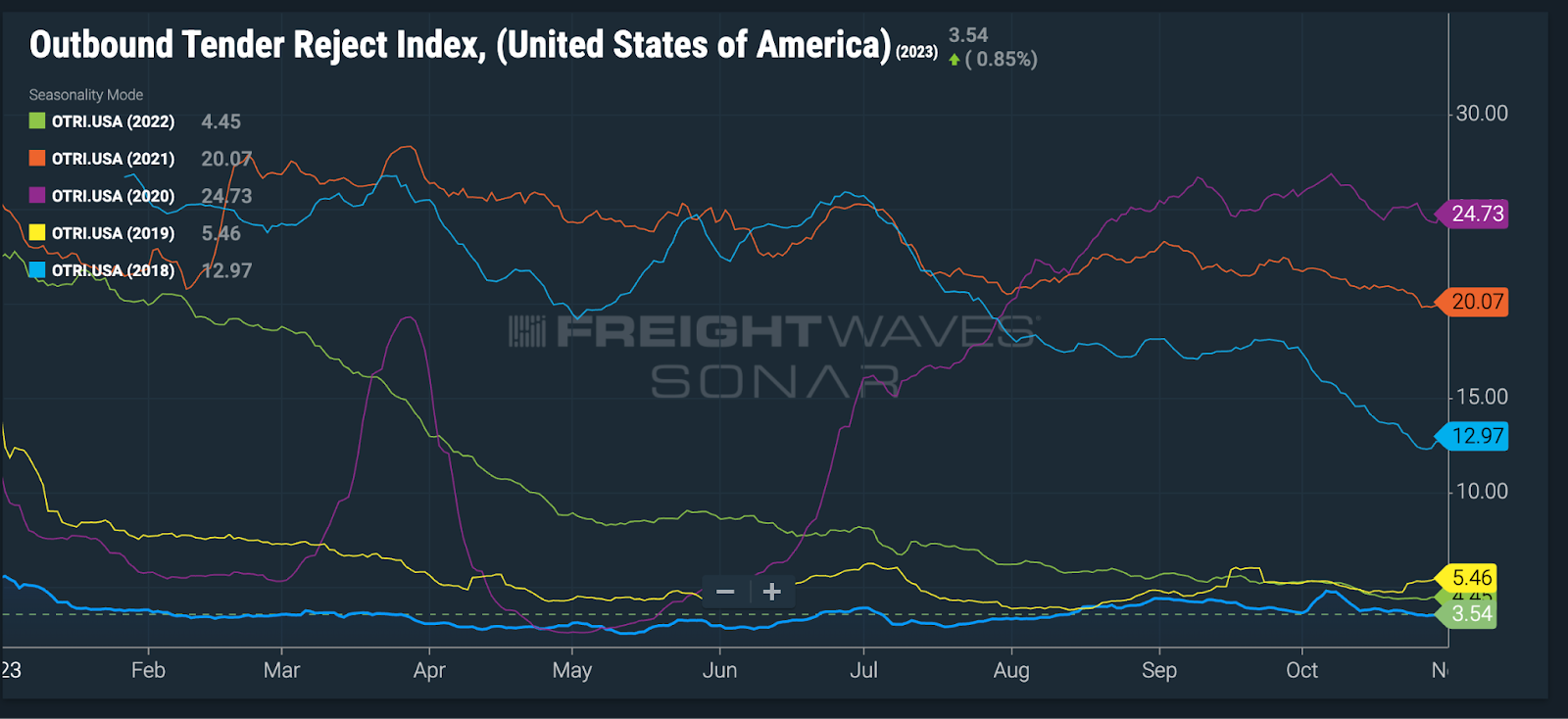
Rejection rates for outbound freight tenders in 2023, represented by the bottom blue line, remain depressed. (Source: FreightWaves SONAR)

“We’re going to have to see trucks leave the market for rates to come back down,” said Collins, the Ohio truck driver. “We also need a stronger economy for rates to come back up.”

American consumers are buying stuff again. Woo-hoo! 

The U.S. economy grew faster than expected in the third quarter of 2023. At 4.9%, it was the biggest uptick since the fourth quarter of 2021. Much of that boost came from increased purchases of durable goods; new orders for durable goods are up 4.4% so far this year compared to 2022. 

For this increase, thank the slowdown of inflation — and the relentless American urge to go on a shopping spree.

“When the economic history of the early 21st century comes to be written, the opening sentence in a bold font should be ‘never go short the hedonism of the US consumer,’” wrote Paul Donovan, UBS global chief economist, in a note last Friday. “Middle-income consumers have lower inflation than consumer price data implies, giving them more spending power.”

Americans are still buying a lot of stuff, despite the Federal Reserve’s attempts to curb spending and corporate zeal to increase the price of everything. Joseph Politano, author of the financial newsletter Apricitas Economics, said continued strong spending reflects the strong labor market.

“The vast majority of people spend a fixed portion, which is the majority of their income, on things,” Politano said. “Over the last year, you have 3.2 million new jobs and employment rates at a very high level. It shouldn’t be too surprising that spending is remaining strong under those conditions.”

Spendy American consumers aren’t saving trucking

No one expected the 2020 to 2021 spending spree to last. 

“You had like those insane months where there was a million new jobs and spending growth was 9%,” Politano said. “Obviously, no one ever expected that to [last] forever.”

However, that didn’t stop more than 100,000 truck drivers from opening up their own trucking companies. And while it’s easy enough for the American consumer to scale up or scale down their spending, truck drivers can’t turn on or off their level of capacity as seamlessly. 

The only level of freight demand that could support that “excess” trucking capacity is one that matches the Great Shopping Spree of 2021. That level of consumerism — where more than 100 container ships are waiting to unload at the ports of Los Angeles and Long Beach, full of stuff purchased with stimulus checks — was likely a once-in-a-lifetime event. 

Analysts believe that the trucking industry will only become healthy again when a significant chunk of those authorities are cleared out. That likely means the collapse of tens of thousands of trucking businesses, even beyond the tens of thousands that have already shut down.

For his part, Carle, the New Mexico truck driver, isn’t keen on closing down his business. “I don’t want to give up what I’ve worked so hard for.”

Are you a carrier, shipper, or broker? Email rpremack@www.freightwaves.com with your experience of the trucking bloodbath. Please subscribe to the MODES newsletter for weekly updates.

Cummins ups full-year revenue estimate but expects Q4 slowdown

Cummins X15N engine

Engine and power systems maker Cummins Inc. reported higher third-quarter sales across all segments and raised its full-year revenue estimate despite softening business conditions expected in Q4.

Cummins reported Q3 revenues of $8.4 billion, 15% ahead of the same quarter a year ago. It beat the $8.1 billion consensus of analysts surveyed by investor site Seeking Alpha. Five percent of the total sales increase resulted from the $3.7 billion acquisition of Meritor Inc. that closed in August 2022, CFO Mark Smith told analysts on the company’s Q3 earnings call.

Net income totaled $656 million, or $4.59 per diluted share, compared to $400 million, or $2.82 per diluted share, in Q3 2022. It included $26 million, or 14 cents, of costs related to the spinoff of Cummins’ filtration business now called Atmus Filtration Technologies.

Full-year revenue guidance raised

The company generated a record $1.5 billion in net cash from operations. It raised full-year revenue guidance to be in the 18-21% range compared to an earlier estimate of 15-20%. 

Cummins reported Q3 earnings before interest, taxes, depreciation and amortization of $1.2 billion, or 14.6% of sales. That compared to $884 million, or 12.1%, a year ago. Excluding the Atmus and Meritor items, EBITDA was 14.9% compared to 13.3% a year. The company expects full-year EBITDA to range between 15.2% and 15.4%, narrowing an earlier estimate of 15-15.7%.

The outlook assumes full-year results for Atmus but does not include expected cost cuts in Q4. That includes offering voluntary retirements and a voluntary separation program in select regions for eligible employees in certain business segments.

“We’re not predicting like a precipitous decline in our revenues at all,” Smith said. “But we feel it’s prudent both to do the cost reduction actions, continue our focus on cash flow and debt reduction that should leave us with the best chances of being very successful in 2024.”

Acquisitions and higher prices help sales rise double digits

Sales in North America rose 16%. International revenues were up 13% with strong demand for engines, components, power distribution and new power products.

In its truck engine business, Cummins sold 29,000 heavy-duty units, up 18% from a year ago. The company produced 37,000 medium-duty engines, up 7% from the same quarter in 2022. Medium-duty sales of 32,000 surpassed 2022 by 19%.

Q3 revenues in China, including joint ventures, were $1.6 billion, an increase of 24% as markets continue to recover compared to a very weak third quarter of 2022.

“While full year revenues are at the high end of our expectations, we are seeing signs of moderating demand in some markets and are taking steps to reduce costs and position the company for success in 2024,” CEO and Chair Jennifer Rumsey said in a news release.

Cummins expects higher full-year revenues in its components segment and higher profits om power system, offset by lower profits in engines resulting from softening aftermarket and off-highway markets. Orders remain relatively strong but inventory management and truck component shortages and fewer working days in the current limit OEM production rates.

“Our leadership team is experienced in managing through periods of economic uncertainty and will continue to make the decisions that ensure we drive cost improvements and maintain a strong financial position,” Rumsey said. 

5 for 5 in segment sales performance

Across its five segments, Cummins reported:

Components Sales of $3.2 billion, up 20%, and EBITDA of $441 million, or 13.6%, compared to $297 million, or 11%, a year ago.  

Engines Sales of $2.9 billion, up 5%, and EBITDA of $395 million, or 13.5%, compared to $362 million, or 13%. On-highway revenues increased 8% because of strong demand in the North American truck market and higher prices.

Distribution Sales of $2.5 billion, up 13%, and EBITDA of $306 million, or 12.1%, compared to $225 million, or 10%. 

Power Systems Sales of $1.4 billion, up 7%, and EBITDA of $234 million, or 16.2%, compared to $193 million, or 14.3%.

Accelera Sales of $103 million, up 106%, and EBITDA loss of $114 million. The former New Power segment saw higher demand for battery electric systems, increased electrolyzer installations. Meritor’s electric powertrain unit and the $197 million purchase of the Siemens Commercial Vehicle business in November 2022 also contributed. Cummins has said it expects Accelera to reach break-even EBITDA by 2027.  

Executive promotions announced

Cummins also announced three executive promotions effective Jan. 1:

Srikanth Padmanabhan, currently vice president and president of the Engine Business, will take on a newly created role of Executive Vice President and President of Operations.

Brett Merritt, currently Vice President of On-Highway Engine Business and Strategic Customer Relations will succeed Padmanabhan as vice president and president of the Engine Business.

Srinkath Padmanabhan and Brett Merritt, two of four recent executive promotions, at Cummins Inc. (Photo: Alan Adler/FreightWaves)

Bonnie Fetch, vice president of Global Supply Chain, will become vice president and president of the distribution business. She succeeds Tony Satterthwaite, who has been acting as interim head.

Last week, Cummins said that Amy Davis, president of Accelera, would add the same role in the components business. Mahesh Narang, the incumbent, left the company last Friday to pursue an external opportunity.

Editor’s note: Updates with additional information from analyst call and adds executive promotions.

Cummins predicts huge growth in natural gas engines

Q2 sales and income higher at Cummins

Cummins replaces 2 legacy engines with new X10 powertrain

Click for more FreightWaves articles by Alan Adler.

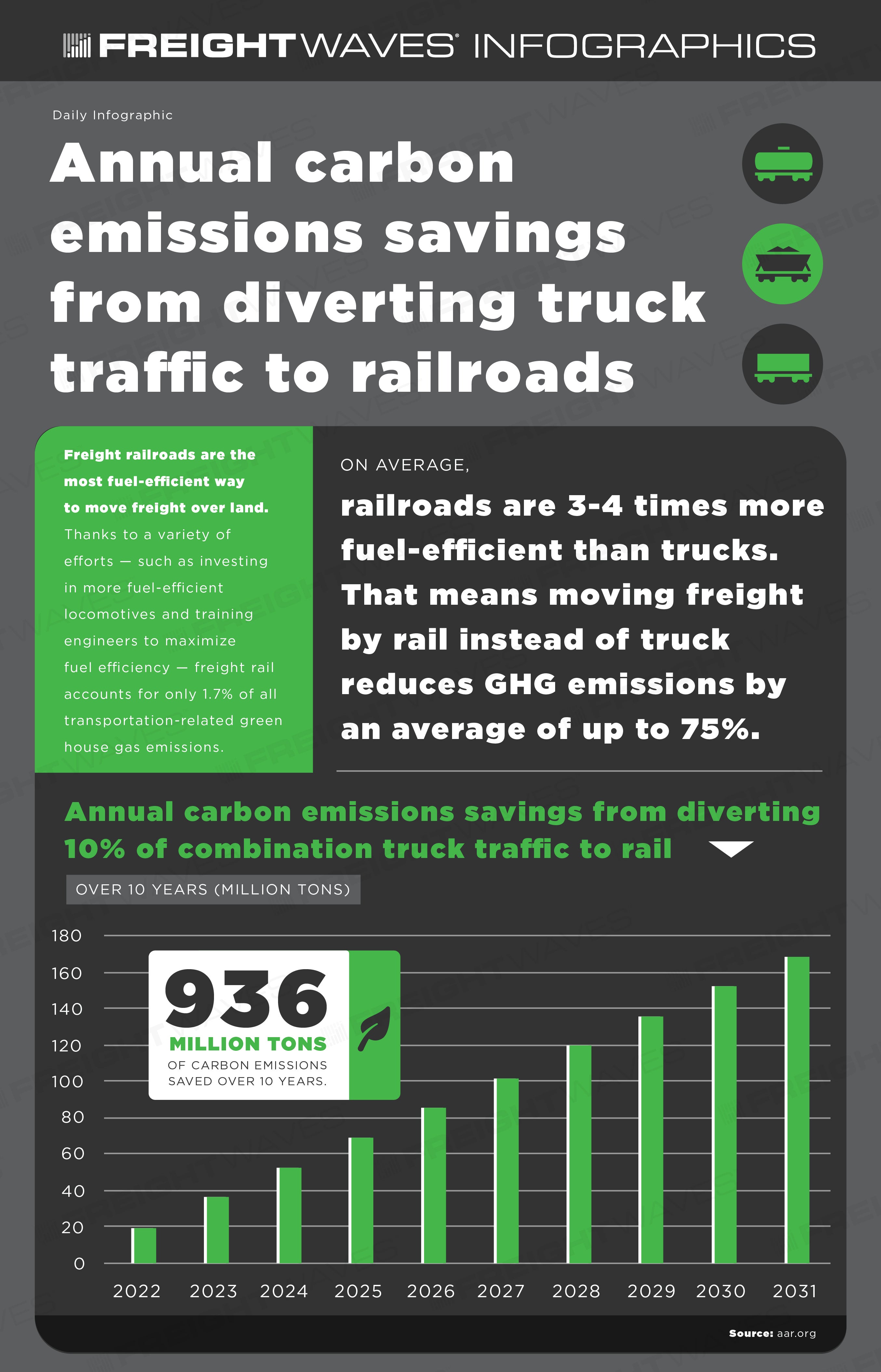
Daily Infographic: Annual carbon emissions savings from diverting truck traffic to railroads


To view more FreightWaves infographics, click here

Head count for US Class I rail operations shows mixed bag

Two people wearing hard hats and protective jackets look at a train wheel.

The average number of employees working for the U.S.-based operations of the Class I railroads for the first three quarters of 2023 is roughly flat to lower compared with the same period in 2020, according to data collected by the Surface Transportation Board.

But when comparing those two periods, only two rail employment categories from within that total number grew: the train and engine (T&E) category and the category for executives, officials and staff assistants. 

On average, the U.S. operations of the Class I railroads had 121,649 employees on staff from January to September, compared with an average of 121,819 employees for that same period in 2020. 

Between March and April 2020, the Class I railroads had slashed the number of employees working for them in response to the COVID-19 pandemic and lower market demand. The railroads aggressively sought to restaff their ranks in 2022, in part because of pressure from regulatory officials who believed there might be a link between lower head count levels at the railroads and subpar rail service.

Potential reasons behind rising and falling employment categories

STB’s employment data has six categories for rail personnel: T&E crew members; professional and administrative; executives, officials and staff assistants; maintenance of equipment and stores; maintenance of way and structures; and transportation employees outside of the train and engine category. 

For the T&E category, which can be sensitive to market demand, the average number of employees for the first three quarters of 2023 was 51,580, about 8.5% higher than an average of 47,542 employees for the first three quarters of 2020. 

Increases within the T&E category were partly in response to scrutiny from regulators and other industry stakeholders such as shippers and rail unions, which had criticized the railroads for cutting back on their head counts too deeply in their pursuit of precision scheduled railroading, a method that seeks to streamline operations and cut costs. Increasing the number of train and engine crews would enable the railroads to meet demands for service, they argued.

Growing the ranks of train and engine crews became a priority for the Class I railroads in 2022, according to comments during earnings calls and as seen in STB data for T&E employees.

But the T&E category was only one of two categories that showed growth when comparing the average head count levels for the three quarters of 2023 with the first three quarters of 2020.

Average head count for those involved in the maintenance of equipment and stories fell 13% from 20,826 for the first three quarters of 2020 to an average of 18,090 for the first three quarters of 2023, according to data from STB. Head count for those involved in the maintenance of way structures fell 4.6% from an average of 30,116 to 28,738, while for transportation workers beyond T&E, head count slipped 5.9% from an average of 4,884 to 5,190. Meanwhile, head count for professional and administrative staff dropped 3.6% from an average of 10,579 to 10,194.

For executives, officials and staff assistants, head count grew 7.9% from an average of 7,566 to 8,164.

A description of the various roles within each of the categories is available here. Roles under the maintenance of equipment and stores category include equipment, shop and electrical inspectors, carmen, electricians, boilermakers and machinists.

One possible reason for the decline in employees in the maintenance of equipment and stores category is that as railroads decide to store and park locomotives, there is less maintenance being conducted on them.

When asked about the decrease of employee totals related to maintenance of equipment and stores, Josh Hartford, special assistant to the president of the International Association of Machinists and Aerospace Workers (IAM) — Rail Division, told FreightWaves that the downward trend has been reflected in IAM’s membership ranks. IAM members maintain locomotives.

Machinist union members in January 2018 working for the U.S operations of the Class I railroads totaled around 7,700 and that number dropped to over 5,100 members in January 2023, according to Hartford, who said membership numbers have flattened out in 2023 at IAM.

But Hartford is concerned that the railroads are not maintaining their locomotive fleet as well as they could be. As an example, he cited the September letter from Administrator Amit Bose of the Federal Railroad Administration to Union Pacific leadership in which Bose noted a locomotive defect ratio of 72.69% when FRA inspectors visited UP’s North Platte rail yard in Nebraska. 

UP CEO Jim Vena responded to Bose’s letter, saying that the defect data didn’t specify whether the defects were major, like something involving a high flange wheel, or minor, such as an amnesty lock on a bathroom door. UP also said it takes FRA’s concerns seriously and that UP believes it has the people and practices in place to maintain locomotives and car fleets safely.  

While railroads such as BNSF may have contracted out some of the maintenance and inspection work because of challenges in finding a qualified workforce, Hartford doesn’t see that as being a contributing factor to the head count decline. 

“We hear all the time that they can’t hire, they can’t find people. I’m just speaking for the machinists. But we’re up over 100 members on Amtrak. How, how can they find employees but the Class Is can’t?” Hartford said. 

Whether the Class I railroads decide to grow the ranks for those in the maintenance of equipment and stores category remains to be seen. But the consensus for now seems to be to hold off on significant hiring sprees and look to attrition as the Class I railroads and their customers manage the ongoing economic downturn.

“We look for cost savings on what our input costs are. And of course, it’s much more difficult in the inflationary place that we find ourselves in this country, but we’re going to look for every opportunity to use less so that we can save costs that way. And on head count, absolutely, we’re going to use attrition to rightsize the company as much as we can,” Vena said on UP’s third-quarter earnings call on Oct. 19.

Subscribe to FreightWaves’ e-newsletters and get the latest insights on freight right in your inbox.

Click here for more FreightWaves articles by Joanna Marsh.

Werner’s Q3 light of expectations

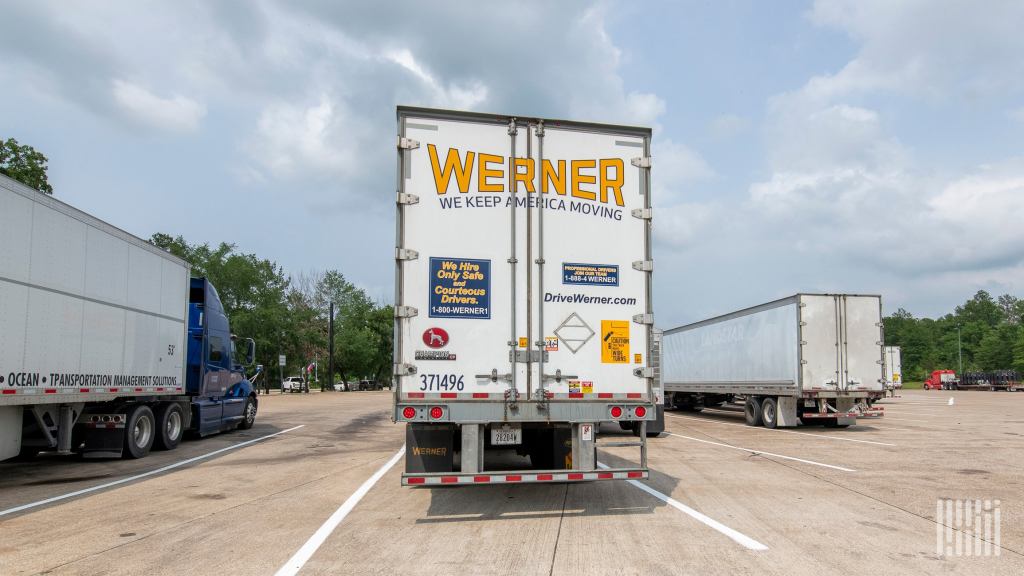
A Werner rig parked at a truckstop

Werner Enterprises said Wednesday that volumes during this year’s peak season will shake out largely in line with last year but pricing will be notably lower.

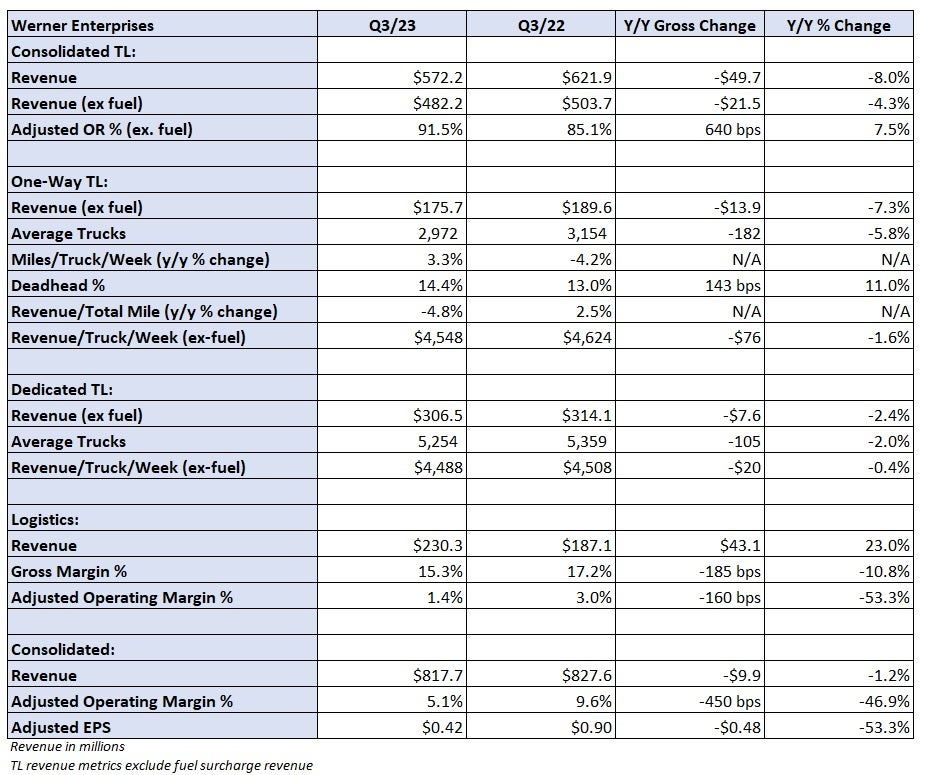
The company’s rate guidance for the fourth quarter calls for revenue per total mile in its one-way segment to be flat to slightly down from the third quarter but off 7% to 9% year over year (y/y). Its outlook for the dedicated fleet was unchanged as revenue per truck per week is still expected to finish the full year flat to up 3%. That metric was up 1.8% year to date through the third quarter.

Werner (NASDAQ: WERN) reported third-quarter adjusted earnings per share of 42 cents, 7 cents light of the consensus estimate and 48 cents lower y/y.

Compared to the year-ago quarter, lower gains on sale were a 14-cent headwind, net interest expense was a 5-cent headwind (increased debt from past acquisitions) and a lower tax rate was a 1-cent tailwind. The result excluded 5 cents in acquisition-related expenses and costs from an insurance claim that has been appealed.

Revenue in the company’s truckload segment was 8% lower y/y to $572 million, down 4% y/y excluding fuel surcharges.

Dedicated revenue was down 2% y/y excluding fuel surcharges as average trucks in service were off by a similar percentage. Revenue per truck per week (excluding fuel) was down just slightly y/y.

Management noted some customers are using fewer trucks on average than they were a year ago. However, it said truck counts with its largest customer, Dollar General (NYSE: DG), were up sequentially. Werner also has plans for further expansion with the company, which has been a concern as Dollar General is building its own private fleet.

“Inside the building our confidence level is high relative to that relationship,” said Derek Leathers, chairman, president and CEO, on a Wednesday call with analysts.

Table: Werner’s key performance indicators

One-way revenue was down 7% y/y excluding fuel surcharges as average trucks in service were down 6% and revenue per truck per week was off 2% excluding fuel. Revenue per total mile (excluding fuel) was down 5% y/y in the period.

The TL segment recorded a 91.5% adjusted operating ratio, which was 640 basis points worse y/y. Werner has identified more than $43 million in cost savings opportunities, of which 70% has been realized.

The company plans to continue to reduce its average tractor age to reduce maintenance expenses. The expense line was 80 bps lower y/y as a percentage of consolidated revenue. The average tractor age was 2 years in the third quarter compared to 2.3 years in the same period last year. The company was running more than 500 trucks with over 400,000 miles a year ago. It’s now operating fewer than 50 units with high mileage currently.

Logistics revenue increased 23% y/y to $230 million in part due to the acquisition of ReedTMS last November. Lower revenue per load in truck brokerage was a headwind. Excluding the acquisition, loads were 8% higher y/y and up 9% from the second quarter.

The logistics unit reported a 1.4% adjusted operating margin, which was 160 bps worse y/y and 100 bps lower than in the second quarter.

More FreightWaves articles by Todd Maiden

C.H. Robinson has weak quarter as expected, but productivity rises

The quarterly numbers for C.H. Robinson came in as one might expect for a 3PL operating in the midst of a weak freight market that has been particularly brutal for brokerages.

Total revenues were down 27.8% from the third quarter of last year. Gross profits were down almost 29%. Income from operations was down 60.5%. Adjusted operating margin was down 1,450 basis points to 17.9%.

But there was enough in the report to encourage Wall Street investors. In the first hour after the release of the earnings, the post-market price of C.H. Robinson (NASDAQ: CHRW) was up almost 4%. It recently has been trading at or near a 52-week low.

One positive: According to SeekingAlpha, the company’s non-GAAP earnings per share of 84 cents beat consensus estimates by 4 cents per share. But total revenue of $4.34 billion was short of consensus by $20 million.

C.H. Robinson President and CEO Dave Bozeman earlier has made references to faster speed and fewer “touches” to get a transaction done. He reiterated those themes:

“As has been well documented by many industry participants and observers, global freight demand continued to be weak in the third quarter,” Bozeman said in the company’s earnings release, the first that has come after a full quarter with Bozeman in the company’s top job. “We are staying focused on what we can control, by providing superior service to our customers and carriers, executing on our plans to streamline our processes by removing waste and manual touches, and delivering tools that enable our customer- and carrier-facing employees to allocate their time to relationship building and exception management.”

Bozeman also said that though he is “pleased” with the team’s efforts, “I’ve challenged them to increase our class speed on decision making and improvement efforts.”

Those cost-cutting efforts were obvious in other data in the earnings. Total operating expenses were down 13.1%. Personnel expenses were lower by 21.5%, and average head count was down 13.7%.

But Amit Mehrotra of Deutsche Bank saw little that was encouraging in the report. After parsing the numbers, he said reductions in expenses didn’t have the impact that might be expected with gross revenue and net revenue down the same percentage. There were restructuring charges taken by the company as part of its cost-cutting efforts, which Mehrotra described as “notable.” But beyond the equal drop in net and gross revenue, he pointed out that adjusted profits were down roughly double the rate of those drops in revenue, which would not be the case if the cost cuts were having a significant impact on profitability.

In C.H. Robinson’s North American Surface Transportation (NAST) results, the heart of the company’s brokerage business, total revenues were down 22.9% to just over $3 billion, down about $915 million. But the decline in adjusted net profits was greater at 31.4%, down to $386.5 million from $563.8 million. Income from operations took an even bigger hit, dropping 47.1% to $112.1 million.

In its release, C.H. Robinson said the drop in revenue was “primarily driven by lower truckload pricing, reflecting an oversupply of truckload capacity compared to soft freight demand.”

Other data from NAST: The group experienced a 6% decline in truckload shipments. The average linehaul rate per mile, excluding fuel, was down about 16.5% from the prior quarter compared to 2022. Costs were down 13.5%. Adjusted gross profit per mile in truckload activity was down 34% from the prior year.

In its LTL operations, C.H. Robinson saw its shipments decline 2%. LTL adjusted gross profit per order was down 13.5%.

Although the discussion of the recent failure of digital brokerage Convoy was brief, with no indication that its collapse had led to any meaningful uptick in business for C.H. Robinson, Bozeman did suggest that the turmoil among some digital brokers was going to benefit the company. “During my many discussions with customers over the past four months, it’s clear that they prefer partners who have financial strength and can invest through the cycles in the customer experience,” he said.

With a stronger freight market not likely to ride to the rescue of C.H. Robinson — or anybody for that matter — anytime soon, Bozeman since his first earnings call has focused consistently on the need for productivity improvements.

And in the third-quarter earnings call, he said the company is getting them. He cited several statistics: an 18% year-to-date increase in shipments per person per day. He said the target for the year was 15% so C.H. Robinson is on track to hit that goal.

The increase in productivity and getting ready for what Bozeman described as “the eventual freight market rebound” is going to need a key component, he said: “growing volume without adding head count. … We believe our team’s continuous efforts to streamline our processes and remove manual touches gets us there.”

CFO Mike Zechmeister said when asked about October trends that even in the wake of the Convoy collapse, “the trends that we’re seeing have been pretty consistent.” Zechmeister also said that C.H. Robinson would have thought that more carrier capacity would have exited the market by now, but pricing has been “at or near the breakeven cost for the carriers. So the exits have been a little slower.”

Asked by an analyst on the call whether the head count cuts have been too deep to have C.H. Robinson ready to take advantage of a recovery, Bozeman said the company believes it has “sufficient capacity for what would be a normal recovery.” But he said capacity is something “we execute on each day, and we’re building ourselves up for the eventual rebound of the market. We need to have the capacity while keeping our head count in check.”

Zechmeister said the company is currently moving a mix of 70% contract and 30% spot freight, a ratio he said is “unusually tilted toward contract for where we are in the cycle.” By contrast, for three quarters of the strong 2021 market, the split was 55% contract and 45% spot.

Separately, COO Arun Rajan said C.H. Robinson has started to use generative AI to “fill in the blanks where there’s incomplete and unstructured information in an automated process.” The result is that the company has been able to cut the time needed to generate a quote to counterparties from about five minutes to less than one minute. It’s been utilized enough that Rajan said in the last week of the third quarter, more than 10,000 “transactional quotes” were created using a generative AI “agent.”

Expanding the offerings will eventually allow quotes to be generated 24 hours per day, Rajan said.

More articles by John Kingston

State of Freight takeaways: From the floor of a very weak trucking market

Tough freight market hits Echo’s debt ratings, down a notch at S&P

Cyberattack response plans need to be in place to avoid chaos

A gallery of early mail delivery by air

In 1918, the airplane was still a new technology, but the Postal Service set out to use it to deliver mail. The undertaking was dangerous and many pilots lost their lives.

The Smithsonian Institution’s National Postal Museum has a catalog of photographs showing what a challenging and surprising job this was. Check out some of the photos below.

historic mail delivery by plane
An airmail plane is parked in front of its hangar in Reno, Nevada. (Photo: National Postal Museum, Smithsonian Institution)
Another airmail plane is parked at the Omaha, Nebraska, airmail field. (Photo: National Postal Museum, Smithsonian Institution)

Pilots steered airmail planes from open-air cockpits. (Photo: National Postal Museum, Smithsonian Institution)

Postmaster Thomas Patten hands Lt. Torrey Webb a bag of letters for the first regularly scheduled airmail delivery in the United States. (Photo: National Postal Museum, Smithsonian Institution)
This JR-1B mail airplane was designed by Standard Aircraft Corp. (Photo: National Postal Museum, Smithsonian Institution)
The de Havilland airmail plane is parked next to a U.S. mail truck in 1922. (Photo: National Postal Museum, Smithsonian Institution)
Airmail planes often crashed. (Photo: National Postal Museum, Smithsonian Institution)
Pilots for the Postal Service were treated like astronauts are today. (Photo: National Postal Museum, Smithsonian Institution)
“To the first superintendent of aerial mail, Capt BB Lipsner, from yours in the bog, Edward W. Killgore” was written by the pilot in the photo. (Photo: National Postal Museum, Smithsonian Institution)
This NC-4 took off from Newfoundland on May 8, 1919, and landed in Portugal on May 27, 1919, in the first trans-Atlantic flight. (Photo: National Postal Museum, Smithsonian Institution)
Pilot Robert Shank crashed in the woods but survived. (Photo: National Postal Museum, Smithsonian Institution)

Shipping braces for impact as Panama Canal slashes capacity

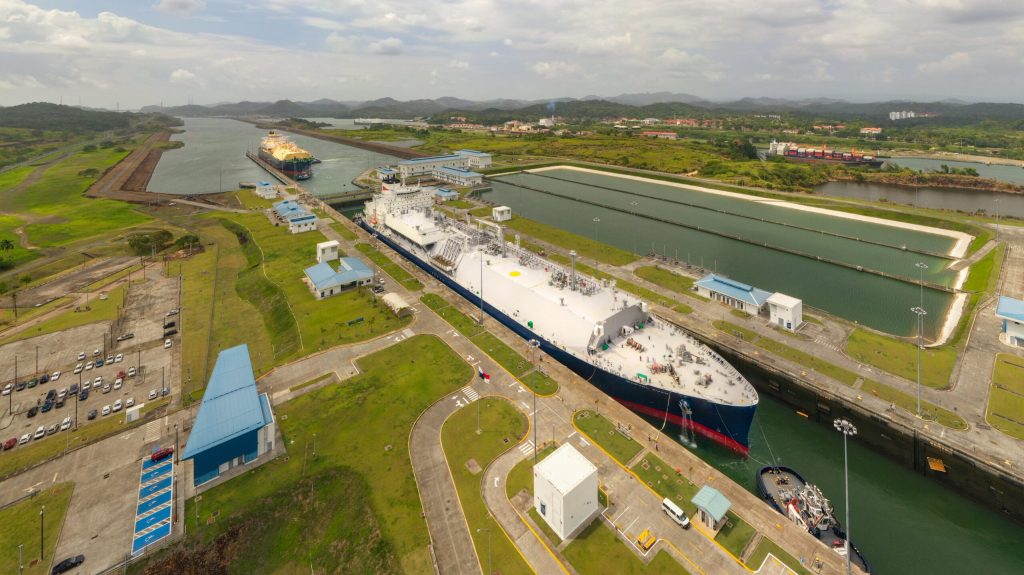
a photo of a ship transiting the Panama Canal

After its driest October on record, the Panama Canal will severely restrict transit capacity to conserve water. Shipping will feel the effects in the months ahead, with different vessel types facing different fallout.

Panama Canal Authority (ACP) Administrator Richarte Vasquez outlined the current challenge during a press conference on Sept. 12: Each transit of the Panama Canal consumes a large amount of water, regardless of ship size. If it doesn’t rain enough, the canal must either limit transits or reduce ship draft (the allowable distance between the waterline and the hull bottom).

Around 70% of vessels using the Panama Canal require a draft of 44 feet, which is the current limit, down from 50 feet at the beginning this year. If the draft is lowered further, most ships won’t be able to transit with full loads.

“We will commit to 44 feet for the foreseeable future. If adjustments are required in order to maintain 44 feet, those adjustments will be on the number of transits per day,” Vazquez said six weeks ago.

Those adjustments are now required. The ACP had previously reduced daily transit reservation slots from 36 to 32. On Tuesday, it announced that reservation slots will be limited to 25 as of Friday, 24 starting Nov. 8 and 22 on Dec. 1. The number of reservation slots will fall to 20 on Jan. 1, 2024, then 18 starting Feb. 1.

chart of Panama Canal reservations slots

Effects on container shipping

The Neopanamax locks that debuted in 2016 primarily handle larger container ships, liquefied natural gas carriers and high-capacity liquefied petroleum gas carriers known as very large gas carriers (VLGCs). The older Panamax locks mainly handle dry bulk ships, tankers, smaller container ships and vehicle carriers.

Larger container ships sailing from Asia to U.S. East and Gulf Coast ports already feel the effect of Panama’s drought, because they need more than 44 feet of draft when fully loaded. Vasquez said that for every foot of lost draft, container ships lose capacity for 350 twenty-foot equivalent units.

Thus, this year’s loss of 6 feet of draft equates to 2,100 TEUs of cargo. Liners have either had to sail with lower utilization or unload 2,100 TEUs on the Pacific side of Panama, rail them across the isthmus and reload on the Atlantic side.

The just-announced transit restrictions avert or delay further draft reductions that would force liner companies to unload and reload even more containers.

However, the transit reservation cap itself looks likely to affect schedules.  

Over the next two months, the number of Neopanamax transit reservation slots will be cut in half, from 10 currently to five as of Jan. 1.

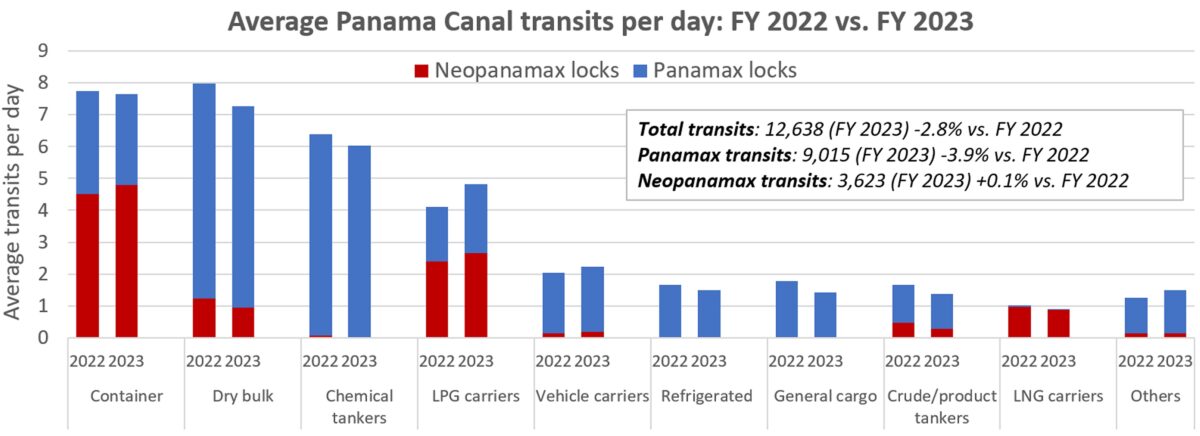
During the past two fiscal years (the ACP’s fiscal year ends Sept. 30), there was an average of 4.7 container ships transiting the Neopanamax locks per day, according to FreightWaves calculations based on ACP transit data.

chart of Panama Canal transits
Note: ACP fiscal year is from Oct. 1-Sept. 30. (Chart: FreightWaves. Data: FreightWaves calculations based on ACP FY 2022 and FY 2023 transit data)

That historical container-ship average is right at the Feb. 1 limit for total Neopanamax reservation slots (for all ship types) — and it’s just an average, meaning that on many days over the past two fiscal years, there were more than five container ship transits through the Neopanamax locks. 

Container shipping flows, as with other ocean cargo flows, rise and fall seasonally. Thus, some container service scheduling changes appear likely while restrictions are in place.

Effects on LNG and LPG shipping

The new limits raise serious questions on the extent non-containerized ships can use the Neopanamax locks (VLGCs and LNG carriers are too big to fit through the Panamax locks.)

Over the past two fiscal years, the Neopanamax locks have averaged 9.9 ship transits per day (including both reserved and non-reserved transits), right at the current reservation slot limit of 10 — which, as of Friday, drops to eight.

In addition to container ships, an average of 2.5 VLGCs, 0.9 LNG carriers and 1.8 ships of other types have transited the Neopanamax locks per day. 

Assuming precedence is given to container ships when restrictions are in place, most LNG carriers and VLGCs would be forced to take the longer route to and from Asia, either via the Suez Canal or the Cape of Good Hope. That rerouting has already begun, and will inevitably accelerate.

Oystein Kalleklev, CEO of Avance Gas (Oslo: AGAS), told FreightWaves in a recent interview that many VLGCs already avert the Panama Canal on their return leg for Asia, due to the uncertainty of meeting their loading windows in the U.S. Gulf as a result of canal delays.

Frode Mørkedal, shipping analyst at Clarksons Securities, said in a client note Wednesday that transit restrictions “will touch most shipping sectors that navigate the canal, [but] VLGCs and LNG carriers are poised to experience the most substantial effects.”

The longer distances traveled by VLGCs and LNG carriers will soak up more transport capacity and support higher rates. Mørkedal noted that VLGC freight futures “strengthened significantly” on news of Panama Canal restrictions, with the 2024 futures contract for VLGC voyages from the Middle East to Japan jumping $10,000 on Tuesday, to $70,000 per day.

Click for more articles by Greg Miller 

Flexport acquires Convoy technology stack for undisclosed sum

Flexport announced Wednesday that it has acquired Convoy’s technology stack. FreightWaves reported on Friday that the two freight startups were in talks for Flexport, a venture-funded freight forwarder, to acquire Convoy, a freight brokerage that shut down on Oct. 19.

“Flexport’s strategy will be to offer a full range of trucking services to our customers who value us as a one-stop-shop for global logistics,” Ryan Petersen, Flexport CEO and founder, wrote in an email sent to Flexport’s team Wednesday afternoon.

“Thanks to this deal, we’re now in a great position to complete our product vision as a true one-stop-shop to ship any product, in any quantity, between any two places in the world,” he added.

Terms of the agreement were not disclosed Wednesday.

A small number of Convoy employees will join Flexport, according to the email from Petersen. Flexport will not take on Convoy as a company or its liabilities.

Petersen wrote that Flexport customers would again be able to access Convoy’s trucking network in “the coming weeks.” Flexport customers have been able to access Convoy’s network since at least 2021. There are more than 400,000 truck drivers and 80,000 carriers, Petersen wrote in his email.

Convoy officially shuttered operations on Oct. 19, just 18 months after it was valued at $3.8 billion in its final funding round. Convoy’s former CEO and co-founder, Dan Lewis, declined to comment.

See the full email from Flexport founder Ryan Petersen

Team,

We’ve acquired Convoy’s technology stack and are planning to retain a small group of team members from their core product and engineering team. We are not acquiring Convoy the company or any of its liabilities, and our expenses will be limited to what’s necessary to maintain the tech.

Although we are not acquiring the business, we will be looking to restore their full-truckload service in the coming weeks and have already received positive intent from some of their largest customers to come back.

In recent years, Convoy became the clear leader in technology for trucking, a vitally important aspect of Flexport’s mission of making global commerce so easy there will be more of it. Trucking is at least one leg of every international shipment Flexport manages. With more than 400,000 truck drivers and 80,000 carriers in Convoy’s network, we will be able to tap into an incredible supply of trucking service providers for our customers. Convoy’s tech stack also includes sophisticated procurement technology that fully automates the supply side for 98% of loads booked. This will allow us to significantly lower our carrier costs on our truckload and eventually our drayage and cartage business.

We made today’s acquisition not just because of the incredible tech stack that Convoy built. We have heard from our customers that they want Flexport to be a one-stop shop for all their logistics needs. Our strategy for the trucking business unit will be very different from Convoy’s or other large truck brokerages who have focused on driving immense scale by pursuing the biggest Fortune 500 FTL accounts. With that scale came complexity and burn, and in a highly competitive market with low barriers to entry, even with all of Convoy’s incredible tech, they were not able to reach the scale required to turn a profit. Their operating position was made much worse by the current freight recession.  

Flexport’s strategy will be to offer a full range of trucking services to our customers who value us as a one-stop-shop for global logistics. We’ll offer expanded trucking services, including FTL, LTL, drayage (ocean) trucking, cartage (airport) trucking, and eventually intermodal (rail) trucking services to customers of our international freight forwarding services. Every container that comes in eventually gets trucked onward to its final destination. Thanks to this deal, we’re now in a great position to complete our product vision as a true one-stop-shop to ship any product, in any quantity, between any two places in the world.  

We enter into this transaction with our eyes wide open regarding the discipline and focus required to integrate the technology successfully. We’re not talking about financial risk, as the purchase price relative to value is modest. Rather, as a company, we are already heads down focused on returning our business to profitability, so we will do everything in our power to minimize distraction and ensure that our leaders can stay focused on the mission at hand. As we succeed, the upside from this acquisition is incredibly inspiring, and we’re thrilled to integrate the incredible tech stack from Convoy and the team we’re bringing over to help us offer expanded services for our customers to realize our vision.

Lots more to come as we begin this exciting chapter, and look out for a deep dive on Flexport’s trucking business in our next Global All Hands.

Aurora opens driverless trucking route in Texas amid autonomous jitters

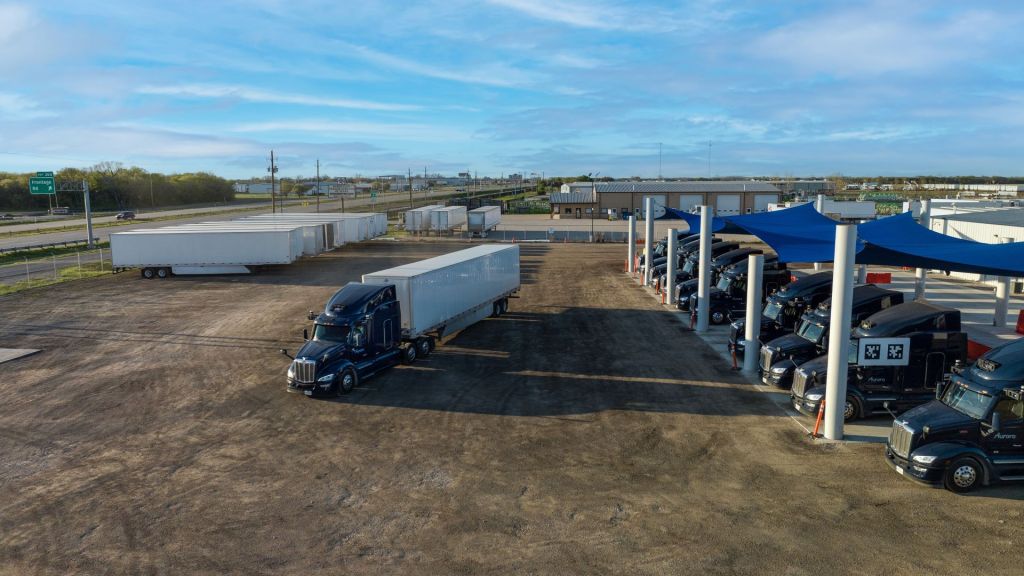
Aurora Innovation terminal in Texas

Aurora Innovation has christened the nation’s first commercial autonomous freight route between Dallas and Houston. But its timing could have been better.

“With this corridor’s launch, we’ve defined, refined, and validated the framework for the expansion of our network with the largest partner ecosystem in the autonomous trucking industry,” Sterling Anderson, an Aurora co-founder and chief product officer, said in a news release.

The choice of the Interstate 45 route was expected. Aurora has created autonomous terminals to launch and land driverless trucks in Palmer, Texas, located south of Dallas, and in Houston.

Inauspicious timing

The announcement comes after robotaxi maker Cruise Automation last Friday suspended operations in Austin, Texas, because of complaints about traffic delays caused by the intentionally cautious driverless cars. On Oct. 24, California suspended Cruise’s autonomous vehicle deployment and driverless testing permits after accidents and traffic tie-ups in San Francisco. 

California Gov. Gavin Newsom in September vetoed a Teamsters-backed bill that would have effectively banned heavy-duty autonomous trucking. California still requires safety drivers to monitor autonomous functions. Most companies pursued commercial trucking software and hardware testing and pilot operations in autonomy-friendly Texas. 

The Teamsters continue to protest against autonomous cars in California while stepping up anti-autonomy protests in Texas.

“Lawmakers in Austin should recognize that their voters do not want to be on the road with driverless cars or trucks,” Brent Taylor, Teamsters Southern Region vice president and secretary-treasurer of Local 745, said in a letter to Texas legislators. “We call on the legislature to seize the opportunity to pass a bill requiring human operators in all commercial vehicles.”

The compoany declined to comment on the Cruise suspension or the Teamsters.

Aurora pushes toward driver-out in 2024

Aurora is the first to name the freight-dense corridor for hub-to-hub operations ahead of planned driver-out commercial freight runs on I-45 as soon as late 2024. It currently operates 75 autonomous runs a week with safety drivers. Terminals for launching and landing autonomous trucks are up and running in the two hubs.

Rival Kodiak Robotics also has terminal operations in Texas. Both Aurora and Kodiak foresee more lucrative longer routes — from Fort Worth to El Paso for Aurora and Houston to Atlanta for Kodiak.

Aurora’s commercial-ready terminals house, maintain, prepare, inspect and deploy autonomous trucks between destinations. Its terminal blueprint maximizes the time autonomous freight-hauling trucks are on the road.

For example, on-site weigh stations ensure Aurora’s trucks comply with regulatory standards while allowing them to bypass on-road inspection sites. That results in a more efficient trip with fewer stops. Human drivers bring trailers of freight to one of the hubs where other human drivers pick up the loads for delivery to distribution centers or other final destinations.

“Bringing our commercial-ready terminals and services online a year ahead of our planned commercial driverless launch between Dallas and Houston enables us to focus next year on integrating our driver-ready trucks into our customer’s operations,” Anderson said.

Aurora is also preparing its command center to support around-the-clock commercial operations. Remote specialists monitor and provide guidance to Aurora-powered trucks. Dispatchers allocate trucks, trailers and vehicle operators to missions.

Aurora Innovation raises $820M in fresh capital

Aurora points to driverless trucks in Texas in 2024 

Continental will build autonomous hardware for Aurora Innovation

Click for more FreightWaves articles by Alan Adler.