




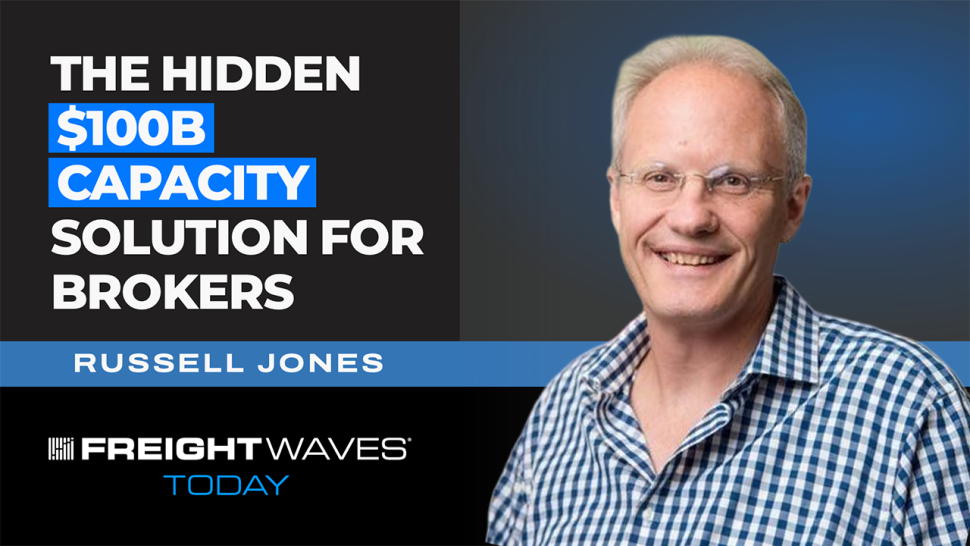
Private fleets face mounting costs while carrying over $100 billion in empty backhaul capacity. Russell Jones, CEO of Private Fleet Net Zero, explains how his platform unlocks this unused capacity, offering freight brokers a 25% discount and higher service levels. Discover how digital freight matching for private fleets can transform your logistics, improve reliability, and boost your bottom line.
Private Fleet Net Zero is targeting what its CEO calls more than $100 billion in untapped truckload capacity by connecting freight brokers with private fleet backhaul lanes — trucks that make up roughly 45% of all vehicles on U.S. highways but run empty on 50% to 90% of their return trips. The company launched its platform less than a year ago and has already signed more than 40 broker buyers and over 65 fleets.
The pitch lands at a moment when brokers are under mounting pressure to source defensible capacity. The $500 million Montgomery nuclear verdict, record-high freight theft flagged by the National Crime Bureau, and chameleon carrier fraud — featured recently on “60 Minutes” — have pushed brokers to tighten carrier networks. ILG Logistics, for example, cut its carrier count by 50% to reduce nuclear-verdict exposure, according to a report cited in the interview.
“At a very high level, the transportation industry has been trying to find the cheapest truck forever,” said Russell Jones, CEO of Private Fleet Net Zero. “Now it’s about, I want a safe truck that’s not going to get me into a lawsuit or have my cargo all over the highway.”
“And it’s basically kind of unlocked $100 billion worth of trucking capacity is just waiting for the brokers’ loads.”— Russell Jones, CEO, Private Fleet Net Zero
Jones says private fleets offer brokers three structural advantages over spot for-hire carriers: safety, cost, and security. The National Private Truck Council data he cited shows private fleets are involved in one-third fewer accidents than for-hire carriers. Drivers at large private fleets such as Walmart — where Jones noted drivers earn $100,000 a year — tend to have higher English-language proficiency, better-maintained equipment, and stable insurance coverage. On price, Jones said private fleets haul freight at an average 25% discount to market rates, which he argues could quadruple or quintuple broker EBITDA margins that currently run at just 2% to 3%.
The platform works differently from a load board. Private fleets submit lane data — either static or dynamic — which is ingested by an AI bot and stored in a database of more than 40,000 lanes covering over 80,000 trucks. Brokers push loads electronically from their TMS, and the system runs matching across 17 data points. A private fleet’s specific lane is only revealed to a broker when the fleet accepts or counters an offer, preserving confidentiality that Jones said is a core requirement for fleet participation. Jones noted that roughly 70% of the top 100 private fleets already hold for-hire authority.
Jones also highlighted a sustainability angle: Forbes data he cited attributes a quarter of the nation’s greenhouse gases and more than half of deadly fine-particle pollution to large trucks. He said Private Fleet Net Zero’s model is on a trajectory to save millions of tons of CO2, equivalent to planting 45 million trees — a metric he said is increasingly relevant for publicly traded shippers reporting to the SEC on Scope 3 emissions.
Jones stepped down as CEO of digital freight platform Cargo Chief — which he said now has more than 1,000 buyers and approaches $10 billion in spend — and left its board in January to focus exclusively on Private Fleet Net Zero. He described it as “the best opportunity of my career.” Brokers and fleets interested in a demo can visit privatefleetnz.com.
- Private Fleet Net Zero matches broker loads to private fleet backhaul lanes across 40,000+ lanes and 80,000+ trucks using 17-point AI matching, with lane data kept confidential until a fleet accepts or counters.
- Private fleets involved in one-third fewer accidents than for-hire carriers and haul at an average 25% discount, which Jones says could quadruple or quintuple broker EBITDA margins currently at 2–3%.
- The platform has signed 40+ broker buyers and 65+ fleets within its first year, targeting a segment Jones estimates represents over $100 billion in currently unused truckload capacity.
This Summary is generated thanks to a transcription of the interview, for the full interview please enjoy the video above.
Brokerage Compliance Symposium
The day before F3. Every compliance issue you face - fraud exposure, carrier liability, FMCSA rules, cargo theft, insurance gaps - navigated by attorneys and operators defining best practices in a changing industry.
F3 Awards Dinner
The night before F3. FreightTech100 companies honored. FreightTech 25 and Shipper of Choice winners revealed live. Cocktail reception into dinner and live music - 300 industry leaders in one purpose-built room.
F3: Future of Freight Festival
Industry-defining keynotes, rapid-fire technology demos, and industry leaders networking in experiences across Chattanooga - plus the inaugural F3 Awards Dinner featuring the FreightTech and Shipper of Choice reveals.
The day before F3. Every compliance issue you face - fraud exposure, carrier liability, FMCSA rules, cargo theft, insurance gaps - navigated by attorneys and operators defining best practices in a changing industry.
The Signal at Chattanooga Choo Choo • Chattanooga, TN Register NowThe night before F3. FreightTech100 companies honored. FreightTech 25 and Shipper of Choice winners revealed live. Cocktail reception into dinner and live music - 300 industry leaders in one purpose-built room.
The Signal at Chattanooga Choo Choo • Chattanooga, TN Register NowIndustry-defining keynotes, rapid-fire technology demos, and industry leaders networking in experiences across Chattanooga - plus the inaugural F3 Awards Dinner featuring the FreightTech and Shipper of Choice reveals.
The Signal at Chattanooga Choo Choo • Chattanooga, TN Register Now