




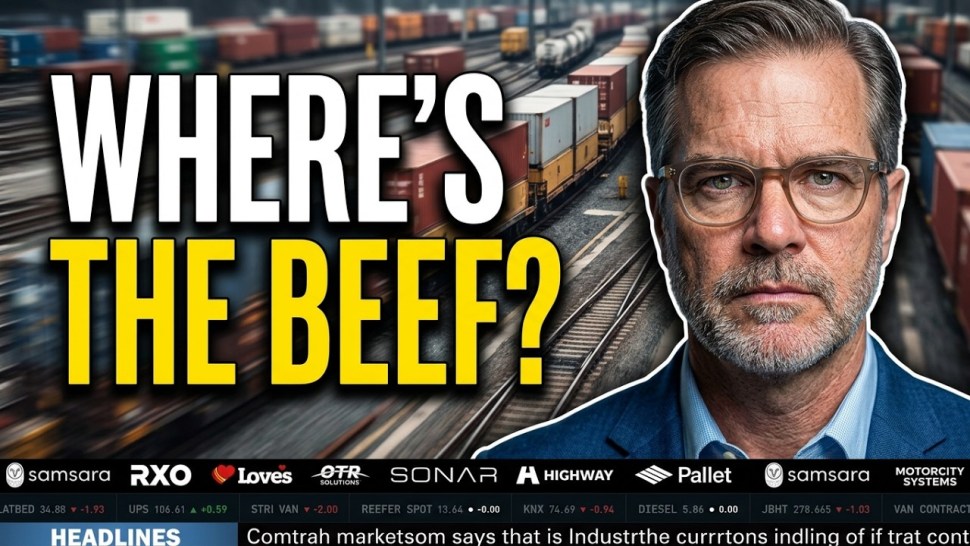
Paul Tonsager, CEO & Founder of Integrated Multi-Modal Solutions, questions the ambitious claims of the recent rail merger applications, asking “Where’s the beef?” in terms of specifics for truckload diversions. He discusses the long-term growth stagnation in freight, the immediate opportunities for railroads, and the complex dynamics of intermodal relationships. Discover why industry veterans are skeptical about big merger promises and what it means for the future of rail and trucking.
A settlement between CN and Union Pacific has injected new momentum into what is being described as one of the largest mergers in transportation history — the proposed Norfolk Southern-UP combination — but a veteran railroader and former Maersk procurement head says the deal’s core freight-diversion promise remains unsubstantiated. Paul Tonsiger, CEO and founder of Integrated Multimodal Solutions, who spent 25 years at CN and its predecessor Illinois Central Railroad, said the CN agreement repositioned a railroad that had been sidelined in the broader merger conversation.
Until the settlement, Tonsiger said, CN “was frankly irrelevant in the conversations that were going on.” In one move, the railroad regained strategic standing. He flagged one underreported asset the deal unlocks: CN’s Elgin, Joliet and Eastern Railway, acquired roughly 15 years ago, which would give UP a bypass route around Chicago, reducing dwell and improving network fluidity for intermodal traffic.
“Where’s the beef? I mean, I still haven’t seen any specifics — maybe I’m wrong, maybe they’re out there — but I haven’t seen any specifics like, you know, from Chicago to Kansas City or Oklahoma City to Atlanta, I’m going to take these specific truckloads off and these are the customers I’m going to work with to do it.”
The merger application cites a diversion of 2.2 million truck moves, a figure Tonsiger called skeptically vague. He argued that the railroads have yet to publish lane-level detail showing which shippers, corridors, and volumes underpin that number. He noted the figure is roughly equivalent to the annual truckload volume of a carrier the size of Knight-Swift, which he said puts the claim in context as a relatively modest shift in overall freight flows.
Tonsiger also pushed back on the notion that collaboration agreements among existing railroads can substitute for consolidation. Drawing on his time as head of procurement at Maersk — where BNSF and CSX were the primary rail carriers — he said past interline arrangements between carriers such as IC, WC, and CN fell apart over pricing and customer ownership disputes. He argued a merged UP-NS network could instead approach a steamship line directly and offer end-to-end solutions, for example moving cargo from Norfolk to Kansas City or Norfolk to Minneapolis, in ways the current fragmented structure does not support.
On the question of who ultimately controls intermodal freight relationships, Tonsiger was direct: it is not the railroads. “The railroads are wholesalers,” he said, noting that their direct customers are large intermodal marketing companies and ocean carriers such as Schneider, J.B. Hunt, Maersk, CMA, and Evergreen — not the beneficial cargo owners such as Home Depot or Walmart. That structure, he said, means railroads have limited direct leverage over volume growth and must rely on IMCs and steamship lines to translate network improvements into actual shipments.
The Surface Transportation Board will have final authority over the merger, and Tonsiger expressed confidence in the STB’s process, noting that — unlike regulatory reviews in other countries — the decision rests with a small number of board members rather than the Treasury Department or Justice Department. He said the merger process has already dragged on for roughly a year and urged the parties to accelerate. “The ball needs to move forward,” he said, adding that he expects the latest CN-related filing to shift the STB calculus, even if the full significance of the settlement may be “being promoted more than it actually means.”
- CN-UP settlement gives CN renewed relevance and would hand UP a Chicago bypass via the EJ&E, a move Tonsiger called ‘incredibly smart’ but underreported.
- Tonsiger, a 25-year CN veteran and former Maersk procurement head, says the merger’s 2.2 million truck-diversion claim still lacks lane-level specifics after roughly a year of proceedings.
- Railroads function as wholesalers in intermodal, with IMCs and steamship lines — not the carriers themselves — controlling BCO relationships and volume growth.
Speaker 1 [0:00] Welcome back. Paul Tonsiger argues the freight industry’s own math doesn’t add up. 20 years of growth stuck near 2.5%, by his account. Joining us now is Paul Tonsiger, CEO and founder of Integrated Multimodal Solutions. Todd, thank you for being here. Thanks for joining us. Tell us a little bit about what you mean about the math not adding up and where that, where that sort of comes from.
Speaker 2 [0:26] Well, thanks for, uh, having me on today. And, you know, it’s a weird day to be a railroader. Uh, there— I’ve never seen so much happen in about a week time period, especially with the announcement last night. But the reality is, you know, I wrote a lot of that a couple of months ago. But even listening to the, uh, the analyst calls, you know, the, the business, you know, they’re getting priced right now Um, it’s a, it’s a supply-driven, uh, situation for them. But, but the key is going to be, you know, how are you going to maintain this? You know, I think I just heard Craig say something that, you know, from a trucking perspective, you know, this is not— well, if you look at a year, is that short-term, midterm, long-term? But, but certainly, you know, the railroads have been handed a gift, um, that, you know, for the next year or so, they’re going to have the ability to bring in new customers. And is that going to be a price situation? Are they really going to dive in and put some meat on the hook and become customer-focused where they’re going to maintain this freight that they’re handling today?
Speaker 3 [1:39] Yeah, I think the announcement for our audience that hasn’t— may not be following the story, you can find it on TrainsPro— is really this merger, this mega merger that we’ve got, one of the largest, if not the largest, merger in transportation history, the Norfolk Southern-UP merger, which by the way, we’re going to cover in depth on Tuesday in our Future of Rail Symposium. We’ve got a jam-packed set of speakers, including the CEOs of both UP and NS here in studio that will be talking about this merger. But really, it’s the idea that CN and UP reached a settlement on the merger. Tell us a little bit about why, Paul, this is a big deal.
Speaker 2 [2:26] You know, I, I worked for CN for 25 years and, and certainly with the Illinois Central Railroad, so I’m, I’m, I’m pretty familiar with all the, the players. And, and, um, the— it was incredibly smart. Um, you know, I mean, up until this point, CN was frankly irrelevant in the conversations that were going on. Uh, in one fell swoop, they became relevant again. And I mean, you know, they’ve talked about Kansas City and St. Louis, but from an intermodal perspective and a transportation perspective, I think the thing to look at is the EJ&E, which the CN bought, I don’t know, 15 years ago. But that’s going to give the UP some fluidity around Chicago that they’ll be able to not have to stop. Um, And I think that will be one of the more underreported pieces of this. But, but certainly if you’re BN and CP— CSX I’ll put off to the side— but if you’re BN and CP right now, um, you, you’re, you’re rethinking things a little bit, I would think. And will this necessarily, um, move the board into a more positive position? I mean, I— and, and there, you know, I’ve supported the merger all along. Um, but I became, you know, less of a supporter over the last couple of months because the reality is, um, you know, they, they’ve moved— the chains have moved, but the ball hasn’t. And, and certainly with the filings and things like that, you know, it became more of a 50-50, uh, situation here. But I think that, that, that this certainly has moved the ball, and now we’ll have to see what the STB says.
Speaker 3 [4:04] But do you think the— you said you’ve been bullish on it Sort of 2 perspectives. One is the likelihood of it actually closing is sort of one perspective. The other question is, is it good for the industry? When you say you’ve been bullish, you’ve been pro it, where on those 2 realms— A, you support it because you think it’s better for the industry and the constituents, and then B, in terms of what you think is likely to happen— I’d love to get your perspective on both those points.
Speaker 2 [4:35] Yeah, I mean, you know, everybody talks about collaboration and I know CP and CSX and BN and CSX, but collaboration has been tried before and it’s not worked. I mean, if you look in the past, you know, IC, WC, CN, now granted that worked just because of the merger situation, but the reality is who owns the customer, how’s the pricing set up, it’s always in the details and frankly you never really get to see them. One thing I’ll say is, you know, part of my, my last full-time job was head of procurement at Maersk. And so I had all of the rail contracts. And, you know, the reality is, um, you know, you’ve got to negotiate with 2 railroads. Uh, in our, in our situation was BN and CSX. Those were our main carriers. But in, in tomorrow’s world, uh, would, would, um, know, the UP, go to Maersk or go to a steamship line and say, hey, my assets are being stuck in LA. I’ll, you know, let’s, let’s talk about moving traffic from Norfolk to Kansas City or Norfolk to Minneapolis. You know, there’s so many more opportunities from a network position that will be out there now. And I think that’s, that’s why I’ve been a supporter. I’m really skeptical on the 2 million truck diversion, you know, going through the the details of that. I don’t know if— but they don’t have to do 2 million trucks of diversion. Um, I think from a network, looking at a network and being able to use St. Louis and Kansas City and other places that aren’t able to be used today as an interchange point, um, will free up congestion and hopefully service customers a little bit better.
Speaker 1 [6:22] Yeah, I think those are all really good points. I want to talk a little bit, um, more about sort of your background and expertise and Talking about the complexity of these railroads and them working together, and you talk a lot about who owns the customer in a relationship. Is that the railroad? Is that an IMC? Is it the carrier? So can you talk a little bit about that and then the role IMCs play in that?
Speaker 2 [6:45] Yeah, I mean, you know, I’ll talk mostly about the US, but the reality is, you know, the railroads are wholesalers. CN has a retail product, that they do up in just specifically in Canada. But for the most part, they’re wholesalers. I mean, you know, their, their customer is Schneider and JB Hunt and Maersk and CMA and Evergreen. Um, you know, they— the, the reality is most of these railroads have BCO-facing groups, which is smart, but they’re tactical. You know, they’re not— you know, they’re, they’re strategic, not tactical, I’ll say, because The reality is they’re not negotiating pricing, um, with the big Home Depots of the world, the Walmarts of the world. I know Amazon’s a little bit different now. BN is doing quite a bit with them, which I think is the right thing. Um, but, but, but the reality is, again, they’re wholesalers. So, you know, you see the bumps and improvement in intermodal, you know, they’ve already, you know, it’s up to JB Hunt, which I know you just had mentioned on the, the, the previous, uh, segment, um, and I would say they are— they’re best in class. But, you know, BN’s relying on them for any kind of volume improvement. So, you know, the railroads themselves don’t have a ton of control over the BCOs. They have control over their service, but the selling point and who owns the customer from an intermodal perspective totally different from the carload side, are the IMCs and the steamship lines.
Speaker 3 [8:20] Yeah, Paul, you mentioned 2 million truckloads. This was in the application. Covering this market, it’s not a lot. I mean, it’s about the equivalent of Knight-Swift’s business. I mean, we’re not talking a lot of truckloads taken off the market. But it does feel like a better product, frankly, from an intermodal standpoint, because you get transcontinental. And the IMCs will certainly benefit from that. But there’s been a lot of pushback from the bulk— rightfully so— the bulk shippers. So where do you think this thing ends up? I mean, we’re going to hear more about that from the STB. Obviously, they’re not talking about the merger on our interview. I had the chance to interview the chair of the STB, Patrick Fuchs. And really, really what he had said that he wouldn’t give any sense of it, but it’s just not a big It’s just not a lot of volume moving off, but the bulk shippers are the sort of the recipients of, uh, of sort of the downside.
Speaker 2 [9:18] Yeah, and you know, I, I know Patrick and I, and I have a lot of faith in him and the STB, even with all the politics and, you know, the Supreme Court ruling and things like that. They will do the right thing. Um, I mean, like you said, this is the biggest deal out there right now, um, unless you look at SpaceX or some of the other things from a technology perspective. This is the biggest deal. I mean, and, you know, 3 or 4 people, you know, unlike other countries in today’s world, those 3 or 4 people will make this decision. It won’t be the Treasury Department. It won’t be the FBI or Justice Department. It will be the STB that will make the final decision. So I think the biggest frustrating part, and this gets back to the 2.2 million trucks, is, you know, used to be Wendy’s. Where’s the beef? I mean, I still haven’t seen any specifics Maybe I’m wrong, maybe they’re out there, but I haven’t seen any specifics like, you know, from Chicago to Kansas City or Oklahoma City to Atlanta, I’m going to take these specific truckloads off and these are the customers I’m going to work with to do it. I mean, as you both know, the devil’s in the detail and it’s a lot of hard work. And so I think that is really my open question on this. You know, I think really with what happened with CN, again, I think maybe it’s, it’s being promoted more than it actually means, but it was incredibly smart. And I think this changes the dynamics a bit. Um, they just need to get moving. I mean, this thing is, is like a slow walk. This has been going on for a year. And, you know, Jim Fennah and, and I mean, all the CEOs and, and C-suite of railroads, they’re pros. I mean, they know what they’re doing. Um, but they— but the ball needs to move forward. So hopefully this last bit of application they give will satisfy the STB and Let the games begin.
Speaker 3 [11:10] Yeah, it’s going to be amazing to watch. As you point out, all these railroad stocks are AI. It’s crazy.
Speaker 2 [11:20] Uh, the only thing on, on the board that’s green is GE and the railroad stocks.
Speaker 3 [11:25] Crazy. Well, they are AI investments. I think they’re frankly better than a lot of the AI companies because they actually generate cash flow. Amazing to own a railroad.
Speaker 2 [11:35] Boy, cash flow, that’s kind of a weird concept, but, uh, thank you for the time.
Speaker 3 [11:39] Well, appreciate it, Paul. We’re gonna be right back.
Brokerage Compliance Symposium
The day before F3. Every compliance issue you face - fraud exposure, carrier liability, FMCSA rules, cargo theft, insurance gaps - navigated by attorneys and operators defining best practices in a changing industry.
F3 Awards Dinner
The night before F3. FreightTech100 companies honored. FreightTech 25 and Shipper of Choice winners revealed live. Cocktail reception into dinner and live music - 300 industry leaders in one purpose-built room.
F3: Future of Freight Festival
Industry-defining keynotes, rapid-fire technology demos, and industry leaders networking in experiences across Chattanooga - plus the inaugural F3 Awards Dinner featuring the FreightTech and Shipper of Choice reveals.
The day before F3. Every compliance issue you face - fraud exposure, carrier liability, FMCSA rules, cargo theft, insurance gaps - navigated by attorneys and operators defining best practices in a changing industry.
The Signal at Chattanooga Choo Choo • Chattanooga, TN Register NowThe night before F3. FreightTech100 companies honored. FreightTech 25 and Shipper of Choice winners revealed live. Cocktail reception into dinner and live music - 300 industry leaders in one purpose-built room.
The Signal at Chattanooga Choo Choo • Chattanooga, TN Register NowIndustry-defining keynotes, rapid-fire technology demos, and industry leaders networking in experiences across Chattanooga - plus the inaugural F3 Awards Dinner featuring the FreightTech and Shipper of Choice reveals.
The Signal at Chattanooga Choo Choo • Chattanooga, TN Register Now