




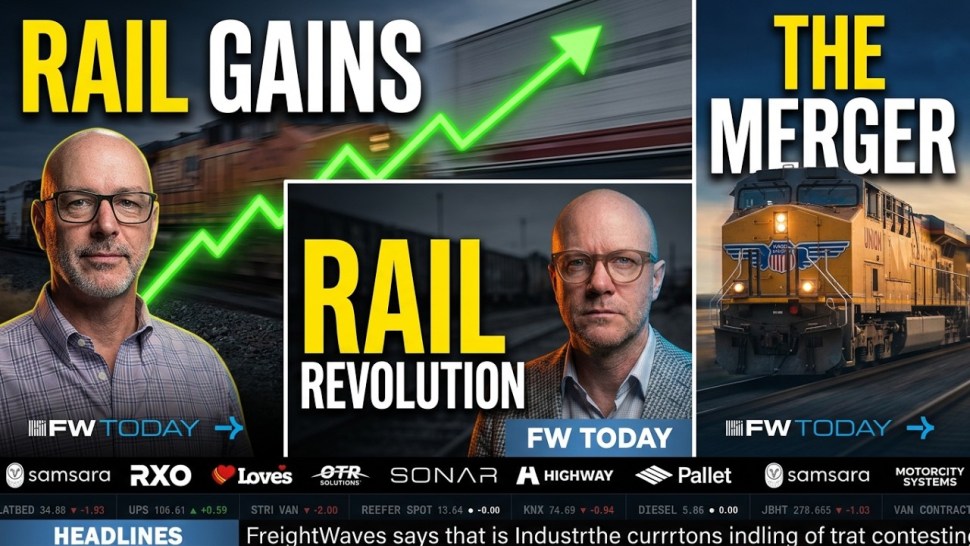
Rail traffic is UP, but the biggest story in North American rail is the proposed CPKC-KCS merger. We unpack the latest AAR data and hear why Union Pacific and Norfolk Southern CEOs believe this merger will be *better* for consumers, improving service, lowering costs, and bringing trucks off highways. But competitors aren’t convinced. Get the full breakdown of rail volumes and the heated merger debate.
Union Pacific CEO Jim Vena and Norfolk Southern CEO Mark George made their first public remarks following Monday’s supplemental merger filing with the Surface Transportation Board, telling the Trains Magazine Future of Rail Symposium that their proposals are shipper-friendly and that the combined railroad will deliver broad cost savings. The filing is a pivotal moment in one of the most closely watched rail consolidation proceedings in years, with opponents including BNSF and CPKC arguing the deal would concentrate too much market power.
At the core of the UP-NS argument is single-line service. Bill Steeves, editor of Trains Magazine, who moderated discussions with both CEOs, noted that shippers are two to three times more likely to complete a rail move when it involves a single railroad versus an interchange. Single-line service also runs 25 to 35% less expensive than a joint-railroad move, according to figures cited in the merger application. The applicants project $3.5 billion in annual savings for shippers and the removal of 2 to 2.2 million truckloads from U.S. highways.
The supplemental filing proposes expanding committed gateway pricing to cover double the number of shipments currently eligible, opening unit train moves — typically bulk commodities like grain — to more shippers, and creating a mechanism for shippers to access a competing railroad if service deteriorates during merger implementation. Vena expressed confidence the deal will be approved, calling it better for consumers through improved service that would lower costs relative to trucking.
“Single-line service is, you know, 25 to 35% less expensive than a joint railroad move because those costs come out — and so that is their argument, that that will save shippers $3.5 billion a year in terms of bringing trucks off the highway to this new transcontinental railroad,” Steeves said, summarizing the UP-NS case.
BNSF CEO Katie Farmer pushed back sharply, saying in a statement that the new filing “does nothing to change the impact of a railroad that would have 50% market share of US rail traffic,” and that the interchange protections on offer are difficult to understand, come with caveats, and apply to very few customers for only a limited time. BNSF has argued that commercial alliances — such as its partnership with CSX — can be equally effective at pulling freight off trucks without the competitive harm of a full merger.
On the week’s AAR traffic data, North American rail carloads rose 3.8% in week 29, ahead of the prior four-week pace of 2.7%, while intermodal decelerated to 2.6% from 6.5% over the same comparison period. In the U.S., intermodal grew 3.5% year over year for the week but slowed sharply from the 9% pace of the prior four weeks. Union Pacific stood out, posting an 8.2% volume gain for the week — more than double any other Class 1 — driven by record domestic intermodal performance for what the company said was a fourth consecutive quarter, with private-asset, rail-owned container, and parcel moves all up, plus share gains in international business previously moving on BNSF.
On the Canadian railroad front, CPKC was set to report earnings later in the day, while CN has already signaled it believes U.S.-Canada-Mexico trade tensions will resolve rationally, though Steeves acknowledged both Canadian carriers have a strong incentive to project optimism given their dependence on cross-border traffic. CN and CPKC are meanwhile working to diversify trade flows by routing more cargo through West Coast ports and developing Canada-Mexico land-bridge corridors. UP’s merger agreement with CN, reached last week, was cited by Steeves as a meaningful development that addresses Midwest overlap concerns and expands CN’s reach into Kansas City and Mexico — potentially strengthening the pro-competition argument before the STB.
- UP CEO Jim Vena says the proposed UP-NS merger will save shippers $3.5 billion annually and remove 2 to 2.2 million truckloads from U.S. highways.
- BNSF CEO Katie Farmer countered that the supplemental STB filing fails to address a combined railroad holding 50% of U.S. rail traffic market share.
- Week 29 AAR data showed U.S. intermodal growth slowing to 3.5% from a 9% pace over the prior four weeks, while Union Pacific outperformed all Class 1s with an 8.2% weekly volume gain.
Speaker 1 [0:00] Starting with our very own Bill Steeves, the editor of Trains Magazine. Let’s talk about the AAR numbers, Bill. I had a moment to glance very briefly in the break since they don’t come out until noon. And it looks like, again, everything’s up year to date except coal, with grain being up really pretty significantly at 13%.
Speaker 2 [0:18] All year really for grain, it’s been a banner year, partly due to comparisons with last year’s tariff impacts. Um, but when we look, uh, at a top level at week 29 AAR traffic for the North American railroads, uh, carloads were up 3.8%. Um, that’s stronger than the last 4 weeks, which was 2.7%. Um, intermodal was up 2.6%. That is a deceleration, uh, compared to the last 4 weeks where it was up 6.5%. And then overall North America up 3.1%, down slightly from 4.7% over the last 4 weeks. So still growth, just slowing down a little bit. But then we drill down more and look at the US volumes. Carloads in the US for week 29 up 1.2%. That is identical to the pace, 1.2% for the last 4 weeks. Intermodal is 3.5% growth year over year in week 29, but that’s quite a bit down from the 9% pace that we saw over the last 4 weeks. So overall, US volume was up 2.5% for the week, and that’s down from 5% over the last 4 weeks. So this is entirely due to the intermodal slowdown. And we’ll see in the coming weeks what direction that winds up going.
Speaker 3 [1:51] You say, when you say slowdown, this is, this is just July, is the July doldrums? Yeah, there’s something else to read into this. We’ll see.
Speaker 2 [2:00] I mean, you know, obviously, the fuel prices remain high, rail service levels remain pretty good. And, you know, everybody on the earnings call so far was really bullish on intermodal and the prospects. Um, but 3.5%, I think if, you know, you ask most railroads if they’d take that, they would say sure. What’s interesting is a little bit of a breakdown, um, you know, by, by railroad. Union Pacific, uh, they were up 8.2% this week. That’s more than double anybody else. Um, and they’re up 8.3% over the last 4, which was stronger than anybody but CSX, which is up about So there is some noise underneath the surface there, right? When you break it down on a railroad-by-railroad basis.
Speaker 1 [2:49] So because we’ve talked a lot about the East Coast railroads really driving a lot of the volume for the earnings we’ve seen so far, right, with carriers and others with large intermodal sectors. So what’s driving that UP volume? Is it all out of California?
Speaker 3 [3:04] Yeah, it’s the Transcon. Just for our audience that may not be as deeply familiar with intermodal and rail networks, EOP is a West-East railroad, not an East like CSX and Norfolk Southern. So Bill, what do you attribute that to, to Julie’s point?
Speaker 2 [3:23] Well, they did mention on their earnings call that their domestic had set a record for, I think it was the 4th straight quarter with private asset moves up, rail-owned container moves up. and also parcel moves up. So that’s pretty much the trifecta, right? But they also gained some additional international business as well that had been moving on BNSF. And so there’s that competitive dynamic at play as well, which I think it would explain for this week their, their overperformance compared to the rest of the railroads. And when you look Down into the carload data, which would be, you know, the industrial products things. Petroleum and petroleum products stood out this week. They were up 11.8%. Lumber and wood, again, another strong showing, 16.8% up compared to last year. And that’s within an overall forest products category that’s down 0.7% for the week. And that’s, you know, continuing the long-term trend there. Metallic ores and metals, again, up 6.8%. And that’s due to the strength of coke that goes into steelmaking, shipments of metals, you know, finished products, and then also scrap, which fuels steelmaking as well for the mini mills. And then autos showed some strength this week, up 2.9%. And they were down 2.2% in the last 4 weeks.
Speaker 1 [4:55] I thought that was an interesting one also. While the number of shipments for the Mexican rails is small in comparison to overall North America, they were up the most significantly, right? 18% in total intermodal units, 11% in total traffic, and it was the largest in auto parts.
Speaker 3 [5:15] But how much of that is— I mean, last year on a year-over-year comp basis, Liberation Day tariffs were playing havoc on industrial supply chains. We’ve got it in the IOTA data. We’ve got it in— last year, it’s really hard to have comps year over year because of the noise that was last year. We also have the USMCA, the fact that the administration does not want to renew that and has now put new tariffs on Canada. Bill, any insights on earnings? Did any of the railroads, particularly the Canadian railroads, have comments on this?
Speaker 2 [5:48] Well, CPKC reports this afternoon, so I’m sure they’ll have something to say. CN did have comments in their call. And, you know, I think both Canadian railroads feel that this will get settled in a rational way and it may take longer than anybody wants because—
Speaker 3 [6:10] Do they have to say that, though? Because the last thing you want to do as a CEO of a company that depends on the United States is to Get on the wrong side of the Trump administration. That’s not talking out of turn. Donald Trump punishes any company that says anything out of line. But do the railroads sincerely believe that, or is that just a narrative to stay out of trouble?
Speaker 2 [6:32] I think that is consistent when, like Keith Creel, for example, the CEO of CPKC, talks about it. He says that the these supply chains in North American trade are just so intertwined, the 3 countries, that it’s really hard to unwind that. And it just makes so much economic sense for all 3. That’s his take. Of course, he just put together the only railroad that links Canada, the US, and Mexico.
Speaker 3 [7:01] He is a USMCA or NAFTA 2.0 beneficiary. As you said, go deep into Mexico and all the way up into deep into Canada. It’s obviously in their vested interest to see that there isn’t trade tensions that are going to cause problems and disruptions, but the administration put on significant tariffs that do impact a lot of the commodities that go over rail. I’m just curious how the railroads are going to navigate that.
Speaker 2 [7:28] Well, one of the things that the Canadian railroads want to do, and the Canadian government as well, is diversify their trade as much as they can away from the US. And so they’re They are looking at driving volumes to ports, particularly on the West Coast, and also using their railroads in the US as a land bridge between Mexico and Canada and trying to increase trade between those countries because of the tariff situation. You have Canadian companies and you have Mexican companies who have been reliant on the US market. Now, you’re never going to replace that, but can we do more trade with each other? And that’s what both CN and CPKC have been talking about. And in some instances, aluminum would be the poster child here. Even though there’s high tariffs on aluminum, we don’t make enough of it. And so that traffic is still moving across the Canadian border into the US.
Speaker 3 [8:24] Yeah, trying to explain that to the administration, that you’re going to come through the United States for trade, but you’re not going to stop to trade those products is always going to be fraught with some narrative violations, at least according to the administration. Bill, you were here in office yesterday. We had some fantastic conversations, probably most notably the CEO of Union Pacific and Norfolk Southern. Everybody wants to know, by the way, it was a great conversation and a great event. It was the first event that trains magazine, which I’ve got a copy of Trainings right here. Please subscribe, support Bill and his efforts to bring clarity to the rail industry. You had the first virtual event. Any takeaways from just your conversation with the 2 CEOs about the merger or just in general about that event?
Speaker 2 [9:16] Yeah, thanks, Craig, and thanks for the plug for the magazine. Always appreciate it. Yeah, Jim Vena, the CEO of Union Pacific, and Mark George, the CEO of Norfolk Southern, made their first comments yesterday after, um, Monday’s filing of supplemental merger information. And they, they really said that, you know, these are shipper-friendly proposals that they have, um, to expand committed gateway pricing, which affects interchange traffic. Um, they’ll double the number of shipments that are eligible for that. They’ll allow unit trains, which typically in this case would be grain and other commodities that move bulk moves and open it up to those shippers. And in the event that there’s service problems related to a merger implementation, if it’s approved, they created a mechanism that would allow shippers to access to another railroad if their service suffers. And one of the things they said too was market share comes from increased competition and customer choice for single-line service. not from diminished competition. Now, of course, BNSF and CPKC and the coalition to stop the merger, they disagree. They see it very differently. And they say that this filing was just more of the same. It’s difficult to understand, comes with caveats, and it’s available to very few customers and only for a short time, is what BNSF CEO Katie Farmer said in a statement yesterday regarding the interchange protections that UP and NS are proposing. And then she also said it does nothing to change the impact of a railroad that would have 50% market share of US rail traffic. So as the merger review unfolds, that’s going to be a debate that we’re going to hear, you know, quite a bit about is these differing views of the merger. And elsewhere, you know, in the Future of Rail Symposium, you had a chat with Patrick Fuchs, the chairman of the Surface Transportation Board. I had a really interesting discussion with the leaders of Intramotive and Parallel Systems. They are developing autonomous railcars and where that could go in 5 years. Chatted with Tom Tisa of Patriot Rail. He’s their chief commercial officer. And part of that discussion centered on how railroads can grow by being more than a railroad, really by getting into transloading and warehousing and distribution and doing more than just moving freight cars for their customers. Spoke with the analyst Rick Patterson about the operating ratio focus that Wall Street has on— for railroads and how that can, in his view, affect service and volume growth negatively for both. And CanDo, a Canadian company, spoke with their Chief Commercial Officer Mike Miller about how they have a solution to this. through helping the Class 1 railroads and their customers with first and last mile service, making it more frequent, more reliable, more dependable car supply, and then you can grow the volume. And we had an in-depth feature on them in our August issue of Trains. And then also spoke with officials from the Federal Railroad Administration and the Association of American Railroads on what they’d like to see happen so that railroads have an easier job of implementing new technology like automated track inspection, automated equipment inspection, and even autonomous vehicles like Parallel and Intramotive are developing.
Speaker 3 [13:05] Congratulations. It was an amazing event. All those videos are available on demand. But I want to go back to the Union Pacific, Norfolk Southern conversation. Jim Bennett was absolutely bullish on the fact that this merger, I think in his exact words, this is going to get approved. And he makes the case that this is better for consumers. His case is it’s gonna improve service, therefore lowering the cost for— and I don’t know that he said trucking, but he certainly was implying versus trucking and competition versus trucking. What is— I mean, he was very confident. Maybe that’s what you say of someone that submitted thousands of pages to the STB. And obviously, you’ve got a lot riding on it. But Is this just— was this just his positioning? It seems like he clearly sincerely believes that this is going to get approved, but was he just talking his book, or was he actually, uh, like, what was your take on that?
Speaker 2 [14:01] I think Jim believes what he says, um, and at the same time, is he talking his book? Of course he is. He wants to see this merger get approved, um, but, uh, I don’t think it’s mutually exclusive. But yeah, the whole central argument here is that shippers prefer single-line service. You deal with one railroad, one invoice. If you have a problem, you call one place. And the stats back that up where, you know, you’re 2 to 3 times more likely to see a rail move when it’s single-line versus interchange because of those— the friction that exists there. And they note that single-line service is, you you know, 25 to 35% less expensive than a joint railroad move because those costs come out. Um, and, and so that is their argument, that that will save shippers $3.5 billion a year, um, in terms of bringing trucks off the highway to this new transcontinental railroad. Um, and then, um, you know, that’s a stronger argument.
Speaker 3 [15:09] I mean, we’ve talked Their application talks about the fact you’re going to remove 2 to 2.2 million truckloads. When we do the math, it’s the size of Knight-Swift. It’s just not that big in our world.
Speaker 2 [15:18] Right.
Speaker 3 [15:19] But I think the cost savings, the significant savings, the improved transit times, the fact that you can now have, as you said, one line across the whole country— I mean, that’s obviously why BN is against it and some of the competitors, because they don’t like that service, because it would be superior in many ways. to what they’re offering their clients. So it’s going to be interesting to watch. Bill, any reads? Again, Patrick gave me nothing in terms of whether, how he’s feeling or what the STB is feeling, but any reads on it in terms of state of play?
Speaker 2 [15:49] I think what was important was the merger agreements that UP reached with Canadian National last week that solved some of the overlap issues in the Midwest. And then also expand CN’s reach into, you know, places like Kansas City and into Mexico. That is helpful for making the argument that we’re enhancing competition. Whether that flies at the STB, well, we’ll have to wait and see. But that would be a big thing. And also BNSF, I think, would tell you that alliances can be just as effective as a merger in taking trucks off the highway. which is something that they’ve shown with CSX, especially.
Speaker 3 [16:33] But some of the posturing seems to contradict that argument when you say, hey, we have great service, but then they come out in some of the narrative, at least in terms of this STB competition concerns. So I don’t know, Bill, it’s a story that’s going to keep on giving where it’s not going away. Like many things we do here on Freightways Today, it is a recurring theme. By the way, if you love Bill Stevens, and we do here at Freightways Today, Please go subscribe to Trains. He deserves it. He’s earned it. And he’s a great person to come here every single Wednesday and celebrate the industrial economy. Bill Stevens, thank you so much for coming into FreightWaves today. We’ll be right back.
F3: Future of Freight Festival
Industry-defining keynotes, rapid-fire technology demos, and industry leaders networking in experiences across Chattanooga - plus the inaugural F3 Awards Dinner featuring the FreightTech and Shipper of Choice reveals.
Industry-defining keynotes, rapid-fire technology demos, and industry leaders networking in experiences across Chattanooga - plus the inaugural F3 Awards Dinner featuring the FreightTech and Shipper of Choice reveals.
The Signal at Chattanooga Choo Choo • Chattanooga, TN Register Now