




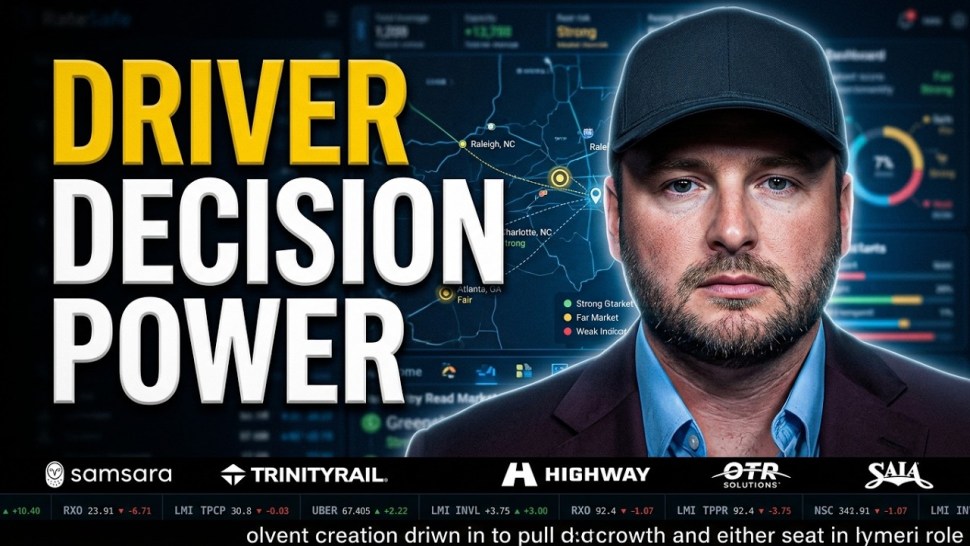
RateSafe, the winning app from FreightWaves’ Driver App Shortage Hackathon, is changing how truckers evaluate loads. Developed by Sean Conley of Vantage Logistics, this app uses SONAR API data and personalized driver metrics to help owner-operators decide whether to ‘take, avoid, or counter’ a load. It goes beyond just price, considering fuel economy, home time, and market conditions to empower drivers with smarter booking decisions.
Sean Connolly, Vice President and Director of Business Development at Vantage Logistics, won the first Driver Application Shortage (DASH) Hackathon — a competition that drew 17 entrants, all building applications using Sonar’s API to address the driver app shortage. His winning entry, RateSafe, strips out market complexity and delivers owner-operators a plain-English verdict on any load offer: take, avoid, or counter.
The Columbus, Ohio-area third-party logistics company was founded in 2014 and began as a trucking operation, giving Connolly an operator’s perspective that shaped RateSafe’s design. The app crosses Sonar’s market analytics with each driver’s personalized operating costs, fuel economy, profit goals, and home-time expectations — inputs that vary widely across drivers and that brokers rarely weigh when tendering loads.
“What I found was the real shortage was decision-making. You have so much data, but for a driver, you want to stay in your lane. You don’t maybe want to become a market analyst. You need decisions, you need them fast, you need them that fall in line with what your goals and expectations are to your own success.”
Connolly had no coding background before roughly two years ago, when he set out to build a load tender parser for Vantage after finding off-the-shelf SaaS solutions prohibitively expensive. Starting with ChatGPT and graduating to tools like Cursor after the turn of this year, he estimates he has logged 1,500 to 2,000 hours of development time since mid-January alone. That effort produced a suite of internal tools — including an accounting automation — before he turned to RateSafe for the hackathon.
Connolly argues that the freight industry’s persistent focus on rate obscures the full picture of whether a load is worth booking. A high-paying haul into a soft market, for example, can strand a driver and erode any rate advantage on the next move. “Any good broker should want drivers to make good decisions,” he said, pointing to three years of depressed spot rates as evidence of what happens when carriers operate without margin discipline.
The next milestone for RateSafe is a beta release within two months, delivered as a web application to sidestep Apple App Store approval delays. Connolly plans to recruit owner-operators already in Vantage’s carrier network for initial testing and intends to work with the Sonar team to incorporate additional data indicators — including fuel indices — that were not fully integrated during the one-week hackathon build sprint.
On the broader freight market, Connolly cited carrier vetting and litigation risk as mounting concerns, noting that the average tenure of a transportation manager at a shipper or freight brokerage runs roughly two years — leaving many decision-makers without the institutional memory to navigate a rapidly shifting regulatory environment. Vantage, a bootstrapped company that has never taken outside financing, plans to stay the course. “You’ve got to be able to pivot on a dime,” Connolly said. “You cannot have the approach of ‘that’s just the way we’ve always done it.'”
- RateSafe won the 17-entry DASH Hackathon by using Sonar’s API to give owner-operators a plain-English take/avoid/counter verdict on load offers based on personalized operating costs and home-time goals.
- Connolly taught himself to code roughly two years ago, logging an estimated 1,500 to 2,000 hours since mid-January building internal tools for Vantage Logistics before developing RateSafe.
- A beta web app targeting Vantage’s own owner-operator network is planned within two months, with potential paths to a direct-to-driver SaaS product or integration into existing driver-facing platforms.
Speaker 1 [0:00] Couple of weeks ago, we put on the very first Driver Application Shortage Hackathon. And we put this contest out. We gave everybody access to Sonar’s API. And we had 17 companies that went out and created an application to address the driver application shortage. To talk about that, our winner is Sean Connolly, who serves as the Vice President and Director of Business Development at Vantage Logistics. Sean, thanks for coming in. You, first of all, let’s talk about, you’ve won this, the product is called RateSafe. Let’s talk about what that is. But before I do that, for those that don’t know you, what is your background? What made you decide to join in this hackathon? Yeah, for sure.
Speaker 2 [0:47] First of all, thanks for having me down. Chattanooga’s beautiful. We were just talking about that off air. My background, as you said, Director of Business Development at Vantage Logistics. We’re a third-party logistics company based in Columbus. It’s Sunbury technically. We’ve got offices in Orville, Ohio, and then Fort Myers, Florida as well. And Adam and Jason, the 2 partners, when they founded it in 2014, we actually started as a trucking company as well. So I think that helped me in coming up with the idea behind RateSafe too. And what RateSafe is, essentially, to put it into one sentence, it helps drivers know when to say no. Or in other words, what not to book, right?
Speaker 1 [1:27] So what exactly is RateSafe? You’ve got the— you’re using Stoner’s API. Talk a little bit about what it actually does. Like, what is the— it helps drivers know not to book, but what does it actually— the product do?
Speaker 2 [1:39] For sure. So to give you an example, take you back like 5 years ago when I was account managing. Customer approaches me, hey, I need you to cover this load, right? So then I, at that point, go out to a multitude of carriers and offer this load to them, right? But that individual load means something different to every single one of those carriers, right? And the reason is, is because they might have different fuel economy, they have different profit and revenue goals, they have different home time expectations. So what might look very good to one driver looks very bad to another, and they should not book it. So RateSafe helps cut through that noise and tell them what they should and shouldn’t book in very plain English, right? So it quite literally says take, avoid, or counter. And then also in plain English is explaining why behind that. So it’s taking Sonar’s APIs, which is the backbone of the market analytics within the app, and it’s telling them what is a good area, right? What is, is that rate that you’re being offered good? And then also comparing it to that driver’s own personalized operating costs, home time expectations, and things of the such.
Speaker 1 [2:50] And the idea— I think one of the insights you had here, and I think one of the reasons that I liked it and that the judges liked it, was the fact that you’re— it’s not built from a broker’s perspective. It’s built from a carrier, owner-operator, or driver’s perspective. Exactly. You know, running trucks, I like to quote Doug Wagner, who said this. Maybe he regrets it because I’ve said this a few times. Doug had said at F3 is that brokers, most brokers that he has worked for him or worked in the industry, couldn’t manage a truck if their life depended on it. It’s a very different activity. Brokers typically are not worried about thinking about the driver’s home time, thinking about that. But having been a part of an asset-based trucking operation is built into Vantage. You understood how important the non-rate decisions are because I think so often in a transaction, brokers are all thinking about price. Of course. And all too often, even carriers, all they talk about price. But there’s all these other decisions that go into it.
Speaker 2 [3:49] There’s, there’s so many more that play into it. And yeah, I think there’s always this stigma of, you know, brokers and carriers not getting along. But I think ultimately any good broker should want drivers to make good decisions. You guys know better than anybody. I think you talk about it every day, what has gone on over the past 3 years when market rates have driven down to the floor rate. So, and shippers included, shippers should want their carriers to make good decisions because if you’ve got a really good driver that shows up on time, that’s very communicative, that does the right job. You don’t want them operating in the red to the point where they’re going to ultimately go out of business. Right. So that from my perspective, if we can add value to the drivers that do and add so much value to us as the broker, why would we not want to do that?
Speaker 3 [4:41] Yeah, and I loved that it was personalized for the driver’s home time, what parts of the country they want to go into, what they need to make based on their cost to break even and how they can do that. Not just one load at a time, but looking at it a little bit further along to where they’re going to end up. And where they would get their next load. So you have a real full-time job. What made you decide to do this, to build this app and to, to participate in the hackathon?
Speaker 2 [5:02] Yeah, well, this is just a bunch of firsts for me. I’ve never been to Chattanooga. Building software is new to me. I do it within the walls of Vantage and I’ve found success with that. But when I follow you on X, Craig, and when I saw, I think you were just initially thinking about it like we should do a hackathon and then it turned into DASH, Driver Application Shortage Hackathon. And I was like, well, I’m building software for Vantage. Why not? Because I’ve seen these at other companies, these hackathons, and just personally, I find it neat. So I wanted to participate. And, you know, I sat down and thought about what could add value to drivers, and it led us here.
Speaker 1 [5:45] So, well, I think it was actually— I credit Reed Lustalot, who it was his idea. There was a conversation on X. He said, why don’t we do a hackathon to improve the lives of drivers? Yeah, of course, I was being a little facetious when I called it the app driver app shortage because I got a lot of hate about the fact that there’s so many apps for drivers. But it was a play on the driver shortage, which is always a fun topic.
Speaker 3 [6:10] There’s a lot of apps, but they’re not all for drivers, right? No, they’re not built with drivers in mind. No, drivers have to use for everyone else.
Speaker 2 [6:17] You’ve got brokers, large fleets, back office, and Track and trace. Yeah. Yeah. And when it comes to the driver, oftentimes you find they’re just throwing another dashboard or more rates or things like that. But what I found was the real shortage was decision-making, right? You have so much data. You guys are the kings and queens of it, right? Sonar, you have so much data that I love, but I have time to sit there and learn how to apply it, right? For a driver, you want to stay in your lane as a driver. You don’t maybe want to become a market analyst. You need decisions, you need them fast, you need them that fall in line with what your goals and expectations are to your own success.
Speaker 1 [7:02] So let’s go back a couple of years ago. So you’re in the middle of a freight broker, that is your career, you’re successful at doing that. Did you ever imagine a couple years ago that you’d be coding anything?
Speaker 2 [7:14] No, not a chance.
Speaker 1 [7:15] Had you ever coded before?
Speaker 2 [7:16] No, no.
Speaker 1 [7:17] When did you start coding? Like, what was that experience like?
Speaker 2 [7:20] Yeah, for sure. So when we were looking at upgrading our TMS platform about 2 years ago, and I have just always been personally fascinated with technology, so I keep my finger on the pulse of what’s new within the market, what can we utilize, things of that nature. And it started with a load tender parser. So I went out and I started talking to multiple companies in that space. I won’t name names, but there’s, there’s plenty of them out there that build out-of-the-box load tender parsers, right? Because I saw It’s a load tender parser, right? So our customer hands us over a load tender in whatever form that may be. PDF.
Speaker 3 [7:58] Yep.
Speaker 2 [7:58] Yep. So here is my load that I need you to cover. Right. And we turn around and we manually input that into our TMS system. So if we fat finger a date or a time, that costs us money, right? Because that’s our fault that we can’t push that off onto the shipper, the carrier. So we’re eating that cost to reschedule or what have you. So I was like, okay, well, let’s try to take out the manual input. Started contacting these companies and learned how expensive it is to purchase a load tender parser from one of these SaaS providers. So I hopped on ChatGPT at the time and just started, you had to copy paste code from the, yeah, back in the day, which ultimately is not too long ago with how quickly this stuff’s moving. So I hit some roadblocks when I came to the machine learning part of it, but at the turn of the year, this year, tools like Cursor started coming out and I was able to get a lot farther. And then of course, the improvements in the models overall that you have access to, but that’s where it all started. So that was the first tool that I built. And then I realized that I could build an entire suite of tools. And you’ve had multiple guests on your show that talk about how you kind of have a leg up when you have this domain expertise, right? So I come from this background as an operator, as an account manager, I know what could add value immediately. It’s what AI does is it just lowers the barrier to entry of somebody like myself who can take a concept and then move it into production very quickly. There then becomes their own problems that can come along with that that you got to be careful of. But I’ve also built tools for our accounting department, right? So I’m not going to sit here and ask AI, what does accounting need for a freight brokerage, right? Because it’s not that simple. One, it’s not going to know. And two, it’s not going to know specifically how the accounting folks at Vantage Logistics handles their accounting. So I had to go sit with them for multiple days and learn what they do because, thank God, I’ve never had to work in accounting. But that’s where I think it gets a little dicey with people just trying to build any and everything. You really have to have that domain expertise to leverage tools like this.
Speaker 1 [10:03] I think it gives you an advantage. The interesting thing is we’re in a world where SaaS or software that used to be— you would design a workflow around the software. So you’d buy a new TMS or accounting piece of software. The workflow, the process is built around the software. Today, I think what you’re describing is that the software is built around the human workflow, which is a totally different game.
Speaker 2 [10:27] Yes, that’s 100% correct. And speaking of RateSafe, the reason why I’m here, you know, you start with a UI. I don’t think that there’s any way around starting with a user interface like an app or a website or something like that. But my goal with Vantage and all of the tools that I’ve built there is to really meet people where they’re at, right? I don’t want them to have to go log into another platform. I don’t want them to have to go out of their way to do something else because that’s been a primary focus of mine is to cut down on noise because you’re right, it’s extremely noisy. There’s stuff everywhere. There’s an app for this and data for that. Like you, you should be designing tools to meet people where they’re at so that they can just operate more efficiently.
Speaker 1 [11:12] Are you bullish on SaaS or do you buy into the SaaS apocalypse based on your own experience?
Speaker 2 [11:20] You know, I don’t necessarily buy into the SaaS apocalypse. I think just like anything else, people really need to spend time with these tools, right? I’ve put in, I tried to calculate it just based on how many code deployments I’ve made to these tools and it’s somewhere in the ballpark of 1,500 to 2,000 hours just since middle of January. So like it takes a lot of time to learn how to work these things efficiently. So there’s a lot of crap out there, for lack of a better term. There really is. And when I was even trying to think of an idea for this hackathon, there’s just a bunch of junk.
Speaker 1 [11:54] Yeah, there’s a lot. It’s a race to the bottom in some ways. Mm-hmm. So Harish, who’s at Augment, he’s the founder of Augment, had a customer summit a couple of months ago. I went, and he makes a point that the vast majority— he’s like, I want you to look at your business. And he’s like, everyone talks about AI being— dealing with— is going to replace the billing clerk or something. He goes, that’s the least return on investment. The highest return on investment is software coding. And he’s like, frankly, what you can get out of software coding— something like 85% to 90% of the tokens today, according to Harish, are spent on software and engineering. That’s where the big value is. Because if you think about it, everything we do in software is either reducing expense, things flow easier, or more importantly, adding growth. And that’s really what software is supposed to do is help you grow your business without adding cost. That’s what he was arguing. That’s where AI should be deployed to, not trying to help a billing clerk because there’s very little value in that versus building actually real tools that improve workflows.
Speaker 2 [13:04] Yeah, and you can go down an entire rabbit hole with this, but I’m of the opinion that people overhired during COVID So you see a lot of these— I think a lot of overhiring for sure. Yeah, so you see these people that are letting people go masses and they’re blaming AI. I don’t buy it.
Speaker 1 [13:17] I think it’s because Wall Street rewards you. If you look at companies that have gone out, a couple of months ago, Square announced that they were eliminating 8,000 jobs. And people are like, oh, the AI job apocalypse is here. A lot of that, I think if you look at it, Jack Dorsey, by the way, if you look at this from Twitter, had, I mean, Elon Musk sort of proved this. He got rid of like 70% of the staff.
Speaker 3 [13:40] Yes.
Speaker 1 [13:41] And look, I’m a prolific Twitter user, now X user.
Speaker 2 [13:45] Yeah, I appreciate it.
Speaker 1 [13:45] It was very painful. Like for a couple of months there, things were breaking inside of the Twittersphere, but then it works better now. But he’s still 2/3 reduced on staff. I bet they only have like 100 engineers total. Exactly. This massive business and they had something like 2,000 before. So yeah, I think Elon Musk model of proving that you can be leaner is better. And to your point, I think it was an overhiring situation.
Speaker 3 [14:08] Situation. Yep. Yeah, there’s— it’s called AI washing, right? I mean, that’s— they talk about earnings have AI washing in them.
Speaker 1 [14:13] Yeah, well, stocks are rewarded. It used to be when a company did a layoff that their stock would get beat because people— right, oh, there’s a— I mean, get beaten because there’s a problem in the business. Now it’s the exact opposite, is that companies, Wall Street investors, are rewarding you for being efficient.
Speaker 2 [14:27] Exactly.
Speaker 1 [14:28] So what do you hope to do?
Speaker 3 [14:29] I mean, what’s next with RateSafe?
Speaker 1 [14:30] For sure.
Speaker 2 [14:31] So with all of that said, I think it’s a good segue into this question. And what I’ve learned in building tools at Vantage is that you have to prove value. AI makes it extremely easy for feature creep to happen where it’s so easy to build feature after feature. So you can get lost in that. And I’ve been victim to it too. And you really got to catch yourself. So with RateSafe, I’m fortunate to be in a position where we are a freight brokerage. We know a lot of really good owner operators, right, that I can then get this to a beta very quickly to then give to them to provide feedback to us on does this add to my quality of life daily as an operator, as a truck driver, right? So to get that feedback to then know, are we going in the right direction with this? And at that point, I think it would be easier to then determine, do we turn this into a direct-to-driver SaaS product? Do we turn this into an integration to preexisting applications that the drivers already work within? I think that’s going to come in due time, but I’m a big advocate for proving value before you get too lost in the features that you build.
Speaker 1 [15:38] What is the timeline for that? So the idea is you can upload this to the App Store. By the way, because of the massive surge of apps, anyone who’s— I know Julie knows this painfully— their timelines to approve is a lot longer than it used to be.
Speaker 2 [15:51] Of course.
Speaker 1 [15:52] But what is the timeline that you would like to see the app in a beta for your drivers?
Speaker 2 [15:57] Yeah, first, I’m a big fan of web applications because partly due to— you don’t have to go through the Apple timeline.
Speaker 3 [16:03] Yeah.
Speaker 2 [16:03] So realistically, my plans are to get it into a beta within 2 months to begin testing at that point. And then working with the Sonar team too to maybe enhance and identify some things that maybe I didn’t see in that week-long hackathon where I could leverage Sonar’s data more efficiently. So I’m really excited to work with you guys on that.
Speaker 1 [16:24] When you were showing it, I remember coming up. I was like, hey, there’s some other indicators. Fuel was one of those. They have a whole set of fuel. Sean, tell us about the Sonar APIs. You had never used— you guys were not a Sonar user before, is that right?
Speaker 2 [16:37] Oh, we are.
Speaker 1 [16:38] Yeah. You were, but in terms of actually using the API, you had not used that before. Had you used it before?
Speaker 2 [16:44] I do. I do use them for Vantage’s software that I’ve built as well.
Speaker 3 [16:48] Oh, you had to log out?
Speaker 1 [16:48] Did you find it easy to use?
Speaker 3 [16:50] Yes.
Speaker 1 [16:50] Yeah.
Speaker 2 [16:51] And your API portal is extremely easy to use. And that’s one of the benefits of AI too, where I can say, hey, robot, go in here and I need you to scrub the API endpoints that we need. And then I create my own knowledge base for that to then turn around and build with.
Speaker 1 [17:07] Did it help that you had experience before using Sonar?
Speaker 2 [17:11] Of course, the timing was very beneficial for me because like I talked about, this entire year I’ve been building software for Vantage. So whether or not that gave me an unfair advantage, I don’t know because I did wait because I didn’t know if you guys were going to be checking like my GitHub commits on like timestamps and stuff like that. So I truly waited until the start date to begin this.
Speaker 1 [17:36] Oh, good.
Speaker 2 [17:36] Oh, good. No, I did not. I did not. No.
Speaker 1 [17:39] So drivers will be suspicious that a broker didn’t cheat.
Speaker 2 [17:42] Oh, that’s fine.
Speaker 3 [17:43] Yeah.
Speaker 2 [17:44] Yeah. No, that’s fine. But no, I’m really looking forward to working with you guys more on the development of the app. And hopefully within, like I said, 2 months, I plan to start beta testing.
Speaker 1 [17:54] Yeah, that’s amazing. I love that we had the opportunity to do this and see the different ideas. There were a lot of great submissions. We had 17 different parties that ended up submitting something.
Speaker 2 [18:05] It’s great.
Speaker 1 [18:06] We thought what you were doing was solving a very specific problem, which is making it easy for drivers to pick the right load for them versus, you know, this sort of— I think oftentimes it’s all about rate and oftentimes the best rate isn’t the best load.
Speaker 2 [18:23] Yeah.
Speaker 3 [18:23] Oh, especially if it’s going into a terrible market, right?
Speaker 1 [18:26] Into a terrible market.
Speaker 3 [18:27] Spot on their next load.
Speaker 1 [18:28] You know, you can get a nice length of haul, but then you’re going to Montana and you’re stuck or you’re on a load for 5 days that pays you a lot, but But then by the time you deal with all of that, and there’s a lot of reasons why you shouldn’t take a load beyond price. Of course. So I would be remiss if I didn’t ask you about the market right now and all of the noise and news. You don’t have to comment on the Sage Robinson lawsuit, but I’d love to hear what your general sense of the market is.
Speaker 2 [18:57] Yeah, well, you know, it’s certainly unnerving to see, and I heard in the first part of your show, and you’ve mentioned it before too, that really strikes a chord. It doesn’t really matter, or at least it doesn’t seemingly matter so much what you do on the front end. It ultimately falls down to what the jury is convinced of in any one of these cases, right? So we, we do our due diligence in carrier vetting, but it is certainly unnerving what’s going on. But at the same time, we’ve— we’re a bootstrap company, right? We started from nothing. We’ve never financed growth or anything like that. We’re very nose to the grindstone mentality. So throughout all of the noise, which this is just another noisy area of life in our industry right now, on top of AI, on top of everything else, where I look at it and we need to just keep doing the right job. I mentioned that good brokers should want drivers to make good decisions. You know, that is the mentality that we need to just put your head down, keep doing what we’re doing. Of course, make improvements when we find out new information that can improve how we operate on a daily basis. Um, we really just put our best foot forward.
Speaker 1 [20:08] What do you think the biggest of all of the things that brokers are now having to consider and think about— what is the biggest change you think as a, as an industry that we will see that comes from this?
Speaker 2 [20:20] I think you’re going to see a lot of people that don’t necessarily have their wits about them on, on how you should form relationships and the types of people that you should be working with their cheapest carrier, correct? They’re going to filter themselves out. And, and even, even on the shipper level, you know, I see that on the shipper level too, where a lot of them are in very bad positions right now because they, you know, it’s not even necessarily their fault because you look at the average tenure of an account manager at a freight brokerage or a transportation manager at a shipper, I believe it’s somewhere in the ballpark of 2 years. Yeah, right.
Speaker 1 [20:57] Not seeing— we’ve talked about this almost every show, right, on how shippers Because there’s been— I’ve never seen a carrier’s market. And look, all of this is new to all of us. The whole regulatory market, these lawsuits, and the whole stuff. It’s all brand new. And it requires a brand new playbook that none of us are familiar with. And it just feels like this regulatory compliance thing is just going to continue.
Speaker 3 [21:20] Yeah.
Speaker 2 [21:21] And you’ve got to be able to pivot on a dime and adjust the way that you— I hate the saying, that’s the way we’ve always done it. I was just talking to one of our account managers. We were in North Carolina on a customer visit, and we all were sitting down talking about how so many people— well, that’s just the way we’ve always done it. You cannot have that approach in the way you vet carriers or in the AI space now too. Like, you’ve got to be able to pivot and adapt to the changes that are coming because it’s only going to speed up. Like, we’re living in a very fast-paced world, and it’s only going to get faster.
Speaker 1 [21:52] Well, Sean, thanks for flying into Chattanooga. Send us some photos of your 182. You flew in on a Cessna 182.
Speaker 2 [21:57] Of course.
Speaker 1 [21:58] Definitely a good choice for our winner. I didn’t know that your dad was a pilot. Oh yeah. Maybe taking the most important form of transportation, general aviation. But we’d love for you, as you get this out in market, come give us an update.
Speaker 3 [22:09] Of course.
Speaker 1 [22:10] Tell us what you learned, good, bad. We’re going to go on the software journey and build in public here.
Speaker 3 [22:14] Yeah, we’re rooting for you.
Speaker 2 [22:15] Yeah, I’ll come down whenever. Thank you very much.
Speaker 1 [22:18] Really excited that we had the chance to bring in those. We want to thank all of our supporters, partners that were a part of this. We’ll be right back.
F3: Future of Freight Festival
Industry-defining keynotes, rapid-fire technology demos, and industry leaders networking in experiences across Chattanooga - plus the inaugural F3 Awards Dinner featuring the FreightTech and Shipper of Choice reveals.
Industry-defining keynotes, rapid-fire technology demos, and industry leaders networking in experiences across Chattanooga - plus the inaugural F3 Awards Dinner featuring the FreightTech and Shipper of Choice reveals.
The Signal at Chattanooga Choo Choo • Chattanooga, TN Register Now