




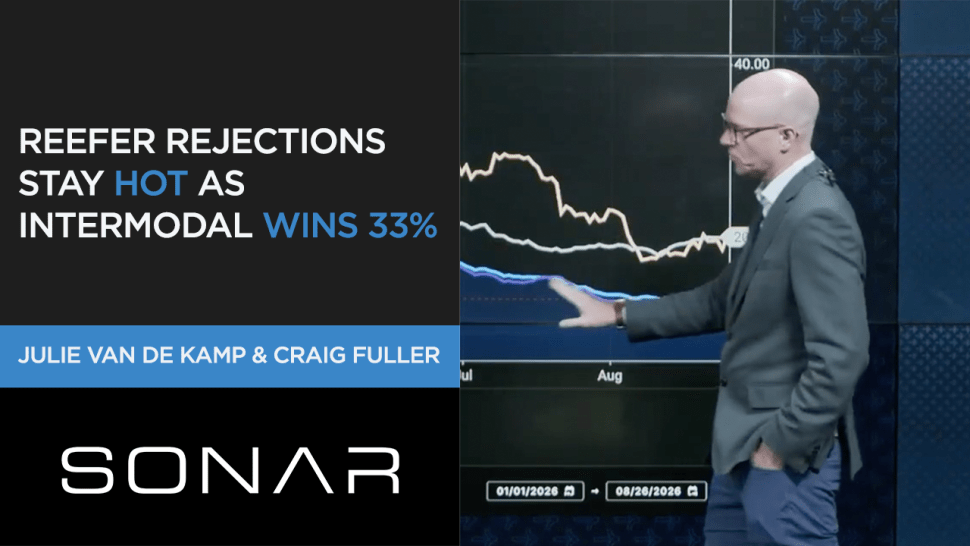
Reefer tender rejections are still running hot while van and flatbed cool off. The big swing factor: intermodal savings are now around 33%, pulling more freight off the road while refrigerated freight stays less flexible. In this SONAR Daily Update, FreightWaves breaks down reefer rejection trends, flatbed seasonality, rail container volume strength and what mode conversion means heading into Labor Day. #ReeferFreight #Intermodal #TenderRejections
Refrigerated tender rejections are bucking a broader softening trend across truckload modes, holding steady at 20% to 20.5% even as van and flatbed rejection rates ease, according to FreightWaves SONAR data reviewed during a recent Sonar Daily Update with Craig Fuller and Julie Van de Kamp.
The persistence of reefer tightness is partly seasonal — hot summer temperatures drive demand for temperature-controlled capacity — but Fuller and Van de Kamp identified a structural factor that may matter more to carriers and shippers: refrigerated trailers cannot easily convert to intermodal. Unlike dry van freight, reefer loads require purpose-built refrigerated containers that must run continuously, making mode substitution largely unavailable as a pressure valve. “Refrigerated is the least fungible mode with intermodal,” Fuller said.
That intermodal pressure valve, meanwhile, is wide open for dry freight. The intermodal contract savings index — which measures the cost gap between intermodal and over-the-road trucking — is running 33% above trucking costs, the highest level in at least three years. Van de Kamp pointed directly to that figure as the driver of record intermodal volumes. “33% — I think that’s your answer on why intermodal is so strong right now,” she said.
“Intermodal is not getting cheaper. It’s just not getting more expensive.”— Julie Van de Kamp
Total outbound rail container volumes are running significantly above the prior three years on a seasonally adjusted basis, with SONAR data showing the current year’s volume trajectory continuing upward alongside the widening cost-savings index. Fuller noted that the modest recent dip in the savings index likely reflects spot truck rates easing slightly rather than any move in intermodal pricing — a dynamic that could narrow the gap if trucking softens further heading into fall.
Flatbed rejections, by contrast, have fallen sharply from their spring highs. Van de Kamp attributed the pullback to construction seasonality: building materials move heavily in the first half of the year before summer heat slows construction activity, particularly in northern markets where the building season can be limited to roughly 10 months. With that demand cycle winding down, flatbed capacity has loosened considerably.
On the cross-border rail front, Fuller flagged early data on Canada-to-U.S. and U.S.-to-Canada outbound rail container volumes as a potential leading indicator for tariff-related trade shifts, though both anchors said it is too early to draw conclusions. Van de Kamp noted that Canadian rail volumes in bulk commodities — metals and mining in particular — have been lagging U.S. levels for some time, predating the current tariff environment. Fuller added that Mexican rail volumes remain relatively strong but represent only a small share of overall North American rail activity. Both said they will continue tracking cross-border flows for signs of tariff impact in the weeks ahead.
- Refrigerated tender rejections are holding at 20%–20.5%, outperforming all other truckload modes, driven by summer heat and a structural lack of intermodal substitution.
- The intermodal contract savings index is 33% above over-the-road trucking costs, a three-year high, fueling record outbound rail container volumes.
- Cross-border U.S.-Canada and U.S.-Mexico rail volume data are being monitored as potential early indicators of tariff-driven trade shifts, though current data are inconclusive.
This Summary is generated thanks to a transcription of the interview, for the full interview please enjoy the video above.
Brokerage Compliance Symposium
The day before F3. Every compliance issue you face - fraud exposure, carrier liability, FMCSA rules, cargo theft, insurance gaps - navigated by attorneys and operators defining best practices in a changing industry.
F3 Awards Dinner
The night before F3. FreightTech100 companies honored. FreightTech 25 and Shipper of Choice winners revealed live. Cocktail reception into dinner and live music - 300 industry leaders in one purpose-built room.
F3: Future of Freight Festival
Industry-defining keynotes, rapid-fire technology demos, and industry leaders networking in experiences across Chattanooga - plus the inaugural F3 Awards Dinner featuring the FreightTech and Shipper of Choice reveals.
The day before F3. Every compliance issue you face - fraud exposure, carrier liability, FMCSA rules, cargo theft, insurance gaps - navigated by attorneys and operators defining best practices in a changing industry.
The Signal at Chattanooga Choo Choo • Chattanooga, TN Register NowThe night before F3. FreightTech100 companies honored. FreightTech 25 and Shipper of Choice winners revealed live. Cocktail reception into dinner and live music - 300 industry leaders in one purpose-built room.
The Signal at Chattanooga Choo Choo • Chattanooga, TN Register NowIndustry-defining keynotes, rapid-fire technology demos, and industry leaders networking in experiences across Chattanooga - plus the inaugural F3 Awards Dinner featuring the FreightTech and Shipper of Choice reveals.
The Signal at Chattanooga Choo Choo • Chattanooga, TN Register Now