Diesel prices are continuing on a mostly downward trend, with the benchmark price used for most fuel surcharges falling to one of its lowest levels since military action against Iran commenced at the beginning of March.
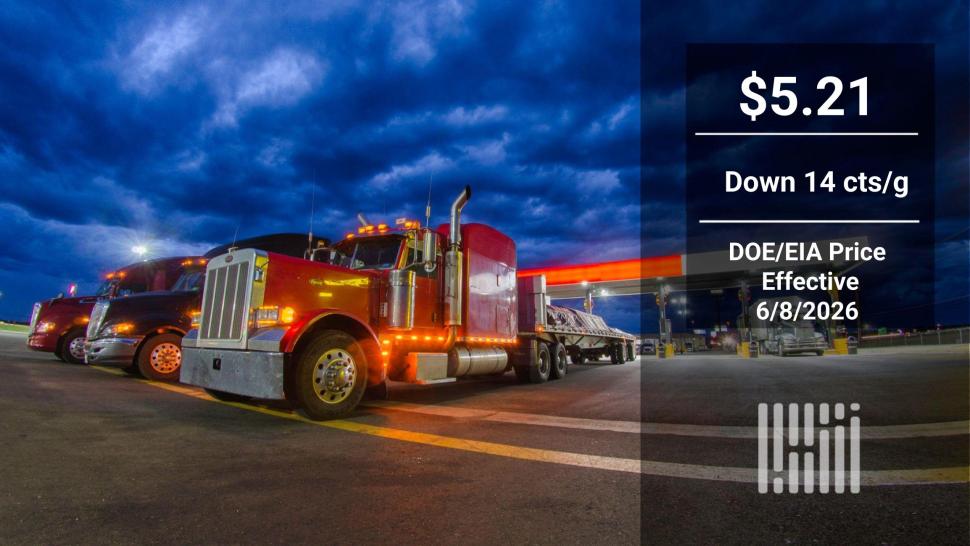
The Department of Energy/Energy Information Administration average weekly retail diesel price was published Tuesday, effective Monday, at $5.21/gallon. It is the lowest price since the first two prices that were published just after the start of hostilities, $4.859/g on March 9 and $5.071/g a week later.
It’s the fifth straight week the price has fallen. During that time, the declines total 43 cts/g.
There is a growing disconnect between the DOE/EIA price and the daily AAA average retail diesel price. That number was posted Tuesday at $5.317/g.
The declines come as futures price continue to fall, for the most part, but where the voices who talk about “tank bottoms”–a withdrawal of global inventories so massive that it gets stocks down to the minimum level needed for the petroleum distribution system to operate–seem to be increasing against that backdrop of falling prices.
That view of a disconnect was summed up in a post on X by John Arnold, a legendary trader and a thought leader on trading issues.
The most recent EIA report on U.S. stocks, released Wednesday for the week ending May 29, showed total inventories of 1.573 billion barrels, the lowest in more than two years and the tenth straight week they had declined. Given their weekly publication, and the U.S. position as the world’s largest consumer, the data is closely watched as a sign of potential global trends.
Ultra low sulfur diesel on the CME commodity exchange posted a recent peak settlement of $3.8481/g on June 3. Its settlement Monday was $3.5999/g, and the market was trending lower Tuesday morning.
Consistent Currie
One of the loudest voices saying that the commodity markets are not adequately pricing in the movement toward “tank bottoms” is Jeffrey Currie. He is the former head of commodity research at Goldman Sachs who is now on his own. And his message has been consistent for several weeks: what matters are the molecules, not paper markets that increasingly are bearish.
In a recent online interview, Currie said paper markets are “entirely disconnected from the physical markets.” Global crude benchmark Brent is now below $90/barrel. But crude delivered in some parts of the world is north of $150/b and product prices like jet or diesel are more than $200/b.
“The supply shock is almost equal to the demand shock during COVID, and we know what that did to global supply chains,” Currie said. “So I think if you’re at $100/b (in the futures market), it’s mispriced what is coming in the physical market.”
Why not buy forward barrels?
But if oil is mispriced, why aren’t traders buying barrels to be delivered several months from now, when the price will presumably be higher? They are not doing that, and the proof of that is in the forward curve.
For example, Brent on CME settled Monday at $94.25 for July delivery. But for January delivery, six months out, Brent settled at $83.91/b.
That structure is called backwardation, with the front month the highest number in the price series. Backwardation develops during periods of tight inventories, as a market that is in perfect balance would see prices rise along the calendar, a structure known as contango.
That backwardation is one reason why companies are reluctant to buy the cheaper crude for later day, according to energy economist Philip Verleger.
In a recent commentary Verleger said it would be expected that some companies that sell oil to consumers would want to accumulate inventories now at lower prices for future delivery.
“These companies would probably want to hedge and, in some cases, would be required to do so by their banks,” Verleger said. “Unfortunately, hedging today locks in a large loss. For example, (a company) who bought diesel at the end of May and sought to sell forward to November would immediately incur a $9-per-barrel loss due to market backwardation. The loss this transaction would have incurred a year ago would have been perhaps $1 per barrel.”
As Verleger noted, “Few firms can afford to accept such losses on significant product volumes.”
Export ban concerns
There also is a market fear, Verleger said, that the U.S. might ban exports of crude and products if the now falling price of oil reverses itself. Should that happen, he said, “such an action would likely depress prices in the United States, possibly violently. Oil in tanks would suddenly be worth much less.”
Given that, according to Verleger, “the risk boosts the incentive to hold no oil. Every US firm in the oil business has every reason to minimize its inventory holdings today to protect against the uncertainties created by President Trump.”
More articles by John Kingston
Texas court nixes shipper liability in Home Depot/Werner case
Carrier Nussbaum sets driver pay increase; others popping up more quietly
Amazon scores big win at NLRB over whether it’s a joint employer with DSPs
Brokerage Compliance Symposium
The day before F3. Every compliance issue you face - fraud exposure, carrier liability, FMCSA rules, cargo theft, insurance gaps - navigated by attorneys and operators defining best practices in a changing industry.
F3 Awards Dinner
The night before F3. FreightTech100 companies honored. FreightTech 25 and Shipper of Choice winners revealed live. Cocktail reception into dinner and live music - 300 industry leaders in one purpose-built room.
F3: Future of Freight Festival
Industry-defining keynotes, rapid-fire technology demos, and industry leaders networking in experiences across Chattanooga - plus the inaugural F3 Awards Dinner featuring the FreightTech and Shipper of Choice reveals.
The day before F3. Every compliance issue you face - fraud exposure, carrier liability, FMCSA rules, cargo theft, insurance gaps - navigated by attorneys and operators defining best practices in a changing industry.
The Signal at Chattanooga Choo Choo • Chattanooga, TN Register NowThe night before F3. FreightTech100 companies honored. FreightTech 25 and Shipper of Choice winners revealed live. Cocktail reception into dinner and live music - 300 industry leaders in one purpose-built room.
The Signal at Chattanooga Choo Choo • Chattanooga, TN Register NowIndustry-defining keynotes, rapid-fire technology demos, and industry leaders networking in experiences across Chattanooga - plus the inaugural F3 Awards Dinner featuring the FreightTech and Shipper of Choice reveals.
The Signal at Chattanooga Choo Choo • Chattanooga, TN Register Now