




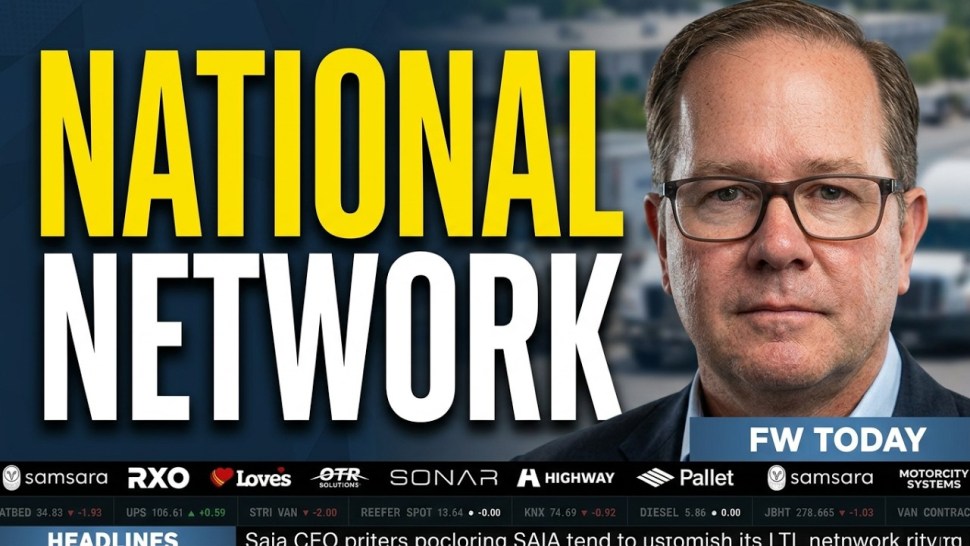
Saia President and CEO, Fritz Holzgrefe, shares insights into the current LTL freight market, including customer sentiment and Saia’s strategic network expansion. Discover how Saia’s investment in new terminals and workforce is cutting transit times, offering unparalleled service, and driving growth in competitive markets across the U.S. Holzgrefe also discusses navigating inflationary costs and balancing wage increases while maintaining a focus on customer value. #LTL #FreightMarket #SupplyChain
Saia has opened 70 terminals since 2017 as part of a deliberate, multiyear organic expansion that CEO Fritz Holzreif says is still far from its full potential. Since 2023 alone, the carrier has added close to 40 new locations and replaced or relocated another 30 facilities — a pace of physical network transformation that Holzreif said no other LTL carrier has matched in the same period.
The buildout matters because it has unlocked transit lanes Saia could not previously offer. Customers can now ship freight from Trenton, N.J., to Texas markets in three days, Holzreif noted — a direct result of the denser footprint. “Customers are coming to us and say, ‘Oh, fantastic, you can now get my freight from Trenton, New Jersey to Texas markets in 3 days,'” he said. “That’s significant. We couldn’t do that historically.”
“We are early innings of tapping the full potential of this business,” Holzreif said, adding that the roughly 40 facilities opened since 2023 have not yet reached the profitability or density levels the company believes they can achieve.
The network strategy has coincided with market share gains in Saia’s own backyard. The carrier added two terminals in the Atlanta metro following a customer-proximity model and has doubled its market share in that market over roughly five years. Saia’s current operating ratio stands at 86, though Holzreif said that figure understates performance in the carrier’s longer-established facilities and that the company has significant room to improve returns across its newer terminals.
On pricing, Saia pushed through a general rate increase in July. Holzreif described customer reaction as largely in line with expectations — frustration with inflation but acceptance tied to service quality. “Customers are like, ‘You’re doing a great job. We don’t like the inflationary nature of what you’re having to do, but at the same time, we understand,'” he said. The carrier also issued two wage increases over the past year, delaying the first to Oct. 1 before returning to its normal schedule with a July 1 increase, which Holzreif framed as a necessary investment in retaining what he called the best team in the business.
Customer sentiment surveys Saia conducts each quarter show sustained optimism heading into the second half of the year. After the first quarter, customers polled by the carrier expected the back half of the year to strengthen — and that view had not changed in the survey conducted after the second quarter, Holzreif said. He sees shippers moving from gauging market conditions to actively selecting which LTL partners they want to grow with.
Holzreif, who previously served as Saia’s CFO before moving into the CEO role, said the transition gave him a fuller view of how sales, operations, and financial discipline interconnect. The 102-year-old carrier’s expansion traces back to 2017, when it began pushing into the Northeast, and accelerated when a competitor exited the LTL market, creating what Holzreif described as a generational real estate opportunity that helped Saia speed up its terminal acquisition pace.
- Saia has opened 70 terminals since 2017 and nearly 40 since 2023, while also replacing or relocating about 30 more facilities in the same recent period.
- The expanded network now enables transit times such as Trenton, N.J., to Texas in three days — a lane Saia could not previously serve — and has doubled market share in the Atlanta metro over roughly five years.
- Saia issued a July general rate increase and two wage increases over the past year, with the CEO saying newer terminals have not yet reached their full profitability potential, leaving the company in what he called the early innings of its growth story.
Speaker 1 [0:00] We have the CEO of SIA coming to us from Atlanta, right up the street from Chattanooga, Fritz Holgreif. Welcome, Fritz. Welcome to FreightWaves Today. How are you?
Speaker 2 [0:11] Hey, great to be here. Doing well.
Speaker 1 [0:13] Well, thank you so much. Congratulations. You guys are continuing to do impressive stuff at SIA. You built out a pretty substantial network, took advantage of some consolidation that’s happening in LTL. Right time to do that with everything that’s happening in the freight market. What are you guys seeing right now?
Speaker 2 [0:31] You know, I think the market, uh, feels pretty good. It’s got room to grow from here. I think that the biggest, biggest takeaway that I see as we talk to customers is that there are a certain level of kind of consistency. People have, uh, under— sort of understand the markets in which we operate. They understand kind of what the challenges there might be, but most importantly, they know the rules of engagement right now. So I think that allows folks to kind of invest in their business, kind of grow their business, work on developing their supply chain. And so I think it’s an interesting time. And, you know, we’ve seen pretty good growth as we’ve built out our national network.
Speaker 1 [1:09] What are shippers seeing right now in terms of sort of, you know, LTL is always a little bit slower to recover than the truckload market. It’s sort of that second part of the cycle. What are shippers experiencing right now? Earlier this year, there was a lot of, I wouldn’t call it denialism, but sort of a state of belief or been a belief among shippers, the market was turning. How are shippers reacting to the market right now?
Speaker 2 [1:32] You know, it’s interesting. We poll our customers every quarter and just kind of get a feel for sense of what they think’s going on and, you know, how they feel about their business or what their next steps are. And what’s interesting is when you look at the poll that we took back at the end of the first quarter, people were focused on, hey, the second half is going to be better. There was an optimism around that. And what’s interesting is that that hasn’t really changed after the second quarter. So we did our survey here a few weeks ago. And I think that’s important for the business. Customers are comfortable with where they are and now they’re looking to, all right, what LTL provider can I grow with and who can I partner with that kind of meet our expect— or their expectations in the second half? So I think that they can, there’s a consistency, it’s there. So I think that that’s, That’s positive. And, you know, we’re ready to see that growth.
Speaker 1 [2:27] Yeah. I mean, you certainly have built out your network. You guys have added a brand new expansion in terminals. Talk a little bit about what the network buildout has been like and what was the purpose of that?
Speaker 2 [2:37] Well, the network buildout, and it’s been a many-year process. So if you’ve been following us, our first real sort of expansion was started in 2017. We had, the company’s 102 years old at this point, but By the time 2017 had come, we’d been through a period of challenges in the 2000, 2010 period. We built through acquisition, got the business stabilized through 2017, and it started in earnest expanding into the Northeast. And we’ve kept going. And as the generational real estate opportunity came about, as one of our competitors exited the business, a few years ago, that’s helped us accelerate that process. Now, what’s been critical to it, and we’ve opened 70 of these facilities since 2017, what you learn in that is the customer expects to have the exact same service everywhere we do business with them. And that’s critically important. So for us, the biggest challenge in an organic expansion like that is you got to build the team, develop those expectations right away. that leans into that historic SIA culture, which is a focus on the customer. And that’s been our focus. So when you go through an organic expansion like that, it’s really, really important that a new customer in Trenton, New Jersey has the exact same experience with SIA that they do in Dallas or one of the established markets that we’ve been in. So the success to date, and I think you see that in our volume numbers and have we been able to grow through this, is that customers say, look, hey, I’m getting the same service across this national network now. And what’s important about that is that gives us some new opportunities for customers. Customers are coming to us and say, oh, fantastic, you can now get my freight from Trenton, New Jersey to Texas markets in 3 days. That, that’s, that’s significant. We couldn’t do that historically. Now we can. Now we’re providing those solutions to customers. So it’s an exciting time for the company and the And the growth, the organic growth is really built around a great team and some great assets that we’ve accumulated over the last number of years.
Speaker 1 [4:41] It’s impressive to watch. Uh, you know, I did, I love history. Julie knows how much of a history nerd I am, just the, the history of Saya, the Jevic business, the connection to Yalo, rest in peace. So it’s been fun to watch what you guys really, uh, cook over the last couple of years as you’ve built out this network and really, uh, grown the business.
Speaker 2 [5:03] Yeah, it’s been exciting. I think what’s really compelling to me is when you see what we can do for a customer now. And that, you know, there were times in SAI’s history where we wanted to do a better job and we couldn’t quite get it done. And now we feel like we’re more and more in a position that we can do that. And that for our team that’s focused on the customer, when you’ve got the ability to continue to match those customer needs, that’s pretty exciting for us.
Speaker 3 [5:28] So I had the pleasure of speaking with Brad Hadley, your VP of National Accounts, last week on the show. And we talked a little bit about general market health and about general rate increases. So I believe that in July you guys did push out your general rate increase. How was that received and what are you hearing from shippers?
Speaker 2 [5:48] You know, listen, I think we all are in a spot where you People don’t like rate increases. People don’t like inflationary cost increases. We understand that. I mean, I think nobody is excited about it. You’re in a better position to go recover those inflationary costs and to put those rate increases in when you’re doing a great job. First and foremost, you don’t get the opportunity to go to a customer and say, hey, look, we need to put a general rate increase in and this is why we’re dealing with inflationary costs across our P&L. Customer has got plenty of problems. They don’t need their LTL partner to be a problem. And if you come in and say, look, this is the service we’ve been providing and you’re creating a lot of value for the customer and you only get a chance to get those rate increases when you’re providing value to the customer. And I think we are. So listen, I don’t know that people were excited about that, but I think they also would say that, hey, this is the best they’ve ever seen from SIA and that feels like a better investment then for them. So, you know, So far, as far as what the impact has been, is that it’s been as we kind of expected, to be quite honest with you. Customers are like, you’re doing a great job. We don’t like the inflationary nature of what you’re having to do, but at the same time, we understand.
Speaker 1 [7:09] Well, shippers need to pay up. I mean, they’ve enjoyed soft markets for the last couple of years. Capacity’s consolidating. We’ve seen the economic challenges in this industry. I mean, theft, cargo theft is a requires substantial investments, investments in safety. These are important facts. Shippers have enjoyed it too soft, too long, where they’ve enjoyed, had an enormous amount of pricing power. This is changing.
Speaker 3 [7:32] Yeah, and I think speaking of investing in your company, your team, and the service that you can provide to your customers, you guys have rolled out 2 wage increases. And so can you talk a little bit about that and how you’re balancing that with margin pressure?
Speaker 2 [7:48] Yeah, listen, our most— and I’ll tell people, anybody to listen, I think we’ve got the best team in the business. We’ve got to invest behind that team. A year ago, if we had this conversation, I would have felt like the market, the business, we had just gone through a really tough first quarter, a so-so second quarter, fair amount of uncertainty in the market. We have always been very, very focused on, listen, we’re not going to get out over our skis. We’ve got to be in a position that we pay as we go. So we delayed a wage increase a year ago to the 1st of October. When we felt better about the business, you know, we were in a position to put that wage increase in in October, we did. And then we got back on our normal schedule here the 1st of July. And that’s important, right? ‘Cause company’s doing well. But the only reason why the company’s doing well is we got that great team we gotta invest behind. So we’re gonna do it. We did it in a very pragmatic way. Our team understands that. They feel good about it. And now we’re in a position that we continue to provide great service. So that’s part of the inflationary costs in the business. And as Craig pointed out, this is an inflationary business that everybody’s gotta deal with. And we gotta continue to focus on recovering, getting a return on the significant capital we’ve deployed in the business and the heck of a team we’ve assembled to get the job done for our customers every day.
Speaker 1 [9:11] I mean, I think, look, the market conditions are enabling shippers have gotten the memo. They now realize that they have to pay up. They have to pay up for service. And right now, if I’m a shipper, I’m thinking about how do I protect the service providers that I depend on? I mean, that feels like in this market, it is critical. Everybody’s fighting the same battle. Labor is a challenge. But also the fact that all of the LTL providers and now truckload, are having to operate far more rationally than they have in the past because the market has consolidated and has enabled the kind of environment that has enabled you guys to achieve a really great OR, 86. But that is actually understating how well you’re performing in some of your existing legacy facilities. Yeah, it is.
Speaker 2 [10:01] Listen, we’re not anywhere where we think we need to be in terms of a company and what the returns we should generate in this business. The potential we feel like of the facilities Particularly the last 40 or so that we have opened, and those date back to sort of 2023. Those are not where we think they can be from a profitability perspective. And, you know, even from a service perspective in terms of making sure that we’ve got the appropriate densities in those markets that we can drive the efficiencies that are needed for our customer set. So we’re early innings of tapping the full potential of this business. It is, that’s why I’m particularly excited about where we are. I mean, I think, I think people, they compare Scia to maybe some of the other national carriers. And one of the things that I think is important to note is that over the last— since ’23, we have opened close to 40 facilities, new locations, new people, new teams, new markets for us. And at the same time, we’ve replaced or relocated another 30 or so facilities. I don’t think anybody else has done that. And What’s important that our customers, and ideally success for us, and how you measure success of a new facility, do you get business? That’s how customers vote. Sometimes they fill out surveys, they respond to surveys, but they vote when somebody’s doing a good job for them.
Speaker 1 [11:24] All the money, Fred, is going to be about that.
Speaker 2 [11:26] That’s when you’re seeing the growth.
Speaker 1 [11:27] So you served as CFO, you’re now running the business. Can I ask, what’s the biggest sort of aha moment going from the finance? I give my CFO a hard time because It’s always easy to put the numbers together and, and make sure that things are running, but when you’re in the, when you’re in the seat, a lot of other decisions. What’s been the biggest change in how you’ve viewed the business when you moved into CEO?
Speaker 2 [11:48] You know, I always felt like I was a pretty good operating CFO, meaning that I was close to the business, uh, being part of the results, driving the value in the organization. Good CFO does that. Our CFO now, Matt Pate, does a great job with it. But one of the things you don’t know, when you’re in that CFO seat and you move into the CEO seat, there’s this— I don’t know how to describe it, but there’s just stuff you don’t know about. It could be as simple of, well, there’s nobody else I can ask, or there’s certain things, wow, I didn’t really know that I was going to have to deal with that, or geez, my phone really is on all the time. And that’s okay. That’s part of it. I think the other thing that’s really exciting about it, though, is you can see how it all comes together. and see how a team really gels together and you see that success. That’s the part I most enjoy. And I don’t think you have that appreciation when you’re in that CFO chair, when you see how, when you’ve got a great sales team fitting together with a great ops team delivering a great product and it’s all profitable and you’re getting a good return, you have that appreciation when you sit in my chair and that’s a great place to be. to understand the business. You don’t necessarily see it all in that CFO chair.
Speaker 1 [13:02] Well, some of our best operators— I mean, trucking is a very financially intensive— and we’re talking pennies. Every penny matters in this business. Understanding unit economics and understanding cost is so important and critical. And look, some of the best operators in the entire business have a finance background. I mean, some of the legends of the space bring the finance office into the CEO office. And I think that’s Significant improvements that you guys have made operationally is a testament to the financial discipline, the understanding of the cost, and the willingness to make those investments. When you’re deciding to add a new terminal, I imagine there’s a pretty rigorous process for modeling that, operationalizing it. What’s the formula there in terms of deciding, hey, we’re going to expand this terminal?
Speaker 2 [13:47] You know, candidly, one of the things that we have learned from this process over time is that At the beginning, it was a process. The first facility in our expansion, I think we opened a facility in 2015. And one of the things that we started with there is where could we find the most economically viable property where the build costs are low, maybe near a highway, that sort of thing. Yeah, that’s a way you can do it. The way we have really focused since that time, which was very very, very cost-driven. We’ve evolved that to be very market-driven. So for us, when we look at a facility, it’s all about what the addressable market is near that facility. What customers can we tap? Because the reality of it is when we deploy capital in the business and get close to the customer like that, that’s creating value for the customer. And that’s where the analytics start there. Now, certainly we care about the build costs, we care about timing of that, how do we deploy the capital behind it? But the fundamentals will always start, and I think you’ve gotta have the business geared this way, starts with what does the customer need? You know, we had a facility that we added in the Dallas Metroplex. It was our 4th facility. And before we put that facility in there, the team, we got together, looked at it and said, and I said, there’s no way we need another facility in Dallas Metroplex. And, you know, we’ve got great market share, we’re doing all the things. The data came back, and said, look, this particular facility was within X proximity to customers. Customers will value this. Like, okay, now we’re talking. So the model in that case was wholly predicated on what does the customer need? Where does this asset need to be deployed? And that’s kind of how we got to the place. So the model when we look at adding a facility is really kind of that sort of top-down focus, meaning start with the customer and where’s the value there? And then you build the team behind it and the team that you bring in behind to develop that, they have to understand the reason why that facility is there is to serve the customers that are there. And that’s our formula.
Speaker 1 [16:04] And you imagine you’re getting the benefit. I mean, DFW, I’ve lived in DFW. I’m part Texan in terms of my residency. The DFW Metroplex is just massively growing so fast. I mean, and I imagine that benefit, you guys are benefiting greatly from that. Atlanta is as well. They always— Atlanta and Dallas are such ancestral cities. They’re so much alike.
Speaker 2 [16:27] Yeah. So part of our growth story, for the long— we undermarket shared Atlanta. We added 2 facilities following the principles I just described. And now we’ve doubled the market share in this market in a period of about 5 years. And all about proximity to the customer and making sure people understand we’re in business to take care of the customer’s business.
Speaker 1 [16:50] Amazing. Well, Fritz, really appreciate your time. Before you go, I got to ask, Notre Dame going to have a good team this year?
Speaker 2 [16:56] I’m a homer. We’re going to have a great team. Marcus Freeman is fantastic.
Speaker 1 [17:02] Well, fantastic. Well, best of luck.
Speaker 2 [17:03] We just got to make sure we beat Wisconsin.
Speaker 3 [17:05] Oh, come on. I knew that’s exactly where that was going to go. I’m glad you’re here, you know.
Speaker 1 [17:10] You know, but he’s an SEC— he’s in— as I am in Chattanooga too, diehard SEC country. I can’t get around it. Can’t get away from it. So, and he’s like an outsider, another new guy in Atlanta, Baylor Bear. And you know, we’re all, we’re all outsiders here.
Speaker 2 [17:24] Yeah, we’re all mixed up now.
Speaker 1 [17:26] We’re rooting against the SEC, Fritz. Appreciate you coming
Brokerage Compliance Symposium
The day before F3. Every compliance issue you face - fraud exposure, carrier liability, FMCSA rules, cargo theft, insurance gaps - navigated by attorneys and operators defining best practices in a changing industry.
F3 Awards Dinner
The night before F3. FreightTech100 companies honored. FreightTech 25 and Shipper of Choice winners revealed live. Cocktail reception into dinner and live music - 300 industry leaders in one purpose-built room.
F3: Future of Freight Festival
Industry-defining keynotes, rapid-fire technology demos, and industry leaders networking in experiences across Chattanooga - plus the inaugural F3 Awards Dinner featuring the FreightTech and Shipper of Choice reveals.
The day before F3. Every compliance issue you face - fraud exposure, carrier liability, FMCSA rules, cargo theft, insurance gaps - navigated by attorneys and operators defining best practices in a changing industry.
The Signal at Chattanooga Choo Choo • Chattanooga, TN Register NowThe night before F3. FreightTech100 companies honored. FreightTech 25 and Shipper of Choice winners revealed live. Cocktail reception into dinner and live music - 300 industry leaders in one purpose-built room.
The Signal at Chattanooga Choo Choo • Chattanooga, TN Register NowIndustry-defining keynotes, rapid-fire technology demos, and industry leaders networking in experiences across Chattanooga - plus the inaugural F3 Awards Dinner featuring the FreightTech and Shipper of Choice reveals.
The Signal at Chattanooga Choo Choo • Chattanooga, TN Register Now