
It was a very different State of Freight webinar to close out 2025 than what its audiences have been hearing for most of the year.
The discussion Thursday was not the first time in the 2025 FreightWaves webinars that the possibility of a stronger freight market was discussed. But that development never truly arrived.
The December webinar, however, was the first time that it took place against a backdrop where a forecast of a bull market could have had some numbers behind it: higher data from SONAR on rejection rates and spot prices, indices that have spiked in recent weeks with logical explanations as to what might be driving the levels higher.
Here are five takeaways from the State of Freight for December.
Spot rates are climbing
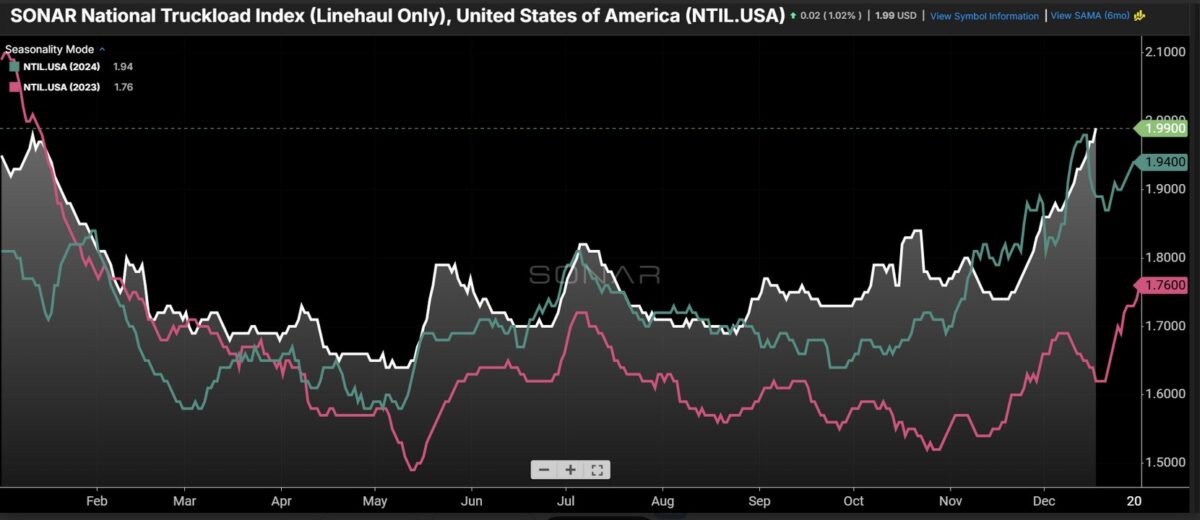
Presenters Zach Strickland, the head of freight market intelligence at SONAR and J.P. Hampstead, strategic analyst at FreightWaves, went through a supply of charts from SONAR that showed a notable upturn in the freight market. One was for the SONAR National Truckload Index, which reflects spot freight rates exclusive of fuel. A month ago, that number stood at less than $1.75 per mile. It has now climbed to just under $2/mile.
“We had an intuition that the market was more sensitive,” Hampstead said. “There were lots of news reports about the exit of capacity. There were different interesting bounces early in the year, but that effect sort of faded.” By contrast, just before Thanksgiving, Hampstead said, “is when things started turning up quickly.”
Strickland said “the traditional dynamics of peak season holiday shipping see spot rates tending to spike.” But the ongoing increase, he said, is that “we really didn’t have a lot of reason to expect this.”
A comparison of spot rates and contract rates in SONAR shows the spot market closing in on contract prices after months of lagging far behind, as would be expected in a weak freight market. A month ago, that spread was about 60 cts/mile. It’s now closer to 40 cts/mile.
And that has occurred parallel to increases in the tender rejection rate
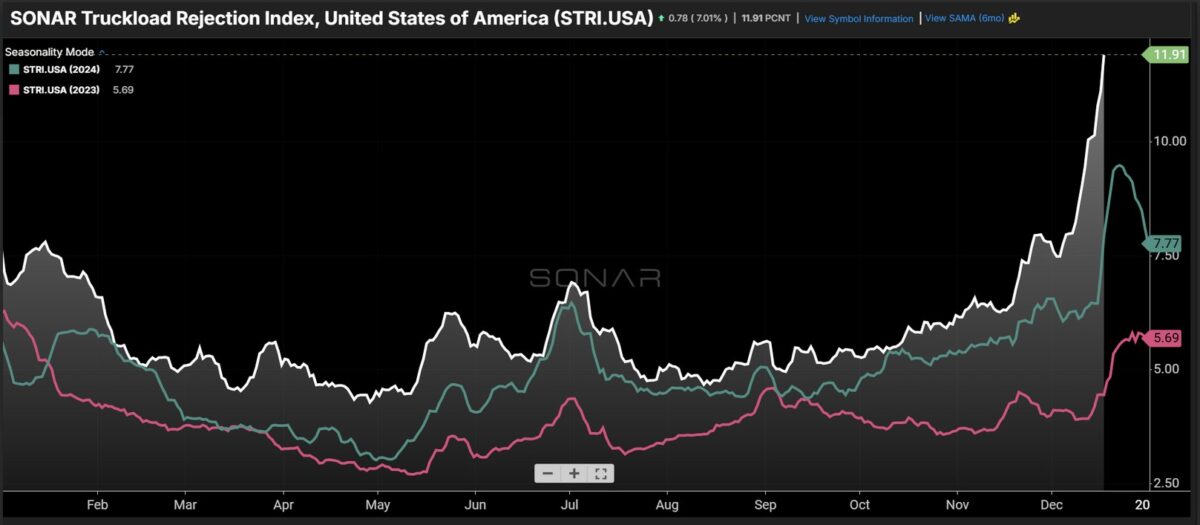
Another SONAR benchmark number that has soared recently has been the Outbound Tender Rejection Index (OTRI), a measurement of capacity driven by the amount of freight being rejected by contract carriers. The higher the OTRI, the tighter the capacity.
Its most recent number was 10.72%. About a week before Thanksgiving it was less than 6%. It did spike over 10% about a year ago but was down to less than 5% by late April.
“This is an early rise in the OTRI,” Strickland said. He added that a number of factors have contributed to the increase: Midwest winter weather, and flooding in the Pacific Northwest.
But those are short-term developments. “This market feels like it has been on this tightened coil and continues to get really wound tighter for a long period of time,” Strickland said. “And it looks like we’re kind of feeling some of that now.”
Hampstead also talked about seasonal restraints on capacity at this time of year. “Drivers are wanting to get home or at least stay in their home region,” he said. There is also the seasonal impact of the need by retailers at times to quickly replenish inventories during holiday shopping.
But the issues are bigger than that, he said. He cited “smaller sketchier carriers” that were using ELDs that now have been taken off the market by FMCSA, or were “using drivers that didn’t speak English very well.”
“There may have been other sorts of issues with their authority that have resulted in them being taken out of the market,” Hampstead said, adding “etcetera, etcetera” for emphasis to include all the various regulatory crackdown steps being taken by FMCSA that have tightened capacity.
“And now when shippers are looking to the spot market for that capacity, they’re finding that it’s much tighter than it was last Christmas,” Hampstead said.
Demand has been volatile
Earlier State of Freight webinars have focused on demand as being the surprise factor in the 2025 freight market. It’s down, as measured by the SONAR Outbound Tender Volume Index, a development that had not been foreseen at the start of the year.
Six months ago, the OTVI stood at more than 10,700. Most recently, it was a little more than 9,800.
But more recently, the OTVI has been rising. Two months ago it stood at about 9,310 before increasing to its current level.
The recent increases, Hampstead said, could be demand levels resetting at a higher level. “Post Thanksgiving this year looks a lot healthier compared to post Thanksgiving in 2023 or 2024,” he said.
Demand’s late jump in 2025, Hampstead said, “looks like shippers were slow playing it and kind of low balling their estimates for the fourth quarter or the holiday shopping season. And then all of a sudden, bam, wait, we need to get some stuff moving.”
And that “sense of urgency” has run into a market with tighter trucking capacity, he added.
What’s going on in warehouses?
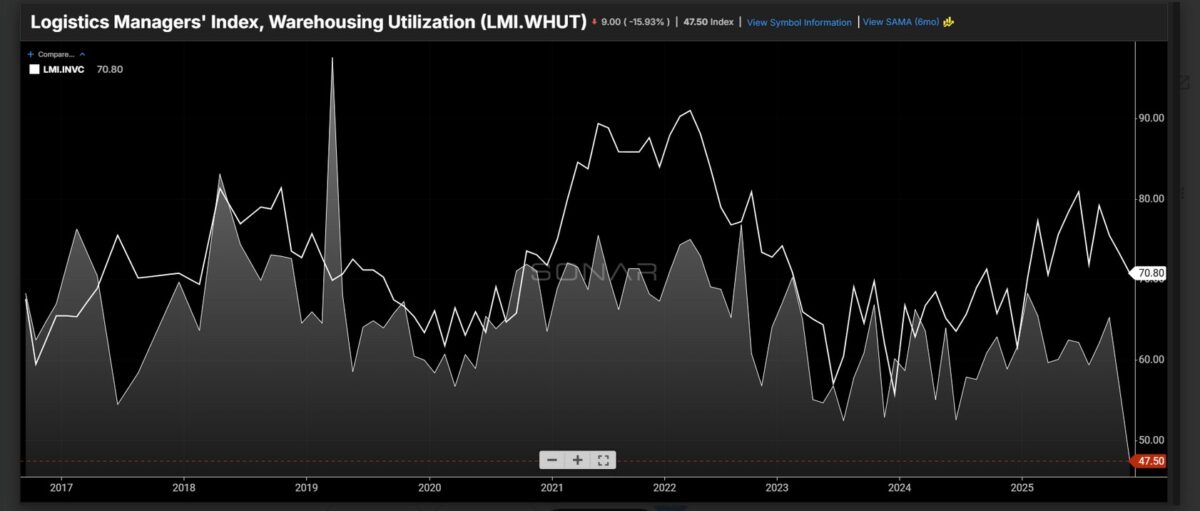
A chart from SONAR of the Logistics Managers’ Index Warehousing Utilization index was striking. It was under 50, which means an industry that is contracting. It has never been below that number in the history of the index, Strickland said.
“My initial read would be that shippers were pessimistic about spending and growth and allowed inventories to run down, because they didn’t think they would need those goods,” Hampstead said. “They didn’t think they would need the extra stocks.”
The back-and-forth of a volatile market is contributing to higher warehousing costs, Strickland said. Tariffs are a factor, he said, “but also the inefficiencies created by erratic movements in supply chains,” he said. “You’re having to manage shifting from a just-in-case to a just-in-time process.” Demand forecasts are “unrefined or off kilter. That’s all a factor in increasing your inventory costs.”
(The Producer Price Index for warehousing actually has declined this year, from a high in March of 161.474 to a September figure of 153.087. But a year ago it was 150.858 in September. September is the most recent month available as a result of the federal government shutdown.)
Capacity will continue to tighten in 2026
Hampstead said it “seems like everything that’s happening on the capacity side will continue to ratchet tighter and tighter.”
But he added that will happen only “if FMCSA keeps their eye on the ball and continues to coordinate various enforcement efforts with the states.”
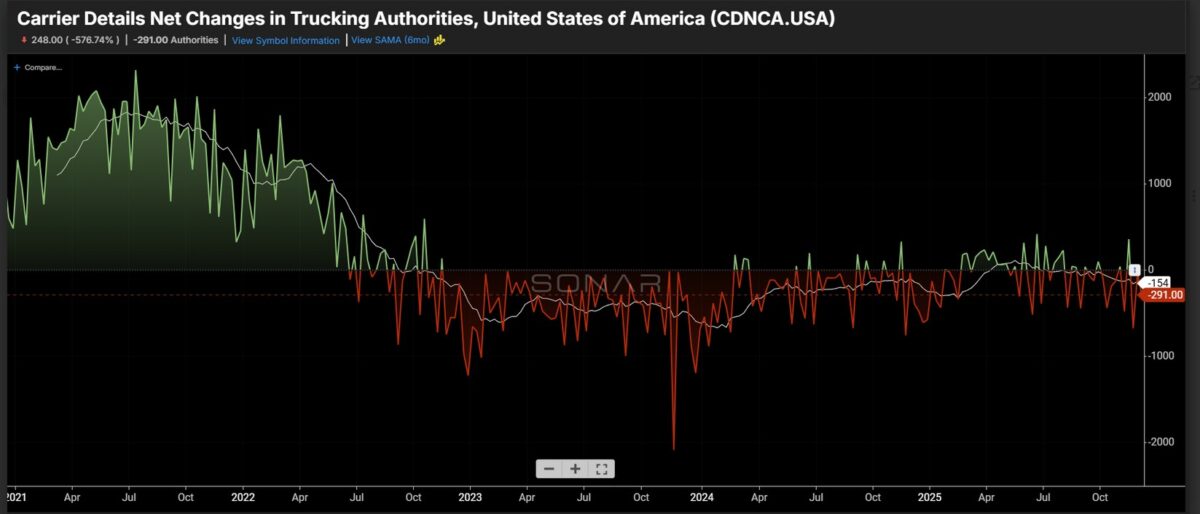
There is confidence in the “general direction of the capacity side of the market,” Hampstead said. And that direction is that capacity is exiting, “slowly but surely being eliminated, especially in the small carrier and independent contract segment but also into mid sized carriers that are still struggling.”
“We’re on a pretty steady trajectory,” he added.
A recent number of bankruptcies, Strickland said is a sign that some carriers “have been holding it together until they can’t, and then you’re getting the spike in rejection rates and spot rates as a result.”
More articles by John Kingston
As dealmakers gather in New York, logistics merger activity holding up
Strange bedfellows as states say brokers not protected under ‘safety exception’
Logistics startup founder loses appeal on conviction, 20-year sentence
Brokerage Compliance Symposium
The day before F3. Every compliance issue you face - fraud exposure, carrier liability, FMCSA rules, cargo theft, insurance gaps - navigated by attorneys and operators defining best practices in a changing industry.
F3 Awards Dinner
The night before F3. FreightTech100 companies honored. FreightTech 25 and Shipper of Choice winners revealed live. Cocktail reception into dinner and live music - 300 industry leaders in one purpose-built room.
F3: Future of Freight Festival
Industry-defining keynotes, rapid-fire technology demos, and industry leaders networking in experiences across Chattanooga - plus the inaugural F3 Awards Dinner featuring the FreightTech and Shipper of Choice reveals.
The day before F3. Every compliance issue you face - fraud exposure, carrier liability, FMCSA rules, cargo theft, insurance gaps - navigated by attorneys and operators defining best practices in a changing industry.
The Signal at Chattanooga Choo Choo • Chattanooga, TN Register NowThe night before F3. FreightTech100 companies honored. FreightTech 25 and Shipper of Choice winners revealed live. Cocktail reception into dinner and live music - 300 industry leaders in one purpose-built room.
The Signal at Chattanooga Choo Choo • Chattanooga, TN Register NowIndustry-defining keynotes, rapid-fire technology demos, and industry leaders networking in experiences across Chattanooga - plus the inaugural F3 Awards Dinner featuring the FreightTech and Shipper of Choice reveals.
The Signal at Chattanooga Choo Choo • Chattanooga, TN Register Now