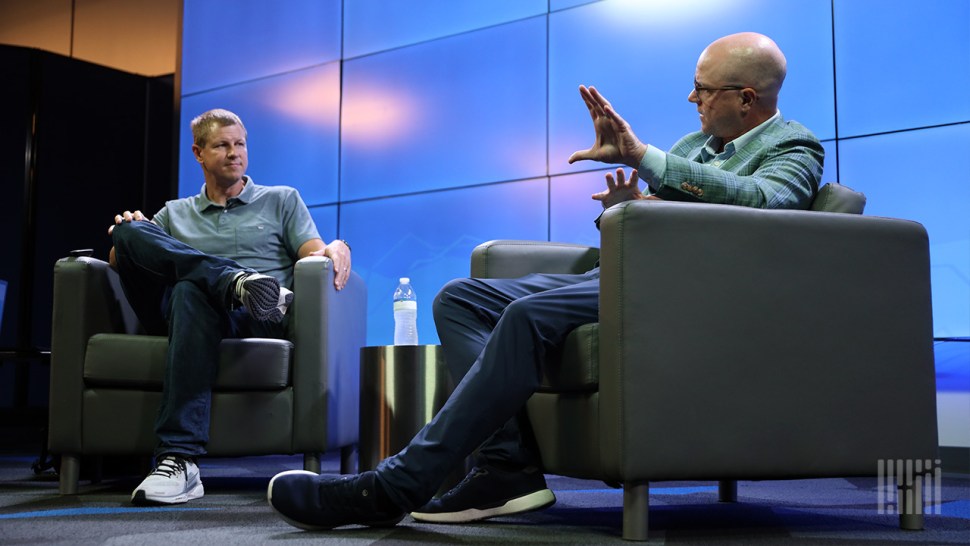
FreightWaves’ State of Freight webinar painted a picture of an industry stuck in neutral as summer draws to a close. Founder and CEO Craig Fuller and Head of Freight Market Intelligence Zach Strickland described a market plagued by soft demand, economic uncertainty, and stubborn structural challenges. Here are five key takeaways:
Freight demand remains historically weak
Strickland noted that national truckload volumes are down 14% to 15% year-over-year, with demand even lower than 2019.
“A lot of the people I talked to in the shipping community, they’re still dealing with some levels of uncertainty, not just from their procurement strategies for the raw inputs and things in the goods economy, but also from their consumers in the downstream, because there’s still some level of, ‘We don’t know where this economy is going,’” Strickland said.
Despite seasonal catalysts like back-to-school and hurricane season, volumes show little sign of rebound.
“It has not been the freight market that we hoped for. That’s the freight market we’ve got,” Fuller said.

Consumer spending shifts are reshaping freight flows
Retailers with strong grocery and staples sales are holding up, while discretionary goods are faltering, Fuller said.
“If you’re in a big-box retailer with groceries, you’re probably doing okay. But when you get into discretionary spending items, that’s where the challenge is,” Fuller said. “Restaurant failures and weak housing turnover are adding more pressure.”
Housing and autos remain critical weak spots
Both sectors, which drive a large share of freight, continue to struggle.
Fuller estimated that as much as 20% of trucking freight is tied to housing. Without a housing recovery, “it’s hard to believe that a freight market would come back,” he said.
Automakers are also showing signs of stress, particularly in the electric vehicle segment.
“One of the core theses of the Biden administration was that electric vehicles should replace internal combustion engines. And a lot of Biden’s infrastructure bill — the core thesis of that was decarbonization and electrification of the auto and power sector. That is no longer a core. It is obvious that that has changed,” Fuller said. “The Trump administration is far more focused on moving back towards a multi-platform energy process.”
Carrier capacity is shrinking, but not enough to spark a recovery
Tender rejection rates are higher than 2019, not because of rising freight volumes, but due to carriers exiting the market.
“The outbound tender rejection index is actually up year over year. And it’s significantly higher than it was in 2019, where we were covering right under 4% at this point in 2019,” Strickland said.

Strickland said more carriers exiting the market through closures and bankruptcies has helped increase tender rejection rates across the country.
“We’re going to continue to see bankruptcies,” Strickland said, pointing to the recent Carroll Fulmer collapse.
Fuller added that the industry is in a “range-bound” cycle where volumes and rates remain stuck.
Uncertainty dominates business decisions
Executives across sectors are pulling back on investment, delaying hiring, and prioritizing cost-cutting.
“It’s the uncertainty element. And hiring people — when you don’t know where things are headed, your natural inclination is to do nothing,” Fuller said.
“Once you resolve that things might get worse, you then resolve yourself to actually shrink, whether we’re talking human capital or investments. That’s what I think businesses have been doing for the last couple of quarters. That’s why earnings look so great, because they’re generating a lot of revenue and yet their costs are being turned out. What they’re actually doing is they are sacrificing growth in the future by cutting back.”
Brokerage Compliance Symposium
The day before F3. Every compliance issue you face - fraud exposure, carrier liability, FMCSA rules, cargo theft, insurance gaps - navigated by attorneys and operators defining best practices in a changing industry.
F3 Awards Dinner
The night before F3. FreightTech100 companies honored. FreightTech 25 and Shipper of Choice winners revealed live. Cocktail reception into dinner and live music - 300 industry leaders in one purpose-built room.
F3: Future of Freight Festival
Industry-defining keynotes, rapid-fire technology demos, and industry leaders networking in experiences across Chattanooga - plus the inaugural F3 Awards Dinner featuring the FreightTech and Shipper of Choice reveals.
The day before F3. Every compliance issue you face - fraud exposure, carrier liability, FMCSA rules, cargo theft, insurance gaps - navigated by attorneys and operators defining best practices in a changing industry.
The Signal at Chattanooga Choo Choo • Chattanooga, TN Register NowThe night before F3. FreightTech100 companies honored. FreightTech 25 and Shipper of Choice winners revealed live. Cocktail reception into dinner and live music - 300 industry leaders in one purpose-built room.
The Signal at Chattanooga Choo Choo • Chattanooga, TN Register NowIndustry-defining keynotes, rapid-fire technology demos, and industry leaders networking in experiences across Chattanooga - plus the inaugural F3 Awards Dinner featuring the FreightTech and Shipper of Choice reveals.
The Signal at Chattanooga Choo Choo • Chattanooga, TN Register Now