




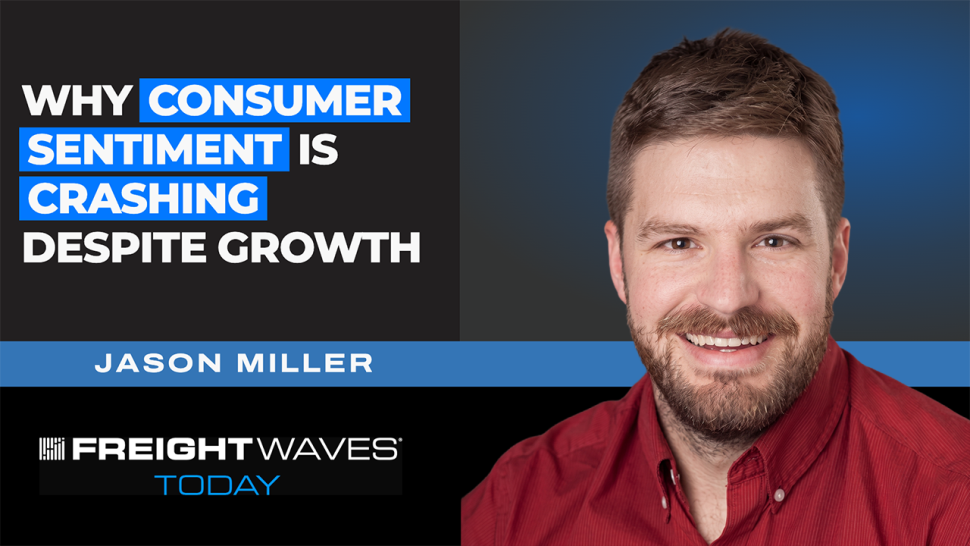
The economy is expanding, yet consumer sentiment is dipping below Global Financial Crisis levels. Dr. Jason Miller breaks down the surprising disconnect, revealing how everything from AI CapEx and rising interest rates to local NIMBYism and GLP-1 drugs are shaping the freight market. Discover which sectors are booming and which are hurting, and what it all means for supply chain pros in 2024 and beyond.
Freight volumes are running about 1.5% above year-ago levels, but that growth is narrowly concentrated in machinery, fabricated metals, and steel — sectors tied almost entirely to the data center construction boom — leaving the broader freight market vulnerable if that buildout stumbles, according to Dr. Jason Miller, who appeared in a recent video interview.
Miller drew a direct parallel to the hydraulic fracturing boom that peaked in 2014 and collapsed into an industrial recession in 2015 and 2016. He said the next six to nine months of data center construction are already “baked in,” but beyond that window, community opposition, AI company finances, and rising interest rates could slow the pipeline. He cited Oracle declaring force majeure on a New Mexico project with Blue Owl Capital as an early warning sign, and noted that OpenAI and Anthropic face mandatory compute payments next year that their revenues may not cover.
“My concern is that if we start to see next year any type of significant slowdown in the data center ecosystem while we still have a very weak single-family housing ecosystem, that would be very bad news from a freight demand standpoint,” Miller said.
On the trucking capacity side, Miller described current conditions as a “Goldilocks zone” — tight enough to support contract rate increases for asset carriers, but not so overheated as to trigger a capacity surge. He cited tender rejection rates around 14%, well below the roughly 28% weekly-average peak seen during the 2021 boom. Three compounding forces removed supply: three consecutive bad years for carriers in 2023, 2024, and 2025; English-language proficiency and non-domiciled CDL enforcement actions; and the Supreme Court’s May ruling in Montgomery v. Carbide, which stripped broker liability protections under state tort law.
Diesel prices above $4 per gallon are acting as an additional brake on capacity re-entry heading into 2027, Miller said. Meanwhile, food and beverage freight demand is down 3% to 4% from a year ago — pressured by GLP-1 drug adoption, reduced discretionary spending, wheat prices at a three-year high, and retaliatory tariffs cutting U.S. export volumes. Miller said the dynamic mirrors 2011–2014, when freight demand grew but bypassed most consumers, keeping sentiment depressed even as GDP expanded.
“The vibes are not good for the consumer,” Miller said, pointing to Conference Board sentiment data that fell sharply in September. He attributed much of the malaise to housing affordability: the median home price is roughly $390,000 to $400,000, creating a gap between qualifying income and median household income that did not exist in 2017–2019. Flatbed carriers dependent on single-family housing starts should plan for a weaker spring 2026 ramp, he warned.
On the macro policy front, Miller said two additional Fed rate hikes — one in October and one in December — would effectively erase all the interest rate cuts made at the end of last year, risking a material freight demand slowdown materializing in 2027. He added that a return to large-scale military conflict involving Iran could push energy prices higher, force the Fed to raise rates further, and compound demand contraction across the freight market.
- Freight volumes are up ~1.5% year-over-year, driven almost entirely by data center-linked sectors like machinery, fabricated metals, and steel, while food and beverage demand is down 3–4%.
- Tender rejection rates sit around 14%, well below the ~28% weekly-average 2021 peak; diesel above $4/gallon, regulatory actions, and three straight bad years are constraining capacity re-entry into 2027.
- Miller warns a data center slowdown beyond the next 6–9 months, combined with weak single-family housing, could be ‘very bad news’ for freight demand, especially if the Fed raises rates in October and December.
This Summary is generated thanks to a transcription of the interview, for the full interview please enjoy the video above.
Brokerage Compliance Symposium
The day before F3. Every compliance issue you face - fraud exposure, carrier liability, FMCSA rules, cargo theft, insurance gaps - navigated by attorneys and operators defining best practices in a changing industry.
F3 Awards Dinner
The night before F3. FreightTech100 companies honored. FreightTech 25 and Shipper of Choice winners revealed live. Cocktail reception into dinner and live music - 300 industry leaders in one purpose-built room.
F3: Future of Freight Festival
Industry-defining keynotes, rapid-fire technology demos, and industry leaders networking in experiences across Chattanooga - plus the inaugural F3 Awards Dinner featuring the FreightTech and Shipper of Choice reveals.
The day before F3. Every compliance issue you face - fraud exposure, carrier liability, FMCSA rules, cargo theft, insurance gaps - navigated by attorneys and operators defining best practices in a changing industry.
The Signal at Chattanooga Choo Choo • Chattanooga, TN Register NowThe night before F3. FreightTech100 companies honored. FreightTech 25 and Shipper of Choice winners revealed live. Cocktail reception into dinner and live music - 300 industry leaders in one purpose-built room.
The Signal at Chattanooga Choo Choo • Chattanooga, TN Register NowIndustry-defining keynotes, rapid-fire technology demos, and industry leaders networking in experiences across Chattanooga - plus the inaugural F3 Awards Dinner featuring the FreightTech and Shipper of Choice reveals.
The Signal at Chattanooga Choo Choo • Chattanooga, TN Register Now