





As Canada Post workers begin to vote on the company’s final contract offer, a survey from the Canadian Federation of Independent Business finds that a postal strike could push two in three businesses (63%) to walk away from Canada Post permanently.
“Yo-yoing in and out of strike mandates is causing Canada’s small businesses — one of Canada Post’s last groups of profitable customers — to leave for good,” said CFIB President Dan Kelly in a news release. “Small business owners and other consumers need certainty. Thirteen percent of small businesses permanently dropped usage of Canada Post during the 2024 strike and every time Canada Post goes on strike, more and more businesses leave forever.”
Canada Post in late May reported a 50% drop in parcel volumes, year over year, because protracted contract negotiations were eroding shipper confidence in the postal operator. Many businesses switched to alternative final-mile couriers after a 32-day strike during the last holiday season and the threat of another strike.
Mail carriers in Canada have been working without a new collective bargaining agreement for 19 months as the sides remain far apart on key issues, despite extensive mediation by the federal government.
Members of the Canadian Union of Postal Workers at the end of May opted against a strike. Instead, mail carriers are refusing to work overtime shifts, limiting their work to eight hours per day and 40 hours per week. On Monday, the Canada Industrial Relations Board began administering an online and phone vote on Canada Post’s proposed contract. Voting runs through Aug. 1. The government imposed the vote on workers over the objections of the CUPW leadership. Canada Post requested government intervention saying it wasn’t confident union leaders were accurately representing how rank-and-file mail carriers felt about its proposed labor agreement.
Labor experts say it is unlikely the vote will solve the lengthy dispute, the Toronto Star reported.
“Another strike at the time of ongoing trade tensions and uncertainty would have a significant impact on small businesses. We estimate the 2024 strike cost small firms between $55 million to $73 million each day. We hope both parties reach a deal to avoid another unnecessary strike,” said CFIB spokeswoman Dariya Baiguzhiyeva in an email to FreightWaves.

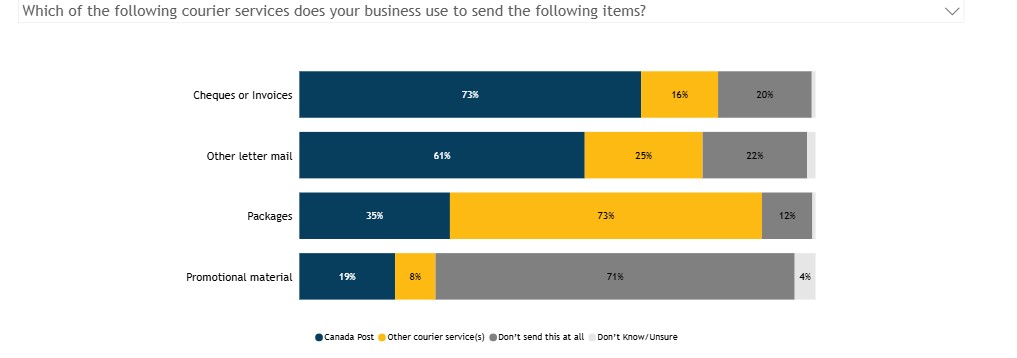
According to CFIB research, four in five businesses still use Canada Post. Nearly three-quarters (73%) of those businesses use it for sending checks, while 61% send other letter mail. Over half (58%) like to use Canada Post for its low cost and convenience, while reliability and customer service ranked much lower as priorities.
Most businesses (71%) responded to the strike disruptions in 2024 by encouraging customers to use digital options. Nearly, nearly half (45%) turned to private couriers, while 27% delayed mail shipping.
Need for new business model
Canada Post is pressing the union to accept a series of changes to operations and work conditions it says are needed to turn around years of financial losses as mail and parcel volumes shrink.
Canada Post’s share of the parcel delivery market has fallen to 24% from 62% in 2019, according to a May report from an industrial dispute commission. Parcel revenue declined by 20.3% in 2024 as volumes fell by 56 million pieces, or 20%, compared to 2023, according to Canada Post’s annual report.
The government’s review commission noted that private couriers, which dominate in urban and suburban settings, benefit from being able to choose which routes to serve while Canada Post is bound by law to serve all addresses. Private couriers also have access to huge amounts of capital and are typically able to hire nonunion workers, many on a part-time basis or as independent contractors.
The national post wants to adjust delivery routes based on parcel volumes and addresses needing service each day rather than adhering to fixed routes; implement a weekend delivery model using a dedicated part-time workforce as well; and create part-time flex positions for mail carriers to work 20 hours per week, with the potential for mandatory weekend hours. Canada Post also seeks to introduce load leveling, whereby supervisors each morning could transfer mail volumes between workers during scheduled hours without additional compensation.
CFIB data shows 73% of small businesses mostly rely on private couriers for package delivery.
“The current model at Canada Post is in dire need of massive reform. It’s long overdue for the federal government to implement the well-studied changes that have been required for over a decade,” said Corinne Pohlmann, executive vice president of advocacy at CFIB, in the news release. “Small business owners deserve a long-term plan and a postal service they can count on.”
The CFIB report was based on 2,317 responses collected in June and July.
Click here for more FreightWaves/American Shipper stories by Eric Kulisch.
Write to Eric Kulisch at ekulisch@freightwaves.com.
RELATED STORIES:
Vote on Canada Post labor contract begins Monday as losses mount
Canada Post parcel volumes drop 50% as labor dispute compounds challenges
Brokerage Compliance Symposium
The day before F3. Every compliance issue you face - fraud exposure, carrier liability, FMCSA rules, cargo theft, insurance gaps - navigated by attorneys and operators defining best practices in a changing industry.
F3 Awards Dinner
The night before F3. FreightTech100 companies honored. FreightTech 25 and Shipper of Choice winners revealed live. Cocktail reception into dinner and live music - 300 industry leaders in one purpose-built room.
F3: Future of Freight Festival
Industry-defining keynotes, rapid-fire technology demos, and industry leaders networking in experiences across Chattanooga - plus the inaugural F3 Awards Dinner featuring the FreightTech and Shipper of Choice reveals.
The day before F3. Every compliance issue you face - fraud exposure, carrier liability, FMCSA rules, cargo theft, insurance gaps - navigated by attorneys and operators defining best practices in a changing industry.
The Signal at Chattanooga Choo Choo • Chattanooga, TN Register NowThe night before F3. FreightTech100 companies honored. FreightTech 25 and Shipper of Choice winners revealed live. Cocktail reception into dinner and live music - 300 industry leaders in one purpose-built room.
The Signal at Chattanooga Choo Choo • Chattanooga, TN Register NowIndustry-defining keynotes, rapid-fire technology demos, and industry leaders networking in experiences across Chattanooga - plus the inaugural F3 Awards Dinner featuring the FreightTech and Shipper of Choice reveals.
The Signal at Chattanooga Choo Choo • Chattanooga, TN Register Now