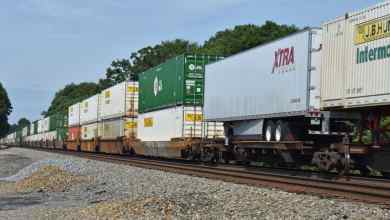
Commentary: Looking ‘Back to the Future’ for perspectives on intermodal 2025+
Jim Blaze writes about the recent history of intermodal rail service and what may happen in the next few years.

Second quarter revenue for BNSF rose 0.3 percent despite lower volumes for agricultural products, consumer products and industrial products.
“If a shipper can share some of its production forecast information to railroads, railroads can plan better to meet that capacity. Conversely, if railroads can open up and show where their empty railcars are to the shipper so that the shipper has a bit more confidence that the right number of railcars are going to show up, then the shipper can more confidently choose rail.”
“I think we’re at a critical juncture. Six months from now I think we’ll be able to take a closer pulse to where things are.”
Ben Thrower examines the costs – in money, lost land and lost businesses – of the high-speed rail line in California.
North American rail volumes are still lower year-over-year, but U.S. carloads recovered somewhat last week.
The Class I railroads have reported their second quarter/first-half of 2019 results. Jim Blaze writes about what may happen during the remainder of 2019.
Train products manufacturer and supplier Wabtec lowered its sales guidance for 2019 but kept its projections for how much profit it expects to make from its operations.
Greenbrier said the acquisition will enable the company to provide customers not only with direct sales or leasing options but also with after-market services. Customers seeking tank cars and covered hoppers will also benefit from Greenbrier’s expanded geographic footprint as a result of the acquisition.
Winchester & Western Railroad is being acquired by OmniTrax in a $105 million deal.
Despite uncertain economic conditions, Trinity Industries (NYSE: TRN) expects rail volumes to improve in the second half of the year, based on “healthy” inquiry levels for its railcars, company leaders said during TRN’s second quarter earnings call on July 25.
U.S. rail volumes fell yet again for the week ending July 20, according to data from the Association of American Railroads.
Total company revenue for Trinity Industries (NYSE: TRN) grew 16 percent to $736 million in the second quarter amid revenue gains for its rail product group.
There is some uncertainty for commodities such as grain, lumber, coal and crude, but Canadian National (NYSE: CNI) leaders are “cautiously optimistic” about volumes and how the company might perform in the second half of the year.
U.S. railroads had fewer employees on their payroll in June amid lower rail volumes overall and company decisions to trim workforce levels as part of changes to their operating models.
Maryland Governor Larry Hogan (R) said Maryland has received a $125 million federal grant that the state hopes will lead to an expanded rail tunnel in Baltimore to allow for taller trains to travel to the Port of Baltimore.
Jim Blaze writes about the pros and cons of shippers owning or leasing their own freight railcars to move their products.
The railroad said second quarter revenue totaled $714 million, a 5 percent increase from $682 million for the same period in 2018.
“You’ve heard me say this many, many times – we’re not going to use the lack of volume as an excuse not to make aggressive achievements on our productivity,” Union Pacific chief financial officer Rob Knight said.