Editor’s note: This article was updated on July 16, 2026 at 1 p.m. to correct information about the Aurora Driver. The Aurora Driver is a self-driving system, not a transportation management system (TMS).
When AVI-SPL launched autonomous freight operations between Dallas and Houston, the technology solutions provider made a deliberate choice: announce what they had already accomplished, not what they hoped to do.
“We think that a lot of people are, especially with AI, saying, ‘This is what we’re going to do [and] we hope to do this,’” said Jeremy Codiroli, vice president of global supply chain at AVI-SPL, in an interview with FreightWaves. “And we wanted to really make a point of saying, ‘We did this. We are doing this. This is not a dream, this is real life.”
AVI-SPL’s commercial autonomous freight operations began the week of June 8, 2026. For Codiroli, the launch represents a forward-thinking approach to risk management in an industry facing mounting pressure.
“This is really a future-focused, risk management solution,” Codiroli said. “My supply chain team, we look out three to five years and say, what problems are we going to be trying to solve in three to five years, and can we try to solve them now?”
Chief among those problems: driver headcount and difficulties with hiring and retention. That’s where Volvo’s self-driving VNL Autonomous semi truck integrated with the Aurora Driver, Aurora’s self-driving system, enter the picture.
Partnering up
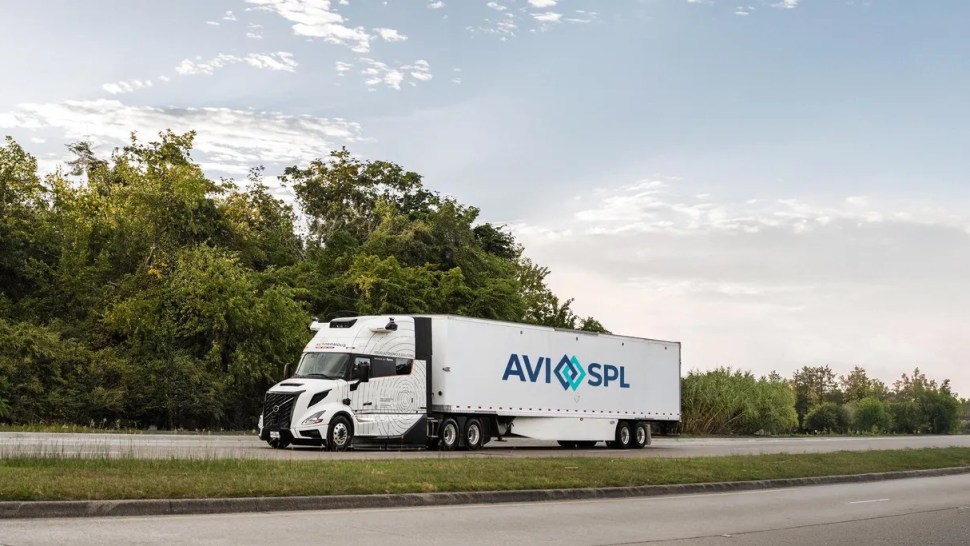
AVI-SPL partnered with Volvo Autonomous Solutions, leveraging its self-driving rig with the Aurora Driver to automate a 239 mile route between Dallas and Houston – no driver required.
The Volvo VNL Autonomous serves as the hardware backbone of the operation. Assembled at Volvo’s flagship New River Valley plant in Dublin, Virginia –the largest Volvo Trucks facility in the world– the vehicle was engineered with safety as the foundational design principle.
According to Volvo Autonomous Solutions’ website, the truck features redundant systems across steering, braking, communication, computation, power management, energy storage and vehicle motion management. While Level 4 automation doesn’t legally mandate such redundancy, Volvo built it in from the start.
The safety case for autonomous trucking centers on eliminating the two of the biggest contributors to highway accidents: driver fatigue and distraction.
Current operations include safety drivers –or more accurately, observers– aboard the vehicles.
“They are just kind of observing,” Codiroli noted. “[They’re there to] make sure everything’s under control and make sure everything’s going according to plan.”
The Texas corridor strategy
The Dallas-Houston corridor operates as a true two-way commercial route, with AVI-SPL taking what Codiroli describes as a “blended approach” to cargo utilization.
On the inbound side, the autonomous trucks pick up products from major vendors with locations in Dallas, transporting audio-visual electronics and equipment to the Houston market to support customer installations.
The return trips serve an equally strategic purpose: moving end-of-life electronics from Houston back to Dallas, where recycling partners process the materials and recover precious metals as part of AVI-SPL’s sustainability initiatives.
“The whole point is to be sustainable, and this fits into that perfectly,” Codiroli told FreightWaves.
But making autonomous trucking work required more than simply booking capacity on self-driving vehicles. AVI-SPL had to fundamentally restructure its internal planning processes.
“You can’t just flick a switch and say you want to start using autonomous trucking,” Codiroli said. “It takes a lot of internal coordination, vendor coordination [and] customer coordination.”
The company’s centralized global supply chain team, including dedicated directors for global logistics and global warehousing, analyzed how autonomous operations would ripple through their entire network.
One major shift included consolidating shipments more aggressively to maximize the value of each truckload rather than shipping frequent smaller loads.
Eyes ahead: Q1 2027 driverless operations
The timeline for fully driverless trucks is accelerating. Volvo Autonomous Solutions plans to remove safety drivers and begin fully driverless operations on U.S. highways in the first quarter of 2027.
“In Q1 2027, we’ll deploy those trucks with nobody behind the wheel in Texas,” Aurora Innovation said in a June LinkedIn post.
The economic rationale is straightforward: asset utilization. Trucks operating without human drivers aren’t bound by hours-of-service regulations, enabling around-the-clock operation.
“The most important impact? Doubling asset utilization,” Volvo Autonomous Solutions stated in its Capital Markets day presentation on June 10. “This is a change the industry cannot ignore.”
Codiroli sees the transformation in historic terms.
“If you look at the biggest improvements to the supply chain strategy overall, worldwide or just in the U.S., this is one of the biggest opportunities that we’ve seen in decades,” he said. “You would have to look very far back to try to find some kind of comparable change –is it potentially [like] looking back at the invention of the plane? That’s the magnitude of impact that we’re talking about.”
He said he believes autonomous trucking could account for up to half of all highway miles traveled within the next five to ten years.
“The only people who will be able to ship on time, on a schedule they want, are those that have already embraced autonomous shipping technology and integrated it into their supply chain,” Codiroli said. “We wanted to make sure that we started early and that we were one of the leaders of this technology and its implementation.”
Brokerage Compliance Symposium
The day before F3. Every compliance issue you face - fraud exposure, carrier liability, FMCSA rules, cargo theft, insurance gaps - navigated by attorneys and operators defining best practices in a changing industry.
F3 Awards Dinner
The night before F3. FreightTech100 companies honored. FreightTech 25 and Shipper of Choice winners revealed live. Cocktail reception into dinner and live music - 300 industry leaders in one purpose-built room.
F3: Future of Freight Festival
Industry-defining keynotes, rapid-fire technology demos, and industry leaders networking in experiences across Chattanooga - plus the inaugural F3 Awards Dinner featuring the FreightTech and Shipper of Choice reveals.
The day before F3. Every compliance issue you face - fraud exposure, carrier liability, FMCSA rules, cargo theft, insurance gaps - navigated by attorneys and operators defining best practices in a changing industry.
The Signal at Chattanooga Choo Choo • Chattanooga, TN Register NowThe night before F3. FreightTech100 companies honored. FreightTech 25 and Shipper of Choice winners revealed live. Cocktail reception into dinner and live music - 300 industry leaders in one purpose-built room.
The Signal at Chattanooga Choo Choo • Chattanooga, TN Register NowIndustry-defining keynotes, rapid-fire technology demos, and industry leaders networking in experiences across Chattanooga - plus the inaugural F3 Awards Dinner featuring the FreightTech and Shipper of Choice reveals.
The Signal at Chattanooga Choo Choo • Chattanooga, TN Register Now