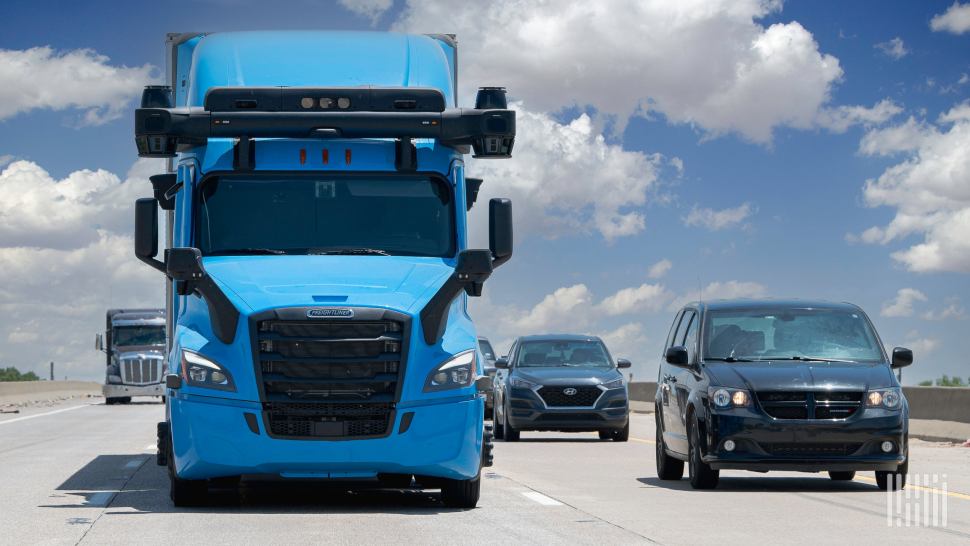
If you’ve spent the last year watching driverless trucks rack up miles on the lanes you used to run and felt something between anger and dread, that reaction is fair, it’s shared by most of the industry, and it isn’t paranoia, because the deployment timeline that always seemed to sit five years out has quietly collapsed into this quarter and the next one.
Here’s what the industry keeps dancing around. The technology is further along than the skeptics claimed, and the business model behind it has a hole in the middle big enough for a small carrier to drive through.
Where this actually stands
Start with the facts, not the hype.
Aurora launched commercial driverless operations on the Dallas-Houston corridor in April 2025. By the end of this past January it had logged more than 250,000 driverless miles, and by the end of June that number was close to 440,000. It now runs across 10 driverless routes in the Sun Belt, including a roughly 1,000-mile Fort Worth to Phoenix lane that goes well past what hours of service allows a single driver, and it has said it expects more than 200 driverless trucks in operation by the end of this year.
Kodiak took a different road. It put its system into trucks the customer owns. Atlas Energy Solutions had 20 driverless Kodiak-powered trucks running in the Permian at the end of last year and 35 by the end of June, with more than 40,000 cumulative hours of paid driverless operations. Kodiak is targeting a driverless long-haul launch on Dallas-Houston by the end of 2026.
And this week, Volvo Autonomous Solutions and Waabi started hauling freight for Warp’s LTL network on the Dallas-Houston corridor, with an observer still in the seat. Waabi says driverless runs on Volvo’s purpose-built truck start next year, and that it has cut the time to open a new lane from three months to three weeks to, on at least one lane, nothing at all.
That last detail is the one carriers should sit with. The constraint used to be geography. It isn’t anymore.
The anger is earned
Drivers aren’t being unreasonable, and the public isn’t either.
A March poll from Advocates for Highway and Auto Safety found 85% of respondents were concerned about sharing the road with autonomous trucks. A January survey of Illinois voters found 78% opposed allowing driverless heavy trucks in the state. Teamsters California sued the state DMV over its autonomous vehicle rules, arguing the regulations could eventually wipe out the jobs of more than 200,000 employee semi-truck drivers in California, with a similar number of self-employed drivers affected on top of that.
OOIDA has been just as direct, opposing the SELF DRIVE Act of 2026 on the grounds that it would let 80,000-pound driverless trucks deploy largely on company self-certification, without independent federal verification and without clear qualifications for the remote operators overseeing them.
Those are legitimate objections, and small-business truckers have every right to keep pressing them. Fighting for oversight and preparing for the market that exists are not mutually exclusive. Drivers who do only the first and none of the second will get run over by a market that didn’t wait for the argument to finish.
What these networks still can’t do
Every one of these deployments has the same shape. Highway middle mile, terminal to terminal, in good weather, on validated lanes.
What falls outside that? Backing into a tight dock. Working a yard. Dealing with a dock worker who moves you to a different door. Strapping and tarping. Chains. Breakdowns on the shoulder. A reefer that throws a code at 2 a.m. Detention negotiations. The customer who needs the driver to walk the freight inside. Anything that requires judgment, hands, or a conversation.
Even Waabi’s pitch tells you this. Its executives talk about running LTL consolidation on a corridor like Dallas-Houston without hours-of-service limits, which means the middle leg is the target. The pickup and the delivery still belong to somebody. Somebody has to pull the trailer to the launch point and somebody has to take it off the landing point and get it to the customer.
Autonomy doesn’t eliminate that work. It concentrates it.
The part of the model that works in your favor
Here’s the structural thing I’d want every owner-operator to understand.
Kodiak’s business model isn’t selling trucking. It’s Driver as a Service. The company sells access to its system on vehicles the customer owns and operates. That’s how Atlas ended up with its own driverless fleet instead of buying capacity from a tech company.
Read that again, because it goes both ways. If a software company will put its system in a customer-owned truck, then the asset owner still matters. The question for small carriers isn’t whether a robot can drive. It’s whether, five years from now, the trucks running these lanes are owned by three tech-backed giants or by a thousand American carriers who figured out how to buy the technology instead of competing against it.
Nobody’s handing a one-truck owner-operator a driverless unit next spring. The capital, the insurance, the lane validation and the maintenance requirements are all real. But the model that puts the asset in the carrier’s name is already operating commercially, and carriers who understand it now will be at the front of the line when the entry cost falls, the way it fell on every other piece of trucking technology.
The businesses that get built around this
Beyond ownership, there’s a service economy forming around these networks, and most of it needs people with CDLs and shop experience. A few avenues worth looking at.
Drayage into and out of transfer points. Every autonomous lane needs a first and last leg. That’s day-cab work, home every night, repeatable, and it’s exactly the kind of local lane that pairs well with a direct shipper relationship rather than a load board.
Yard and hostling contracts. Someone has to spot trailers, move equipment, and keep the lot flowing. Autonomous networks make yards busier, not emptier.
Recovery and roadside response. When an autonomous unit goes down, somebody local has to get to it fast. Tire service, jump starts, towing coordination, sensor cleaning, securing a load that shifted. That’s a contract business for an operator with the right equipment and a service mindset.
Remote oversight and fleet monitoring. OOIDA’s own objection points at the opening here, since the qualifications for remote operators of commercial vehicles are still unsettled. The people best qualified to oversee a truck remotely are people who have driven one. If that role gets a federal standard, experienced drivers should be first in line, and they should be pushing for that standard now.
Trailer pools and equipment leasing. These networks need boxes, and plenty of them. Owning trailers that run inside an autonomous network is a way to earn off the technology without driving the lane yourself.
Maintenance, upfitting and calibration. Kodiak partners with commercial upfitters to install its hardware because OEMs aren’t producing driverless-ready trucks at scale yet. Sensor calibration and AV preventive maintenance are new line items in every shop that wants them.
Freight autonomy isn’t built for. Flatbed and heavy haul. Hazmat. Final mile and white glove. Local and regional work with handling. Construction and aggregate. Anything where the driver is doing more than steering is freight these systems aren’t touching anytime soon.
Why it matters
The honest version of this story isn’t that autonomy is harmless, and it isn’t that drivers are about to be erased. It’s that the work is being restructured, and restructuring always moves the money. Long-haul middle mile is getting automated first because it’s the easiest piece and the one drivers like least. Everything hard, local and human-dependent is getting more valuable as a result.
The drivers who lose here will be the ones who kept running the exact lane a machine was built to run, with no shipper relationships, no local footprint and no plan. The ones who win will be the ones who saw the whole network, found the part of it that still needs hands and judgment, and charged accordingly.
American truckers have been told to adapt for 40 years, usually by people who have never backed into a dock. This is different, because for the first time the technology is being sold in a form that lets the carrier own the asset.
F3: Future of Freight Festival
Industry-defining keynotes, rapid-fire technology demos, and industry leaders networking in experiences across Chattanooga - plus the inaugural F3 Awards Dinner featuring the FreightTech and Shipper of Choice reveals.
Industry-defining keynotes, rapid-fire technology demos, and industry leaders networking in experiences across Chattanooga - plus the inaugural F3 Awards Dinner featuring the FreightTech and Shipper of Choice reveals.
The Signal at Chattanooga Choo Choo • Chattanooga, TN Register Now