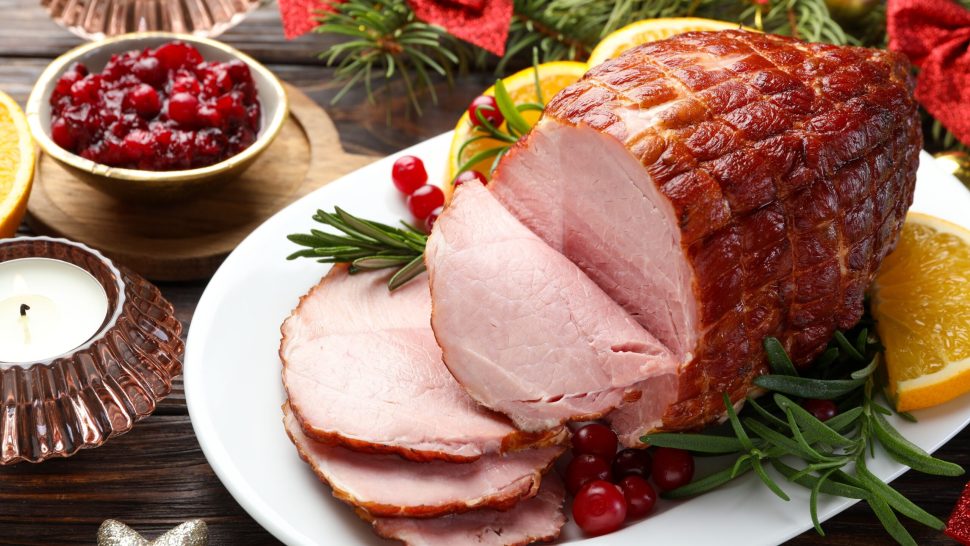
By the time Christmas dinner hits the table, the hardest logistics decisions behind the holiday ham have already been made, often months earlier. For the supply chain, Christmas ham is not a December problem. It’s a forecasting, cold-storage, and execution challenge that begins well before winter weather enters the picture.
Ham’s role as a Christmas staple is rooted in tradition, but its continued dominance is also driven by reliability. Holiday demand for ham is relatively stable year over year, giving processors and retailers a clearer view of volume needs than many other seasonal proteins. That predictability, however, doesn’t remove risk, it simply shifts it earlier in the calendar.
Predictable demand, rising stakes
Heading into the holidays, pork demand has been strong, tightening supplies and pushing prices higher. Retailers increasingly position pork, and ham in particular, as a centerpiece protein for year-end meals, especially as consumers look for alternatives to turkey.
For logistics planners, higher pork prices raise the cost of mistakes. Temperature excursions, delayed deliveries, or excess shrink don’t just disrupt service levels, they erode margins on product that is already carrying a seasonal premium. That reality puts pressure on every link of the cold chain.
Christmas ham is produced long before Christmas
Unlike fresh proteins that move quickly from plant to shelf, most Christmas hams are produced well ahead of December. Hogs destined for holiday demand are processed, cured, smoked, and packaged weeks or even months in advance.
The early production window allows processors to balance plant throughput, manage labor availability, and avoid the risk of ramping output during the most congested logistics period of the year. Once processed, the product moves into refrigerated or frozen storage, where it waits for retail pull signals.
In practice, Christmas ham is not a just-in-time product. It is a just-in-case one. Inventory exists early, and the logistical challenge becomes holding it safely and moving it precisely when needed.
Transportation is about timing, not distance
When inventory begins to move, refrigerated transportation becomes the next pressure point. Reefer capacity is inherently constrained compared to dry freight, and the holiday season compresses delivery windows even further.
Most ham shipments move in phases, longer-haul transfers from cold storage to regional distribution centers, followed by shorter, time-sensitive runs into retail networks as Christmas approaches. Missed appointments or late deliveries can cascade quickly when dock schedules are tight and alternative capacity is scarce.
December weather adds another layer of risk. Winter storms, reduced driver availability around the holidays, and congested retail facilities all increase the odds of disruption, even when inventory planning has been flawless.
The last mile still matters
For retailers, the cold chain doesn’t end at the dock door. Store-level refrigeration, inventory rotation, and display timing play a critical role in preventing shrink during one of the highest-volume weeks of the year.
Direct-to-consumer shipments add further complexity. While cured meats are more forgiving than fresh cuts, shipping holiday hams still requires insulated packaging, careful handling, and precise delivery timing, challenges that scale quickly during peak season.
A logistics success you only notice when it fails
From a supply chain perspective, Christmas ham is a quiet success story. Millions of units move through processing plants, cold storage facilities, reefer trailers, and retail coolers every year with little visible disruption to consumers.
That success depends on decisions made long before December, accurate forecasting, early production, secured cold storage, committed refrigerated capacity, and disciplined execution during the most congested time of the year.
Like Thanksgiving turkey, the Christmas ham isn’t just a holiday meal. It’s proof that when cold-chain logistics works as intended, one of the most complex seasonal supply chains fades into the background, exactly where supply chain professionals want it.
Brokerage Compliance Symposium
The day before F3. Every compliance issue you face - fraud exposure, carrier liability, FMCSA rules, cargo theft, insurance gaps - navigated by attorneys and operators defining best practices in a changing industry.
F3 Awards Dinner
The night before F3. FreightTech100 companies honored. FreightTech 25 and Shipper of Choice winners revealed live. Cocktail reception into dinner and live music - 300 industry leaders in one purpose-built room.
F3: Future of Freight Festival
Industry-defining keynotes, rapid-fire technology demos, and industry leaders networking in experiences across Chattanooga - plus the inaugural F3 Awards Dinner featuring the FreightTech and Shipper of Choice reveals.
The day before F3. Every compliance issue you face - fraud exposure, carrier liability, FMCSA rules, cargo theft, insurance gaps - navigated by attorneys and operators defining best practices in a changing industry.
The Signal at Chattanooga Choo Choo • Chattanooga, TN Register NowThe night before F3. FreightTech100 companies honored. FreightTech 25 and Shipper of Choice winners revealed live. Cocktail reception into dinner and live music - 300 industry leaders in one purpose-built room.
The Signal at Chattanooga Choo Choo • Chattanooga, TN Register NowIndustry-defining keynotes, rapid-fire technology demos, and industry leaders networking in experiences across Chattanooga - plus the inaugural F3 Awards Dinner featuring the FreightTech and Shipper of Choice reveals.
The Signal at Chattanooga Choo Choo • Chattanooga, TN Register Now