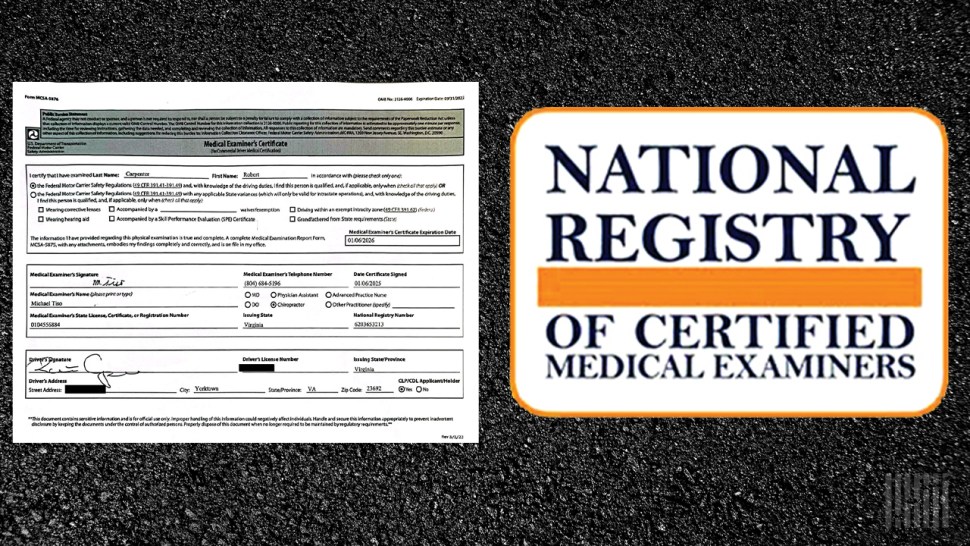
Two people I know personally reached out to me in the past week with the same problem. Gord Magill, a veteran of the trucking industry and a voice that most people in this space know, went for his DOT physical in New York and received his medical examiner’s certificate from the physician without issue. Weeks later, he discovered that the physician had not uploaded the results to FMCSA’s National Registry system, which meant the state of New York had no record of a current medical certification on file. Mill owner and friend Sam Motley had the identical experience with a physician in Virginia. Two different states, two different doctors, the same failure. I get dozens of these calls a week. In both cases, the driver did everything right. In both cases, the physician did not complete the process. In both cases, the driver was at risk of a CDL downgrade that would have pulled them off the road through no fault of their own.
These are symptoms of a systemic transition that FMCSA implemented and that the medical examiner community has not fully adopted, and most don’t know about. This same issue happened with Carriers and Clearinghouse. Half the carriers we deal with don’t realize Clearinghouse is a “thing and it’s existed for 6 years. The change is significant, shifting a critical compliance burden from the driver to the physician in a way that many certified medical examiners do not yet fully understand.
What changed
Under the previous system, a commercial driver who completed a DOT physical received a Medical Examiner’s Certificate (and the long form) directly from the physician. The driver was then responsible for providing that certificate to the state driver licensing agency to self-certify. The state would update the driver’s record to reflect the current medical certification, and the Motor Vehicle Record would show the driver as medically qualified. The process depended on the driver taking the certificate to the state, and if the driver forgot or delayed, the state record would not reflect the current medical status. Carriers then had to verify the self-certification and medical certification status through an MVR pull.
Under National Registry 2, that workflow changed. The certified medical examiner is now required to electronically transmit the results of the DOT physical directly to FMCSA through the National Registry system. FMCSA then transmits the medical certification data to the appropriate state driver licensing agency. The state automatically updates the driver’s record based on data it receives from the FMCSA. The driver no longer needs to hand-carry the certificate to the DMV. The physician uploads it, FMCSA routes it, and the state records it. The process is cleaner on paper and eliminates the compliance gap that existed when drivers failed to submit their own certificates. But it only works if the physician completes the upload.
Where the process is breaking
The failure point is at the first step. Not all certified medical examiners, including physicians, chiropractors, nurse practitioners, physician assistants, and doctors of osteopathic medicine, are aware that the upload responsibility has shifted to them. Many are still handing the driver the paper certificate and considering the encounter complete. The driver walks out with a valid medical certificate in hand, believes the process is complete, and has no reason to suspect that the electronic transmission to the FMCSA did not occur. Weeks or months later, the state sends a notice that no current medical certification is on file, and the CDL will be downgraded if the issue is not resolved.
The problem is compounded by the variety of medical professionals who perform DOT physicals. A hospital-affiliated occupational health clinic with dedicated EHR integration may have built the FMCSA upload into its standard workflow. A solo-practice chiropractor performing DOT physicals on the side may not know the upload exists. A nurse practitioner at a walk-in clinic may know the requirement but lack access to the National Registry portal, or may not have been trained to use it. The certification to perform DOT physicals requires completing a training program and passing an examination, but training in the administrative upload process is not always part of that curriculum, and the administrative infrastructure varies widely across practice settings.
The resulting compliance gap is invisible to the driver and the carrier until the state sends the downgrade notice. The driver has the paper certificate. The carrier has a copy in the driver qualification file. The annual MVR pull, if the carrier runs one, may not reflect the problem until the state has already initiated the downgrade. At that point, the carrier has a driver who is technically disqualified from operating a commercial motor vehicle, and every mile that driver drove between the failed upload and the downgrade notice is a mile the carrier’s insurance may not cover.
What drivers need to do
A driver who completes a DOT physical should not leave the examiner’s office until confirming that the physician is aware of and intends to complete the electronic upload to the FMCSA through the National Registry portal. That is not a confrontational question. It is a compliance question, and any certified medical examiner who is up to date on the requirements will understand it. If the physician is not familiar with the upload requirement, the driver needs to find a different examiner, because a certificate not transmitted electronically is one the state will never see.
After the exam, the driver should check with their state licensing agency to see if the results do not appear within a reasonable period. If the results do not appear within a reasonable period, the driver should contact the examiner’s office and request that the upload be completed again. Waiting for the state to send a downgrade notice is waiting too long. By the time that letter arrives, the driver’s MVR already shows a lapsed medical certification, and any carrier that checked the MVR during that window would see a driver who appears disqualified.
What carriers need to do
The carrier’s obligation under Part 391 is to ensure that every driver in the fleet holds a current, valid medical certificate and that the driver qualification file contains a copy. Under National Registry 2, that obligation now includes verifying that the physician’s upload actually reached the state. The DQ file may show a valid paper certificate dated last month. The state MVR may show no current medical certification on file because the physician never uploaded it. Those two records contradict each other, and in a post-crash litigation environment, a plaintiff’s attorney will use that contradiction to argue that the carrier either did not check or did not care.
The fix is an MVR check within 30 days of every DOT physical. Not the annual pull that most carriers run as a regulatory minimum, but a targeted pull specifically to confirm that the new medical certification appears on the state record. If it does not, the carrier contacts the physician’s office and demands that the upload be completed before the driver’s next dispatch. Carriers should also consider adding a line to their onboarding and recertification processes that requires the driver to confirm the examining physician’s name and National Registry number, so the carrier has a direct point of contact if the upload fails.
What physicians need to understand
The certified medical examiner who performs a DOT physical and does not upload the results to FMCSA has not completed the examination. The regulatory process does not end when the physician signs the certificate and hands it to the driver. It ends when the electronic transmission reaches the FMCSA, which then transmits the data to the state. A physician who performs DOT physicals under National Registry certification and fails to complete the upload is putting the driver’s CDL at risk, exposing the driver to a potential downgrade, and creating a compliance gap that the driver and the carrier may not discover until the damage is done.
The upload isn’t optional; it’s a federal requirement tied to the physician’s certification with the National Registry of Certified Medical Examiners. A physician who consistently fails to complete uploads risks referral to FMCSA for review of their National Registry certification. More immediately, the physician risks a phone call from a very unhappy commercial driver whose CDL was downgraded because the physician did not complete the paperwork, followed by a call from the carrier’s safety director, and, in some cases, a call from regulators. Those calls are avoidable by completing the five-minute electronic upload required by the regulation.
The system works when everyone in the chain does their part. The driver gets the physical. The physician uploads the results. FMCSA routes the data. The state updates the record. The carrier pulls the MVR and confirms the cycle is complete. When any link in that chain fails, the driver is the one who pays, and the driver is the one with the least ability to fix it. That is why this matters. A commercial driver’s livelihood depends on a medical certification that a physician may not know they are supposed to transmit, through a system the physician may not know how to use, to an agency that will downgrade the license without asking whether the failure was the driver’s fault. The process has changed. The industry needs to catch up.
Brokerage Compliance Symposium
The day before F3. Every compliance issue you face - fraud exposure, carrier liability, FMCSA rules, cargo theft, insurance gaps - navigated by attorneys and operators defining best practices in a changing industry.
F3 Awards Dinner
The night before F3. FreightTech100 companies honored. FreightTech 25 and Shipper of Choice winners revealed live. Cocktail reception into dinner and live music - 300 industry leaders in one purpose-built room.
F3: Future of Freight Festival
Industry-defining keynotes, rapid-fire technology demos, and industry leaders networking in experiences across Chattanooga - plus the inaugural F3 Awards Dinner featuring the FreightTech and Shipper of Choice reveals.
The day before F3. Every compliance issue you face - fraud exposure, carrier liability, FMCSA rules, cargo theft, insurance gaps - navigated by attorneys and operators defining best practices in a changing industry.
The Signal at Chattanooga Choo Choo • Chattanooga, TN Register NowThe night before F3. FreightTech100 companies honored. FreightTech 25 and Shipper of Choice winners revealed live. Cocktail reception into dinner and live music - 300 industry leaders in one purpose-built room.
The Signal at Chattanooga Choo Choo • Chattanooga, TN Register NowIndustry-defining keynotes, rapid-fire technology demos, and industry leaders networking in experiences across Chattanooga - plus the inaugural F3 Awards Dinner featuring the FreightTech and Shipper of Choice reveals.
The Signal at Chattanooga Choo Choo • Chattanooga, TN Register Now