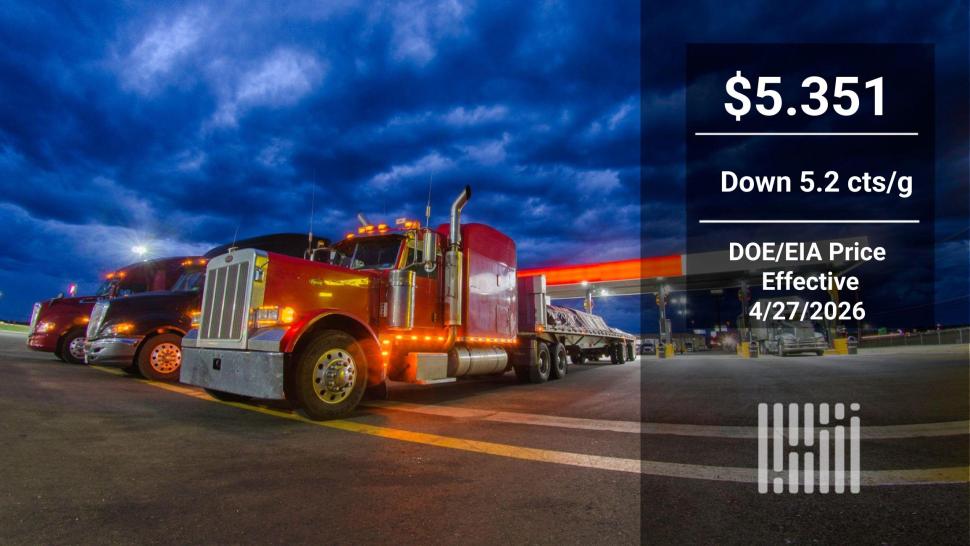
The weekly benchmark diesel price used for most fuel surcharges recorded its third straight decrease after weeks of higher numbers, but the recent direction of futures prices suggest the pullback may not continue.
The Department of Energy\Energy Information Administration average weekly retail diesel price fell 5.2 cents/gallon to $5.351/g, published Tuesday and effective Monday.
That’s a decline of 29.2 cts/g over the last 3 weeks in the benchmark price used to set most fuel surcharges. But futures prices have turned higher, the AAA price was up today for the first time in more than 2 weeks, and there’s little bearish news out of the Strait of Hormuz. The price released Tuesday could be a bottom for this cycle.
The price has declined 29.2 cts/g over the last three weeks, which means it is that much under the highest price in the cycle since the start of the war in Iran and the broader Middle East. The price published by the DOE/EIA right before the recent downturn was $5.643/g on April 6.
The record high in the DOE/EIA series, which goes back to 1994, is $5.81, set in June 2022.
The settlement price of ultra low sulfur diesel (ULSD) on the CME commodity exchange reached its highest level since the war began on March 27, when it settled at $4.4955/g. It settled slightly below that on April 7, at $4.4744/g.
ULSD plummeted a day later, more than 66 cts/g, on announcement of a ceasefire, settling at $3.8084/g. Prices have made a steady move higher since then, despite a market that has been up and down on any given day’s news on the possible reopening of the Strait of Hormuz.
ULSD crossed the $4/g mark in trading Monday before settling just under that. It exceeded the $4 mark again Tuesday before a slight decline by 11 a.m. Tuesday.
What comes next
There has been enough stability in current markets that extreme talk of an eventual $200/b price for Brent crude, the world’s benchmark, has mostly faded.
But what hasn’t faded are growing concerns that oil prices may be sticking at higher levels for awhile, regardless of whatever developments occur with the reopening of the Strait of Hormuz.
The energy research team at Bank of America summed up that view in a recent report.
The team led by Francisco Blanch said in the report that the oil market “is facing a sobering reality.”
The “quick resolution scenario—with the assumption that full oil flows would be restored in Hormuz in short order—seems now highly unlikely,” the report said.
The report noted that the physical oil markets remain tight. However, dated Brent, which is a physical crude barrel for short-term delivery in contrast to Brent traded on futures market for June delivery, is now only about $5-$6/b more than Brent on commodity exchanges. That gap was about $10/b until recently.
“The physical oil market continues to tighten as a large share of global seaborne volumes remains trapped in the Middle East and global oil markets remain in steep backwardation,” BOA said.
Market structure tells a story
Backwardation is a market structure where the highest price in the market is oil for immediate delivery, with prices then declining as the forward curve goes out into the future. Backwardation is a structure that develops when a commodity market is tight, as the current one is.
Its opposite is called contango, and a market in perfect balance is in contango, with prices along the calendar rising gradually to reflect the cost of storage and the time value of money.
The BOA report said it has a base case of an end to military action, with oil flows “mostly normalizing” by the third quarter. Under that scenario, Brent would average $92.50 for the year. (Brent on the CME settled Monday at $108.23/b).
But that is the best case. What BOA called a “fragile ceasefire” would involve a more negative situation for oil consumers.
“Under this case, military activity would be constrained but not eliminated, and Hormuz would remain heavily securitized, with limited crossings and thus rising oil prices,” the report said. “A strait that is neither fully open nor totally closed in 2Q/3Q may push Brent to average $120/bbl this year.”
More articles by John Kingston
Why truckers should care about DOL’s latest proposal on joint employers
Triumph Financial sets new metrics, has strong quarter in factoring
TFI’s Bedard optimistic about U.S. LTL, but some of its issues persist
Brokerage Compliance Symposium
The day before F3. Every compliance issue you face - fraud exposure, carrier liability, FMCSA rules, cargo theft, insurance gaps - navigated by attorneys and operators defining best practices in a changing industry.
F3 Awards Dinner
The night before F3. FreightTech100 companies honored. FreightTech 25 and Shipper of Choice winners revealed live. Cocktail reception into dinner and live music - 300 industry leaders in one purpose-built room.
F3: Future of Freight Festival
Industry-defining keynotes, rapid-fire technology demos, and industry leaders networking in experiences across Chattanooga - plus the inaugural F3 Awards Dinner featuring the FreightTech and Shipper of Choice reveals.
The day before F3. Every compliance issue you face - fraud exposure, carrier liability, FMCSA rules, cargo theft, insurance gaps - navigated by attorneys and operators defining best practices in a changing industry.
The Signal at Chattanooga Choo Choo • Chattanooga, TN Register NowThe night before F3. FreightTech100 companies honored. FreightTech 25 and Shipper of Choice winners revealed live. Cocktail reception into dinner and live music - 300 industry leaders in one purpose-built room.
The Signal at Chattanooga Choo Choo • Chattanooga, TN Register NowIndustry-defining keynotes, rapid-fire technology demos, and industry leaders networking in experiences across Chattanooga - plus the inaugural F3 Awards Dinner featuring the FreightTech and Shipper of Choice reveals.
The Signal at Chattanooga Choo Choo • Chattanooga, TN Register Now