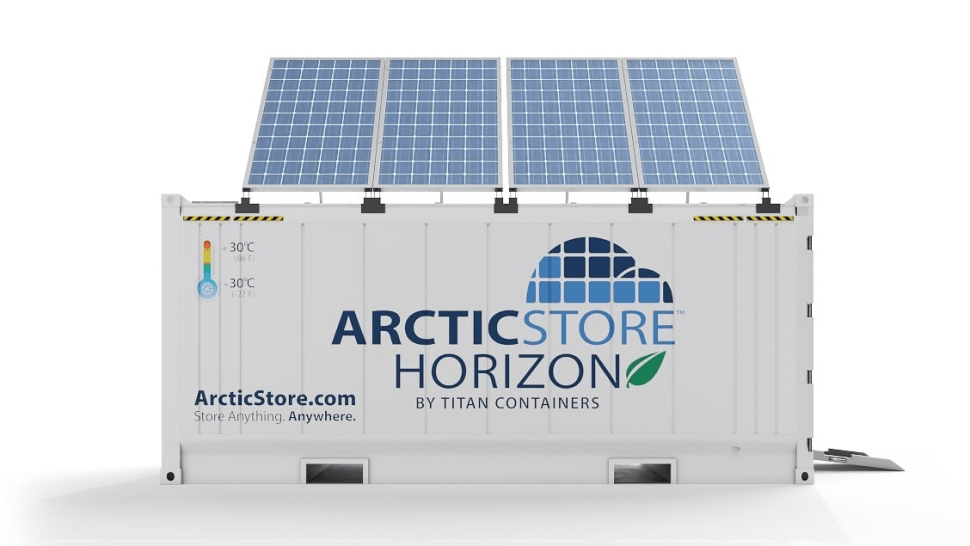
TITAN Containers is making a bold play to redefine what sustainable cold storage looks like with the launch of ArcticStore Horizon, a portable cold room engineered to slash energy use and global warming potential at a scale the industry hasn’t seen before. Horizon delivers an average 55% reduction in energy consumption and uses a near-zero-GWP refrigerant, CEO Søren Skov Mogensen says are arriving at exactly the right moment for a sector under pressure.
Cold storage demand is surging globally, growing between 10% and 20% every year as grocery delivery expands, food consumption patterns shift, and the pharmaceutical supply chain moves deeper into temperature-sensitive biologics and cell and gene therapies. But the infrastructure supporting that growth is strained.
Many facilities rely on aging, energy-intensive reefer technology at a time when electricity accounts for around 70% of operational costs. At the same time, regulations are tightening around refrigerant use, emissions reporting, and end-to-end temperature visibility.
“We’ve been doing refrigerated storage for more than three decades, and we understand the pain points,” Mogensen said. “Demand is rising across food, producers, pharma—everywhere. Customers need more capacity, but they also need to meet sustainability targets and control runaway energy costs. Horizon was built to solve both problems.”
Horizon’s efficiency gains come from a combination of vacuum insulation panels and an integrated solar-ready roof. Hyper-efficient vacuum insulation panels(VIP) have long been used in high-end pharmaceutical shipping boxes, but TITAN is the first to incorporate them into a containerized cold room without sacrificing transportability or structural integrity.
The engineering lift was substantial: the roof had to be lowered by 10 centimeters; however, corner castings and frame have been kept as is to ensure compatibility with global shipping and stacking requirements.
The solar component posed another challenge. Instead of fixed panels, Horizon uses roof-mounted panels that tilt toward the sun to maximize output. Ensuring they could withstand movement, shipboard handling, and harsh weather while still meeting ISO container standards required extensive redesign. “It had never been done before,” Mogensen said. “But now that we’ve solved it, we’re delivering the most environmentally friendly portable cold room in the world.”
The result is a system where about 30% of energy savings stem from improved insulation and roughly 25% from solar contribution. That solar benefit varies by geography, but remains meaningful everywhere TITAN has tested it. “None of the locations made the solar irrelevant,” Mogensen noted.
Customers are already showing strong interest across segments. Pharmaceutical companies with emissions-reduction mandates see Horizon as an immediate win, while food producers and distributors welcome relief from escalating electricity bills. “Without exception, our customers care about operating costs,” Mogensen said. “And they care about sustainability. Horizon finally gives them leverage on both.”
Beyond energy performance, Horizon offers practical advantages over traditional cold rooms. Conventional builds can cost four times as much and take up to two years to complete. Horizon arrives ready to run; customers plug it in and go live. Units can be scaled, linked into TITAN’s modular “SuperStores,” expanded, or returned as needs shift.
Every unit comes with SmartArctic, TITAN’s cloud-based monitoring platform that enables real-time visibility and two-way remote control, a growing requirement as compliance rules like FSMA 204 reshape temperature-controlled logistics.
For TITAN, Horizon marks the start of a new chapter. The company is preparing additional innovations rooted in the same out-of-the-box thinking, but Mogensen said the priority now is execution: “Our focus is on getting Horizon into the hands of customers and helping them reduce GWP and energy consumption. We’ve built something the industry truly needs right now.”
Brokerage Compliance Symposium
The day before F3. Every compliance issue you face - fraud exposure, carrier liability, FMCSA rules, cargo theft, insurance gaps - navigated by attorneys and operators defining best practices in a changing industry.
F3 Awards Dinner
The night before F3. FreightTech100 companies honored. FreightTech 25 and Shipper of Choice winners revealed live. Cocktail reception into dinner and live music - 300 industry leaders in one purpose-built room.
F3: Future of Freight Festival
Industry-defining keynotes, rapid-fire technology demos, and industry leaders networking in experiences across Chattanooga - plus the inaugural F3 Awards Dinner featuring the FreightTech and Shipper of Choice reveals.
The day before F3. Every compliance issue you face - fraud exposure, carrier liability, FMCSA rules, cargo theft, insurance gaps - navigated by attorneys and operators defining best practices in a changing industry.
The Signal at Chattanooga Choo Choo • Chattanooga, TN Register NowThe night before F3. FreightTech100 companies honored. FreightTech 25 and Shipper of Choice winners revealed live. Cocktail reception into dinner and live music - 300 industry leaders in one purpose-built room.
The Signal at Chattanooga Choo Choo • Chattanooga, TN Register NowIndustry-defining keynotes, rapid-fire technology demos, and industry leaders networking in experiences across Chattanooga - plus the inaugural F3 Awards Dinner featuring the FreightTech and Shipper of Choice reveals.
The Signal at Chattanooga Choo Choo • Chattanooga, TN Register Now