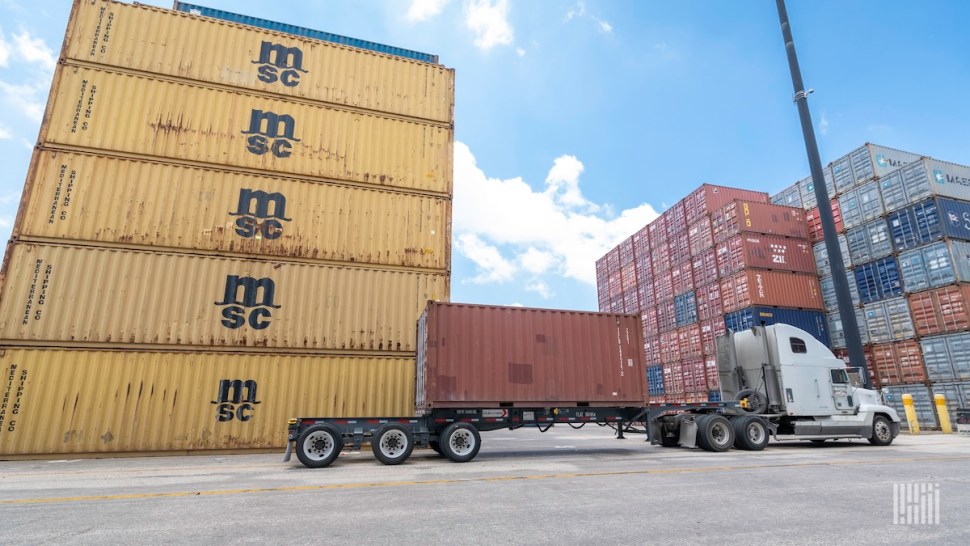
Manufacturers and retailers across North America are increasingly turning to mobile storage trailers as a flexible alternative to traditional warehouses as supply chains face tariff volatility, labor shortages and rising logistics costs, John Brooks, founder and CEO of Warehouse on Wheels, said.
Warehouse on Wheels, a mobile storage provider headquartered in Crestview Hills, Kentucky, operates about 37,000 trailers across roughly 37 locations in the U.S., Canada and Mexico, serving more than 7,000 customers across manufacturing, retail and nonprofit sectors.
Brooks said the company’s storage trailers are designed to give companies temporary capacity when warehouses are full or supply chains are disrupted.
“The instinct is to build more or lease more warehouse space, but you can’t easily go less,” Brooks told FreightWaves. “We exist to be the pressure relief valve between a corporate forecast and a frontline fire drill.”
Instead of committing to long-term warehouse leases, companies can rent trailers month-to-month and use them as overflow storage at factories, distribution centers or ports.
A lower-cost alternative to warehouse space
Brooks said companies are increasingly looking for ways to convert fixed logistics costs into more flexible operating expenses.
According to an internal analysis by Warehouse on Wheels, traditional warehouse leases average about $11 per square foot before operating expenses, while storage trailers cost roughly $6.64 per square foot, delivering significant savings for customers using temporary storage capacity.
“When you calculate the opportunity cost of a fixed warehouse lease versus renting a trailer for a few hundred dollars a month, the logic becomes pretty clear,” Brooks said. “We want to be another tool in the toolbox for supply chain leaders.”
The trailers are typically refurbished units with forklift-rated floors that can be used for storage or short-distance cartage within regional supply chains.
Supply chain disruptions fueling demand
Demand for flexible storage has grown as supply chains deal with unexpected disruptions, including tariff changes, port congestion and sudden shifts in inventory demand.
“Any kink in a finely tuned just-in-time supply chain creates total chaos,” Brooks said. “You don’t have time to negotiate a warehouse lease when production is on the line. You need assets ready to go immediately.”
Companies often use the trailers to temporarily store inbound inventory, stage components for manufacturing or hold empty packaging used in production systems.
In some cases, large manufacturers have scaled their use of mobile storage significantly over time. Brooks said one Midwest automotive assembly plant increased its deployment from about 60 trailers to more than 1,600 units.
Nearshoring boosting demand in Mexico
Warehouse on Wheels is also seeing strong demand tied to nearshoring and cross-border trade.
Brooks said manufacturers operating along key logistics corridors in Monterrey, Laredo and El Paso are increasingly using mobile storage to manage cross-border supply chains.
“Manufacturers need reliable physical capacity along the border,” Brooks said. “Instead of borrowing equipment from local trucking providers, they can scale instantly using a dedicated storage network.”
While demand tied to nearshoring remains strong in Mexico and the U.S, Brooks said the Canadian market has been softer amid slower economic conditions.
Growth strategy targets 100 locations
Warehouse on Wheels has expanded rapidly in recent years through acquisitions and new market launches, integrating regional trailer rental providers into its network.
The company’s long-term goal is to grow to 100 locations and about 100,000 trailers across North America, Brooks said.
Because its trailers are often used when warehouse space is tight or when companies begin ramping up production, Brooks said the company also provides an early signal of supply chain activity.
“At the peak of the cycle warehouse space is maxed out, and at the bottom companies don’t want to commit long-term capital,” Brooks said. “We’re seeing early green shoots and a bit of an uptick heading into 2026.”
Brokerage Compliance Symposium
The day before F3. Every compliance issue you face - fraud exposure, carrier liability, FMCSA rules, cargo theft, insurance gaps - navigated by attorneys and operators defining best practices in a changing industry.
F3 Awards Dinner
The night before F3. FreightTech100 companies honored. FreightTech 25 and Shipper of Choice winners revealed live. Cocktail reception into dinner and live music - 300 industry leaders in one purpose-built room.
F3: Future of Freight Festival
Industry-defining keynotes, rapid-fire technology demos, and industry leaders networking in experiences across Chattanooga - plus the inaugural F3 Awards Dinner featuring the FreightTech and Shipper of Choice reveals.
The day before F3. Every compliance issue you face - fraud exposure, carrier liability, FMCSA rules, cargo theft, insurance gaps - navigated by attorneys and operators defining best practices in a changing industry.
The Signal at Chattanooga Choo Choo • Chattanooga, TN Register NowThe night before F3. FreightTech100 companies honored. FreightTech 25 and Shipper of Choice winners revealed live. Cocktail reception into dinner and live music - 300 industry leaders in one purpose-built room.
The Signal at Chattanooga Choo Choo • Chattanooga, TN Register NowIndustry-defining keynotes, rapid-fire technology demos, and industry leaders networking in experiences across Chattanooga - plus the inaugural F3 Awards Dinner featuring the FreightTech and Shipper of Choice reveals.
The Signal at Chattanooga Choo Choo • Chattanooga, TN Register Now