




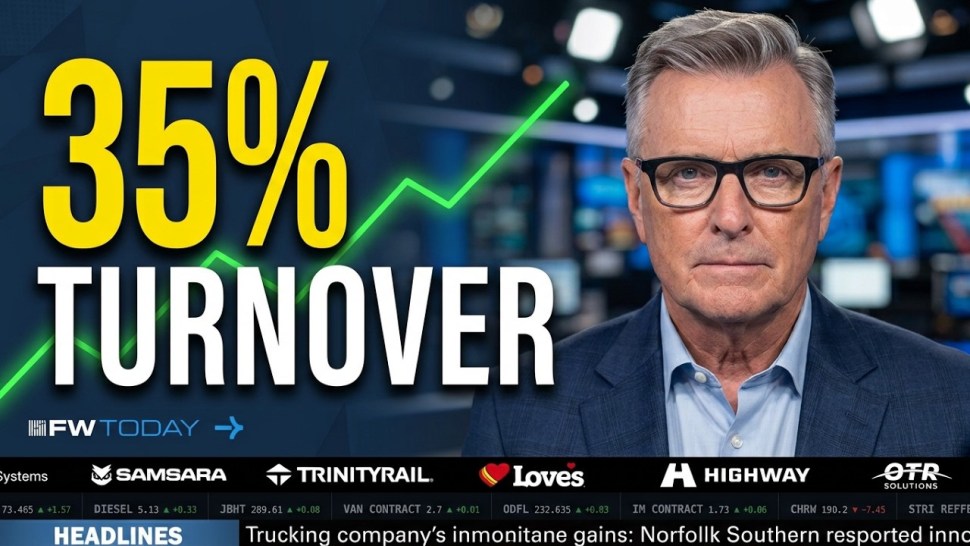
Nussbaum Transportation, a leading 600-truck fleet, made a pivotal decision in 2018: transitioning to an Employee Stock Ownership Plan (ESOP). CEO Brent Nussbaum reveals the motivations behind this move, emphasizing a core philosophy passed down from his father: ‘take care of your people.’ Discover how employee ownership helps retain drivers with industry-low 35% turnover and builds long-term wealth beyond traditional 401K plans. Learn about the unique challenges and benefits of this model in the volatile freight market.
Nussbaum Transportation, an 80-year-old, 600-truck truckload carrier, runs driver turnover in the 35% to 39% range — a fraction of the industry norm — and CEO Brent Nussbaum credits a 2018 employee stock ownership plan as a central pillar of that performance. The privately held Illinois company sold 45% of the business to its employees that year, and Nussbaum said a second ESOP sale is planned for the first quarter of next year.
The ESOP structure means employees receive 4% to 6% of their annual salary in company shares each year, building wealth beyond a standard 401(k). The stock is independently valued each spring; Nussbaum said the share price was flat in the most recent valuation after several years of increases. “This last year it was flat, which I was thankful it didn’t go down after this market,” he said. The company holds quarterly all-hands financial meetings that include drivers, keeping the full workforce informed on operating results.
“If I leave my career someday and all of our employees have done well, I get to walk away proud of what we’ve done for them.”
Beyond equity, Nussbaum layers in a certified RED safety-and-performance program that takes a full year to complete, rewarding graduates with a pay raise, a special hat and ring, and a company-wide celebration. Drivers who continue their safe journey can stack additional pay increases through the program in years when across-the-board raises were scarce. The company also began issuing profit-sharing checks this year, with the first disbursement going out at the time of the interview.
Nussbaum described two operational habits he calls part of the carrier’s “secret sauce.” Each week he personally calls every incoming driver before their start date — a gesture he said consistently surprises recruits who say they have never heard from a CEO. He also reviews a weekly shop report and phones any driver whose truck earns an exceptional cleanliness rating. “I’ll have drivers that’ll say, yep, saw that. Just waiting for you to call,” Nussbaum said.
The carrier also offers a $2,000 early-exit bonus to any driver who decides within the first 90 days — after giving 30 days on the job — that the company is not the right fit, provided the driver returns the truck to a company facility and leaves in good standing. Nussbaum said the payout is rare because most drivers who clear the 30-day mark stay on. The company’s average driver age has dropped to 49 from 55, a shift Nussbaum said may reduce the subset of drivers who pull back miles after a pay raise.
On the growth front, Nussbaum said dedicated freight carried the company financially through the recent soft market while over-the-road results were negative. The carrier is now scaling in both segments and expects to grow at least double its typical 3% to 5% annual rate this year. To support that expansion, the sales team was directed to push contract rates higher first — a process Nussbaum acknowledged is creating friction, including a request from a large shipper to meet directly with the CEO and chief sales officer in late August to understand the rate environment firsthand.
Separately, Nussbaum said the company developed an in-house bid-pricing tool called BidRight, originally built for internal use by five company developers. The software consolidates shipper RFP data, normalizes fuel programs, and generates a bid in seconds. It is now being resold through KSM alongside a product called Freight Math to a group of roughly 100 carriers, with Nussbaum framing broader industry adoption as a way to close the pricing gap between carriers and lift the overall rate floor.
- Nussbaum Transportation sold 45% of the company to employees via an ESOP in 2018, with a second ESOP sale planned for Q1 next year.
- Driver turnover runs 35%–39%, supported by profit sharing, a year-long certified driver program, and a $2,000 early-exit bonus.
- The carrier’s in-house bid-pricing tool, BidRight, is now sold through KSM to roughly 100 carriers to help standardize truckload pricing.
Speaker 1 [0:00] Look, you’re in for a treat. We have Brent Nussbaum. He is the CEO of 600-truck operator Nussbaum Transportation, privately held. We always love, we talk about public earnings ’cause this is a big time.
Speaker 2 [0:12] We’re privately held, but we ran out an ESOP.
Speaker 1 [0:14] We, we’ll talk about that in a second. Right. You don’t have, you don’t have to report to public investors on the exchanges. But let’s talk about what an ESOP is. You guys have 600 trucks, been around for, for decades as a generational company. In 2018, you did something called an ESOP or an employee stock Ownership Plan. What exactly is that?
Speaker 2 [0:34] So, uh, in 2018, well, actually before that, we were looking around going, uh, my family is not getting any younger. We’ve gotta figure out how we’re gonna transition this company. Uh, and as I talked to different fleet owners, the one thing that I, uh, discovered was a lot of ’em said, you know, I sold to another company, but just at the, at the end of it, 2 years down the road, it just wasn’t what I thought it was gonna be. And so we didn’t want that to be the same for our employees because my father’s favorite expression was, we take care of your people, everything else takes care of itself. So we started shopping around and actually ended up talking to, uh, you guys may know him, Bill Prevost. Um, he was CEO of, uh, Quickway Transportation out of Nashville. Bill was a big proponent early on of ESOPs. And the idea was you sell your company to your employees so that they ultimately have the ability to build wealth beyond a 401. So we started the process in 2018. Each sold 45% of the company to our employees. And each year we talked to them about stock price. They go, uh, every quarterly, uh, financial meeting we have involves all of our employees, involves all of our drivers. They know exactly how we’re operating. They do a— there’s a valuation of our stock that’s done in, um, late spring. And then we celebrate, uh, the stock, uh, because usually it’s been going up. Now this last year it was flat, which I was thankful it didn’t go down after This market.
Speaker 1 [2:19] Yeah, for sure.
Speaker 2 [2:20] But it was, it was really good. And so our employees are really bought in. We’ve traditionally got low turnover. We’re in the 30, anywhere from 35 to 38, 39 area as far as turnover goes. We believe that an ESOP is a big part of that because it helps them build something for the future.
Speaker 1 [2:44] And a friend of mine who’s in media is going through the ESOP process and he’s explained to me, I, it was not something I was deeply familiar. I’ve heard, you see, uh, you guys have it on your trailers, uh, employee-owned company, something that ESOP companies are very proud of the fact that their employees get ownership. I think UPS at one point was an ESOP before it went public. It’s a different structure than selling to a private equity group or selling, taking the company public or selling to another owner. I mean, you know, Max, Dad, you know this painfully of A business that you’ve operated in, that you’ve built, that, that someone else is taking over. I mean, in many ways you lose your identity.
Speaker 3 [3:19] You do. And, you know, an ESOP, in my opinion, is fantastic because your employees are the ones helping you build the company.
Speaker 2 [3:27] Right.
Speaker 3 [3:27] And it shows, you know, if your turnover is almost unrealistic in this industry.
Speaker 1 [3:32] A 30% turnover.
Speaker 3 [3:33] Yes. Or more turnover basically shows it’s working, working very well. Yeah.
Speaker 2 [3:38] It was working prior to that. So we, we’ve always been in the, in the 30s range, uh, with turnover. And I don’t know if that’s because we were a smaller company, family owned. You know, there’s a, there’s a lot that can be said, um, for, you know, for smaller companies. And I will tell you over the years, you know, drivers have said, man, do we, why do we have to grow? Can’t we just stay small? You know, this family owned. I left the thing and I said, folks, if we don’t grow, we’re gonna die. Because ultimately shippers, when you’re, when you’ve only got so much capacity to offer ’em, they look at you and go, well, you can only give me 5 trucks a day outta that location. I can get US Express to come in and, and give me 20.
Speaker 3 [4:21] Yeah.
Speaker 2 [4:22] You know, so why should I do that? And, uh, so over the, over time we’ve grown, but we’ve grown smartly.
Speaker 3 [4:28] Yeah.
Speaker 2 [4:30] And, and not trying to grow.
Speaker 1 [4:31] You had the opportunity to grow. I mean, you guys could have easily— the nice thing about trucking, it does allow you to grow, but you chose to stay more intimate, we’ll say, small, smaller versus what you could have.
Speaker 2 [4:44] Well, well, let’s, let’s go back to the beginning. We’re an 80-year-old company. So we started off, my dad started off with one truck. We were an LTL and 65% of our business was LTL. And we were a niche carrier, uh, with, uh, in the Midwest. And as we know from deregulation, uh, that just killed LTL, uh, did a number on it. And we had a truckload operation that was all owner operators. And so in 2001, we made the decision to exit LTL because a lot of the big box stores were coming along. They were growing and they were buying in truckload quantities. The smaller mom-and-pops that we used to service with LTL were going out of business. So we recognized that, said we’ve gotta build our truckload operation, but we can’t do it with just all over-the-road. We need to do it with some dedicated as well. And, and I love dedicated until I get into a market like this and I see where returns on over-the-road are going.
Speaker 1 [5:50] Yeah.
Speaker 2 [5:50] Like this, a dedicated’s good, but, uh, it’s an annuity.
Speaker 1 [5:55] Like, we want that dopamine hit.
Speaker 4 [5:57] It’s more demand. It’ll continue to come for dedicated.
Speaker 1 [5:59] But there’s an ebb and flow.
Speaker 2 [6:01] Exactly.
Speaker 3 [6:01] There’s an ebb and flow.
Speaker 1 [6:02] Julie’s a fan of the dedicated. She, she ran your specialty. Julie?
Speaker 4 [6:06] Yeah, I, the dedicated demand will come, right? And then it will remain. And then you’ll get those elevated rates that will come later this year or next year, and they’ll hold for a couple of years versus OTR will be up and down. But I think there’s more to that turnover number. than just the ESOP. There are a lot of things that you do as a CEO to interact with your drivers and training programs and recognition for those drivers. Can you talk a little bit about the culture you’ve created that creates that kind of turnover number?
Speaker 2 [6:31] Again, we’re— there’s a career path for a driver coming in. So they can either train, they could be a driver trainer, which pays really well. They could be a road captain, which is assigned to new drivers that are coming in through orientation. And it, it, those folks can answer questions for driver, for new drivers that are coming in. And then there’s also, uh, somebody who could be a, a certified RED, um, uh, trainer, if you will. So we have a certified RED program and it’s a safety and, um, performance program. So it takes a year to get through it. It’s an, it’s a whole nother level of training. And it, after that year, we’re gonna celebrate that driver. They’re gonna get a special hat. They’re gonna get a special ring. We’re gonna do a big celebration in front of all the employees. Uh, and, uh, and that driver’s gonna get a pay raise. And the next year, uh, if they continue on the, on the safe journey, they can continue to build their, uh, their pay. So in the last few years when pay raises were really scarce, they could still do increases by just growing their Certified Driver Program. So, um, but there’s also, um, along the way we’ve, you know, this year we announced we saw this thing coming out. You guys were doing your reporting and we’re going, we think this thing’s going to really go someplace. And so, um, based on Craig Fuller, let’s— Oh no, that’s, that, that’s—
Speaker 1 [8:07] yeah, I get accused of a lot of things. I wish, by the way, I wish I had the power that I get accused of having because I’m on both sides of that. I’m very flattered that people think I have that kind of power.
Speaker 3 [8:19] But you did make the call in November.
Speaker 1 [8:21] I did make the call in November, but you know, I occasionally get— I’ve gotten that one wrong too, a recession.
Speaker 2 [8:25] No, no, you did well. And so we talked to our people and we said, you know, we’ve got equipment sitting because it made no sense to get rid of it because the market was You know, was tanked as far as equipment values. And then there was, um, we’ve had opportunities, uh, that have come our way. Uh, how does the, you know, you were talking about dedicated, dedicated carried us the last few years financially.
Speaker 4 [8:49] That’s very evident.
Speaker 2 [8:50] Yep. And, and it kept us, uh, it kept us in the, in the green. So, uh, unfortunately our, our irregular route or our over-the-road market did not. But that’s okay. We were still whole. So it carried us through. Now we’ve got opportunities in both over-the-road and in dedicated. And, uh, we’re really trying to figure out where to go because we’ve got so many opportunities that, uh, it’s nuts. So we, we, we decided we were going to start scaling and we’re, we’re scaling as fast as we can this year. And we’re not, you know, we’re not being, uh, shy about it. Uh, as it makes sense.
Speaker 1 [9:32] Brett, what is the constraints on growth? You, you obviously can get freight. Shippers are looking for commitments. They’re looking for capacity. They’re willing to pay up for it. What is actually holding you guys back in terms of growing faster?
Speaker 2 [9:44] Well, uh, we want to do the second ESOP sale in the first quarter of this next year. So we still have some left to sell to our employees, and that will take some financial you know, uh, wherewithal in the first quarter of next year.
Speaker 1 [10:00] So you’re wanting to, you know, we’ve talked to, uh, Mark Scudder. He’s on the, uh, board, a couple of public boards in trucking. He talked about the fact that the companies, particularly the bigger companies, and perhaps you’re the same, are really trying to optimize the business. A couple of years of just absolutely being abused by this market means that you’re also focused on optimization, right? You want to grow, but you also want to grow responsibly.
Speaker 3 [10:23] Right.
Speaker 2 [10:24] We want to grow responsibly because we’ve told our people, you know, we’re an employee-owned company. So the last thing you want to do is show them you’re reckless.
Speaker 3 [10:31] Yeah.
Speaker 2 [10:32] And so we talked to them about that. We talked to them at our quarterly financial meetings. And we’ve had some— we went out to them and we said, guys and gals, we’re going to grow this year and we’re going to grow more than normal. Ordinarily, we might grow 3 to 5% in one year. This year it’s gonna be at least double that because we have a lot of really good opportunities. But before we did that, we went to our sales department and said, we’re gonna grow. We need to get rates back up where they need to be. And so I wanna be careful as I talk about our shippers because some of them are feeling the pain. You know, they’re not, their businesses aren’t great right now. And all of a sudden they’re feeling the heat of rate increases. So I want them to understand that we hear you, we’re sensitive, we’re not insensitive to that. But what we want to do in the meantime, you need to understand, last 3 years there haven’t been many rate increases. And if anything, rates have gone backwards.
Speaker 1 [11:35] I mean, our data supports that. I mean, we’ve seen a drop of at least a quarter in contract rates on a national average. It has— we’ve made up some of that. I think we’re up about half. About halfway to where we were, but we still have a long way to go if you look at where we’ve been the last couple years. Is the is the issue one thing we’ve talked about? Julie and I’ve talked about is a lot of shippers, particularly folks that are running the the bids or making routing decisions. With the exception of COVID a lot of them have never lived in a carrier’s market, and they’re sort of surprised by. I think a lot of people have been surprised about how how how how significant of a bounce back we’ve had. But A lot of shippers just don’t know how to navigate it. Has that been your experience as well?
Speaker 2 [12:17] Yeah, it is. And we’re having to do a lot of explaining, especially when you get into double-digit rate increases. You know, all of a sudden they’re going, you know, we just had this week, as a matter of fact, a large shipper we do business with. We agreed to, to take part of it now, a good chunk of it now, and then a month later come along and, and do the second part of it. Uh, and just to help them, but they called us up and they said, I want the CEO of your company and I want your, you know, your, your chief sales officer, um, to come up and at the end of August and we, I want to talk, I want to, I want to understand from you, not through my logistics manager, what’s going on.
Speaker 1 [13:01] Yeah. I think that’s important. I think that communication’s important. So from you, you know, you, Family-owned business, you guys decide to do the ESOP. One thing that I learned about ESOPs is you have to have an independent board. Uh, so it, and you have an independent valuation that’s out there.
Speaker 2 [13:16] Well, typically, like in our case, we’ve got 3 internal board members. And then we’ve got, uh, right now we’re in the process of putting another one in. Uh, we’ll have to have, generally you have 3 and 3. So the idea is to have 3 internals, you have 3 externals. And then you have a trustee that is not part of the board, but the trustee represents the, the, uh, buyers of the company.
Speaker 3 [13:39] Hmm.
Speaker 2 [13:40] And so it’s up to the trustee and they’re overseen by the Department of Labor to make sure that we’re running, you know, the way we should be and that we’re doing what we should do. That trustee is not involved in the way we operate our business. They don’t tell us what to do. Um, we’ve got a great trustee. stays out of our way. He’s an attorney. Um, but, uh, we just call him and say, well, we either need to put another building up and you just need to be aware of, we’ve got a capital expenditure here that, you know, that we’ve got to—
Speaker 1 [14:13] but, um, what has it been like for you going from a family company where it’s your family that owns this business, you don’t have outside investors, to all of a sudden now you have a responsibility not to just your own fiduciary, your own family and your family members. Now you have a fiduciary to the employees. What has that been like in terms of how you guys operate the business, the shift for you?
Speaker 2 [14:30] It’s always been, you know, it’s always been very much focused on our employees. So it’s never ever been, actually, I could come to work every day and not worry about what I owned, right? If I leave my career someday and all of our employees have done well, I get to walk away proud of what we’ve done for them.
Speaker 3 [14:55] Yeah.
Speaker 2 [14:57] You know, that’s why we did, uh, we did the ESOP. Uh, it’s one of the reasons that we instituted this profit sharing program. So I don’t know how many other carriers are doing that, but ultimately, uh, we decided why not? Um, and we’ve had drivers come up to us and say, man, that is one of the best things you’ve ever done for us. Now they haven’t collected a check yet, but this Friday—
Speaker 3 [15:19] Well, when they do. Yeah, when they do.
Speaker 2 [15:21] Profit sharing checks are going out this Friday.
Speaker 1 [15:23] Congratulations to the drivers of Nussbaum on getting a profit sharing check. And of course, this market is such a— offers the opportunity to generate profits. Drivers know that companies are doing better, they’re doing better. When you talk about the whole package, you guys have announced that you’re, you know, John Kingston reported earlier this year that you guys are doing pay increases to truck drivers.
Speaker 4 [15:48] Yeah.
Speaker 1 [15:49] What does the package look like that’s really driving retention?
Speaker 2 [15:52] Well, there’s also a, uh, uh, we call it early exit option. So, uh, drivers make a commitment to come to us and ultimately we want them to feel good about the decision that they’ve made. So what we do is we just say, hey, look, within the first 90 days you’re here, as long as you’re here 30 days to give us a chance to show us, you know, how to, how to How to make it the best for you. And as long as you return your truck to our facilities and you leave in good standing, we’ll give you a $2,000 bonus if you decide that we’re not for you. So, you know, that’s one thing that we’ve done. Again, think about in the ESOP world, think of it in the way of, and we did cover this a few moments ago, But think of every year somebody giving you 4 to 6% of your salary in ESOP shares for you to continue to build your wealth with. That happens in the ESOP world. That doesn’t happen in a non-ESOP world. There are, I mean, there are safety bonuses, there are performance bonuses, there’s things that you can do as I mentioned, as a trainer. One, a couple of things that I do. You could call it our secret sauce, if you will. But I do. I didn’t full you know full disclosure. I didn’t do it prior to this year. But if every week recruiting sends me a list of all the drivers that are coming to work at New Spot, I pick up the phone to each one of them and I say, “Look, here I hear you’re coming in a couple weeks.” Wanna walk walk away? And I’m. And I’ve had drivers say, I’ve had drivers laugh and they’ll go, I go, what are you laughing for? And they go, I have never had a CEO call me before. Never. I don’t even know who the CEO of my company is.
Speaker 1 [17:45] Was that, was that, was that awkward initially? Because you, because there’s always, companies do have a pretty significant divide between management and sometimes it feels, I think just the awkwardness. Was that, was that awkward?
Speaker 2 [17:58] Not in our company. Not at New Smile. It’s very, if you came and you got to know our people, we’re very much, uh, we hire for character. We don’t hire for skills. We can teach what they need to know as far as skills, but we hire for character. We want those people to care about drivers.
Speaker 1 [18:15] It’s probably why you have a 30% turnover as well, because you get the bad apples. Hiring’s always a, there’s a risk that you make a bad judgment. Early exit means that you get the people who don’t want to be there.
Speaker 3 [18:26] Right.
Speaker 1 [18:27] have a reason to leave and it causes a lot less headaches.
Speaker 2 [18:29] But it’s rare.
Speaker 4 [18:29] If you can make it through the first 30 days. Yeah.
Speaker 2 [18:32] You can make it through the first 30.
Speaker 3 [18:34] That’s true.
Speaker 1 [18:35] That’s a great point.
Speaker 2 [18:35] Yeah. It’s, it’s, it’s, it’s a rare, rare day that we would ever have to pay that out because most people come and stay. Maybe at the 6-month mark they might decide, you know, I don’t know if that’s for me. If they’re over the road, they might want dedicated. We don’t have a dedicated position open for them. Then, you know, ultimately, uh, they might decide that, hey, I’m gonna leave because I’ve got an opportunity. That helps to do something that’s really, really crazy. And that’s, uh, I get a list every week of trucks that are in the shop. And the last thing we do is a cleanliness inspection on the truck. Now, if they’re in there 3 or 4 times a year, they’re only gonna get one phone call, but I will pick up the phone every week and call drivers if they get an exceptional On their, on their equipment report. And, uh, and I’ll have drivers that’ll say, yep, saw that. Just waiting for you to call.
Speaker 1 [19:26] Amazing. Well, look, I, yeah, Brent, you’re doing it right. And you’re doing, congratulations. Congratulations to the employees. Love stories. We talk a lot about the issues and the challenges in this industry. And, and look, this is just the nature of what we do. We don’t get the opportunity to celebrate as much as we would like companies that are doing it right. Um, congratulations to you, what you built, and your employees.
Speaker 4 [19:49] Yeah.
Speaker 2 [19:49] Can I just end with one thing? I think there’s a little bit of a misconception out there, and this, I’m not, this is not criticism towards those who think this, um, at all, that if you give drivers a raise, they’ll want to work less. And we have not seen that ever. Yeah. Every time we’ve given a raise to our drivers, we have not had to worry about them saying, well, I think I want to run 100 less miles this week.
Speaker 3 [20:15] There is a group that, that will work less, right? But it’s not a big percentage.
Speaker 2 [20:20] Yeah. And I think, I think Max, you’re right. One last comment to that. It makes me wonder if some of that was related to the age of the drivers. So our drivers’ average today, our average age is 49.
Speaker 1 [20:34] Wow.
Speaker 2 [20:35] It used to be 55 and, you know, we thought it was neat. Yeah.
Speaker 3 [20:39] They only needed so much, right? So they only wanted to work at that level.
Speaker 1 [20:43] Right.
Speaker 3 [20:43] You know, hats off to what you’re doing. You know, that personal relationship with the driver does make a big difference. But then, you know, the one thing we didn’t talk about is your technology. And I always push technology in trucking. You do too. And a lot of times I’d read the articles on what you were doing. He’s ahead of it.
Speaker 1 [21:04] Brett, what is, just real quick, ’cause we only have a few seconds and we gotta go to Bill Stevens. We’re gonna talk rail and the AAR report, my favorite part of the week. What is the technology that you’re most excited about that’s, that’s going into fleets?
Speaker 2 [21:15] Oh my gosh. Well, right now the most exciting one is something that Max won’t be, well, he might be excited about, is we have a separate technology company, uh, and it’s got a product called BidRight. And, you know, most people do pricing with spreadsheets, right? So BidRight takes all the information that comes in from a shipper, consolidates it, puts it in the right format, adjusts it to the right fuel, fuel program. And when they get done with it, ultimately they can, they can do a bid in seconds.
Speaker 3 [21:49] That’s great.
Speaker 1 [21:50] And is this something that is offered, sold as a subscription to the, to other companies?
Speaker 2 [21:54] Yes, actually right now it’s being sold through KSM and KSM is Chris Henry’s running it, and Chris has got a product called Freight Math, and it’s being sold along with Freight Math to, and they’ve got a group of carriers, probably 100 carriers or so that are a part of that. So we did, we went to them as a reseller because we’ve got 5 developers that have, we actually developed it for our own use. And then we said, should we sell it? No, we don’t want to do that. Finally, I came around and I said, we need to get the industry, we need to get pricing in industry up because we look like we’re, we’re pillaging people when we go in with these rates and they go, they’re 10 or 15% lower than you are. And we need to, we need to get everybody to the, to the same plane.
Speaker 1 [22:46] Transparency is a good thing. I mean, we’ve argued—
Speaker 4 [22:48] Your dumbest competitor, right?
Speaker 1 [22:49] Like, well, that problem, the dumbest guy in the industry sets the price is the sort of old adage. Look, what are the things you know whether or not you like transparency? One of my arguments is that everybody can make better decisions when they know what’s happening, right? And that’s one of the reasons we have Freightways today, and one of the reasons we have Brent Nussbaum here in studio is to provide that insight. So appreciate so much for coming in.
Speaker 2 [23:11] Thank you. Appreciate it.
Speaker 1 [23:12] Yeah, we’ll be right back with Bill Stevens. Our favorite day of the week, Wednesday, with the ATR about better work. I want to hear, and he’s going to tell us what he learned yesterday as a new future of Ransom host.
Speaker 4 [23:23] Stay with us.
Brokerage Compliance Symposium
The day before F3. Every compliance issue you face - fraud exposure, carrier liability, FMCSA rules, cargo theft, insurance gaps - navigated by attorneys and operators defining best practices in a changing industry.
F3 Awards Dinner
The night before F3. FreightTech100 companies honored. FreightTech 25 and Shipper of Choice winners revealed live. Cocktail reception into dinner and live music - 300 industry leaders in one purpose-built room.
F3: Future of Freight Festival
Industry-defining keynotes, rapid-fire technology demos, and industry leaders networking in experiences across Chattanooga - plus the inaugural F3 Awards Dinner featuring the FreightTech and Shipper of Choice reveals.
The day before F3. Every compliance issue you face - fraud exposure, carrier liability, FMCSA rules, cargo theft, insurance gaps - navigated by attorneys and operators defining best practices in a changing industry.
The Signal at Chattanooga Choo Choo • Chattanooga, TN Register NowThe night before F3. FreightTech100 companies honored. FreightTech 25 and Shipper of Choice winners revealed live. Cocktail reception into dinner and live music - 300 industry leaders in one purpose-built room.
The Signal at Chattanooga Choo Choo • Chattanooga, TN Register NowIndustry-defining keynotes, rapid-fire technology demos, and industry leaders networking in experiences across Chattanooga - plus the inaugural F3 Awards Dinner featuring the FreightTech and Shipper of Choice reveals.
The Signal at Chattanooga Choo Choo • Chattanooga, TN Register Now