




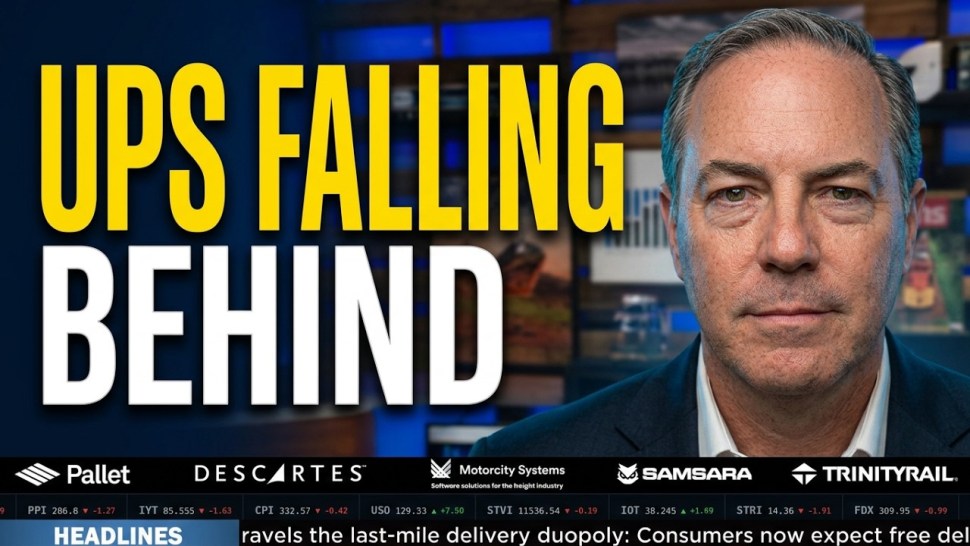
While the freight market shows resilience, UPS earnings paint a different picture, raising questions about Amazon’s impact and the carrier’s restructuring. Meanwhile, truck OEMs like PACCAR are reporting strong performance, indicating robust demand and favorable pricing ahead. Christopher Versace breaks down the Q2 earnings season in logistics and transportation.
UPS stock sold off after the parcel giant declined to guide its domestic business meaningfully higher for the second half of the year — a notable omission given resilient consumer demand and robust freight volumes across the broader market. Chris Frusciante, portfolio manager at TheStreet Pro and chief investment officer at Tematica, said the company’s restrained outlook stands out as a red flag relative to what the rest of the industry is reporting.
The Amazon overhang remains the central concern. Amazon’s earlier announcement that it is moving into business freight and delivery through its Flex service has raised fresh questions about UPS’s long-term volume trajectory. UPS attempted to frame its second-quarter results by arguing that, excluding volumes it intentionally ceded to the market, it actually grew. Frusciante was unimpressed. “If UPS is saying, oh, on an adjusted basis, if we strip this out, strip that out, you know, oh, we would have done this, that’s not really what happened,” he said. “And I think that’s kind of trying to, as some might say, put lipstick on a pig.”
“UPS is not exactly guiding for a much stronger second half of the year compared to the first half. That’s a little worrisome to me.” — Chris Frusciante, portfolio manager at TheStreet Pro
While UPS stumbles through what Frusciante described as a prolonged restructuring — punctuated by divestitures including the sale of brokerage unit Coyote — the broader trucking sector is telling a different story. Old Dominion reported an operating ratio of 70, and Werner Enterprises CEO Derek Leathers characterized the freight cycle as being in the third inning, citing a tight driver market as a natural cap on capacity growth.
PACCAR stood out as the clearest bright spot. The Kenworth and Peterbilt parent reported 105,000 heavy trucks delivered in the first half of the year and guided for 145,000 in the second half — a roughly 38% sequential increase. Frusciante said filling order slots and incremental pricing power prompted him to raise his price target on PACCAR shares. “Tight capacity, demand, pricing, better margins, better earnings potentially in the second half of the year,” he said, summarizing the bull case.
The 2027 EPA engine mandate is shaping OEM strategy heading into next year. PACCAR signaled it plans to continue selling current engines through 2026 and gradually phase in compliant 2027 powertrains to avoid a sharp pre-order cliff. Frusciante noted the timing of PACCAR’s annual model reveal — whether early or late in the first quarter — will determine how long 2026 engines remain available. Rising capital expenditures at carriers including Werner and TFI point to a mix of fleet replacement and pre-buy activity ahead of the mandate.
On the carrier side, the tight driver market is constraining capacity expansion and supporting rates. Veteran drivers at well-run fleets typically receive new equipment first, with one trucking operator on the panel noting a goal of keeping average fleet age below two years. That discipline, combined with incremental demand, is expected to support margin improvement across the sector in the back half of 2025.
- UPS declined to guide domestic volumes meaningfully higher for H2, unsettling Wall Street despite resilient consumer freight demand and Amazon competitive pressure.
- PACCAR guided for 145,000 heavy truck deliveries in H2, up from 105,000 in H1, prompting Frusciante to raise his price target on the stock.
- The 2027 EPA engine mandate is driving a pre-buy cycle; PACCAR plans to smooth production by gradually phasing in compliant engines rather than abruptly cutting off 2026 models.
Speaker 1 [0:00] Welcome back to FreightWaves Today. It is earnings season. We’re on a roll, not just the railroads. We have OEM earnings. We’ve got big transport earnings. And the person to break it down for us is Chris Frusciante. He is the portfolio manager at TheStreet Pro. He’s the chief investment officer at Tematica. Chris, welcome to FreightWaves Today. Second, by the way—
Speaker 2 [0:24] Nice to be back, fellas.
Speaker 1 [0:26] Welcome back. Thank you.
Speaker 2 [0:29] Thanks for having me back.
Speaker 1 [0:30] Let’s talk earnings. UPS has reported. Their stock sold off. I think some of it was guidance. Obviously, the Amazon story has been overhanging their stock. What’s your general sense of UPS right now?
Speaker 2 [0:43] Well, UPS to me has been a tough one to contemplate owning as an investor. Having said that, I get packages all the time, you know, but from an investor, you know, we have to always assess a few things. One is the competitive landscape. Clearly Amazon, not only on the retail side, but the Flex that it announced earlier this year by moving into business freight and delivery, that’s raised a lot of questions. And when we talked about UPS’s earnings, they didn’t really guide the back half of the year higher for the domestic business, which is kind of counterintuitive if you think about it, given what we’re seeing in terms of the consumer being resilient, the lead-up to the holiday shopping season, and just overall demand for freight. So it’s a bit of a puzzle to me.
Speaker 1 [1:36] And it’s just, I guess, so much— it’s just, it’s hard right now knowing all the different impacts, the regulatory environment, container flows are really robust compared to where they’ve been. I think our data actually channel checks say that the consumer is doing quite well. At least the freight part of the consumer supply chain is doing quite well. But it looks like this Amazon story with UPS, it feels like that’s the biggest factor. Chris, am I reading that incorrectly?
Speaker 2 [2:03] Yeah, I think that’s right. I mean, you have to remember too that UPS has kind of been a restructuring story. And, you know, a lot of folks are still waiting for the payoff in that to the extent that it is taking longer than expected or these other competitive challenges that we’re talking about are going to take it— make it even longer to show progress that people are hoping to see. I think that’s really what’s weighing on the shares and really the company’s business. To me, it’s very much a wait and see. But at the same time, given the seasonal dynamics, especially in the consumer freight delivery business or consumer package delivery business, to the extent that Amazon is taking more share out of UPS, Flip it around, UPS is not exactly guiding for a much stronger second half of the year compared to the first half. That’s a little worrisome to me.
Speaker 1 [2:57] Yeah, it is interesting. We do a lot of channel checks, not only on the show, but certainly on the show. Consumer, the freight market, at least the channel checks that we’ve gotten, the interviews have all talked about how robust it is. But it was like a UPS story. I think you talked about the fact that it is a sort of, I wouldn’t call it a turnaround, but a restructuring post-Amazon. As well as when Carol has come in and divested a lot of their businesses, Coyote, which we’ll hear from RXO in a couple of weeks about how they’re performing. I guess that is next week. Oh my gosh, I can’t believe we’re the last week of July.
Speaker 3 [3:32] We have a guest from RXO tomorrow too.
Speaker 1 [3:34] Yeah, we have a lot of guests.
Speaker 3 [3:36] Yeah, I agree, Chris, with what you said regarding— I think they tried to do damage control by saying if you ignore Amazon and the volume we intentionally made available to the market, we actually grew our volume in the second quarter. But then just the 3rd quarter outlook felt so weak that it felt like a little bit of a—
Speaker 1 [3:53] Was that weakness just by Wall Street’s expectations because everybody else had been so robust, Chris? Or was this a weakness that they actually felt across their network?
Speaker 2 [4:01] I think it’s a little bit of both. And the point about blah, blah, blah, but the reality is that you can talk about underlying strength, but relative to what Wall Street is looking for, it’s the overall numbers that really matter most. So if UPS is saying, oh, on an adjusted basis, if we strip this out, strip that out, you know, oh, we would have done this, that’s not really what happened. And I think that’s kind of trying to, as some might say, put lipstick on a pig. Not exactly what you want to hear. But again, you know, the outlook wasn’t quite as robust as Wall Street was looking for. I will say, that a lot of what we’re seeing in the larger stock market today is companies that are even putting up good numbers, maybe falling short of some of those whisper expectations that the market might have had given the run-up in the overall stock market from earlier this year, certainly off the April lows. And I think to the extent that companies are not able to deliver not only a beat for the quarter they’re reporting, but a raise That is weighing on shares. And I think we’re seeing some of that play out in the shares of UPS.
Speaker 1 [5:11] Well, the market got so elevated. And even the transportation, the truckers, have one of the best— up until really the last month or so, best performing sector, one of the best performing sectors. I mean, truckers specifically, which we haven’t been able to say that in a long time, just how strong things are.
Speaker 3 [5:29] Well, even ARK Best, after their report of the OR that we talked about at 70, their stock fell.
Speaker 1 [5:34] You mean Old Dominion?
Speaker 3 [5:35] Oh, I’m sorry.
Speaker 1 [5:35] Old Dominion.
Speaker 4 [5:36] Although we are going to talk about ARK Best.
Speaker 1 [5:39] Old Dominion, Chris, 70OR. I mean, everyone in transportation and trucking looks good. Old Dominion looks best. They did look best.
Speaker 2 [5:49] Well, I mean, so I have to be honest, I haven’t dug deep into that report. What I can say is this, is that we are seeing demand from the rails be very strong. We are seeing tight capacity utilization for the truck fleets. And there are some very specific reasons for that, both demand side and supply side. But at the same time, we’re also seeing, and this is something that we touched on the last time I was on, we are seeing OEMs and owner operators open up their wallets for replacing, you know, heavy trucks. You take a look at what PACCAR said the other day, you know, 105,000 heavy trucks in the first half of the year, 145,000 expected for the second half. of the year. That’s a big jump. So I do think that while we are talking about areas of, you know, some call it frustration, other areas where companies may not be achieving what was expected, there are others, and I would put PACCAR in this camp, that the outlook continues to look very favorable into the back half of the year.
Speaker 1 [6:59] So Chris, I get, you know, I want to bring my dad in. He’s bought more trucks than all of us combined. PACCAR is Kenworth, Peterbilt is really the portfolio there. What in this market— whom do you think of the OEMs that has the best product lineup? Does PACCAR have the right product lineup for this market? Or do you think that Daimler or Volvo are better positioned, or International?
Speaker 4 [7:30] I think they’re all positioned pretty well for this type of market. But, you know, PACCAR has been pretty innovative in a lot of their products, you know, especially having Peterbilt, which a lot of truckers think is probably one of the better driver-type trucks in the market. Kenworth has been pretty innovative in a lot of their fuel economy.
Speaker 2 [7:52] Yeah.
Speaker 4 [7:53] But PACCAR is a very strong company. You know, they bring a lot to the industry and they’ve helped redefine this industry Quite a bit over the last probably 30, 40 years. That doesn’t mean Freightliner and Volvo are very strong too, though.
Speaker 1 [8:10] You mean that they are very strong?
Speaker 4 [8:11] They are very strong.
Speaker 1 [8:12] Chris, any thoughts on that?
Speaker 2 [8:14] You know, I’m just going to say what he said, pretty much.
Speaker 1 [8:18] Well, our audience, especially on X, has an opinion on what they call plastic trucks. And they’re really knocking the Freightliner trucks because they like the whole They like to go old. The old Peterbilt is the deal. I’m personally— I think Mack has got the best looking truck on the road. But nobody asked my opinion on which truck to get.
Speaker 2 [8:37] And yet nobody’s mentioning a name from the past known as Western Star.
Speaker 1 [8:41] Yeah.
Speaker 4 [8:42] Yeah.
Speaker 1 [8:44] So it is— I mean, it is interesting just how all of the OEMs are coming in with real strong guides. How much of this, Chris, is the pre-buy, or how much of it is— Are you getting a sense that this is replacement or expansion?
Speaker 2 [8:58] I think it’s a little bit of both, obviously. You know, the pre-buy is something that we’re gonna be talking about over the next several months, you know, and PACCAR, I thought, had an interesting comment about the way— how the way they’re gonna attempt to try and smooth out the pre-build into 2027. We’ll see how that happens. But at the same time, if we listen to, you know, rising CapEx levels from some of the logistic companies, Werner, for example, TFI, you know, it speaks to them them, you know, replacing existing capacity potentially for ones that are, you know, more fuel efficient and obviously ahead of that mandate. So again, I think it’s a little bit of both.
Speaker 3 [9:38] So I did think I read that as well, and I thought that was a really interesting comment, the way they talked about to dig into the EPA mandate a little bit more, that they’re going to continue selling their current engines through 2026 and then gradually phase in the compliant 2027 engines because they don’t want to have that pre-order cliff.
Speaker 1 [9:52] Are they allowed to sell if they have a ’26 engine in stock? Are they allowed to sell it into ’27, or do they have to actually Do they have to actually have the 27 engines when that goes into effect?
Speaker 2 [10:03] Yeah, my understanding is that the cutoff point is when they— or historically it’s been when they introduce the new model year. And I think PACCAR tends to have, in particular PACCAR tends to have an annual event where they reveal the new model. And I think that’s when it is. The question is, is that early in the first quarter, late in the first quarter, or do they push it even to a little bit later in order to accommodate maintaining the 2026 engine for a little further.
Speaker 1 [10:33] Now, what are you expecting beyond obviously the emissions? Any cool technology that the OEMs are talking about, or is this going to be a year that the drivers themselves are going to be a little disappointed in their product rollout?
Speaker 2 [10:43] I think primarily the drivers from an industry order, industry delivery mechanism is going to be more influenced by that EPA mandate than anything else. I’m sure we’ll see some incremental new features, but I haven’t seen anything that is Jumping out at me that says, “Wow, this this is cool.
Speaker 1 [11:05] This is the new toy, right?
Speaker 2 [11:07] Right, right. That this is cool. This is the must have. This is what’s gonna you know if this was the iPhone, we’d be talking about oh what’s gonna drive the upgrade cycle. I I haven’t seen anything out there that jumps at me to that degree.
Speaker 1 [11:20] Although Chris, much like the OEMs, Apple’s gotten criticized because their release feels like much of the same. In fact, Steve Jobs’ daughter is a great. tweet a couple of years ago where she’s like, this is exactly— like, all the features are the same. Dad, when you look at OEMs rolling out things, obviously, you’ve got the new engines. But is there anything that you got really excited about? Like, what was that like when they would do new features? What were the things that you were looking for? Was it more fuel economy? Obviously, it’s important. Total cost of ownership. Was there anything that you’re like, whoa, that would be amazing?
Speaker 4 [11:53] Well, total cost of ownership is probably the number one.
Speaker 1 [11:57] Yeah.
Speaker 4 [11:57] Because you have to be able to afford it. Number 2 is, you know, when you’ve got a truck that gets better fuel economy or a truck that basically has a better ride for the driver, better safety. I mean, there’s a blend of things that you’re looking for when you buy a truck.
Speaker 1 [12:13] Very different than consumers buy cars. I’m a pilot, and if you’ve looked at a Cessna 172 from 1960, it looks the same. And so the joke is, Seston’s going to release the same thing. If they upgrade the upholstery in the airplane, that’s an innovation for Tesla.
Speaker 2 [12:29] So—
Speaker 3 [12:30] I’m sorry.
Speaker 1 [12:30] Go ahead, Chris.
Speaker 2 [12:31] I was going to say it’s all about those creature comforts. The one thing I didn’t hear your dad mention is kind of the setup for the driver in the back. I think to the extent that there can be some incremental room or other creature comforts, I think that’s a plus.
Speaker 4 [12:44] Yeah, for sure.
Speaker 3 [12:45] So did anything else stand out in PACCAR’s earnings to you, Chris, that we haven’t touched on?
Speaker 2 [12:50] Just the fact that production levels are poised to go higher, that The build level, if you look at it, the slots are really filling up for the balance of this year. And I think that bodes well for some incremental pricing, which in my opinion, you know, when we tie it together with rising volumes and better pricing, that’s great for margins in the back half of the year. That and the reason I talk about this is we took our price target up on PACCAR shares because of that incremental profit expectation in the back half of the year. So I am very bullish on those shares.
Speaker 1 [13:28] Chris, Derek Leathers, the CEO of Werner, talked about how tight the driver market is, how difficult it is to find qualified drivers that can meet the standards. And that’s really putting a cap on capacity growth. And he thinks that we’re in the 3rd inning. Obviously, there’s 9 of those, which I think is promising for the cycle. Dad, when you’re hiring drivers, when you have a tight market, how much is new truck important? So that’s important to attract drivers. And do the new drivers get the new trucks or does it go to the more veteran drivers to retain them?
Speaker 4 [13:58] Well, usually your veteran drivers get the new trucks first, you know, and new drivers come in, they get the older trucks. But you’ve got to have a fleet that’s relatively new anyway. We try to keep our average age below 2 years. Yeah. Yeah. Which basically meant you didn’t have hardly anything over 4 years old. But at the same time, Drivers always like getting the new equipment, especially a lot of the new technologies that were coming out.
Speaker 1 [14:26] Yeah, for sure.
Speaker 4 [14:26] Made their jobs a lot easier, a lot more comfortable in the process.
Speaker 1 [14:30] Chris, any closing thoughts on earnings? TFI’s earnings, Old Dominion Art Gas?
Speaker 3 [14:35] So many.
Speaker 1 [14:35] I mean, like, it is the problem of this week is it just one after another after another.
Speaker 2 [14:39] Well, that’s so— that’s a problem for some. For me, that’s great because you get to sit back, kind of connect the dots. And piece it all together for— and that helps kind of improve the outlook for the back half of the year, greater clarity in other words. So the one thing I would say just to touch on is as long as the industry remains— has tight capacity, excuse me, and we do see some incremental demand, I think that’s going to allow for more favorable pricing. And if you just take my comments for PACCAR and follow it through, tight capacity, demand, Pricing, better margins, better earnings potentially in the second half of the year.
Speaker 1 [15:17] Well, it feels like we’re really in the third inning. Companies can improve. We’ll see how good Old Dominion can make that $70. Appreciate it, Chris. Thanks for joining us. Always great to get an update as we have earnings.
Brokerage Compliance Symposium
The day before F3. Every compliance issue you face - fraud exposure, carrier liability, FMCSA rules, cargo theft, insurance gaps - navigated by attorneys and operators defining best practices in a changing industry.
F3 Awards Dinner
The night before F3. FreightTech100 companies honored. FreightTech 25 and Shipper of Choice winners revealed live. Cocktail reception into dinner and live music - 300 industry leaders in one purpose-built room.
F3: Future of Freight Festival
Industry-defining keynotes, rapid-fire technology demos, and industry leaders networking in experiences across Chattanooga - plus the inaugural F3 Awards Dinner featuring the FreightTech and Shipper of Choice reveals.
The day before F3. Every compliance issue you face - fraud exposure, carrier liability, FMCSA rules, cargo theft, insurance gaps - navigated by attorneys and operators defining best practices in a changing industry.
The Signal at Chattanooga Choo Choo • Chattanooga, TN Register NowThe night before F3. FreightTech100 companies honored. FreightTech 25 and Shipper of Choice winners revealed live. Cocktail reception into dinner and live music - 300 industry leaders in one purpose-built room.
The Signal at Chattanooga Choo Choo • Chattanooga, TN Register NowIndustry-defining keynotes, rapid-fire technology demos, and industry leaders networking in experiences across Chattanooga - plus the inaugural F3 Awards Dinner featuring the FreightTech and Shipper of Choice reveals.
The Signal at Chattanooga Choo Choo • Chattanooga, TN Register Now