




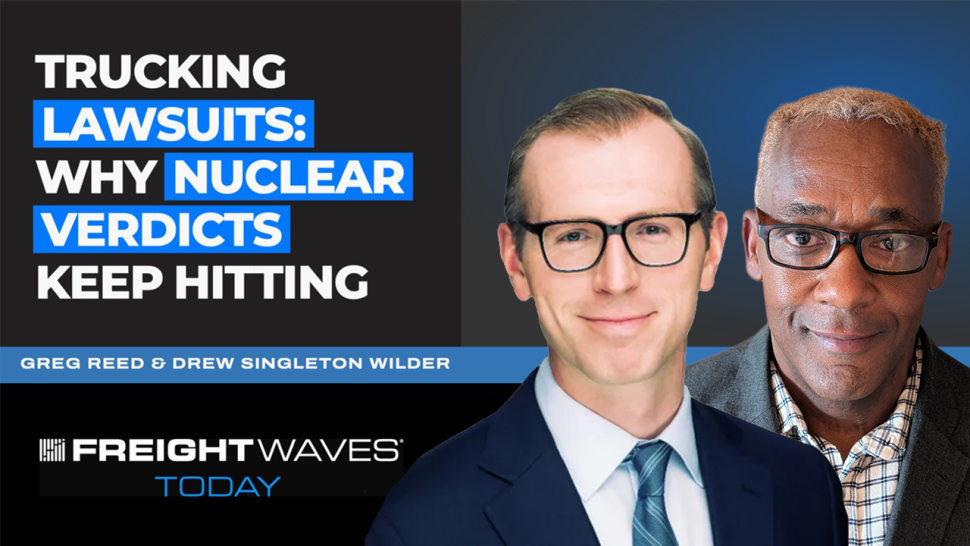
Nuclear verdicts in trucking are reshaping carrier risk, insurance costs and courtroom strategy. In this FW Today roundtable, Greg Reed of Hanson Bridgett and Drew Singleton Wilder of Vicarious Liability Risk Management break down what fleets, brokers and trucking leaders need to know. The panel digs into liability exposure, litigation trends and how the legal climate is changing the cost of doing business across freight. #Trucking #NuclearVerdicts #FreightWaves
The legal firewall that once protected freight brokers under Federal Aviation Administration Authorization Act preemption has largely eroded, and the industry is still grappling with what comes next. In the wake of the Montgomery and Lopez Superior decisions, brokers face direct liability exposure for carrier selection — and that exposure may be traveling upstream to the compliance technology platforms brokers use to vet carriers.
Drew Singleton Wilder, founder and CEO of Vicarious Liability Risk Management, warned that the post-Montgomery landscape has generated a surge of discussion about tightening carrier contracts but not nearly enough scrutiny of the technology intermediaries doing the actual vetting. “There has not been a lot of discussion about actually vetting the third-party compliance administrators,” Wilder said, pointing to platforms such as Highway and RMIS as examples of entities whose accuracy and insurance coverage warrant the same due diligence as the carriers themselves.
Greg Reed, a partner at Hanson Bridget, noted that the liability calculus is complicated by deeply asymmetrical contractual relationships. Shippers contract with brokers but not carriers; brokers contract with third-party data platforms but not insurers; carriers have no direct relationship with the platforms judging their compliance. Reed argued that information gaps created by those disconnected relationships — including changes in a carrier’s insurance status — may not reach brokers or platforms quickly enough to prevent a bad carrier selection.
“If we look out across other industries and across the nation, there is currently no federal or state statutes or regulations governing B2B sort of data broker relationships,” Reed said, contrasting the gap with consumer protections under the Fair Credit Reporting Act. “The recourse, if you will, for accountability for a broker who maybe relies upon a decision by a third-party solution and then finds itself on the wrong end of a lawsuit is time-consuming, it is uncertain, and it’s expensive.”
The discussion surfaced a pointed practical problem: if brokers want indemnification from platforms like Highway or RMIS for data errors that contribute to litigation, those platforms are unlikely to provide it. Reed noted that a mid-sized broker’s annual contract with a vetting platform typically runs $40,000 to $100,000, while large brokers managing billion-dollar books spend only a few hundred thousand dollars a year on such tools — sums far too small to underwrite the litigation exposure a single nuclear verdict can create. A Lopez Superior jury returned a $604 million award against a carrier that held a satisfactory FMCSA safety rating at the time of the accident, Reed noted.
Wilder cautioned that brokers treating third-party vetting platforms as an “easy button” are misreading the post-Montgomery liability framework. He argued that brokers must build rigorous, documented internal carrier-selection criteria that integrate — but do not simply defer to — whatever third-party platforms recommend. He also raised a cascading-risk concern: when one platform flags a carrier negatively, whether correctly or not, that judgment can ripple across a broker’s network and then across the broader transportation market, quietly constraining available capacity and pushing up pricing.
Wilder said the deeper fix likely requires tort reform, though he acknowledged that prospect is remote. In the near term, he and Reed agreed that brokers should consult their commercial insurance agents now to determine whether existing policies will respond if a third-party vetting platform’s data leads to a covered loss — and whether AI-related exclusions could leave them exposed. Reed added that broker margins of roughly 12% to 16% of the transaction should be sufficient to absorb higher insurance costs, even if premiums rise significantly, framing proper coverage not as optional but as a cost of doing business in the current legal environment.
- The post-Montgomery and Lopez Superior decisions have eliminated much of brokers’ FMCSA preemption shield, extending potential liability to carrier-vetting technology platforms like Highway and RMIS.
- A $604 million verdict in the Lopez Superior case involved a carrier with a satisfactory FMCSA safety rating, illustrating that regulatory compliance scores alone are insufficient protection.
- Brokers are advised to build documented in-house carrier-selection protocols and verify whether their insurance policies cover losses tied to third-party vetting platform errors, including AI-related mistakes.
This Summary is generated thanks to a transcription of the interview, for the full interview please enjoy the video above.
Brokerage Compliance Symposium
The day before F3. Every compliance issue you face - fraud exposure, carrier liability, FMCSA rules, cargo theft, insurance gaps - navigated by attorneys and operators defining best practices in a changing industry.
F3 Awards Dinner
The night before F3. FreightTech100 companies honored. FreightTech 25 and Shipper of Choice winners revealed live. Cocktail reception into dinner and live music - 300 industry leaders in one purpose-built room.
F3: Future of Freight Festival
Industry-defining keynotes, rapid-fire technology demos, and industry leaders networking in experiences across Chattanooga - plus the inaugural F3 Awards Dinner featuring the FreightTech and Shipper of Choice reveals.
The day before F3. Every compliance issue you face - fraud exposure, carrier liability, FMCSA rules, cargo theft, insurance gaps - navigated by attorneys and operators defining best practices in a changing industry.
The Signal at Chattanooga Choo Choo • Chattanooga, TN Register NowThe night before F3. FreightTech100 companies honored. FreightTech 25 and Shipper of Choice winners revealed live. Cocktail reception into dinner and live music - 300 industry leaders in one purpose-built room.
The Signal at Chattanooga Choo Choo • Chattanooga, TN Register NowIndustry-defining keynotes, rapid-fire technology demos, and industry leaders networking in experiences across Chattanooga - plus the inaugural F3 Awards Dinner featuring the FreightTech and Shipper of Choice reveals.
The Signal at Chattanooga Choo Choo • Chattanooga, TN Register Now