




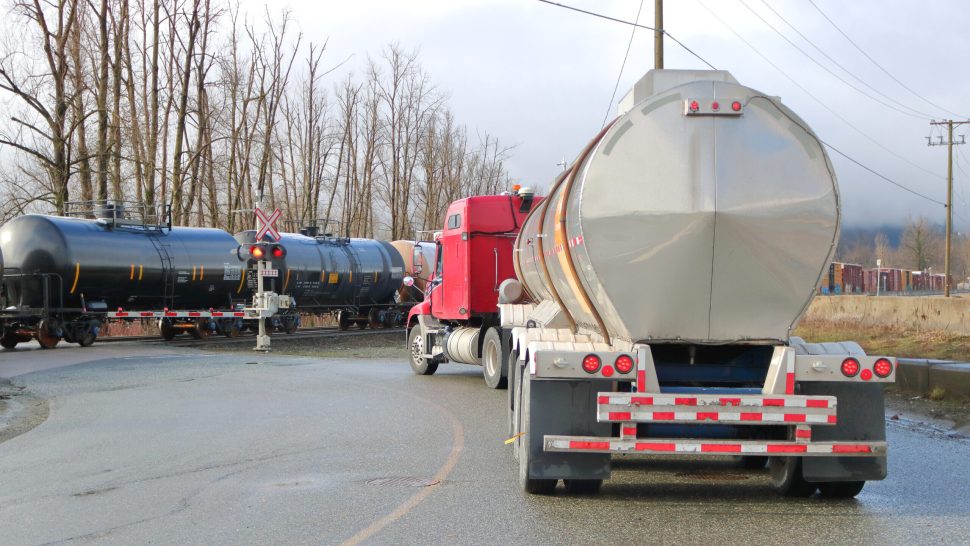
WASHINGTON — The railroad industry is warning that collisions between trains and trucks potentially could increase if regulators allow trucks hauling hazardous materials to drive through certain types of grade crossings without stopping.
Hazmat haulers and passenger buses are currently exempted from stopping at railroad tracks when the crossing is controlled by a functioning highway traffic light with a green signal, or a police officer is directing traffic to proceed through.
If finalized, FMCSA’s proposal – which is supported by the American Trucking Associations and the Owner-Operator Independent Drivers Association – would add a similar exception for rail crossings that have functioning warning devices such as lights and crossing gates but are not activated.
“FMCSA believes it would be appropriate to permit a CMV [commercial motor vehicle] to proceed through an active warning device equipped railroad grade crossing without stopping where the warning device is not in activated state, because local law allows vehicles to proceed across the railroad tracks without slowing or stopping,” the agency stated in the proposed rule.
“This would add an additional exception and therefore reduce the number of required stops” for trucks and buses, it noted.
Like ATA and OOIDA, which highlighted the potential for improved traffic flow, the National Tank Truck Carriers, whose members transport hazardous materials, also supports the proposed rule.
The association pointed out that the likelihood of a collision between a tank truck and a locomotive at grade crossings “is substantially lower than the likelihood of a rear-end collision between a tank truck and another motorist at the same grade crossing” when the truck is stopping or is fully stopped.
“By eliminating unnecessary stops, this reform would prioritize highway safety with the added benefits of delay reduction and congestion mitigation.”
But while there could be cost savings for trucks and other vehicles associated with improved traffic flow, “it does not appear that FMCSA considered the full impact of the change to the railroad industry from increased highway-rail collisions” with trucks and buses that would not have occurred if the vehicle had stopped before attempting to cross the track, wrote the Association of American Railroads and the American Short Line and Regional Railroad Association, in joint comments filed with the agency.
“These costs could be substantial because introducing a change in behavior for some crossings increases the potential for human error.”
They also emphasized that truck drivers approaching highway-rail grade crossing will not always know if the crossing has active warning devices.
“Requiring vehicles to stop provides commercial drivers with extra time to react to unexpected situations, such as a train approaching rapidly around a curve or other vehicles behaving unpredictably around the crossing,” the railroad groups asserted.
The proposal also received pushback from several rail unions, including the Brotherhood of Railroad Signalmen (BRS), which represents workers who install and repair grade crossing signal systems.
“FMCSA’s proposed rule prioritizes speculative data over proven, life-saving practices,” wrote BRS President Michael Baldwin in comments filed with FMCSA. “There is no reliable data supporting the removal of the stop requirement, and a single error, technical or human at a crossing can result in mass fatality events involving children or hazardous materials.”
The Commercial Vehicle Safe Alliance (CVSA), which represents state and local law enforcement, was concerned with the potential for increased crash risk between trucks and trains that the new exception would introduce at grade crossings equipped with active warning devices but are not working properly or are out of order.
Unlike the current exception that gives notice that it is safe to proceed either by a green traffic signal or a human being, “the active warning devices provide notice when it is unsafe to proceed, and there is no active confirmation of safety when those systems are not functional,” CVSA stated.
“Unfortunately, because these CMVs are currently required to stop at grade crossings equipped with active warning devices, there is no readily available crash data related to incidents where a crash occurred due to a malfunctioning warning device.”
Related articles:
Brokerage Compliance Symposium
The day before F3. Every compliance issue you face - fraud exposure, carrier liability, FMCSA rules, cargo theft, insurance gaps - navigated by attorneys and operators defining best practices in a changing industry.
F3 Awards Dinner
The night before F3. FreightTech100 companies honored. FreightTech 25 and Shipper of Choice winners revealed live. Cocktail reception into dinner and live music - 300 industry leaders in one purpose-built room.
F3: Future of Freight Festival
Industry-defining keynotes, rapid-fire technology demos, and industry leaders networking in experiences across Chattanooga - plus the inaugural F3 Awards Dinner featuring the FreightTech and Shipper of Choice reveals.
The day before F3. Every compliance issue you face - fraud exposure, carrier liability, FMCSA rules, cargo theft, insurance gaps - navigated by attorneys and operators defining best practices in a changing industry.
The Signal at Chattanooga Choo Choo • Chattanooga, TN Register NowThe night before F3. FreightTech100 companies honored. FreightTech 25 and Shipper of Choice winners revealed live. Cocktail reception into dinner and live music - 300 industry leaders in one purpose-built room.
The Signal at Chattanooga Choo Choo • Chattanooga, TN Register NowIndustry-defining keynotes, rapid-fire technology demos, and industry leaders networking in experiences across Chattanooga - plus the inaugural F3 Awards Dinner featuring the FreightTech and Shipper of Choice reveals.
The Signal at Chattanooga Choo Choo • Chattanooga, TN Register Now