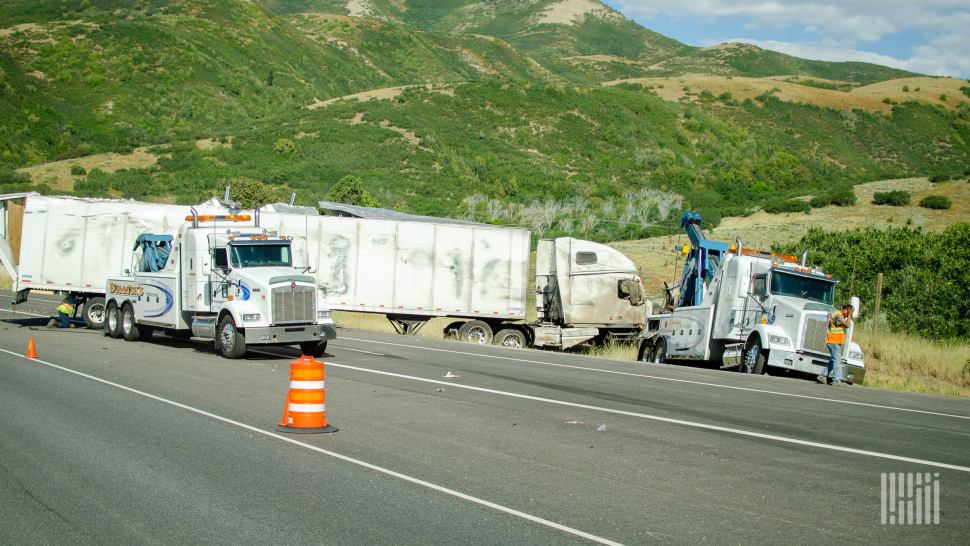
In a $1 million settlement, James Richardson of Chicago couldn’t collect a dime.
Richardson was seriously injured in a crash at 53rd Street and Western Avenue when Night Dream Inc.’s truck slammed into him. The case settled. The release was signed. The documents were delivered. But Spirit Commercial Auto Risk Retention Group, the insurer behind Night Dream’s policy, had already been placed into permanent receivership by a Nevada court. Spirit was insolvent. Because Spirit was a Risk Retention Group rather than a traditional insurance company, Richardson had no access to state insurance guaranty funds in Nevada or Illinois.
He had a judgment. He had a settlement. He had nothing.
A year later, Global Hawk Risk Retention Group collapsed in Vermont, leaving 1,008 commercial trucks “effectively uninsured.” Its president had embezzled $19 million. He pleaded guilty to federal fraud charges. The Vermont insurance commissioner said the company was “so deeply insolvent that the vehicles are effectively uninsured.” Crash victims and creditors were told to file proofs of claim and await a distribution of Global Hawk’s assets, “possibly years from now.”
Combine that guaranty fund gap with the fastest-growing fraud vector in American trucking: chameleon carriers. Networks of affiliated companies shuffling trucks across DOT numbers, spreading risk across shell entities, and diluting accountability until there’s nothing left for the family standing in a courtroom asking who’s going to pay.
This is how the system breaks.
What Is a Risk Retention Group?
A Risk Retention Group is a liability insurance company owned by its members. Authorized under the Federal Liability Risk Retention Act of 1986, RRGs allow businesses with similar risk profiles to pool their resources and self-insure. They’re chartered in one state and can operate nationwide without obtaining separate licenses in each state where they do business.
In theory, that’s a reasonable model. In practice, it depends entirely on who’s running the show.
The structural problem that matters to every person sharing a highway with a truck is that RRGs are federally prohibited from participating in state insurance guaranty funds. Under 15 U.S.C. § 3902(a)(2), no RRG can join, contribute to, or benefit from any state guaranty fund. Every policy issued by every RRG in America must include a notice: “State insurance insolvency guaranty fund protection is not available for your risk retention group.”
Translation: if the RRG goes under, crash victims are on their own. There’s no backstop. No safety net. The assets of the RRG constitute the only resources available to pay claims. When those assets are exhausted, the victims bear the loss.
There are 221 Risk Retention Groups operating in the United States today. Vermont alone dominates as the preferred domicile, housing 85 licensed RRGs that collectively wrote $2.92 billion in gross premiums in 2023. The estimated national RRG market across all sectors amounts to approximately $5 billion in annual premiums. Vermont controls nearly 59% of that.
The Insurance Food Chain
Most people hear “insurance” and think it’s one thing. It’s not. In trucking, there’s a hierarchy, and where a carrier lands on that hierarchy tells you almost everything you need to know about how they run their operation. I’ve been saying this for 25 years, and now we have the data to prove it.
We developed a scoring methodology that cross-references 2.84 million insurer-to-carrier relationships in FMCSA filing data with carrier safety performance. Each carrier receives a risk score ranging from 0 to 100 based on five factors: crash history, fatal crash history, out-of-service rates, total violations, and prior revocations. We then map each active insurance filing to the carrier’s risk score and aggregate the scores at the insurer level.
Here’s how the food chain works, from top to bottom:
Sole-member captives and group captives. The Rolls-Royces of trucking insurance. Your Schneiders, your J.B. Hunts, your legacy fleets. They self-insure through a dedicated insurance entity, maintain limits well above the federal minimum, accept on-site loss-control audits, and budget for risk management as a hospital budgets for malpractice prevention. These fleets don’t shop for insurance. They build insurance programs.
Admitted carriers with underwritten programs. Travelers, Great West, the bigger names. They review every file before binding. They inspect your equipment, review your DQ files, and request your training records and telematics data. Premiums are higher because underwriting costs money. But the carriers that purchase this coverage tend to be those that have something to show an underwriter.
Surplus lines and E&S. This is where it gets problematic. E&S exists for risks that the admitted market will not cover. Legitimate uses exist. The problem is when it becomes the default channel for carriers whose safety record is a dumpster fire.
Risk Retention Groups. Member-owned insurance pools are authorized under federal law. Can be excellent, OOIDA’s RRG has served owner-operators for nearly 25 years. Can also be catastrophic; Spirit and Global Hawk proved that. The key difference that matters to crash victims: the absence of state guaranty fund protection. When an RRG fails, there’s no backstop. Zero.
Instant-issue and non-standard. Bottom of the barrel. Online platforms where you get a quote in minutes, a policy in hours, and nothing more than a self-attested application. No inspection. No driver file review. No verification that the three trucks you declared are actually the thirty trucks you’re running. This is where the chameleon carriers live. This is where the fraud breeds.
The Data
Among 1,310 insurers we analyzed, we identified a cluster of 13 insurers that each insure 500 or more carriers, with more than half of their book scoring HIGH or CRITICAL on our safety indicators. Those 13 insurers represent just 0.65% of all insurer-to-carrier relationships in the dataset. However, they account for 6% of all crashes. Six percent of all fatal crashes. Six percent of all injuries across 2.84 million relationships.
A tiny slice of the insurance market is disproportionately connected to the worst safety outcomes in American trucking. That’s not a coincidence. That’s a business model.
And the new-entrant pipeline is even more concentrated. The top 10 insurers for new authority placements account for more than 50% of all new carriers filing for their first insurance policy. The top 20 account for nearly 68%. That means a handful of insurance companies are the gatekeepers for who gets on the highway. And if those gatekeepers are processing applications at speed rather than scrutiny, the gate isn’t functioning.
Our carrier analysis scripts identified 248,384 carriers that experienced a crash within their first year of operation. Of those, 27,722 involved fatalities. Nearly 28,000 people died in crashes involving carriers that had been in business for less than twelve months. That’s not an insurance statistic. That’s a body count.
The RRG Universe By the Numbers
No one has produced a comprehensive risk profile of the trucking RRG market. Not FMCSA. Not the states. Not the National Risk Retention Association. The data didn’t exist in any centralized form. So we built it.
We extracted every RRG-identified insurer from FMCSA’s insurance filing data, matched it against the census, crash, violation, and inspection files, and scored each carrier-insurer relationship using the TruckSafe methodology. The result is the first complete picture of RRG risk concentration in American trucking.
The numbers: 76 RRGs insuring approximately 29,423 unique motor carriers. Those carriers account for 209,854 total crashes, 6,373 fatal crashes, and 116,157 injuries in the FMCSA crash file. All backed by entities that carry zero guaranty fund protection.
The Largest RRGs by Carrier Count

Two names jump off the page. Global Hawk Insurance Company still shows 10,332 carriers in the dataset with 15,457 total crashes and 507 fatal crashes. Global Hawk was liquidated in June 2020. Its president embezzled $19 million and created 512 ghost policies. Federal criminal charges followed. Those 10,332 carriers are the historical book: carriers that, at some point, were covered by an entity whose president was wiring money to the British Virgin Islands while they hauled freight.
Federal Motor Carriers RRG shows 3,768 carriers and 175 fatal crashes. It was liquidated in 2011. Its operator, Thomas Mulligan, went on to form Spirit Commercial Auto RRG the next year. Spirit was placed into permanent receivership in 2019 with $199 million in unpaid losses. The forensic audit conducted by FTI Consulting identified at least $30 million in missing funds. Mulligan also formed a third entity, County Hall RRG, while Spirit was still operating. The same person. Three RRGs. Two insolvencies. No regulatory mechanism stopped it.
RRGs Where the Majority of Carriers Are High-Risk
Among RRGs with 10 or more carriers, 11 have books where more than half their insured carriers score HIGH or CRITICAL on our risk methodology:
American Trucking and Transportation Insurance Company, an RRG, insures 68 carriers, with a 72% high-and-critical rate and 494 fatal crashes, and 16,057 total crashes across its book. Like Red Rock and Mountain Lake below, these are likely large fleet operators running thousands of trucks and millions of miles annually, which produce higher absolute crash numbers than small-carrier books. But the concentration of that exposure within an entity without guaranty fund protection is the point. A single nuclear verdict against one of these carriers could test the RRG’s capital in ways the admitted market’s guaranty fund backstop was designed to absorb.”
Then there are the small-carrier RRGs with catastrophic exposure. Red Rock RRG insures only 4 carriers but reports 28,358 crashes and 825 fatal crashes, the highest fatal count of any RRG in the dataset. Mountain Lake RRG insures 3 carriers with 11,125 crashes and 314 fatalities. These are likely large fleet operators using RRG structures for specific liability programs, but the key point is the concentration of catastrophic exposure in entities without guaranty fund protection.
The Body Count
The trucking RRG sector has already demonstrated what happens when the model fails.
Spirit Commercial Auto RRG | Nevada | Receivership 2019. Placed into permanent receivership on February 27, 2019, by the Eighth Judicial District Court of Nevada. In 2017, Spirit refiled its annual statement and reduced its reported surplus from $13.4 million to $703,000. That’s a $12.7 million downward adjustment in a single restatement. An examination found Spirit had underreported its loss reserves by $26.9 million in 2016 and had negative equity of $14.2 million at year’s end. Total unpaid losses and loss adjustment expenses: $199 million. The Nevada Division of Insurance did not submit the examination report to the NAIC. Operator Thomas Mulligan, through CTC Transportation, previously ran Federal Motor Carriers RRG into insolvency in 2011. FTI Consulting’s forensic audit found at least $30 million missing. Mulligan invested $500,000 of Spirit’s premium trust funds into a cryptocurrency hedge fund called Iterative Capital.
Global Hawk RRG | Vermont | Liquidated 2020. President Jasbir Thandi embezzled over $19 million, including wiring more than $1 million to an entity in the British Virgin Islands. Covered 1,008 trucks, primarily small California carriers. Falsified financial statements overstating assets by tens of millions. Created 512 “ghost policies” that collected no premium and provided no coverage. Federal indictment December 2023. Total liabilities: $23.8 million vs. $3.4 million in assets. Vermont’s top captive regulator, David Provost: “Every RRG insolvency is another black eye on the industry. It’s almost always worse than originally thought.”
Federal Motor Carriers RRG | Delaware | Insolvent 2011. Same operator as Spirit. No regulatory barrier prevented Mulligan from starting a new RRG after the first one failed. He then formed County Hall RRG while Spirit was still operating.
Universal Casualty RRG | New York | Hazardous Condition 2024. Oklahoma Insurance Commissioner Glen Mulready filed a regulatory action styled as a “Suspension Instrument Due to Hazardous Financial Condition.” Revenue under $5 million, fewer than 25 employees. Insures Moondog Freight, a Protrust network entity.
Evolum RRG | Alabama | Active, est. 2024. One year old. “InsurTech” model targeting small carriers. Caps at 50 units per member. Insures Protrust Logistics and MSL Express, both Protrust network entities.
Thomas Mulligan ran Federal Motor Carriers RRG into insolvency in 2011. He then established Spirit Commercial Auto RRG. Spirit underreported its loss reserves by $26.9 million in a single year. Total unpaid losses ballooned to $199 million before Nevada shut it down. The same person failed the same way twice, and there was no regulatory mechanism to stop it. Jasbir Thandi didn’t even bother with mismanagement. He just stole $19 million from Global Hawk while its 1,008-member trucks rolled down American highways backed by falsified financials.
Both Spirit and Global Hawk shared a common operational model: MGA-driven RRGs that churned small trucking carriers through the membership for fee revenue, with minimal underwriting discipline and no meaningful loss control engagement.
The Chicago Insurance Exodus
What’s happening right now in the Chicago trucking insurance market is a five-alarm fire that nobody outside the broker community is talking about.
Chubb, one of the largest property and casualty insurers on the planet, is reportedly non-renewing its commercial trucking book through the legacy ACE program in the greater Chicago area. The word from brokers on the ground is that Chubb ran what the industry calls an “annual VIN recorder” program. A carrier could declare 30 vehicles at binding, add 250 trucks throughout the policy year, and only true up the premium at the annual audit.
Think about what that means. You’ve got a policy covering 30 VINs. You run 250 trucks. Two hundred and twenty of those trucks are operating on your authority but aren’t on the schedule. If one of those unscheduled trucks turns a family into a funeral, the insurer has a declination argument. The coverage was never real for those vehicles. But the MCS-90 was filed. The FMCSA database shows “active insurance.” Everything looks compliant to a broker, a shipper, or a cop at a weigh station.
Reportedly, brokers in the space told Chubb it was hemorrhaging money. So it’s leaving. Not just non-renewing the bad actors. Non-renewing everybody through that book. AmTrust and its subsidiary Wesco are reportedly following the same path out the door. Notice I said reporting.
Our data backs it up. ACE Property and Casualty reported 328 carrier relationships in Illinois with an average risk score of 31.4. American Inter-Fidelity Exchange runs 331 Illinois carriers at 34.0. State National Specialty holds 651 carrier relationships in Illinois at 28.4, the largest high-risk book in the state by carrier count.
When names like these leave, the carriers who were in those programs don’t stop needing insurance. The trucks don’t park themselves. The freight still needs to move. The business flows downhill. From admitted carriers with guaranty fund backing and capital requirements, to MGAs, surplus lines, and RRGs.
Illinois: Ground Zero
Illinois has 893 unique motor carriers insured by RRGs in the dataset, with 208 at HIGH risk, 143 at MODERATE risk, and 590 at LOW risk. Those carriers account for 5,659 total crashes. The average authority age for an Illinois RRG-insured carrier is 8.6 years, significantly younger than the national RRG-insured average of 11.2 years.
Twenty-four different RRGs operate in Illinois. Here’s how they stack up:

Compass Specialty Insurance RRG dominates the Illinois high-risk picture. Of its 348 nationwide carriers, 211 (60.6%) are in Illinois. Among those 211, 89 are classified as HIGH risk. The Illinois book carries an average risk score of 19.0 with 1,615 total crashes. This is not a national RRG that happens to have Illinois carriers. This is an Illinois RRG with a national footnote.
A-One Commercial Insurance RRG is the largest RRG by carrier count in Illinois, with 402 carriers, although its average risk score is lower at 9.9. Still, 57 of those carriers are HIGH risk. A-One’s national footprint is California-heavy (2,626 carriers), but Illinois is its fourth-largest state.
When Chubb, Wesco, and AmTrust leave, the carriers they shed don’t improve. They need coverage. Compass Specialty, with its 60% Illinois concentration and 89 high-risk carriers already in the state, is effectively the catch-all for the Chicago trucking market’s worst risks. Compass has no guarantee fund protection.
The New-Entrant Pipeline
New-entrant carriers, those under 18 months old, are the highest-risk cohort in the FMCSA universe. They have the least history, the fewest inspections, and the thinnest safety records. They’re also the carriers most likely to be chameleon reincarnations of previously shut-down operations.
The new-entrant pipeline is concentrated among a handful of RRGs:

Star Mutual RRG leads the pipeline with 461 carriers under 18 months old out of 2,803 total carriers, a 16.4% new-entrant rate. Brooklyn Specialty Insurance Company RRG insures 3,713 carriers in total, of whom 919 are under 3 years old. Its membership is overwhelmingly concentrated in Florida: 2,873 carriers, accounting for 77% of its book, with the youngest average authority age of any major RRG at 4.8 years.
The new-entrant risk scores are low now. They should be; these carriers haven’t yet accumulated violations. The question is what these books look like in 24 months, and whether the RRGs underwriting them have the reserves to absorb what’s coming.
The Protrust Thread
This is where the RRG story connects directly to the chameleon carrier investigation that launched this series.
One of my suspect Chameleon investigations identified an 11-entity carrier network operating from residential addresses across the Chicago suburbs, controlled by at least seven members of a single extended family. The network operates under a self-described “Protrust Trucking Group.” It’s declared CEO’s Instagram bio lists six affiliated companies.
The investigation began when an industry source observed trucks being physically rebranded from one carrier name to another within a matter of days. FMCSA data, Illinois Secretary of State records, and fleet monitoring platforms revealed 46 vehicles previously operated by other entities within the network, 10 simultaneously operated across multiple DOT numbers, and 27 subsequently transferred to other network entities. Multiple entities are registered at a single-family residence, an apartment, and a licensed massage therapist’s home office.
The insurance picture is where the systemic risk gets real:

Three different insurers. Two of them are RRGs with zero guarantee fund protection. One of those RRGs has already been flagged by a state insurance commissioner as financially hazardous. All insuring entities within the same family-controlled network.
Note: Protrust Logistics reports 1 registered power unit to FMCSA but has accumulated 77 inspections. That’s a mathematical impossibility without vehicle sharing across DOT numbers. The network has recorded more than 206 inspections, 137 violations, 42 out-of-service orders, and 20 crashes across its member entities.
The Coverage Gap
When a truck is inspected under Moondog Freight’s DOT number on Monday, shows up on Protrust Logistics’ authority on Thursday, and causes a catastrophic crash on Friday, which insurance policy responds?
Moondog is insured by Universal Casualty RRG. Protrust is insured by Evolum RRG. The truck may or may not have been scheduled under either policy at the time of the crash. Both insurers have a declination argument. Both can point to the other entity and say, “That’s not our insured. That vehicle wasn’t on our policy.”
The MCS-90 endorsement, the federal filing that’s supposed to ensure minimum financial responsibility, was never designed to handle a scenario where the same physical truck floats between multiple DOT-numbered carriers with different insurers on a weekly basis. The endorsement follows the carrier authority, not the VIN.
Now layer in the RRG reality. Neither Universal Casualty nor Evolum participates in state guaranty funds. If either is unable to pay, and Universal Casualty has already been identified by the Oklahoma Insurance Commissioner as being in a hazardous financial condition, the victim has no fallback. The vehicle shuffling doesn’t just evade safety enforcement. It creates insurance coverage gaps. Whether intentionally or not, the structure ensures that when physics catches up with the business model, there may be no one left to pay.
Nuclear Verdicts Meet Paper-Thin Coverage
From 2010 to 2018, the average verdict in truck crash lawsuits exceeding $1 million jumped from $2.3 million to $22.3 million. A 967% increase in eight years. By 2020-2023, the average ran roughly $27.5 million. In 2024, thermonuclear verdicts exceeding $100 million were awarded in 49 cases.
The federal minimum liability requirement is still $750,000. That number hasn’t changed since the Motor Carrier Act in the 1980s. Adjusted for inflation, it should be approximately $5.5 million. That $750,000 is the total available for all claims from a single incident. Not per victim. Not per vehicle. Total.
Now layer the RRG problem on top of those numbers. A carrier insured by an RRG at the federal minimum is involved in a fatal crash. The RRG is undercapitalized or already in hazardous financial condition. The victim’s family files a claim. The claim exceeds the policy limit, which was already a fraction of a reasonable minimum. The excess goes to the carrier, which is a chameleon operation with no real assets. The RRG can’t pay even the policy limit because it’s insolvent. And there is no guarantee fund.
The victim’s family gets nothing. Medicaid covers 15.8% of hospital costs. Medicare covers 7.3%. The rest falls on the victim, the hospital’s uncompensated care fund, and the taxpayer. Everyone pays except the people who created the risk.
The Cycle
Here’s the pattern, documented by a decade of data:
Step one. Admitted carriers tighten underwriting or exit markets where carrier fraud is endemic. Chubb, AmTrust, and Wesco leave Chicago.
Step two. The carriers who were gaming those programs, running 250 trucks on a 30-truck policy, cannot obtain admitted coverage. Nobody in the voluntary market wants them.
Step three. Those carriers land with MGAs, surplus lines, and RRGs. The oversight disappears. The coverage on paper may satisfy FMCSA’s filing requirements, but the actual protection for the motoring public gets thinner.
Step four. The crashes happen. The claims come in. If the RRG is well-run, it raises rates and tightens underwriting. If it’s a volume play, and the MGA’s incentive is fee revenue rather than loss control, it continues writing until the math catches up. Then it goes the way of Spirit and Global Hawk.
Step five. Insolvency. No guarantee fund. Crash victims holding paper worth nothing. The carriers that caused the problem reincarnate under new DOT numbers and restart the cycle.
This is not a hypothetical sequence. Every step has already happened. The data says it’s happening again in Chicago right now.
Chicago’s Chameleon Carrier Epidemic
The Protrust network is not an isolated case. In February 2026, FMCSA launched an investigation into a separate Chicago-area chameleon carrier network after a crash in Jay County, Indiana, killed four members of an Amish community. DOT Secretary Sean Duffy confirmed the investigation, stating that the affiliated carriers “have all the markings of FRAUD and are accused of being CHAMELEON CARRIERS.”
That network, involving AJ Partners, Sam Express, Tutash Express, and KG Line Group, shared 139 VINs between just two of its entities. It operated from residential addresses in Chicago suburbs. The parallels to the Protrust network are striking.
Each of these networks needs insurance. Each needs coverage that’s fast, flexible, and doesn’t ask too many questions about affiliated entities or shared equipment. RRGs, particularly new, small, speed-focused RRGs, are the natural home for that business. And when those RRGs can’t pay the claims, the victims have nowhere to turn.
The people who use I-55, I-80, and I-94 to get to work and take their kids to school don’t know any of this. They don’t know that the truck in the next lane might be insured by a Risk Retention Group that’s been flagged for hazardous financial condition. They don’t know that the carrier might be one of eleven entities shuffling trucks across DOT numbers to stay ahead of enforcement. They don’t know that if that truck hits them, the “insurance” backing the carrier might not be worth the paper it’s printed on.
They don’t know, but they should. Because the people putting them at risk sure as hell know what they’re doing.
What Needs to Change
The RRG model isn’t inherently broken. OOIDA proves that. However, the current regulatory framework creates a gap that chameleon carriers are exploiting, and the Chicago market dynamics are about to exacerbate it.
Insurer type classification in FMCSA filings. Every insurance filing should include a field indicating whether the insurer is admitted, surplus lines, RRG, or captive. This is a database field. It costs nothing relative to the information it unlocks.
DOT-to-MC crosswalk as a maintained data product. FMCSA already has both numbers for every carrier. Publishing a clean crosswalk would enable analyses that are currently impossible.
RRG safety performance reporting. With insurer type classification and a clean crosswalk, FMCSA could publish annual reports comparing crash rates, violation rates, and out-of-service rates by insurer type. This is what regulatory agencies are supposed to do.
Prohibit serial RRG operators. Thomas Mulligan went from one insolvent RRG to another. Any individual associated with a failed RRG should face enhanced scrutiny, if not outright prohibition, from forming or managing another one.
End annual VIN reconciliation for fleets above 10 trucks. Monthly or quarterly VIN audits should be a standard. Any material discrepancy between the declared and actual fleet size should trigger automatic notification to FMCSA.
Cross-reference insurance filings across affiliated DOT numbers. FMCSA’s registration system does not connect insurance filings across affiliated carriers. A single family can obtain authority for multiple carriers insured by multiple RRGs, and no federal system connects the dots.
MGAs writing commercial trucking should disclose carrier portfolios to state regulators. The MGA model creates a layer of opacity between the insurer and the insured. When the MGA’s revenue comes from volume rather than quality, transparency is the minimum fix.
Raise the federal minimum insurance requirement. $750,000 has not been adequate for decades. The math has not changed. The victims have not stopped dying.
Mandatory guaranty fund participation or equivalent bonding for RRGs insuring commercial vehicles. The Liability Risk Retention Act was written in 1986. The trucking industry for which it was written no longer exists. The law needs to catch up.
FMCSA Administrator Derek Barrs and DOT Secretary Sean Duffy have signaled that chameleon carrier enforcement is a priority. If so, the insurance infrastructure that enables these networks should be included in the discussion. You can’t fix the chameleon carrier problem by chasing DOT numbers if the insurance system keeps issuing new policies to the same operators under new names.
The Safety Net Has Holes
The families who lose someone to a truck crash don’t care whether the insurer was an RRG or an admitted carrier. They care whether there’s money to pay the judgment. The current system allows family-controlled carrier networks to distribute risk across multiple shell entities, insure each one through a different undercapitalized RRG, shuffle trucks between authorities to create coverage ambiguity, and rely on the guaranty fund exclusion to limit recovery to whatever the RRG has in the bank when the music stops.
James Richardson found that out in Chicago. The 1,008 truckers insured by Global Hawk found that out in Vermont. The four members of an Amish community in Jay County, Indiana, are about to find out, too.
The safety net has holes, and the people falling through them aren’t the ones who put them there.
DISCLOSURE & METHODOLOGY
Rob Carpenter provides risk control assessment services to insurance companies, captive groups, and third-party administrators in the transportation sector. Carpenter does not have a business relationship with any of the carriers, insurers, or RRGs named in this article. Carpenter is also an independent writer for FreightWaves, holds CDS and CDM/E certifications with over 25 years of experience spanning CDL driver, fleet executive, compliance consultant, and expert witness in highway accident litigation.
Data sources include FMCSA SAFER system records, FMCSA insurance filing data (LI_Insurance_History and LI_Active_Insurance datasets), FMCSA Census data, Illinois Secretary of State business entity filings, fleet monitoring platforms, public court records, and public corporate disclosures. The insurer safety scorecard methodology uses a composite 0-100 risk score across five FMCSA-linked performance indicators applied to 2.84 million insurer-to-carrier relationships. The RRG extract covers 76 RRGs insuring 29,423 unique DOT numbers. Carrier safety statistics drawn from FMCSA inspection and crash data are publicly available through the SAFER system.
Brokerage Compliance Symposium
The day before F3. Every compliance issue you face - fraud exposure, carrier liability, FMCSA rules, cargo theft, insurance gaps - navigated by attorneys and operators defining best practices in a changing industry.
F3 Awards Dinner
The night before F3. FreightTech100 companies honored. FreightTech 25 and Shipper of Choice winners revealed live. Cocktail reception into dinner and live music - 300 industry leaders in one purpose-built room.
F3: Future of Freight Festival
Industry-defining keynotes, rapid-fire technology demos, and industry leaders networking in experiences across Chattanooga - plus the inaugural F3 Awards Dinner featuring the FreightTech and Shipper of Choice reveals.
The day before F3. Every compliance issue you face - fraud exposure, carrier liability, FMCSA rules, cargo theft, insurance gaps - navigated by attorneys and operators defining best practices in a changing industry.
The Signal at Chattanooga Choo Choo • Chattanooga, TN Register NowThe night before F3. FreightTech100 companies honored. FreightTech 25 and Shipper of Choice winners revealed live. Cocktail reception into dinner and live music - 300 industry leaders in one purpose-built room.
The Signal at Chattanooga Choo Choo • Chattanooga, TN Register NowIndustry-defining keynotes, rapid-fire technology demos, and industry leaders networking in experiences across Chattanooga - plus the inaugural F3 Awards Dinner featuring the FreightTech and Shipper of Choice reveals.
The Signal at Chattanooga Choo Choo • Chattanooga, TN Register Now