




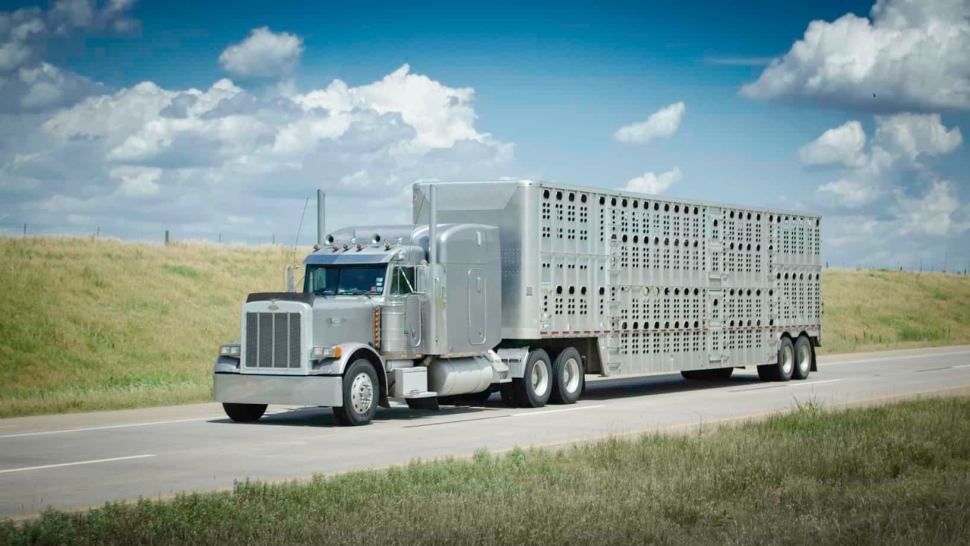
Regulators overseeing the trucking and agriculture industries will be looking to make it easier for haulers of agricultural commodities and livestock to comply with work rule regulations.
An advanced notice of proposed rulemaking to be issued shortly by the Federal Motor Carrier Safety Administration (FMCSA), in coordination with the U.S. Department of Agriculture (USDA), was prompted by confusion over what constitutes an “agricultural commodity” and what defines “livestock,” leading to inconsistent enforcement of exemptions from hours-of-service (HOS) requirements.
“FMCSA has worked closely with the agriculture industry and USDA in crafting this advanced notice,” said FMCSA Administrator Ray Martinez in announcing the proposal on July 22. “We have heard concerns from the industry, and we are acting. We encourage all [commercial motor vehicle] stakeholders, especially those involved in transporting agricultural commodities and livestock, to provide valuable feedback on how the current definitions impact safety, compliance and enforcement.”
USDA Secretary Sonny Perdue commented that the current regulations “impose restrictions upon the agriculture industry that lack flexibility necessary for the unique realities of hauling agriculture commodities,” and that his agency looks forward to helping revise them.
Current limits on maximum driving and on-duty time (for example, 11 hours of driving time within a 14-hour period, after coming on duty following 10 consecutive hours off duty) do not apply during the harvest and planting seasons, as determined by each state, to drivers transporting agricultural commodities. The HOS exemption applies when the commodity is hauled to a location within a 150 air-mile radius from the source.
But the definition of the term “agricultural commodity” is ambiguous and applied inconsistently between the USDA and the FMCSA, according to the agency’s proposal. For example, while federal code includes “non-processed food, feed, fiber or livestock” within the definition, the FMCSA is seeking clarification on how the term “non-processed” should be applied for the purposes of determining where the processing point begins and the haulage distances involved.
The agency also points out in its proposal that because frozen fruits and vegetables are processed and packaged, “Congress did not intend to include frozen commodities within the scope” of its definition by federal code. “On the other hand, there may be many non-frozen fruits and vegetables that fall within the scope of both FMCSA’s definition of ‘agricultural commodity’ and USDA’s definition of ‘fresh fruits and vegetables’.”
The work-hour exemption applies to haulers of livestock because certain animals such as cattle, sheep and swine are subject to health risks if exposed to prolonged transit times due to the HOS rules. But some carriers have argued that the current definition of “livestock” is incomplete and not sufficiently broad to include, for example, aquatic animals other than live fish and crawfish.
Among the 11 questions for which the agency will be seeking comment, FMCSA would like information on cost, benefit or safety implications of adding specific agricultural commodities or livestock to their respective definitions, and to provide data to support answers.
Comments on the proposal are due 60 days after it is published in the Federal Register.
F3: Future of Freight Festival
Industry-defining keynotes, rapid-fire technology demos, and industry leaders networking in experiences across Chattanooga - plus the inaugural F3 Awards Dinner featuring the FreightTech and Shipper of Choice reveals.
Industry-defining keynotes, rapid-fire technology demos, and industry leaders networking in experiences across Chattanooga - plus the inaugural F3 Awards Dinner featuring the FreightTech and Shipper of Choice reveals.
The Signal at Chattanooga Choo Choo • Chattanooga, TN Register Now