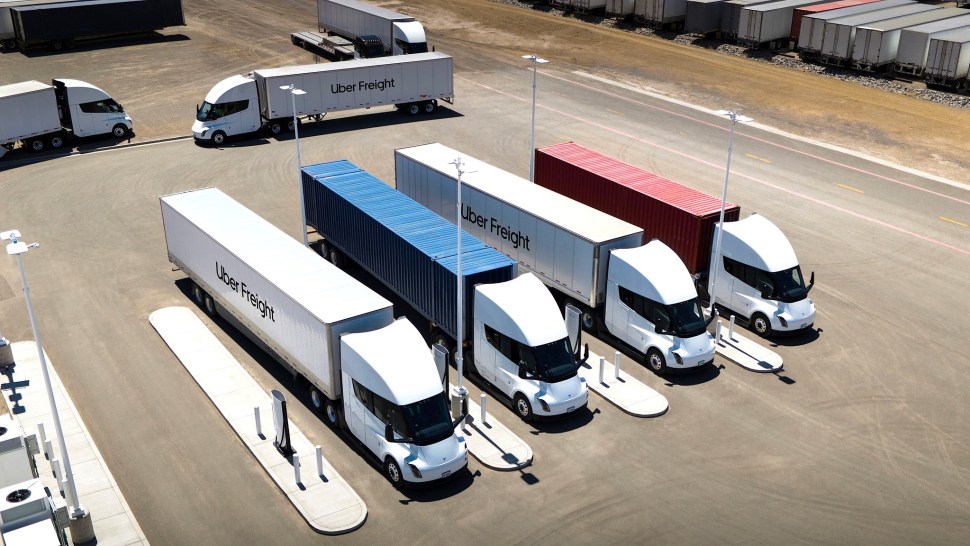
JACKSONVILLE — In a move to decarbonize freight transportation, Uber Freight has launched its Dedicated EV Fleet Accelerator Program, aimed at driving electric truck adoption through a strategic partnership with automaker Tesla.
Uber Freight founder and chairman Lior Ron announced the Tesla partnership on Tuesday during Deliver 2025, the company’s annual summit held this year in Jacksonville, Florida.
“This is the first program of its kind, truly designed to help fleets and shippers adopt electric trucks at scale and with confidence,” Ron said.
The Dedicated EV Fleet Accelerator Program is a direct response to widespread industry feedback, Uber Freight officials said. The program will give fleets subsidized access to Tesla Semi trucks, guaranteed demand from Uber Freight’s shipper network, and direct support to maximize vehicle utilization and long-term return on investment.
While electric trucks offer significant operational savings over time, high upfront costs, charging infrastructure gaps, and uncertainty around revenue potential have often discouraged broader adoption, Ron said.
“We’re going to work together with Tesla to really educate fleets and really help them accelerate the adoption of electric trucks … by helping with financing and making the price of these beautiful trucks actually equal to the price of diesel trucks. We’re going to work with those fleets to fully optimize their network and fully optimize their charging location and freight routes to ensure that charging is seamless in their operation as well,” Ron said.
Tesla unveiled the all-electric Class 8 Semi truck in 2017 and began manufacturing units in 2022. Mass production is expected to start at the end of 2025, with the Semi expected to go on sale in 2026. The truck has an estimated range of 300 to 500 miles carrying a full load.
Under the program:
- Fleets purchasing Tesla Semi trucks will receive a price subsidy.
- Fleets will integrate their Tesla Semi trucks into Uber Freight’s dedicated solutions for shippers for a pre-determined period.
- Uber Freight taps into its extensive freight network to match carriers with consistent freight from its shipper base.
During a two-month pilot of the EV accelerator program, the Tesla Semi trucks clocked over 394 hours of drive time, with carriers covering 12,377 miles. The trucks averaged net energy consumption of 1.72 kWh per mile on 60 hours of total charge time.

Deliver 2025 is a three-day event that includes around 200 shippers and industry experts discussing topics such as last mile, fraud, tariffs, nearshoring, AI, cross-border logistics and intermodal.
During the keynote address of Deliver 2025, Uber Freight CEO Rebecca Tinucci said logistics have become a “priority” across boardrooms.
Tinucci was announced as the company’s new CEO in August. She succeeds Ron, who is taking on a new role as COO of Waabi, a company pioneering autonomous trucking in which Uber is a major investor.
“In the past year, we’ve had new tariffs on global imports, major rail line disruptions, or geopolitical events that impacted shipping lanes. These are not headlines. These were real-world events that impacted your bottom line and made it so that logistics became a boardroom priority,” Tinucci said. “At Uber Freight, we don’t see supply chains as simply a cost to manage. We see it as a lever for growth.”
Uber Freight also unveiled new platform features designed to make logistic workflows more simple and connected. The company showcased how intelligence, automation, and integration are reshaping freight operations.
“From procurement to payment, shippers face constant complexity,” said Steve Barber, vice president of product at Uber Freight. “Our continued investment in automation, intelligence, and integration delivers faster decisions, smarter cost control, and more resilient supply chains.”
The company’s transportation management system (TMS) now integrates order-to-cash tracking, allowing shippers to manage receivables and payables directly within the portal. The update streamlines workflows, reduces disputes by up to 20%, and accelerates payments to carriers.
Uber Freight also expanded its exchange procurement platform with scenario analysis, enabling shippers to model multiple bid strategies in minutes instead of weeks. Side-by-side comparisons of cost, service, and carrier mix help reduce expenses and strengthen reliability, while awards can be exported directly into any TMS.
Brokerage Compliance Symposium
The day before F3. Every compliance issue you face - fraud exposure, carrier liability, FMCSA rules, cargo theft, insurance gaps - navigated by attorneys and operators defining best practices in a changing industry.
F3 Awards Dinner
The night before F3. FreightTech100 companies honored. FreightTech 25 and Shipper of Choice winners revealed live. Cocktail reception into dinner and live music - 300 industry leaders in one purpose-built room.
F3: Future of Freight Festival
Industry-defining keynotes, rapid-fire technology demos, and industry leaders networking in experiences across Chattanooga - plus the inaugural F3 Awards Dinner featuring the FreightTech and Shipper of Choice reveals.
The day before F3. Every compliance issue you face - fraud exposure, carrier liability, FMCSA rules, cargo theft, insurance gaps - navigated by attorneys and operators defining best practices in a changing industry.
The Signal at Chattanooga Choo Choo • Chattanooga, TN Register NowThe night before F3. FreightTech100 companies honored. FreightTech 25 and Shipper of Choice winners revealed live. Cocktail reception into dinner and live music - 300 industry leaders in one purpose-built room.
The Signal at Chattanooga Choo Choo • Chattanooga, TN Register NowIndustry-defining keynotes, rapid-fire technology demos, and industry leaders networking in experiences across Chattanooga - plus the inaugural F3 Awards Dinner featuring the FreightTech and Shipper of Choice reveals.
The Signal at Chattanooga Choo Choo • Chattanooga, TN Register Now