




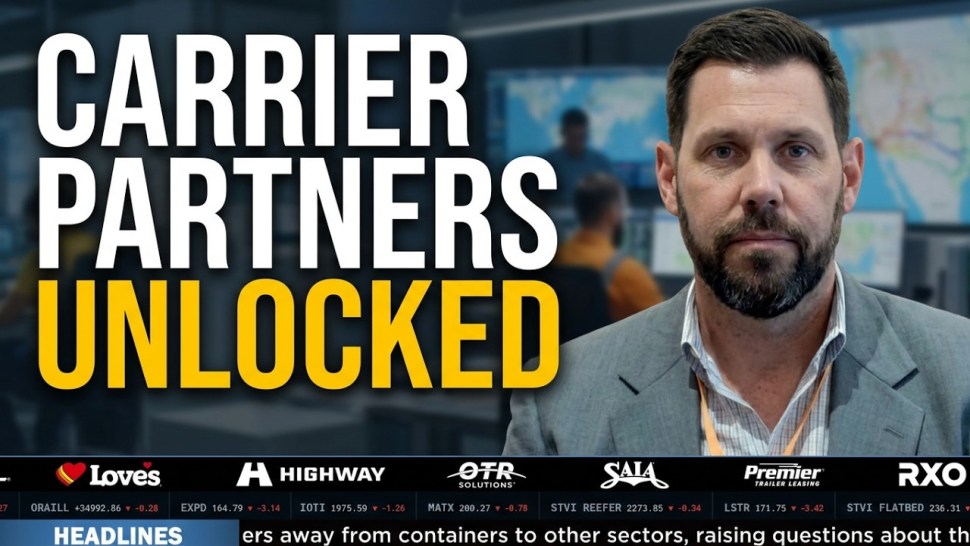
Brian Reilly, VP National Account Sales at RXO, breaks down the critical role of strong carrier partnerships and communication in today’s dynamic freight market. Learn how RXO helps shippers build lasting relationships, optimize capacity, and create a ‘shipper of choice’ environment that rewards top performers.
Spot freight rates are running 40% to 70% above contracted lane rates in the current market, and shippers clinging to traditional waterfall routing guides risk paying a steep price, according to Brian Riley, VP of National Account Sales at RXO. Riley made the remarks during a FreightWaves interview at the Univar Solutions Carrier Kickoff Event in Chattanooga, Tennessee, where roughly 60 to 70 carriers gathered for an annual supplier conference that Riley described as his third consecutive year attending.
The core problem, Riley said, is that contract awards on infrequent lanes have become effectively unenforceable. A rate locked in October on a lane that ships only once over six months carries almost no chance of being honored when a truck is finally needed. “Spot was a slight premium. Now acceptance being lower, spot is 40%, 50%, 60%, sometimes 70% higher than what you thought your contract rate was going to be,” he said. “But it’s a paper rate that’s never going to be honored.”
“Our carriers are an extension of our brand, of our business. You’re not just signing up to perform a task or a contract award. You’re really signing up to be and represent that customer and obviously your own reputation as well.”
Riley said the “tail” of small, infrequent shipments — lanes moving fewer than 5 to 20 times per year — has grown longer and is now the primary stress point in shipper networks. His recommended fix: move away from a single high-volume primary award paired with a tail of marginal lanes, and instead restructure into multiple primary awards with adjusted percent allocations across carriers. He also pointed to proactive rate increases as a tool some shippers are already using, noting that customers who voluntarily offered contract increases to offset rising rejections and spot exposure were able to secure greater carrier commitment — though he was direct that the move carries a firm service expectation in return.
On the technology side, Riley highlighted RXO’s investment in automated spot processes, including indexed or cost-plus models and staging dedicated power-only equipment on customer yards exclusively for spot coverage. He also credited the 2023 Coyote acquisition with expanding RXO’s carrier network into industries and markets where the two companies had limited prior overlap, providing both consistent coverage and surge capacity.
Riley described RXO’s carrier retention strategy as centering on the RXO Extra program, which offers drivers fuel discounts, tire benefits, and maintenance support — programs he said are especially impactful for smaller carriers facing soaring fuel costs. The goal is straightforward: give carriers a concrete reason to prioritize RXO freight when capacity is tight and tiebreakers matter. “Win the tiebreak” is the internal framework Riley uses when coaching his team: if price and service metrics are equal among a room of 60 to 70 providers, relationship and reliability determine who gets the load.
Riley also flagged an upcoming RXO quarterly state-of-industry webinar scheduled for August 25, to be led by Chief Strategy Officer Jared Weisfeld and Corey Klujsza. The session will feature the RXO Curve along with market forecasts and projections. RXO’s quarterly earnings announcement was also described as imminent at the time of the interview. Shippers with routing guide failures can access capacity resources at rxo.com/capacity.
- Spot rates are running 40% to 70% above contracted lane pricing as carrier acceptance rates fall, effectively making many contract awards paper rates
- RXO’s Riley recommends shippers shift from traditional waterfall routing guides to multiple primary carrier awards with adjusted percent allocations to improve coverage on low-frequency lanes
- RXO’s quarterly state-of-industry webinar, featuring the RXO Curve and market forecasts, is scheduled for August 25, led by Chief Strategy Officer Jared Weisfeld and Corey Klujsza
Speaker 1 [0:00] Don’t worry, we’re here at the Unified Solutions Carrier Kickoff Event here at the Westin, Chattanooga, Tennessee. And I visited this man’s city, the Queen City, and now you had to return the favor in the scenic city.
Speaker 2 [0:12] Told you I was coming back.
Speaker 1 [0:13] You told me, you meant it, you were. You meant it, you were. Y’all, this is Brian Riley, for those that don’t know, VP of National Account Sales at RXO. Brian, first off, it’s good to see you as always.
Speaker 2 [0:22] You too. Looking good.
Speaker 1 [0:23] Well.
Speaker 2 [0:24] Looking good.
Speaker 1 [0:24] Trying to keep up with you. No, stop it, stop it.
Speaker 2 [0:26] You got the summer bod going.
Speaker 1 [0:27] I gotta lose a couple. Guilty as charged.
Speaker 2 [0:33] Very nice to meet you officially. Thanks for having me.
Speaker 3 [0:36] All right, so tell us, what do you think of the event so far? Have you enjoyed it? Uh, have you learned anything yet?
Speaker 2 [0:41] Absolutely. So I would say yes to all the above. This is my 3rd year at the U of R Supplier Conference. Um, I think every time it’s gotten— they’ve dialed it in. Uh, I think just the overall— the way they set this up, having all their providers come in, giving a clear concise message to the team, setting expectations, leading with RFP. Not a lot of customers continue to do this, whether it be the expense of having, you know, putting on the event, bringing all their team members in, and then obviously having all of us in the same room. So it’s been, it’s been great. I think I always appreciate Rob and the team kind of giving the insight and their direction going forward.
Speaker 1 [1:18] You know, this is a relationship-based business. We talked about this when you were on with the truck. It’s not necessarily what you know, which that’s important conceptually, what you know, It’s who you know as well. You pride yourself on this. RXO prides itself on this. Why is that continually to be the fabric of what you all do each and every single day you wake up and log into these systems and get the day started?
Speaker 2 [1:40] Yeah, I think that Dorica said it great today during her presentation. You know, you’re in— our carriers are an extension of our brand, of our business. And so, and I think when, when you, when you really look at business in that way, in that You’re not just signing up to perform a task or a contract award. You’re really signing up to be and represent that customer and obviously your own reputation as well. So the communication piece and building that foundation of a partnership, and I would say across the organization, and what this event specifically does that a lot of others don’t do is I have access and we all have access, equal access to all of their stakeholders across the organization. So whereas I may have a strong relationship with someone at a various level or a particular site, site, I have the opportunity now to expand that partnership and discuss opportunities that are specific to each site and location. And so rather than having to physically travel individually to all— to 15 different sites or to have 50 different people trying to talk to one person, I think it just creates a streamlined approach that really does great for the— as a provider and also for as a customer with Eurobar.
Speaker 3 [2:47] Sales guy’s dream. Right. Like you get to expand and see the right people to expand to without having to do their research. They’re already here. You don’t have to make the 27 trips.
Speaker 2 [2:56] That’s— Yep, 100%. And I think, you know, my theory has always been you do prepare for any— you always prepare for something to where you’re providing value. But knowing who all is going to be here, knowing whether it be talking through opportunities or talking through challenges or maybe just talking in an informal setting about what they’re facing at a specific site or location that you might not always get from a corporate leader. That makes a lot of sense.
Speaker 3 [3:19] So in a current— I think we can all agree that capacity is tight in the current market. So in a market like this, what can and should shippers do to continue to preserve those relationships with their providers?
Speaker 2 [3:33] Yeah, I think, you know, we talk a lot about one thing we use a lot of time is win the tiebreak. If all things are equal, what’s the differentiator? That’s why you would choose one thing over another. If price is the same, if services metrics are the same, because in a room of 60 to 70 providers, there’s a lot of equal performance. They’ve had some award winners who outperform some others. But what is it that you do and your company does that separates you to win the tiebreak? And so I think where that comes into play from a capacity standpoint is they have to have the trust and the communication that you’re going to answer the phone in the good times and the bad. You’re not just constantly searching for what can you do for me. Right. Where that win-win collaboration is going to happen. And so I think if customers take that approach of not just looking for a one-way outcome that is maybe just a lower cost, I’m willing to sacrifice on service, but outlining with clear direction as to what their goals and objectives are, holding everybody equal to those performance measurements, rewarding those who perform, and really, I mean, frankly, and they’ve done this over the last 3 years, Not everyone makes it to the party next year. And so very clearly they outlined, like, it’s nice to see a lot of the same faces. And for those that aren’t here anymore, you’ve outperformed them to have the opportunity to be in this room. And so I think customers rewarding their providers that way is really what I think sets to help make people feel a shared sense of ownership for their business.
Speaker 3 [5:05] So you work with a lot of shippers, right? Inevitably in that provider-shipper relationship, there are gonna be breakdowns, there are gonna be exceptions, there are gonna be service issues, there’s gonna be lack of tenders that you expected occasionally because something changes in the network. Where do shippers go wrong in those relationships when there are issues? And then can you give us some examples of how the ones who are doing it right do it?
Speaker 2 [5:28] Yeah, again, the foundation of communication is critical. I think that You know, the capacity and the rate balance has been a struggle and a challenge depending on the timing of when bids were live. I think customers who are either willing to proactively engage in those discussions and say, look, I know everybody’s struggling, let’s come to a realistic— what is the current environment and how can we set a standard that wasn’t the same 3 months ago, 6 months ago, 12 months ago? So I think that the proactiveness of understanding that It— we have to find something that works for both parties. As a shipper, we can’t subsidize a customer’s routing guide. And on the same side, a customer can’t expect to pay a premium like the spot on things that you signed up basically to do through your contract. So if things have changed that dramatic, you have to work together to find what that middle ground is. So specific examples I think of that work good, we’ve had a couple customers that have come to us with proactive increases. Hey, I understand the market is, is really changing. I understand we’re paying a premium, but we’re seeing more rejections, seeing more spot. What if we gave you a proactive increase on your contract lanes? Would that help?
Speaker 3 [6:37] Oh, that’s smart.
Speaker 2 [6:38] That carries a big expectation of service though. Don’t pay me 10% more and expect me to not—
Speaker 3 [6:44] They’re also setting the anchor.
Speaker 2 [6:45] Exactly.
Speaker 3 [6:46] And they’re setting the budget versus not knowing what’s coming.
Speaker 2 [6:48] Exactly. So I think that, that helps because then that allows us to pass that over to our carrier partners as well, to be able to encourage them to pick To take more of that consistency. That’s been a big one. Another thing that we really try to do is implement some technologies to help facilitate more of an automated spot process. So rather than you get a rejection, it goes to a spot board, you got to coordinate a load, you got your operations juggling stuff through the warehouse.
Speaker 1 [7:12] Yeah.
Speaker 2 [7:12] Finding things that works more, maybe an indexed or maybe a cost-plus model to where maybe it’s staging equipment on the customer’s yard that’s only for spot. Don’t use it for contract lanes. Use it for spot to where it gets it off your facility, puts it in a situation, and I’m covering a power-only move. So again, being creative for how you’re bringing a solution to a customer that’s not just, I need more money.
Speaker 3 [7:33] So let’s talk a little bit more about that specifically. We do a segment every week, RXO Capacity Now. Appreciate you having us.
Speaker 2 [7:41] Yep.
Speaker 3 [7:42] Appreciate you being a sponsor. So we, uh, in a market like this, it’s a tight market. What does RXO do to protect their shippers and find that bulk capacity, specialized capacity, those hard things at the last minute? How do you guys do that? How do you go about procuring it? You gave us a few examples of some creative solutions, but—
Speaker 2 [8:05] Yeah, our tagline, massive capacity, cutting-edge technology, is not just a tagline. Like, we honestly and firmly believe that is how— that is what separates RXO. Personally, that’s the way I feel. That’s the way you guys have probably heard Drew say the exact same thing. The the reality is is what does that mean and how you execute it? And I think it goes to extension of the carrier partners that you have, building long-term relationships, rewarding those carriers with contract dedicated business that you can fulfill. And a lot of that comes back to the sales teams of having some very tough, challenging conversations with customers about where we feel confident. and where we don’t. And I think if we can build that synergy to where we’re looking for consistency in lanes that we can basically get— we talk about this at the What the Truck.
Speaker 1 [8:49] We do.
Speaker 2 [8:49] That trilogy of customer, carrier, and provider, you have to make sure that everyone, no one feels left out. And I think as a, is a, from a carrier standpoint, we talked a lot about some of the programs we’re doing such as the RXO Extra program, which is doing things to reward drivers with fuel programs, tires, maintenance, We’ve really doubled down and invested in that to try to attract and encourage people. Fuel prices are soaring. How can we help alleviate some of that burden for more smaller providers who it’s more impactful to? And then in return, we want you taking our loads, winning the tiebreak. So I think those are some of the programs we’ve done to attract and retain carriers that allow us to say, if we have someone fall off, we have someone else who’s there. And I also think the Coyote acquisition was a big lift for us in just overall capacity. A lot of synergy with carrier partners, but we found a lot where we didn’t in certain industries and markets that lifted both of us up to be able to provide consistent coverage, but also surge and flex capacity, which has become very critical in this market now.
Speaker 1 [9:51] Perfect segue to my next question because it feels like, you know, from not only yourself, Drew, so many other folks, y’all figured out the people puzzle very, very early and often at RXL, which is a testament to your leadership. But there’s decisions that are made that are predicated off of data as well as technology. How do you keep this human aspect? Like, it’s, it’s from you, it’s from the leadership there at RXO all the way down to the bottom of the organization so that every single customer that’s touched by somebody at RXO feels what I feel right now here at the Univar Solutions conference?
Speaker 2 [10:24] Yeah, I think one thing we do really well is we’ve embraced the digital, obviously the technology component, and we’ve embraced the digital process. But it never loses the human element. And I would say from Drew through the various levels of management, all the way down to our desk-level operators, I— my personal approach, I never say an account is my account. It’s always our account.
Speaker 1 [10:48] Our account.
Speaker 2 [10:49] And it’s a shared responsibility from whether it be the key account manager, the operator, the carrier procurement team, the branch operations, all the way to the sales leader, all the way to our executive team. that we’re all a shared growth goal and a solution-based approach to selling. And I could call Drew, I could call Corey Klujsza. You talk to Corey a lot of times. Corey’s great. Jared Weisfeld, our Chief Strategy Officer, just joined me at 15-minute notice. I called him, I was like, bro, I need you. He was like, I’m in.
Speaker 1 [11:19] I’m down.
Speaker 2 [11:20] And I think that approach of just, there’s nobody bigger than the customer within our organization. I love that. Everybody is like, it’s about servicing the customer first and foremost. And I’ve never once felt that I didn’t have support. And I also don’t want everybody who works— I hate to say under, but I’m there to support on my team. Anybody else that it’s a collaborative effort through the entire customer process.
Speaker 1 [11:45] Sure.
Speaker 2 [11:47] Definitely shares.
Speaker 1 [11:47] Now, you know, we’re here obviously talking. You kind of gave us the trilogy. Say that one more time because you said it on What the Truck. It was a, it was shipper, carrier, where was one more?
Speaker 2 [11:57] I would say shipper, carrier, and the provider. Like, so if it’s a broker environment, so.
Speaker 1 [12:01] All right, so that triangle, how do you keep a healthy blend amongst everyone so everybody gets the most out of the relationship when it comes to that triangle specifically?
Speaker 2 [12:12] So if we start with the customer, customers obviously, we talked about a lot today, they want us to, they want providers to fulfill their commitments when it comes to contract. They want good communication. and they want to execute the KPIs.
Speaker 1 [12:23] Yeah.
Speaker 2 [12:24] If you’re the carrier, you’re an extension of that customer. So you’re connected in the way you represent yourself on site at their facilities, the way you represent the provider who’s coordinated the load, whether that be your own company or whether it be through a broker or capacity solutions provider. At the same time, the customer is also responsible for everyone. They pride themselves on shipper of choice, providing an environment that wants carriers to want to come to their facility, to be willing to take their loads, to be willing to wait when there’s a time maybe where they had to work themselves their ways in, and the shipper of choice. So customers are also taking a responsibility to create an environment that people want to do business with you. I think a lot of times, like I say this to my daughters all the time, a boy should never— or you should never chase a boy. The boys should be chasing you.
Speaker 1 [13:10] Yeah.
Speaker 2 [13:11] And I think that in that relationship between a customer and a provider, It should be a two-way street where it’s not always the provider wanting to do business, want to do business, want to do business. You have to give me a good reason why I want to do business with you.
Speaker 1 [13:24] Absolutely.
Speaker 2 [13:25] Because there are customers out there that frankly, I don’t want to do business with.
Speaker 1 [13:28] All business is not good business.
Speaker 2 [13:29] All business is not good business. And I think it’s not so much that it’s bad business, it’s that you haven’t found the right partner, the right relationship, or the right method of communication, or maybe just the operation doesn’t fit yours. And that’s okay.
Speaker 1 [13:42] That is okay.
Speaker 2 [13:43] But before you invest time, resources, and money that just wastes everyone’s, like, decide quick, be really good at what you’re good at, and when you’re not, don’t be scared to step back.
Speaker 3 [13:54] Yeah, you don’t ever want to be the shipper where like when the provider’s phone rings, you’re like, oh, like, you know, versus like excited to like talk about business and what’s going on. So we’re here for, it’s really an RFP kickoff event for Univar. So as shippers are entering the back half of the year, how do you think they should be thinking about their networks and What should be allocated to spot versus contract?
Speaker 2 [14:15] So that’s— if you asked me 6 months ago, I’d have given— if you asked me with the truck, I’d have given you an answer. And I would say now, I think the biggest challenge right now and that everyone is facing with it is it’s not your high-volume consistent lanes that run that typically. It’s that the tail has gotten longer. So the tail of smaller infrequent shipments And before the balance was, I have tons of capacity, anybody’s going to sign up, there’s always going to be a truck. Well, if I said if it’s less than 20 shipments a year, no problem. Now you start looking at 5, 10, 15, 20 shipments a year, they’re going to come in inopportune times or maybe all at one time and then none the rest of the time. It’s really understanding where that benefit between spot. I don’t think they’re.
Speaker 3 [15:04] I think contract at that point is paper rates.
Speaker 2 [15:06] It is. It is. Because if you’re given— if I give you a rate in October that you’re not going to ship maybe one time for 6 months, the likelihood of accepting it is going to be extremely thin in the market environment we’re in now. For the last 3 years, everyone’s accepted everything with a high degree and spot has been less. Your spot was a slight premium. Now acceptance being lower, spot is 40%, 50%, 60%, sometimes 70% higher than what you thought your contract rate was going to be. But it’s a paper rate that’s never going to be honored.
Speaker 3 [15:35] What are your thoughts on in those scenarios with less frequent moves like a backup matrix that’s at backup level rates that is contracted versus just straight spot?
Speaker 2 [15:45] I think backup right now is a gamble. Yeah. I mean, it’s— if you’re backup, you’re like—
Speaker 3 [15:51] Different market return rejections aren’t so high. I mean, if you’re a backup at a high— I don’t mean like a backup like you’re the second person on the routed guide and provided a primary rate and you’re awarded it. I mean backup like at a higher rate level than a primary.
Speaker 2 [16:03] I think And I’ve heard a lot of customers doing this, changing their strategy from more of like what we’ll call a traditional waterfall to more of changing the allocations to multiple primary awards, but just adjusting the percent allocation.
Speaker 3 [16:16] Yeah, that’s right.
Speaker 2 [16:17] And I think if for any customer, if they give me what the number is, we’ll work with it. But I don’t think that give me one high-volume primary lane and then a tail of just small lanes that I know it’s going to be extremely challenging to serve. But the customer concern is I can’t predict how high or how aggressive that spot market is gonna run.
Speaker 3 [16:38] Right.
Speaker 2 [16:38] You’ve had shippers for the last 3 years that have done only spot because they’ve been able to be so competitive.
Speaker 3 [16:44] Well, yeah.
Speaker 2 [16:45] And avoid market shifts. That’s totally changed.
Speaker 3 [16:48] I agree. So I’ve gotta ask, I asked earlier, tell us what you think of Chattanooga and the event so far and of being here.
Speaker 1 [16:56] Chattanooga is—
Speaker 2 [16:57] this is only my second time in Chattanooga. My first time was actually at the Division IAA National Championship. I watched Joe Flacco from the Delaware Terrapins.
Speaker 1 [17:08] Yeah.
Speaker 2 [17:09] So I played football at App State and I ran— I did a youth clinic after my senior year that was here. And I would say the turning 30 former college football players loose in downtown Chattanooga, they probably want to rethink that. But so my pace of life has changed a lot since then. But no, we had a great dinner at Scotty’s at the River last night. Had a great dinner. Downtown Chattanooga is amazing. Great people and obviously becoming a booming freight city that I’m very happy to be here.
Speaker 1 [17:37] We’re really happy for you to be here. And again, Brian Riley with RXO.
Speaker 2 [17:42] Thank you so much for being on FreightWaves today.
Speaker 1 [17:45] Fantastic. Where can we find more information, obviously, about you and what the rest of the team at RXO are currently doing right now?
Speaker 2 [17:51] Where can we— where can you find me? Yeah, yeah, try to give me a plug. So, so this is an alley-oop. So August 25th, we’re doing our quarterly state of industry. So Corey Klujsza and Jared Weisfeld will lead the state of industry call. It’s a, it’s an online webinar we host every quarter. Uh, we have our earnings announcement on Thursday, so there should be some good information hopefully we get to announce on Thursday. We’re excited about the earnings announcement, but the state of industry talks— it’s the Curve, but really talking a deeper dive and looking at some of the market forecasts and projections that they see that I think will be very informative for everyone.
Speaker 1 [18:25] So that sounds—
Speaker 3 [18:26] I think they use a little sonar data when they’re coming up with that.
Speaker 2 [18:28] They always do. There’s a lot of FreightWaves sonar in that data. Absolutely.
Speaker 3 [18:32] And I know this by heart at this point. If your routing guide’s breaking down and you’re a shipper who needs capacity, rxo.com/capacity. Capacity now.
Speaker 1 [18:40] That was a perfect way to leave it. Brian, thank you so much.
Speaker 2 [18:44] Thank you both very much.
Brokerage Compliance Symposium
The day before F3. Every compliance issue you face - fraud exposure, carrier liability, FMCSA rules, cargo theft, insurance gaps - navigated by attorneys and operators defining best practices in a changing industry.
F3 Awards Dinner
The night before F3. FreightTech100 companies honored. FreightTech 25 and Shipper of Choice winners revealed live. Cocktail reception into dinner and live music - 300 industry leaders in one purpose-built room.
F3: Future of Freight Festival
Industry-defining keynotes, rapid-fire technology demos, and industry leaders networking in experiences across Chattanooga - plus the inaugural F3 Awards Dinner featuring the FreightTech and Shipper of Choice reveals.
The day before F3. Every compliance issue you face - fraud exposure, carrier liability, FMCSA rules, cargo theft, insurance gaps - navigated by attorneys and operators defining best practices in a changing industry.
The Signal at Chattanooga Choo Choo • Chattanooga, TN Register NowThe night before F3. FreightTech100 companies honored. FreightTech 25 and Shipper of Choice winners revealed live. Cocktail reception into dinner and live music - 300 industry leaders in one purpose-built room.
The Signal at Chattanooga Choo Choo • Chattanooga, TN Register NowIndustry-defining keynotes, rapid-fire technology demos, and industry leaders networking in experiences across Chattanooga - plus the inaugural F3 Awards Dinner featuring the FreightTech and Shipper of Choice reveals.
The Signal at Chattanooga Choo Choo • Chattanooga, TN Register Now