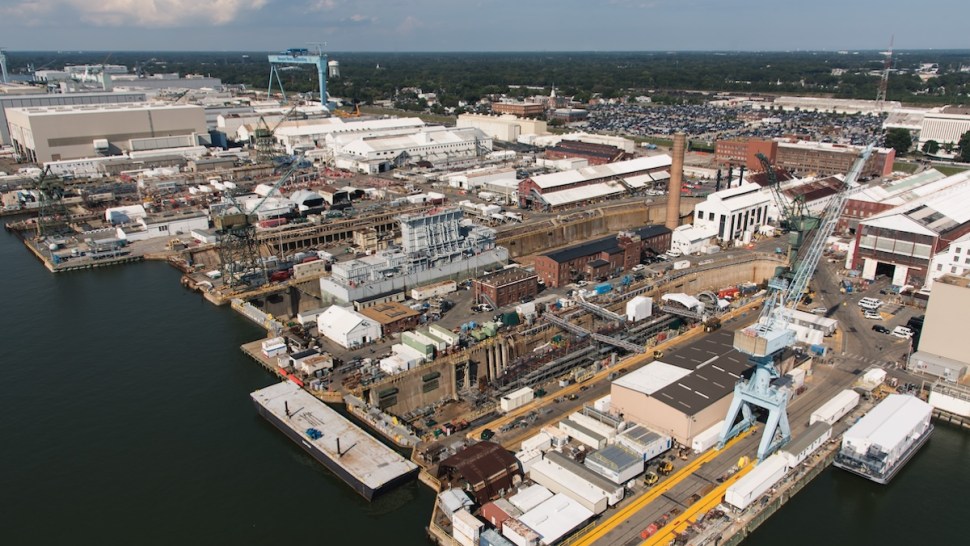
Revised shipping legislation aimed at revitalizing the domestic maritime industry calls for creation of a fleet of 250 U.S.-flag cargo vessels, and federal funding to aid shipbuilding development.
The bipartisan SHIPS for America Act was reintroduced Wednesday at a press conference by co-sponsors Sens. Mark Kelly of Arizona and Todd Young of Indiana, and Reps. Trent Kelly, also of Indiana, and John Garamendi of California.
The legislation, initially introduced in December 2024, aims to strengthen American sealift capacity, rebuild domestic shipbuilding and develop a robust maritime workforce.
It will be introduced in two parts in the Senate: the SHIPS for America Act and the Building SHIPS in America Act.
A cornerstone of the revised act is the new Strategic Commercial Fleet Program, which sets an ambitious goal of establishing a fleet of 250 U.S.-flagged vessels in international commerce, and prioritizes tanker vessels. The program provides support payments for capital and operational costs to encourage the introduction of new U.S.-built, -flagged and -crewed vessels. There are currently 80 U.S.-flag merchant ships.
The legislation significantly enhances cargo preference requirements, increasing the percentage of U.S. government cargo that must sail on U.S.-flagged vessels from 50% to 100%. It also requires that within 15 years, 10% of all cargo imported from China must be transported on U.S.-flagged vessels. There are subsidies for U.S. agricultural exports, and a requirement that U.S. ports give U.S.-flagged vessels priority over non-U.S. ships.
The bill envisions a dedicated shipbuilding financial incentive program with $250 million in annual funding through 2035, and $100 million in yearly allocations for small shipyards. However, that’s an exceedingly modest outlay since a neopanamax container ship, which carries 15,000 twenty-foot equivalent units, typically costs $150 million to $160 million to construct.
The bill also provides significant tax benefits, including a 33% investment tax credit for U.S. vessel construction and a 25% investment tax credit for shipyard facilities.
The legislation addresses the critical need for qualified maritime workers through public service loan forgiveness for merchant mariners, enhanced support for maritime academies and establishment of a Maritime Career Retention Program.
A maritime security adviser position within the White House was included in the original version of the bill.
Find more articles by Stuart Chirls here.
Related coverage:
As tariffs wreck China-US exports, container rates weather storm
Longshore union blasts Trump tariffs, warns of massive job losses
‘No way’ US can recoup lost China container imports: Analyst
Drewry: Global container volumes to drop 1% on Trump tariffs
Brokerage Compliance Symposium
The day before F3. Every compliance issue you face - fraud exposure, carrier liability, FMCSA rules, cargo theft, insurance gaps - navigated by attorneys and operators defining best practices in a changing industry.
F3 Awards Dinner
The night before F3. FreightTech100 companies honored. FreightTech 25 and Shipper of Choice winners revealed live. Cocktail reception into dinner and live music - 300 industry leaders in one purpose-built room.
F3: Future of Freight Festival
Industry-defining keynotes, rapid-fire technology demos, and industry leaders networking in experiences across Chattanooga - plus the inaugural F3 Awards Dinner featuring the FreightTech and Shipper of Choice reveals.
The day before F3. Every compliance issue you face - fraud exposure, carrier liability, FMCSA rules, cargo theft, insurance gaps - navigated by attorneys and operators defining best practices in a changing industry.
The Signal at Chattanooga Choo Choo • Chattanooga, TN Register NowThe night before F3. FreightTech100 companies honored. FreightTech 25 and Shipper of Choice winners revealed live. Cocktail reception into dinner and live music - 300 industry leaders in one purpose-built room.
The Signal at Chattanooga Choo Choo • Chattanooga, TN Register NowIndustry-defining keynotes, rapid-fire technology demos, and industry leaders networking in experiences across Chattanooga - plus the inaugural F3 Awards Dinner featuring the FreightTech and Shipper of Choice reveals.
The Signal at Chattanooga Choo Choo • Chattanooga, TN Register Now